Historically, countries have struggled with the question of how to supply credit to support economic growth. The creation of financial institutions is always the outcome of a negotiation process between the different stakeholders, and financial institutions have emerged with specific institutional designs to finance trade and wars, and help sustain political order. As Charles Calomiris and Stephen Haber (Reference Calomiris and Haber2014, p. 61) have recently shown, different environments create different outcomes, such as centralized versus decentralized, bank versus market-based, and stable versus fragile financial systems.
An interesting financial intermediary emerged in Prussia in the late eighteenth century after the Seven Years War (1756–1763). Triggered by the need to supply credit to the large Prussian landowners—commonly called the Junkers—King Frederick the Great created several cooperative mortgage associations called Landschaften. Landschaften were compulsory mortgage credit institutions that combined all estates located in a geographic region of Prussia and issued bearer bonds—Pfandbriefe—that were jointly backed by the estates. The key idea of the Landschaften rested on the premise that Prussian landholders were land-rich but cash-poor and often lacked funds to farm or improve their estates. Therefore, land would be used as collateral for the Pfandbriefe—approved and administered through the institution of the Landschaft—which could then be sold to investors to raise funds.
For the casual observer, the design of the Landschaften appeared ripe for failure: It was a system created by the King to favor the Junkers. The Junker-class itself was politically powerful. It is easy to imagine how an alliance between the King and the most influential Junkers would weaken and exploit the Landschaften system. Nevertheless, the design of the system with several checks-and-balances and specific physical assets tied as securities, persuaded creditors to lend, and Pfandbriefe quickly became popular investment choices.
A closer examination of the credit system of the Landschaften shapes our view of Prussian economic history. As Alexander Gerschenkron (Reference Gerschenkron1946) described the German “Sonderweg,” the Prussian rural elite held persistent control on civil service, the military, and diplomacy through the nineteenth and into the twentieth century. Yet, little is known about the extent to which Junkers relied on credit markets, and how financial markets contributed to their economic and political dominance. Narrative histories of the Landschaften by Walther Altrock (Reference Altrock1914), Fred Hagedorn (Reference Hagedorn1978), Hartwig Jessen (Reference Jessen1962), and Hermann Mauer (Reference Mauer1907) have focused on their institutional design and specific legal features, but without quantifying their economic effects. When economic outcomes were noted, the Landschaften were often associated with the persistence of unequal land distribution in Prussia (Mauer Reference Mauer1907, p. 158). While recognizing the favoritism that Frederick the Great granted the Junkers by establishing an exclusive credit institute, the historical literature on the Prussian nobility by Hanna Schissler (Reference Schissler1978, p.82f, Reference Schissler1980) and Rene Schiller (Reference Schiller2003, p. 94) comes to the conclusion that Landschaften played a small formal role for the estates. A notable exception to this literature is Bernd Ristau (Reference Ristau and Vierhaus1992), who stipulated that Landschaften had a large effect on the Prussian economy and were important political and economic institutions for the landholders.
The current analysis, which is the first to rely on estate level data, supports Ristau's view. It documents that large estates frequently used the Landschaften, and that the credit extended by the Landschaften was substantial. The study of data on loans, assessments, and interest arrears provides insights into the workings of the institution.
Using the example of the Landschaft of East Prussia, the current article offers a detailed look at the loan portfolio of a Landschaft, explaining which estates were mortgaged through the Landschaft and to what degree. The analysis offers insights into the self-selection of participants and the distribution of credit, as well as the loan policies and the financial situation of the Landschaft. The dataset also contains information on unpaid interest payments, indicating which of the borrowers might have exhibited higher default risk and providing information regarding moral hazard within the Landschaft. Results show that large estates of over 1,000 hectares borrowed heavily through the Landschaft. It was also the same group of large landowners that accumulated the highest interest arrears. Thus, the group of landowners for whom the Landschaft was originally created, used and abused the system the most, but without triggering its demise. This analysis also offers an assessment of the Landschaft's economic impact, measuring its effect on estate size and estate turnover. For the period after 1823, the current article finds no systematic enlargement of noble estates that relied on the Landschaft to access credit. Similarly, the turnover of estates varies by estate size but cannot be causally linked to the Landschaft. Nevertheless, the Landschaft was an important institution facilitating estate transfers and subsidies during a time of economic distress.
THE CREATION OF LANDSCHAFTEN
At the end of the eighteenth century, Prussia was an agrarian state, with low per capita income compared to its neighbors. As Toni Pierenkemper and Richard Tilly (Reference Pierenkemper and Tilly2004, p. 15) describe, the dominant economic structure east of the river Elbe was the estate enterprise system (Gutsherrschaft) based on near-feudal relations and the estate as an economic unit. Manorial lords held a set of rights and privileges, including judicial and executive powers over the estate and its workers, and utilized these to maximize economic profit, often geared towards exports (Schissler Reference Schissler1980). Tenants depended on their landlords for all aspects of life. This stood in contrast to the manorial system (Grundherrschaft) predominant in Western parts of Prussia, where peasants cultivated small farms in exchange for regular payments to the landlord in cash and kind. The Prussian estate system began to change following the October edict of 1807, which granted personal freedom to the peasantry, but changes were slow and only complete after the revolutions of 1848/49. For the first one-half of the eighteenth century, most tenants in the Eastern Parts of Prussia still depended on the landlord. Smallholders were not initially included in the reforms and land could only be obtained in exchange for significant transfer fees in land or cash to the nobility. Nevertheless the reforms slowly introduced changes in property rights, especially opening the market for land (Pierenkemper and Tilly Reference Pierenkemper and Tilly2004, p. 24ff).
The Landschaften were introduced into this agrarian system in the last one-third of the eighteenth century. At the end of the Seven Years War in 1763, Prussia emerged as a political and economic power in Europe. But during the war, military operations and enemy occupation had disrupted trade and economic activity, especially the areas east of the river Elbe. W.O. Henderson (Reference Henderson1962) shows that farms were neglected and landowners, farmers, and peasants were short on horses, cattle, sheep, fodder, and seed. To restore agricultural production, landowners were in urgent need of funds.
The war had disrupted the previously established credit lines, and made financial capital difficult to obtain. Moritz Weyermann (Reference Weyermann1910, p.66) outlines that following the financial panic of 1763, King Frederick the Great announced a three-year moratorium on all outstanding debt payments. This, combined with the desolate state of some of the estates, meant that creditors were unwilling to lend. Lieselott Enders (Reference Enders2008) explains that traditionally, landholders had relied on the church, family ties, and intermarriage with merchants to obtain funds. But after the war neither of these options provided the long-term affordable credit needed to restore the estates.
Landschaften were created in this vacuum of agricultural credit. Following D. M. Frederiksen (Reference Frederiksen1894), they were worldwide among the first institutions to issue credit based on land in an organized form. To address the problems of adverse selection and moral hazard inherent in banking, the original Landschaften were based on a system of forced membership and relied on joint liability to secure their loans. Kirsten Wandschneider (Reference Wandschneider, Fishback, Snowden and White2014) explains that Landschaften reduced transaction costs by standardizing the debt contract and centralizing the mortgage market. Landschaften also offered improved monitoring and enforcement over private contracts. At the time, the creation of the Landschaften represented an important financial innovation. They were a new non-bank financial intermediary, which affected the mobilization and allocation of financial resources.
Going back to a proposal by a Berlin merchant named Bühring, King Frederick the Great and his successor Frederick Wilhelm II set up the first Landschaften. Landschaften built on earlier financial functions of Prussian feudal organizations, which had provided banking services to their members. Most of these old credit banks had been shut down by a decree of the King in 1717 and only the “Kreditwerk der Churmärkischen Landschaft” had survived and functioned as the credit institute for the Prussian upper class until 1820.
Initially, the crown endowed each Landschaft with a loan of 200,000 Taler starting capital, so the Landschaften could set up administrative offices, pay initial wages to their administrators, and begin to lend. The King officially nominated the general president of the Landschaft, thereby monitoring the institution, but all other Landschafts-officials were elected by the general assembly from its pool of members. The board of directors of the Landschaft, which included the general director, a corporate counsel, and three additional members, made all operative decisions (Altrock Reference Altrock1914, p. 3). This ensured that landholders themselves granted and monitored all loan activity of the Landschaft, so that the Landschaft in its day-to-day activities was self-administered and operated independently (Altrock Reference Altrock1914, p. 24). The Landschaftens' objective was the provision of long-term credit at affordable rates to the members of the first estate. Landschaften took on an intermediary role between landholders and creditors, issuing covered bearer mortgage bonds—Pfandbriefe—that were tied to individual estates, but backed by the joint liability of all estates in the Landschaft.
The first of the Landschaften was the Silesian Landschaft, servicing the nobility in the newly acquired territory of Silesia. Its statutes were ratified by the general assembly of the Silesian feudal class in the summer of 1770, and in December of 1770 the first Pfandbriefe were issued (Jessen Reference Jessen1962, p. 47). Other Landschaften in the Kur- and Neumark, Pomerania, and West Prussia followed suit. The East Prussian Landschaft was the last of the five so-called “old” Landschaften, founded in 1788 in Königsberg. The initiative to set up a Landschaft in East Prussia originally came from the East Prussian administration in Königsberg, but was enthusiastically welcomed by the landholders, who pledged donations of more than 800,000 Taler in start-up guarantees to support the new institute (Hein Reference Hein1938, p. 5). Frederick II opposed the plan, in order to “punish” the East Prussian nobility who had been supportive of the Russian Empress Elizabeth during the Seven Years War. The East Prussian Landschaft was finally established in 1788, under the reign of Frederick Wilhelm II. The King had also threatened to withhold the 200,000 Taler starting capital, but when the Landschaft was established, it was paid out. This exchange surrounding the creation of the East Prussian Landschaft illustrates how the Landschaften were part of the social contract between the King and the landed nobility. Each relied on their mutual protection and support—a complicated quid pro quo in which the landholding elite staffed the Prussian military and bureaucracy and the crown protected the economic independence of the landholding class (Ristau Reference Ristau1976; Schissler Reference Schissler1980, pp. 93–94).
Previous work on the Landschaften has argued that the key to their success and stability was based on their specific institutional features (Wandschneider Reference Wandschneider, Fishback, Snowden and White2014). Landschaften served as intermediaries between lenders and borrowers, channeling investments through Pfandbriefe, but without taking on modern banking functions such as deposit banking. They were public institutions, designed on the principle of self-help for the landowners. Aside from some funds to cover their administrative cost, and in the second half of the nineteenth century also some reserve assets, accumulated for an eventual amortization of the outstanding Pfandbrief debt, Landschaften did not hold their own funds. As Landschaften did not take in deposits, Pfandbriefe were their sole liabilities.
To obtain a loan, a landholder had to place a request with the Landschaft. Then a local assessor for the Landschaft would estimate the value of the estate and determine a credit limit, based on the net profit of the estate or its last sale price. After the credit was granted, the Pfandbriefe were handed to the estate holder who could then present these bonds to the Landschaft and ask to be paid in cash after a period of six months. Alternatively, estate holders could sell the bonds directly in the open market. Bonds were initially issued at 4 percent, and borrowers paid bi-annual interest payments plus an added one-third to one-half percentage point for administrative purposes, to be paid in cash to the administrative offices (Landschaftskasse) in Königsberg (Wandschneider Reference Wandschneider, Fishback, Snowden and White2014).Footnote 1
To raise funds, the Landschaft sold Pfandbriefe to urban merchant bankers and other investors. Pfandbriefe of the East Prussian Landschaft were first sold at their nominal value. With rising popularity they demanded a premium of 1/4 to 1/2 percent and landholders could sell Pfandbriefe directly to the market.Footnote 2 A secondary market emerged and Pfandbriefe were one of the first securities listed on the Berlin Bourse.
Landschaften reduced transaction costs related to borrowing and investing, as lenders and borrowers would now turn to the Landschaft rather than finding a match in the private credit market. Self-administration and reliance on locals for assessments kept expenses low. By standardizing loans, verifying collateral, and securing and administering interest payments, Landschaften also made mortgage credit more accessible to a broader pool of investors. Moreover, the emerging secondary market greatly increased the liquidity of mortgage finance (Wandschneider Reference Wandschneider, Fishback, Snowden and White2014).
Landschaften devised special mechanisms to address the problems of adverse selection and moral hazard that are common in credit markets. The key element to address adverse selection was the compulsory membership and the strict control of the credit limit. Four of the five “old” Landschaften mandated the inclusion of all noble estates that were situated within the geographic expanse of the Landschaft. This did not change the overall destitute economic situation of the estates, but it gave all estates equal credit access at fixed interest rates and thus reduced the odds that a borrower would be a “lemon.” Since all estates that were part of the Landschaft were also included in the joint liability, landowners had an incentive to rely on the Landschaft for credit, increasing participation, and improving the pool of potential borrowers (Wandschneider Reference Wandschneider, Fishback, Snowden and White2014).
Corresponding to the compulsory membership, all member estates of the Landschaften held a “right to credit” and could not be denied funds. Therefore, the second key tool to mitigate adverse selection was the determination of the credit limit. For the East Prussian Landschaft the credit limit was initially set at two-thirds of the value of the estate. In 1823, in the face of an agricultural crisis, which threatened the profitability of the estates, it was lowered to one-half of the estate value. Alternatively, estates could forego the assessment and receive a loan based on the last sale price of the estate. The vast majority of estates preferred the assessment, as it provided access to more funds. Loans based on the sale price were initially intended for estate holders that needed a small loan rather quickly (Altrock Reference Altrock1914, p. 25). Correct valuation of the estates was critical for the security of the bonds and the survival of the Landschaft, so the Landschaft spent significant efforts to ensure the accuracy of the process. In some cases, assessors who were local landholders and also members of the Landschaft were threatened with personal liability in the event of an inflated assessment.
To secure the mortgage bonds, Pfandbriefe were entered into the cadastral land register of the estates and took precedence over all other outstanding debt. Often landholders exchanged Pfandbriefe for existing debt up to the credit limit (Altrock Reference Altrock1914, pp. 60–61). Pfandbriefe were also used to service standing obligations such as rent payments or payments resulting from inheritance or estate settlements (Ritterschaftliche Haupt Direktion, Rep 23A Kurmärkische Stände).
The Landschaft's key features to mitigate moral hazard were dual recourse and the principle of joint unlimited liability (Wandschneider Reference Wandschneider, Fishback, Snowden and White2014). Every Pfandbrief carried two legal obligations that provided the creditor with additional security: First, the owner of the Pfandbrief held a claim against the individual estate to which the Pfandbrief was tied. Second, the Pfandbrief constituted a claim against the Landschaft itself (Mauer Reference Mauer1907, pp. 3–4). This dual recourse remains the key security feature of Pfandbriefe to this day: Modern Pfandbriefe are backed by their issuing bank as well as a corresponding list of assets that adheres to stringent valuation protocols. Since historically the Landschaft functioned as an intermediary, the Pfandbrief was backed by all liquid assets of the Landschaft and all land of the member estates of the Landschaft, whether they had borrowed or not. This joint unlimited liability feature was originally rejected by the East Prussian landholders, who would have preferred that only estates that had borrowed joined the liability pool (Hein Reference Hein1938, pp. 6–7). For the crown, however, who through minister von Carmer negotiated the Landschafts-charter with the landholders, the joint liability feature was a sine-qua-non and the landholders quickly relented. This exchange demonstrates that the crown understood the advantage of the joint unlimited liability while the individual landholders were aware of its risks.
The joint liability also has an interesting modern comparison in the group-lending contracts used in modern microfinance. Timothy Guinnane (Reference Guinnane2001, Reference Guinnane2002) shows that it is also repeated in the design of the German credit cooperatives founded in the mid-nineteenth century by Friedrich Raiffeisen and Hermann Schulze-Delitzsch. This underscores the long-run effects that the institutional design of the Landschaften held for German financial development.
Even though the Landschaft's joint liability was never called on in practice, it served as an important signal, and it increased the incentive for neighbors to monitor each other (Hagedorn Reference Hagedorn1978, p. 58). Since Landschaften were relatively large institutions often comprising over 1,000 estates, local monitoring was not always easy. But all member estates of the Landschaft belonged to the same social class, and Landschaften built on the existing political and social order, continuing the organization of the “Stände,” which had historically ensured representation of the nobles.
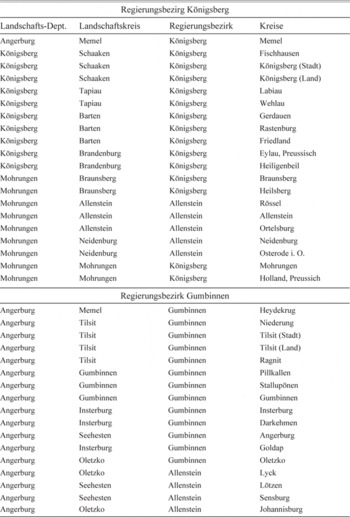
Landschaften were subdivided into smaller regional groups for administrative purposes. The East Prussian Landschaft, for example, was split into three administrative regions—Angerburg, Königsberg, and Mohrungen. Angerburg comprised the easternmost region, Mohrungen the western section, bordering on West Prussia, Königsberg was located in the center, along the Baltic coast, straddling both the Curonian and the Vistula Lagoon. At the time, all of East Prussia was predominantly agrarian, but compared with Angerburg and Mohrungen, the region of Königsberg was the richest part of East Prussia, having access to the Baltic trade and including the largest East Prussian city, Königsberg.
THE EAST PRUSSIAN LANDSCHAFT
Immediately after its creation in 1788, the East Prussian Landschaft was successful in issuing Pfandbriefe and by 1798 it was considered to have achieved its main purpose of securing agrarian credit to the noble estates (Altrock Reference Altrock1914, p. 109). In 1790, 133 estates had issued Pfandbriefe through the Landschaft, and this number rose to 308 in 1798, and 478 in 1806 (Ostpreussische Landschaft 1788–1913, 1913).
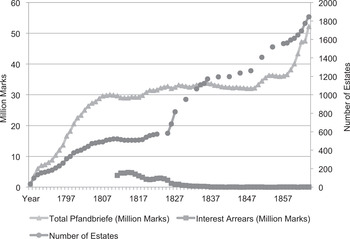
The growth of the Landschaft can be seen in Figure 1, which illustrates the number of estates that were borrowing, as well as the total amount of Pfandbriefe issued for the East Prussian Landschaft, from its creation through the first one-half of the nineteenth century. From the beginnings of the Landschaft in 1788 to the start of the Napoleonic Wars, both, the number of estates that borrowed through the Landschaft, and with it the total amount of Pfandbriefe issued, rose quickly. During the war, caused by its economic impact, both series stagnated and fell off, but recovered with the end of the war. The Napoleonic Wars had burdened East Prussia with a total of 260 million marks in war cost between 1808 and 1813, so its effect on the estates was significant (Altrock Reference Altrock1914, p. 110). This can also be seen on the accumulated interest arrears, which spiked between 1811–1814 and virtually disappeared after the 1830s. New Pfandbrief issues were halted in 1812, but resumed in 1816. For the last part of this period, the large increase in the number of estates borrowing coincided with a more moderate increase in the amount of the Pfandbriefe after 1824. This reflected a conscious choice on the part of the Landschaft to expand the number of borrowers, especially among smaller estates following the 1848/49 revolutions.
TOTAL PFANDBRIEF AMOUNT ISSUED, TOTAL INTEREST ARREARS, AND NUMBER OF ESTATES IN THE EAST PRUSSIAN LANDSCHAFT (1788–1865)

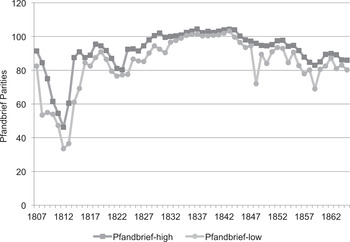
The growth and the economic contribution of the Landschaft can also be seen in the prices of the Pfandbriefe, as quoted in the secondary market and shown for the period 1807–1865 in Figure 2. The price movements generally responded to the same events as the previous series: Prices drastically fell, and spreads between high and low prices increased with the beginning of the Napoleonic wars, but recovered quickly at the end of the wars. The wars disturbed the international grain trade through the Continental Blockade (1806–1814). Changes in the international grain markets were of major importance for the Prussian landholders and were therefore reflected in the price movements of the Pfandbriefe. Prior to 1805, grain was Prussia's major export product, especially to England. About 50 percent of all British grain imports originated in Prussia, and the large estates were the main producers of this export crop. After a brief recovery at the end of the Napoleonic wars, grain prices collapsed, following the 1815 imposition of British import restrictions (Corn Laws). This contributed to an agricultural crisis in Prussia that lasted through the 1820s and led to a second dip in Pfandbrief prices. Estates were struggling, many defaulting on their outstanding debt. The crisis presented a test for the stability of the Landschaft. The King's moratorium, which during the Napoleonic Wars had allowed borrowers to fall behind on their interest payments, was extended to 1832. The moratorium implied that even borrowers that were able to pay their interest often did not, and arrears accumulated. On the other hand, the Landschaft was well aware that Pfandbriefe would lose their value if interest payments to creditors were not made. Thus the Landschaft continued to pay out interest despite falling contributions. This was only possible with direct support from the King and additional private loans to the Landschaft (Hein Reference Hein1938, p. 77).
HIGH AND LOW PARITIES OF THE PFANDBRIEFE FOR THE EAST PRUSSIAN LANDSCHAFT (1807–1865)

In 1809 the East Prussian Landschaft had allowed crown lands (Domänen) to be included in the Landschaft. Taking out Pfandbriefe against the Domänen allowed the King to cover some of the war-induced obligations, supporting state finances. But it also triggered an important bail-in of the crown, which presented additional guarantees for the creditors. When the King refused further support payments in 1830, the Landschaft used the joint liability clause to force the King's hand. The Landschaft's board of directors decided that the joint liability would be invoked according to estate size and that since the Domänen covered about two-thirds of the land included in the Landschaft, this would make the state liable for two-thirds of the payments needed. This put sufficient pressure on the King to continue support payments and the Landschaft did not need to resort to the joint liability (Hein Reference Hein1938, p. 126).
The Landschaft had the right to take over, and eventually sell, estates that had accumulated interest arrears of more than 5 percent of the loan value, a feature that was frequently used at the time. It was also during this time (1822/23) that the Landschaft conducted the survey that forms the basis for the empirical analysis of this article. The 1822/23 survey provides unique snapshot of the Landschaft during a time of economic distress, highlighting the continued lending. The East Prussian Landschaft also responded to the burdens imposed by the wars and the crisis by expanding its member base. For example, in 1808 the Landschaft began to include smaller estates above a minimum value of 500 Talers that belonged to free farmers (Köllmer).
DATA AND ANALYSIS
The data used in this article stem from three different sources: A survey conducted by the Landschaft in 1822/23 including a supplemental list of estates that were in receivership between 1806 and 1823, a list of member estates from 1829, also published by the Landschaft, and the 1834 official estate register, sanctioned by the King, that designated estates as knight's estates (called Matrikel). In 1822/23, the Landschaft apparently carried out a detailed survey of all estates that had borrowed from the Landschaft in an attempt to generate an overview of its assets. This survey contains information on 554 estates that at the time had borrowed from the Landschaft. For each estate listed, the survey includes the name of the estate, the “Kreis” (district) in which the estate was located, the “Department” (administrative region), the name of the property owner, the size of the estate (in kulm. Hufen), a value assessment of the estate (in Reichstaler), the size of the loan provided by the Landschaft, and the size of the unpaid interest arrears owed to the Landschaft.Footnote 3 For most estates, the assessment contains further detailed information on the separate estate revenues from farming, animal husbandry, brewing, and other sources, and it lists the number of life stock on the estate (oxen, horses, cows, calves, and sheep). In cases where no assessment is provided, the survey lists the last sale price of the estate, as well as the year of the sale. For some estates, the survey even includes additional notes about the physical condition of the estate and the possibility of expanding or establishing wool production on the estate, a branch of farming deemed profitable at the time. A supplement to the survey also includes information on estates that entered receivership or had to be sold by the Landschaft to cover interest arrears and the outstanding loan balance between 1806 and 1823.
The aggregate number of estates listed in the survey matches the membership numbers given in other sources. While the survey lists 554 estates with a total amount of Pfandbriefe issued of 33.9 million marks, the Denkschrift for the 125-year anniversary of the East Prussian Landschaft gives 574 estates and a total Pfandbrief amount of 31.6 million marks for 1823 (Ostpreussische Landschaft 1913). Part of the discrepancy could stem from the fact that the survey was completed over two years, 1822 and 1823.
In addition to the survey, Landschaften documents include the 1829 list that enumerates 887 estates that had borrowed through the Landschaft in 1829. For each estate, it gives the name, the department, the owner in 1806, the owner in 1829, as well as a description of how the current owner acquired the estate (inheritance, purchase, foreclosure, or no ownership change). Again, the Denkschrift lists the number of estates that borrowed through the Landschaft as 815 in 1828 and 950 in 1831, so the 1829 list may well be a complete list for that year (Ostpreussische Landschaft 1913).
Both the 1822/23 survey and the 1829 list only include estates that had obtained Pfandbriefe through the Landschaft, so while producing a detailed picture of estate features and borrowing patterns, their examination does not provide information about the selection of estates that borrowed from the Landschaft. To address this, both sources were matched with the 1834 official estate register. This official register constitutes a complete listing of estates that were sanctioned by the King as knight's estates (Rittergüter) or as estates of similar statue. These estates carried with them certain political privileges, such as voting rights in the local district assembly (Kreistag) and the provincial legislature (Landtag) (Eddie Reference Eddie2008, Chapter 6). Being listed in this official estate register also gave rights to membership in the first estate (Ritterschaft) to owners of these estates, regardless of their birth.Footnote 4 This implied that at least in theory non-nobles could obtain voting privileges through the purchase of a knight's estate, even though many different practical restrictions were in place for the time before 1839 (Schiller Reference Schiller1998). The estates listed in the register were the target members of in the Landschaft, so they constituted the pool of potential borrowers. For 1834, the official estate register enumerates 1,398 estates in East Prussia, covering a total area of 789,855 hectares. The average size of the estates was 565 hectares. Of these, 1,108 estates were noble estates and 290 estates were designated as köllmisch, i.e., belonging to a special stand of free farmers. Since the geographic boundaries of the Landschaften did not fully concur with the geographic distinctions in the register, I added 12 noble estates from the West Prussian register, located in the border region of Rosenberg, as these could be matched with estates in the 1822/23 survey. This brings the pool of potential estates that could have borrowed from the Landschaft to 1,410.
Estates were matched among the 1822/23 survey, the 1829 survey, and the 1834 estate register, by estate name and location, using a Levenshtein distance algorithm. Estates of the same name for which neither the location nor the name of the owner was consistent across the survey and the register were only matched for unique names. Matching was complicated by the fact that, as mentioned previously, the administrative units of the Landschaft did not perfectly coincide with the administrative regions of East Prussia.Footnote 5 In addition, estate partitions and re-allocation of land between estates was frequent and estates often carried multiple names. Spelling errors or alternate spellings of names were also common and present a possible source of error.
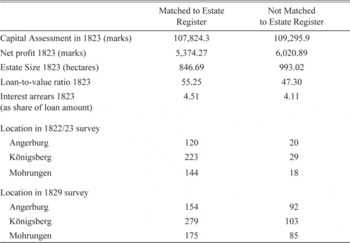
Nevertheless, changes in the designation of estates were relatively rare so that the 1834 estate register presents a good estimate of the pool of estates that belonged to the Landschaft in 1823 and 1829. Exactly 487 of the 554 estates from the 1822/23, survey and 607 of the 887 estates from the 1829 list could be matched to estates in the register. Out of the 554 estates in the 1823 survey 537 could be matched with the 1829 estate list, so almost all estates that borrowed in 1823 also did so in 1829. There were 476 estates that could be identified in all three sources. Since matching is not complete, this could give rise to potential selection bias. Table 1 shows the comparison of matched and non-matches estates between the estate register and the surveys. The geographical distribution of matched and non-matched estates looks similar, so the matching does not favor one particular region. With respect to size and estate value, the estates from the 1823 survey that could not be matched to the 1834 register appear slightly larger and wealthier and have a slightly smaller loan-to-value ratio and lower interest arrears. Therefore an analysis of the borrowing patterns of the matched estates should be biased towards the heavier borrowers.
COMPARISON OF MATCHED AND NON-MATCHED ESTATES

Source:
Source: Matrikel: GStA PK I Rep 77 Tit. 438, Nr. 62, Band 2; Survey: XX. HA Hist. Sta. Königsberg, Rep 2 Oberpräsident der Provinz Ostpreussen, Titel 40, Nr 16, Bd1.
By 1834, the number of estates that borrowed through the Landschaft had risen to 1,064 (Ostpreussische Landschaft 1913). As loans were not amortized, and as most of the 1823 borrowers also borrowed in 1829, these same estates likely also borrowed from the Landschaft in 1834, but they only present a subset of all borrowers in 1834. Nevertheless, the 1834 register presents the best approximation for the likely pool of borrowers in 1823 and 1829.
DISTRIBUTION OF CREDIT
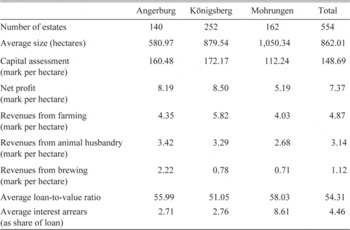
The most detailed information about individual estates can be found in the 1822/23 survey, and is disaggregated in Table 2. Of the 554 estates listed, 140 were located in Angerburg, 252 in Königsberg, and 162 in Mohrungen. Estates differed markedly by average size, with the largest estates located in Mohrungen (average size 1,050 hectares) almost twice the size of estates in Angerburg (average size 581 hectares). Königsberg estates fell in the middle with 880 hectares on average. While the estates were largest in Mohrungen, the assessment per hectare as well as the net profit of the estates was highest in Königsberg, followed by Angerburg, then Mohrungen. One can also see that farming generated the most revenue for the estates in Königsberg, while animal husbandry and brewing were larger revenue sources in Angerburg.
NUMBER AND SIZE OF ESTATES IN THE 1822/23 SURVEY

Source:
XX. HA Hist Sta Königsberg, Rep 2 Oberpräsident der Provinz Ostpreussen, Titel 40, Nr 16, Bd1.
Different regional patterns in the use of the Landschaft are already apparent from the summary statistics. Estates in Mohrungen had the highest loan-to-value ratio (calculated as the size of the Landschafts loan over the value of the assessment) and displayed the highest share of unpaid interest arrears (calculated as the amount of unpaid interest over the amount of the Landschafts loan). The overall loan-to-value ratio was 54 percent and the overall share of interest arrears 4.5 percent.
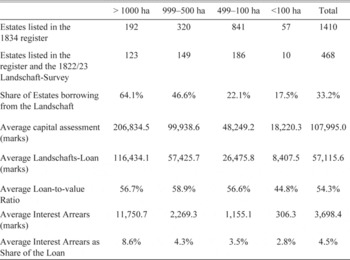
Table 3 shows the aggregate number of estates listed in the survey and the 1834 register, as well as key loan parameters, separated by the size of the estate.Footnote 6 Out of a total of 1,410 estates in East Prussia, about one-third are shown as having taken out Pfandbriefe in 1823, as indicated by the survey. It is evident that compared to the full sample, large estates of more than 1,000 hectares are over-represented in the borrower sample. Almost two-thirds of all large estates borrowed from the Landschaft, while the share for estates smaller than 500 hectares was less than one-quarter and for estates of less than 100 hectares only about 17 percent.
ESTATES BY SIZE CATEGORY

Source:
Matrikel: GStA PK I Rep 77 Tit. 438, Nr. 62, Band 2; Survey: XX. HA Hist. Sta. Königsberg, Rep 2 Oberpräsident der Provinz Ostpreussen, Titel 40, Nr 16, Bd1.
Table 3 also presents the average value of the estates, the average size of a Landschafts loan, average loan-to-value ratio, as well as the outstanding interest arrears (average and as share of the loan), all broken down by size classifications of the estate. Large estates of more than 1,000 hectares of course had the largest loans, based on their high capital assessment, but had a comparable loan-to-value ratio to medium size estates between 100–1,000 hectares. Table 3 also points to the conservative loan procedures of the Landschaft. At the time, estate holders could borrow up to two-thirds of the value of their estate, but for all size classifications, average borrowing remained lower than this threshold and loan-to-value ratios were consistent across the different size categories. Interestingly, it was the group of large estate holders that with 8.6 percent also showed the highest share of interest arrears to loan value. This number is significantly above the overall average of 4.5 percent and higher than in any other group. Small estates of less than 100 hectares had the lowest arrear share of only 2.8 percent.
To further support the hypothesis of large estates as major borrowers of the Landschaft, this section provides Logit and Ordinary Least Squares (OLS) regressions on the choice of estates to borrow through the Landschaft and on the default risk as implied by the outstanding interest arrears.
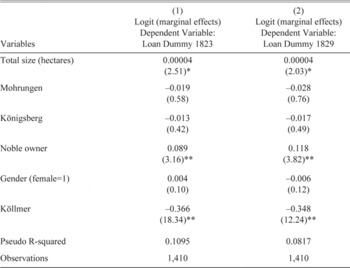
Table 4 displays the marginal effects of a logit estimation of estates borrowing through the Landschaft in 1823 and 1829, respectively. This regression is based on the estates listed in the 1834 register. The dependent variables “Loan Dummy 1823” and “Loan Dummy 1829” indicate whether an estate took out a loan in 1823 or 1829, respectively. Independent variables in this regression include the size of the estate, its location (department), and whether the estate's owner was of noble status, as well as the gender of the owner, and whether the owner was a free farmer (Köllmer).
PROBABILITY OF LANDSCHAFTS LOANS, 1806–1829

p-values in parentheses.
∗∗∗ p<0.01, ∗∗ p<0.05, ∗ p<0.1
Source:
Author's own estimates.
The results confirm that larger estates were more likely to rely on the Landschaft for their financing needs. An increase in the estate size of 100 hectares raised the likelihood of a Landschafts loan by about one-half of 1 percentage point in 1823 and 1829, and is statistically significant. It is notable that the large estates (over 1,000 hectares) are about 2,000 hectares on average, while estates less than 1,000 hectares average about 500 hectares. Thus large estates were on average 1,500 hectares bigger and therefore about 8 percent more likely to take out a Landschafts loan. The status of the owner was significant in 1823 and 1829. Noble ownership increased the likelihood of a Landschafts-loan by 9 percentage points and 12 percentage points, respectively, while being a free farmer decreased the likelihood of a loan by 37 percentage points in 1823 and 35 percentage points in 1829.
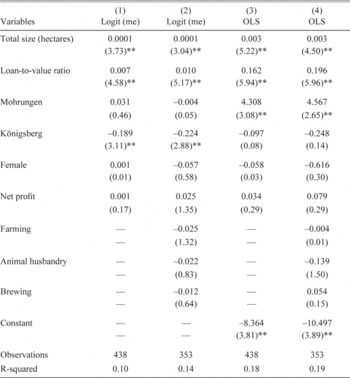
A second set of regressions takes the 554 estates listed in the 1822/23 survey as sample and estimates the likelihood of accumulating interest arrears and the size of these outstanding payments.Footnote 7 Results are shown in Table 5. Large estates, as well as estates with high loan-to-value ratios were more likely to have outstanding interest payments and more likely to accumulate larger amounts. An increase in the estate size of 100ha increased the likelihood of outstanding interest payments by about 1 percentage point. Estates located in Königsberg were between 19–22 percent less likely to have outstanding interest payments, while estates in Mohrungen accumulated larger amounts. This is consistent with the survey statistics in the previous section. Estates in Königsberg appear generally wealthier, possibly related to their strategic location closer to the Baltic Coast, which provided them with easier access to trade routes. The analysis further controls for the net profit of the estate and how the net profit was broken down into revenues from farming, animal husbandry, and brewing. None of these variables had a significant effect, suggesting that the type of estate and the specific revenue sources had no influence on its repayment patterns.
PROBABILITY AND SIZE OF OUTSTANDING INTEREST PAYMENTS

p-values in parentheses.
∗∗∗ p<0.01, ∗∗ p<0.05, ∗ p<0.1
Source:
Author's own estimates.
These regression results underscore that the Landschaft was predominately used by the large estate owners. It was also the group of large estate owners that had the highest default risk, as measured by the larger outstanding interest payments. Therefore, at least in the first 50 years of the Landschaft's existence, the estate holders, which had put up the highest collateral through compulsory membership and joint liability also took out the highest amount of loans.
There was little adverse selection in the sense that smaller estate holders took advantage of the joint liability clause and ran up large balances in anticipation that they would be bailed out by the larger estate holders. Overall, the Landschaft was successful in keeping loan-to-value ratios below the set limits, even in difficult times. Out of the 554 estates listed in the survey, 61 had loan-to-value ratios exceeding two-thirds, which was the limit set by the Landschaft. Of these 61 estates, 31 had outstanding interest payments that exceeded 5 percent of their loan amount, meaning that they were more than a year behind in payments and at risk for default. Eighteen of these 61 were estates of more than 1,000 hectares, again showing that the large landowners were overrepresented in taking on large amounts of debt through the Landschaft.
If there was any evidence of moral hazard and adverse selection it was within the group of large estates holders. But this was also the group where monitoring was thought to be most effective since monitoring was reinforced by the social cohesion of the group and limited to a relatively small number of estates. So while the desolate situation of the large estates initiated the emergence of the Landschaften, it was this group that used the Landschaft the most and was probably helped the most by its existence.
A similar story can be told from the supplementary list of 239 estates in receivership between 1806–1823 and the 121 estates that were auctioned off and sold by the Landschaft over the same time frame to cover the outstanding loan amount and interest arrears. While the number of foreclosed estates over this timeframe is significant, the Landschaft had apparently adopted an efficient mechanism to continue the flow of credit. The Landschaft had the legal right to take over and manage, and in extreme cases, liquidate failing estates. The number of liquidated estates rose through the early 1830s, but trailed off by the end of the decade. Unfortunately, the detailed data included in the survey only cover the years through 1823. From the survey data, it is clear that receivership and foreclosure did not constitute an empty threat, but that the Landschaft made use of this regularly. For the estates included in this sample, in all but three cases the proceeds from the sale more than covered the outstanding loan amount. In most cases the proceeds covered the outstanding loan amount plus interest arrears, underscoring the conservative loan policies of the Landschaft. Corresponding to larger borrowing and higher arrears for large estates, it is noticeable that sales and receivership through the Landschaft also did occur more frequently for larger estates: The average valuation of estates in receivership between 1806–1823 was 122,316 marks and the average loan size 70,485 marks, compared with 107,995 marks and 57,115 marks, respectively, for all estates (Table 3). For estates that were liquidated, average assessments were slightly smaller at 90,210 marks and loan sizes relatively larger at 60,051 marks. Corresponding average loan-to-value ratios were increasing from 54 percent overall to 59 percent for estates in receivership to 77 percent for estates taken over and eventually sold by the Landschaft.
CHANGES IN ESTATE SIZE AND OWNERSHIP
Previous literature on the Landschaften has noted that especially wealthy estates used the Landschaften to expand their landholdings at the expense of the free farmers. After the establishment of the Landschaften, an estate holder could take out Pfandbriefe based on the size and value of the estate, and then use the proceeds to buy additional land. These additional land purchases then again could form the basis for a new or enlarged Landschafts loan. This practice appears to have been widespread and frequent in the time period before 1806 (Maurer 1907; Schissler Reference Schissler1978; Schiller Reference Schiller2003). Comparing the data from the 1823 survey, which includes the size of the estate, with the 1834 register, I can track changes in estate size for the estates that were part of the Landschaft for the short time span between 1823 and 1834. Based on this limited data, it does not appear that the enlargement of estates using Landschaft loans continued systematically, at least not after 1823. There are 419 estates in the data set that list estate size in 1823 and 1834. These 419 estates list an average size of 846 hectares in 1823 but only 733 hectares in 1834. Out of these 419 estates, 127 had grown in size between 1823 and 1834, while 291 were smaller in 1834. There is no significant regional difference, with 34 of the 127 estates that had grown in size in Angerburg, 43 in Königsberg, and 50 located in Mohrungen. While these size measures might be imprecise, they do appear to indicate that in the nineteenth century Landschafts-loans were not broadly used for large land purchases.
The 1829 list of estates also provides a unique look into the ownership changes of estates that had borrowed through the Landschaft. Unfortunately, since no previous ownership information is included in the 1834 estate register, we can only document the ownership patterns for Landschaften members and not use this data to test whether ownership changes of estates that had borrowed through the Landschaft were significantly different from estates that did not use the Landschaft for their financing. Theoretically, the Landschaft could do both, increase the frequency of ownership turnover by allowing buyers a reduced purchase price if they could take over the existing Landschafts-loan and service its regular payments, or reduce the frequency of turnover by allowing landholders access to easy credit at comparatively low interest rates. A stated goal of the Landschaften was to concentrate the ownership of estates in the hands of nobles and prevent estate sales to the bourgeoisie. Despite the descriptive nature of the data, a look at the ownership change patterns from the 1829 survey gives some interesting insights with regard to the type of estates that borrowed. Of the 887 estates in the 1829 survey, 144 had no change in ownership between 1806–1829; 250 were sold. For 256, the estate was passed on within the family. Slightly more, 260, changed hands through some form of foreclosure process, often involving the Landschaft. Throughout the same period, six estates were owned by the state. For 21 the owner in 1829 was unknown and 43 estates changed hands more than once during this time. These turnover patterns reflect the high degree of economic instability following the agricultural crisis of the 1820s and suggest that the Landschaft did play a large role in the survival and facilitated estate foreclosures and turnover for failing estates. But it also confirms, that the Landschaft was used by estates that displayed all types of ownership change, testifying to its popularity. Landschafts-credit was used not only in crisis situations, but also to support ongoing business operations. For example, the estate Friedrichstein, owned by the prominent Dönhoff family and analyzed in detail by Marion von Dönhoff (Reference Dönhoff1936), remained with the same owner between 1806 and 1829 and held a Landschafts-loan of 87,900 mark, compared to an assessment of the estate valued at 546,000 mark and annual revenues and expenses of about 100,000 mark.
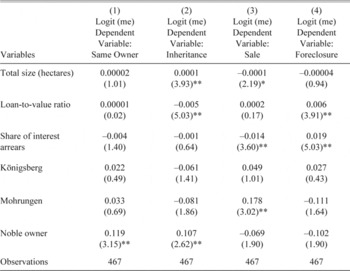
Table 6 presents the results of a Multinomial Logit regression based on the transfer data, taking the type of ownership change as a dependent variable and testing for the effect of estate size, loan-to-value ratio, interest share, location, and status of the owner on the probability of the type of turnover. Marginal effects are reported in the table. The results again are consistent with the summary statistics discussed previously and show statistical significance.
Types of Ownership Change

p-values in parentheses.
∗∗∗ p<0.01, ∗∗ p<0.05, ∗ p<0.1
Pseudo R-squared = 0.12
Source:
Author's own estimates.
Estate size increased the likelihood that an estate was passed on through inheritance and it reduced the likelihood of a sale. An increase in size of 100 hectares raised the likelihood of an inheritance by 1 percentage point and reduced the likelihood of a sale by 1 percentage point. High loan-to-value ratios and high levels of interest arrears were correlated with foreclosures. But higher loan-to-value ratios reduced the likelihood of an inheritance and larger interest arrears reduced the likelihood of a sale. Being located in Mohrungen raised the likelihood of a sale by 17 percentage points, but apart from this result, location had no effect on the type of transfer. Noble owner status increased the likelihood that the estate was passed on through inheritance or that the estate remained with the same owner by 11 and 12 percentage points, respectively. These results indicate that large and noble estates were more likely to be passed on via inheritance. Sales appear to be unrelated to the loan-to-value ratio, suggesting that most sales did not take place in response to economic distress, but that distressed estates with high loan-to-value ratios and large interest arrears were predominantly foreclosed upon.
In addition to turnover, it would also be interesting to investigate which estates changed hands from noble to non-noble estate holders and whether the Landschaft influenced this changeover. The question whether noble estates could be sold to non-noble owners such as wealthy merchants or free farmers was a continuing source of controversy. On the one hand, both nobles and the crown had an interest in restricting these types of sales, as knights' estates traditionally entitled the owner to executive and judicial powers on the estate, and also voting and representation rights in local and district assemblies. On the other hand, exclusively limiting estate sales to noble owners restricted the demand for estates and depressed estate prices, especially in times of economic distress. Before 1807, estates sales to non-nobles were only allowed with special permission by the King, and restrictions were put in place to limit voting rights by bourgeois owners (Schiller Reference Schiller1998). But since the status of the owner is not recorded in the 1829 list, the data only provide partial information. Previous studies of ownership changes show that 66 percent of all Prussian estates (East and West Prussia combined) were owned by non-nobles by the mid nineteenth century. Scott Eddie (Reference Eddie2005) speculates that most of this changeover took place in the 1820s, but cannot differentiate whether most purchases of estates were carried out for political or economic reasons. The 1834 estate register lists one-third of the estates listed for East Prussia with noble ownership (469 out of 1410, 33 percent) and 941 with non-noble owners (67 percent). Of the 607 estates that can be identified in the 1829 survey as well as in the 1834 register, identification of owner status is possible. Of these, 260 (43 percent) have noble ownership compared with 347 (57 percent) non-noble owners, suggesting that the Landschaft favored a higher percentage of noble owners and possibly helped the nobility to hold onto their estates.
CONCLUSION
The current article highlights a unique type of economic institution that emerged in Prussia towards the end of the eighteenth century—Landschaften—focusing on the example of the East Prussian Landschaft. The analysis of the loan portfolio of the East Prussian Landschaft provided here is the first comprehensive quantitative assessment of a Landschaft. Using data from a 1822/23 estate survey, an 1829 estate list, as well as the 1834 estate register, this article shows that large landholders, with estates of more than 1,000 hectares, were more likely to take out loans from the Landschaft, were, based on their estate size, more likely to hold large loans, and were also more likely to be in arrear with their interest payments. The Landschaft was dominated by this relatively small number of large estate holders, both in terms of the loan value and in terms of assets. However, this small group of estate holders was not able to capture and exploit the institution. The data confirm that the Landschaft was relatively successful in monitoring its member estates, since the loan-to-value ratios rarely exceeded the set limits. There was also limited moral hazard in the sense that smaller estates tried to run up large debt ratios or outstanding interest balances. Even in times of extreme economic distress, such as the Napoleonic Wars and the agricultural crisis of the 1820s, the system of the Landschaften remained intact and supported the estates, albeit with direct financial support from the King. With respect to the economic effects of the Landschaft, results on estate size and ownership changes suggest that the Landschaft did not trigger large-scale estate enlargements during the 1820s, as they might have done during earlier periods. Landschaften did facilitate foreclosures and the transfer of distressed economic estates, but in contrast to foreclosures, sales were not driven by an estate's loan-to-value ratio, indicating that sales did not take place out of economic necessity. Moreover, large estates were more likely to be passed on through inheritance. The analysis supports the importance of the Landschaften for the Prussian Junkers and documents the effectiveness of the institutional features put in place to curb moral hazard and adverse selection.
Further testament to the long-term success of the Landschaften is the continued existence of Pfandbriefe. Pfandbriefe have flourished to this day and served as predecessor for modern mortgage covered bonds. Especially following the 2007/08 U.S. mortgage crisis, Pfandbriefe have gained in importance as an extremely secure form of mortgage assets. They have also been investigated as a possible template to replace the U.S. federal guarantees in the mortgage market, as they provide high liquidity at minimal risk and without government intervention. The key characteristic of historical as well as modern Pfandbriefe is the system of dual recourse, where each bond is backed by the issuer, as well as by a cover pool of assets. Pfandbriefe do not allow for credit risk transfer, further enhancing their security. The features that made Landschaften historically successful remain the key institutional features behind the success and popularity of Pfandbriefe today.
Appendix
CORRESPONDENCE BETWEEN PRUSSIAN ADMINISTRATIVE REGIONS AND THE DEPARTMENTS AND KREISE OF THE LANDSCHAFT