INTRODUCTION
Patients with cancer face enormous stressors, including loss of bodily function, fear of death and dying, and exposure to extremely toxic chemotherapy, radiation therapy, and mutilating surgeries (Barni et al., 1996). Moreover, relationships are altered and daily productive life is diminished. These stressors are felt by the entire family unit and by their nurses, doctors, and other professional caregivers. The occupational stress of physicians (Cooper et al., 1989; O'Amelio, 1989; Ullrich & FitzGerald, 1990; Frank et al., 1999; Geurts et al., 1999; Tattersall et al., 1999; McMurray et al., 2000; Linzer et al., 2001) and nurses (Jenkins & Ostchega, 1986; Bennett et al., 1991; Emery, 1993; Parker & Kulik, 1995; Lake, 1998; Leiter et al., 1998; Fitch et al., 1999; Clarke et al., 2002; Vahey et al., 2004) has been studied for many years, and conceptual models and measures are becoming more sophisticated (Aiken et al., 1997; Maslach et al., 2001). However, fewer investigations have focused specifically on the experience of staff working in oncology settings. There is a salient need for greater attention to this area given the multiple challenges that confront oncology staff, including the growing number of cancer patients requiring care, the increasing intensity and complexity of treatment protocols, the disruptive changes that have transformed the health care environment, and the burdens inherent in caring for individuals with life-threatening illness.
The vocational strain experienced by health care professionals is often called burnout, which refers to the erosion of emotional or physical strength and professional engagement as a function of a taxing work environment (Felton, 1998). The most common model of burnout (Maslach, 1982; Maslach et al., 2001) depicts it as a multidimensional construct that encompasses (1) emotional exhaustion (i.e., feeling depleted and overextended); (2) depersonalization (i.e., emotional and cognitive detachment from the work); and reduced personal accomplishment (i.e., perceived lack of effectiveness) (Linzer et al., 2001). Among several instruments that have been developed to assess burnout (e.g., Burnout Scale [Pines & Aronson, 1988] and Burnout Scale for Health Professionals [Jones, 1980]), the most widely used and best validated is the Maslach Burnout Inventory (Maslach et al., 1996). Burnout is conceptually distinct from, but associated with, job satisfaction and more general psychosocial distress. On an organizational level, the adverse effects of burnout on the health care system have been measured in terms of lower productivity, decreases in team morale, and increases in absenteeism, health care costs, and personnel turnover (Cordes & Dougherty, 1993; Parker & Kulik, 1995; Lake, 1998). Furthermore, burnout has been tied to lower patient satisfaction (Leiter et al., 1998; Vahey et al., 2004) and decrements in self-reported quality of care (Clarke et al., 2002; Morita et al., 2002).
In this article, we review recent research findings concerning the prevalence of burnout and distress among oncologists and oncology nurses and examine some of the multidimensional occupational and personal factors associated with risk. We also consider interventions that might be useful and offer recommendations for future work in this area.
METHODS
Our search strategy consisted of the following: Inclusion criteria included quantitative studies published in English-language peer-reviewed journals published between January 1989 and December 2004, which focused on burnout or psychosocial distress among oncologists or oncology nurses. Exclusion criteria included qualitative studies, dissertations, book chapters, abstracts, and studies focusing on pediatric staff. Search strategies included use of computerized databases (Medline, 1989–2004; PsycInfo, 1989–2004) and examination of article reference sections and reviews. Variables abstracted included study design, measures, sample size, response rates, practice settings, target populations (e.g., medical oncologists, palliative care specialists, oncology nurses), and outcomes.
RESULTS
Prevalence of Burnout and Psychosocial Distress among Oncology Physicians
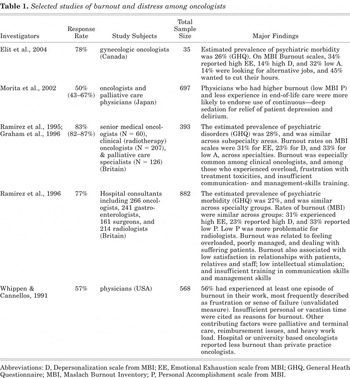
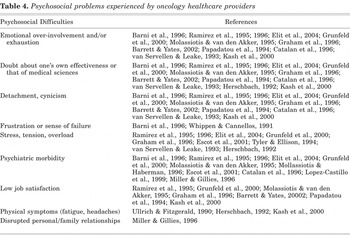
Recent studies in North America and Great Britain suggest that burnout and psychosocial distress are notable concerns in oncology settings. Six published investigations (Whippen & Canellos, 1991; Molassiotis & van den Akker, 1995; Ramirez et al., 1995, 1996; Grunfeld et al., 2000; Elit et al., 2004) were identified that met eligibility criteria concerning prevalence of burnout among oncologists (see Table 1 for studies concerning oncologists, Table 3 for studies concerning mixed samples including subgroups of oncologists, and Table 4 for types of psychosocial problems). Five investigations provided estimates of general psychosocial distress (Molassiotis & van den Akker, 1995; Ramirez et al., 1995, 1996; Grunfeld et al., 2000; Elit et al., 2004). Whippen and Canellos (1991) conducted the largest study to date on burnout among oncology physicians. They surveyed 1000 randomly selected subscribers to the Journal of Clinical Oncology, who are members of the American Society of Clinical Oncology. The survey consisted of a brief, unvalidated 12-item questionnaire. Of the 1000 subjects who were queried, 568 responded. Of all responders, 56% indicated that they definitely had experienced at least one episode of burnout in their work. This was most frequently described as frustration or a sense of failure, and insufficient personal and/or vacation time was the reason most of them said they experienced burnout (95%). Of interest, the rate of burnout was significantly lower among academic oncologists than among community oncologists.
Selected studies of burnout and distress among oncologists

In a methodologically stronger series of studies, Ramirez et al. (1995, 1996; Graham et al., 1996) found that burnout and psychiatric problems were common among senior oncologists and palliative care specialists. These investigators conducted a national survey of consultant nonsurgical oncologists in Great Britain, using validated measures (Ramirez et al., 1995). Of 465 consultants, 393 (83%) returned their questionnaires. The estimated prevalence of psychiatric disorder among these clinicians was 28% and on the three dimensions of burnout (i.e., work-related emotional exhaustion, depersonalization, and reduced personal accomplishment), prevalence rates ranged from 13% to 38%. Clinical oncologists (radiotherapists) fared worse in terms of burnout than palliative care specialists and (to a lesser extent) medical oncologists. Other correlates of burnout included feeling overloaded, dealing with patient suffering, involvement with treatment toxicity and errors, and deriving little satisfaction from professional status. Clinicians who felt insufficiently trained in communication and management skills were also particularly at risk for high burnout.
The estimates of psychosocial morbidity (28%) found in this study of British medical oncologists (Ramirez et al., 1995) were similar to those that emerged in subsequent studies of Canadian medical oncologists (Grunfeld et al., 2000) and gynecologic oncologists (Elit et al., 2004; 25% and 26%, respectively) and diverse British medical specialists, including oncologists (22%–34%; Molassiotis & van den Akker, 1995; Ramirez et al., 1996). The prevalence of various dimensions of burnout (which focuses specifically on work-related adjustment) has varied from 13% to 53% among British and Canadian medical, radiotherapy, and gynecologic oncologists (Molassiotis & van den Akker, 1995; Ramirez et al., 1996; Grunfeld et al., 2000; Elit et al., 2004), as assessed by the most commonly used instrument (i.e., Maslach Burnout Inventory [MBI]; Maslach et al., 1996).
In a survey of Canadian oncology staff, for example, about one-half of medical oncologists and one-third of allied health professionals (e.g., nurses, social workers, pharmacists, etc.) reported high levels of emotional exhaustion, and roughly half of each group experienced low personal accomplishment (48% and 54%, respectively; Grunfeld et al., 2000). A large proportion of both groups reported high job stress (42% for medical oncologists and 37% for allied health professionals). Emotional exhaustion and job stress were among the factors that predicted potential turnover (i.e., serious interest in leaving one's work situation). Disconcertingly, 39% of medical oncologists reported seriously considering seeking a job outside of oncology.
Aside from its association with anticipated staff turnover (Grunfeld et al., 2000; Elit et al., 2004), burnout may also be linked to compromised quality of care. A national survey of Japanese oncologists and palliative care specialists examined the use of continuous deep sedation (maintaining unconsciousness until death) among terminally ill patients (Morita et al., 2002). One dimension of burnout (low accomplishment) was among the factors associated with inappropriate physician preference for use of continuous deep sedation to manage problems such as depression and delirium, which often respond well to psychiatric intervention. Clinicians who were less experienced in end-of-life care and older were also more likely to select this treatment option.
Thus, marked work-related difficulties and more general psychiatric distress appear to affect a significant proportion of oncologists across different geographical regions. There are preliminary indications that oncologist burnout may adversely affect staff turnover and quality of treatment. Methodologically, most of these studies had reasonably high response rates (relative to other national surveys) and large samples (for exceptions, see Graham et al., 1996; Elit et al., 2004). Burnout and general distress were assessed by a common set of validated measures with established norms, enhancing comparisons across studies, and at least partial accommodation was made for multiple statistical comparisons. However, all of these projects relied on cross-sectional research designs, so it remains unclear how these outcomes (and their determinants) might change over time. A measure of specific job stressors and satisfactions developed by Ramirez et al. (1995) was used widely in these studies and appears promising, but thus far only limited information has been presented about its psychometric properties. In future investigations, it would be useful to supplement self-report measures with structured interviews, which would offer richer information and more accurate estimates of psychosocial morbidity, notwithstanding the notable logistic challenges entailed. It would also be helpful for investigators to extend these findings specifically to American oncologists (thus far most work has centered on Canadian and British samples), to further explore potential differences among subspecialists (Ramirez et al., 1995) and to examine prospective associations between burnout and other important endpoints that have received little attention (e.g., physician health status and biological stress markers, intended turnover, patient satisfaction, medical errors, quality of care; Grunfeld et al., 2000; Morita et al., 2002; Elit et al., 2004).
Prevalence of Burnout and Distress among Oncology Nurses
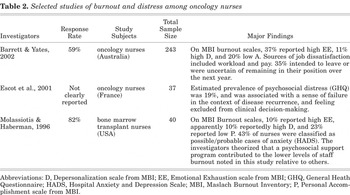
A national shortage of nurses, in conjunction with briefer hospital stays and increased workloads, has heightened concern about burnout among nurses. A few studies have examined burnout and job stress among oncology nurses in various Western countries. Four eligible studies (Papadatou et al., 1994; Molassiotis & van den Akker, 1995; Molassiotis & Haberman, 1996; Barrett & Yates, 2002) were identified that provided data about the prevalence of burnout (see Table 2 for studies concerning oncology nurses and Table 3 for studies concerning mixed samples including subgroups of oncology nurses). Three investigations (Molassiotis & van den Akker, 1995; Molassiotis & Haberman, 1996; Escot et al., 2001) provided prevalence data about psychosocial distress, and four additional studies offered estimates for combined samples of oncology nurses and physicians (Barni et al., 1996; Catalan et al., 1996; Miller & Gillies, 1996; Lopez-Castillo et al., 1999).
Selected studies of burnout and distress among oncology nurses

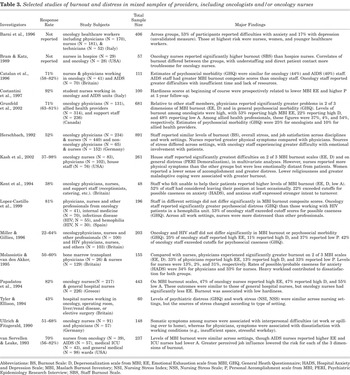
Selected studies of burnout and distress in mixed samples of providers, including oncologists and/or oncology nurses

Psychosocial problems experienced by oncology healthcare providers

In separate multicenter surveys of Australian (Barrett & Yates, 2002; N = 243) and Greek (Papadatou et al., 1994; N = 443) nurses, assessed using the MBI (Maslach et al., 1996), 37%–47% reported high emotional exhaustion, 11%–47% reported high depersonalization, and 20%–55% experienced low personal accomplishment. Indices of burnout were notably lower among British (Molassiotis & van den Akker, 1995; N = 129) and American (Molassiotis & Haberman, 1996; N = 40) nurses in a more specialized setting, bone marrow transplant centers (i.e., emotional exhaustion 10%–13%; depersonalization 2%–10%, low personal accomplishment 23%–31%).
Less information is available about psychiatric distress. Prevalence estimates vary widely in the few available studies, in part reflecting use of different measures in different settings. Estimates of possible cases among bone marrow transplant nurses were 33%–43% for anxiety and 6%–10% for depression (Molassiotis & van den Akker, 1995; Molassiotis & Haberman, 1996), based on standardized self-report measures. In combined samples of oncologists and nurses, 42%–53% exceeded cutoffs on a standardized measure of psychiatric morbidity (Catalan et al., 1996; Miller & Gillies, 1996; Lopez-Castillo et al., 1999). Fifty-three percent portrayed themselves as highly anxious and 17% as highly depressed on an unvalidated measure in a mixed sample including Italian oncologists, oncology nurses, and other cancer professionals (N = 406; Barni et al., 1996). Finally, 19% scored in the case range for distress in a small study of French oncology nurses (N = 37; Escot et al., 2001).
Some studies have directly compared rates of burnout or general distress among oncology nurses versus nurses in other settings. In a small investigation (N = 57), oncology nurses reported significantly greater burnout than hospice nurses (Bram & Katz, 1989). In other studies, however, oncology nurses did not fare more poorly than their peers working in other settings, including general medical, medical ICU, or AIDS units (Herschbach, 1992; van Servellen & Leake, 1993; Papadatou et al., 1994; Tyler & Ellison, 1994; Miller & Gillies, 1996; Catalan et al., 1996), though the specific types of stressors identified varied across settings (e.g., emotional involvement with patients was more taxing for oncology staff; Herschbach, 1992; Tyler & Ellison, 1994). Some but not all of these investigations made at least some attempt to account for important covariates (e.g., demographic differences) that may have influenced the results (van Servellen & Leake, 1993; Papadatou et al., 1994; Catalan et al., 1996). Notwithstanding their methodological limitations, studies do not offer much support for the assumption that oncology nurses experience poorer outcomes than nurses working in other practice settings.
A few studies have compared the experience of oncology nurses with that of physicians. Findings are inconsistent. Among cancer care workers in Ontario (Grunfeld et al., 2000), oncologists scored significantly higher on two of three indices of MBI burnout and on general distress, relative to comparison groups of allied health professionals (nurses, pharmacists, dieticians, etc.) and support staff (clerks, receptionists, etc.; N = 681). Similarly, in a multicenter study, bone marrow transplant physicians reported greater difficulties than nurses on two MBI burnout scales and on a measure of job satisfaction (Molassiotis & van den Akker, 1995). Kash et al. (2000) assessed burnout, distress, and somatic symptoms among oncologists, house staff, and nurses (N = 261) in a single institution. Perhaps not surprisingly, house staff reported the highest levels of MBI emotional exhaustion and MBI depersonalization, along with the greatest general distress, after controlling for demographic differences among the groups. However, nurses struggled with low accomplishment (MBI) and greater somatic symptoms. A multicenter study by Herschbach (1992; N = 891) found few differences in outcomes (i.e., burnout, overall work stress, job satisfaction) between oncology nurses and physicians. Once again, however, nurses reported greater somatic symptoms than oncologists, a finding that was evident across different practice settings (i.e., oncology, ICU, cardiac, and surgery units). Finally, nurses reported greater burnout and general distress than physicians in a study that evaluated staff from oncology, internal medicine, infectious disease, and hemophilia units (N = 196; Lopez-Castillo et al., 1999). In most of these investigations, no efforts were made to adjust for potential differences in demographic (e.g., gender) or work (e.g., duration of employment) characteristics across the professional groups (for exceptions, see Lopez-Castillo et al., 1999; Kash et al., 2000), so it is unclear whether professional discipline or other factors contributed to the results.
In sum, recent research suggests that levels of burnout and general distress are notable among oncology nurses as well as physicians. The existing database regarding oncology nurses is diverse with respect to geographical/cultural representation, targeted endpoints, and methodological quality. Available studies have enhanced our understanding of some of the challenges faced by oncology nurses, but relatively few provided prevalence estimates of burnout or distress. Although a number of investigators used the MBI as a common measure of burnout, they did not report the percentage of nurses who scored above cutoff values (van Servellen & Leake, 1993; Kent et al., 1994; Kash et al., 2000; Escot et al., 2001) or reported these data in a way that is not comparable to other studies (Catalan et al., 1996). Very little information is available about related outcomes such as physiological stress indices (Kuiper et al., 1998; Schulz et al., 1998), intended turnover (Lopez-Castillo et al., 1999; Barrett & Yates, 2002), or quality of care. Moreover, some investigations were limited by reliance on relatively small samples of oncology staff (N ≤ 60; Bram & Katz, 1989; Bennett et al., 1991; Kent et al., 1994; Tyler & Ellison, 1994; Catalan et al., 1996; Lopez-Castillo et al., 1999) or heterogeneous samples that did not distinguish outcomes among subgroups of professionals (i.e., nurses vs. other disciplines; Kent et al., 1994; Catalan et al., 1996; Miller & Gillies, 1996; Grunfeld et al., 2000). Other studies had low response rates (Kent et al., 1994; Tyler & Ellison, 1994; Miller & Gillies, 1996) or omitted information about accrual (Bram & Katz, 1989; Barni et al., 1996). It would be helpful for future nursing studies to move toward a common set of outcome measures for burnout and distress, to indicate the percentage of respondents that exceed cutoff values, and ideally to track changes longitudinally. Moreover, it is clear that the prevalence of work-related difficulties varies considerably. What factors influence these outcomes?
Determinants of Burnout
Burnout is influenced by multiple factors, including aspects of the work setting (e.g., institutional characteristics, clinical demands, health care system changes) and qualities of the individual (e.g., personality, coping). Information is relatively limited concerning correlates of burnout specifically among oncology clinicians; thus, in the following discussion, selected findings from the broader literature on physicians and nurses are included.
Occupational Factors
In the broader literature regarding occupational stress, the demand-control model of job strain has been an important conceptual framework (Karasek et al., 1981). Job strain focuses on the impact of high work demands in conjunction with limited control or decision latitude. Workers are expected to experience adverse outcomes when demands are high and control is low. Although the model posits an interaction between these two factors, this has not always been borne out: often job demands and control have independent effects (Tyler & Cushman, 1988; De Rijk et al., 1998; De Croon et al., 2000). Nevertheless, these factors have been associated with increased burnout (Maslach et al., 2001) and increased risk for cardiovascular morbidity and mortality (Karasek et al., 1981; Johnson et al., 1996; Schnall et al., 1998). Consistent with the broader occupational literature, there are indications that limited control also may be tied to adverse work adjustment among health care providers. Low job influence or control was associated with increased burnout among nurses working in diverse hospital settings (including oncology; van Servellen & Leake, 1993). Similarly, in national surveys of American and Dutch physicians (Linzer et al., 2001), diminished control at work was associated with higher levels of perceived job stress and reduced satisfaction, which in turn were tied to burnout. In a nationally representative study of women physicians, lower work control was tied to reduced career satisfaction (Frank et al., 1999). Moreover, in the Physician Work Life Study, another large national survey encompassing diverse specialty areas, women who experienced little workplace control reported higher burnout (McMurray et al., 2000). Very little research has focused on job control specifically in the oncology setting.
High work demands also appear linked to poorer outcomes. Dissatisfaction with workload was a common complaint in several surveys of oncology nurses (Tyler & Ellison, 1994; Molassiotis & van den Akker, 1995; Escot et al., 2001; Barrett & Yates, 2002), and high workload in turn was related to burnout in several investigations of oncology nurses (Bram & Katz, 1989; Papadatou et al., 1994; Molassiotis & van den Akker, 1995) and oncologists (Ramirez et al., 1995; Graham et al., 1996). In the broader literature, both objective (e.g., high patient-to-nurse ratio; Geurts et al., 1999; Aiken et al., 2002) and subjective (e.g., self-rated demands, perceived home-work conflict; Tyler & Cushman, 1988; Bennett et al., 2001) measures of work demands seem associated with poor outcomes (e.g., burnout, job dissatisfaction, psychiatric distress). As noted by a number of observers, heavy work demands have been exacerbated in recent years by nursing shortages, briefer hospital stays, the increased number and acuity of cases, and advances in treatment (Grunfeld et al., 2000; Systemic Therapy Task Force, 2000; Vahey et al., 2004).
Several other occupational factors have been examined by investigators. Among British oncologists, indices of burnout and distress were significantly tied to experiencing concerns about treatment toxicities and witnessing the suffering of patients (Ramirez et al., 1995). Discomfort with patient suffering and sense of failure have been noted among oncology nurses as well (Herschbach, 1992; Tyler & Ellison, 1994; Escot et al., 2001). Conversely, satisfaction derived from dealing well with patients or finding intellectual stimulation was associated with lower burnout and psychiatric morbidity (Ramirez et al., 1995; Graham et al., 1996). Field of specialization was also linked with aspects of burnout: palliative care specialists and hospice nurses fared better than their professional counterparts in other care settings (Bram & Katz, 1989; Mallett et al., 1991; Ramirez et al., 1995; Vachon, 1995). In particular, these clinicians reported less stress when confronted with death and dying or when interacting with distressed relatives (Mallett et al., 1991; Graham et al., 1996). Finally, outside of the oncology setting, a history of sexual harassment also contributed to reduced career satisfaction and greater mental health difficulties in several reports (Tyler & Cushman, 1988; Frank et al., 1998, 1999).
Demographic and Role Factors
In the general occupational stress literature, demographic factors have been tied to burnout in some studies, but findings are inconsistent and the magnitude of the effects generally has been small (Maslach et al., 2001). For example, women reported greater distress (Barni et al., 1996; Kash et al., 2000) and lower personal accomplishment (Kash et al., 2000) than men in surveys of nurses, medical oncologists, and house staff employed in cancer centers. Similarly, in the U.S. Physician Worklife Study, female physicians reported less work control and greater burnout than male physicians (McMurray et al., 2000; Linzer et al., 2002). However, in a study of hospital nurses, men experienced greater depersonalization than women (van Servellen & Leake, 1993), and numerous other studies did not find gender differences (Ramirez et al., 1995, 1996; Catalan et al., 1996; Tattersall et al., 1999; Kirkcaldy & Martin, 2000). Indices of potential role strain also have yielded mixed results. In the Women Physicians' Health Study (Frank et al., 1999), women who spend the most time performing child care reported the greatest career dissatisfaction. At the same time however, those with the most children were most satisfied with their careers in this investigation (Frank et al., 1999), and having children was related to reduced burnout or stress in separate studies of physicians (Toyry et al., 2004) and nurses (Tyler & Ellison, 1994). In other investigations, having children was unrelated to burnout among nurses (van Servellen & Leake, 1993) and physicians (McMurray et al., 2000). Finally, younger age has been associated with poorer outcomes in several studies, including greater levels of burnout among nurses (van Servellen & Leake, 1993; Lopez-Castillo et al., 1999) and oncologists (Ramirez et al., 1995), higher general distress in a mixed group of cancer professionals (Barni et al., 1996), and lower career satisfaction among physicians in various specialties (Schermerhorn et al., 1986; Cooper et al., 1989; Frank et al., 1999). On the other hand, in other studies older nurses and physicians reported greater levels of emotional exhaustion (Papadatou et al., 1994; Ramirez et al., 1996), depersonalization (Elit et al., 2004), and work stress (Kirkcaldy & Martin, 2000). Thus, basic demographic factors have yielded mixed results, highlighting the need to broaden the inquiry to include other conceptually important variables.
Personality and Social Factors
Surprisingly little attention has focused on personality and social characteristics as risk or protective factors among oncology staff (Papadatou et al., 1994; Costantini et al., 1997; Kash et al., 2000). Nevertheless, the resources that an individual brings to the situation would be expected to play a critical role in determining his/her responses to a challenging work environment. In the broader literature, low hardiness, high neuroticism, external locus of control, and passive-avoidant coping are among the factors that seem tied to greater burnout (Maslach et al., 2001) or stress (Jones & Johnson, 1996; Tattersall et al., 1999; Kirkcaldy & Martin, 2000).
In the cancer care workplace, hardiness (i.e., sense of commitment, control, and challenge) was associated with lower burnout in several surveys of oncologists and nurses (Papadatou et al., 1994; Costantini et al., 1997; Kash et al., 2000; Armstrong & Holland, 2004). However, the measure of hardiness used in these studies (Kobasa et al., 1982) includes items that overlap with burnout (e.g., alienation from work), which perhaps may spuriously inflate these findings (Papadatou et al., 1994). A few other studies examined coping responses among oncology staff, with significant but modest results. Avoidant (Tyler & Ellison, 1994) or maladaptive coping (e.g., smoking, alcohol use; Kash et al., 2000) was tied to indices of burnout or general distress, whereas problem-focused coping was related to enhanced MBI personal accomplishment (Papadatou et al., 1994). Finally, social support was assessed in a few investigations: high perceived support in the workplace was associated with reduced burnout (Bram & Katz, 1989) and distress (Kash et al., 2000). However, seeking formal support was tied to increased burnout (perhaps because distress mobilized staff to seek formal assistance; Catalan et al., 1996), and support from family or friends at home was unrelated to burnout (Molassiotis & van den Akker, 1995; Molassiotis & Haberman, 1996). In the broader literature, findings regarding social support are variable and shaped in part by the gender of the participants, the sources of support (e.g., work vs. home), the dimensions of support (e.g., quantitative vs. qualitative), and the focus on direct versus moderating effects (Hagihara et al., 1998; Bellman et al., 2003).
There is an obvious need for additional research on personality and social factors in the oncology setting. In particular, responses to working with life-threatening illness may be influenced by existential (Papadatou et al., 1994) or spiritual (Catalan et al., 1996; Kash et al., 2000) factors or derived meaning (Leiter & Harvie, 1997; Leiter et al., 1998; Leiter & Maslach, 1999), which may offer staff a sense of purpose or comfort. To our knowledge, these factors have rarely been examined despite their conceptual relevance.
In sum, most research has been directed toward some of the occupational factors that contribute to burnout and vocational stress, with decidedly less attention to personal factors (e.g., optimism, self-efficacy, conscientiousness) and, in particular, to the potential interactions or mismatches between personal and occupational factors (i.e., the person in the work setting) or the broader cultural context (Leiter & Maslach, 1999; Maslach et al., 2001). There has been a call to widen the focus of this work (Maslach et al., 2001). Moreover, almost all studies have used cross-sectional designs (for an exception, see Costantini et al., 1997), which offer few clues about temporal or casual relationships. Future research would be enhanced by a stronger grounding in theoretical models (e.g., Effort-Reward Imbalance [Siegrist, 1996]; Demand-Control-Support [Johnson & Hall, 1988]; organizational models [Leiter & Maslach, 1999; Aiken et al., 2002]), and by greater use of longitudinal strategies to clarify relationships among the multifactorial antecedents of burnout among oncology staff. Additionally, recent efforts have sought to examine organizational factors in more sophisticated ways, using the hospital unit or the organization as a whole rather than the individual staff member as the unit of analysis. Aiken and colleagues (Aiken & Patrician, 2000; Aiken et al., 2002), for example, have developed interesting models and measures that scrutinize a number of features of the health care setting at the institutional level (e.g., nurse autonomy, nurse–physician relations, organizational support). Thus, tools are available to refine the inquiry regarding both personal- and organizational-level risk factors.
Special Problems among Health care Providers in a Veterans Administration Hospital
Oncology units in a Department of Veterans Affairs Healthcare Center (VA) offer an especially appealing setting in which to study multilevel determinants of staff burnout and distress. On a clinical level, veterans with cancer present staff with a range of difficult challenges. Many suffer from posttraumatic stress disorder (Switzer et al., 1999; Fontana et al., 2000) and may experience exacerbation of anxiety and psychological stress with the added trauma of a cancer diagnosis. Moreover, many are homeless or otherwise socioeconomically deprived. Also, veterans with chronic diseases have more comorbidities than nonveterans (Wolinsky et al., 1985; Randall et al., 1987). On an institutional level, VA centers are large and organizationally complex and are widely recognized as challenging settings in which to work. Thus, it may be anticipated that providers in VA oncology settings face multiple stressors. It is now more feasible for investigators to examine connections between provider stress or burnout and patient outcomes, thanks in part to recent implementation of innovative electronic medical records and information management systems. Nevertheless, there has been surprisingly little research on burnout among VA staff, its risk factors or consequences. In preliminary pilot work, one of the authors (D.E.) found that the primary concerns of oncology nurse managers were similar to those of nurse managers in other non-cancer units. In particular, nurse managers were concerned with overwork, nurse shortages resulting in longer work schedules than desired, and insufficient training in communication skills and in end-of-life care. Other investigators might profit by drawing on the VA setting to model some of the multidimensional antecedents of burnout and its impact on patient care processes and outcomes, pointing the way toward potential interventions.
Interventions to Reduce Burnout among Oncology Staff
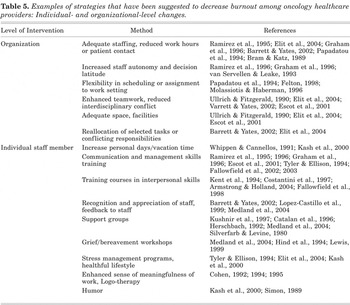
Thus far, very little work has focused on practical interventions to prevent or reduce burnout among oncology staff. There have been very few controlled studies. However, preliminary investigations and anecdotal reports may offer an initial foundation upon which to build (see Table 5). Most of these efforts have focused on addressing personal resources of staff members through communication skills training, emotional support, or stress management. We found no oncology studies that attempted the more challenging task of targeting systemic changes on a broader, organizational level (e.g., alterations in patient–staff ratios, scheduling flexibility, decision latitude, paper work reduction, team building).
Examples of strategies that have been suggested to decrease burnout among oncology healthcare providers: Individual- and organizational-level changes.

One area of concern that many writers have emphasized involves inadequate training in communication skills, particularly as related to breaking bad news, transitions in treatment, end-of-life care, and error disclosure (Armstrong & Holland, 2004). In response, a large and growing literature has emerged regarding communication skills training for oncology physicians and nurses, including a few controlled trials that have documented improvements in objective behavioral outcomes (i.e., observer ratings of actual communication skills; Fallowfield et al., 1998, 2002; Razavi et al., 2003; Wilkinson et al., 2003). In addition to enhancing clinician–patient communication, these programs tend to improve staff confidence and attitudes toward comprehensive care (Fallowfield et al., 1998; Jenkins & Fallowfield, 2002; Wilkinson et al., 2003); as yet, however, few studies have evaluated the potential benefits in terms of burnout or job satisfaction.
In a demonstration project, for example, Fallowfield et al. (1998) offered 1½- or 3-day residential courses to senior oncologists, and included workshops with role-playing in dealing with the angry patient, the depressed patient, and the apathetic patient, among other clinical concerns. Despite having to take time off from work and to pay for the program, most of these oncologists felt that the project was very helpful and that it improved their morale at work. Less than 35% had received any prior communication skills training. Before the course, oncologists expressed difficulty with 998 different issues, including providing complex information, obtaining informed consent, managing ethnic and cultural differences, and other things. After the course, 95% reported significant improvement in these concerns. These improvements were associated with positive shifts in attitudes toward patients' psychosocial needs and patient-centered care. In a subsequent randomized trial (Fallowfield et al., 2002, 2003) with 160 oncologists, a 3-day training course resulted in objective improvements in observer-rated communication skills (e.g., use of focused and open questions, empathy, appropriate responses to patient cues) for participants relative to controls. At 12-month follow-up, most of these gains were maintained, suggesting that participants had integrated the skills into their clinical practice (Fallowfield et al., 2003). The impact on staff burnout, stress, or turnover has yet to be scrutinized. Nevertheless, findings imply that a short course may make a meaningful difference for a long time.
A large number of anecdotal reports and reviews hint at other interventions that might be useful in some settings. Medland et al. (2004) suggested that demonstrating appreciation or acknowledgement of oncology nurses was critical in staff retention. They advocated “Circles of Care Retreats”—1-day workshops addressing the psychosocial health of nurses and others. Participants share their experiences, acknowledge vulnerability, sadness, and other emotional responses and provide mutual support. Another suggestion from this group was an adaptation of the management style FISH, in which play is facilitated as part of work, positive attitudes are promoted, supervisors express appreciation for their staff, and each one finds ways to “be there” for others (Lundin et al., 2000). They also advocated bereavement celebrations, a memory honor board to remember patients who have died, and bereavement cards for family. In addition they recommended support groups, stress management sessions, self-care behavior coaching, skill building in compassion, and individual counseling for those at high risk for burnout. In the broader literature, stress management workshops have demonstrated promise in preliminary, nonrandomized pilot work with residents (McCue & Sachs, 1991; Ospina-Kammerer & Figley, 2003). Other suggestions have included establishment of mentoring programs to guide junior staff, continuing education classes to bolster self-care and well-being, staff retreats to promote team-building, and sabbaticals based on productivity to enhance commitment and professional development (Spickard et al., 2002). Armstrong and Holland (2004) noted that staff also would benefit from additional training in alternative/complementary medicine and in spiritual aspects of death and dying.
Support groups have sometimes been deemed helpful for oncology health care workers, but much may depend on the structure and quality of the leader(s). In some settings, support groups may do more harm than good. For example, Silberfarb and Levine (1980) reported that nurses who completed 6 months of a psychodynamically oriented support group had more negative attitude shifts than nonrandomized oncology nurses who did not participate in the group. This could have been due to bringing out issues that stirred emotional turmoil without resolving them. However, in other preliminary, qualitative work, group interventions have been found to be helpful by teaching cognitive coping strategies to decrease stress and to improve professional self esteem (Kushnir et al., 1997).
Similarly, several investigators have suggested that grief/bereavement workshops for oncology health care givers may be useful (Hind et al., 1994; Lewis, 1999; Medland et al., 2004), though again sometimes negative effects have been noted, particularly among more experienced nurses (Hind et al., 1994). Nonetheless, the amount of grief that oncology staff holds is underestimated and underappreciated, and support services merit additional study. Other teams have drawn on “logotherapy,” first introduced by Victor Frankl (1963), to enhance participants' sense of purpose and meaning as a way of addressing the stressors and burdens of oncology care (Cohen & Sarter, 1992; Cohen et al., 1994; Cohen, 1995). Meaning can be derived from a religious or spiritual source or from recognizing that one's work makes a difference in patients' lives. (Knowing “why” we are at one place can often provide the wherewithal to discovering the “how”; Frankl, 1963.) Finally, humor has been proposed as an additional strategy to assuage miscommunication, stress, and depression (Simon, 1989; Kash et al., 2000). Humor however is often discouraged in oncology settings for fear that it may appear to mock patients' suffering.
DISCUSSION
Cancer is a psychologically and physically threatening disease. Health care providers empathize with their patients' losses and at times may feel a personal sense of failure or futility. In addition, working “on the edge” between life and death poses daily psychosocial challenges and forces one to become acutely aware of the fragility of life. At the same time, treatment approaches have become more complex and the health care system has undergone challenging transitions; thus the professionals who care for these patients are themselves at risk for psychosocial stress and burnout. Existing studies suggest that levels of work-related stress are high among oncology physicians and nurses, though not necessarily higher than among staff in other clinical settings. Investigations have begun to chart the scope of these difficulties and to delineate some of the organizational (e.g., high workload) and personal (e.g., poor coping) characteristics that contribute to risk. The subsequent impact of burnout on objective markers of productivity, absenteeism, turnover, and patient outcomes has yet to be clarified in the oncology setting, but findings in the broader literature are sobering. There is a need for longitudinal, multivariate studies to examine changes over time in levels of burnout and distress in various practice areas (e.g., medical oncology, radiotherapy, terminal care), to extend our understanding of risk factors, and to illuminate associated outcomes (e.g., endocrine or immune correlates, provider health status, staff turnover, quality of care indices).
Intervention research is at a much earlier phase of development. Little is known about effective intervention methods, either at the level of the individual provider (e.g., communication training, bereavement workshops, stress management training, career development) or at the organizational level (e.g., shifts in task allocation, autonomy, staffing, scheduling, managerial input). To date, none have been shown to help large numbers of distressed providers, nor have any preventive measures been demonstrably successful. There is clearly a need for additional model development regarding creative, innovative methods of preventing and/or treating burnout, promoting resilience, and increasing personal and professional fulfillment in caring for cancer patients. As the number of patients requiring care expands, the course of treatment for many malignancies becomes more chronic, and the pressures in the health care environment become more taxing, there will be an increasing need to address caregiver concerns.