Heterotaxy syndrome is a rare disease and occurs in just over 1 in 10,000 live births. The word heterotaxy is derived from the Greek: heteros – meaning other than; taxis – meaning arrangement. Heterotaxy, therefore, literally means a pattern of the anatomical organisation of the thoracic and the abdominal organs, which is not the expected usual or normal arrangement, also known as "situs solitus". Reference Jacobs, Anderson and Weinberg1 Although it has become traditional to use heterotaxy to describe patients who have neither the normal nor the mirror-imaged arrangement, controversy still exists. Some authors prefer that all arrangements other than situs solitus should be included in the spectrum of heterotaxy. Reference Zhu, Belmont and Ware2
Those having isomeric right atrial appendages frequently have bilaterally tri-lobed lungs, each with a short bronchus and absence of the spleen. Those having isomeric left atrial appendages frequently have bilaterally bi-lobed lungs, each with a long bronchus and multiple spleens. Nevertheless, in patients with heterotaxy, the anatomy of the atrial appendages does not always correspond with the bronchial arrangement, and the correlation of splenic anatomy with the atrial appendages is actually weaker than the bronchial counterpart. Hence, the absence or presence of multiple spleens is not always easy to document, even at autopsy. Reference Macartney, Stark and deLeval3 Immune system dysfunction is usually associated with right isomerism, but it may also present with left isomerism. Reference Seo, Brown, Ho and Anderson4 Thus, significant uncertainty and overlapping may occur during diagnosing heterotaxy syndrome.
Dextrocardia might be seen with situs inversus or with situs solitus, and the incidence of 1/30,000 live births and generally presents with the high occurrence of associated cardiac and/or extracardiac anomalies. Reference Seo, Brown, Ho and Anderson4 The incidence of Dextrocardia with situs solitus has been reported as 43.1% and 74% in recent studies among all patients with Dextrocardia. Reference Offen, Jackson, Canniffe, Choudhary and Celermajer5,Reference Tripathi and Ajit Kumar6
In this context, the term of cardiac and visceral laterality abnormalities may define a broader spectrum of congenital heart diseases, which constitute one of the most challenging surgical groups because of the high incidence of severe cardiac and non-cardiac anomalies. Many studies have been performed to compare the patients with right and left isomerism, whereas studies analysing all types of lateralisation anomalies are rare.
The aim of this study is to analyse the incidence, outcomes, associated anomalies, survival rates, and risk factors for mortality among various lateralisation anomalies.
Materials and methods
We retrospectively reviewed the patients' medical records, who underwent congenital cardiac surgery in our institute between July 2014 and July 2020. Among 1658 patients, we identified 64 patients (3.86%), which were defined as lateralisation anomalies according to the classification of Anderson et al. Reference Anderson and Shirali7 Patients were divided into four groups according to their dominant anatomic features: Situs Solitus with Dextrocardia (SSD) (n = 12; 18.75%), Situs Inversus (SI) (n = 16; 25%), Right Atrial Isomerism (RAI) (n = 29; 45.3%) and Left Atrial Isomerism (LAI) (n = 7; 10.9%). Thirty-five of the patients were male, and 29 were female (45.3%). Female dominance in LAI (85.7%) and male dominance in the RAI group (81.3%) were prominent. Gender distribution was balanced in other groups. At the time of the surgery, the median age was 5 weeks (0.5–168 weeks). The median body weight was 6.25 kg (2.35–47.7 kg).
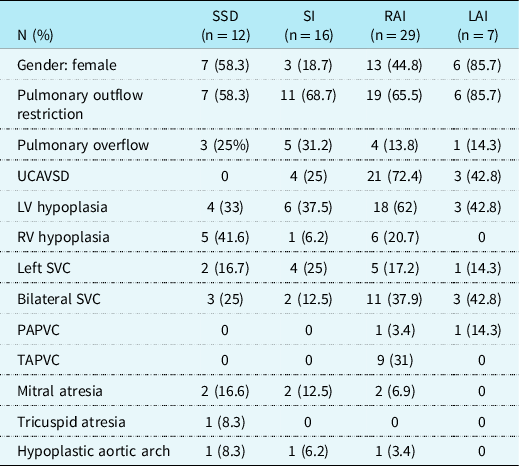
Associated cardiac anomalies in each group were presented in Table 1. RAI was mostly associated with unbalanced complete Atrioventricular Septal Defect (AVSD) (72.4%). Associated Total Anomalous of Pulmonary Venous Connection (TAPVC) was only present in the RAI group (31%). Incidence of mitral or tricuspid atresia was higher in the SSD group (25%) than in the other groups. Pulmonary outflow restriction was more prevalent than pulmonary overflow (67.2% vs. 20%, respectively) (p = 0.33) in all groups. Ventricular hypoplasia was present in 82.7% and 75% in the RAI and SSD group, respectively. Only 6.9 % (n = 2) patients had biventricular physiology in the RAI group and none in the SSD group. Biventricular physiology was present in 42.8% and 37.5% in LAI and SI groups, respectively.
Patient’s characteristics and pathologies

LV: Left Ventricle; PAPVC: Partial Anomalous of Pulmonary Venous Connection; RV: Right Ventricle; SVC: Superior Vena Cava; TAPVC: Total Anomalous of Pulmonary Venous Connection; UCAVSD: Unbalanced Complete Atrio-ventricular Septal Defect.
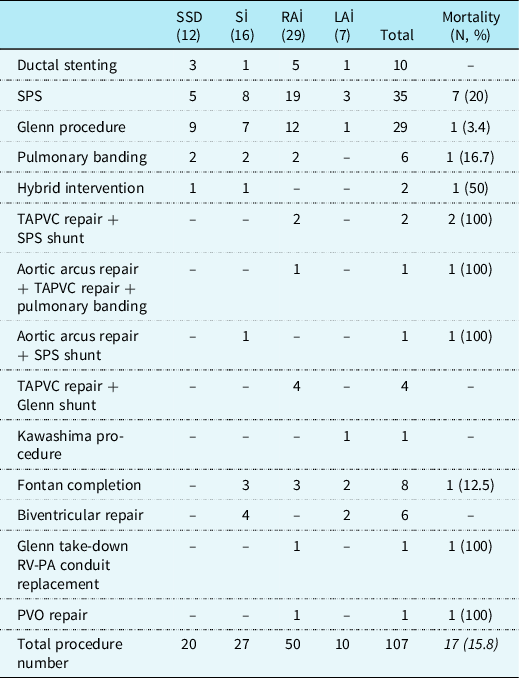
A total of 107 procedures were performed in 64 patients (Table 2). Eleven of the patients had primary intervention in another centre. Fifty-two procedures were performed during the neonatal period. All neonatal procedures except ductal stenting, which was performed in the cardiac catheterisation laboratory, were performed with median sternotomy. Cardiopulmonary bypass was used only when necessary during shunt operations. In patients with ductus-dependent pulmonary circulation, the arterial duct was encircled with silk ligatures and banded using a ligaclip. Reference Onan and Erek8 Bilateral banding was performed first, and ductal stenting was performed a few days later in the cardiac catheterisation laboratory in patients who had hybrid procedure. Modified Fontan operations were performed with extracardiac conduit (20 mm PTFE graft) and routine 4 mm fenestration. Nine patients underwent definitive Fontan or Kawashima operations. Biventricular repair was performed in six patients.
Procedures and mortalities

SPS: Systemic-to-Pulmonary Shunt, PVO: Pulmonary Venous Obstruction, TAPVC: Total Pulmonary Venous Connection.
Italic represents significant of P values.
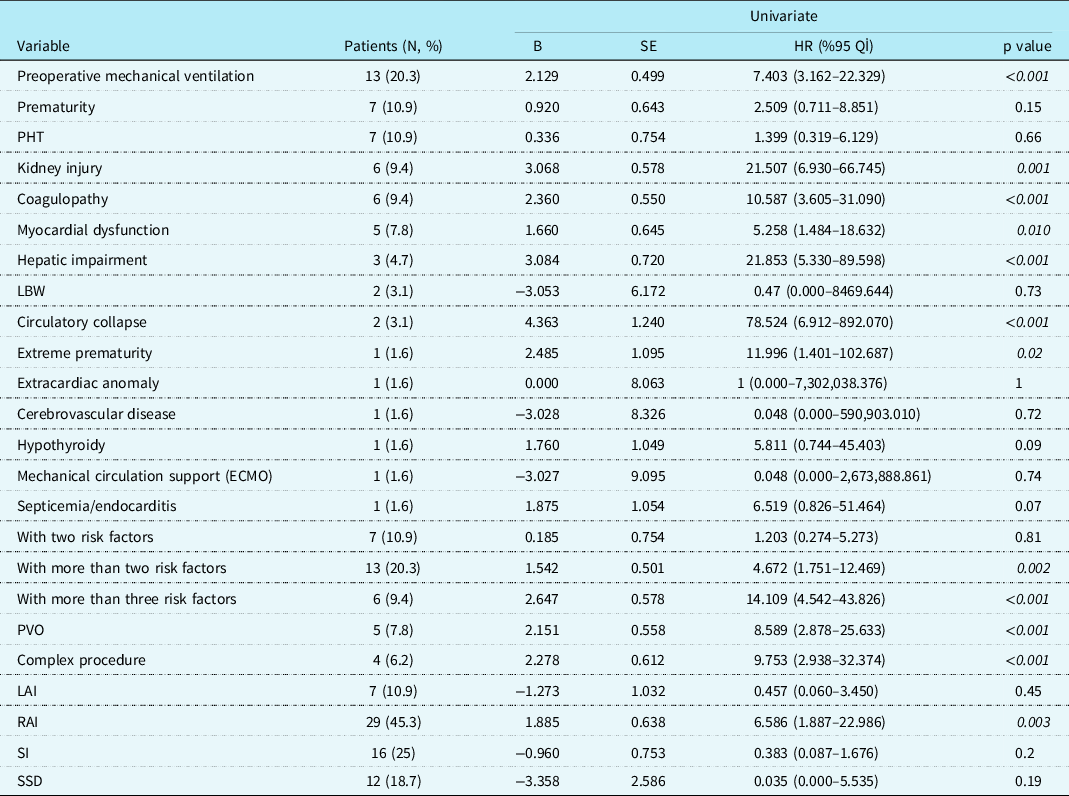
Hospital mortality was defined as death before discharge or death within one month from surgery. Patient-dependent and patient un-dependent preoperative risk factors were evaluated using the Cox regression model. Preoperative mechanical ventilation was the most prevalent risk factor (20.3%).
Follow-up was complete for all patients. Patients who did not come to regular hospital visits were contacted by phone to complete their follow-up records. This study was approved by the institutional ethics committee (ATADEK 2020-23/09).
Statistical analysis
In the study, the distribution of variables was classified, and descriptive results were obtained using SPSS version 15 (Statistical Package for the Social Sciences for Windows) program. The normality of data was analysed using Kolmogorov–Smirnov. Continuous variables are presented as mean ± SD, median with range, and categoric variables presented as frequencies and percentages of the total. Continuous variables were compared using Kruskal–Wallis and significant results were compared using Post Hoc tests. Categorical variables were compared using the Chi-square test. Overall survival analyses of the groups were evaluated with Kaplan–Meier curves, and differences were tested with a log-rank test. A statistically significant difference was accepted with a p-value of <0.05. The effects of covariates on the possibility of mortality in univariate and multivariate analysis are reported as hazard ratios with the 95% confidence interval using Cox proportional hazards regression.
Results
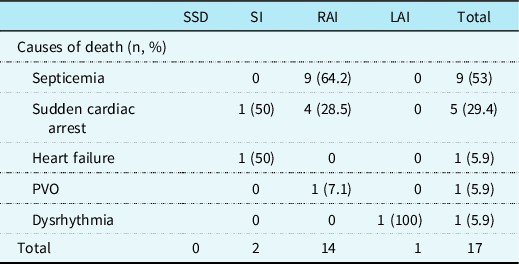
Early postoperative mortality was 17 patients, among 107 procedures (15.8%). Twelve patients were in the neonatal period. Seven of them died after systemic to pulmonary shunt operations (20%). One of the two patients who underwent hybrid procedure died (50%). All four patients who underwent complex neonatal surgery (associated TAPVC or aortic arch repair) died (100%). Causes of deaths were presented in Table 3. All ten patients survived after isolated ductal stenting, but procedural complication during ductal stenting (cardiac arrest) was a cause of death in one patient who had the hybrid procedure. One patient who had poor preoperative condition died after pulmonary banding (16.7%). Mortality rate was 3.4% (n = 1) after Glenn operations. All four patients who underwent associated TAPVC repair during Glenn operations survived. No mortality was observed after biventricular repairs or Kawashima operation. One patient died after Fontan completion (12.5%). This patient had a Kawashima operation in another centre. Deep cyanosis and multiple pulmonary arterio-venous collaterals were present. He died after hepatic vein redirection because of septicemia and multiple organ failure. One patient who had recurrent severe pulmonary vein stenosis after TAPVC repair died of pulmonary hypertension crisis. The last patient had superior vena cava syndrome after Glenn operation. Although Glenn take-down and RV-PA conduit (Sano modification) placement were performed successfully, the patient died of cardiac arrest in the early postoperative period.
Causes of mortalities in the early postoperative period

PVO: Pulmonary Venous Obstruction.
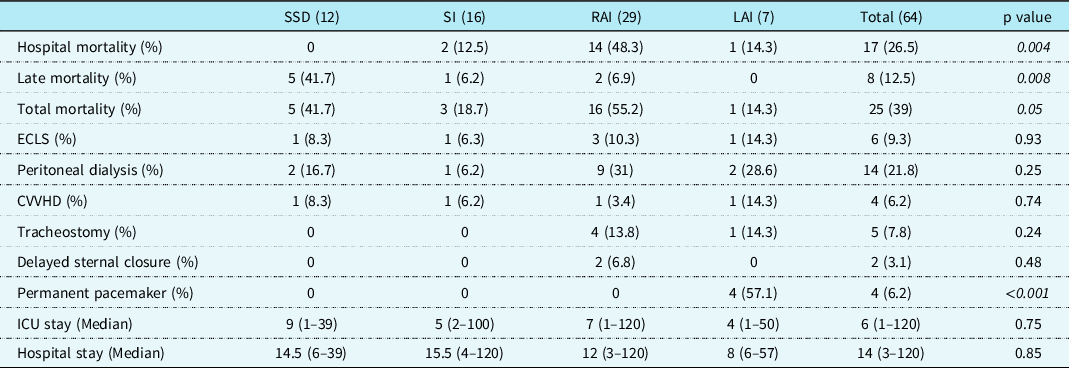
No hospital mortality had seen in the SSD group. Hospital mortality rates were 12.5% (n = 2) in SI, 14.3% (n = 1) in LAI and 48.3% (n = 14) in RAI group. It was statistically significant between the groups (p = 0.004). Median ICU and hospital stays were 6 days (1–120 days) and 14 days (3–120 days), respectively. They were not statistically different between the groups.
ECMO support was applied in six patients because of ECPR (n = 4), low cardiac output (n = 1), and failure to wean from CPB (n = 1). Although one of them was weaned from ECMO support, all died of multiorgan failure. Renal replacement therapy (peritoneal dialysis n = 14; continue veno-venous hemofiltration n = 4) needed in 18 patients (28.1%). Permanent pacemaker implantation was performed in four patients (6.2%). All of them were in the LAI group (p < 0.001). Postoperative complications were presented in Table 4.
Postoperative complications

CVVHD: Continuous veno-venous hemodiafiltration; ECLS: Extracorporeal Life Support; ICU: Intensive Care Unit.
Italic represents significant of P values.
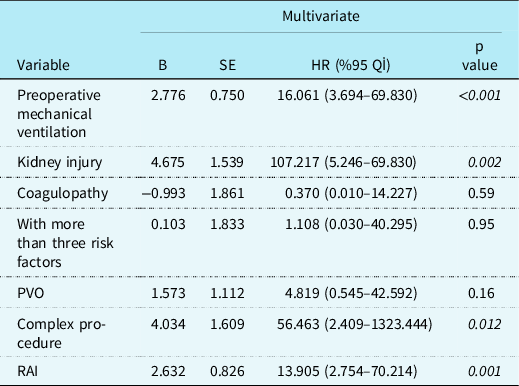
We analysed the preoperative risk factors, Pulmonary Venous Obstruction (PVO) repair, complex procedure, and patients’ groups on the possibility of early mortality by univariate analysis and were presented in Table 5. Preoperative mechanical ventilation, kidney injury, coagulopathy, myocardial dysfunction, hepatic impairment, circulatory collapse, and extreme prematurity were statistically significant in the univariate analysis as preoperative risk factors. The mortality rate was 53.8% and 83.3% in patients with more than two preoperative risk factors and more than three preoperative risk factors, respectively. Having more than two and three preoperative risk factors were also found to be independent risk factors on early mortality (p = 0.002, HR 4.672 and 1.751–12.469 %95 CI; p < 0.001, HR 14.109 and 4.542–43.826 %95 CI, respectively). PVO repair and complex procedures in the neonatal period were independent risk factors on early mortality with the HR 8.589 and 9.753, respectively. RAI was also statistically significant in univariate analysis (p = 0.003, HR 6.586 and 1.887–22.986 %95 CI). The statistically significant variables were preoperative mechanical ventilation, kidney injury, complex procedure, and RAI in multivariate analysis. Details were presented in Table 6.
Predictors of the early mortality by univariate analysis

CI: confidence interval; HR: Hazard ratio; LBW: Low Birth Weight; PHT: Pulmonary Hypertension; PVO: Pulmonary Venous Obstruction; SE: Standard error.
Italic represents significant of P values.
Predictors of early mortality by multivariate analysis

CI: confidence interval; HR: Hazard ratio; PVO: Pulmonary Venous Obstruction; SE: Standard error.
Italic represents significant of P values.
A total of eight patients died during the follow-up period. Surprisingly, the SSD group, which had no early postoperative mortality, had a statistically higher follow-up mortality rate than other groups (p = 0.008). No late mortality had seen in the LAI group. Late mortality rates were 41.7% (n = 5) in SSD, 6.2% (n = 1) in SI and 6.9% (n = 2) in RAI group. Four patients, who had shunt-dependent pulmonary circulation, died suddenly at home 5 to 15 months after shunt operations, probably due to shunt thrombosis. One patient died 5 months after a pulmonary banding operation. Other three patients who had successful Glenn procedures died 8, 24, and 45 months after the procedures due to pneumonia and/or sepsis.
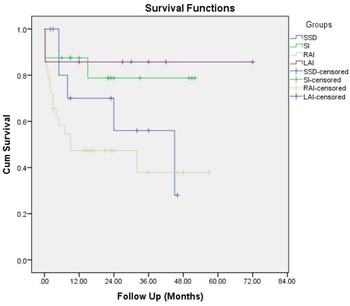
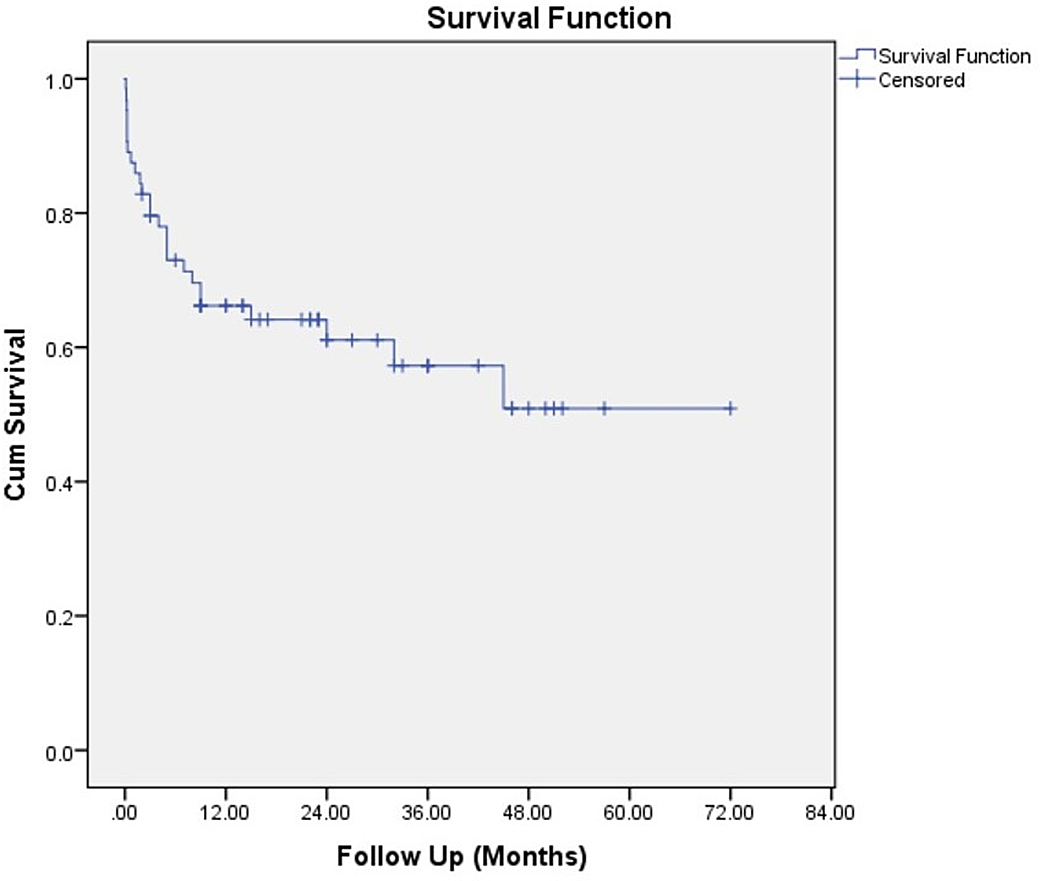
The estimated survival time was 42.86 ± 4.49 months for the total cohort. The 1- and 5-year survival rates were 73.4 and 50%, respectively. The 3-year survival rates were 85% in LAI, 78.7% in SI, 55.8% in SSD, and 38% in RAI groups. The p-value of the log-rank test for cumulative survival for groups was 0.054. Survival plots for groups and total cohort were presented in Figures 1 and 2.
Kaplan–Meier curve of cumulative survival for each group (log-rank: p = 0.054).

Kaplan-Meier curve of cumulative survival for the total cohort.

Discussion
In this study, we analysed the outcomes of 64 patients with abnormal laterality. Most of the patients were in the RAI group, and they had the worst outcome. The early mortality rate was 26.5% in the total cohort, while the RAI mortality rate was 48.3%. RAI was mostly associated with Unbalanced CAVSD and TAPVC. None of the patients with RAI and SSD were suitable for biventricular repair. Biventricular repair could be performed in four patients in group SI (25%) and two (28.6%) patients in LAI. Nine out of 17 deaths were due to infectious complications in the early postoperative period, and all of them were in the RAI group. According to our multivariable Cox regression model, preoperative mechanical ventilation, kidney injury, being RAI, and complex procedures in the neonatal period were independent risk factors for early mortality.
We could not find a study comparing these four types of laterality anomalies. Most studies compared heterotaxy patients as RAI, LAI, and situs inversus. Whereas a respectable number of patients included in heterotaxy syndrome are SSD. A few of the patients with SSD have normal atrioventricular and ventriculoarterial connections. Tripathi et al reported a study, which was including 378 patients with Dextrocardia. Situs solitus was present in 43.1%, and SI was present in 38.1%. Only 3.7% of SSD patients had normal morphological characteristics. Reference Tripathi and Ajit Kumar6 Fesslova et al reported a study including 1508 fetuses with congenital heart disease. There were 94 (6.3%) patients with abnormal visceroatrial situs. SSD was present in 39.1% of these patients. Reference Fesslova, Pluchinotta and Brankovic9 The main morphological characteristics are ventriculoarterial discordant with pulmonary flow restrictions in SSD. Mitral or tricuspid atresia and one of the hypoplasia of ventricles are associated in a part of patients. Most of the SSD patients are undergoing the Fontan pathway because of the accompanying complex cardiac anomalies. Considering the majority of SSD patients among Heterotaxy patients, we believe that SSD patients should not be underestimated. Some studies compared patients in the Fontan pathway as heterotaxy syndrome and non-heterotaxy. Patients with heterotaxy syndrome mostly have univentricular physiology, and it is not clear that being heterotaxy is a risk factor in the Fontan pathway. Several studies reported that heterotaxy is a risk factor for poor long-term outcomes after Fontan. Reference d'Udekem, Xu and Galati10,Reference Pundi, Johnson and Dearani11 In contrast, some studies reported that heterotaxy is not a risk factor. Reference Kim, Kim, Lim, Lee and Lee12–Reference Marathe, Zannino and Cao14 Marathe and colleagues recently published a meta-analysis of 848 patients, including 21 studies. They reported that even in the early period after the Fontan procedure, mortality is high, long-term survival after a successful Fontan operation is comparable to that of the overall Fontan cohort. Therefore, heterotaxy should not be considered a significant risk factor for late mortality after its successful Fontan operation. Reference Marathe, Zannino and Cao14 Although this study does not compare patients as heterotaxy and non-heterotaxy, we found that mortality rates were high in heterotaxy patients, especially in RAI and SSD groups (55.2% and 41.7%, respectively). There was no hospital mortality in the SSD group, but all deaths were in the follow-up period. LAI had excellent surgical results comparing other groups. Only one (14.3%) patient died after surgery. This patient had surgery under poor preoperative condition. She was an extremely premature baby (<32 weeks) and mechanically ventilated. Also, she has kidney failure, coagulopathy, receiving inotropes because of myocardial dysfunction, and AV block with temporary pacemaker support (preoperative risk score: 5). She died after a systemic-pulmonary shunt operation.
Surgical results were also satisfying in the SI group, and the mortality rate was 18.7% (n = 3). Both two hospital deaths were preoperatively poor condition, and preoperative risk scores were 5 and 7 points. Only one patient died during the follow-up period, probably because of shunt thrombosis causing sudden cardiac death. This patient had a second mBT shunt because of thrombosis of the first one. Except for these patients who had poor preoperative conditions, the results in the SI and LAI groups were excellent. The 3-year survival rates were 85% in LAI and 78.7% in the SI group.
Chen et al reported a study which was comparing 42 Heterotaxy patients as RAI and LAI. They found that the 3- and 5-year survival rates were 79.9% for LAI and 70.8 ± 5.8 for RAI. Reference Chen, Ma and Cui15 This may be because some proportion of patients had biventricular repair in LAI (28.5%) and SI (25%). As Hashmi et al mentioned before in their study, a high biventricular repair rate in LAI may explain the improved results compared with patients with right isomerism. Reference Hashmi, Abu-Sulaiman, McCrindle, Smallhorn, Williams and Freedom16 As far as we know, the most comprehensive study with biventricular repair in heterotaxy patients is that of Lim et al. They reported that 371 patients received a diagnosis of heterotaxy syndrome, and 91 patients underwent biventricular repair. LAI was present in 73% (66/91) and RAI in 10% (9/91), with undetermined atrial anatomy in 17% (16/91). They did not indicate the biventricular repair prevalence for each type of isomerism, but survival rates and functional capacity of survivors in the biventricular repair group were better than those who underwent single ventricle palliation in heterotaxy patients. The estimated survival was 93.4 ± 3.2 % at 15 years for the biventricular repair group. Reference Lim, Bacha and Marx17 We could perform biventricular repair in six patients, and all of them were alive with a median follow-up time of 25.5 (range 9–72) months.
Dextrocardia is a rare cardiac anomaly, and there is not enough study in patients undergoing cardiac surgery. Poh et al reported a study of 41 patients (19 patients with isomerism and 22 patients without isomerism) with Dextrocardia. Except for one patient who underwent the Mustard operation, single ventricle palliation was applied to all patients. They reported that overall survival to 15 years of age was 56%. Mortality rates were 58% in isomerism and 27% in the non-isomerism groups. Reference Poh, Xu and Galati18 In our study, we identified 12 out of 64 patients as Dextrocardia without isomerism (SSD). All SSD patients underwent single ventricle repair, and the mortality rate was 41% (5 out of 12). All five patients died during the follow-up period. Bhaskar et al have reported a study comparing heterotaxy patients as RAI and LAI. They found that the presence of Dextrocardia is an independent risk factor for mortality (p = 0.009; HR = 3.0; 95% CI 1.3–6.7). Reference Bhaskar, Galati and Brooks19 Dextrocardia with isomerism is mostly associated with the common AV valve. According to Poh and Bhaskar, the technical difficulty of achieving a sustainable AV valve repair in these patients contributed to their mortality. Although dextrocardia patients without isomerism are not often accompanied with common AV valve, mortality remains high. Poh et al. indicated that dextrocardia patients with bilateral BCPS have better survival. This may explain the high mortality rates of SSD patients during follow-up.
Seventeen out of 64 (26.5%) patients died early postoperative period. Fourteen of these patients were in the RAI group. Pulmonary venous return anomalies are mostly associated with RAI. In our cohort, all nine patients with TAPVC were in the RAI group. TAPVC is associated with high mortality rates and poor outcomes, especially in the neonatal period. Reference Chen, Ma and Cui15,Reference Khan, Bryant and Kim20–Reference McGovern, Kelleher and Potts23 All three patients died after TAPVC repair in the neonatal period. Another patient with pulmonary venous obstruction died after surgery in the infantile period. Chen et al reported that pulmonary venous obstruction is a significant risk factor for mortality by univariate and multivariate analysis; p-values were 0.001 and 0.005, respectively. Reference Chen, Ma and Cui15 In our study, we found that PVO repair is a statistically significant risk factor in univariate analysis (p < 0.001; HR = 8.589; 95% CI 2.878–25.633). In multivariate analysis, it was not statistically significant. In our study, we found that being RAI was an independent risk factor in both univariate and multivariate analyses. In the multivariate analysis, we found that RAI is an independent risk factor with the 6.586 HR and the p-value of 0.003. Many studies reported that being RAI is associated with high mortality and poor survival. Reference Chen, Ma and Cui15,Reference Bhaskar, Galati and Brooks19,Reference Alongi, Kirklin and Deng22,Reference Banka, Adar, Schaetzle, Sleeper, Emani and Geva24 Banka et al reported a study that compare Heterotaxy patients as asplenia and polysplenia. They found that asplenia phenotype is an independent risk factor by multivariable Cox regression model with the 1.78 HR and p-value of 0.002. Reference Banka, Adar, Schaetzle, Sleeper, Emani and Geva24 Similar to previous studies, RAI, especially when associated with TAPVC, had the worst prognosis.
Many authors have reported that mortality rates are high in the neonatal period. Reference Chen, Ma and Cui15,Reference Khan, Bryant and Kim20,Reference Chen, Guariento and Chen25 In our study, 12 out of 17 hospital mortalities were in the neonatal period. As we mentioned before, performing pulmonary venous connection repair carries a high risk of death. According to our experience, if possible, complex procedures such as aortic arch repair and anomalous pulmonary venous return repair should be postponed after the neonatal period. Ductal stenting and hybrid approach should be considered instead of complex surgeries during the neonatal period. We performed ten ductal stenting with no mortality. Also, we performed hybrid procedures for two patients. One of the hybrid patients died because of complications of ductal stenting. Patients with pulmonary stenosis who did not require intervention in the neonatal period had excellent surgical results after the Glenn procedure even though they had TAPVC repair.
Because of the nature of Heterotaxy Syndrome, patients are more prone to respiratory complications. Our results showed that mortality rates were high due to infectious complications in heterotaxy patients, especially in RAI. Nine out of 17 deaths (53%) were because of infection and respiratory complications. Swisher et al reported a study comparing 87 heterotaxy patients and 634 cardiac surgical patients with congenital heart disease without laterality defects. They found the mean length of postoperative hospital stay (17 vs. 11 days) and mechanical ventilation (11 vs. 4 days) were significantly high in heterotaxy patients. They reported that prolonged ventilatory courses (23% vs. 12.3%; odds ratio, 2.1) and the need for tracheostomy (6.9% vs. 1.6%; odds ratio, 4.6) were significantly higher in heterotaxy patients than the others. Reference Swisher, Jonas, Tian, Lee, Lo and Leatherbury26
This study has several limitations. This is a retrospective single-centre study with the limited number of patients. Heterogeneity of the pathologies and procedures may influence the statistical inference.
Conclusion
Laterality anomalies are one of the most challenging patients who commonly had univentricular physiology. The most prevalent of them was RAI, and patients with RAI had the worst outcome and survival. Care should be taken in terms of pulmonary and infectious complications in the postoperative period. Biventricular repair should be considered in suitable patients. Patients with Dextrocardia and RAI need close follow-up to avoid casualties. Ductal stent and hybrid approaches are acceptable first interventions during the neonatal period in suitable patients. Complex procedures carry a high risk of death in the neonatal period. Therefore, TAPVC repair should be postponed after the neonatal period if possible.
Acknowledgements
None.
Financial support
This research received no specific grant from any funding agency, commercial or not-for-profit sectors.
Conflicts of interest
None.
Ethical standards
The authors assert that all procedures contributing to this work comply with the ethical standards of the relevant national guidelines on human experimentation and with the Helsinki Declaration of 1975, as revised in 2008, and have been approved by the institutional committees. The authors assert that all procedures contributing to this work comply with the ethical standards of the relevant national guides on the care and have been approved by the institutional committee.