INTRODUCTION
Pre-European contact ceramics from the Northeast culture area of North America are important chronological markers that continue to be one of the main means to date other artifacts, features, and entire sites by association. In the Maine–Maritimes Region, ceramics are most commonly dated using the sequence developed by Petersen and Sanger (Reference Petersen, Sanger, Deal and Blair1991); however, the sequence has not been significantly revised or updated since the 1990s. Periods defined in the sequence remain coarse-grained, each spanning from 300 to 800 years, making for imprecision when using the sequence to date ceramics. These large periods have contributed to an impression that ceramics did not change very much through time except superficially; however, a careful examination of some of the region’s large ceramic assemblages shows that ceramics changed technologically as well as decoratively and, more significantly, that they changed together with other cultural phenomena at specific times across a large region. This suggests that potters were interacting with each other and influencing each other’s practices, a phenomenon that deserves much greater attention than it has received thus far.
Significantly more can be learned about ceramics in this region by refining our understanding of the evolution of ceramic manufacturing techniques using site-specific, fine-resolution chronologies to determine the degree to which potters in different locations influenced each other, and hence, identified with common ideas and beliefs. This paper presents the largest directly dated and continuous ceramic sequence from a single site—the Gaspereau Lake Reservoir (GLR) Site Complex—from the Maine–Maritimes Region as part of a ceramic study of technological change at Gaspereau Lake (Woolsey Reference Woolsey2017). A representative sample of 10 ceramics were selected for accelerator mass spectrometry (AMS) dating of carbonized foodstuffs on their interiors. The objectives of this study were (1) to build a fine-resolution AMS sequence, (2) to identify and then delineate the changes in ceramics through time using the dated sequence to build a more detailed chronology, and (3) to propose an explanation for these changes through time. The proposed sequence is intended to be refined by other researchers and compared to ceramic sequences in adjacent regions in future work.
BACKGROUND
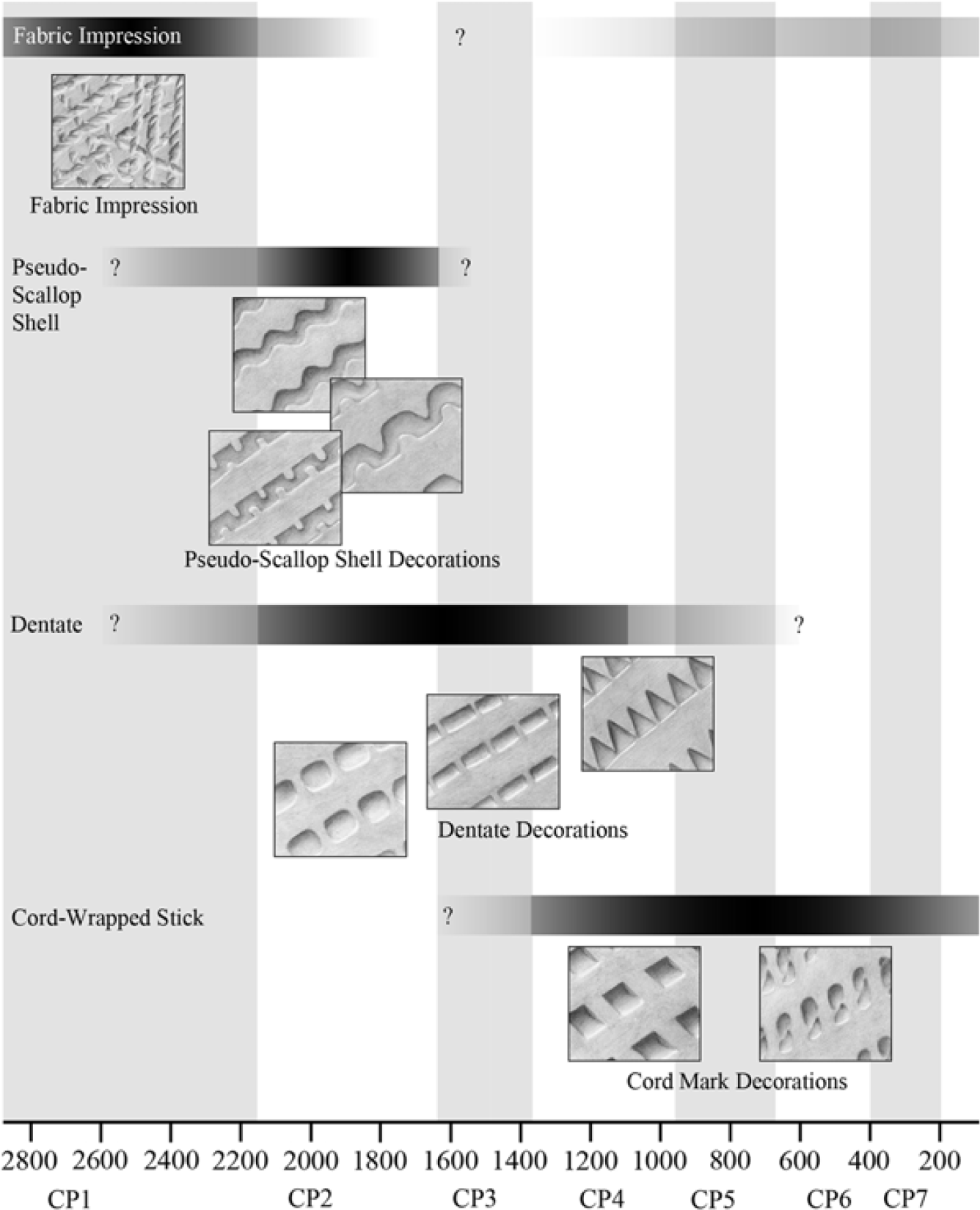
Petersen and Sanger’s (Reference Petersen, Sanger, Deal and Blair1991) ceramic sequence (summarized in Figure 1 and Supplementary Table S1) has become the main means by which ceramics in this region are dated. Radiocarbon dating tends to be reserved for features and layers, while ceramics are used as a supporting line of evidence. For example, Leonard (Reference Leonard2002:7), assessing time periods of site layers in northeastern New Brunswick, wrote that “Pottery … bearing impressions made with a cord-wrapped stick [is] typical of the Late Woodland period, from about A.D. 1000 to 1450 (Petersen and Sanger Reference Petersen, Sanger, Deal and Blair1991).” Hrynick and Betts (Reference Hrynick and Betts2017:7), suggesting the time period for a house floor in southern Nova Scotia, wrote that “This feature yielded cord-wrapped stick pottery, suggesting a Late Maritime Woodland Period occupation (Petersen and Sanger Reference Petersen, Sanger, Deal and Blair1991).” In both cases, the radiocarbon dates were acquired on stratigraphic context (charcoal), with ceramics used to support the evidence from the dates. Unfortunately, the sequence has not been significantly updated in nearly three decades, despite attempts at subregional refinements. Directly dating ceramics is rare since ceramics are themselves thought to indicate date ranges. As a result, the seven “ceramic periods” (or CPs) originally proposed by Petersen and Sanger spanning the Woodland period (3000–500 BP) have remained mostly unchanged with the exception of Bourgeois’ (Reference Bourgeois1999) proposal of two subperiods for CP2 (2150–1650 BP) in the St. John River Valley of New Brunswick and Godfrey-Smith et al.’s (Reference Godfrey-Smith, Deal and Kunelius1997) sequence of directly dated ceramics from the St. Croix River using thermoluminescence dating, neither of which has significantly impacted how ceramics are classified chronologically in this region.
Summary of the Petersen and Sanger ceramic sequence (Reference Petersen, Sanger, Deal and Blair1991). CP = Ceramic Period. CWS = Cord-Wrapped Stick (decoration).

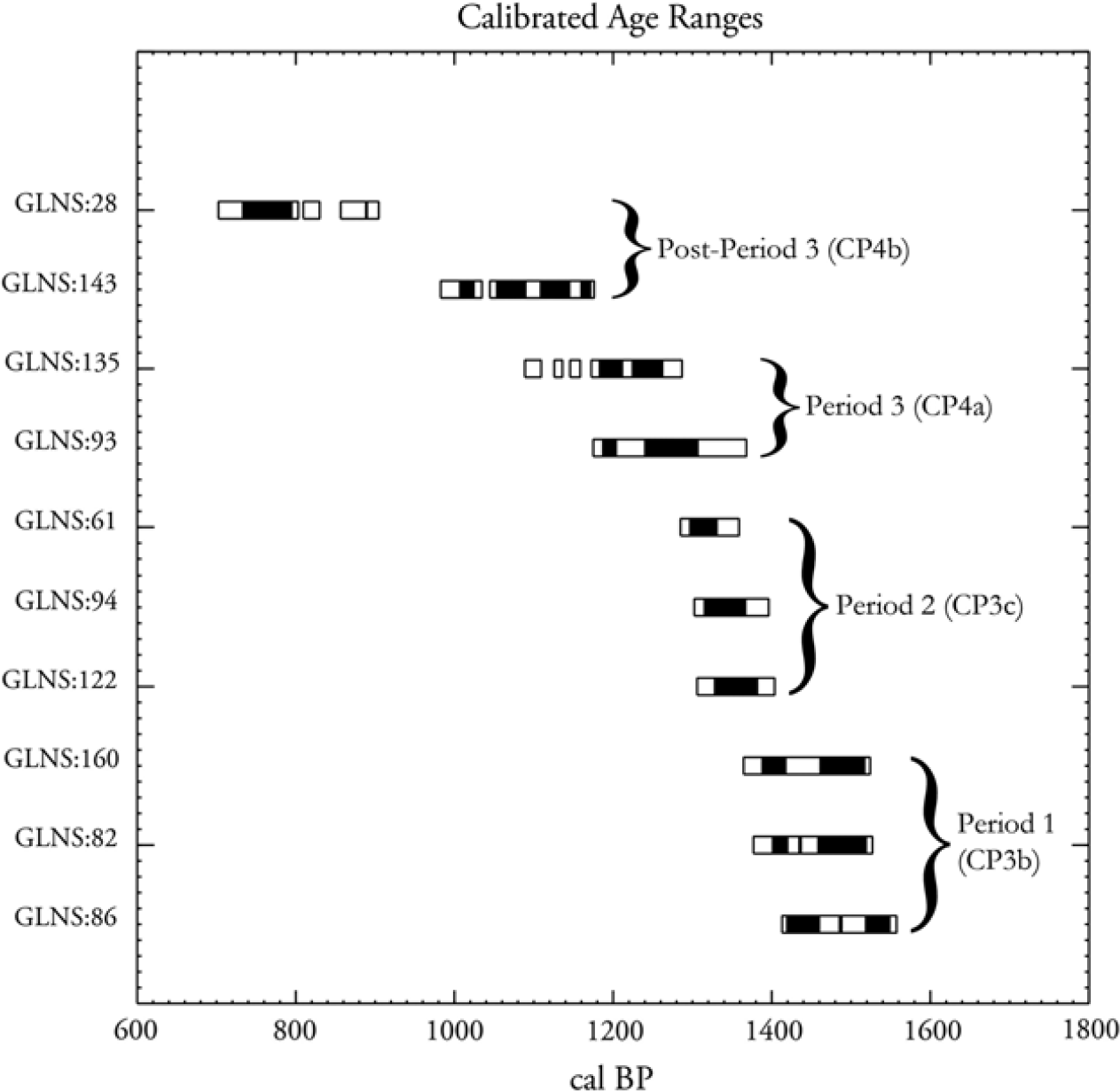
Calibrated dates showing probability distributions for each age range at the 1- and 2-σ range, following Stuiver et al. (Reference Stuiver, Reimer and Reimer2005).*

* Most of the ceramics dated come from units with high ceramic density and these units received a large amount of analysis that took into account stratigraphic context, relationships (if any) to other ceramics (classification confidence), and compositional analysis. The ceramics with the two last dates did not have enough context to be able to confidently place them in a classification system nor to suggest their depositional history. In the case of #143, the surface decorations, paste type, and forming attributes were obscured by charring, making it impossible to suggest whether it belonged in an existing class. In the case of #28, the sherd came from another part of the site with much lower ceramic density and that had received much less analysis; therefore, it could not be classed with any confidence. CM = Cord-Marked. CWS = Cord-Wrapped Stick.
Since heterogeneity of ceramic attributes is high in this region, it is important to find the most appropriate means of identifying chronologically significant attributes. Doing so requires a two-pronged approach: first, direct dating of ceramics is necessary to develop a high-resolution sequence of absolute dates, and second, a large range of attributes must be studied across a large assemblage to create a fine-grained understanding of clustering attributes (i.e., groups, types, or classes). In this study, I developed a high-resolution dataset of ceramic attributes from the Gaspereau Lake Reservoir (GLR) assemblage and acquired 10 AMS dates directly from ceramics (Table 1) to identify chronologically significant attributes and attribute clustersFootnote 1 using both statistics and qualitative classification techniques. Elsewhere, I demonstrated a statistical method using manufacturing attributes to build a classification (Woolsey Reference Woolsey2018). This was done both to build a chronological model for comparison with other sites and to develop a picture of how and why ceramics changed through time. For a full discussion of methods, see Woolsey (Reference Woolsey2017).
The Maine–Maritimes Region
The Maine–Maritimes Region is situated on the east coast of Canada between the Arctic regions of northern Quebec, Labrador, and Newfoundland and the more southerly New England coast. The region is a highly productive ecotone on the Atlantic Ocean intersected by hilly and mountainous boreal forest, macro-tidal bays and large river systems, and high-energy coastal weather systems (Sanger Reference Sanger1988:83–84). It has been occupied since at least ca. 11,000 BP and in some places as early as 13,600 BP (Suttie et al. Reference Suttie, Hamilton, Nicholas, Jarratt and McGrath2017), with Paleoindian occupation of the area apparent from several large sites in Nova Scotia (Bernard et al. Reference Bernard, Rosenmeier and Farrell2011; Ellis Reference Ellis2004) and Maine (Spiess et al. Reference Spiess, Bradley and Wilson1998). Material culture throughout the Holocene shows that occupants of the area tended to be heavily focused on marine resources, but also on terrestrial lifeways to varying extents through time (Sanger Reference Sanger1988:81–83). Later on, during the the Archaic Period (6000–3000 BP), mobile hunter-gatherers lived in small bands and had distinctive mortuary practices, including covering the dead with red ochre, as well as a suite of distinctive material culture evolved for harvesting marine resources including bone toggling harpoons, ground-slate knives, and ground-stone bayonets (Tuck Reference Tuck1975; Bourque Reference Bourque2001).
After ca. 3000 BP, the Maine–Maritimes Region saw several changes that ushered in the Woodland Period (3000–500 BP), the most widely cited being the use of pottery (Rutherford Reference Rutherford, Deal and Blair1991). Horticulture became prevalent in other parts of the Northeast Region of North America, but no evidence has been found in the Maine–Maritimes Region (Bourque Reference Bourque2001), although participation in Woodland-Period interaction spheres, most notably the Adena cultural complex (3000–2100 BP) in New Brunswick and Nova Scotia, is clearly evident (Taché Reference Taché2011). During the Woodland Period, subsistence practices shifted away from large marine animals to shellfish, anadromous and catadromous fish, terrestrial mammals, migratory birds, and a wide range of terrestrial and riverine plants. Unlike in other parts of the Northeast, permanent settlement or palisaded villages do not appear to have been part of the cultural complex in this region. The Protohistoric and Historic periods (500 BP to present) saw dramatic change and much of the traditional culture from the Woodland Period being lost, one of which was pottery manufacture.
The advent of pottery in the Maine–Maritimes Region has interested researchers because of the somewhat atypical conditions in which this pottery tradition arose. Pottery is usually considered most likely to arise in the context of horticulture or agriculture, full sedentism, or the need to intensify nutrient extraction from existing resources (Barnett and Hoopes Reference Barnett and Hoopes1995). None of these conditions existed in the highly productive Maine–Maritimes Region, leading researchers to speculate on the need or desire for pottery in this region (e.g., Foulkes Reference Foulkes1981). Aside from “diffusion,” no rigorous explanation has been convincingly proposed.
Pottery has typically represented a fairly small portion of material culture yielded by Woodland-Period sites. Prior to 2010, the largest known pottery assemblages in New Brunswick came from the Oxbow site, which yielded ca. 4000 pottery sherds (Allen Reference Allen1980), while in Nova Scotia the largest assemblage came from the L’sitkuk Bear River site, which yielded ca. 2800 sherds (Stapelfeldt Reference Stapelfeldt2009), and in Maine from the Goddard site, which yielded ca. 10,000 sherds.Footnote 2 Sites typically contain at most a small number of sherds from the Early Woodland period (3000–2100 BP),Footnote 3 then a sudden increase in pottery from the Middle Woodland Period (2100–1300 BP), and equal or fewer pottery sherds from the Late Woodland Period (1300–500 BP). Besides this chronological distribution, change is also evident in the ceramics themselves. Early Woodland pottery exhibits coarse pastes and fabric-impressed (undecorated) surfaces during the Early Woodland, later changing to thin, hard-bodied, often fine-tempered vessels with decorated surfaces during the Middle Woodland. Middle Woodland decorations are of two main varieties: “pseudo-scallop shell,” which has been associated with the period between 2150 and 1650 BP, and dentate decorations, which have been found between 2500 and 1000 BP (Figure 2). Pottery changed again during the Late Woodland to more coarse pastes, more frequent coil breaks, and thicker walls. Late Woodland pottery was decorated predominantly with cord marks (Figure 2). These changes have been observed across the region but also connect with changes in the larger Northeast and even further abroad, indicating stylistic ties with regions to the south, west, and north. More importantly, these broad changes at specific times across broad areas of North America indicate responses to conditions not necessarily arising from pottery manufacture, such as changing subsistence strategies, kinship relations, or economic activities.
Chronological significance of decorative tool types throughout the Woodland Period. Shown are some typical variations of tool impressions.

The Petersen and Sanger Sequence
Seven periods (based on uncalibrated dates) were defined by Petersen and Sanger, the first (CP1) more-or-less corresponding to the Early Woodland Period (3000–2150 BP) and the last corresponding roughly with the Historic Period (after ca. 500 years ago). CP 1 is characterized by small (ca. 4 ltr), fabric-impressed, conoidal-shaped vessels with no decorations except in rare instances. This kind of vessel is seen across the broader Northeast Region and beyond, first defined and dubbed “Vinette 1” by Ritchie and MacNeish (Reference Ritchie and MacNeish1949); its highly visible horizon style during the Early Woodland and association with the Adena and Meadowood/Middlesex interaction spheres and exchange networks suggests an export of a suite of ideas and technologies (Petersen Reference Petersen1988; Petersen and Hamilton Reference Petersen and Hamilton1984; Taché and Hart Reference Taché and Hart2013). Unlike in areas to the west and south, CP1 ceramics are relatively rare.
CP2 (2150–1650 BP) represents a dramatic shift from CP1. Ceramics of CP2 are thin, hard-bodied, elaborately decorated with pseudo-scallop shell and dentate stamps, and formed with more complex shapes including constricted necks and elongated bases. There is some disagreement about when CP2 should begin (Petersen and Sanger Reference Petersen, Sanger, Deal and Blair1991:123) because ceramics with attributes typical of this period seem to occur earlier at the St. Croix Site (Godfrey-Smith et al. Reference Godfrey-Smith, Deal and Kunelius1997) and Oxbow site (Allen Reference Allen1980) than elsewhere in the far Northeast. Petersen and Sanger feel this period begins at 2150 BP, but Allen’s and Godfrey-Smith et al.’s data pushes the period to much earlier, ca. 2600 BP. Pseudo-scallop shell stamping is considered highly diagnostic of CP2, although dentate and linear stamping also appeared at this time. Ceramics from this period are sometimes interpreted as representing a peak in the elaboration and proficiency of Maritimes pre-contact ceramics.
Bourgeois (Reference Bourgeois1999) refined this period for the St. John River drainage, dividing it into two periods (CP2a and CP2b), the former roughly corresponding to Petersen and Sanger’s CP2 definition while the latter saw the introduction of collars, interior punctates resulting in exterior bossing, and more frequent rocker-stamping of both dentate and pseudo-scallop shell decorations. Both he and Kristmanson (Reference Kristmanson1992) noted the absence of channelling on interiors during this period.
CP 3 (1650–1350 BP) is characterized by collared rims and thicker walls, as well as continued use of dentate stamping, with tools having larger teeth than in CP2. Rocker stamping became dominant; pseudo-scallop shell decorations seemed to decrease in popularity or disappear altogether. Fabric impression reappeared. Petersen and Sanger identify a phenomenon that occurred during this period that they call “full-field relationship,” in which design elements are not discrete but rather work off each other in broad areas of design.
CP 4 (1350–950 BP) is generally characterized by the introduction of cord marks (usually called “cord-wrapped stick”), another change that occurred across the broader Northeast and beyond at this time (Petersen and Hamilton Reference Petersen and Hamilton1984; Petersen and Sanger Reference Petersen, Sanger, Deal and Blair1991; Curtis Reference Curtis2004). Rocker stamping and drag stamping disappeared, and dentates gradually declined. Punctates became more circular, and incision appears to have been more common, suggesting influence from (or over) regions to the west such as the emerging Iroquoian cultures in the Great Lakes Region and along the St. Lawrence drainage to the north. Another diagnostic trait of CP 4 is the appearance of shell and organic temper.
CP 5 (950–650 BP) continued many traits from CP 4, including incision, shell temper, and cord-wrapped stick, applied with simple stamping. The diameter of circular punctates decreased, as did the cord used in cord-wrapped stick. Rims returned to a simple rounded style, without collars. Ceramic numbers decreased during this period in many parts of New Brunswick and Nova Scotia or else this period is altogether absent, causing Foulkes (Reference Foulkes1981) to propose a “postceramic” period and Bourgeois (Reference Bourgeois1999) to elide the periods from 1350–400 BP into a single period called “CP4/5/6.” However, evidence from the only Late Woodland burial excavated in the Maritime Provinces shows that shell-tempered pottery was at least sometimes deposited in large amounts (Leonard Reference Leonard1996). The unique context suggests that pottery was still being manufactured but was now being deposited in sacred contexts rather than domestic or manufacturing ones.
The main characteristic distinguishing CP 6 (650–400 BP) is a dramatic decrease in wall thickness. Some diffusion from Owasco-Iroquoian ceramics may have caused Far Northeastern ceramics to include collared rims once again and to treat these rims as a discrete decorative field. Patterns such as chevrons began to be common, with incision, cord-wrapped stick, and dentate stamping. In most regions of the Maritimes, collared rims did not appear.
CP 7 (400–200 BP) ceramics were made during the European contact period. In New Brunswick and Nova Scotia, Aboriginal ceramic manufacture ceased either by the time of European contact or shortly thereafter, but where ceramic manufacture continued, many of the attributes from CP 6 were carried over. A range of new shapes and sizes were introduced in the southerly portions of the Far northeast, a reflection of manufacturing practices further south.
Calibration of the dates used to define the ceramic periods would likely adjust the boundaries of the periods to somewhat later than they appear here, with the exception of CP1, which might occur slightly earlier (Woolsey Reference Woolsey2017).
The Gaspereau Lake Reservoir Site Complex
In 2011 and 2012, the Gaspereau Lake Reservoir Site Complex was excavated, yielding the largest ceramic assemblage in the Maine–Maritimes Region (Sanders et al. Reference Sanders, Finnie, Green, Shears and Stewart2014; Woolsey Reference Woolsey2018). At more than 18,000 sherds, the assemblage consists of ceramics that could potentially come from all three Woodland periods; however, as with most sites in the region, the Early Woodland Period is represented by only a few sherds. The majority of the sherds come from the Late Woodland. Because of the large number of sherds and the distribution of sherds among time periods with a large Late Woodland component, the assemblage offers some insights into how ceramics changed at the transition to the Late Woodland and what role ceramics played in Woodland-Period societies of this region.
Gaspereau Lake is a moderately large lake (ca. 22 km2) in Kings County, Nova Scotia, situated at the head of the Gaspereau River, which stretches ca. 24 km to empty out into the Minas Basin on the Bay of Fundy. Its head is unusually rich in food resources, including seasonal runs of gaspereaux (Alosa pseudoharengus), Atlantic salmon (Salmo salar), and smelt (Osmerus mordax) (Sanders et al. Reference Sanders, Finnie, Green, Shears and Stewart2014:350). The Gaspereau Lake Reservoir Site Complex is a group of 21 sites clustered around the northeastern edge of Gaspereau Lake near where it feeds into the Gaspereau River. The total number of archaeological sites in the northwestern corner of the lake is 33, 31 of which are pre-European (Sanders et al. Reference Sanders, Finnie, Green, Shears and Stewart2014:3). The largest of these sites, the End of Dyke Site, is directly on the shoreline and just north of the Gaspereau River outlet as well as the reservoir created by the dam.
METHODS
AMS was used to date carbonized food residues adhering to the interiors of sherds. Following Fischer and Heinemeier (Reference Fischer and Heinemeier2003:451), carbonized foodstuffs or “food residue” “refers to charred, usually dark residues up to several mm thick … fixed to the vessels during the cooking process.” Depositional material adhering to the residue was removed by flaking off the outer layer with a sterile plastic knife. Once the underlying carbonized material showed through as a black, shiny surface, pieces ca. 0.5 cm2 were removed using the knife. These tended to come off in layers no more than 1 mm thick. Wherever possible, larger chunks of material were acquired and small pieces or powdered material were avoided.
No attempt was made to acquire all layers of material down to the ceramic surface because the differences in layers are likely to represent a range of calendar years smaller than the error range that can currently be achieved using AMS dating. Age differences between layers are therefore not significant. Conversely, accidentally including ceramic material can return a significantly older age range than the actual artifact (Gabasio and Evin Reference Gabasio and Evin1986).
Carbonized material was stored in aluminum foil (uncoated) and shipped to two AMS dating facilities, two samples to the Accelerator Mass Spectrometry Laboratory at the University of Arizona and eight to the Beta Analytic Laboratory in Miami, Florida. At both facilities, samples were pretreated with an acid-alkali-acid method and graphitized before being pressed into targets and analyzed for 14C using an accelerator-mass-spectrometer (Taylor and Bar-Yosef Reference Taylor and Bar-Yosef2014). Calibrations of the resulting radiocarbon age determinations were applied using the IntCal13 curve to convert conventional radiocarbon dates to calendar age ranges. Calibration was performed using the calibration software Calib, version 7.0.4 (Reimer et al. Reference Reimer, Bard, Bayliss, Beck, Blackwell, Ramsey, Buck, Cheng, Edwards and Friedrich2013).
Classification and Chronological Significance
The AMS dates were applied to the classification developed for the assemblage. The classification system used the regionally accepted sequence but also incorporated a larger number of attributes based on classification systems developed around the chaîne opératoire methodology developed by Kolb (Reference Kolb and Scarella2011), Sillar and Tite (Reference Sillar and Tite2000), and Schiffer and Skibo (Reference Schiffer and Skibo1997) and on the ceramic ecology approach developed by Arnold (Reference Arnold1985, Reference Arnold2008). Ceramics were assigned to vessel lots,Footnote 4 after which they were classed four different times by paste, surface modifications, forming attributes, and firing attributes. The groups were then superimposed to develop overarching groups.Footnote 5 Finally, the AMS dates were used to date the groups to which each dated specimen belonged. In this way, ceramics that were not directly dated were assigned a date based on membership in a group with one or more dated specimen. Some groups could not be directly dated because no dated ceramic was classed in these groups, but relative position to other groups was suggested based on stratigraphic evidence or contextual evidence from the other groups (e.g., a continuation of a certain attribute from a previous group or a known chronologically significant attribute).
Having positioned each group in time (some contemporaneous with each other), periods are proposed here based on the apparent clustering of dates and the degree to which groups seem to represent a departure from each other. As was the case for Petersen and Sanger’s (Reference Petersen, Sanger, Deal and Blair1991:114) sequence, the sequence proposed here is intended to be updated as more information arises.
Sampling of the Assemblage
The assemblage consists of over 18,000 sherds. Approximately 3000 sherds were bulk-sampled from this population and comprised the entire lot from Area 3, the area of highest ceramic density on the End of Dyke Site, the largest site in the GLR site complex. This method was chosen to achieve maximum control over stratigraphy and quantification by exhaustively analyzing ceramics within a single area. Most ceramics were assigned to vessel lots, resulting in a total of 181 vessel lots; the majority of vessel lots were classed into traditions. The number used in quantitative analysis varies depending on the test because vessel lots varied in their completeness and preservation and not every vessel lot had the same analyzable information. For example, tests using neck thickness were only possible if a neck thickness was recorded, which required at least one sherd with a confirmed neck section and both interior and exterior surfaces intact; not all vessel lots met these conditions. However, vessel lots that did not meet these conditions might still be used in tests on temper type distributed by period.
AMS Sampling
The representative sample of 10 dated ceramics was chosen from ca. 20 possible candidates that had sufficient carbonized residue on their interiors. An effort was made to select samples from different decorative and paste groups that had been defined so that dates were stretched over as many classes as possible. It was not possible to sample any ceramics with pseudo-scallop shell decorations or fabric impressions because carbonized encrustations did not exist on any of the sherds in these classes. No class of ceramics was sampled twice, although subsequent analysis resulted in assigning two ceramics to the same overarching tradition despite a difference in classes of decorations and paste. For full details on the process of analysis, see Woolsey (Reference Woolsey2017).
RESULTS
The AMS sequence is continuously overlapping at the 2-σ range from ca. 1550 BP to ca. 1050 BP with one later date of ca. 800 BP (Figure 3). This covers a period from the later Middle Woodland to the earlier Late Woodland, during the period when researchers have observed that ceramics moved from hard-bodied, fine-tempered, and carefully decorated to crumbly, coarsely tempered, and decorated with larger stamps with less elaboration.
AMS sequence acquired on foodstuffs encrusted on ceramic interiors and calibrated to 1- and 2-σ ranges. 1-σ = black blocks. 2-σ = white blocks.

Three arbitrary periods have been defined using the acquired dates based on clustering. Each period consists of three dates that are closer to each other than they are to other dates; no statistical analysis (e.g., pooling) was conducted since there is no reason to believe the dates should be related. It is hoped that future research will refine this chronology with more dates and ceramic analysis. Although the dates appear to cluster into three groups, their 1-σ ranges are close enough to each other that the apparent clustering may not represent reality—in other words, they may be evenly spaced out and not representative of three distinct periods or manufacturing moments. The last two dates are from ceramics with too little context and so they have not been attached to a classification.
The carbonized foodstuffs used for the AMS dates were probably not significantly affected by the marine estuary effect. The GLR ceramic sample registers a δ13C signature predominantly below the level of –20‰, indicating that the organic material was probably terrestrial or mostly terrestrial (Table S1). Three vessel lots registered a δ13C signature between –21 and –25‰ and could potentially result from marine birds, anadromous fish such as gaspereaux (Alosa pseudoharengus), and C3 herbivores. These carbon isotope signatures should be viewed with caution because they could potentially represent a source of marine carbon; however, the skewing effect, if any, ought to be minimal. The rest of the samples are clearly terrestrial in signature and can be considered accurate when calibrated with the IntCal13 calibration curve (Reimer et al. Reference Reimer, Bard, Bayliss, Beck, Blackwell, Ramsey, Buck, Cheng, Edwards and Friedrich2013). Therefore, this AMS sequence is here considered accurate, including the three potential partly-marine signatures.
Chronological Significance of Attributes
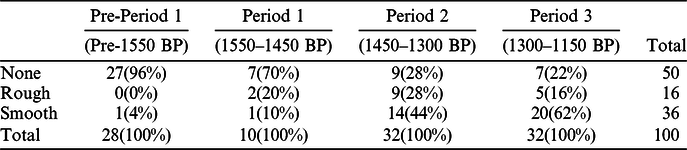
This AMS sequence is the longest continuous, directly dated ceramic sequence to have been acquired in the Maritime Provinces. It shows continuous use of ceramic vessels for cooking between ca. 1500 and ca. 1000 cal BP, indicating continuous site occupation. The sequence adds to the regional sequence by refining the chronological significance of some attributes. The sequence shows that coil break types are highly chronologically sensitive within this time range. As Table 2 shows, prior to ca. 1550 BP, ceramics exhibit a very low incidence of coil breaks. After 1550 BP, rough coil breaks became more prevalent in some ceramics, particularly those that also show attribute clustering. After 1450 BP, both rough and smooth coil breaks became more prevalent, whereas after 1300 BP, the majority of ceramics are characterized by smooth coil breaks. This shows that potters reduced the amount of paddling on each vessel through time (see Woolsey Reference Woolsey2018) and that this change occurred over several hundred years, manifesting first as rough coil breaks and evolving to smooth coil breaks, rather than abruptly, suggesting in situ evolution of the ceramic tradition.
Distribution of coil break types among periods defined by AMS dates.*

* Note that the number of “none” listed for Period 3 may partly represent sherds that are so badly damaged that no coil breaks could be identified.
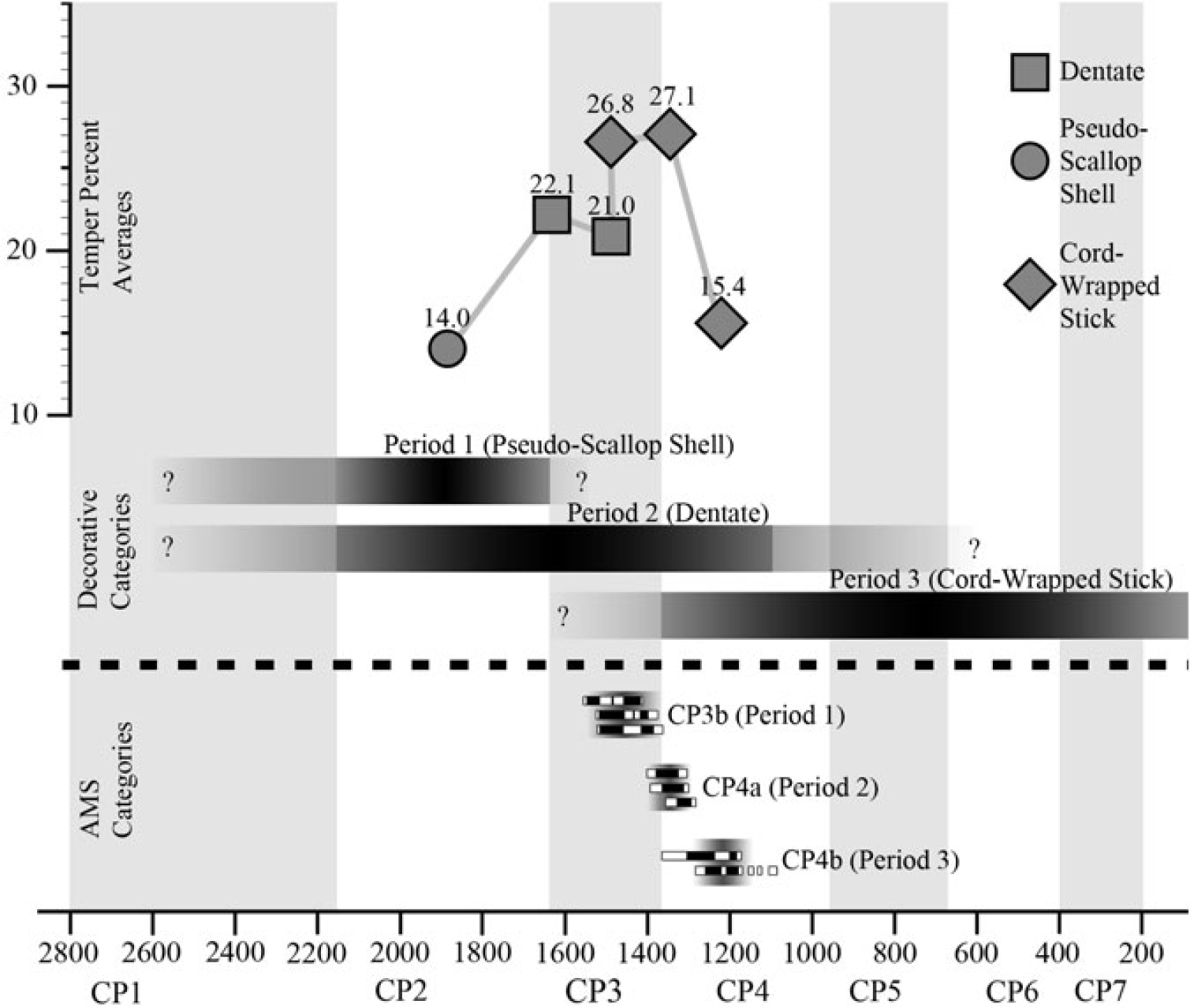
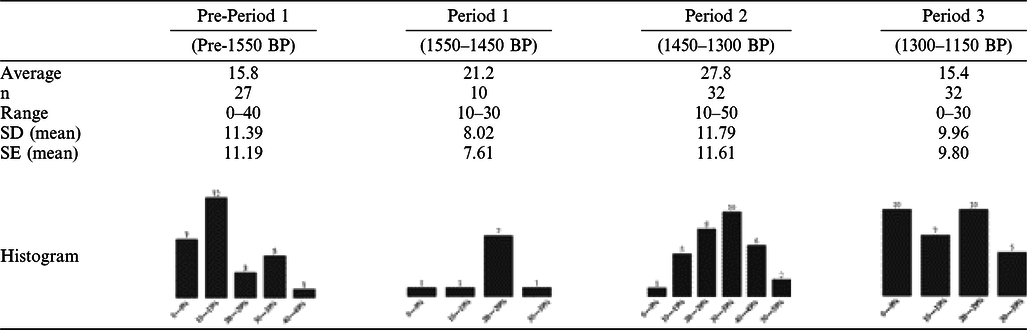
Temper percent and type were also shown to be chronologically sensitive (Figure 4). Table 3 shows the average temper percents during each period. Temper prior to ca. 1550 BP was fairly variable, but many of these pots contain <20% temper. All temper before this time was grit. The temper average increased during Period 1, although it rarely exceeded 25%. The highest temper average occurs in Period 3, when many pots contained in excess of 20% temper; during this period, organic temper was also introduced. Period 3’s temper percent dropped, although some pots were very coarsely tempered (>25%). The low temper amounts in Period 3 may partly be due to the difficulty of estimating organic temper. Iron oxide as a tempering agent increased steadily from Period 1 to Period 3. The last period is the most variable in temper types used, particularly in how they occur together in the same vessels [see Supplemental Figure S1].
Average temper percent through time compared with AMS dates and with the Petersen and Sanger sequence. Temper percent averages are chronologically situated using a combination of AMS-defined periods and chronologically sensitive decorative tools. PSS = Pseudo-Scallop Shell. CWS = Cord-Wrapped Stick. CP = Ceramic.

Distribution of temper percentages among periods defined by AMS dates. Temper percent was estimated by comparing archaeological specimens to experimental tiles with known temper percentages. Tiles were tempered at 0%, 5%, 10%, 20%, 30%, 40%, and 50%. Estimates for each sherd also follow these increments, and temper was calculated for the overall vessel lot by averaging the sherd estimates. A one-way ANOVA test found significant differences among periods in temper percent at the 0.05 significance level (f = 9.23477; p = 0.000019; n = 102).

Other attributes are also chronologically dependent. A trend from lighter to darker color through time is observable, with more reduced clays tending to occur later and whiter or pinker clays tending to occur earlier (Supplemental Figure S1). As expected, earlier decorations are dentate, while later decorations are cord marks (Supplemental Figure S2). An important finding at this site is that channeling occurs exclusively on pottery made after 1450 BP. This contradicts Petersen and Sanger’s (Reference Petersen, Sanger, Deal and Blair1991) observation that channeling only occurs on pottery between 2150 and 1650 BP on pseudo-scallop shell- or dentate-decorated pottery but is in agreement with Kristmanson (Reference Kristmanson1992).
Classes were defined by the method outlined above. For a full description of the classes and how they were defined and chronologically situated, readers are directed to Woolsey (Reference Woolsey2017). Following is a summary of ceramic changes through time evident from the defined classes. This summary builds upon existing knowledge of ceramics in this region and is intended to be further refined as more evidence emerges.
Pre-Period 1 (Prior to 1550 BP)
This period is defined on the basis of work dating pseudo-scallop shell decorations to the period between 2150 and 1650 BP (Allen Reference Allen1980; Bourgeois Reference Bourgeois1999; Deal Reference Deal1986; Foulkes Reference Foulkes1981; Kristmanson Reference Kristmanson1992; Nash and Stewart Reference Nash and Stewart1990; Petersen and Sanger Reference Petersen, Sanger, Deal and Blair1991; Sheldon Reference Sheldon1988). No dates were acquired on pseudo-scallop shell-decorated pottery but these pots likely came before 1550 BP. During this period, pottery exhibits a lack of coil breaks, fine to medium paste coarseness (percent of temper), granite mineral temper, and a range of materials, forming methods, and decorative strategies. This suggests that potters adhered loosely to a broad style and knowledge base but expressed their style and employed their knowledge in individualistic ways.
Period 1 (1550–1450 BP)
During this period, earlier practices were still employed, especially in the expressive ways that decorations were applied and in the fine, well-paddled ceramic fabrics. However, some pots show a departure from earlier, elaborately decorated fineware, using less varied decorative strategies (horizontal or vertical rows) and were coarser-tempered with a new, distinctive bluish-grey quartz and mica. These new pots show some coil breaks, indicating less-intensively paddled pottery. The decrease in paddling suggests that potters were looking for ways to decrease time invested per pot.
Period 2 (1450–1300 BP)
Pottery after 1450 BP changed significantly. Cord marks became the dominant decoration, pastes became significantly coarser, and pot interiors were aggressively channeled (scraped with a toothed tool). Continuity with Period 1 is evident in the use of the same distinctive temper mineral and light-colored clay. Coil breaks became more numerous and surfaces along coil breaks are smoother than from the previous period, indicating less intensive paddling. The clustering of materials, manufacturing attributes, channeling marks, and coarse pastes, as well as larger numbers compared to previous periods, suggest that the scale of production was increasing and some potters were moving towards part-time specialization. Other pottery during this period is less standardized, exhibiting a range of materials and manufacturing techniques, suggesting that they were made by non-specialists making pottery for their household.
Period 3 (1300–1150 BP)
During Period 3, pottery again changed, most dramatically in temper types and paste compositions, but also in manufacturing practices. Coil breaks increased and coil break surfaces are smooth with very little indication of having been joined through paddling. Temper types diversified to include organic temper; iron oxide, which had been added as a granulate in previous periods, was added during Period 3 in larger amounts, turning the paste red. Organic temper was mixed and matched with grit temper (often still the distinctive bluish-grey quartz and accompanying mica) to create a range of pastes. Interiors continued to be channeled but often were subsequently partly smoothed or burnished. This period exhibits striking diversity and the largest numbers of any period. However, standardization is still apparent in homogeneous coil breaks, some recurring decorations, and the continued use of the bluish-grey quartz temper. This suggests that part-time specialists had increased production and were seeking ways to turn out pottery faster. The use of organic temper probably was meant to help pottery dry faster and increase firing survival rates.
Post-Period 3 (1150–850 BP)
Little can be said about this later period since the dates are separated in time and too little context exists to understand the significance of these sherds. The earlier-dated sherd is too badly damaged to relate it to a tradition and, because it occurred in a disturbed layer, it is not easily related to other ceramics stratigraphically. The later-dated sherd does not bear significant similarity to any ceramics and cannot be classed on the basis of attributes. It is tentatively suggested that this sherd may represent a common manufacturing practice at around 850 years ago, particularly since it is similar to contemporaneous ceramics from other sites, but further evidence from future analysis will be required to confirm or refute this. Regardless, the lack of dates acquired after 1000 years ago is consistent with other sites in the region (e.g., Fulton Island) and conforms with observations made by other researchers that ceramic manufacture appears to have declined during this period (e.g., Foulkes Reference Foulkes1981; Davis Reference Davis, Deal and Blair1991).
DISCUSSION
The AMS sequence presented here refines Petersen and Sanger’s sequence, particularly CP3 (1650–1350 BP) and CP4 (1300–950 BP). A tentative refinement with five new subperiods follows. This refinement is intended to be tested by examining other assemblages in future research to determine whether it applies to the rest of the region.
CP3a (Pre-Period 1, ?–1550 cal BP): The loosely defined period between the start of CP3 (1650 BP) and Period 1 (1550 BP) likely fits Petersen and Sanger’s definition of CP3 (larger dentates compared with CP2, the cessation of pseudo-scallop shell decorations, slightly coarser pastes, and slightly thicker walls). In many ways, this period is more similar to the previous CP2 than to the following periods.
CP3b (Period 1, 1550–1450 cal BP): This period is marked by the beginning of standardized dentate-decorated pottery with distinctive bluish-grey quartz temper, distinctive dentate decorations, and some rough coil joins. Highly expressive fineware pots were still being made during this period, which would have resembled CP3a pots.
CP3c (Period 2, 1450BP–1300 cal BP): This period is characterized by the addition of cord marks, coarser pastes, continuing use of the distinctive bluish-grey quartz temper, and aggressive channeling on interior surfaces. Although vessel lots exhibit a range of decoration strategies, a majority of pots with coil breaks (rough and smooth), light-colored clay, and bluish-grey quartz indicate that potters were heavily influencing each other and/or may have been part-time specialists.
CP4a (Period 3, 1300–1150 cal BP): This period is characterized by a majority of pots with smooth coil breaks, pastes ranging from grit-tempered and coarse to fine-tempered and organic and mixtures of both grit and organic in varying percentages. Decorations are typically large and often not very carefully applied. Walls tend to be thicker than in previous periods and channeling continued to characterize interiors.
CP4b (Post-Period 3, 1150–? cal BP): Attributes characterizing this period are unknown, but likely include many coil breaks, cord-marked surfaces, grit temper, and channeled interiors.
The change in manufacturing attributes after 1550 cal BP and the increase in ceramic production throughout the following 400 years suggest that this is an important time in the Maine–Maritimes Region. Indeed, this corresponds to what has been called the Middle–Late Woodland Transition, an enigmatic and controversial time in the prehistory of the Northeast and adjacent areas (e.g., Black Reference Black2004; Hart and Reith Reference Hart and Reith2002; Hart and Brumbach Reference Hart and Brumbach2009; Curtis Reference Curtis2004; Custer Reference Custer1991). The data presented here and elsewhere (Woolsey Reference Woolsey2017, Reference Woolsey2018) shows that ceramic production changed significantly from the earlier Middle Woodland at this time, but that the change was gradual, in contrast to the abrupt transition at the Early–Middle Woodland transition (Allen Reference Allen1980). This is in agreement with Black (Reference Black, Hart and Rieth2002), who also found that a transitional period should be recognized in the Quoddy Region of New Brunswick and Maine. The increase in ceramic production supports other evidence of increasing trade (Sanders et al. Reference Sanders, Finnie, Green, Shears and Stewart2014) and large-scale gatherings, as was known to have occurred in the Historic Period at the L’sitkuk Bear River Site ca. 100 km away (Ricker Reference Ricker1998). Pottery was probably used to support large-scale gatherings and would have required fast turnaround to produce enough pottery, possibly causing reorganization in how pottery was produced (i.e., moving from individual pottery production to recruiting kin to help with aspects of production such as decoration and clay procurement). As a result of this apparent change, which began earlier but was in full effect by 1450 BP and lasting as long as 1150 BP, a new period, the Transition to the Late Woodland Period, is proposed.
The Petersen and Sanger sequence has not been significantly refined because attempts at refinement have usually incorporated multiple site assemblages in order to increase sample size. Doing so introduces significant variability that cannot be addressed at the level of in situ evolution and therefore becomes unwieldy, resulting in the same coarse resolution of data and resulting periods as the original sequence. Instead, refinements should occur at the site level, treating the Petersen and Sanger classes as questions to be answered rather than a priori categories, and absolute dates should be acquired directly from ceramics in a quantity that reflects the variability of ceramic classes (≥10 dates would be optimal).Footnote 6 Site sequences can then be compared to build larger sequences; these larger sequences can refine the Petersen and Sanger sequence at a subregional or regional level. Finally, these multi-site sequences could be compared with adjacent regions to understand the degree of contact among them and how ceramic traditions (i.e., ceramic learning lineages and influences through contact) moved among groups.
CONCLUSION
This paper reports on the AMS sequence acquired for the Gaspereau Lake Reservoir (GLR) Site Complex as part of the first study of ceramics in the Maritime Provinces that looked at technological change as well as decorations to delineate chronological periods. Technological attributes were included to identify mechanisms of change and to find new chronologically sensitive attributes. Although the full classification is not reported here, the AMS dates are used to illustrate ceramic changes through time at this site.
The dates from the GLR Site Complex overlap at the 2-σ range from ca. 1550 to 1150 cal BP with a less well understood period running from ca. 1150 to ca. 850 cal BP. Between 1550 and 1150 cal BP, three new periods have been defined on the basis of stylistic, manufacturing, and materials attributes. Additionally, the sequence makes clear that pottery manufacture changed as the goals of the potters changed. Scale of production increased, ceramic manufacture became more expedient, and risky practices such as paddling and firing were mitigated through reduction of paddling and increasing temper percent. The loss of structural integrity that would have accompanied poorly joined coils was apparently acceptable to potters later in the sequence, probably indicating that pottery was not meant to last long but rather was made for single use during specific events. On the basis of these changes in pottery manufacture, a new period is proposed for the Maine–Maritimes Region: the Transition to the Late Woodland, spanning 1450–1150 BP.
ACKNOWLEDGMENTS
AMS dates were funded by the Archaeology Research Grant from the Museum of Natural History in Nova Scotia and by the Archaeological Services Branch of the Province of New Brunswick. Analysis of ceramics was facilitated by the Department of Anthropology at the University of New Brunswick and by the Museum of Natural History.
SUPPLEMENTARY MATERIAL
To view supplementary material for this article, please visit https://doi.org/10.1017/RDC.2019.149