Introduction
Most social policy studies have regarded the United States as representative of a liberal, residual, reluctant, or divided model of welfare states (Esping-Andersen, Reference Esping-Andersen1990; Jansson, Reference Jansson2008; Hacker, Reference Hacker2002). The US public pension, which is small in expense and weak in de-commodification, thus provided a basis for such evaluations (Esping-Andersen, Reference Esping-Andersen1990; Palme, Reference Palme1990; Bonoli and Shinkawa, Reference Bonoli and Shinkawa2005). The US is also well known as an ideological centre of neoliberalism, which strongly supports retrenchments of welfare states around the world (Harvey, Reference Harvey2005). This article emphasises another aspect of the US welfare state system: the relative stability of Social Security, formally ‘the Old Age, Survivors and Disability Insurance (OASDI)’, which is the nationwide public pension in the US.
Stability is one of the most crucial elements of social security systems and, in general, provisions for social policies reflect a nation's promises to its people. Rash changes or breaches can thus undermine trust, support, or even the legitimacy of these promises. This is particularly true for pension systems because the promises extend far into the future. Indeed, since the OECD declared the crisis of welfare states in 1981, public pensions have lost the trust of the people, with repeated reforms in such developed countries as the UK, Germany, and Japan (Hyde et al., Reference Hyde, Dixon and Drover2007; Yoshida et al., Reference Yoshida, Guo and Cheng2006). Of course, it is desirable, and often necessary, for policy makers to reconstruct public pensions to adapt to the new socio-economic environment, to introduce new good ideas, and to restore future stability. To begin with, social security systems should be designed as institutions that are more durable in the face of long-term environmental changes. The age of ‘the crisis of welfare states’ can be understood as a practical test of the stability of social security systems around the world.
Despite the increasing importance of pension stability in the changing social and economic environment, the existing literature on welfare states has not paid sufficient attention to stability for comparative analyses. International pension studies have merely observed the scale of institutions and functions such as benefit adequacy, re-distribution, de-commodification, and range of coverage, while, in economics, pension stability is usually discussed as a matter of financial sustainability (Barr and Diamond, Reference Barr and Diamond2009). Some economists and institutions insist that unsustainable pay-as-you-go schemes should be replaced by fully funded schemes, including individual accounts (World Bank, Reference Bank1994). However, this view does not account for the stability of public pensions in the US and other industrialised countries, which are managed under ‘pay-as-you go’ schemes. With respect to the political sustainability of pensions, Hyde et al.’s (Reference Hyde, Dixon and Drover2007) noteworthy study explored the legitimacy of pension principles and developed six design benchmarks that must be met in order for pensions to be trusted. However, this comprises a normative approach based on polls about ideal pension institutions, and has not yet been tested with real experiences in the history of welfare states’ restructuring.
This article investigates the stability of US Social Security in the age of welfare state crises through a comparative analysis of stability, and attempts to determine internal and external factors that keep pensions balanced. First, I explain the methodology used to measure the past and future ‘stability’ of public pensions. Second, I demonstrate how the US public pension is more stable than that of other countries. Third, I examine the factors affecting US public pension stability and highlight the importance of institutional design. Finally, I focus on the three unique characteristics of Social Security that have helped to make it a technically rational and politically strong system in a changing environment: having a floor-of-protection, being self-sustaining, and providing universal coverage.
Methodology to evaluate stability
It is impossible to evaluate the stability of public pensions with any single criterion due to the complex nature of pension reforms. The simplest and most direct approach is to count the frequency of changes in a certain period, but this is only an approximate individual measure in which certain questions remain unresolved. First, pension reforms vary in terms of scale, direction, and aspects, while the extent and components of change should also be considered in evaluating stability. Second, a lower frequency of past reforms might result in a ‘false stability’ as politicians may postpone reforms, even those that are necessary to adapt to a new environment, as a ‘blame avoidance’ strategy, as discussed below. Such falsified steadiness necessarily results in a worse financial condition for public pensions. Thus, it is necessary to evaluate ‘false stability’ in determining the current financial sustainability of public pensions.
With these difficulties, evaluating the stability of public pensions requires multifaceted approaches, both qualitative and quantitative. To complete this broad task, my research is mainly based on a literature review with the research targets limited to six major countries. France, Germany, Japan, the UK, and the US were selected based on their status as the leading economies among traditional developed nations, rather than the emerging market, while Sweden was selected as a representative of the social democratic model of welfare regimes (Esping-Andersen, Reference Esping-Andersen1990).
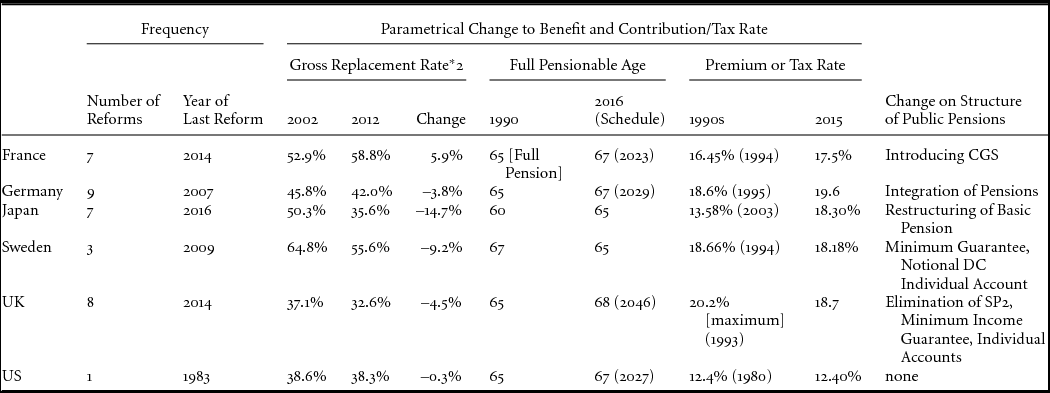
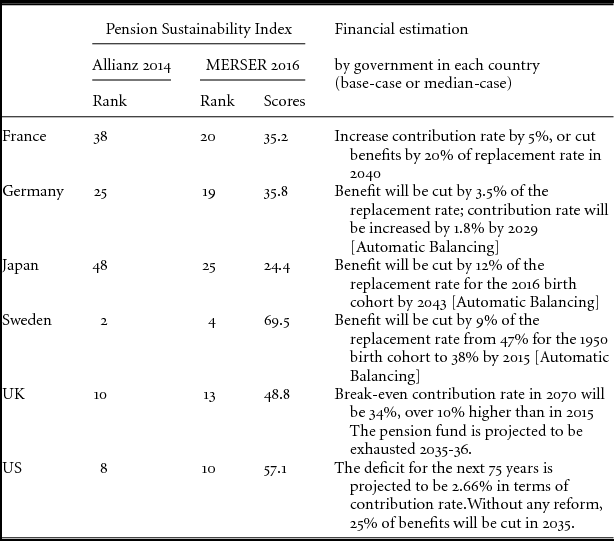
In this paper, stability is evaluated in three steps. First, I compare the frequency of substantial reforms since 1980, the year in which the OECD declared the welfare state crisis, in addition to the amount of time since the most recent reforms in each nation. These are shown in the left-hand column of Table 1. The term ‘substantial reform’ refers both to ‘parametric reform’, which is the permanent alteration of the general parameters of social insurance for older people, such as the benefit formula including the variables of indexation, normal retirement age, eligibility criteria, contribution rate, and taxable earnings, as well as to the ‘paradigmatic reform’, which comprises changes to the structure of public pension systems, such as coverage, arrangement of tiers, access to individual account schemes, and financial sources. Second, I analyse the scale of parametric reforms and components of paradigmatic reform. The middle column of Table 1 shows parametric changes in the replacement rate of public pension benefits, as reported by the OECD in 2002 and 2012, the pensionable age, and the premium/tax rate since the 1990s. Additionally, the right-hand column of Table 1 exhibits the changes in terms of public pension structure. Third, to distinguish unfavourable ‘false stability’ from favourable stability, I have researched the current financial stability of public pensions. It is difficult to compare financial stability among different countries because each government has its various ideas and schemes for managing public pension scheme finance. However, there is a small amount of comparative research available on the financial sustainability of pensions, led by global financial institutions: the 2016 Melbourne Mercer Global Pension Index, a report by the largest human resource consulting firms, and the Australian Center for Financial Study and the Pension Sustainability Index by Allianz, the largest German insurance company (Allianz, 2014; Mercer, 2016). Table 2 (left) displays the score and ranking of the major countries. However, these indexes are merely an approximation for general comparison. To grasp sustainability in more detail, I review the latest financial reports published by the public pension authorities in each country. Table 2 (right) shows what further parametric reform will be needed to balance the finances of public pensions in the long term in the reports, including adjustments by automatic indexation.
Substantial Public Pension Reforms since 1980*1

*1 Enactment that permanently alters the general parameters of social insurance for older people and survivors, such as changes to benefit formula variables, including indexations, normal retirement age, conditions of eligibility, premium/tax rate, and taxable earnings, or changes to the structure of the public pension system, such as coverage, arrangement of tiers, access to individual account scheme, and financial sources.
*2 Replacement rate calculated in OECD (2005) and OECD (2013)
Source: Author's elaboration.
Sustainability of current provisions of public pensions

Source: MERSER (2016), Allianz (2014), France (2012), Germany (2015), Japan (2014), Sweden (2016), UK (2015), US (2016).
Results: the most stable public pension: US social security
In the twenty-first century, US Social Security has unexpectedly emerged as one of the most stable public pensions in the world. First, this can be verified by the simple fact that it has experienced fewer and smaller reforms than have public pensions in other countries since the declaration of the welfare states’ crisis. Table 1 (left) lists recent substantial changes to public pensions in the six major countries targeted. It indicates the number of reforms since 1980 and the year of the most recent reform. We have observed the struggles that many welfare states have faced in adapting their public pensions to the new social and economic conditions, and resolving financial problems: Germany has implemented nine pension reforms, the UK eight, France and Japan seven, and even Sweden has implemented three. On the other hand, US politicians have enacted no major changes to Social Security since 1983 (Weaver, Reference Weaver, Bonoli and Shinkawa2005; Lain et al., Reference Lain, Vickerstaff and Loretto2013).
The scale of the adjustments in other countries reinforces the stability of the US public pension. Table 1 (middle) displays recent changes in the gross replacement rate, normal retirement age, and tax/premium rate for earnings, respectively. The OECD (2005, 2011, 2013) reported that the Japanese replacement rate, which is defined as a ratio of individual pension benefits to the pre-retirement average earnings, for median income individuals, saw the largest change of –14.7 per cent, down from 50.3 per cent in 2002 to 35.6 per cent in 2012, while a decline was also observed in Sweden, Germany, and the UK. All this occurred while US Social Security remained at its original level and France saw an increase. Moreover, in 1983, the US became the first country to raise the normal retirement age from 65 to 67. However, this only came into effect in 2003 and will conclude in 2027, more than 40 years after its enactment. In the twenty-first century, the UK, Germany, and France followed suit in raising the retirement age to 67 or over, while Japan raised its retirement age from 60 to 65. Only Sweden remains at 65 after lowering it from 67 in 1977. In terms of premium/tax rate, Japan's tax rate increase, at more than 5 per cent, represents the highest increase, with France and Germany also raising their rates. While the UK and Sweden have reduced rates, their original rates were higher than those of other countries. The UK has maintained the lowest payroll tax rates, 12.4 per cent for old age and survivors insurance, since 1977. Overall, with respect to adjustments made to balance benefit and burden, it is reasonable to say that US Social Security has been a relatively more stable public pension system, although some countries have maintained more stability in a specific area.
In terms of structure, the stability of the US public pension is more apparent. The reforms in all other major countries included paradigmatic changes to the coverage, financial methods, and tier systems as well as parametric changes to benefits and contributions. Table 1 lists the structural changes to public pensions. First, separate occupational pensions were unified or restructured. For instance, Germany integrated a division between the social pension insurances of blue-collar workers and white collar workers in 2005, while, in 1985, Japan altered the National Pension from a pension for non-employees to a basic pension covering employees. Meanwhile, the UK eliminated its second tier public pension in 2016. Second, new pension taxes and new programmes financed by these taxes were created. In 1991, France established a new type of income tax, Contribution Sociale Généralisée (CSG), and repeatedly raised its rates to offset normal pension contributions. In 1999, the UK introduced tax financed programmes for low-income retirees, a Minimum Income Guarantee and, in 2002, introduced a Pension Credit. Third, defined contribution systems, such as individual accounts, which the World Bank has traditionally recommended, were introduced in many countries. Germany developed the Riester-Pension in 2001, the UK initiated stakeholder pensions in 2001 (enacted in 1999), and France added the Plan d’Épargne Retraite Populaire (PERP) in 2004. Sweden executed the most radical and comprehensive reform in 1999, which included replacing the defined benefit system, a main component of public pensions, with a notional defined contribution system. This introduced privately managed individual accounts as a second tier, and instituted a guaranteed minimum benefit financed by the general budget for people in poverty.
In contrast, the US did not follow this path. During the restructuring age, the US public pension never experienced such structural changes to division of coverage, financial methods, and tiers, with the exception of expanding the coverage for newly hired federal employees as part of the 1983 amendment. The basic structure has been maintained since the amendment of the Social Security Act in 1950 or even, in principle, since the original Social Security Act of 1935.
Nevertheless, it is dangerous to assert and admire the stability of US Social Security simply because the system has remained unchanged for decades. As pointed out above, this may represent a ‘false stability’. An absence of reforms can be caused by political unsoundness as well as by institutional stability. Policy makers can postpone painful decisions to address the financial problems of pensions and this ‘blame-avoidance strategy’ is a common tendency in the pension politics of industrialised countries (Bonoli and Shinkawa, Reference Bonoli and Shinkawa2005). However, the later that remedies are implemented, the worse the financial risks and instability of pensions and such concerns also apply to the US. The financial problems with Social Security have been highlighted since the 1990s and there is no doubt that the next reform needs to restore the financial soundness of the public pension.
Nevertheless, the existence of financial risks does not mean that Social Security has achieved only a ‘false stability’ through the political blame-avoidance strategy. Despite the lack of reforms, the financial status of Social Security is neither desperate nor worse than other major public pensions, which have been adjusted and fixed repeatedly. Table 2 provides a picture of the financial sustainability of public pensions. The first and second columns show each country's ranking on the public pension system sustainability indexes of Mercer and Allianz. The sustainability index, as explained by Mercer, provides an indication of a country's need for reforms to maintain long-term financial sustainability. Though the two research efforts differed in their methodology, research year, scope, and target, the order of the six countries is the same: Sweden ranks first, due to its big reform in 1999, followed by the US, the UK, Germany, France, and Japan. Of course, it is difficult to assess the sustainability of pension systems, and these efforts should be considered rough assessments, rather than precise measures.
Both the board of trustees of the US public pension and the other target governments believe further adjustment of benefits or tax rates will be required and the scales are not smaller than in the US. Table 2 (column 3) displays how the pension authorities in each country word the necessity to adjust public pension benefits/contributions in the future in their official reports. France needs to implement a large cut to benefits or increase the contribution rate for fifteen years (France, 2012). Japan, Germany, and Sweden have already introduced automatic balancing for economic or demographic changes, which will make their systems financially stable through automatic benefit cuts from current levels (Japan, 2014; Germany, 2012; Sweden, 2016). The UK estimates that its base contribution rate should be 35 per cent, an increase of approximately 10 per cent, to balance its finances, or the fund will be exhausted in 2035–2036 (UK, 2014).
The current US Social Security system could be sustained for the next 75 years by increasing Social Security tax by 2.66 per cent to approximately 15.1 per cent (US, 2016). The corresponding 2012 payroll tax rates of other major countries are 16.67 per cent in Japan, 19.6 per cent in Germany, 16.85 per cent in France, and 17.21 per cent in Sweden, and they are all scheduled to increase further. Even without any remedy, it is theoretically possible to keep an actuarial balance through a 25 per cent benefit cut from the current system just after the 2035 exhaustion of the fund (Goss, Reference Goss2010; US, 2016). In order to make such a sudden reduction less disruptive and more gradual, several options have been proposed for restoring financial solvency to Social Security. These include increasing the normal retirement age, changing the calculating method of the cost of living adjustment for active workers, modifying the benefit formula, and so on. Moreover, the Social Security shortfall can be readily addressed without reducing benefits to recipients (Meyer, Reference Meyer2013). Combined with increasing maximum taxable earnings and applying a new tax above the maximum, a more gradual increase of the payroll tax can finance the long-term deficit in the US (SSA, 2010). Furthermore, incremental adjustments of benefits and taxes can make up the long-term Social Security deficit.
Discussion
Stability Factors
What brought about the unexpected stability of US Social Security? First, the stability may be attributed to the political barriers to reform. With respect to the stability of pensions, studies of welfare states have focused on the political nature of welfare programmes, such as ‘path-dependency’ and ‘a strategy of blame avoidance’. (Pierson, 2001; Bonoli and Shinkawa, Reference Bonoli and Shinkawa2005). The literature on US Social Security forms similar conclusions. Tynes (Reference Tynes1996: 1) employed his ‘organizational dynamics’ approach, which stressed the role of several political actors in the story of Social Security development and its becoming widely accepted as a ‘sacred entitlement’. Weaver (Reference Weaver, Bonoli and Shinkawa2005: 247) also described recent US public pension policy as having an ‘almost complete absence of substantial policy change’ due to the popularity of Social Security in the US political system. It has been regarded as the ‘third rail’ in the US, which delivers a deadly electric shock to politicians who touch it (Hacker, Reference Hacker2006). In addition, it is more politically difficult to make a structural change to public pensions with a pay-as-you-go system than to other welfare programmes because, in the former, government is required to pay huge transition financing costs for unfunded pension promises.
These political barriers play an important role but are not the sole reason for the minimal changes to Social Security in the US. As many studies have indicated, such obstacles to significant reforms are very common in democratic welfare states, and not solely challenges faced by the US. Rather, some studies imply that such barriers work more in ‘Social Insurance’ countries (Bonoli and Shinkawa, Reference Bonoli and Shinkawa2005), or corporatist systems (Immergut and Abou-Chadai, Reference Immergut and Abou-Chadai2014), like France and Germany. Therefore, this cannot explain why the outstanding stability of the public pension emerged only in the US, while other developed countries underwent repeated pension reforms.
Another condition, outside of pensions, is the most plausible factor behind the US Social Security's stability. The US has had a better demographic and economic environment. Since the 1970s, welfare states have been forced to change due to an aging population and a decrease in economic growth. However, such factors were less severe in the US than in other industrialised countries. First, the population is ageing more slowly thanks to increasing immigration and a high birth rate. According to the United Nations’ 2008 estimation, the percentage of the US population over the age of 65 will be 13.0 per cent in 2010 and 21.0 per cent in 2050. Both estimates were lower than other major countries: France at 17.0 per cent and 26.5 per cent, Germany at 20.5 per cent and 31.8 per cent, Japan at 23.1 per cent and 36.5 per cent, Sweden at 18.3 per cent and 24.1 per cent, and the UK at 16.6 per cent and 22.6 per cent (United Nations, 2008). Second, the US's economic growth has been relatively balanced. The average growth rate of the US's real GDP was 3.1 per cent in the 1980s, 3.2 per cent in the 1990s, and 1.9 per cent in the 2000s, all of which ranked at least second among the six major countries in each decade (United Nations, 2010).
Although it is impossible to achieve Social Security stability without a favourable demographic and economic environment, explaining it based on exterior factors alone is insufficient. The US also had an ageing population and declining economic growth, and the board of trustees of Social Security showed its severe financial unsustainability in the 1970s, approximately 20 years earlier than other major countries. In addition, political pressure toward pension reform is aroused not only to address financial problems but also to fine-tune the structure of pension systems, and US Social Security has been under a greater strain for such structural changes in the era of neoliberalism and globalisation. At least seven options were proposed for reforms to the structure of Social Security as early as the 1970s (National Commission on Social Security, 1981). Moreover, the US is home to economists who have criticised traditional pay-as-you-go systems and propagated the idea of introducing fully funded pensions and individual accounts into public pensions. This idea, often called the privatisation of Social Security, has had a strong influence on pension policy. In the late 1990s, the Clinton administration presented a report on Social Security reform that included a suggestion to implement a new individual account system. The most serious challenge to Social Security in its current form was the proposal of privatisation by President George W. Bush in 2004. He pushed the concept of an ownership society during his re-election campaign and the privatisation of Social Security was set as the top domestic priority for realising his vision (Meyer, Reference Meyer2013). The stability of Social Security is never a natural consequence, but rather the outcome that occurs after serious tests in unfavourable political situations.
The political pressure to retrench the US welfare state is not just meretricious. As stated above, the US is at the centre of neoliberalism and globalisation, and also classed as a ‘liberal country’ in comparative studies. Such a reputation is applicable to other parts of the US welfare regime. Despite having the same favourable environment, the US welfare regime – apart from its Social Security – has experienced drastic retrenchments and changes. US private pensions have changed the fastest and the most drastically as traditionally defined benefit plans were replaced with defined contribution plans: a sort of individual account called 401(k) plans (Mackenzie, Reference Mackenzie2010). In Congress, other public welfare programmes like Supplemental Security Income, Food Stamps, Medicare, Medicaid, and Aid to Families with Dependent Children, came under fierce attack during the Reagan presidency, especially after the Republicans held the majority in the House in 1996.
The stability of Social Security raises the question as to why only the public pension could remain stable among the various components of the US welfare regime, and why it was stable relative to the public pensions of the other major developed nations. The favourable environment cannot be the solution to this puzzle. In other words, when external factors do not guarantee the stability of welfare regimes, we should focus on the internal factors: the characteristics of the institutions.
The contribution of institutional design to stability
The design of welfare institutions is a significant factor that affects economic and social outcomes (Goodin et al., Reference Goodin, Headey, Muffels and Dirven1999). However, there are few studies that inquire into what design makes the public pension more stable. Hyde et al. (Reference Hyde, Dixon and Drover2007) is one of the few articles that attempts to consider the factor of building trust in pensions, which seems an important condition for stability. Their study developed six benchmarks for a normative design for building trust: flexibility, inclusive administration, transparency, security, rights enactment, and rights enforcement. It seems natural that people's trust should make public pensions more stable. Indeed, as pointed out below, a number of benchmarks help us to understand the stability of US Social Security, but it is apparent that Social Security itself does not directly meet all of these benchmarks. The framework seems to be built upon a normative rather than a positive approach. To develop a theory of institutional design for trust building, it is necessary to explore the characteristics of a stable institution, and consider which should be present in an ideal institution.
The US public pension has been regarded as part of the ‘liberal welfare regime’ for many years (Esping-Andersen, Reference Esping-Andersen1990). It is true that both the levels of pension benefits and de-commodification are lower than in other countries with conservative regimes like Germany and France or social democratic models like Sweden, a result of pressure under ‘the liberal tradition’, where the values of freedom and self-reliance are favoured and government interventions in the market are detested (Rimlinger, Reference Rimlinger1971). While growth of the US public pension was constrained, the institutional design, which is technically rational and politically strong in a changing environment, was also forged under the pressure of the liberal tradition. It consists of three components: it has a floor-of-protection, provides universal coverage, and is self-sustaining.
Floor-of-protection
In the US, it is generally agreed that Social Security should provide only a minimum floor-of-protection against risks (Myers, Reference Myers1993). Although the minimum is controversial, it has been accepted with the rough interpretation as a level at which the benefits of Social Security should not be sufficient to provide a comfortable retirement without other resources or income, such as employer-sponsored pensions and individual savings. In the liberal tradition, it was difficult for Social Security to be born, or even to grow beyond the minimum: there was strong opposition from the conservatives and manufacturers against the Social Security Act, which pressed for Social Security to be a ‘basic’ pension to allow room for private pensions (Lubove, Reference Lubove1968; Jacoby, Reference Jacoby1997).
Historically, Social Security has accounted for approximately 40 per cent of workers’ pre-retirement income. This is the degree to which the current benefit formula, retained since 1977, provides for an average earner. The initial formula of the Social Security Amendment in 1939 would have provided a similar degree of benefit. During the 1970s, however, the level of benefit once exceeded 50 per cent as a result of an automatic cost of living adjustment to inflation, introduced by the 1972 amendment. Yet, such excess was corrected with the 1977 amendment and was noted as being the result of a technical error (Snee and Ross, Reference Snee and Ross1978).
The concept of floor-of-protection provides a solid floor of retirement income for a wide range of socio-economic classes. While Social Security is designed to be an earnings-related pension, embodying the concept of self-help, work-ethics, or ‘individual equity’, it is also devised to meet a special consideration for the concept of ‘social adequacy’: low-income workers can expect a higher replacement rate than average and high earners. In the benefit formula of 2011, a replacement rate of 57.8 per cent is set for workers who earn half of the average salary, 44.9 per cent for average earners, and 28.5 per cent for workers who reach the maximum taxable earnings. Some earners are also eligible for family benefits. Moreover, the maturity period for receiving the full benefit of Social Security (35 years), is shorter than that of the public pensions in other nations.
The floor-of-protection concept is indispensable for explaining the stability of Social Security over the past 40 years. First, as it includes a minimum social protection floor, the benefit level of Social Security is moderate enough to be politically successful in an adverse climate for welfare states. As Table 1 indicates, the US pension benefit level ranked second lowest among the six countries in 2002. Assuming there is agreement that the current benefit level meets the floor-of-protection level for a large portion of Americans, it would be difficult to make them accept a benefit cut.
Second, the solid floor of Social Security has worked well for a broad range of Americans, not just for certain groups. In fact, Social Security is already the largest and widest income source for older people in the US. In 2014, Social Security accounted for 33.2 per cent of the older population's aggregate income and 80.7 per cent of the aggregate income for the lowest quintile of earners. It provides at least 90 per cent of income for 33.4 per cent of older people and 50 per cent or more for 61.1 per cent of older people (SSA, 2016). It also functions as insurance that guarantees a minimum income against the risk of low income in retirement. When defined contribution plans such as the 401(k) plan, which is a more risky scheme than defined benefit plans, spread throughout employer sponsored retirement plans, another main pillar of retirement income security in the US, the Social Security function of insurance became more important (Hacker, Reference Hacker2006).
The challenge to President Bush's Social Security reform was a good example of the effectiveness of the floor-of-protection concept in maintaining the durability of the system. It is noteworthy that Americans rejected his proposal to introduce the individual accounts feature, or privatised Social Security, although many contemporary polls found that the idea of individual accounts for retirement income security was broadly accepted, or even preferred. For example, in October 2003, 62 per cent of respondents favoured the privatisation of a portion of Social Security while only 34 per cent opposed it (Gallup, 2005). The proposal faced strong opposition because it would include measures to hurt the floor-of-protection concept, not only by allowing the diversion of contributions into individual accounts but also by changing the method of calculating the Cost of Living Adjustments (AARP, 2005b).
Universal Coverage
In the US, Social Security is formally regarded as a nearly universal system (SSA, 2011). This may sound strange to social policy experts because the term ‘universal’, the antithesis of ‘selective’, is a system covering all citizens regardless of contribution, and commonly financed by general taxes like basic pensions in Denmark and New Zealand. Nevertheless, among contributory social insurance schemes, which have been adopted by a large number of countries, Social Security is one of the most universal systems because it is among the most integrated and wide reaching.
Social Security is an integrated pension, covering the entire country and all jobs, except some state employees and retired railroad workers. This is in contrast to German, French, and Japanese public pensions, which are operated as occupational or plural systems, where citizens are treated differently depending on their status in the labour market. With a single integrated system, almost all US workers are covered under the same pension benefit formula regardless of their type of work. Also, the number of workers who meet the criteria for coverage is larger under Social Security and its tax is collected with stronger authority than in other countries. Workers earning over 400 dollars per year, including the self-employed, are obliged to pay Social Security taxes, which means a wider range of workers are covered than in other countries. This single plan alone covers approximately 94 per cent of the US workforce (SSA, 2011).
Universal coverage has played an important role in maintaining Social Security's stability, both technically and politically. First, pensions with universal coverage are structurally durable in changing environments. In other words, Social Security experienced fewer defects that required structural reforms. As described above, other countries have undergone several reforms in the age of the welfare state crisis. Many of these revisions, including the integration of divided pensions, were to cope with defects in the occupational pension system that arose in emerging post-industrial and global economies. For instance, financial disparity among divided public pensions required inter-institutional adjustments. A growing number of uninsured individuals and exoduses from pensions were the result of gaps in occupational pensions.
Second, the integrated pension system consolidates American citizens into a single political interest. American society consists of various races, genders, regions, occupations, religions, and so on, and political activities have been developed in consideration of such groups. Universal coverage, together with the solid floor-of-protection, allows Social Security to succeed in assigning all citizens to a single institution, which makes it the strongest social programme in the US. Several polls show that the majority of working Americans support maintaining the current system as much as possible, even if they have to pay more. This support was visible across various races, generations, regions, and political parties, including members of the Tea Party movement (AARP, 2005a; Gallup, 2011; Weaver, Reference Weaver, Bonoli and Shinkawa2005; NASI, 2013; Skocpol, Reference Skocpol2012). The unity on Social Security is backed by the existence of the American Association for Retired Persons, the most influential advocacy group in the US, which has a diverse membership of over 33 million, and played a significant role in blocking Bush's proposal in 2005.
Self-sustainability
Social Security is a self-sustaining system, in principle. It has been financed simply by an object tax, the so-called Social Security tax, similar to a social insurance premium, and is not subsidised by general taxes, with some exceptions. This has been a feature of Social Security from the beginning and makes the US public pension unique; government subsidies have been traditionally considered an essential component of social insurance (Rubinow, Reference Rubinow1913) and, in fact, there are no other nations, amongst the six countries in Tables 1 and 2, where public pensions do not constantly depend on general tax revenues.
While the absence of general funds disappointed supporters of social insurance when the Social Security Act was enacted (Lubove, Reference Lubove1968), in the long run it is effective for maintaining the stability of social insurance in three ways. First, it harmonises with the traditional American concept of self-help, that people should sustain their retirement living on their own earnings, which has provided an ethical base for attacking the welfare systems. Without subsidies from general funds, Social Security is very different from other entitlement programmes financed by federal general funds, like Supplemental Security Income, and other public aids. Social Security is a system where the contributors earn a right to its benefit. Therefore, the Social Security tax is regarded as one of those least questioned by the American public today (Tynes, Reference Tynes1996). Financing Social Security with other general tax revenues would make the quasi-self-help concept vague.
Second, its financial independence makes the management of Social Security more actuarially rational. Social Security assets are controlled in the form of a trust fund outside the general budget of the federal government. It is more important for the management of the fund to consider financial soundness and actuarial rationality within its own resources than it is for a programme depending on general revenue. Every year, the board of the trust fund reports its financial estimation for the future of the fund, providing a 10-year short-term forecast, a 25-year middle-term forecast, and a 75-year long-term forecast, using three scenarios of different economic assumptions. In contrast, such estimation was done at least once every five years in France, the UK, and Japan. It was done every year in Germany but offered only a 15-year forecast. The effort to achieve the financial soundness of Social Security was described as ‘while Americans look 75 years ahead, Europeans tend to rely on projections for the next 15 sometimes 20 years’, and ‘if the US did the same, there would probably be far less debate on the long-term sustainability of pensions in that country’ (Bonoli and Shinkawa, Reference Bonoli and Shinkawa2005).
Actuarial rationality worked at the beginning of the welfare states’ crisis. In 1975, the board of the Social Security fund declared itself in financial crisis and the US government quickly responded, resulting in the enactment of two amendments to the Social Security Act in 1975 and 1983. With these adjustments, the financial problems were addressed, improving not only the short-term deficit of the fund but also its financial long-term sustainability. Although these amendments were neither perfect nor permanent solutions, the current stability of Social Security is the direct result of these rational, forestalling, and audacious reforms.
Third, its financial autonomy placed Social Security outside the fierce political battles over the federal budget. It is no exaggeration that every policy over the retrenchment of welfare states can be understood as a budget matter. In the US, conservative politicians have attacked welfare programmes to accommodate their tax cut plans and desire for a small government, while liberals have attacked tax cuts in defence of the programme in Congress. While Social Security is certainly a federal entitlement programme, it exists relatively far from such political battles because, in principle, it was financed on its own and has no direct financial relationship with general taxes or other welfare programmes. For instance, when reducing the federal budget deficit was a main emerging issue in Congress, President Obama, his officials, and Democratic Senators emphasised that Social Security is ‘not the huge contributor to the deficit’, because its benefits are ‘self-financing’ (Jackson, Reference Jackson2011). Social Security's financing through a clear and publicly accepted tax constitutes a significant part of its political strength.
Aside from proposals for structural changes such as those made by Bush, one problem of Social Security is simply the parametric and actuarial issue of how it should be reformed to ensure its sustainability. Of course, this can be a political matter, which may divide conservatives and liberals over what balance is appropriate between revenue and expenses and how to attain it. Such questions must be resolved only in the context of Social Security, not considering the total budget. Moreover, if you assume that there is a broader and bipartisan consensus over the floor-of-protection concept in US politics, the balancing of Social Security can be accepted as a purely technical issue. The two amendments in 1977 and 1983 were good examples of the technical nature of Social Security reforms. They are highly technical solutions for restoring financial soundness by way of the self-sustaining principle, which was developed through the prudent negotiations of a bi-partisan committee. In contrast, two decades later, President Bush failed to enact his proposal to introduce individual accounts, partly because it was assumed it would hurt the self-sustaining feature of the system, making Social Security dependent on general taxes for a lengthy period (Orszag and Stigliz, Reference Orszag and Stigliz1999). On multiple occasions, the liberals have also insisted on breaking the fiscal independence of Social Security (Myers, Reference Myers1993), and, in fact, the general fund was injected into the trust fund of Social Security from 2010 to 2012. However, this financing of Social Security was merely a temporary change, which was proposed by President Obama to rescue the US economy from the serious recession it was facing at that time. This policy was even criticised by the Democrats on the basis that the dependence on general funds could ‘disrupt the link that President Franklin Delano Roosevelt forged to lock in support for Social Security: with workers taxed for their benefits, politicians would not cut them’ (Calmes, Reference Calmes2011: A28).
Conclusion
In this article, I have focused on the stability of the public pension in the age of a welfare crisis. First, I have found that US Social Security has remained outstandingly stable. It has remained structurally unchanged for 30 years and its financial challenges continue to be fewer than those of other industrialised countries, all of which have enacted several adjustments. US Social Security has also maintained its basic structure from the 1950 amendments while other nations have changed the public pension system, for instance, by introducing or replacing traditional components with new schemes, new taxes, and individual accounts. Second, I have examined the factors contributing to US stability, including overcoming political barriers and a favourable environment, and indicate that institutional design of the public pension must be considered. The characteristics of US Social Security are the floor-of-protection, universal coverage, and self-sustainability, which reflect values forged in the course of US history. These have made the system more durable, both technically and politically, in changing environments, including the crisis of the welfare state. The steadiness of public pensions is discussed as a reflection of political unsoundness (Bonoli and Shinkawa, Reference Bonoli and Shinkawa2005) or as a result of financial sustainability (World Bank, Reference Bank1994; Barr and Diamond, Reference Barr and Diamond2009). When considering the long-term value of stability, it is necessary to pay attention to durable public pension design as well as the external environment.
Finally, I will briefly sketch the theoretical and normative efforts to stabilise the pension system. The effects of three main features on the stability of the Social Security, i.e. floor-of-protection, universal coverage, and self-sustainability, match some of the six benchmarks of ‘trust building’ outlined in Hyde et al. (Reference Hyde, Dixon and Drover2007). The floor-of-protection concept brought ‘flexibility’ to the US system. Social Security itself is mandatory and has no flexibility; participants cannot choose whether they want to contribute, they cannot decide on their eligibility, and they cannot control the benefits of the programme. However, the US pension system has some flexibility overall. As the targeted benefits of the mandatory Social Security are limited to the minimum, employers and workers have more choice to build their retirement income through, for example, employer-sponsored retirement plans. Together with the floor-of-protection, the universal coverage provides retirement income security close to ‘right enactment’. While not every American citizen is entitled to Social Security like tax-based pensions, the institution does cover a wider range of workers with benefits than the programmes of other industrialised nations. ‘Transparency’ and ‘security’ seem consistent with the actuarial rationality, as explained above, through Social Security's ‘self-sustaining’ feature. Concerning the relationship of Social Security's three main features with the remaining benchmarks, it is difficult to infer a theoretical relationship with ‘right enforcement’ and ‘administrative inclusion’. The former is common in all of the developed countries examined and the latter is absent from Social Security.
Through this short analysis, it appears as though the three main features of US Social Security correspond to some of the trust building theory benchmarks, which has reinforced its stability. Considerable further study is necessary to interpret these implications. There is room for the trust building theory to be refined and further developed, including the weighting of the benchmarks, defining the scope of the analysed system, and exploring variations and combinations. The exploration of an institutional design for stability undertaken in this paper was based on a case study of the one public pension system that appears outstanding, and unexpectedly, stable. To theorise this system, and to derive direct and general implications for pension reform in developed counties as well as to construct pension systems in emerging economies, it is necessary to study more countries, including at least one with an unstable public pension, and then to score factors across several countries. The stability of US Social Security represents a stepping stone in the development of this theoretical approach.