Nearly 47 million unnecessary antibiotic prescriptions are written each year in the outpatient setting.Reference Talkington, Hyun, Zetts and Kothari 1 Indications such as viral upper respiratory infections, acute bronchitis, and bronchiolitis have clear guidelines that do not support the use of antibiotics.Reference Snow, Mottur-Pilson and Gonzales 2 , Reference Harris, Hicks and Qaseem 3 Overuse of antibiotics has been the primary driver for increasing prevalence of multidrug-resistant bacterial infections that affect vulnerable populations and contribute to increased mortality.Reference Napolitano 4 – Reference Bassetti, Carnelutti and Peghin 7
To combat increasing resistance to available antibiotics, the White House released a National Action Plan in 2015 that set a goal of reducing inappropriate outpatient antibiotic use by 50% by 2020. 8 Since that time, several studies have been published that describe baseline prescribing rates in outpatient practices.Reference Sanchez, Hersh, Shapiro, Cawley and Hicks 9 – Reference Tamma and Cosgrove 14 Many of these reports focused on a single outpatient setting, such as primary care, or used national data such as the National Ambulatory Health Care Data or the National Ambulatory Medical Care Survey for their analysis.Reference Fleming-Dutra, Hersh and Shapiro 12 Few studies have included practice types, provider, and patient characteristics to determine their impact on antimicrobial prescribing for common indications in the ambulatory care space.
Understanding characteristics that influence prescribing rates across different environments, providers, and patients will inform strategies for effective antimicrobial stewardship and improve patient care in the outpatient setting. The goal of this study was to identify patient, provider and practice characteristics that may contribute to inappropriate antibiotic prescribing. We targeted 4 clinical conditions where antimicrobials are not indicated: acute upper respiratory infection (URI), acute bronchitis, bronchiolitis, and nonsuppurative otitis media.Reference Snow, Mottur-Pilson and Gonzales 2 , 15 – Reference Hersh, Jackson and Hicks 17 Several patient factors were included: indication for the visit, age, race, gender, Charlson comorbidity index (CCI), and average number of visits per patient during the analysis period. At the practice level, characteristics included practice type, rural versus urban setting, and year of visit. Finally, provider level factors included age of provider and provider type.
METHODS
Data Description
Carolinas HealthCare System (CHS) is a large, integrated network of acute-care hospitals, ambulatory care, urgent care, free-standing emergency departments and skilled nursing facilities. Between 2014 and 2016, the average annual number of outpatient visits for common upper respiratory infections was 377,617 (95% confidence interval [CI], 376,970–378,264). As an integrated system, sites across the care continuum share the same electronic medical record (EMR) system where prescriptions and primary, secondary, and tertiary diagnoses for each outpatient visit are documented. These EMR data are captured and updated daily in our data warehouse, which is used for research and quality monitoring purposes.
Using this validated data source, ambulatory visits between January 1, 2014, and May 31, 2016, were extracted for this study. These data included any outpatient visit where the patient had any of the following diagnoses (International Classification of Disease, Ninth and Tenth Revisions, Clinical Modification [ICD-9/10-CM] diagnostic categoriesReference Sanchez, Hersh, Shapiro, Cawley and Hicks 9 , Reference Fleming-Dutra, Hersh and Shapiro 12 ): acute bronchitis, bronchiolitis, nonsuppurative otitis media, or viral URI (Supplementary Table 1).Reference Snow, Mottur-Pilson and Gonzales 2 , Reference Harris, Hicks and Qaseem 3 , Reference Fleming-Dutra, Hersh and Shapiro 12 , Reference Snow, Mottur-Pilson and Gonzales 18 – Reference Fleming-Dutra, Hersh and Shapiro 20 These diagnoses were selected to reflect guidelines indicating that antibiotic prescribing is not appropriate.Reference Snow, Mottur-Pilson and Gonzales 2 , 15 – Reference Hersh, Jackson and Hicks 17 There was no overlap between acute bronchitis, bronchiolitis, and URI. For our study, URI included pharyngitis, nasopharyngitis, acute supraglottis, acute epiglottitis, cough, and acute tracheitis. Bronchitis and bronchiolitis were specified by acute codes for these indications.
Only oral antibiotic prescriptions were included for this study. The classes of antibiotics were categorized as follows in order of frequency: macrolides, penicillins, cephalosporins, quinolones, and other less frequently prescribed antibiotics (ie, tetracyclines or lincomycin derivatives). We captured the route of delivery for the drug prescribed in our data and included only oral prescriptions written during the outpatient visit.
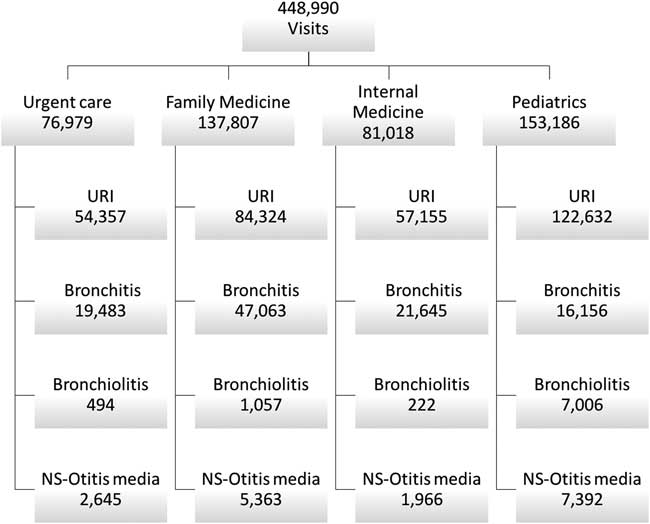
A total of 448,990 visits were extracted for study inclusion, which involved 281,315 unique patients seen across 246 practices and 898 providers. We included urgent care, family medicine, internal medicine, and pediatrics practices, and we extracted only visits in which there was any diagnosis of URI, acute bronchitis, bronchiolitis or nonsuppurative otitis media (Figure 1). The primary outcome of interest was visit-level antibiotic prescribing. Prescribing an antibiotic was defined as a visit where ≥1 antibiotic prescription was written. Prescribing rates were standardized per 1,000 visits by indication.
Number of patient visits by practice type and diagnosis.

Data extracted to support the analyses included several patient-level characteristics: age, race, gender, Charlson comorbidity index at the time of the visit, and primary insurance type. Providers were divided into 2 categories: (1) advanced practice providers (APP) that included nurse providers and physician assistants or (2) physicians holding a medical doctor or doctor of osteopath degree. The age of the provider at the time of the visit was also captured. Practice-level factors included the year the visit occurred and type of practice (internal medicine, family medicine, urgent care, or pediatrics). The year of the visit was included in the analyses to control for practice-level changes that were not directly captured in our model but occurred over time. For example, new policies may have been implemented or diagnosis shifting may have occurred that could impact prescribing trends. By including the calendar year in the model, we adjusted for these changes in prescribing rates due to policy changes.
Statistical Analyses
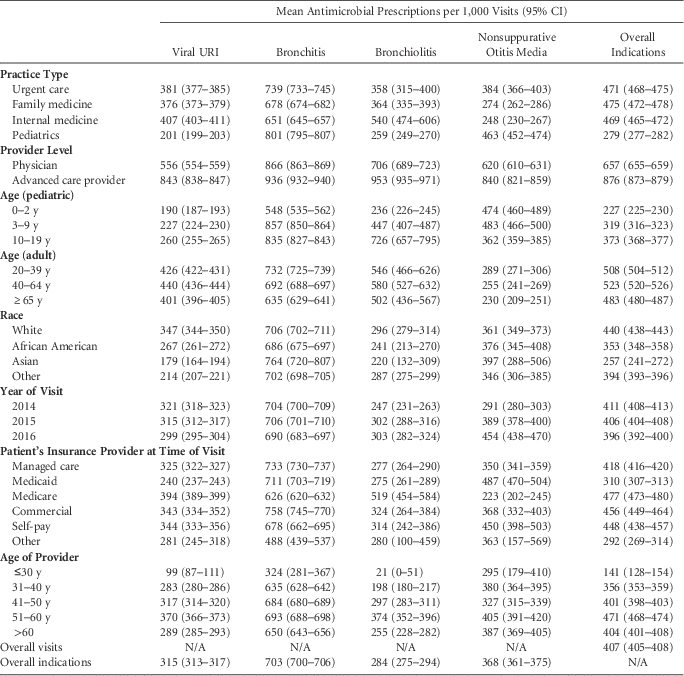
All analyses were performed using Stata software version 14.0 (StatCorp, College Station, TX). Standardized prescribing rates were calculated by obtaining the total number of visits during which an antimicrobial was prescribed, divided by the total number of visits for each of the 5 indications, then multiplied by 1,000. Rates were reported across indications by patient demographics, provider characteristics and practice type (Table 1).
Antimicrobial Prescribing Rates per 1,000 Visits by IndicationFootnote a

NOTE. NA, not available.
a Standardization of prescribing rates = (total visits where antimicrobial was prescribed/total visits) × 1,000.
To adjust for factors that could confound prescribing rates between visits within a single provider, we constructed 2 multivariable models using Poisson regression with robust errors clustered on providers with incident risk ratios reported.Reference Cameron and Pravin 21 – Reference Zou 23 The measured outcome was whether an antibiotic was prescribed at the visit (yes/no). Two models were built to separate pediatric patients (ages 0–19 years) from adult patients (20–65 years and older) given the systematic differences in the care of these 2 populations. Incident risk ratios (IRRs) were reported to facilitate ease of interpreting the risk of receiving an antibiotic. Patient, provider, and practice factors chosen for the models were selected from literature review and guidelines.Reference Harris, Hicks and Qaseem 3 , Reference McKay, Mah, Law, McGrail and Patrick 24 – Reference Ubhi, Patel and Ludwig 26 Once the factors were selected, they were not dropped from our models and the estimates reported. Clustered errors, using providers as the unit of clustering, adjusted for similarities in prescribing practices within individual providers.Reference McKay, Mah, Law, McGrail and Patrick 24
RESULTS
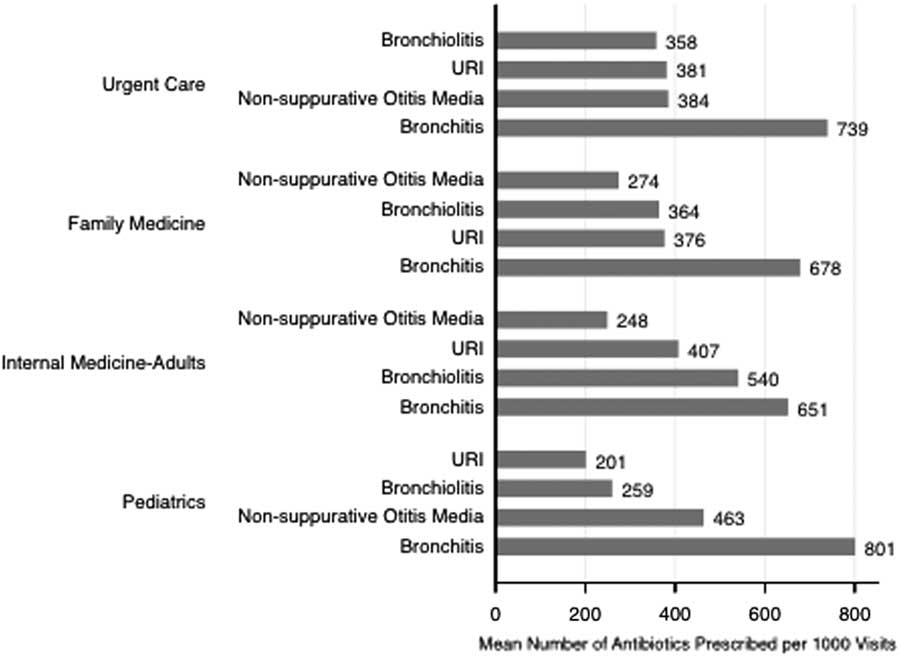
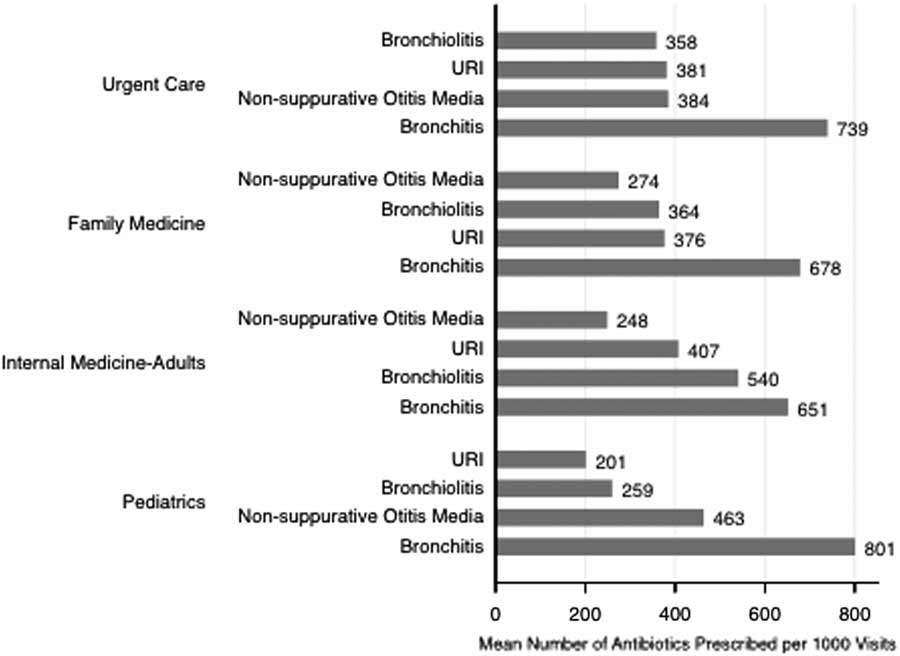
The overall prescribing rate for the 4 indications evaluated (adults and pediatrics) was 407 prescriptions per 1,000 visits (95% CI, 405–408) (Table 1). In the unadjusted analysis, the highest rate of inappropriate prescribing was for acute bronchitis at 703 prescriptions per 1,000 visits (95% CI, 700–706) (Table 1). Family medicine practices had more visits for acute bronchitis than other practice types, while pediatric practices had the most visits for URI (supplementary table 3). For visits with a bronchitis diagnosis for which an antibiotic prescription was written, the most frequently prescribed antibiotic classes were macrolides (59.9%) followed by penicillins (17.2%), quinolones (14.5%), cephalosporins (8.0%), and other (0.4%) (supplementary Table 1). Across all antibiotic classes, the 3 most frequently prescribed antibiotics were azithromycin (46.6%) followed by amoxicillin (18.1%), and amoxicillin-clavulanate (11.8%). Penicillins were the most frequently prescribed antibiotic for nonsuppurative otitis media (62.5%) and bronchiolitis (51.0%). Azithromycin was most frequently prescribed for URI in adults and for acute bronchitis in pediatric patients (Supplementary Table 4).
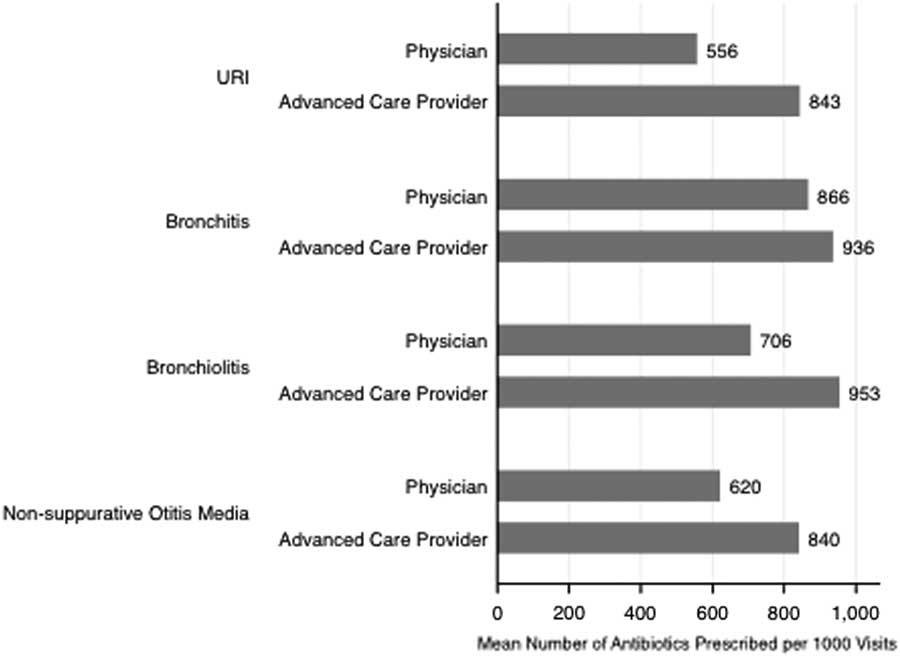
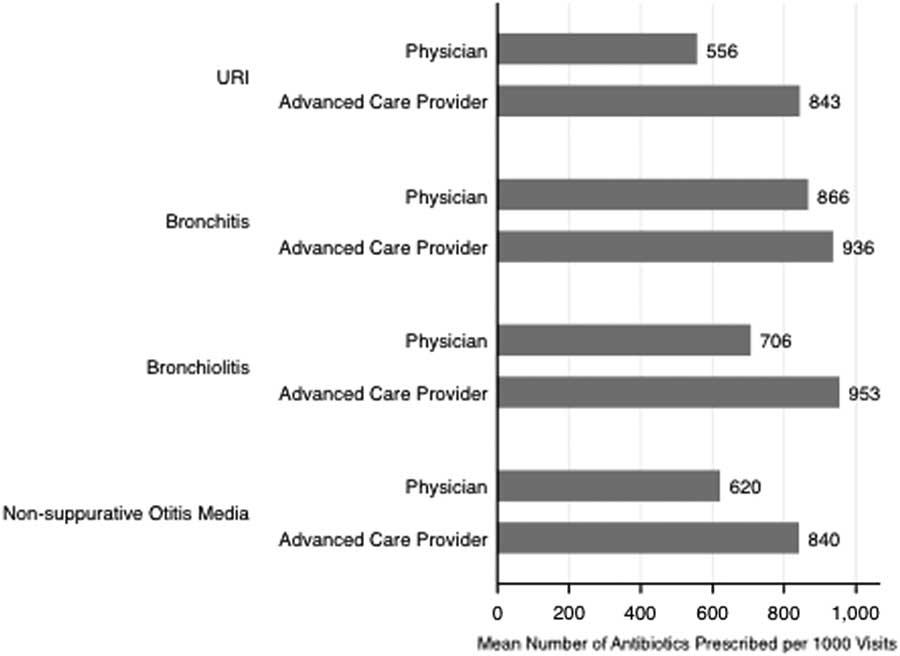
Across all practice types the rates of prescribing were greater for APPs compared to physician providers (Table 1). At the practice level, family medicine practices had the highest rate of prescribing, while pediatric practices had the lowest rate. There was a 133.4% increase in the antibiotic prescribing rate across all indications for patients aged 0 to 64 years (227–523 per 1,000 visits) (Table 1 pediatric and adult overall rates). Prescribing rates began to decline for patients aged >64 years.
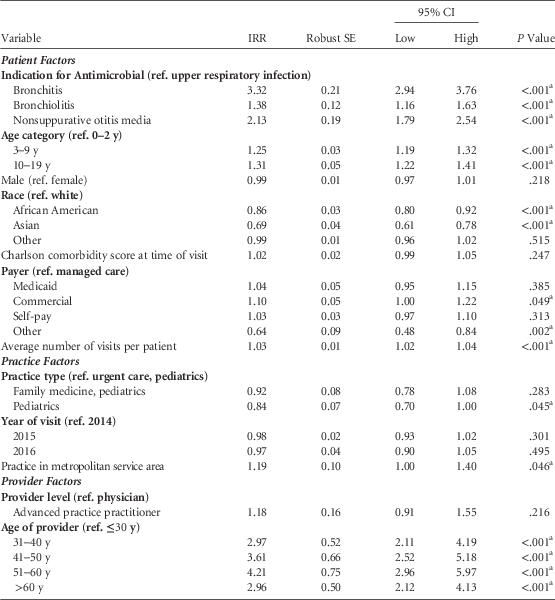
In the adjusted analyses for the pediatric sample, the risk of receiving an antimicrobial at a visit increased as patient age increased (Table 2). For example, patients 3–9 years of age had a 25% greater risk of receiving an antimicrobial than those aged 0–2 years (IRR, 1.25; 95% CI, 1.19–1.32), and this rate increased further for those aged 10–19 years (Table 2). African-American and Asian pediatric patients were less likely than white patients to receive an antibiotic at a visit (Table 2). Pediatric patients with commercial insurance plans were 10% more likely to receive an antibiotic prescription than those with managed care plans (IRR, 1.10; 95% CI, 1.00–1.22). However, patients with other methods of payments that included worker’s compensation plans, homeless without insurance, and community grant coverage were 36% less likely to receive an antibiotic prescription (IRR, 0.64; 95% CI, 0.48–0.84).
Pediatrics Poisson Regression Model with Provider Clustered Errors

NOTE. IRR, incident risk ratio.
a Significance level, P<.05.
At the practice level, pediatric practices were 16% less likely to prescribe an antimicrobial than urgent care practices (IRR, 0.84; 95% CI, 0.70–1.00). Practices seeing pediatric patients and residing in an urban setting prescribed more antibiotics than those in rural settings (Table 2).
Among providers, the risk of a patient receiving an antibiotic increased as the provider’s age increased up to age 61 across all indications (Table 1). When adjusted in the pediatric sample, providers aged 51–60 years at the time of the visit were 4 times more likely to prescribe an antimicrobial compared to providers aged ≤30 years (IRR, 4.21; 95% CI, 2.96–5.97), but the risk began to decrease for providers aged ≥60 years (IRR, 2.96; 95% CI, 2.12–4.13) (Table 2).
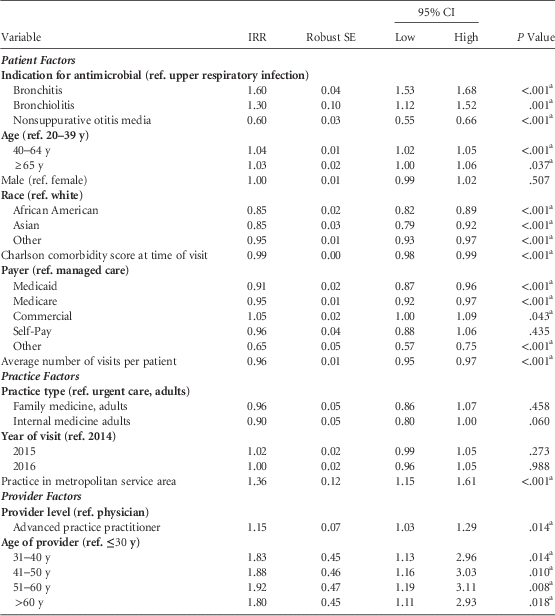
In the adult adjusted model, patient age and race were associated with prescribing (Table 3). Patients aged 40–64 years were 4% more likely to receive an antibiotic than patients aged 20–39 years (IRR, 1.04; 95% CI, 1.02–1.05). All other races were less likely to receive an antibiotic than white patients (Table 3). Patients with Medicaid, Medicare or other payment methods were also less likely to receive an antimicrobial compared to those with managed care plans (Table 3). For adults seen in a metropolitan area, the risk of receiving an antibiotic was 36% greater than in rural practices (IRR, 1.36; 95% CI, 1.15–1.61). However, the type of practice was not associated with antimicrobial prescribing for adult visits.
Adults Poisson Regression Model with Provider Clustered Errors

NOTE. IRR, incident risk ratio.
a Significance level, P<.05.
After adjusting for patient and practice factors, APPs were 15% more likely to prescribe an antibiotic than physician providers (IRR, 1.15; 95% CI, 1.03–1.29) in adult patients (Table 3), but this did not hold true for pediatric visits (Table 2). The age of the prescribing provider was associated with an increased risk of prescribing an antibiotic and was similar in the pediatric sample (Table 3).
DISCUSSION
Antimicrobial stewardship in the acute inpatient care setting has demonstrated effectiveness in decreasing inappropriate antibiotic utilization over the last 20 years and has been associated with decreasing antimicrobial resistance.Reference Ubhi, Patel and Ludwig 26 – Reference Dobson, Klepser and Pogue 29 Studies have identified multiple interventions that have been part of successful inpatient stewardship, such as front-end restriction or post-prescription review and feedback.Reference Dobson, Klepser and Pogue 29 , Reference Drekonja, Filice and Greer 30 In contrast to the outpatient setting, inpatient stewardship focuses on a somewhat static patient population; patients are admitted for several days and can be followed over time to evaluate clinical progress, to review culture data, and to conduct interventions.Reference Pollack and Srinivasan 31
Antimicrobial stewardship in the outpatient setting seeks to address a population that differs in acuity, microbiologic etiology, and patient characteristics. While outpatients are typically less acutely ill than inpatients, national data demonstrate that the volume of antibiotics used in the outpatient setting is much greater, with up to 30% of all outpatient antibiotic prescriptions deemed unnecessary and up to 50% inappropriate for the indication.Reference Fleming-Dutra, Hersh and Shapiro 20 , 32 Traditional interventions used in the inpatient setting cannot be practically applied to outpatient stewardship.Reference Gangat and Hsu 33 Because of these differences, the large (and diverse) population of patients that need to be reached, and limited resources available for outpatient antimicrobial stewardship programs, clear evidence is needed to determine which patient populations should be targeted for interventions that can be easily implemented and will yield the greatest reduction in inappropriate prescribing.
A good starting point for identifying how to reduce inappropriate outpatient prescribing is to evaluate diagnoses for which antibiotics are rarely, if ever, indicated. We chose 4 common conditions that do not routinely require antibiotics: acute bronchitis, bronchiolitis, nonsuppurative otitis media, and URI. While these conditions are commonly seen across all outpatient practices, our findings demonstrate that variation in prescribing patterns exists and is associated with several patient, practice, and provider characteristics. The breadth of this study, which included evaluation of prescribing rates for more than 448,990 patient visits, is a key strength that supported the detailed analysis to detect these differences.
Some of our findings were consistent across practice settings. For example, acute bronchitis was the most common indication for which an antibiotic was prescribed. The most common drug prescribed for bronchitis was azithromycin in both adult and pediatric populations. Previous studies and our results suggest that patient and provider education on appropriate prescribing for bronchitis, including guidance on correct use of azithromycin, may be an effective way to reduce prescribing rates.Reference Ubhi, Patel and Ludwig 26 , Reference Fleming-Dutra, Demirjian, Bartoces, Roberts, Taylor and Hicks 34 – Reference Altiner, Brockmann, Sielk, Wilm, Wegscheider and Abholz 37
Our analysis found that patient age was strongly associated with the rates of antimicrobial prescribing even after adjusting for other factors, such as comorbidities, gender, race, and indication. The study results demonstrated that, as patient age increased, the risk of receiving an antimicrobial for any of the 4 indications also rose to age 64, with IRRs increasing by age category in both adult and pediatric models (Tables 2 and 3). After age 64, the rates declined (Table 3). The underlying reason for this association could not be not identified in this study. Based on previous studies and on qualitative work in progress, we hypothesize that working-age patients may pressure providers to prescribe antibiotics based on their misunderstanding of which illnesses will improve with antibiotic treatment and on their need to return quickly to work and family responsibilities.Reference Holmes, Metlay, Holmes and Mikanatha 38 , Reference Pechere 39 These patient dynamics and the pressure they place on provider decisions need to be better understood. In-depth qualitative research could assess this hypothesis and help elucidate the interactions between providers and patients of varying ages that lead to unnecessary prescribing. This information is essential to informing effective antibiotic stewardship interventions.
Many publications have evaluated patient characteristics and attitudes surrounding antimicrobial prescribing.Reference Kuzujanakis, Kleinman, Rifas-Shiman and Finkelstein 36 , Reference Holmes, Metlay, Holmes and Mikanatha 38 , Reference Pechere 39 However, we found that provider characteristics may also impact prescribing rates. A study conducted in urgent care, emergency, and primary care outpatient clinics of the Veterans Affairs Health System found significant variation by provider in prescribing for acute respiratory illnesses, but it did not evaluate provider-specific factors, such as age and level of training.Reference Jones, Sauer and Jones 40 Our results showed significant variation based on provider age, with younger providers prescribing fewer inappropriate antibiotics than older providers.
In the present study, we also found higher levels of inappropriate prescribing by APPs compared to other providers for the adult patient population. For pediatric patients, higher prescribing rates were not associated with APPs. Our findings are similar to other previously published literature which have also found increased associations with prescribing by APPs, especially for acute respiratory tract infections.Reference Sanchez, Hersh, Shapiro, Cawley and Hicks 9 Future national stewardship efforts should target education and antimicrobial stewardship interventions for APPs as their role in patient care continues to grow.Reference Sanchez, Hersh, Shapiro, Cawley and Hicks 9 Unlike other recent studies, we found that prescribing rates were also higher in urban versus rural practice settings, after adjusting for other variables. 41 Our patient population is limited to the southeastern region of the United States, which has been well documented to have the highest prescribing rates.Reference Fleming-Dutra, Hersh and Shapiro 20 , 41 Further evaluation is needed to better identify socioeconomic factors contributing to prescribing in outpatient population.
We detected variation in prescribing rates by patient race. In both pediatric and adult samples, white patients received significantly more antibiotics than other races. These study results are consistent with those in many other studies, for both pediatric and adult populations.Reference Gerber, Prasad and Localio 42 – Reference Mangione-Smith, Elliott, Stivers, McDonald, Heritage and McGlynn 44 Several studies have demonstrated that antibiotics are underprescribed for black adults, but the reasons for this are not fully understood.Reference Kornblith, Fahimi, Kanzaria and Wang 45 , Reference Fleming-Dutra, Shapiro, Hicks, Gerber and Hersh 46
This study had several limitations. First, while data were analyzed at the visit level, administrative billing data were used to identify visits where any of the 4 indications were present as a diagnosis for a single visit. This strategy assumed that the antibiotic was given for the indication identified, which may have affected the accuracy of prescribing rates. Although we also recognize limitations when using billing codes to define the study cohort, we followed prior strategies used by multiple publications to identify our visits to include in the analysis.Reference Fleming-Dutra, Hersh and Shapiro 20 , Reference Watson, Wang and Klima 47 Despite these limitations, our study results are consistent with previously published work reporting that acute bronchitis is a frequent indication for antibiotic misuse.Reference Roberts, Hicks and Bartoces 10 , Reference McCullough, Pollack and Plejdrup Hansen 48 Additionally, our findings support prior results that identified higher antibiotic prescribing rates for APPs than for physician providers.Reference Sanchez, Hersh, Shapiro, Cawley and Hicks 9
Our study identified variation in patient-, provider-, and practice-level factors associated with inappropriate antibiotic prescribing. Antibiotics are not recommended for any of the indications selected for inclusion in this study.Reference Snow, Mottur-Pilson and Gonzales 2 , 15 , Reference Ralston, Lieberthal and Meissner 16 , Reference Chow, Benninger and Brook 49 Understanding the factors that impact prescribing is critical to determining how to reduce the misuse of antibiotics. A “one size fits all” approach to antibiotic stewardship interventions may not be the best strategy to meet aggressive goals for reducing inappropriate prescribing. This study suggests that opportunities exist to tailor interventions to specific settings of care, provider types, and patient characteristics that could be more effective and efficient in improving appropriate prescribing and, ultimately, in reducing antibiotic resistance.
Prescribing rates per 1000 patient visits by practice type and diagnosis.
Prescribing rates per 1000 patient visits by diagnosis and provider type.
ACKNOWLEDGMENTS
Financial support: Support for this study was received from a grant awarded by The Duke Endowment to extend an existing acute-care antimicrobial stewardship program to the outpatient setting. The Duke Endowment provided Carolinas HealthCare with funding to collect baseline data, to perform qualitative research, and to provide education to patients, providers, and practices regarding antimicrobial stewardship. This paper reflects information collected prior to the roll out of an antimicrobial stewardship program to inform and tailor interventions to our ambulatory care setting. The Duke Endowment did not participate in analysis, preparation, review, or any aspect of the research performed at Carolinas HealthCare.
Potential conflicts of interest: All authors report no conflicts of interest relevant to this article.
SUPPLEMENTARY MATERIAL
To view supplementary material for this article, please visit https://doi.org/10.1017/ice.2017.263