Smoking rates are estimated at 70% among persons who are homeless. Veterans experiencing homelessness smoke at even higher rates (74%) (Hammett, Fu, Lando, Owen, & Okuyemi, Reference Hammett, Fu, Lando, Owen and Okuyemi2015). Compared to smokers who are not homeless, smokers experiencing homelessness do not differ in their desire to quit smoking (Baggett, Lebrun-Harris, & Rigotti, Reference Baggett, Lebrun-Harris and Rigotti2013) or in their quit attempt rates (Vijayaraghavan, Tieu, Ponath, Guzman, & Kushel, Reference Vijayaraghavan, Tieu, Ponath, Guzman and Kushel2016), but they are significantly less likely to quit smoking (Vijayaraghavan et al., Reference Vijayaraghavan, Tieu, Ponath, Guzman and Kushel2016). There is a need to identify effective smoking cessation treatment approaches and innovative methods to promote implementation of evidence-based smoking cessation interventions in the health care delivery system for smokers experiencing homelessness.
Currently, there are few approaches that have had significant impact on smoking among the homeless. In a small pilot study of homeless smokers (Shelley et al., Reference Shelley, Cantrell, Warn, Wong, Connor and Scharf2010), an intervention combining group counselling with smoking cessation aides (nicotine replacement therapy, bupropion, or varenicline) resulted in moderate abstinence rates at 24-weeks post-quit. Results of a small-scale randomised controlled trial involving homeless smokers suggested that a smoking cessation intervention combining motivational interviewing (MI), nicotine replacement therapy, and group counselling was feasible and effective (Okuyemi et al., Reference Okuyemi, Thomas, Hall, Nollen, Richter and Jeffries2006). To date, these results have not been replicated in larger scale studies. While there is evidence that provider contact and advice is associated with a measurable effect on smoking cessation in non-homeless smokers (Fiore et al., Reference Fiore, Bailey, Cohen, Dorfman, Goldstein and Gritz2010), physician contact had no impact on smoking rates in a study of 754 homeless persons including homeless veterans (Tsai & Rosenheck, Reference Tsai and Rosenheck2012). Few trials of smoking cessation (particularly that include cognitive-behavioural counselling) have been conducted in highly disadvantaged groups, including homeless smokers (Bryant, Boneski, Paul, McElduff, & Attia, Reference Bryant, Boneski, Paul, McElduff and Attia2011). Indeed, homeless smokers are often excluded from clinical trials for smoking cessation (Goldade et al., Reference Goldade, Whembolua, Thomas, Eischen, Guo and Connett2011).
While the Department of Veterans Affairs (VA) routinely screens for smoking status and offers pharmacological and brief behavioural interventions in primary care settings (McGinnis et al., Reference McGinnis, Brandt, Skanderson, Justice, Shahrir and Butt2011), most VA facilities employ and prefer intensive specialty cessation clinics to reduce smoking (Sherman et al., Reference Sherman, Joseph, Yano, Simon, Arikian and Rubenstein2006). The effectiveness of intensive specialty-based care is compromised by limited access and poor adherence. Attendance rates for specialty smoking clinics are as low as 8% (Yano et al., Reference Yano, Rubenstein, Farmer, Chernof, Mittman and Lanto2008). While the VA removed co-pays for smoking cessation care visits in 2005, other barriers including issues associated with travel, scheduling conflicts, work-related concerns, and the number of smoking cessation counsellors continue to limit access.
An alternative to specialty-based smoking cessation clinics is a treatment model that integrates smoking cessation treatment into other ongoing treatment plans, such as treatment for mental health problems or substance abuse treatment (Hall & Prochaska, Reference Hall and Prochaska2009; McFall et al., 2005; Reference McFall, Atkins, Yoshimoto, Thompson, Kanter and Malte2006; Reference McFall, Saxon, Malte, Chow, Bailey and Baker2010). Originally developed to reduce smoking among persons with posttraumatic stress disorder, integrated care (IC) conceptualises smoking as a chronic relapsing condition and capitalises on the ongoing relationship between provider and patient (McFall et al., Reference McFall, Saxon, Malte, Chow, Bailey and Baker2010). A randomised trial found that IC improved cessation outcomes (compared to referral to specialised smoking cessation clinics) among smokers with posttraumatic stress disorder (McFall et al., Reference McFall, Saxon, Malte, Chow, Bailey and Baker2010). It has been suggested that homeless programme providers integrate smoking cessation treatment with other services, such as supported housing (Tsai & Rosenheck, Reference Tsai and Rosenheck2012).
The objective of the project was to evaluate the feasibility of implementing an IC approach in VA clinics that provide homeless services in order to improve the availability of smoking cessation interventions to homeless veterans. The intervention used in the IC approach included counselling (which incorporated MI techniques) and smoking cessation aides, which, in small-scale studies, have been shown to be feasible and effective in reducing smoking among homeless smokers (Okuyemi et al., Reference Okuyemi, Thomas, Hall, Nollen, Richter and Jeffries2006). By leveraging the ongoing relationship between veterans experiencing homelessness and their service providers in homeless programmes, an IC smoking cessation model based in homeless programmes could significantly increase the reach of current smoking cessation services.
A previous project (Ebert et al., Reference Ebert, Malte, Hamlett-Berry, Beckham, McFall and Saxon2014) utilised a learning collaborative (LC) methodology to disseminate and implement the IC smoking cessation model in VA mental health clinics. The LC methodology relies on the participation of multidisciplinary teams and recognised field experts in developing methods for accelerating the use of evidence-based treatments (Ebert et al., Reference Ebert, Malte, Hamlett-Berry, Beckham, McFall and Saxon2014). It emphasises building clinical competence and organisational implementation competence through intensive instruction, booster sessions, ongoing consultation, and reviews (Murphy, Reference Murphy2011). Key components of the LC model include (1) a collaborative goals framework, which specifies the mission and goals of the collaborative and provides guidelines for reaching the goals; (2) monthly improvement metrics, which allow teams to measure progress towards collaborative goals; (3) leadership teams with expertise in the evidence-based practice, implementation, and organisational challenges; and (4) interdisciplinary collaborative teams who represent roles necessary for dissemination and implementation (Langley, Nolan, Nolan, Norman, & Provost, Reference Langley, Nolan, Nolan, Norman and Provost1996).
While the IC model has previously been implemented in other VA programmes (Ebert et al., Reference Ebert, Malte, Hamlett-Berry, Beckham, McFall and Saxon2014; Murphy, Reference Murphy2011), a large-scale dissemination project focused on smoking cessation in homeless veterans has not been completed. In the current quality improvement project, the LC methodology was used to train providers and implement IC in seven VA clinics providing specialty services to veterans experiencing homelessness. The project was undertaken to examine whether the LC model is appropriate for influencing dissemination and implementation of IC smoking cessation among VA homeless programmes. Through this initiative, participating clinical teams were trained in the IC model, received clinical support in the model, and provided with implementation assistance and organisational sustainability guidance via experienced clinical and implementation coaches. As a part of the seven participating teams, 34 providers received training in the IC model while also being provided MI (front-line providers) and nicotine replacement therapies pharmaceutical (prescribers) booster trainings.
Several aspects of training and treatment delivery were assessed, including whether (1) VA staff actively participated in the collaborative and considered LC methodology useful in supporting IC implementation, (2) LC participation resulted in rapid delivery of IC (i.e., delivery within 3 months) and use of the intervention after LC completion, and (3) VA providers viewed IC as compatible with current clinical practices and feasible to deliver as part of routine health care for veterans experiencing homelessness.
Methods
This 10-month quality improvement project used an LC methodology to deliver clinical training and provide organisational support for the implementation of IC in VA homeless programmes. The key LC stages included (1) identifying VA clinical faculty to provide training and consultation, (2) conducting expert panel interviews, (3) writing of the collaborative goals framework (based on the expert panel interviews), (4) selecting teams, (5) performing organisational assessments of each team, (6) executing launch period activities, (7) implementing Learning Session One, (8) executing Action Period One, (9) implementing Learning Session Two, (10) executing Action Period Two, and (11) implementing Learning Session Three. Figure 1 depicts each stage (See Figure 1).
Flow and structure of learning collaborative. Figure adapted from Institute for Healthcare Improvement (IHI), 2003.

The LC project was completed as a result of collaboration between key stakeholders within VA and Duke University's Evidence-Based Practice Implementation Center (EPIC). Duke EPIC was responsible for assisting with organisation and implementation of all portions of the LC. Seven VA providers (four doctoral level psychologists, two masters’ level counsellors, and one physician expert in smoking cessation prescriptions) were identified to serve as clinical faculty for the LC, and their role was to provide IC clinical training and consultation. Local clinical faculty were selected because they each had demonstrated expertise in provision of smoking cessation among veterans – in fact, most clinicians had expertise in provision of IC smoking cessation among veterans. In addition, several clinical faculty members had experience providing smoking cessation to homeless veterans. Next, we identified expert panel members to interview regarding their views on appropriate goals and guidelines for implementing the programme in VA homeless programmes. Expert panellists did not work with clinical staff or clinical teams; they served in an administrative and advisory capacity. Thirteen experts were invited, but one panellist was unable to participate due to scheduling conflicts. Experts were selected based on their expertise in areas impacted by the LC. Local and national VA experts in health care for homeless veterans were chosen because they could help identify implementation science experts, including those who had developed and/or participated in LCs. Finally, smoking cessation experts, including IC experts, pharmacists, and other clinicians, were chosen to assist in identification and development of appropriate training materials and dissemination ideas. All interviews were completed by phone. The focus of these interviews was to establish the intersection of the benefits of smoking cessation treatment and the needs of the homeless veteran population. Experts were interviewed regarding (1) recommended treatment delivery options, (2) goals for treatment outcomes in the priority population, (3) organisational supports and barriers to implementation of smoking cessation programmes in homeless programmes, (4) clinical team composition, and (5) recommendation of participating VA sites. Based on Langley and colleagues’ (Reference Langley, Nolan, Nolan, Norman and Provost1996) model for improvement, a collaborative goals framework was finalised that summarised the goals of the programme and guidelines for reaching those goals. The framework identified six programme goals related to (1) identification of homeless veterans who smoke, (2) education regarding smoking, (3) treatment provision, (4) supervision, (5) dissemination of training, and (6) evaluation of the programme. The framework for change (i.e., guidelines) identified three areas of importance, including clinical competence in providing IC, organisational capacity to cultivate a team culture that addresses smoking cessation, and veteran engagement in smoking cessation.
Teams from seven different VA Medical Centers (VAMCs) within the VA Mid-Atlantic region (VISN 6) were identified in partnership with VISN 6 leadership. Teams received an information packet and completed a team application outlining training and implementation expectations, assessing each site's organisational readiness, and identifying team members to serve in the four team roles (senior leadership, clinical supervisor/substance abuse specialist, clinician(s), and prescriber). The team application was developed specifically for use in this project, and included questions regarding potential fit of IC into teams’ programmes and perceived challenges to implementation.
Clinical and organisational assessments were completed by each team member as a means of (1) baselining each team's performance at the beginning of the LC and (2) refining training and implementation activities needed to address the gaps/needs of participating teams. The assessment, developed for use specifically in this project, included questions regarding team members’ familiarity with substance use treatment interventions and confidence to provide IC, knowledge about smoking and smoking cessation, and perceptions about (1) barriers to smoking cessation, (2) feasibility of IC, (3) comfort discussing smoking with participants, (4) efficacy of smoking cessation interventions, and (5) importance of smoking cessation among homeless veterans.
Launch period activities included the project team hosting two launch calls to introduce teams to the IC intervention, the LC, and to each other prior to the first training event. During this period, teams completed launch period assignments including self-assessment and readiness activities, introduction to IC intervention, and orientation to the computerised LC workspace.
In Learning Session One, teams met for a two-day training event. The focus was to train the participants in the delivery of IC, share specific implementation areas and strategies for team focus, and orient participants to monthly measures and reporting expectations. During the action period, there was a focus on the development of IC services within the participating homeless programmes, recruitment of veteran patients, and completion of monthly reporting. Bi-monthly action period calls focused on clinical skills/challenges (e.g., MI and nicotine replacement therapies) and organisational/implementation efforts (e.g., patient recruitment and referral to prescribers).
Learning Session Two was held virtually. This learning session focused on teams’ and LC progress on the collaborative goals framework domains (clinical competence, organisational capacity, and veteran engagement) through discussing implementation challenges and solutions and a deep-dive on common clinical challenges teams were facing. Teams also learned additional techniques, skills, and approaches through participating in a veterans’ panel, in which past participants in IC shared challenges and benefits of the model. Additionally, clinicians received a more in-depth training on MI techniques.
As a part of action period activities, a member of Duke EPIC's Implementation Team and a VA IC clinical faculty member jointly conducted site visits with all participating sites/teams. The general outline of these site visits focused on (1) facilitating a discussion on local IC implementation in homeless programmes, (2) celebrating team progress and successes up to that point, (3) working together on local goals and next steps for implementation, and (4) identifying opportunities for collaborative learning such as planning team support. Site visits were completed because they were a cost-effective way to allow study teams to meet face-to-face with clinical staff and the implementation team.
Learning Session Three brought all of the teams together for a face-to-face, two-day event. The focus of this learning session was on (1) sharing successful tools/resources, (2) developing patient flow frameworks and identifying actions that would improve patient flow, (3) discussing clinical successes and barriers, and (4) creating an action plan for spread after the LC.
At the end of Learning Sessions One and Three, participants completed evaluations containing questions about the usefulness/relevance of the information, process questions about quality of specific presentations/topics, reach and spread of IC, and questions aimed at identifying what action steps participants would take from knowledge/skills gained at the learning session. Each participant was sent a link to a Qualtrics survey the day after each learning session. Participants rated items on a four-point Likert scale (1 = strongly disagree, 2 = disagree, 3 = agree, 4 = strongly agree). Less than one month after completion of Learning Session Three, teams completed a post-collaborative interview designed to assess improvements and challenges resulting from the LC, and to identify areas of needed support post-LC.
Intervention description. The IC smoking cessation intervention was developed based on U.S. Department of Health and Human Services’ Clinical Practice Guidelines (Fiore et al., 2010) and the IC intervention that was used in a previous LC among VA mental health providers (Ebert et al., Reference Ebert, Malte, Hamlett-Berry, Beckham, McFall and Saxon2014; McFall et al., Reference McFall, Saxon, Malte, Chow, Bailey and Baker2010). In the IC treatment, clinic providers deliver IC in five individual sessions using a treatment manual that follows best practices in tobacco cessation. The core sessions are delivered once a week for a total of three weeks, focusing on tobacco use education, behavioural skills for quitting smoking, setting a quit date, and relapse prevention. Cessation medications are prescribed by medical staff prior to planned quit dates. At the quit date, clinic providers deliver two-weekly or bi-weekly follow-up visits in which they assess tobacco use, reinforce abstinence, assist with relapse prevention, and reapply cessation treatment to continued smokers. Booster sessions can be available thereafter. In those sessions, clinicians provide assessment, relapse prevention, and reinstatement of smoking interventions. Assignments from a participant workbook correspond with treatment session topics. Because the focus of this project was on efficacy of the LC in impacting organisation change rather than efficacy of the IC intervention, rates of veteran smoking abstinence were not assessed.
Results
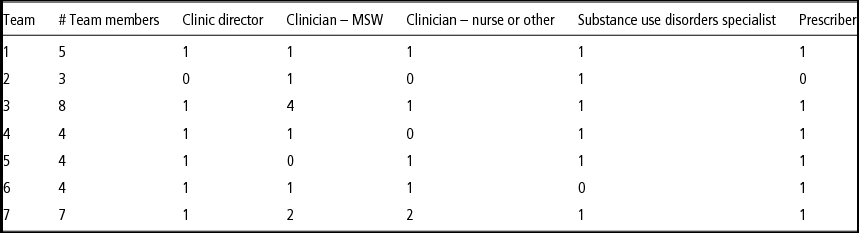
Clinical teams. Table 1 summarises the final make-up of the multidisciplinary teams. Participating teams ranged in size from three to seven. There was a broad range of participants representing each role on their agency team, and most teams had at least one member from each role represented.
Multidisciplinary team roles

Organisation pre-assessment. Based on the organisation pre-assessment, the cohort was optimistic about the impact of and their ability to implement IC treatment. They understood the dangers and risks of smoking and 95% agreed or strongly agreed that counselling by a clinician helps motivate smokers to quit, and 75% agreed or strongly agreed that smoking cessation counselling is an important part of their job. In general, the participants had not gone through an LC before (65%). They commonly highlighted concerns about patients not being interested in quitting and that other health problems requiring attention would interfere with their smoking cessation treatment. They were least concerned about obtaining productivity credits, lack of patient education material, and the complexity of smoking cessation guidelines. Before being trained in the IC treatment, 70% already felt that treating tobacco use as part of routine mental health care is considerably or extremely feasible. The cohort also expressed concerns about implementing IC. These included (1) lack of capacity to identify smokers and assess readiness to engage in smoking cessation treatment, (2) lack of capacity to train additional staff to deliver IC, (3) uncertainty in timely access to smoking cessation medications, (4) practical constraints by each provider (e.g., not enough time) and organisational priorities (i.e., heavy focus on housing identification first) that would inhibit the ability and support to provide the intervention, (5) unsureness of organisational commitment to ongoing supervision on IC, (6) concerns about ensuring continuity of care when working across multiple clinics, and (7) concerns about overcoming challenges inherent in providing this intervention to homeless veterans (e.g., the transient nature of the population, lack of reliable transportation, and inconsistent motivation for change).
Learning Collaborative Components – Participation and Participant Feedback
Participation. Thirty-four participants completed training to provide IC with veterans in the homeless programmes. Participation in the learning sessions, action period activities, consultation calls, and site visits trained team members on providing IC. There were a total of 30 hours of in-person training and 13.5 hours of virtual training/consultation calls.
Across the entire cohort, average participation in in-person training was 24.07 hours (~80% of full participation). There was a large decline in participation at Learning Session Three with 19 of 34 fully participating in this two-day learning session. Conversely, ~92% of team members participated in the site visits, a day-long visit to each site by two LC faculty members that focused on clinical, organisational, and sustainability challenges and successes.
Across the entire cohort, average participation in the virtual training/consultation calls modalities was 6.3 hours (~47% of full participation). An example event impacting this low participation rate was that only ~60% of team members participated in virtual Learning Session Two. This low participation rate was unfortunate, as the content focused on implementing the model effectively considering some of the unique challenges of homeless veterans and organisational challenges of homeless programmes. Also, only about 40% of team members attended a webinar focusing on MI skills. As skillful use of MI techniques are an important aspect of providing IC, the low attendance to this booster training not only affected the participation rate in key LC activities, but also may have limited uptake of key skills by many participants. Conversely, there was strong participation (~80%) in buddy calls, during which homeless programmes with similar patient populations (e.g. rural vs. urban; outpatient vs. domiciliary) were paired to share successes and brainstorm solutions to problems.
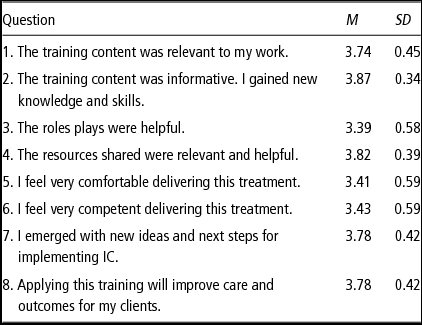
Feedback from clinicians at Learning/session One. Participants completed a measure in which they evaluated components of the training. Completion rate for the measure was 68% (23 evaluations/34 participants). Table 2 summarises the results of the measure. Gaining new knowledge and learning about specific smoking cessation and treatment resources were found to be the most valued aspects of this training activity. The helpfulness of role plays and having an increased comfort level to carry out the intervention were rated as the least successful aspects of the learning session, albeit with only one respondent disagreeing with the usefulness/quality in each of these areas.
Participant feedback regarding learning session 1 (N = 23)

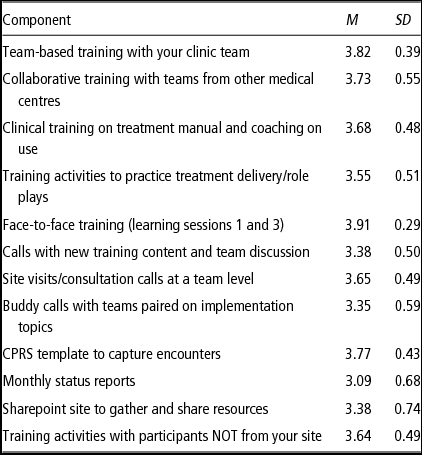
Feedback from clinicians at Learning Session Three. Participants completed a measure evaluating the effectiveness of the components of the LC components. Completion rate for the measure was 76% (22 evaluations/29 participants). Table 3 summarises the results of the measure. Three of the four highest rated components all had to do with the face-to-face, team-based training components, which are an essential part of the LC.
Effectiveness of components of the learning collaborative (N = 22)

Another highly rated component was the electronic medical record template to capture encounters. This finding is surprising given that there was only implementation of templates at one site (seemingly due primarily to each site's internal barriers for standard processes/procedures to have templates added to the VA electronic medical record).
By far, the lowest rated of the LC components were the monthly status reports (M = 3.09), despite the fact that participants received training on use of monthly status reports, including how to use them, how to interpret them, and how to use results to influence team change. While note templates were seen as very valued, monthly status reports that captured much of the same information (although de-identified and not linked to a veteran's chart) was seen to have very limited value. Completion rates of the monthly status reports dwindled significantly after the first few months post-Learning Session One.
Feedback from clinicians at the post-collaborative interview. Per self-report by providers and teams in the post-collaborative interview, the number of providers providing IC intervention in homeless programmes went from zero prior to Learning Session One to 19 (of 34 or 56%) providers one month after the completion of Learning Session Three. All seven teams reported that post-LC, they had improved efforts in assessing smoking among their patients and providing smoking cessation care as a result of LC participation; however, only three teams had standardised procedures in place to (1) identify patients who smoke, (2) assess smokers’ interest in tobacco cessation at the start of treatment, (3) reassess interest in cessation for those not interested initially, and (4) provide information about IC to patients who smoke. Due to internal barriers for processes to add electronic note templates to VA's electronic medical record, we were unable to assess the percent of VA patients who were screened for smoking or received information on IC. As reported by the study teams, site variability in implementation and adoption was related to variations in local resources and expertise, as well as time constraints and organisational commitment.
While all teams claimed in their post-collaborative interviews that they experienced a culture shift towards improved awareness about the importance of IC and providing this model to patients they serve, a detailed analysis showed areas of strengths and continued challenges within this cohort to sustain this culture shift. Six of seven sites reported that a culture shift had taken place where smoking cessation was a priority embraced by all programme staff. Four of seven sites implemented a mechanism to track the progress of those who were interested in smoking cessation. Four of seven sites reported they had a mechanism in place in which their patients could have timely access to smoking cessation medications. Four of seven sites reported they had a mechanism in place to provide initial training to new staff on the IC model, but only two of seven reported having mechanisms for on-going support or consultation for staff newly implementing IC. Three of seven sites reported they had a mechanism in place to use data to monitor IC provision to assure it is applied at current or greater levels within their homeless programmes. These changes were measured less than one month after the end of Learning Session Three; it is unclear whether these represent sustainable changes.
Discussion
More than half of the trained providers reported use of IC at the end of the 10-month LC, and increased significant buy-in to their role and their agency's role in supporting tobacco cessation. In this historically neglected group of smokers, changing provider attitudes in the way that we did in this project is a potentially important shift.
While there were many implementation successes and barriers identified at the end of this LC, an additional goal of this initiative was to provide recommendations for future LC training and implementation initiatives focused on VA homeless programmes. These recommendations are based on the assessed feasibility and fit of implementation of IC via the LC model. There are five recommendations. First, it would be important to provide ongoing support to providers trained in IC during the initiative. Further, it would likely be helpful to provide additional training opportunities to participants on MI. Because in-person training is intensive and costly in terms of personnel resources, other mechanisms such as videoconferencing could be used to increase the reach of training, thereby increasing widespread sustainability. Second, it would likely be helpful to continue to support a culture shift towards tobacco cessation. This could include creating a programme culture and/or an administrative leadership culture that highlights the importance of tobacco cessation efforts, as well as providing incentives for veterans that support follow through with IC treatment (Businelle et al., Reference Businelle, Kendzor, Kesh, Cuate, Poonawalla and Reitzel2014). Third, it would be useful to provide further support for the use of ongoing standard screening and assessment procedures for tobacco use and interest in quitting among homeless veterans. Fourth, it would be helpful to create a tracking tool for clinical progress in IC based on the electronic medical record and require IC providers to complete templated notes. Fifth, continued emphasis on timely access to smoking cessation medications is vital to clinician providers and patient participation; this could be potentially achieved by ongoing and required education for prescribers as well as provision of multiple prescribers for each clinical team.
While this project generated several potentially useful recommendations to impact future training and implementation initiatives on tobacco cessation in the homeless veteran population, there were limitations. Evaluation tools were put into place to elicit feedback, identify barriers, and investigate subjective reports about the treatment model and the training and implementation process. While these subjective measures yielded useful information, it would have been particularly helpful to have had an electronic medical record templated note set for IC in homeless programmes. This would have allowed for objective measurement of the number of veterans screened, assessed, participating in any session of IC, and who actually had a successful quit attempt. Another limitation of the project was that the training provided to participating clinical teams was intense, and relied heavily upon in-person training sessions. Participation may have been more complete had the implementation team relied more upon electronic trainings such as webinars, Skype meetings, and/or educational materials made available through a shared web server. Another limitation was that the project team did not provide to participating clinical teams instructions or guidance for increasing IC implementation among other homeless programme providers in the participating VAMCs. Including this guidance may have increased implementation throughout the homeless programmes.
Conclusion
This project utilised an LC approach to disseminate and implement IC for smoking cessation in seven VAMCs. Although this smoking cessation model had been successfully implemented in other VA health care settings, the model had not been implemented within VA homeless programmes. As a result of this project, implementation successes and barriers were identified, and recommendations for improvement were provided. Participating clinical teams in the LC increased their support for the idea that they, along with their agency, have an important role in supporting tobacco cessation. Although that is an important outcome, it will be important to continue to investigate additional treatment delivery methods and health care policy standards that maximise initial and repeated evidence-based smoking cessation treatment access to homeless smokers.
Financial Support
This work was supported by the Department of Veterans Affairs Office of Mental Health Services, the Veterans Health Administration, Office of Research and Development Grant 1lK2CX000718, Clinical Science Research and Development, and the Mid-Atlantic Mental Illness Research, Education and Clinical Center, Department of Veterans Affairs (VISN 6 MIRECC) of the Department of Veterans Affairs Office of Mental Health Services. The views expressed in this manuscript are those of the authors and do not necessarily represent the views of the Department of Veterans Affairs or the National Institutes of Health.
Conflict of Interest
The authors have no competing interests to report.
Ethical Standards
The authors assert that all procedures contributing to this work comply with the ethical standards of the relevant national and institutional committees on human experimentation and with the Helsinki Declaration of 1975, as revised in 2008.