INTRODUCTION
Knowledge of stomatopod larvae, both taxonomically and ecologically, is limited. At least 450 extant species have been described worldwide (Ahyong, Reference Ahyong2001) arrayed in 17 families and 7 superfamilies (Ahyong & Lowry, Reference Ahyong and Lowry2001). Shanbhogue (Reference Shanbhogue1975b) reported the presence of 115 species falling under 27 genera and 4 families from the Indian Ocean region. Most species of stopmatopods live in shallow water, species of the superfamily Bathysquilloidea are found on outer shelf habitats, down to 1500 m (Manning, Reference Manning1991). Reports by Hof (Reference Hof1998) and Ahyong & Harling (Reference Ahyong and Harling2000) are the most recent phylogenetic studies of the stomatopods, and Manning (Reference Manning1995) and Ahyong (Reference Ahyong2001) are the most recent major taxonomic studies.
The late larval stages are transparent and are active predators in the plankton community (Jutte et al., Reference Jutte, Cronin and Caldwell1998; Image Quest 3-D, 2001). The major contributions on the study of stomatopod larvae are Milne-Edwards (Reference Milne-Edwards1837); Brooks (Reference Brooks1886, Reference Brooks1892); Hansen (Reference Hansen1895); Foxon (Reference Foxon1932, Reference Foxon1939); Gurney (Reference Gurney1937, Reference Gurney1946); Townsley (Reference Townsley1953); Lebour (Reference Lebour1954); Serene (Reference Serene1954); Gohar & Al-Kholy (Reference Gohar and Al-Kholy1957); Manning (Reference Manning1962); Manning & Provenzano (Reference Manning and Provenzano1963); Ingle & Della Croce (Reference Ingle and Della Croce1967); Michel & Wing (Reference Michel and Wing1972); Alikunhi (Reference Alikunhi1975); Provenzano & Manning (Reference Provenzano and Manning1978); Morgan & Provenzano (Reference Morgan and Provenzano1979); Greenwood & Williams (Reference Greenwood and Williams1984); Cronin et al. (Reference Cronin, Marshall, Caldwell and Pales1995) and Moazzam & Moazzam (Reference Moazzam and Moazzam2006).
From the Indian Ocean region stomatopod larvae have been studied by Lanchester (Reference Lanchester and Gardiner1903); Tattersall (Reference Tattersall1906) and Borradaile (Reference Borradaile1907). Our knowledge of stomatopod larvae from the seas around India comprises 86 species which have been studied by Lele (Reference Lele1937); Nair (Reference Nair1941); Alikunhi & Gopala Aiyar (Reference Alikunhi and Gopala Aiyar1942, Reference Alikunhi and Gopala Aiyar1943); Alikunhi (Reference Alikunhi1944a, Reference Alikunhib, Reference Alikunhi1950, Reference Alikunhi1952, Reference Alikunhi1959, Reference Alikunhi1965); Shanbhogue (Reference Shanbhogue1975a, Reference Shanbhogueb, Reference Shanbhogue1978) and Bano & Kazmi (Reference Bano and Kazmi2007). The present study reports the stomatopod larvae collected from the shore of Visakhapatnam in India and identification to the species level for the first time from the Indian east coast.
MATERIALS AND METHODS
Specimens of the mantis shrimp larvae were collected by a shore seine net of 20–25 m span operated off Nagamayapalem, Visakhapatnam inshore area (17°50′46.31″N 83°24′44.25″E); at a depth of 10–12 m on 20 March 2008. The net operation was done during the early hours of the day for a period of two hours. The catch comprised mainly juveniles of leiognathids, lesser sardines (Sardinella fimbriata), lizard fish (Saurida tumbil), and cephalopods of the Sepiidae, besides the mantis shrimp larval specimens being reported. A few octopus and gastropods also were seen in the catch. The net also dragged in about 500 g of plastic materials and some floating weeds.
The stomatopod larvae were seen entangled in the net and were carefully sorted. They were preserved in separate pet containers with 70% (v/v) ethanol. Identification of the specimens was done using the reports by Brooks (Reference Brooks1886); Nair (Reference Nair1941); Alikunhi & Gopala Aiyar (Reference Alikunhi and Gopala Aiyar1942, 1943); Alikunhi (Reference Alikunhi1944a, Reference Alikunhib, Reference Alikunhi1950, Reference Alikunhi1952, Reference Alikunhi1959, Reference Alikunhi1965); Shanbhogue (Reference Shanbhogue1975a); Ahyong (Reference Ahyong2002) and Ahyong et al. (Reference Ahyong, Chan and Liao2008). For photographic documentation and detailed study, a Fuji camera A850 fitted on an Olympus binocular microscope was used.
RESULTS
Six specimens of mantis shrimp larvae were examined.
SYSTEMATICS
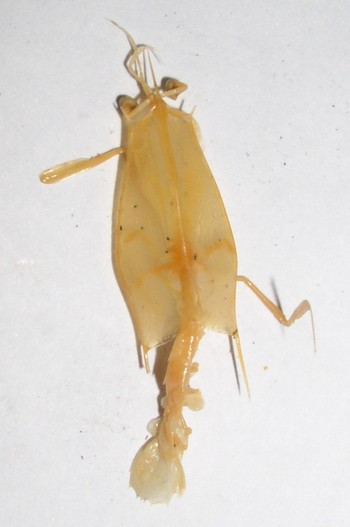
Harpiosquilla harpax, dorsal view.

MATERIAL EXAMINED
Late pelagic larval Stage 5(Nagamayapalem, Visakhapatnam inshore area, 17°50′46.31″N 83°24′44.25″E; depth 10 – 12 m), coll. S. Veena, 20 March 2008.
The specimens are 29–38 mm in length from the tip of the rostral spine to the posterior margin of the telson. Larvae are classified into one group and identified as a single species of the genus Harpiosquilla. Six pelagic stages have been identified previously (Brooks, Reference Brooks1886), but the stage in our findings comprised only late pelagic larval Stage 5. The adult of Harpiosquilla harpax is a common species available in these waters (Shanbhogue, Reference Shanbhogue1969) and the larvae examined resemble those of Harpiosquilla harpax reported by Shanbhogue (Reference Shanbhogue1975a, Reference Shanbhogueb), but further study by culture of the larvae would help to confirm the identification, and hence the search for live specimens continues. The larvae are known to occur in these waters during the months of March–May. The larvae were transparent when they were collected, but on preservation they turned yellowish in colour.
DESCRIPTION OF LARVAE EXAMINED
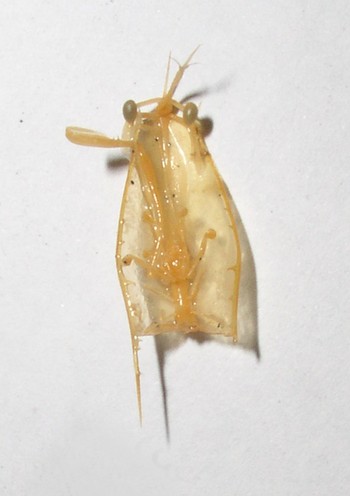
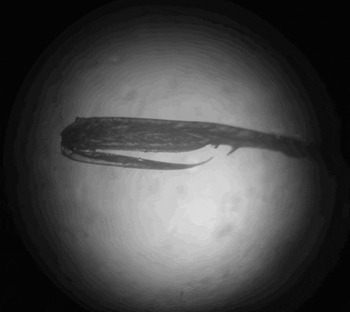
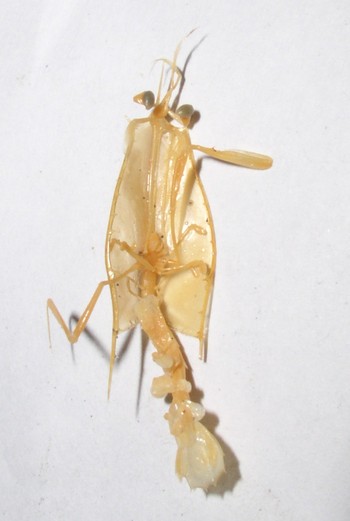
The body is narrow and elongated, exposed hind body is about half the total length as measured from tip of the long slender rostrum to posterior margin of the telson (Figure 1). The raptorial claw of the second thoracic appendage is narrow and greatly elongated; the dactylus is only about half as long as the propodus (Figure 4). The telson has six large marginal carinae, with minute denticles between the submedian carinae, and also between the submedian and intermediate carinae (Figure 5). The anterolateral angle of the carapace has nine small spines on both sides. There are small dorsomedian spines on the posterior edge of the carapace which exposes the last three thoracic somites and another slightly longer spine on the median anterior side of the carapace (Figure 2). The eyes are pear-shaped and the stalks very long (Figure 3). The 5th, 6th, 7th and 8th thoracic somites are shortened, and their appendages are bud-like. The abdominal somites are also short and appendages are represented by a minute bilobed bud (Figure 6). This larva has all the appendages of the adult, either functional or represented by buds, and all the somites of the hind body. The rostrum is very short and pointed. The width of the carapace is about half its length. The carapace with the rostrum makes up almost exactly half of the total length. Total length is 29 mm, median length of the carapace 14 mm, anterior width of the carapace 4 mm, maximum width of the carapace 7 mm, length of the rostrum 3.8 mm, width of the eye 1 mm, median length of the telson 3.2 mm, and width of telson 3 mm.
Carapace with spines.

Stalked eyes.

Claw of appendage.

Telson showing the spines and the tiny spines inbetween.

Ventral view. Abdominal appendages as lumpy outgrowths.

DISCUSSION
Considering the magnitude of the quantities of stomatopods landed along the entire coastline of India by the indigenous craft and the mechanized trawlers the stomatopods are an important group of crustaceans, although they are not fully utilized in the country (Shanbhogue, Reference Shanbhogue1973). They are used for human consumption in certain places in the Indo-Pacific but in India they are not used as food (Kemp, Reference Kemp1913; Roxas & Estampador, Reference Roxas and Estampador1930; Tweedie, Reference Tweedie1934; Kubo et al., Reference Kubo, Hori, Kumemura, Naganawa and Soedjono1959; Shanbhogue, Reference Shanbhogue1973). The stomatopod exhibits two types of larval development, the earlier stages of which are passed in the burrow. Gohar & Al-Kholy (Reference Gohar and Al-Kholy1957) have designated the first three stages as propelagic stages and the later three stages as pelagic stages. The later stages leading to the late pelagic larval Stage 5 of stomatopod resemble the adult and prior to settling out, after six weeks or so in the plankton, they may be 5 cm in length and as transparent as glass. The larvae are known to be associated with coral reefs (Barber et al., Reference Barber, Palumbi, Erdmann and Moosa2002). Since the area under surveillance in this study has no record of coral reefs the presence of these larvae here is interesting.
Our knowledge of stomatopod larvae from the seas around India mainly stems from the extensive studies which have shown the diversity of larvae and the adults to which they belong. Taking into account the number of species known, larvae of a large number of species have not yet been identified and described. With this objective in view and for a better understanding of the distribution of stomatopod larvae from this region, detailed studies on their identification are being undertaken. The stomatopods are considered low value catch and hence discarded or used for manure and fish feed production. It is envisaged to culture these larvae in the laboratory and understand the development and to study the importance of this animal. Although mantis shrimp larvae have been reported from these waters, there has been no study that could identify them to species level until this report.
ACKNOWLEDGEMENT
The authors thank Dr Syda Rao, Director of the Central Marine Fisheries Research Institute (CMFRI) for the encouragements received.