Introduction
Palmer amaranth is one of the most common and troublesome weeds in corn, cotton, and soybean production fields in the southern United States (Webster Reference Webster2005). Palmer amaranth is dioecious (has separate male and female plants) (Keeley et al. Reference Keeley, Carter and Thullen1987). High seed production (0.6 million plant–1), fast growth (Klingaman and Oliver Reference Klingaman and Oliver1994; Norsworthy et al. Reference Norsworthy, Griffith, Scott, Smith and Oliver2008a), continuous emergence (Jha et al. Reference Jha, Norsworthy, Malik, Bangarwa and Oliveira2006), and tall stature (Culpepper et al. Reference Culpepper, Grey, Vencill, Kichler, Webster, Brown, York, Davis and Hanna2006) make Palmer amaranth highly competitive with crops. Ten Palmer amaranth plants per square meter can reduce soybean yield as much as 68% (Klingaman and Oliver Reference Klingaman and Oliver1994), and 0.9 plant m–2 can reduce cotton lint yield by as much as 92% (Rowland et al. Reference Rowland, Murry and Verhalen1999). A density of 0.3 plant m–2 can reduce cotton yield by 22% and can reduce mechanical harvesting efficiency by 2.4% (Smith et al. Reference Smith, Baker and Steele2000). Palmer amaranth density of 0.5 to 8 plants m–1 of row can reduce corn yield 11% to 91% (Massinga et al. Reference Massinga, Currie, Horak and Boyer2001; Massinga and Currie Reference Massinga and Currie2002).
Managing Palmer amaranth is a major challenge, because effective herbicide options are reduced by the evolution of resistance to multiple herbicide modes of action. To date, populations of Palmer amaranth have evolved resistance to inhibitors of ALS (acetolactate synthase), of EPSPS (5-enolpyruvyl-shikimate-3-phosphate synthase), of microtubule assembly, of PS II (photosystem II), of HPPD (4-hydroxyphenylpyruvate dioxygenase), and of PPO (protoporphyrinogen oxidase) (Heap Reference Heap2017). Widespread resistance was a consequence of using glyphosate as the primary and often only tool to manage Palmer amaranth and all other weeds in glyphosate-resistant (GR) crops (Bond et al. Reference Bond, Oliver and Stephenson2006; Starke and Oliver Reference Starke and Oliver1998).
Resistance to glyphosate among Palmer amaranth populations is widespread in the United States (Heap Reference Heap2017). Palmer amaranth is an obligate outcrossing species, allowing herbicide resistance to spread rapidly (Steckel Reference Steckel2007). The glyphosate resistance trait can be transferred to other populations across a distance of at least 300 m through pollen flow (Sosnoskie et al. Reference Sosnoskie, Webster, Kichler, MacRae, Grey and Culpepper2012). Hence, apart from high fecundity and patch expansion, resistance to glyphosate is also spreading long distance through wind pollination and movement of tiny seeds by various vectors. This, in addition to simultaneous independent selection for resistance, has accelerated the spread of GR populations.
The first case of GR Palmer amaranth was confirmed in 2005 in Georgia, where GR cotton was planted in the same field for approximately 7 yr and growers used only glyphosate for weed control (Culpepper et al. Reference Culpepper, Grey, Vencill, Kichler, Webster, Brown, York, Davis and Hanna2006). In the same period (2005), Palmer amaranth plants resistant to glyphosate were confirmed in Tennessee in GR cotton fields (Steckel et al. Reference Steckel, Main, Ellis and Mueller2008) and in Arkansas in GR soybean fields (Norsworthy et al. Reference Norsworthy, Griffith, Scott, Smith and Oliver2008a). Thus, GR Palmer amaranth evolved simultaneously in at least three states and spread rapidly across the southern United States. Three years after detecting the first case of GR Palmer amaranth, 49 counties in the southern United States were reported to have at least one GR population in 2008. One year later the number increased to 93 counties (Nichols et al. Reference Nichols, Bond, Culpepper, Dodds, Nandula, Main, Marshall, Mueller, Norsworthy, Price and Patterson2009). Currently, 27 states have reported GR Palmer amaranth (Heap Reference Heap2017). Many cases of multiple resistances to different herbicide modes of action in Palmer amaranth have also been reported. Therefore, it is important to determine the response of Palmer amaranth to alternative herbicides to make effective herbicide recommendations for resistance management. The evolution of resistance to glyphosate became a concern, because a reliable and most affordable chemical tool to manage weeds POST lost its utility. Consequently, Liberty Link® gene technology and other modes of action are promoted to growers to manage GR Palmer amaranth.
Mesotrione inhibits HPPD, resulting in the depletion of plant plastoquinone and vitamin E pools, leading to bleaching symptoms. HPPD is the target of several herbicide families: isoxazoles, triketones, and pyroxazoles. HPPD inhibitors are used mainly in corn, grain sorghum (Sorghum bicolor L.), and wheat (Triticum aestivum L.). Effective control of annual broadleaf (Amaranthus spp., Ipomoea spp., Solanum spp., Polygonum spp. etc.) and grass [Urochloa platyphylla (Munro ex C.Wright) R.D.Webster, Digitaria spp., Setaria spp. etc.] weeds and excellent crop tolerance are some of the characteristics of this group, which had made HPPD inhibitors an integral part of weed management in corn, grain sorghum, and wheat production systems (Beaudegnies et al. Reference Beaudegnies, Edmunds, Fraser, Hall, Hawkes, Mitchell, Schaetzer, Wendeborn and Wibley2009).
Recently, resistance to HPPD inhibitors has been reported in two Amaranthus spp.: tall waterhemp [Amaranthus tuberculatus (Moq.) Sauer] and Palmer amaranth. The first case of HPPD inhibitor–resistant tall waterhemp was reported in Illinois in 2009. The Illinois population population (MCR) was from a corn field subjected to 7 yr of selection and had 10- to 35-fold resistance to mesotrione (Hausman et al. Reference Hausman, Singh, Tranel, Riechers, Kaundun, Polge, Thomas and Hager2011). Shortly thereafter, HPPD-resistant tall waterhemp was reported in Iowa and Nebraska, showing 8-fold and 13-fold resistance, respectively (McMullan and Green Reference McMullan and Green2011; Oliveira et al. Reference Oliveira, Jhala, Gaines, Irmak, Amundsen, Scott and Knezevic2017). Palmer amaranth has also evolved resistance to HPPD-inhibiting herbicides in Kansas (Thompson et al. Reference Thompson, Peterson and Lally2012) and Nebraska (Jhala et al. Reference Jhala, Sandell, Rana, Kruger and Knezevic2014) within the same period as tall waterhemp. The mesotrione-resistant Palmer amaranth population in Kansas (KSR) was at least 10 times more resistant than the susceptible standard used (Nakka et al. Reference Nakka, Godar, Wani, Thompson, Peterson, Roelofs and Jugulam2017), whereas that in Nebraska had low-level resistance (four-fold) to mesotrione (Jhala et al. Reference Jhala, Sandell, Rana, Kruger and Knezevic2014). In general, across the corn production area of the United States, HPPD-inhibiting herbicides are still an effective tool to control weeds that are resistant to other herbicide modes of action. However, the evolution of resistance to HPPD inhibitors is increasing in already affected states, which would limit the chemical control options for effective management of Palmer amaranth. This is critical, especially because HPPD-tolerant soybeans have been developed (Siehl et al. Reference Siehl, Tao, Albert, Dong, Heckert, Madrigal, Lincoln-Cabatu, Lu, Fenwick, Bermudez and Sandoval2014). The same trait will be placed in cotton. Once these are commercialized, selection for resistance to HPPD inhibitors will intensify and resistance evolution will accelerate, just as we have observed with GR crops, if farmers misuse and overuse the technology.
Having crops that resist HPPD inhibitors is of value, because these herbicides can be mixed with herbicides with different modes of action to broaden the spectrum of weed control and improve total efficacy. Those who adopt this technology must consider, however, that there are already mesotrione-resistant tall waterhemp and Palmer amaranth populations in the United States (Heap Reference Heap2017). It is important to sustain the efficacy of herbicides that still work, especially when crops with multiple stacked traits are commercialized. We conducted this research to evaluate the differential response of Palmer amaranth from Arkansas to glyphosate or mesotrione, to identify mesotrione-recalcitrant populations, to determine if tolerance to mesotrione is heritable, and to quantify the level of tolerance to mesotrione in recalcitrant accessions and their offspring.
Materials and Methods
Plant Materials and Bioassays with Glyphosate and Mesotrione
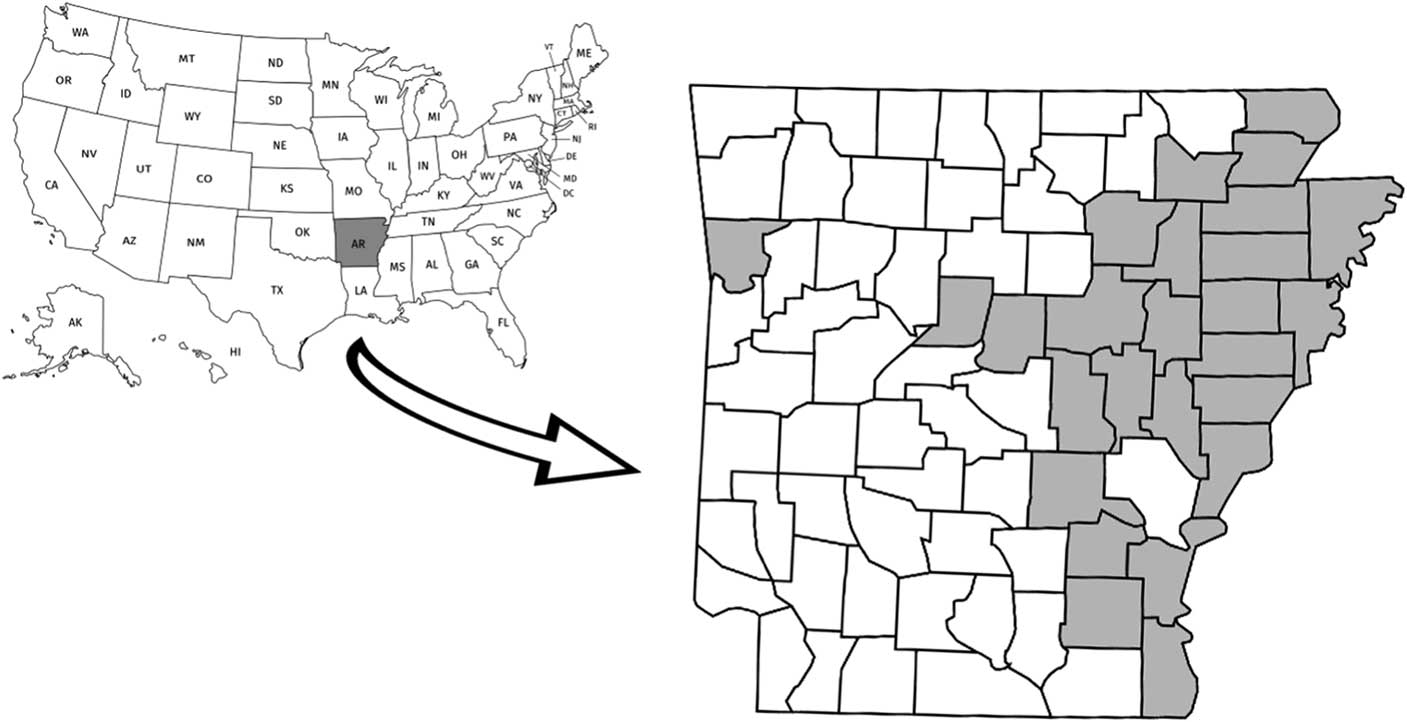
Palmer amaranth plants that remained in the fields at the end of the growing season were sampled in late summer between 2008 and 2016 across the eastern part of Arkansas (Figure 1). Ten to twenty plants from each field were threshed separately. A total of 172 accessions were treated with glyphosate, and 174 accessions were treated with mesotrione. To conduct the herbicide bioassays, a composite seed sample from each field (hereafter referred to as an accession) was prepared by combining 500 mg of seed from each individual plant sample. Accessions were planted in 50-cell trays (Redwayfeed Garden and Pet Supply, Reedway, CA) filled with Sunshine® potting medium (Sunshine premix #1®, Sun Gro Horticulture, Bellevue, WA). Treatments were arranged in a randomized complete design with two replications, where each tray was a replication for that accession with a single seedling per cell. The experiment was conducted twice––first between 2013 and 2014, then between 2014 and 2016. A known susceptible Palmer amaranth population, collected from a vegetable field in Crawford County, was included in each run. Two hundred plants per accession were treated when 7 to 10 cm tall, with glyphosate at 840 g ae ha–1 (Roundup PowerMax®, Monsanto) or mesotrione at 105 g ha–1 (Callisto® 480 SL, Syngenta Crop Protection, Inc.). Mesotrione was applied with 1% crop oil concentrate (COC) and 2.5% liquid ammonium sulfate (AMS). Plants were treated in a spray chamber using a boom fitted with two 80067 flat-fan nozzles (TeeJet spray nozzles, Spraying Systems Co., Wheaton, IL) delivering 187 L ha–1 at 269 kPa. Plants were evaluated 21 d after treatment (DAT) for injury and mortality relative to the nontreated control. Injury was determined using a scale of 0% to 100%, where 0% represented no injury and 100% represented plant death. Data were analyzed using ANOVA in JMP Pro v12 (SAS Institute Inc., Cary, NC). Hierarchical clustering of accessions was accomplished using injury and mortality data.
Map of Arkansas showing eastern counties from where the Palmer amaranth accessions were collected between 2008 and 2014.

Mesotrione Dose–Response Bioassay
Among 174 accessions tested, 4 accessions that had the most survivors with the least injury (11% to 60%) were used in a dose–response assay to determine the level of tolerance. Survivors from the four recalcitrant accessions were grown to produce seed. Survivors from the same accession were grown together outdoors and were separated from other accessions at a minimum distance of 20 m. The F1 progeny were also subjected to dose–response assays to determine if the tolerance level was heritable. In dose–response assays, seeds of the parent accession and F1 progeny were planted in 11- by 11-cm pots filled with Sunshine Mix LC1 potting soil (Sun Gro Horticulture Canada Ltd., Vancouver, British Columbia, Canada). Mesotrione-susceptible Palmer amaranth (CRW09-A), susceptible tall waterhemp (TW-S), and resistant tall waterhemp (TW-R) populations were included as control populations. A known mesotrione-resistant Palmer amaranth population was not available at the time. Seedlings were thinned to five per pot and treated when 7 to 10 cm tall. The recalcitrant Palmer amaranth and resistant TW-R populations were treated with 0, 13.25, 26.25, 52.5, 105, and 210 g ha–1 mesotrione. The susceptible populations were treated with 0, 3.28, 6.56, 13.25, 26.25, 52.5 and 105 g ha–1 of mesotrione. The herbicide was applied with 1% COC and 2.5% vol/vol liquid AMS as described previously. Treatments were arranged in a randomized complete design with six replications and five plants per replication. At 21 DAT, plants were evaluated for injury and the number of survivors. Injury ratings were based on visual estimations of bleaching, necrosis, and plant vigor on a scale of 0% (no effect) to 100% (plant death). Data were analyzed using SigmaPlot v.13 (Systat Software, Inc., San Jose, CA). Data were subjected to nonlinear regression analysis using a three-parameter log-logistic equation (equation 1) to determine the mesotrione dose causing 50% control.
 $$y{\equals}c\,/\,\left[ {1{\plus}e^{{-a{\rm }(x-b)}} } \right]$$
where y is the percentage injury of the nontreated control; a is the asymptote; b is the growth rate; c is the inflection point; and x is the mesotrione dose.
Results and Discussion
Palmer Amaranth Response to Glyphosate
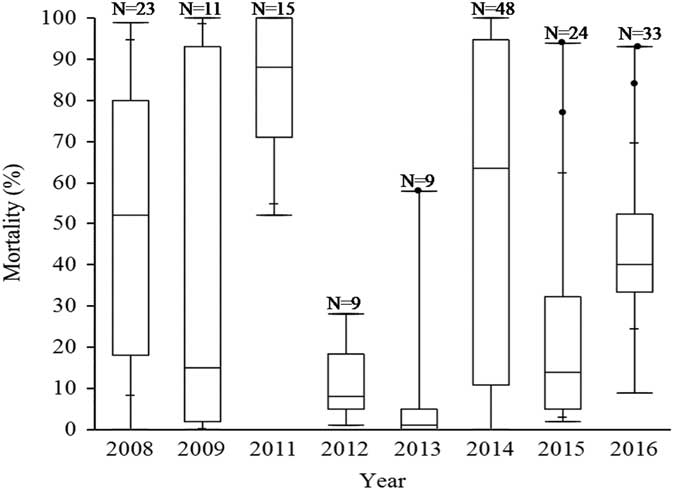
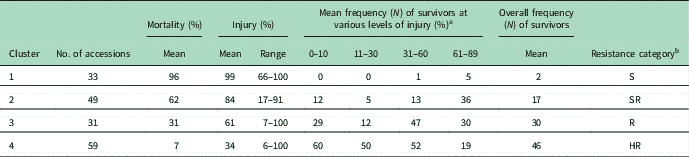
GR Palmer amaranth has been reported in Arkansas (Norsworthy et al. Reference Norsworthy, Scott, Smith and Oliver2008b). The research presented here revealed inter- and intrapopulation variation for injury and mortality of 172 Palmer amaranth accessions treated with glyphosate (840 g ae ha–1). The 172 accessions were collected generally from fields planted with GR cotton or soybean for many years. The accessions differentiated into four clusters based on mortality and levels of injury of survivors (Table 1). Each cluster was assigned a nominal category (S=susceptible, SR=slightly resistant, R=resistant, HR=highly resistant) to indicate their statistical grouping. About 20% of the accessions were susceptible to the glyphosate dose used; the rest fell into various resistance categories. The largest proportion of accessions (34%) were highly resistant (cluster 4), wherein only less than 10% of individuals on average could be killed. The accessions collected during the first sampling (2008) had an average mortality of 52% in response to treatment with glyphosate, with values ranging from 0% to almost 100% (Figure 2). Palmer amaranth response to glyphosate did not change significantly in the follow-up large-scale samplings of 2014 and 2016. This is probably a reflection of mitigation practices adopted by most farmers, primarily including the use of residual herbicides and POST application of multiple modes of action. In other years, samples were collected specifically to confirm suspected resistance in certain fields, upon the request of extension agents or consultants. Such fields generally were confirmed glyphosate resistant. The exceptions were accessions collected in 2011, which were either susceptible or had low frequency of GR individuals.
Variability of Palmer amaranth response to glyphosate (840 g ae ha–1). Glyphosate was applied to seedlings at 7 to 10 cm height. Plant response was evaluated 21 DAT. Box plot shows median values (horizontal line inside the box), first and third quartile values (box-outlines), minimum and maximum values (whiskers), and outlier values (closed circles).

Cluster analysis of Palmer amaranth accessions collected between 2008 and 2016 from Arkansas, USA, and treated with 840 g ae ha–1 glyphosate.

a Average number of survivors based on levels of injury.
b S, susceptible (90% to 100% injury); SR, slightly resistant (61% to 89%); R, resistant (31% to 60%); HR, highly resistant (0 to 30%).
The field populations represented by clusters 3 and 4 are economically problematic for growers because of the high number of Palmer amaranth plants that would survive glyphosate application. An alternative cropping system, alternative modes of action, integrated cultural practices, and new herbicide-resistant crop traits are needed to continue producing cotton or soybean in such fields.
Palmer Amaranth Response to Mesotrione
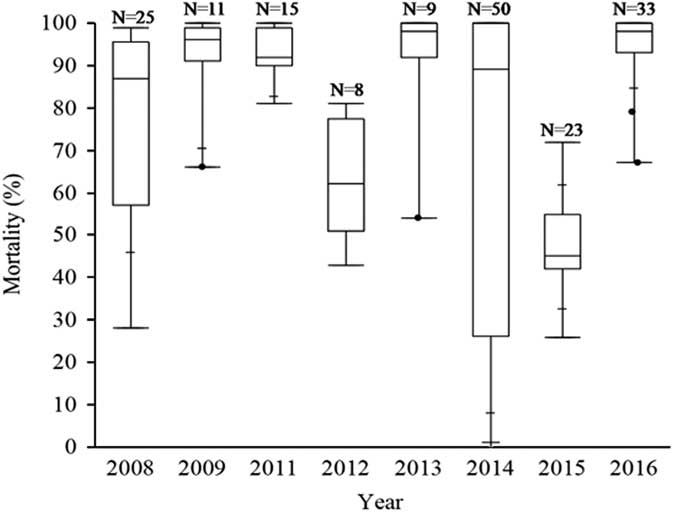
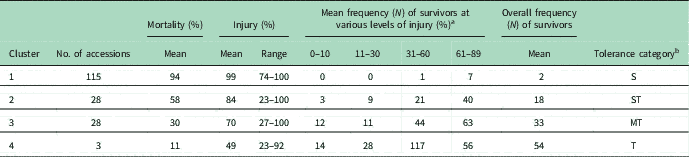
Palmer amaranth in Arkansas has evolved resistance to major herbicide modes of action including inhibitors of EPSPS (Norsworthy et al. Reference Norsworthy, Griffith, Scott, Smith and Oliver2008a), ALS (Burgos et al. Reference Burgos, Kuk and Talbert2001), and PPO (Salas et al. Reference Salas, Burgos, Tranel, Singh, Glasgow, Scott and Nichols2016). A newer chemistry of herbicides that inhibit HPPD (e.g., mesotrione, tembotrione) has been used to control Palmer amaranth. Palmer amaranth populations in Arkansas have not been subjected yet to selection pressure from HPPD inhibitors and are expected to be susceptible to these herbicides. In the present study, only 66% of the accessions were controlled completely with 105 g ha–1 mesotrione (Table 2), which was lower than expected. The rest were grouped into three levels of tolerance. The response of 174 Palmer amaranth accessions differed within and among accessions. Three accessions (cluster 4) were noteworthy, with about one-half of the survivors being healthy enough to produce seed when grown without competition. This shows that some Palmer amaranth populations in Arkansas are more difficult to control with mesotrione than others. An important aspect is the variability in sensitivity to mesotrione within and among populations (Figure 3). Although the average median mortality values generally fall within the 90th percentile, the lowest mortality among accessions was around 30%. The accessions collected in 2015 showed a moderate level of tolerance to mesotrione, with an average mortality of 45%. The lowest mortality was 28%. Among all accessions collected between 2008 and 2016, four accessions [CRW09-B (2009), CLA13-A (2013), CRI16-D (2016), and LIN16-B (2016)] were outliers. These were classified as recalcitrant accessions with 66%, 54%, 67%, and 79% mortality, respectively, which was lower than the mortality of the remaining accessions.
Variability of Palmer amaranth response to mesotrione (105 g ha–1). Mesotrione was applied to seedlings at 7 to 10 cm height, and mortality was evaluated at 21 DAT. Box plot shows median values (horizontal line inside the box), first and third quartile values (box-outlines), minimum and maximum values (whiskers), and outlier values (closed circles).

Cluster analysis of Palmer amaranth accessions collected between 2008 and 2016 from Arkansas, USA, and treated with 105 g ha–1 mesotrione.

a Average number of survivors based on level of injury.
b S, susceptible (90% to 100% injury); ST, slightly tolerant (61% to 89%); MT, moderately tolerant (31% to 60%); T, tolerant (11% to 30%); H, highly tolerant (0 to 10%).
Accessions with many survivors and low injury represent high-risk field populations and are expected to be prone to resistance evolution. The mesotrione-resistant Palmer amaranth population from Nebraska can be controlled only 55% with a full dose of mesotrione (Jhala et al. Reference Jhala, Sandell, Rana, Kruger and Knezevic2014). Resistance has also evolved in tall waterhemp, the dominant Amaranthus species in the northern United States (Hausman et al. Reference Hausman, Singh, Tranel, Riechers, Kaundun, Polge, Thomas and Hager2011). The first case reported was in Illinois, where a full dose of mesotrione controlled the resistant tall waterhemp population only 40% (Hausman et al. Reference Hausman, Singh, Tranel, Riechers, Kaundun, Polge, Thomas and Hager2011). Mesotrione-resistant tall waterhemp was also reported in Iowa and Nebraska in 2009 and 2011 (Heap Reference Heap2017). Thus, resistance to mesotrione among Amaranthus spp. evolved first in states with large areas of corn production where HPPD inhibitors are widely used. The combined area under corn production in Illinois, Iowa, Kansas, and Nebraska was 16 million ha in 2016, representing 43% of the total corn production area in the United States (USDA 2016).
Extensive screening of Palmer amaranth in Arkansas with the field-recommended dose of mesotrione (105 g ha–1) revealed the existence of tolerant genotypes. Tolerant plants usually go unnoticed until the population size becomes large enough to cause reduced herbicide efficacy. Resistant populations could also evolve from repeated selection of recalcitrant plants that are not killed by inadvertent exposure to variable, sublethal doses of herbicides in the field. This would evolve into a population with non–target site resistance. It is important to detect recalcitrant populations, or fields with some tolerant individuals, so that the management approach is adjusted to control such types of populations. Otherwise, resistance would evolve sooner from recalcitrant populations. The relatively tolerant plants can be controlled with the addition of another mode of action in the spray mixture, or a sequential application of another herbicide, preferably with a different mode of action.
Knowing the herbicide response profiles of troublesome weed species informs the development of new technologies to combat resistant weeds. Currently, agrochemical companies have stacked multiple herbicide resistance traits in crops on top of the GR trait. One of these is resistance to HPPD inhibitors in soybean and cotton. Balance™ GT Soybean (Bayer CropScience, MS Technologies, and Mertec LLC) was developed to provide tolerance to glyphosate and the HPPD-inhibiting herbicide isoxaflutole. Similarly, MGI soybean from Syngenta has been transformed to tolerate the HPPD herbicides mesotrione and isoxaflutole as well as glufosinate. Commercializing HPPD herbicide–resistant cotton would also benefit cotton farmers, because these herbicides are compatible tank-mix partners with various herbicides used in cotton. It could have additive or synergistic interactions with glufosinate, glyphosate, the PS II inhibitors (diuron, fluometuron, prometryn), PPO inhibitors (flumioxazin, fomesafen), and others. HPPD herbicide–resistant crops could be another tool for the management of glyphosate-, ALS-, and PSII-resistant Palmer amaranth.
Tolerance Level to Mesotrione
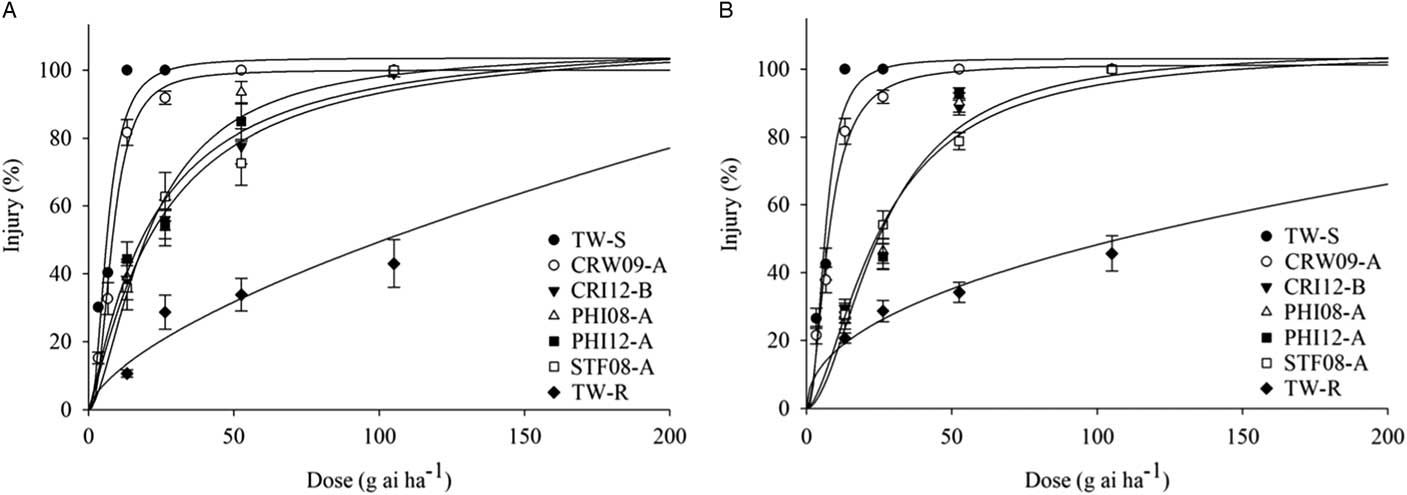
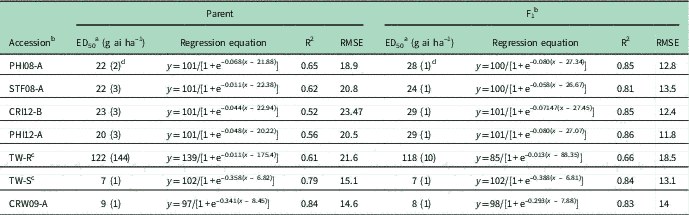
The Palmer amaranth susceptible standard (CRW09-A) and the susceptible tall waterhemp (TW-S) were equally susceptible to mesotrione (Table 3). In contrast, the resistant tall waterhemp was controlled only 50% with the full dose of mesotrione. The recalcitrant accessions had three-fold tolerance to mesotrione compared to the susceptible standard (Figure 4). The tolerance level was heritable, as the ED50 values of the F1 progeny were similar to those of the parent accessions. Practically, this low-level tolerance would not cause an economic problem in the field, because the ED50 values were below 25 g ai ha–1––roughly one-fourth the recommended field dose. Nevertheless, plants in the field are highly variable in size and will be tougher to kill than greenhouse-grown plants. The efficacy of POST herbicides generally declines with increasing plant size. Therefore, the risk for escapes from these recalcitrant populations would be higher in the field than what was observed in the greenhouse. It is expected that repeated selection would increase the tolerance level as the population continues to accumulate tolerance-conferring genes. Recalcitrant populations, if not managed well, will most likely be the harbingers of evolved resistance.
Dose–response analysis of recalcitrant Palmer amaranth accessions. (A) Field-collected accessions; (B) F1 progeny of survivors. Recalcitrant parent accessions and the F1 progeny of survivors were treated at 7–10 cm tall (0, 13.25, 26.25, 52.5, 105, or 210 g ha–1 mesotrione). The susceptible standards (TW-S and CRW09-A) were treated with 0, 3.28, 6.56, 13.25, 26.25, 52.5, or 105 g ha–1 of mesotrione. COC (1%) and AMS (2.5% vol/vol) were added in the spray mixture. Plant response was evaluated 21 DAT.

ED50 values of recalcitrant parent and F1 progeny of Palmer amaranth accessions treated with mesotrione, Arkansas, USA.

a ED50 is the herbicide concentration that could effectively control 50% of the plants at 3 wk after treatment.
b Putative tolerant accessions (parent and F1) were treated when 7 to 10 cm tall with five doses plus control (0, 13.25, 26.25, 52.5, 105, or 210 g ai ha–1); the susceptible standards (TW-S and CRW09-A) were treated with six doses plus control (0, 3.28, 6.56, 13.25, 26.25, 52.5, or 105 g ai ha–1) of mesotrione. COC (1%) and AMS (2.5% v/v) were added to the spray mixture.
c Tall waterhemp, resistant (TW-R), and tall waterhemp, susceptible (TW-S).
Overall, although resistance to glyphosate is widespread in Arkansas, a large proportion (about 50%) of the populations is still susceptible to glyphosate. The GR populations are at different levels of purification. Scientists in the private sector and academia have been searching actively for options. The triketones, including mesotrione, are effective for management of Palmer amaranth, but these and other herbicides must be used judiciously. Alternative herbicide modes of action, such as HPPD inhibitors, should be used with other chemical and nonchemical tools to ensure complete control of Palmer amaranth across a wide range of conditions. The mesotrione-tolerant phenotype was a variant in the population, which could be controlled by tank mixtures of herbicides with different modes of action or sequential herbicide applications. The F1 progeny inherited the low-level tolerance trait from the parent population, but the level of tolerance did not increase after one cycle of selection with mesotrione. Mesotrione, or other HPPD inhibitors, is still a viable option for chemical management of Palmer amaranth, but it has to be used well, because Palmer amaranth (and tall waterhemp) had already evolved resistance to HPPD inhibitors.
Acknowledgments. The authors thank Seth Abugho, Jun Estorninos, Josiane Argenta, and Pamela Carvalho de Lima for their help in planting and spraying the plants. We also thank Syngenta Crop Protection, Inc., the Arkansas Soybean and Promotion Board, and the Arkansas Cotton Board for funding this project. The authors declare no conflicts of interest.