INTRODUCTION
Forest fragmentation may modify the gene flow pattern amongst and within natural plant populations by restricting pollen and seed dispersal (Ghazoul Reference GHAZOUL2005). Negative consequences, such as a heterogeneous pollen pool, endogamy, increase of genetic drift and consequently decrease of genetic diversity may arise when natural populations reveal a spatial genetic structure (SGS) and limited gene flow pattern as a result of forest fragmentation (Bittencourt & Sebbenn Reference BITTENCOURT and SEBBENN2008, Dyer & Sork Reference DYER and SORK2001, Dyer et al. Reference DYER, WESTFALL, SORK and SMOUSE2004, Young et al. Reference YOUNG, BOYLE and BROWN2001). Pollen-mediated gene flow could be considered the main gene flow component, because pollen dispersal covers a spatial area larger than seed dispersal (Robledo-Arnuncio & Gill Reference ROBLEDO-ARNUNCIO and GILL2005, Smouse & Sork Reference SMOUSE and SORK2004). Nevertheless, gene flow via seed dispersal is more important in determining the effective population size and levels of population subdivision, because seeds carry two nuclear alleles, whilst pollen grains carry only one (Hamilton & Miller Reference HAMILTON and MILLER2002, Garcia et al. Reference GARCIA, JORDANO and GODOY2007). However, it is important to consider all potential gene-flow mechanisms when investigating determinants of spatial genetic structure (Freeland et al. Reference FREELAND, BISS and SILVERTOWN2011).
The kinship and spatial distance between individuals within or amongst populations are useful parameters to quantify SGS levels and gene flow (Hardy et al. Reference HARDY, MAGGIA, BANDOU, BREYNE, CARON, CHEVALLIER, DOLIGNEZ, DUTECH, KREMER, HALLÉ, TROISPOUX, VERON and DEGEN2006, Vekemans & Hardy Reference VEKEMANS and HARDY2004). Landscape genetic models may indicate how habitat fragmentation affects levels of gene-flow, genetic structure, local adaptation and genetic boundaries of a population (Guillot et al. Reference GUILLOT, ESTOUP, MORTIER and COSSON2005a). Consequently, both genetic spatial limits and the current gene flow amongst natural populations could be considered important population parameters providing ecological information about forest fragmentation.
The deforestation of large natural areas, which has been occurring in nearly all Brazilian biomes, is responsible for a vast and irreversible loss of biological diversity (Cardinale et al. Reference CARDINALE, DUFFY, GONZALEZ, U., PERRINGS, VENAIL, NARWANI, MACE, TILMAN, WARDLE, KINZIG, DAILY, LOREAU, GRACE, LARIGAUDERIE, SRIVASTAVA and NAEEM2012). Even with high levels of diversity and endemism, more than 90% of the Brazilian Atlantic forest biome has already been lost (Colombo & Joly Reference COLOMBO and JOLY2010). This process has a direct influence on genetic composition of plant and animal populations (Lowe et al. Reference LOWE, BOSHIER, WARD, BACLES and NAVARRO2005). Several studies have shown how habitat fragmentation affects the genetic diversity of the Brazilian Atlantic forest trees (Auler et al. Reference AULER, REIS, GUERRA and NODARI2002, Conte et al. Reference CONTE, REIS, MANTOVANI and VENCOVSKY2008, Franceschinelli et al. Reference FRANCESCHINELLI, VASCONCELOS, LANDAU, ONO and SANTOS2007, Ribeiro et al. Reference RIBEIRO, METZGER, MARTENSEN, PONZONI and HIROTA2009, Salgueiro et al. Reference SALGUEIRO, FELIX, CALDAS, PINHEIRO and MARGIS2004, Seoane et al. Reference SEOANE, KAGEYAMA and SEBBEN2000, Tarazi et al. Reference TARAZI, MANTOVANI and REIS2010). However, few studies have analysed the current pollen-mediated gene flow amongst populations and its consequences for their fine-scale spatial genetic structure and inbreeding level.
Therefore, the main goal of our study was to estimate the levels of pollen-mediated gene flow in C. canjerana spp. canjerana populations located in disturbed and conserved areas, and to assess whether this gene flow is able to prevent the occurrence of a spatial genetic structure within and amongst fragments of montane Atlantic forest of Southern Minas Gerais State, Brazil. Furthermore, the major inquiry that guided this study was related with understanding how the process of habitat fragmentation may affect the pollen dispersal, changing the spatial genetic structure pattern. We hypothesize that forest fragmentation should restrict pollinator movement and gene flow within fragments, enhancing genetic differentiation amongst populations located in separate fragments.
STUDY SPECIES
Cabralea canjerana belongs to a monospecific Meliaceae genus. This species comprises three subspecies, amongst which C. canjerana ssp. canjerana is a tree that grows up to 25 m tall and occurs in Neotropical forests with wide geographic distribution that ranges from Costa Rica to northern of Argentina (Pennington et al. Reference PENNINGTON, STYLES and TAYLOR1981). Cabralea canjerana spp. canjerana is a dioecious subspecies pollinated through visit of small moths to flowers of both sexes, showing high pollinator dependence on seed production (Franceschinelli et al. Reference FRANCESCHINELLI, CARMO, SILVA-NETO and MESQUITA-NETO2015). In Brazil, C. canjerana ssp. canjerana is abundant in southern Minas Gerais State, mainly in montane forests (Barreiros & Souza Reference BARREIROS and SOUZA1986).
STUDY SITES
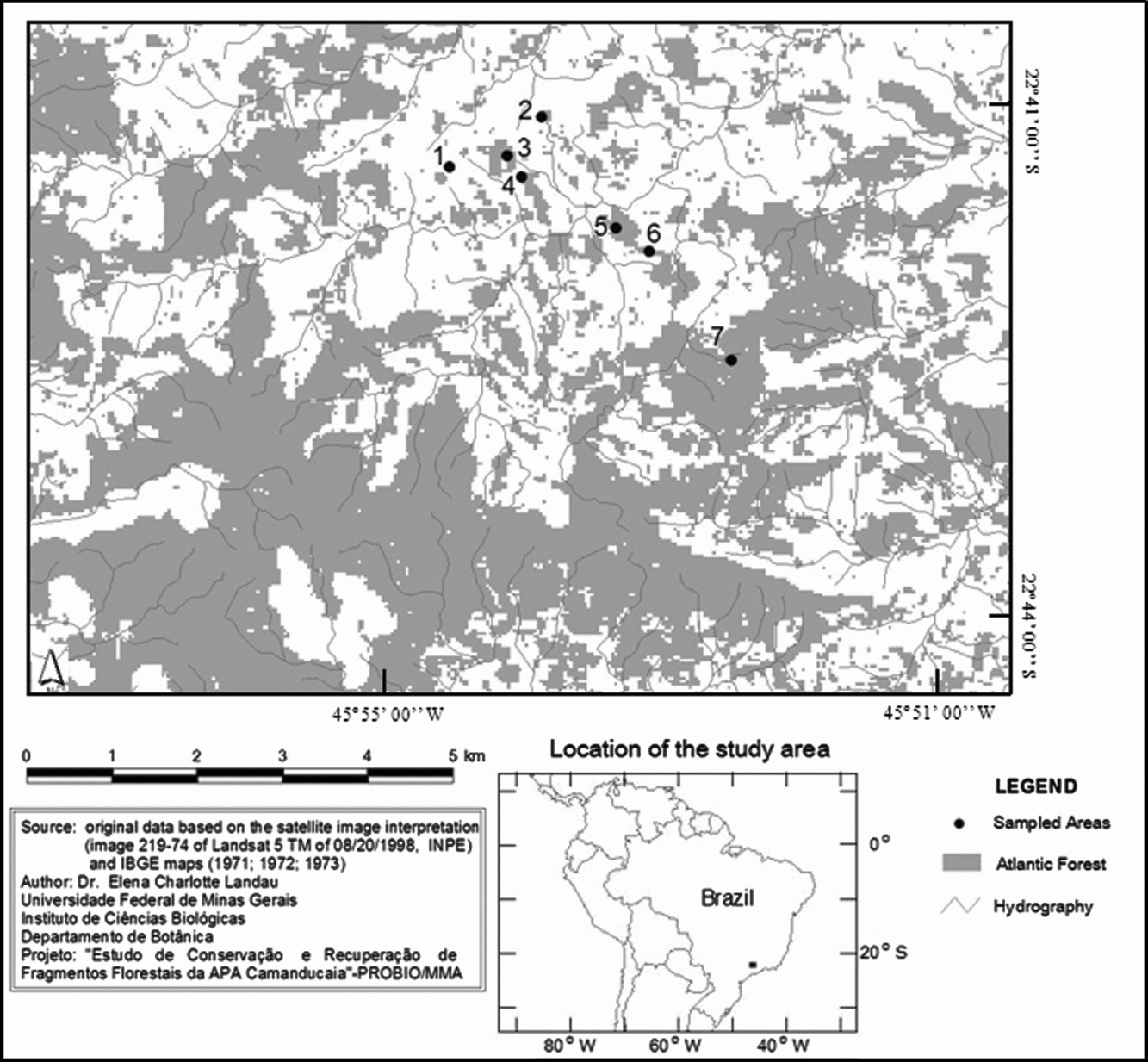
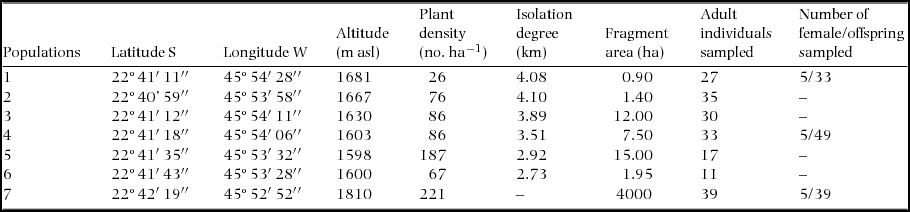
The sampling sites are located at high altitudes in Atlantic forest fragments (montane forest) in southern Minas Gerais State, in Brazil. This type of forest has many close fragments of varying sizes, which are important biodiversity reservoirs. The Brazilian Forest Code law stipulates that natural areas above 1800 m asl, forests located on steep mountainsides and riverbanks be Permanent Protection Areas (PPA) and completely preserved to prevent erosion. The study area has several close fragments frequently linked through riparian forest or other corridors that may facilitate gene flow amongst them. Specifically, the sampled sites are within an Environmental Protection Area (EPA), called Fernão Dias, which covers 180073 ha in a well-known region called Serra da Mantiqueira. Samples were taken from six small fragments (area ≤ 15 ha), of which two are also considered ecological corridors, and in a large area of continuous forest, amounting to seven sampled sites in an area of c. 10 km2. Each sampled site was considered a population and the distances between them ranged from 0.38 to 4.10 km (Figure 1, Table 1).
Studied sites in the montane Atlantic Forest of southern Minas Gerais State, Brazil.

Sample sites, geographic coordinates, demographic traits and number of individuals sampled in Cabralea canjerana subsp. canjerana populations of montane Atlantic forest fragments of Minas Gerais State, Brazil. The degree of isolation is the distance (km) from each site (forest fragment) to the largest sample site (forest fragment 7). Population density refers to the number of adult C. canjerana trees per hectare.
The Atlantic forest in this area was continuous until 1910, when human activity increased with intense logging for many years, causing severe habitat fragmentation. The deforestation decreased after 1985, when timber exploitation and the expansion of agriculture became less intense. In Reference GOODMAN1997, with the implementation of the EPA Fernão Dias, land use and forest exploitation were better controlled (Aguari 2001). Currently, several fragments are well conserved, but others remain subject to selective logging and cattle grazing.
METHODS
Samples and molecular procedures
Leaves of adult C. canjerana ssp. canjerana individuals were randomly collected in the seven study sites. On average, 27 individuals were sampled from each population, totalling 192 adult individuals. On average eight fruits from 15 female trees were also sampled out of these 192 individuals. The females and their offspring were collected from three different populations. We sampled a total of 192 adult individuals and 121 offspring (Table 1). Genomic DNA was extracted using the Slotta et al. (Reference SLOTTA, BRADY and CHAO2008) protocol. Genotyping was carried out for the six microsatellite loci described by Pereira et al. (Reference PEREIRA, BANDEIRA, BLANCO, COELHO, CIAMPI and FRANCESCHINELLI2011). Capillary electrophoresis was performed with an automated ABI-3100 DNA fragment analyser and genotyping was done in GeneMapper 3.5 software.
Gene diversity and spatial genetic structure
The software Identity1.0 was used to evaluate the power of microsatellite loci based on the exclusion probability and genotype identity values. Allelic richness and unbiased expected heterozygosity (HE) (Nei Reference NEI1973) were estimated for each population. The intrapopulation fixation index (f), overall inbreeding coefficient (F) and the measure of genetic structure amongst populations (θ) were estimated according to the parameters of Weir & Cockerham (Reference WEIR and COCKERHAM1984), which are analogous to Wright's F-statistics, FIS, FIT and FST, respectively. We used the software FSTAT 2.9.3.2 for these estimates. Slatkin's RST genetic structure parameter appropriated for microsatellite loci was estimated using RST-calc (Goodman Reference GOODMAN1997). A recent population bottleneck was evaluated for each population using a Luikart & Cornuet (Reference LUIKART and CORNUET1998) empirical test available in the Bottleneck software (Cornuet & Luikart Reference CORNUET and LUIKART1996).
The pattern of the fine-scale spatial genetic structure was evaluated using both geographic distances and kinship estimates between adults, based on the algorithm of Loiselle et al. (Reference LOISELLE, SORK, NASON and GRAHAM1995). The spatial genetic structure was quantified through Sp = b/(F1–1), where F1 is the average kinship coefficient between individuals from the first distance class and b is the regression coefficient proposed by Vekemans & Hardy (Reference VEKEMANS and HARDY2004). SPAGeDi 1.2 software (Hardy & Vekemans Reference HARDY and VEKEMANS2002) was used in these analyses. The independence between genetic kinship and geographic distance matrix was assessed using the Mantel test with 10000 permutations (Sokal Reference SOKAL1979) in R software. An analysis was performed in a Geneland (Guillot et al. Reference GUILLOT, MORTIER and ESTOUP2005b) R package, according to the F spatial model with two groups (K = 2), as previous reported by Melo et al. (Reference MELO, COELHO, PEREIRA, BLANCO and FRANCESCHINELLI2014), to identify the number of genetic groups and geographic boundaries between them. A total of 10000 MCMC interactions and 10 independent runs for each K were used in a Bayesian analysis, considering a burn-in period of 500 steps and sampling frequency of 1 every 100 steps (thinning).
Pollen-mediated gene flow analysis
The global differentiation of the pollen gene pool amongst trees (ФFT) and pollen dispersal distance (δ) were quantified using three populations (Pop. 1, Pop. 4, Pop. 7), based on a normal and exponential distribution model and a fixed male density (de). Both measures were estimated in POLDISP software (Robledo-Arnuncio et al. Reference ROBLEDO-ARNUNCIO, AUSTERLITZ and SMOUSE2007), using 15 female trees and 121 offspring. Austerlitz & Smouse (Reference AUSTERLITZ and SMOUSE2001), cautioned that the ФFT could be overestimated due to the parental inbreeding coefficient (Fp) and proposed a simple correction Ф′FT = ФFT/(1 + Fp). The fixation index (f) may be used as a parental inbreeding coefficient (Fp) since C. canjerana is a dioecious species. The effective number of pollen donors (Nep) was calculated as Nep = 1/2 Ф′FT, which was used to estimate the effective pollination neighbourhood area (Aep = Nep/de), considering the population density (de) of each population studied (Austerlitz & Smouse Reference AUSTERLITZ and SMOUSE2001). The variance of the effective population size (Ne(v)) could be estimated using the coancestry coefficient (Θxy), as proposed by Cockerham (Reference COCKERHAM1969): Ne(v) = 0.5/Θxy, where Θxy = 0.125 (1 + Fp) (1 + rp(m)). The paternity coefficient (rp(m)) proposed by Ritland (Reference RITLAND2002) may be determined as twice of Ф′FT (Hardy et al. Reference HARDY, GONZALEZ-MARTINEZ, COLAS, FREVILLE, MIGNOT and OLIVERI2004).
RESULTS
Population genetic diversity
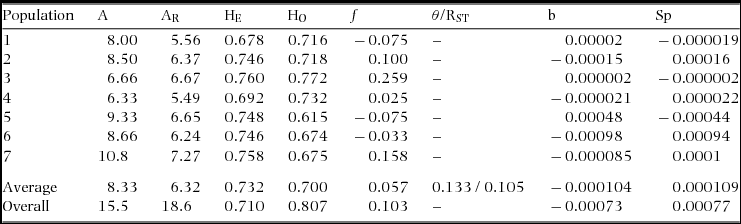
The set of microsatellite loci used to estimate the molecular ecology parameters showed a good performance based on the overall loci estimation of paternity exclusion (0.00000036) and identity probability (0.999). One hundred and thirty-eight alleles were found in the seven C. canjerana populations evaluated. The average of Nei genetic diversity was high (HE = 0.732), as well as the average of allelic richness (AR = 6.32). No bottleneck effect was detected, except for population 2, in which an excess of heterozygosity was found according to the Wilcoxon test (P = 0.015). We also found a low level of intrapopulational inbreeding coefficient (f = 0.057, CI95% = −0.103 to 0.224), and a moderate genetic structure amongst populations (θ = 0.133 CI95% = 0.074–0.208). Approximately 86% of the total genetic diversity was observed within populations (Table 2). The RST = 0.105 (P < 0.05) is consistent with evidence of a strong genetic structure amongst populations.
Genetic population parameters of Cabralea canjerana subsp. canjerana populations located at high altitudes in Atlantic forest fragments in southern Minas Gerais State, in Brazil. A and AR refer to the average of allele number and average allelic richness, respectively. HO is the observed heterozygosity and HE is the Nei gene diversity. f is the intrapopulation fixation index, θ / RST are measures of population genetic structure, b is the regression of kinship coefficient and Sp is the statistic used to quantify spatial genetic substructure. b is the regression of kinship coefficient and Sp is the statistic used to quantify spatial genetic substructure. Except for θ / RST, these parameters were estimated for each population individually and considered as a single overall population.
Spatial genetic structure
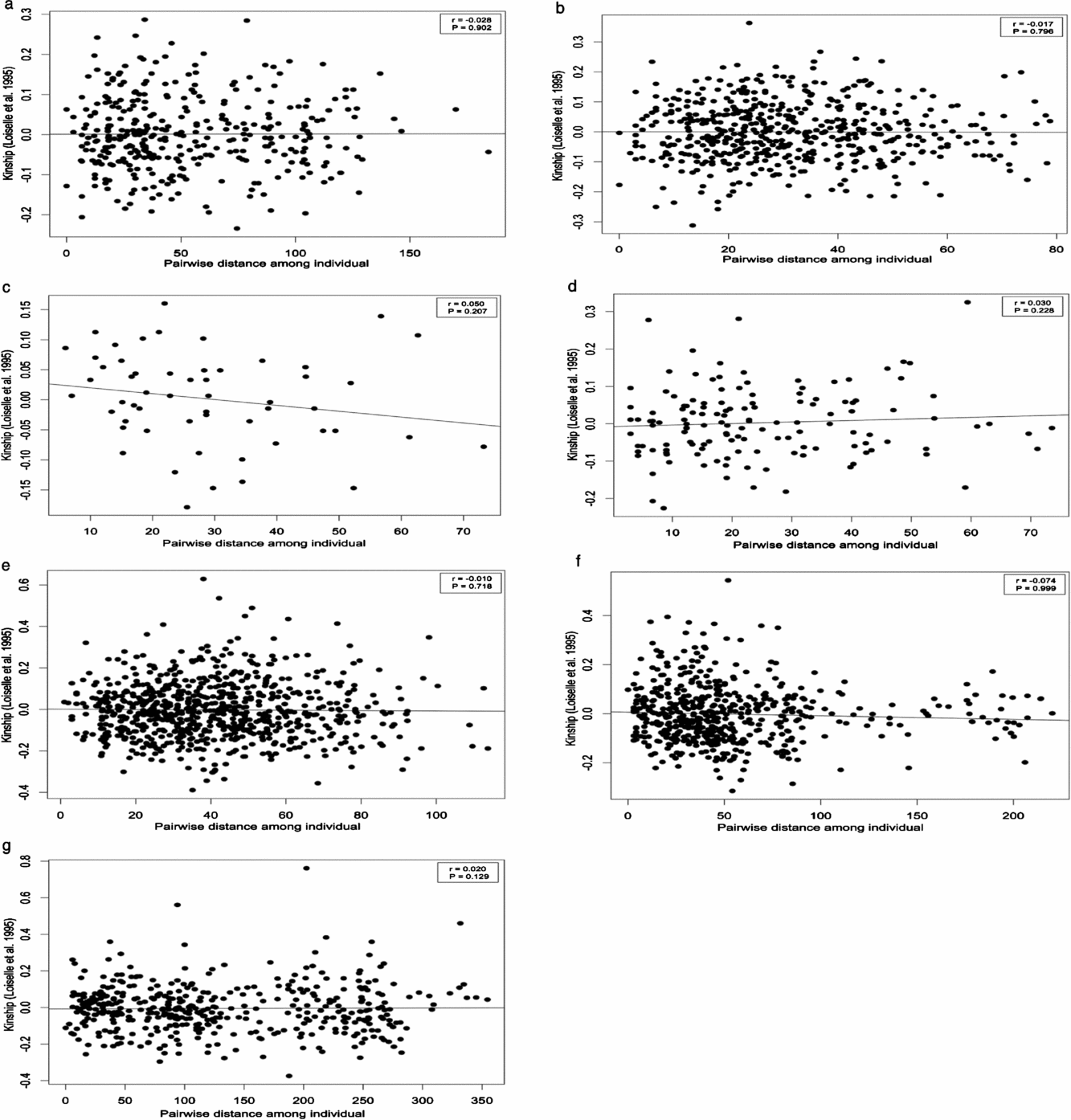
A non-significant relationship between physical distance amongst adult trees and their kinship coefficient was found (Sp = 0.000109) within each population (Table 2). The Mantel test correlogram evaluated the independence between kinship and distance matrices and supported the absence of SGS (Figure 2). The average distance between female individuals was estimated in 127 m, ranging from 10 m (Population 7) to 1040 m (Population 1) amongst the individuals from the same population.
Mantel test correlogram showing the pairwise relationship between Loiselle et al. (Reference LOISELLE, SORK, NASON and GRAHAM1995) kinship (Fij) and the geographic distance (metres) between individuals for the seven Cabralea canjerana subsp. canjerana populations evaluated at high altitudes in Atlantic forest fragments in southern Minas Gerais State, in Brazil.
In the landscape genetic analysis (Figure 3), each group of black points represents one population sampled. The Bayesian analyses of allele frequency found that the seven populations are structured in two distinct groups. The first group (Group A), comprising populations 1, 2, 3 and 4, is represented as white in Figure 3a which means these four populations have high a posteriori probability (around 90%) of being correctly assigned to the same group, whilst populations 5, 6 and 7 have low a posteriori probability of belonging to Group A. In Figure 3b, the scenario is the opposite, as populations 5, 6 and 7 (Group B) have high a posteriori probability to be correctly assigned to the same group. Both scenarios are consistent with the real localization of each sampled site.
Geneland Bayesian allele frequency analysis and graphic representation showing the genetic structure of the population and the genetic boundaries of Cabralea canjerana subsp. canjerana populations in the landscape of the sites studied. Each group of black points represents one population. Populations 1 to 4 are represented in white, meaning that these four populations have a high posteriori probability (around 90%) of being correctly assigned to the same group. Populations 5, 6 and 7, represented in red, have a low posteriori probability (lower than 10%) of belonging to Group A (a), whilst in Group B (b), an opposite scenario is observed.
Pollen-mediated gene-flow analysis
No difference between the normal and exponential dispersal model was found during current pollen-flow estimation. The ФFT values were statistically different from zero in all three populations analysed, with an average of ФFT = 0.156 (Table 3). The average of pollen dispersal distance (δ) for each population was 206 m (range = 140–1040 m), 111 m (42–351 m) and 65 m (10–78 m) for populations 1, 4 and 7, respectively (Table 3), using an exponential distribution model and considering 50% of the plants within a population as the male population density. These values revealed that the pollen dispersal patterns are concentrated within populations (average of 127 m) and are inversely related with fragment size and plant density.
Current pollen mediated gene-flow parameters of three Cabralea canjerana subsp. canjerana populations located at high altitudes in Atlantic forest fragments in southern Minas Gerais State, in Brazil. N/de is the number of adult individuals sampled divided by population density. ФFT = structure of the pollen cloud that fertilized different female trees; Ф′FT = ФFT/(1 + Fp) (Austerlitz & Smouse Reference AUSTERLITZ and SMOUSE2001); δ = pollen dispersal distance between different female trees; Nep = effective population size of pollen donor; Θxy = coancestry coefficient; Ne(v) = variance of the effective population size and Aep = effective size of the neighbourhood area (m2).

The indirect estimates of gene flow (Nem), based on Wright's F statistics (θ = 0.133), suggested the occurrence of 1.63 migrant individuals amongst populations per generation. In addition, the effective number of pollen donors (Nep) was approximately three individuals for each population. Based on the inbreeding coefficient in parental generation (Fp) and co-ancestry coefficient within the progeny (Θxy), the variance of effective population size (Ne(v)) was 3.30 for Population 1, 3.03 for Population 4 and 2.63 for Population 7. Furthermore, we estimated the effective pollination neighbourhood area (Aep), for populations 1, 4 and 7 as 1244 m2, 406 m2 and 146 m2 (Table 3), respectively.
DISCUSSION
Genetic diversity
The high levels of genetic diversity (HE = 0.732) found in C. canjerana populations could be explained by its sexual system, because in dioecious species outcrossing amongst individuals is required. The high levels of intra-population heterozygosity, commonly encountered in microsatellite DNA loci, can lead to very low genetic differentiation measures, as pointed out by Hedrick (Reference HEDRICK1999). However, the estimated θ and RST values revealed that a high proportion of genetic diversity is concentrated within rather than amongst populations. This genetic structure pattern is common amongst outcrossing plant species (Loveless & Hamrick Reference LOVELESS and HAMRICK1984). The similarity between θ and RST estimates suggests that genetic drift is the main force determining the genetic structure of the population and that the dispersive effect of mutation is still of minor importance (Holsinger & Weir Reference HOLSINGER and WEIR2009). The forest fragmentation scenario may have enhanced the levels of genetic differentiation amongst populations through genetic drift and genetic isolation.
The location of population 7 may explain the high levels of genetic diversity found for this population. The forest fragment where this population occurs is one of the largest in the region (about 4000 ha), and is located above 1800 m asl in a steep landscape. According to the Brazilian environmental laws, exploration activities are prohibited in areas located above 1800 m asl. Therefore, human activities are more difficult in the area of population 7, maintaining a high plant density and genetic diversity. Franceschinelli et al. (Reference FRANCESCHINELLI, VASCONCELOS, LANDAU, ONO and SANTOS2007), studying young plants of Myrciaria floribunda in the same area, found higher levels of genetic diversity within populations in higher altitudes as well. Our results show the importance of this type of law in protecting the genetic diversity of Atlantic forest trees. There are significant correlations between altitude, population density and genetic diversity in C. canjerana populations from Fernão Dias EPA (Melo et al. Reference MELO, COELHO, PEREIRA, BLANCO and FRANCESCHINELLI2015).
Short-distance pollen-mediated gene flow
The pollen dispersal distance found was on average 127 m for the C. canjerana population evaluated. Considering this dispersal distance and that a female plant is generally pollinated by pollens that come from three different male trees, most male plants have a high chance of pollinating female plants of the same population. Thus, pollen dispersal is restricted between a few neighbouring plants, mainly in forest fragments with low population density of dioecious plants. However, pollination may eventually happen amongst plants of different populations considering that pollen dispersal distance ranged from 10 to 1040 m.
The pollinator flight behaviour amongst plants and flowers of a plant is an important factor that defines distance over which pollen is dispersed (Dick et al. Reference DICK, ETCHELECU and AUSTERLITZ2003). The concentration of pollen-mediated gene flow within populations may be the consequence of the limited flight distance of C. canjerana pollinators. This subspecies is commonly pollinated by small nocturnal moths (Franceschinelli et al. Reference FRANCESCHINELLI, CARMO, SILVA-NETO and MESQUITA-NETO2015), which usually have a short flight distance (Vilarinho et al. Reference VILARINHO, FERNANDES, HUNT and CAIXETA2011), limiting the pollen flow within populations. This short flight behaviour causes pollination to occur mainly between closer trees, which also explains the small effective pollination in the surrounding area (Aep = 598 m2) and effective population size (Ne(v) = 3.31).
Short-distance pollen dispersal has also been recorded for other tropical tree species pollinated by insects, such as Copaifera langsdorffii in a remnant of semi-deciduous Atlantic forest (Sebbenn et al. Reference SEBBENN, CARVALHO, FREITAS, MORAES, GAINO, DA, M., JOLIVET and MORAES2011), Himatanthus drasticus in fragments of dry forest in Brazil (Baldaulf et al. Reference BALDAULF, CIAMPI-GUILLARDI, AGUIRRA, CORRÊA, SANTOS, SOUZA and SEBBENN2014), and Eurycorymbus cavaleriei in a highly fragmented forest of South-East Asia (Wang et al. Reference WANG, COMPTON and CHEN2011). Short-distance pollen dispersal was also reported in continuous forests for other insect-pollinated species, such as Carapa guianensis (Cloutier et al. Reference CLOUTIER, HARDY, CARON, CIAMPI, DEGEN, KANASHIRO and SCHOEN2007) and Dinizia excelsa in the Amazon rain forest (Dick et al. Reference DICK, ETCHELECU and AUSTERLITZ2003), as well as Calophyllum longifolium, Spondias mombin and Turpinia occidentalis in Barro Colorado Island, Panama (Stacy et al. Reference STACY, HAMRICK, NASON, HUBBELL, FOSTER and CONDIT1996). These studies suggested that the pollen dispersal distance depends mainly on the degree of plant density and aggregation amongst plants within a population.
Nevertheless, it has been found that isolated trees and populations occurring in highly fragmented landscapes, including Symphonia globulifera (Aldrich & Hamrick Reference ALDRICH and HAMRICK1998), Swietenia macrophylla (White et al. Reference WHITE, BOSHIER and POWELL2002), Swietenia humilis (Rosas et al. Reference ROSAS, M., A. and SORK2011) and Dinizia excelsa (Dick et al. Reference DICK, ETCHELECU and AUSTERLITZ2003), may exhibit longer pollen dispersal distance. Here, we found similar results. Populations located in smaller and disturbed fragments showed higher-distance pollen flow than population 7, for example, which is located in a very large and pristine fragment. Probably, the pollinator moths in population 7 only visit neighbouring plants and do not have to fly much further than 65 m to find the necessary resource for their survival. Still, the moths have to travel further to feed in disturbed fragments, such as was shown for populations 1 and 4 (Table 3).
A low Ф′FT value indicates less population differentiation and is consistent with more gene flow within forest fragment. The Ф′FT values estimated for C. canjerana (Table 3) were higher than for other tropical tree species. For example, Bittencourt & Sebbenn (Reference BITTENCOURT and SEBBENN2008) found Ф′FT = 0.084 for Araucaria angustifolia, a dominant tree species in Araucaria forests of southern Brazil. Cloutier et al. (Reference CLOUTIER, HARDY, CARON, CIAMPI, DEGEN, KANASHIRO and SCHOEN2007), studying two Amazon rain-forest species, found Ф′FT = 0.053 and Ф′FT = 0.064 for Carapa guianensis and Sextonia rubra, respectively. However Dick et al. (Reference DICK, ETCHELECU and AUSTERLITZ2003), evaluating populations of an Amazon forest emergent tree, Dinizia excelsa, found Ф′FT = 0.104, a similar value to that found for C. canjerana. However, in contrast to the reports for D. excelsa, Franceschinelli et al. (Reference FRANCESCHINELLI, CARMO, SILVA-NETO and MESQUITA-NETO2015a) found lower fruit and seed production for C. canjerana individuals located in smaller fragments than for those located within a continuous forest. A lower rate of pollinator visits in small fragments than in a continuous forest has also been reported (Franceschinelli et al. 2015b). Therefore, pollen may be moving further in smaller fragments due to the lower plant density, but pollinators are either less abundant or are moving less frequently amongst plants in smaller fragments, causing a pollination deficit in C. canjerana trees of smaller areas.
No pattern of fine-scale spatial genetic structure
Strong SGS was detected among populations although no pattern of fine-scale spatial genetic structure was found. Melo et al. (Reference MELO, COELHO, PEREIRA, BLANCO and FRANCESCHINELLI2014) have already reported a strong SGS amongst these same populations and concluded that isolation by distance and fragmentation could explain this pattern of genetic structure. In our study, the Bayesian analysis of allele frequencies clearly showed that the seven populations are genetically structured in two distinct groups, according to landscape, i.e. the populations from the same group are located in the same mountainside. In addition, populations 1 to 4 are located very close each other, whereas the area of population 6 is an ecological corridor that connects population 5 to the large continuous forest where population 7 is located (Figure 3). Therefore, the isolation amongst close fragments located in the same mountainside or connected through corridors can be weaker.
Although C. canjerana pollinators disperse pollen amongst neighbouring plants, no genetic substructure was found within populations. The absence of an intrapopulational spatial genetic structure (Sp = 0.000109) was not expected because some birds eat the seed aril of C. canjerana in the study fragments and drop the seeds very close to the mother plants (Carmo Reference CARMO2005). However, Pizo & Oliveira (Reference PIZO and OLIVEIRA1998) highlighted that birds performed an efficient seed-dispersal mechanism for C. canjerana subsp. canjerana and in some situations it can fly long distances and efficiently disperse the seeds carried in their bodies, even in a fragmented landscape. Nonetheless, some studies verified that habitat fragmentation might restrict the number of seed dispersers and could change the ecological behaviour of seed dispersers and their relative contribution to plant gene flow (Cordeiro & Howe Reference CORDEIRO and HOWE2003, Ricketts Reference RICKETTS2001). Then, forest fragmentation may also restrict the access of seed dispersers of C. canjerana within populations, contributing to an increase in population differentiation in each generation.
A strong SGS and low level of gene flow was found for populations of other Atlantic forest trees, such as Ocotea catharinensis (Tarazi et al. Reference TARAZI, MANTOVANI and REIS2010), Copaifera langsdorffii (Sebbenn et al. Reference SEBBENN, CARVALHO, FREITAS, MORAES, GAINO, DA, M., JOLIVET and MORAES2011) and Esenbeckia leiocarpa (Forti et al. Reference FORTI, TAMBARUSSI, KAGEYAMA, MORENO, FERRAZ, IBAÑES, VENCOVSKY, MORI and SEBBENN2014). Forest fragmentation was considered the main factor restricting the gene flow and promoting SGS amongst these populations. Furthermore, Wang et al. (Reference WANG, COMPTON and CHEN2011) evaluated the fine-scale SGS in populations of Castanopsis sclerophylla before and after forest fragmentation in the south-eastern section of Qiandao Lake in China. Contrary to our results, significantly greater fine-scale SGS was found in post-fragmentation subpopulations in the most fragmented habitat. Castanopsis sclerophylla is wind-pollinated and seeds are dispersed by gravity and secondarily by rodents. According to the authors, fragmentation may be restricting the secondary dispersal of these seeds. In the present study, fragmentation may be reducing seed dispersal amongst fragments. However, this reduction is not strong enough to cause fine-scale genetic structure within populations.
Therefore, we can conclude that current pollen-mediated gene flow occurs mainly within forest fragment due to short-distance flights of the pollinator of C. canjerana and also due to the forest fragmentation that may have reduced this distance. In addition, plant density decreased with fragmentation, reducing the number of pollinator visits amongst plants. We did not detect any fine-scale SGS in the C. canjerana populations studied, probably because seed-dispersal is an efficient mechanism that promotes gene flow within populations. The high levels of genetic differentiation found amongst these seven sampled sites reinforced how habitat fragmentation affects the gene flow process in natural areas, although a natural corridor and low distance amongst fragments may reduce genetic differentiation.
ACKNOWLEDGEMENTS
We thank the Conservation International (CI) and GEF (Global Environment Fund) for funding this research and CAPES (Coordenação de Aperfeiçoamento de Pessoal de Nível Superior) for the scholarship to the first author. We are indebted to M.F. Pereira, L.F. Bandeira and A.Y. Ciampi for their collaboration in designing the primers. We would like to especially thank to ASG Coelho for all contributions in this work. The authors also wish to thank the journal's anonymous reviewers for their critical feedback.