Introduction
According to a World Health Organization report, China, where suicide ranks the fifth leading cause of death, accounts for an estimated 22% of global suicides, or roughly 200,000 deaths, every year (Weiyuan, Reference Weiyuan2009). In fact, this number may be underreported, considering that some occurrences leading to death are usually not counted as suicide. For example, a study has reported that over 2% of traffic accidents are commonly suicidal behaviors, but suicides by car accident are usually reported as accidental deaths in the national statistics (Pompili et al., Reference Pompili2012). Previous studies have investigated the mortality rates and risk factors for completed suicide; however, in marked contrast to this, there is a lack of a better understanding of attempted suicide in the elderly. Nevertheless, attempted suicide is more relevant in terms of suicide prevention and has particular methodological advantages over examining completed suicide, since completed suicide is at the end of a spectrum of suicidality, while attempted suicide is an important intermediate process that may or may not progress to completed suicide (Chen et al., Reference Chen2009).
In fact, attempted suicide may represent an “unsuccessful” bid for completed suicide where the individual has fortuitously survived (Shah and De, Reference Shah and De1998). Previous studies have also demonstrated that the risk of completed suicide after attempted suicide is relatively high compared to other factors (Hawton and Harriss, Reference Hawton and Harriss2006; Simon et al., Reference Simon, Chang, Zeng and Dong2013). The ratio of attempted suicide to completed suicide is estimated to range between 8:1 and 20:1 in the whole population, and 4:1 in the elderly, which means that most suicide attempts among older adults are first-ever attempts (Szanto et al., Reference Szanto, Gildengers, Mulsant, Brown, Alexopoulos and Reynolds2002). Therefore, significant research on suicide attempts in the elderly is essential for improving prevention.
Most of the research on suicide attempts has been conducted in Western settings, with reported rates focusing mainly on lifetime prevalence and ranging from 0.6% to 6.9% (Ritchie et al., Reference Ritchie2004; Cheng et al., Reference Cheng2010; Ciulla et al., Reference Ciulla2014). To the best of our knowledge, only one study related to attempted suicide in the elderly has been conducted in China using epidemiological approaches. Ma et al. (2009) investigated 5,926 participants in Beijing using the Composite International Diagnostic Interview and found that the lifetime prevalence estimate of suicidal attempts for all age groups was 1.0%. In that study, the prevalence of attempted suicide among 1,159 elderly people aged 65 years or more was 1.2%. However, that study aimed to investigate suicidal behaviors in all age groups and did not pay special attention to the elderly in its discussion.
The exploration of risk factors is important for the prevention of attempted suicide in the elderly. Factors associated with attempted suicide in previous studies included age, gender, marital status, education level, having caregivers, living alone, and mental symptoms (Tsoh et al., Reference Tsoh2005; Shah, Reference Shah2009; Wiktorsson et al., Reference Wiktorsson, Runeson, Skoog, Ostling and Waern2010; Maniam et al., Reference Maniam2014). Considering that these studies refer to either hospitals or psychiatric centers, the generalization of their findings was limited, as many cases of attempted suicide are not reported to the health authorities and may go unobserved (De Leo et al., Reference De Leo2001).
Due to the aging trend in China, suicide in the elderly has become a severe public health issue in recent years. The aging trend in Shanghai is the most serious in China. As of December 31, 2015, the household population (individuals with a registered permanent residence) over 60 years of age was 4.36 million, which accounted for 30.2% of the total household population in Shanghai (Shanghai Research Center on Aging, 2016). Therefore, it is meaningful to conduct an in-depth investigation of attempted suicide in the elderly in Shanghai. This study was based on a large cluster sample of elderly community-dwelling residents in Shanghai and aimed to estimate the prevalence of attempted suicide and examine the associated factors.
Methods
Participants and sample
This study was conducted as part of a project funded by the Shanghai Health and Family Planning Commission, whose principal objective was to assess the aging service needs of the elderly population in Shanghai, China. The research was conducted from March to September 2013, and the sampling method has been described elsewhere (Zhang et al., Reference Zhang2016). In brief, a multi-stage cluster sample of 8,525 house-dwelling residents, aged 60 years or older and living in Shanghai for more than five years, was screened as representative of the elderly population in the downtown area. All eligible participants were then targeted with the help of the local household registry. As our study focused on attempted suicide, 126 participants with missing data on suicidal attempts were excluded from the analysis and 8,399 individuals composed the final sample, giving a valid response rate of 98.52%.
Data collection
Face-to-face interviews were conducted at the participants’ homes. The interviewers were staff at each surveyed neighborhood committee, who were trained by professional investigators in a workshop. The survey was carried out only when written informed consent had been obtained from participants or their family members (except for illiterate participants, who provided only oral consent). First, the interviewers explained the questionnaire items to the participants before the interview. Personnel in charge of quality control and guidance were present during the interview process. Each participant completed the questionnaire independently. To guarantee the validity of the questionnaire, staff of the community health service centers made multiple checks. The study was approved by the Ethics Committee of the Shanghai Medical and Technology Information Institute.
Instruments
The research team designed the questions pertaining to socio-demographic information, which included age, gender, living arrangement, and caregiver details.
The question used to examine suicide attempts was, “How many times have you attempted suicide in the last two weeks?” The possible answers were “none,” “once,” “two or three times,” and “four times or more.” In order to facilitate our analysis, those reporting one or more attempts were defined as having attempted suicide. As a result, the definition of someone that had attempted suicide in this study was a participant that had performed an actual or seemingly life-threatening behavior to end his or her life, but which had not resulted in death, in the past two weeks.
In the present study, the Barthel Index of Activities of Daily Living (ADL) (Mahoney, Reference Mahoney1965) and the Lawton Instrumental Activities of Daily Living Scale (IADL) (Lawton and Brody, Reference Lawton and Brody1969) were used to assess the participants’ capabilities in daily activities. The ADL includes ten items on fundamental activities of daily living: feeding, grooming, bathing, dressing, bowel and bladder care, toilet use, ambulation, transfers, and stair climbing. The IADL assesses the ability to use the telephone, travel, shop, cook, do housework or handyman work, do the laundry, take medication, and manage money. Possible total scores range from 0 to 20 for the ADL and from 0 to 8 for the IADL, with higher scores indicating increased capability in activities of daily living. The internal consistency for the ADL and the IADL in this study was 0.93 and 0.92, respectively.
Mental symptoms were measured using a locally adapted scale, including depressive, anxiety, sad, fear, obsessive-compulsive, and anger symptom. Each symptom was assessed by one specific question. For example, the question to assess depressive symptom was, “During the last two weeks, did you have depressive symptom for more than seven days?” Participants were considered to have the symptom if the answer was “yes.”
Statistical analysis
Frequencies and percentages were calculated for descriptive data. The ADL and IADL scores were computed according to the respective manuals. Bivariate logistic regression and stepwise multiple logistic regression analyses were used to examine the independent associations between each study variable and attempted suicide. The entry and removal criteria for the variables in the multivariate analysis were 0.05 and 0.10, respectively. Odds ratios (ORs) and their 95% confidence intervals (CIs) were calculated to examine the association. The level of significance was set at 0.05 (two-tailed). Data were analyzed using SAS 9.2 (SAS Institute Inc., 2007).
Results
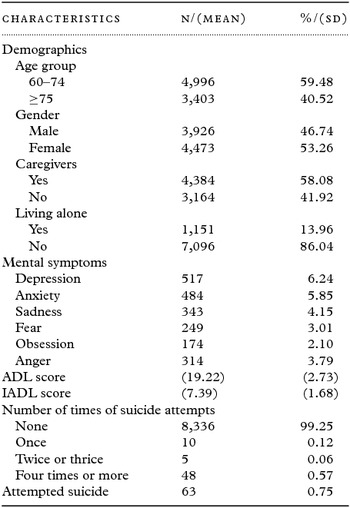
The mean age (SD) of the participants was 72.13 (9.17) years, with a range from 60 to 112 years. Table 1 shows the basic characteristics of the participants. Most were between 60 and 74 years of age, female, having caregivers, and not living alone. Depressive, anxiety, and sad symptoms were found to be the most common mental symptoms. The mean score (SD) was 19.22 (2.73) for the ADL and 7.39 (1.68) for the IADL. The prevalence of suicide attempts by number of attempts was as follows: 0.12% (once), 0.06% (two or three times), and 0.57% (four times or more), respectively. Therefore, the prevalence of attempted suicide was 0.75% and the prevalence of repeated attempted suicide (two or more suicide attempts) was 0.63%.
Characteristics of the elderly residents in Shanghai, China

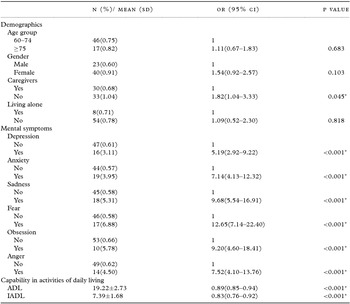
Table 2 shows the bivariate logistic regression analysis of attempted suicide. Having no caregivers, depressive, anxiety, sad, fear, obsessive-compulsive and anger symptom, and lower ADL and IADL scores were significantly associated with an increased risk of attempted suicide in the elderly.
Bivariate logistic regression analysis of attempted suicide among the elderly residents in Shanghai, China

* Statistically significant (p < 0.05).
Table 3 shows the stepwise multiple logistic regression analysis of attempted suicide. Sad (OR = 3.29, 95% CI = 1.12–10.99; p = 0.043) and fear (OR = 5.03, 95% CI = 1.48–17.24; p = 0.010) symptoms were significantly and independently associated with a higher risk of attempted suicide in the elderly.
Stepwise multiple logistic regression analysis of attempted suicide among the elderly residents in Shanghai, China.a

aControlled for age group (60–74 = 0, ≥75 = 1), gender (male = 0, female = 1), caregivers (yes = 0, no = 1), living alone (yes = 0, no = 1), mental symptoms (no = 0, yes = 1), ADL and IADL.
* Statistically significant (p < 0.05).
Discussion
It is observed that 0.75% of the elderly in this study were estimated to have attempted suicide. The two-week prevalence reported here may be higher than the annualized attempted suicide range of 2.6–1,100 per 100,000 for attempted suicide reported in a previous review of 20 studies (Welch, Reference Welch2001). The rate may also be considered above average when compared with the annualized and lifetime rates reported in other studies conducted both in China (Ma et al., Reference Ma2009; Reference Ma2010) and in foreign settings (Ritchie et al., Reference Ritchie2004; Cheng et al., Reference Cheng2010; Ciulla et al., Reference Ciulla2014). Unfortunately, the lack of studies assessing two-week prevalence hinders further comparison. To date, no study has provided strong evidence on the comparability of weekly, monthly, annualized, or lifetime prevalence rates, which should be explored in the future. Nevertheless, recent studies have suggested a relatively short time frame to estimate the prevalence of elderly suicidal behavior (Park et al., Reference Park2013). Therefore, we hope that our study may act as a solid foundation to estimate the prevalence of suicidal behavior within a relatively short time frame.
Prior suicide attempt may increase the relative risk of a further suicide attempt (Miranda et al., Reference Miranda, Scott, Hicks, Wilcox, Munfakh and Shaffer2008; Jeon et al., Reference Jeon2010). Our study suggests that 0.63% of the elderly residents have attempted suicide more than once. However, no previous study has ever focused on multiple/repetitive suicide attempts in elderly populations. To our knowledge, only one study has explored this point and reported a prevalence of multiple/repetitive suicide attempts of 1.1% (Jeon et al., Reference Jeon2010). However, that study did not examine different age groups and hence lacks comparability with our study. Nevertheless, it is still noteworthy that more than 80% of the attempters have conducted repeated suicidal attempts in our study, which should definitely attract the attention of researchers and intervenors. Attempted suicide in the elderly, if not dealt with, may eventually lead to complete suicide.
Demographic factors such as age, gender, having caregivers, and living alone, which have been shown previously to have robust relationships with suicidal attempts (Wiktorsson et al., Reference Wiktorsson, Runeson, Skoog, Ostling and Waern2010; Maniam et al., Reference Maniam2014), were not significant in this study. This may be partly attributable to cultural differences, since most of the existing literature on suicidality is based on Western settings and our sample is based on an Asian country. Nevertheless, we still noticed that having caregivers was significantly associated with a nearly twofold reduction in the risk of attempted suicide in the bivariate analysis. In present China, most of the caregivers of older adults are their family members. It can then be assumed that the caregivers could not only facilitate the elderly's daily life, but also provide them with spiritual support, which would shield them against emotional deterioration and hence prevent the occurrence of suicidal behaviors (Lee et al., Reference Lee2007). We therefore suggest that future studies should focus on suicidal attempts among the elderly population in Asian countries, so as to provide a greater basis for comparison between different cultures.
Capability in activities of daily living, which has been shown to be associated with both suicide (Kaplan et al., Reference Kaplan, McFarland, Huguet and Newsom2007) and suicide ideation (Fanning and Pietrzak, Reference Fanning and Pietrzak2013), has received little attention in relation to suicidal attempts among the elderly. It may be assumed that elderly individuals with low capability in activities of daily living view themselves as a constant burden to others, and this inability may trigger feelings of hopelessness and despair (Zhang et al., Reference Zhang2016), and may hence promote suicidal attempts. In this study, lower ADL and IADL scores were significantly associated with attempted suicide in the bivariate analysis, but not in the multivariate analysis. This is inconsistent with Tsoh's study (Tsoh et al., Reference Tsoh2005), which found that poor functioning levels in activities of daily living were independently associated with suicidal attempts. However, it should be noticed that Tsoh's study was a multi-group controlled study with only 224 participants, whereas ours is a cross-sectional study with 8,399 participants. Considering that it is common for the elderly to lose some abilities with increasing age, further exploration of the relationship between capability in activities of daily living and attempted suicide should be conducted in future studies.
Prior studies have demonstrated a significant association between mental symptoms and suicidal attempts (Ma et al., Reference Ma2009; Jeon et al., Reference Jeon2010). In this study, sad and fear symptoms were independent predictors of attempted suicide in the elderly. This is in consistence with Ballard's studies, which have also suggested fear symptom as an important risk factor for suicide attempts (Ballard et al., Reference Ballard2014). However, Jeon et al. (2010) reported that panic disorder, which is related to fear symptom, was not associated with suicidal attempts in a Korean national study. The potential role of sad and fear symptoms in suicidal attempts among the elderly may be explained as follows. On the one hand, sad and fear symptom are usually associated with stressful and negative life events, such as high medical expenses, death of spouse, and absence of material and spiritual support from children, which actually represent poor living conditions. These poor living conditions may increase feelings of loneliness and hopelessness, both of which have been identified as independent predictors of suicidal behavior in the elderly (Kovacs and Garrison, Reference Kovacs and Garrison1985; Wiktorsson et al., Reference Wiktorsson, Runeson, Skoog, Ostling and Waern2010). On the other hand, it may be assumed that such specific symptoms can be attributed to the age-associated cognitive impairment in older individuals, which has also proved to be highly associated with suicidal attempts in the elderly (Tsoh et al., Reference Tsoh2005).
It is also noteworthy that in this study fear symptom is associated with a more than fivefold increase in the risk of attempted suicide, which suggests that older adults with this symptom should definitely seek the attention of mental health staff. Unfortunately, the degree of generalization of mental health counseling in China is not high at present, not to mention specialized counseling services for the elderly. To use Shanghai as an example, psychological counseling services are mainly provided in some top-level comprehensive hospitals, psychiatric hospitals, and private psychological clinics. However, counseling fees might be too expensive for the elderly, since basic medical insurance does not cover this service to date. Even worse, in the cultural background of China, the elderly is usually reluctant to seek psychological counseling, even if they are already suffering from serious mental illness and experiencing suicide ideation. Nevertheless, the findings of our study suggest the importance of mental health counseling for the elderly to reduce suicidal behaviors. Therefore, the access of older persons to mental health counseling should be promoted and the relevant services should be provided more cheaply and conveniently in order to prevent suicidal behaviors.
In this representative sample of Shanghai, a suicide attempt rate of 0.75% translates into 32,696 elderly house-dwelling residents conducting suicide attempts (Shanghai Research Center on Aging, 2016). However, how many of these would go on to commit suicide is uncertain, since the data on attempted and completed suicide do not necessarily correlate well. The correlation may be affected by various factors such as the intent and resolution of the attempter, the way of committing suicide, and so on. For example, if the elderly has a strong resolution to commit suicide, the way they conduct it may be more lethal and, consequently, it would be almost impossible to perform rescue operations. Nevertheless, it is necessary to remember that a prior history of suicide attempts confers a greater risk of completed suicide, and sustained attention should thus be paid to attempters in order to prevent further potentially fatal attempts. Furthermore, it is also salutary to reduce the possible ways to commit suicide.
Certain limitations to our study should be recognized. First, the absence of psychometric instruments to assess suicidal attempts is one limitation, since one single question may be not enough to characterize the individuals who have attempted suicide in the past. It should be viewed as the main limitation of this study. Second, the cross-sectional design may limit the opportunity to make causality inferences. Third, considering that this particular study is part of a larger investigation, some variables that might have contributed to suicide attempts such as marital status and education level were not measured in order to keep the whole interview manageably short. Fourth, the estimate of the prevalence of attempted suicide may be inaccurate, since there were 126 respondents with missing data on suicidal attempts. At last, mental symptoms were not measured with professional instruments. Therefore, any generalizations based on the findings should be carefully considered.
Nevertheless, the large representative sample still provides robustness to the results, and furthermore, our findings could help public health workers to screen for those at high risk of suicidal attempts among the elderly. To the best of our knowledge, this study is the first to focus on the prevalence and risk factors of suicide attempts among the elderly in Shanghai, China. In order to develop more reasonable preventive strategies for suicidal behaviors, further prospective studies should be undertaken in this area.
Conclusion
The two-week prevalence of attempted suicide among the elderly is relatively high when compared with the annualized or lifetime prevalence reported in China and foreign settings. Mental symptoms such as sad and fear symptom are significantly and independently associated with a higher risk of attempted suicide in the elderly. As a result, elderly individuals with these mental symptoms should be targeted for suicide prevention and provided with timely mental health support.
Conflict of interest
None.
Description of authors’ roles
W. Zhang designed the study and wrote the paper. H. Ding designed the study and supervised the data collection. P. Su supervised the data collection and assisted with writing the paper. Q. Xu was responsible for the statistical design of the study and for carrying out the statistical analysis. L. Du, C. Xie, R. Chen, Y. Yang, C. Jin, L. Gong supervised the data collection. G. Duan and Y. Li assisted with writing and revising the paper. W. Tian designed the study and reviewed the final manuscript.
Acknowledgments
This study was supported by National Natural Science Foundation of China (71373279/71073104/G0308), and Three-year Action Plan Project of Shanghai Health and Family Planning Commission (43).