INTRODUCTION
LCS cognitively biases processing of threat-related data. The result is that the potential threat is perceived to be looming at a frightening velocity. Perceived velocity of the threat is a central component of this construct. Another key construct is that it is not necessarily real dangers that seems to “loom” at dizzying velocities but more often relatively mundane or ambiguous situations (Riskind & Williams, Reference Riskind and Williams1999; Riskind et al., Reference Riskind, Williams and Gessner2000). For example, “loomers” may perceive spiders as moving towards them with greater velocity (Riskind et al., Reference Riskind, Moore and Bowley1995), interpret chest pain as pathological, and hear ambiguous words as more menacing (e.g., sleigh vs. slay) (Riskind et al., Reference Riskind, Williams and Gessner2000), than others.
Although catastophizing, a familiar concept to many readers, bears superficial similarity to looming, it is quite distinct. Despite catastrophizing's “ing” suffix being suggestive of velocity, it actually involves imagined static outcomes rather than the perceived threat velocity. To illustrate, catastrophizing may associate missing a mortgage payment with the static consequence of being homeless. Looming involves the perceived speed at which missing a mortgage payment might cascade into homelessness. In a similar manner, the velocity-dependent function also differentiates looming from interpretive biases that focus on outcomes alone (Williams et al., Reference Williams, Shahar and Riskind2005). Additionally, although catastrophizing has considerable clinical utility in cognitive therapy, quantifying it in anxiety research has proven to be complex. For example, one self-report catastophization measure contains confounding constructs such as rumination, helplessness, magnification, and even suicidality (Turner & Aaron, Reference Turner and Aaron2001).
Previously our group validated the Looming Cancer scale, a 10-item measure, designed specifically for assessing the looming construct in cancer patients (Levin et al., 2007a). Although in non-medical cohorts, looming is generally implicated in an individual's vulnerability to anxiety (Riskind et al., Reference Riskind, Williams and Gessner2000), we found that it correlated equally well with depression in a CLL cohort (Levin et al., 2007a).
The primary aim of this study was to assess the contribution of looming threat processing style to impaired quality of life.
We hypothesized the following:
1. The perceived velocity of cancer worsening (Looming Cancer) is correlated with reduced QOL and
2. Looming Cancer incrementally predicts decreased QOL beyond the variance shared with anxiety and depression.
PATIENTS AND METHODS
Methodogy and sample characteristics have been previously described in detail (Levin et al., Reference Levin, Riskind and Li2007a, Reference Levin, Riskind and Li2007b) and this represents a continuation of the analysis of that dataset. In brief, using a cross-sectional design, approved by the instituational review board (IRB) of the North Shore Long Island Jewish Health System, 207 surveys were mailed to patients listed on a CLL research database. If the subject wished to participate, completed packages were mailed back in a stamped self-addressed envelope together with the signed consent form. Participants did not receive remuneration. In addition to patient characteristics information, the following psychosocial assessments were administered:
1. Beck Anxiety Inventory (BAI) with thresholds >8 indicating clinically important anxiety (Beck & Steer, Reference Beck and Steer1993).
2. Beck Depression Inventory II (BDI-II) with scores >14 indicating clinically important anxiety (Beck et al., Reference Beck, Steer and Brown1996) (item 9, the suicide item was removed because of an IRB stipulation but it did not affect internal consistancy and scoring).
3. SF-36 Health Survey v2, a QOL measure with two summation scores, the Mental Component Score (MCS) and the Physical Component Score (PCS) (Ware & Gandek, Reference Ware and Gandek1994).
4. Functional Assessment of Chronic Illness Therapy (FACT): This widely-used, QOL measure has four sub-scales: physical, social/family, emotional, and functional (FACT-G) (Cella et al., Reference Cella, Tulsky and Gray1993). Other companion FACT instruments are tailored to specific disease states but there was no validated CLL-specific QOL module available. For this reason we used the FACT-Lymphoma (15-item), validated for use in indolent Non-Hodgkins Lymphoma (NHL)12. This type of lymphoma is clinically simlar to CLL. We further removed all mental health items (worry about infections, sleep disturbance, difficulty concentrating, worry about new symptoms, isolation, emotional ups and downs, difficulty planning for the future) from the FACT-Lymphoma (15-item). The remaining physical items (pain, lumps or swellings, fevers, night sweats, itching, fatigue, loss of weight, loss of appetite) were labeled the FACT-Lymphoma Physical (8-item).
5. Looming Cognitive Style Questionnaire (LCSQ): This well-validated self-report measures the perceived velocity of six potentially threatening scenarios, three social threats and three physical threats. Subjects complete three questions assessing LCS for each vignette (e.g., “Is the level of threat in the encounter staying fairly constant or is it growing rapidly larger with each passing moment?”) using a five-point Likert scale, the sum of which is the looming cognitive score. Riskind provides evidence for internal consistency (coefficient alpha = 0.91), predictive, convergent and discriminant validity and test–retest stability (Riskind et al., Reference Riskind, Williams and Gessner2000).
6. Looming Cancer Scale: This 10-item self-report was developed to assess the perceived velocity of threat depicted in hypothetical scenarios involving cancer treatment and surveillance. For example, the subject is asked to imagine the scenario, “You have cancer and develop a bad pain in your side that you have never had before. You feel overwhelmed and wonder if you can cope with the pain.” The perceived velocity of the threat (looming) is then rated on a four-point Likert scale with the following question: “How much do you visualize the risk of not being able to cope with the pain, increasing more and more with each passing moment?” Internal consistency is high (Cronbach's α 0.926) with convergent validity demonstrated by Pearson correlation with the LCSQ (0.418), BAI (0.380), BDI (0.336) and the mental component score of the SF-36 (-0.434) (all p < 0.001). An area under the ROC curve analysis revealed high sensitivity (82%) and specificity (69%) in detecting mixed anxiety–depression using a cut-off score of >20 (out of a possible total of 30).
Statistical Methods and Scale Scoring
All QOL scales were scored according to published scoring rules whenever available. We followed the procedures described by Brucker et al. (Reference Brucker, Yost and Cashy2005) to convert the FACT-G raw scores into normed scores. Where they were not available, sums of individual item raw scores were calculated as scale scores. We conducted profile analysis using repeated-measures analysis of variance (Maxwell & Delaney, Reference Maxwell and Delaney1990), to test whether or not the profiles of QOL assessments differed across patients with varied characteristics. We tested whether or not patients' QOL profiles differed depending upon their looming scores and anxiety scores. In such tests we refrain from dichotomizing the continuous looming and anxiety scores into categories to minimize the statistical problems in dichotomizing a continuous variable (such as median split) (Maxwell & Delaney, Reference Maxwell and Delaney1993). The statistical software package SPSS v.12 for Windows was used for descriptive data analysis and statistical tests (Spitzer et al., Reference Spitzer, Kroenke and Williams1999).
RESULTS
A total of 207 packages were mailed out, and 107 patients (51.69%) gave informed consent, and completed and returned the study. Two patients who did not complete >50% of the data were removed from the analysis. Twenty-four (11.59%) patients declined to participate. Seventy-seven (37.20%) patients did not return the package.
Demographic data for this cohort has been reported previously (Levin et al., 2007a). It was largely Caucasian, married, well-educated, and relatively affluent with a geographical bias reflecting the catchment area of the institution. Mean age was 59 years, mean years since diagnosis was 4.9 years (SD 3.8). Approximately 20% reported taking medications for depression or anxiety.
Zero-Order Correlations
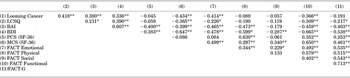
Table 1 summarizes the Pearson correlation coefficients between the 11 assessments made in this study. Looming cancer scores were designated as assessment number 1 in the table. Specifically, there is a positive correlation between looming cancer scores and the general LCS of information processing (assessment number 2). High cancer looming is significantly correlated with high Beck Anxiety and Depression scores, low mental component scores of the SF-36, low FACT total and FACT-Emotional scores, and low FACT-Functional scores. Looming cancer correlated with the FACT emotional and functional scores but not the physical or social subscales.
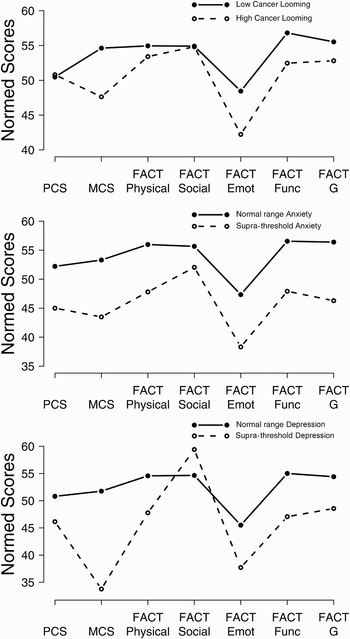
A lower normed score represents a lower QOL. The uppermost plot shows how low loomers (broken line) have a lower MCS, FACT-Emotional, and FACT- Functional compared to high loomers (solid line), using a median split. The PCS and FACT-Physical are similar in both groups, indicating that looming is not associated with a worse physical quality of life. This differs from both depression and anxiety in the middle and lower plots, the PCS and the FACT-Physical both seem to be detrimentally influenced negatively by supra-threshold anxiety and depression.

Pearson correlation of looming threat-processing styles with anxiety, depression and QOL

**Correlation is significant at the 0.001 level (2-tailed).
*Correlation is significant at the 0.005 level (2-tailed).
Hierarchical Regression Analyses
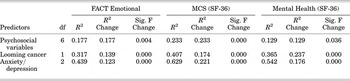
Whereas looming was significantly related to emotional or mental QOL, as described previously, a further question concerns whether it shows incremental prediction of QOL, above and beyond the effects of anxiety and depression. Hierarchical regression analyses are reported in Table 2. These show that, above and beyond the variance predicted by a combination of psychosocial variables and anxiety/depression, looming predicts a further 13.9% of the variance of the FACT-Emotional, 17.4% of the variance on the MCS (SF-36) and 23.7% of the variance on the mental health subscale (SF-36). Once the regression model controlled for anxiety and depression in the third step of the equations, looming cancer still predicted 5.4% of the variance on the FACT-Emotional, 5.1% on the MCS (SF-36), and 9.3% on the mental health subscale (SF-36), above and beyond the variance predicted by a constellation of those symptoms and the psychosocial factors.
Hierarchical regression analysis

Profile Analysis using Repeated Measure ANOVA
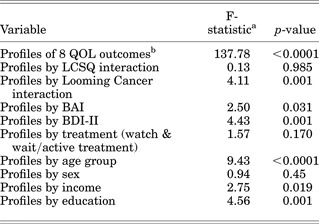
We examined whether or not the profiles of the eight assessments of patient QOL differed depending upon the patients' looming cancer and general looming style. The eight QOL assessments included SF36-MCS, SF36-PCS, FACT-Physical, FACT-Social, FACT-Emotional, FACT-Functional, FACT-General, and FACT-Lymphoma. The profile of QOL measures were treated as the dependent variable. The independent variables included the looming cancer scale, BDI, BAI, age, income, and education. The results of the profile analysis are presented in both Figure 1 and Table 3. To better visualize the impact of patient characteristics on QOL, the looming cancer scores and the Beck Depression and Anxiety scores were dichotomized. However, the statistical tests reported in Table 3 were conducted with the continuous predictors, not the dichotomized predictors.
Repeated measures of psychosocial profiles

aThe F-statistics are adjusted for the Greenhouse-Geisser test of sphericity.
bThe profiles include QOL assessments in SF36-MCS, SF36-PCS, FACT-Physical, FACT-Social, FACT-Emotional, FACT-Functional, FACT-General, FACT-Lymphoma (15 item).
Figure 1 shows the profiles of QOL outcomes by patient characteristics. Visual inspection shows that high loomers had worse QOL than low loomers in SF-Mental Component, FACT-Emotional, FACT-Functional, and FACT-General. This was tested using the continuous looming cancer scores in Table 3 (designated as “Profiles by Looming Cancer interaction”). The F-statistic of 4.11 (p = 0.001) indicates that QOL profiles differed across patients with different cancer looming scores. Similarly, the statistical tests in Table 3 show that the QOL profiles were different depending upon the patients' Beck Anxiety score (p = 0.031), Beck Depression score (p = 0.001), age (p = 0.0001), income (p = 0.019), and education (p = 0.001).
The lower two panels of Figure 1 show similar gestalts for anxiety or depression, with the exception of a clear impact on physical QOL that was not seen for looming.
DISCUSSION
This study examined whether the perceived speed of cancer worsening, measured by the Looming Cancer scale, a cancer-specific indicator of perceived cognitive threat-processing velocity, impacts on QOL outcomes in a CLL cohort.
The Looming Cancer measure correlated significtly with overall QOL (FACT-G, p = 0.005). This effect was largely due to the contribution of emotional QOL (MCS: SF-36, p = 0.001; FACT-Emotional, p = 0.001) and functional QOL (FACT-Functional, p = 0.001). Looming, unlike anxiety and depression, did not correlate with a worse physical QOL (PCS:F-36, FACT-Physical). Looming did not impact on social QOL.
Hierarchical regression analysis showed that Looming Cancer scores predicted 5.4% on the FACT-Emotional, 5.1% of the variance of the MCS (SF-36), and 9.3% on the mental health subscale (SF-36), above and beyond the variance predicted by a constellation of psychosocial factors (including age, marital status, education, income) and the combined effect of depression and anxiety. This is a conservative and stringent test when one considers that a large percentage of anxious and depressed patients might well be loomers. It sugggests that the relationship of perceived velocity of cancer progression (Looming Cancer) has a distinct relationship to emotional QOL that is not simply reducible to a facet of anxiety or depression; looming robustly contributes to emotional QOL even when adjusting for anxiety and depression.
A repeated measures analysis showed that the looming cancer measure (but not the LCVQ), depression, (younger) age, (higher) income and education but not anxiety or sex, predicted a constellation of pooled QOL measures.
There are several limitations to this study. The Looming Cancer measure, although validiated, is a new measure with uncertain clinical utility that confines its current use to research settings. This study was conducted on a limited cohort who were well-educated and relatively affluent and therefore these results may not be generalizable. The cross-sectional design also limits causal inference.
Despite the exploratory nature of these data, this study shows that the perceived velocity of cancer threat (Looming Cancer) clearly has a distinct effect on QOL, above and beyond that of depression and anxiety. This is the first time that looming has been examined in relation to QOL in cancer. We suggest that the looming construct merits further study in the medically ill, especially in view of the aforementioned limitations of catastrophizing. New work should attempt to revise the looming construct to increase its clinical utiliity. Consideration should also be given to using technology and simulation techniques to measure the perceived velocity of threats, as it is often in ambigious situations that looming is most apparent, whereas the cancer setting is threat-laden, and many of the threats are, unfortunately, all too real.
ACKNOWLEDGMENTS
This study was supported by a grant from the Service Guild of Long Island Jewish Medical Center (T.T. Levin, P.I.). The authors also thank the following individuals for their help in data collection: K. Rai, A Echivaria, M. Hoffman, U. Iqbal, D. Jansen, B. Mehrotra, D. Patel, L. Russo, and T. Wasil.