Introduction
Ecological specialization leading to the formation of so-called – ‘host races’ – can be considered a first step towards sympatric speciation (Frantz et al., Reference Frantz, Plantegenest, Mieuzet and Simon2006, Reference Frantz, Calcano, Mieuzet, Plantegenest, Mieuzet and Simon2009). However, the mechanism driving initial divergence in host use (e.g. predation, competition, etc.) often remains uncertain. Phytophagous insects – and especially the pea aphid, Acyrthosiphon pisum Harris (Hemiptera: Aphididae) – are useful models to identify how divergence in host plant use may have arisen (Simon et al., Reference Simon, Carre, Boutin, Prunier-Leterme, Sabater-Muñoz, Latorre and Bournoville2003; Sword et al., Reference Sword, Joern and Senior2005). About 11 pea aphid host races have been documented worldwide (Peccoud et al., Reference Peccoud, Ollivier, Plantegenest and Simon2009a, Reference Peccoud, Simon, McLaughlin and Moranb; Peccoud & Simon, Reference Peccoud and Simon2010). Pea aphids are highly specialized and reproductively isolated on clover and alfalfa in North America (Via, Reference Via1999; Via et al., Reference Via, Bouck and Skillman2000). Experiments have revealed that these plant host-based populations may interact through shared insect natural enemies and may influence each others’ population densities (Via, Reference Via2001; van Veen et al., Reference van Veen, Morris and Godfray2006). Pea aphids also occur in distinct green and red colour morphs. The divergence in plant host use by colour morphs is believed to have originated on a common broad bean (Vicia fabae L.) host (Via, Reference Via1991; Reference Via1999; Via et al., Reference Via, Bouck and Skillman2000).
A potential driving factor for host divergence in pea aphid colour morphs is susceptibility to natural enemies. Many predators, including ladybird beetles (Coleoptera: Coccinelidae), damsel bugs (Nabids; Hemiptera: Nabidae), hover flies (Diptera: Syphidae) and parasitoid wasps (Hymenoptera: Braconidae) are known to attack pea aphids (Snyder & Ives, Reference Snyder and Ives2003; Nelson & Rosenheim, Reference Nelson and Rosenheim2006; Nelson, Reference Nelson2007). More specifically, Losey et al. (Reference Losey, Ives, Harmon, Ballentyne and Brown1997) have shown that green-red colour polymorphism may be maintained by differential vulnerability to natural enemies because green morphs are more susceptible to wasp parasitoids and red morphs to predators. This work was conducted on a single host plant, alfalfa (Medicago sativa) and so did not reveal the potential costs and benefits of host switching from the common host bean, to the derived host alfalfa. Pea aphid susceptibility to natural enemies may indeed vary with host plant (Aquilino et al., Reference Aquilino, Cardinale and Ives2005), but the relative performances of green and red morphs on different hosts remain incompletely understood. Therefore, in the present study, the susceptibility of pea aphid colour morphs to insect predation on the general host plant, V. fabae was compared with that on the alternative host red clover, Trifolium pratense. This was done in order to build on previous insights involving examination of the interplay between host plant and predation as a mechanism determining the differential abundance of pea aphid colour morphs on different host plants (Losey et al., Reference Losey, Ives, Harmon, Ballentyne and Brown1997; Aquilino et al., Reference Aquilino, Cardinale and Ives2005). The main aim was to provide further insights into potential mechanism of divergence in plant host use.
Natural history
Pea aphids are small, soft-bodied herbivorous insects with complex life cycles that include numerous all-female, parthenogenetic generations produced during spring and summer that alternate with annual sexual generations produced only in the autumn period (Dixon, Reference Dixon1998). They feed exclusively on plant phloem sap by inserting their slender sucking mouthparts into sieve elements. Pea aphids provide some of the best-studied instances of host plant adaptation and have repeatedly generated host-specialized populations adapted to both crops and wild legumes (Via, Reference Via1999; Ferrari et al., Reference Ferrari, Muller, Kraaijeveld and Godfray2001; Reference Ferrari, Godfray, Faulconbridge, Prior and Via2006). Specialization and differentiation have been most closely studied in populations sampled from red clover (Trifolium pratense L.) and alfalfa (Medicago sativa L.) in the United States (Via, Reference Via1999; Caillaud & Via, Reference Caillaud and Via2000). Each of these hosts have their own specialized pea aphid populations, which putatively have higher fecundity and better offspring survival than those sampled from their ‘home’ (natal) plant. Significant differences in colour morph frequencies were found on different host plants where red morphs accounted for approximately 1–2% of the pea aphid population on pea and some 30% on red clover (Simon et al., Reference Simon, Carre, Boutin, Prunier-Leterme, Sabater-Muñoz, Latorre and Bournoville2003). Different behavioural responses were also observed: red morphs tended to drop off more easily from bean plants and produce more winged offspring after disturbance than green morphs (Braendle & Weisser, Reference Braendle and Weisser2001; Weisser & Braendle, Reference Weisser and Braendle2001). As a result, pea aphid colour polymorphism may be under a mixture of selective pressures from both – ‘bottom up’ – and – ‘top down’ – levels which may be associated with other factors such as behavioural differences or host plant preferences (Caillaud & Losey, Reference Caillaud and Losey2010).
Materials and methods
Insect collection and rearing
Green and red morphs of the pea aphid were collected from wild clover plants at six different fields in Central Europe (two from Satu-Mare (47.69°N, 22.89°E), two from Mures (46.59°N, 24.61°E) and two from Harghita county (46.36°N, 25.80°E) in an area of around 1 ha. each. Aphids were transferred live to the laboratory and were reared on the general host, broad bean (Vicia faba) (stock name – ‘The Sutton’ –, Nickerson-Zwaan, USA) and on red clover plants (stock name – ‘Starfire Red Clover’ –, Ampac Seed Company, USA) to produce asexual colonies for testing. Aphids from different fields were reared separately on host plants and later distributed equally over the treatments. Plants were grown individually in 15 cm diam.×20 cm deep plastic pots under constant climatic conditions (16 h light, 8 h dark, 20 °C, 75% relative humidity). To avoid the appearance of aphid-winged dispersal only high-quality young plants (four leaves vegetative stage for broad bean (Knott, Reference Knott1990) and third trifoliate stage for red clover) were used and individuals were transferred periodically to new host plants to prevent overcrowding. Aphids were reared on host plants broad bean and clover for up to ten generations until the offspring had adapted both these host plants under lab conditions. Then aphids reared on bean were used on bean, those reared on clover were used on clover for the experiment. During and after aphid collection, assessments were performed daily for three week periods in the field to identify the dominant insect/arthropod predator. Six plots/fields of ∼6 m2 each were randomly established. Inside each plot, another six subplots of ∼1 m2 each were established and sweep netted. All insect predators were counted by separately evaluating the most frequent species. Two-spotted lady beetles, Adalia bipunctata (L) were found to be the most frequent predator during the whole assessment period, with numbers reaching a maximum of around 50 individuals in one subplot. For experiments, ladybirds were obtained from the same fields 48 h prior to their use in field cages. To identify males and females, all individuals from the same field were kept together for 24 h. If mating between two individuals was observed, they were isolated together in a separate plastic Petri dish and held together (male+female) in cages for the duration of the experiment. This avoided biased predator effects, because predation levels of males and females may differ; in particular, mated females are considered to have higher appetites than males when forming eggs.
Measuring aphid colour morph fitness as a function of host plant and predation
The experiment was conducted in the laboratory under long day conditions (16 h light, 8 h dark), 20 °C and 75% relative humidity using young four-leaf stage broad bean and third trifoliate stage clover plants. Host plants were grown in plastic pots (15 cm diam.×20 cm. deep) in a commercial growing medium (Professional Growing Mixes, Sun Gro Horticulture, Canada), and were placed in dishes used for watering the plants. The experiment comprised three treatments: two host plants (bean and clover); two predation levels (control and predation); and three aphid colour morph levels (green alone, red alone and green and red in mixture). Host plants were potted individually and placed in dishes and watered by filling the dishes. This allowed water to be drawn upwards through holes at the bottom of the pots, thereby preventing disturbance to aphids on plants. To compare aphid performances on different host plants, one bean and one clover plant were paired and spaced 10 cm apart between leaves to prevent the plants from touching each other. Each plant pair received 12 aphids per host plant (either six wingless newly emerged adult green aphids/plant, six wingless red aphids/plant or a mixture of three wingless adult green and three wingless adult red aphids/plant). Paired replicates were as follows: green alone n=40, red alone n=40 and green and red in mixture n=40. The pairing ensured that the same predator would influence individuals on the two hosts. Plants were assigned as pairs into replicated blocks on the benches (i.e. bean+clover [control], bean+clover [predation]). Blocks and plant pairs within blocks were isolated from each other to prevent contamination due to predator mixing across pairs and blocks. To ensure that the initial conditions remained constant, each plant was examined after two days (when each adult had given birth up to approximately 12 offspring) for dead or missing adult females. Missing females were replaced (this in fact only happened once while the female with 12 offspring was replaced from the same stock and having the same age and same reproduction rate as those on experimental plants). At this time, two ladybird adults (one male and one female) were randomly placed on one of the paired-plants and left to move and feed for 12 h, after which time they were removed. This was done because continuous predator pressure on limited host plant space would otherwise result in artificially high predation rates and thus all aphids would have been killed within one to two days, or predation risk would have caused them to migrate from (or fall off) the host plant. In addition, this approach was followed to ensure that predator presence or activity on a plant would not be biased or disturbed while taking a count of the aphids. After another 12 h, aphid population density was assessed on each plant by counting the number of individuals in different age groups (i.e. number of apterous (non-winged) adult, first instar nymphs, older nymphs (no alatae were found during the experiment). The predator was reintroduced again for 12 h and the entire procedure repeated. The experiment was run until first-born aphids had become fourth instar nymphs (before starting to reproduce) and/or the host plants had become too old, whereafter the whole procedure was repeated. Assessments were made in each 24 h period up to the full experimental period in order to assess reproduction and development of offspring. Aphid fitness was then estimated by colour morph separately (when performed alone or in mixture), by dividing the total number of offspring produced (number of offspring at the end of the experiment) by the initial female density (per capita reproduction).
Statistical analyses
The per capita reproductions (final number of offspring prior to the first born nymphs becoming adult) were used for data analyses. All the data were normally distributed and ANOVA (SPSS) was used to compare how colour morphs fared on bean and clover plants, either when alone or when mixed in the presence and absence of predators. The fitness of green and red morphs was compared when alone on host plants and when mixed. Analysis using ANOVA followed by Tukey's HSD tests to identify any statistical differences between treatments revealed significant effects. Predator preferences of colour morphs on host plants were analysed by computing the log ratio of predator effect magnitudes using the formula [ln (aphid fitness of predator treatment/aphid fitness control)]. ANOVA was then used to test predator interaction effects in terms of colour morph performed alone and when mixed.
Results
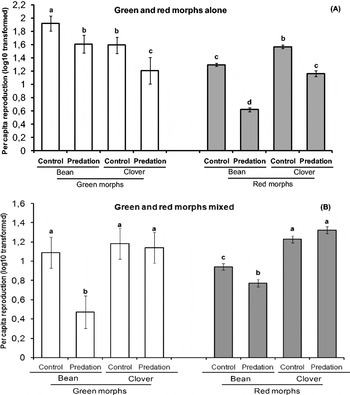
Statistical analysis revealed significant effects of predation on pea aphid populations infesting broad bean and red clover when colour morphs were reared alone (green on bean F=4.48, P<0.03, green on clover F=5.57, P<0.002; red on bean F=9.71, P<0.001, red on clover F=5.85 and P<0.001). The analysis also showed that green aphids had the highest fitness on beans when alone in the absence of predation, while red aphids had the lowest fitness on beans under the influence of predation (fig. 1a).
The performance of pea aphids green and red morphs alone (a) and together (b) on host plants broad bean and red clover in the presence and absence of insect predators. Different letters represent statistical significance. White columns represent green morphs, grey columns red morphs.

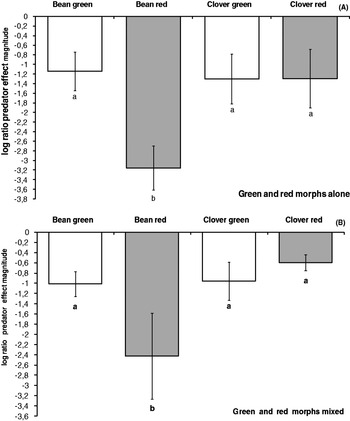
When colour morphs were reared together, predators significantly reduced the fitness of both green and red morphs on broad bean (green on bean F=6.85, P<0.001, red on bean F=4.21, P<0.003), but had no effect on aphids (red and/or green morphs) reared on clover (green on clover F=0.47, P<0.91, red on clover F=1.05 and P<0.99) (fig. 1b). The log ratio predator effect magnitude was substantially higher in terms of red morphs when these were reared on broad bean alone (F=5.80, P<0.01), and together with greens (F=5.16, P<0.01), while no observable effects were seen when aphids (red and/or green morphs) were reared on clover (alone F=0.63, P<0.47, mixed F=0.87 and P<0.92) (fig. 2a, b).
Predator preferences of pea aphid green and red morphs alone (a) and together (b) on host plants broad bean and red clover. Data were analysed by computing the log ratio predator effect magnitudes using the formula [ln (aphid fitness of predator treatment/aphid fitness control)]. White columns represent green morphs, grey columns red morphs.

Discussion
The results clearly show that pea aphid colour polymorphisms are, under differential selective pressure, arising from both higher as well as lower trophic levels. Green pea aphid morphs alone showed higher fitness on beans and clover in the absence of predation (fig. 1a). In contrast, green morph fitness was found to be reduced by predation when infesting beans together with reds, while there was no net fitness loss due to predation for aphids on clover when mixed with red morphs (fig. 1b). Red morphs exhibited fitness loss on both beans and clover, while on clover plants, they showed clear fitness loss in the presence of predation when mixed with green morphs (figs 1b and 2b). Accordingly, our study along with earlier studies (i.e. Losey et al., Reference Losey, Ives, Harmon, Ballentyne and Brown1997; Aquilino et al., Reference Aquilino, Cardinale and Ives2005) indicates that host plant-adapted aphid species can create much context-dependency in terms of the nature and strength of predation effects, which may in turn alter costs and benefits of host switching and maintenance colour of polymorphism. Insect predators had significant effects only on red morphs on broad beans when reds were reared alone as well as when mixed with green morphs (fig. 2a, b). Thus, only red morphs experienced any observable benefits of switching from the general to the derived host red clover in the presence of predation. For green morphs, there was no apparent cost of switching host plants when aphids faced predation. This means that colour polymorphism may be maintained through some form of interaction in which the red morph gains fitness on the derived host clover due to a host plant and predation reduction effects. The net effect is that both green and red morphs together have similar fitness effects when reared on the derived host plant, clover (which may maintain polymorphism) despite different reasons for switching. Differences in performance of red and green pea aphid morphs on different host plants were first detected by Markkula (Reference Markkula1963). Resistance of different host plants to the pea aphid was also demonstrated in later studies by Markkula (Reference Markkula1970) and Markkula & Roukka (Reference Markkula and Roukka1970a, Reference Markkula and Roukkab; Reference Markkula and Roukka1971a, Reference Markkula and Roukkab). The colour morphs exhibited different propensities to engage in escape behaviour (red forms dropped off more frequently than green ones when predators were present (Braendle & Weisser, Reference Braendle and Weisser2001). This may be because red morphs are more sensitive to crowding than green ones, such that there is a marked response of red morphs to ladybird kairomones associated with crowding (Dixon & Agarwala, Reference Dixon and Agarwala1999). This result necessarily assumes that predators have difficulty distinguishing between aphid colour morphs as potential prey, for which there is indeed some evidence (Pietrewicy & Kamil, Reference Pietrewicy, Kamil, Kamil and Sargent1981; Agawa & Kawata, Reference Agawa and Kawata1995). Also, it may reflect the possibility that red morphs are far more amenable to host switching from bean to clover than green morphs as a response to high predation on beans.
Altogether, these findings suggest that for pea aphids, both the presence of insect predators and the nature of the host plant together influence the population growth rate in terms of the response to the presence or absence – and hence ratio – of the two colour morphs. Such a predator–host plant interaction may well have ecological-evolutionary consequences for traits that affect the colour morphs tolerances to different selective pressures and consequently, allow increased adaptation to a new host plant.
Acknowledgements
This work was supported by the grant of the Romanian National Authority for Scientific Research, CNCS – UEFISCDI, project number PN-II-RU-TE-2011-3-0096. I thank Professor Hugh Loxdale for his helpful editorial suggestions on the manuscript.