Political science instructors across the nation frequently face the formidable task of engaging large numbers of students in lower-level, general education courses outside students' primary domain of interest. Their students typically have little incentive to enjoy the course and often resent being required to take the class. Further, students frequently have a difficult time understanding the course material and emerge from the course with very negative impressions of the discipline of political science in general and little interest in or knowledge of politics or public affairs. The research presented here confirms that the use of low-cost, simple visual images can enhance students' willingness to consider political science as a major or minor as well as boost their involvement in, and knowledge of, politics and public affairs outside the classroom.
BOOSTING CIVIC ENGAGMENT THROUGH CLASSROOM ACTIVITIES
The United States is witnessing an alarming trend of civic disengagement among young adults of traditional college age (e.g., Mann Reference Mann1999; Mattson Reference Mattson2003). For more than a decade, educators across the nation have attempted to reverse this trend with programs such as Campus Compact, the Carnegie Foundation's Political Engagement Project, and APSA's Task Force on Civic Engagement. While these programs have shown the benefits of many innovative pedagogical approaches, the benefits of more traditional, lecture-style political science courses have only recently been explored.
Service-learning programs stand as one of the best studied of these pedagogical approaches, with many studies confirming that student participation in service-learning activities increases civic engagement (Levine Reference Levine2007; McCartney Reference McCartney2006; Prentice Reference Prentice2007; Spiezio, Baker, and Boland Reference Spiezio, Baker and Boland2005). It also appears that conducting classroom discussions of current events (Levine Reference Levine2007; Niemi and Junn Reference Niemi and Junn1998), requiring students to follow the news (Kahne, Sporte, and de la Torre Reference Kahne, Sporte and de la Torre2006), conducting mock elections (Levine Reference Levine2007; McDevitt and Kiousis Reference McDevitt and Kiousis2006), and implementing democratic classroom procedures (Levine Reference Levine2007; Spiezio, Baker, and Boland Reference Spiezio, Baker and Boland2005) can boost civic engagement levels among youths and young adults.
Until recently, many saw more typical lecture-oriented classes as unrelated to programs targeted at civically engaging students (Niemi and Junn Reference Niemi and Junn1998, 16). The typical lecture setting has been seen as a poor context for promoting civic engagement because of the characteristic passive learning style of this approach (Herman Reference Herman, Becker and Couto1996, 55; Spiezio, Baker, and Boland Reference Spiezio, Baker and Boland2005, 275–76). In order for more traditional, lecture-style presentations to boost student civic engagement, the lecture must make learning an active process (Colby et al. Reference Colby, Ehrlich, Beaumont and Stephens2003; Greeno, Collins, and Resnick Reference Greeno, Collins, Resnick, Berliner and Calfee1996). Along these lines, recent research has shown that students who like studying government and politics tend to discuss politics more frequently, and be more efficacious and knowledgeable than their peers (Gimpel, Lay, and Schuknecht Reference Gimpel, Lay and Schuknecht2003, 150–52).Footnote 1 Further, research has shown that simply taking civically oriented classes (those that touch on topics related to government, politics, and civic engagement), regardless of the pedagogical approaches utilized in them, can boost civic engagement. Students enrolled in civics-oriented classes have been shown to exhibit increased civic knowledge (Comber Reference Comber2005; Gimpel, Lay and Schuknecht Reference Gimpel, Lay and Schuknecht2003; Levine Reference Levine2007; Niemi and Junn Reference Niemi and Junn1998), more self-confidence about participating in the political process (Gimpel, Lay, and Schuknecht Reference Gimpel, Lay and Schuknecht2003; Levine Reference Levine2007), improved civic skills (Niemi and Junn Reference Niemi and Junn1998), and heightened participation in a range of activities (Comber Reference Comber2003; Reference Comber2005; Gimpel, Lay, and Schuknecht Reference Gimpel, Lay and Schuknecht2003).
Findings further suggest that even typical lecture-style courses can lead to enhanced civic engagement if they provide students with an interesting classroom experience (Herman Reference Herman, Becker and Couto1996, 56). Because learning appears to occur best when students are interested in and enthusiastic about what they are studying (Colby et al. Reference Colby, Ehrlich, Beaumont and Stephens2003), it seems worthy to attempt to make introductory political science courses as engaging as possible (Levine Reference Levine2007, 125). And the use of visually enhanced lecture materials offers one possible method of achieving this goal.
VISUAL IMAGES IN THE CLASSROOM
Researchers have highlighted a litany of possible advantages associated with the use of visually enhanced teaching materials. Multimedia forms of instruction are thought to facilitate the presentation of material, maintain student attention, increase student motivation, and provide a more active teaching environment (Bartlett and Strough Reference Bartlett and Strough2003; Seaman Reference Seaman1998). The abstract nature of much classroom learning suggests that concrete visual cues could aid student recall of class material, and such effects have been documented.
Classes utilizing multimedia presentations have been shown to produce improvements in student learning, whether measured with objective outcome testing or students' subjective reports (Frey Reference Frey1994; Mayer Reference Mayer1997; McNeil and Nelson Reference McNeil and Nelson1991; Sekuler Reference Sekuler1996; Smith and Woody Reference Smith and Woody2000; Welsh and Null Reference Welsh and Null1991; Worthington et al. Reference Worthington, Welsh, Archer, Mindes and Forsyth1996). The marriage of visual and verbal information appears to aid the mental connections necessary for learning (Chanlin Reference Chanlin1997; Reference Chanlin1998). Student test scores improved when they were exposed to graphically enhanced instructional materials (McKay Reference McKay1999) and in classes utilizing multimedia formats (Bartlett and Strough Reference Bartlett and Strough2003; Erwin and Rieppi Reference Erwin and Rieppi1999; Smith and Woody Reference Smith and Woody2000). Further, both recall of course material and the complexity of the language used in the recall were boosted by lecture presentations augmented with audio, video, animation, graphics, and special effects (Hallett and Faria Reference Hallett and Faria2006). Thus, the use of visual images in the classroom can greatly enhance student ability to recall information presented in the classroom.
Visual images have also been shown to improve student engagement in the classroom and assessments of classroom activities. Students often perceive typical passive learning, lecture-style classroom presentations as extremely impersonal (Erwin and Rieppi Reference Erwin and Rieppi1999), and this “depersonalization … can negatively affect their motivation, interest, and satisfaction during a lecture” (Erwin and Rieppi Reference Erwin and Rieppi1999, 2). The use of visual images in the classroom can stimulate more engaged learning and enhance student interest in classroom activities. Multimedia presentations appeal to a greater number of students' senses than traditional lecture presentations, which can hold their attention (Liu and Beamer Reference Liu and Beamer1997), increase their interest (Nowaczyk, Santos, and Patron Reference Nowaczyk, Santos and Patron1998; Rankin and Hoaas Reference Rankin and Hoaas2001), spark their imaginations (Liu and Beamer Reference Liu and Beamer1997), and boost satisfaction and participation (Hagen, Edwards, and Brown Reference Hagen, Edwards and Brown1997). There is further evidence that students prefer multimedia presentations of material (Nowaczyk, Santos, and Patron Reference Nowaczyk, Santos and Patron1998), and thus are likely to be more pleased with their classroom experience when such methods are used.
While visually enhanced classroom presentations appear to have many benefits, it is important to note that not all presentations are created equal. While some have shown that color images are more effective than black and white ones (Kleinman and Dwyer Reference Kleinman and Dwyer1999), others have documented the negative effects of too much visual stimuli. Animated graphics have been shown to be no better than still graphics, but perhaps more distracting (Chanlin Reference Chanlin1998). Similarly, visual presentations emphasizing the exciting or entertaining aspects of the topic may impede learning (Sherry Reference Sherry1996). Such findings have led some researchers to conclude that simpler visual images are more effective than more complex ones (Myatt and Carter Reference Myatt and Carter1979), and to admonish users of such materials that they “can interfere with the learning process” (Hashemzadeh and Wilson Reference Hashemzadeh and Wilson2007, 611). It thus appears that it is possible to have too much of a good thing.
Further, the benefits of visually enhanced presentations vary according to some student attributes. Not surprisingly, students with visually oriented learning styles benefit more from visually enhanced presentations (McKay Reference McKay1999; Smith and Woody Reference Smith and Woody2000). Student ability may also be a key factor (Wetzel, Radtke, and Stern Reference Wetzel, Radtke and Stern1994). Students having lower prior knowledge of the subject appear to respond better to visual images (Chanlin Reference Chanlin1997; Reference Chanlin1998; McKay Reference McKay1999). And poorer, less experienced students may find the visual images less beneficial (Mayer et al. Reference Mayer, Bove, Bryman, Mars and Tapangco1996), with weaker students benefiting more from the structure of more traditional lecture styles (Harrington Reference Harrington1999).
This study investigates the impact that simple, colorful still (e.g., photographic, illustrative, clip art) images have on students enrolled in a college-level introductory political science course. This course is representative of many on college campuses nationwide. It is a lower-level course required of all students as part of the general education core requirements for graduation. Consequently, students in the course tend to be either underclassmen just starting their college careers or upperclassmen who have unsuccessfully attempted the course in the past. Most students come to the class with little prior exposure to the subject, and for most, the topics in the class are outside their primary domain of interest. Thus, this study investigates the impact that simple, still images have on inexperienced or poorer learners with little prior knowledge of the subject matter.
RESEARCH DESIGN AND MEASURES
Students enrolled in an introductory American government course at Missouri State University in the spring 2007 semester serve as the subjects in this study. Missouri State University is typical of many state universities in the nation. It is a large public university located in the Springfield metropolitan area, and draws students mostly from the southwest Missouri/northeast Arkansas region. Students generally come from modest financial backgrounds and many represent the first in their family to attend college. The course utilized in this study, PLS101: American Democracy and Citizenship, serves as a general-education degree requirement for all students at the university. The course covers topics typical to such classes—foundations of American government (American founding, Constitution, federalism), institutions of government (legislative, executive, judicial), citizen-government linkages (parties, interest groups, media, campaigns, voting, and elections), and policy (economic and foreign).
Two different 65-student sections of the same PLS101 course were involved in this project. One section, chosen randomly, served as the treatment group and the other served as the control group.Footnote 2 The two groups received identical oral lectures, but different accompanying in-class PowerPoint slides. The treatment group viewed slides containing an outline of lecture material and colorful, iconic, and sometimes comical still images. The control group viewed slides that contained the same outline of lecture notes, but did not contain the enhanced visual images.Footnote 3 (See Appendix A for sample slides.) The type of slide presentation (control or treatment) serves as the key independent variable in the analyses that follow.
Student engagement serves as the dependent variable of interest, and was measured using a pre-test/post-test design. Students voluntarily and anonymously completed a short survey on both the first and last day of the semester (January 22 and May 4). I analyze student impressions of the discipline of political science as well as their interest in and knowledge of politics and public affairs. First, both surveys asked students how well the statement “I am considering a [major/minor] in political science” described them.Footnote 4 Second, they were asked how often, in an average week, they discussed politics with their families and/or friends,Footnote 5 how interested they were in the most recent political campaigns to occur,Footnote 6 and how much they trusted the government in Washington.Footnote 7 Finally, student political knowledge was assessed through a short, four-item “civics quiz” battery. I expected students in the experimental group to be more likely to consider political science as a major or minor, report higher levels of all other engagement activities, and exhibit more knowledge gain.
To control for a number of possibly confounding factors, I held the following elements constant across both groups: the professor, lecture material, oral presentation, required readings and assignments, other supporting course materials, population (both sections are formed through the standard Missouri State class registration system), and class meeting situation (same class sizes, same classroom, similar class meeting time—back-to-back morning classes meeting three times a week).Footnote 8
COMPARISON OF GROUP CHARACTERISTICS
Since both groups were populated through the university's typical class enrollment procedures, the control and treatment groups are remarkably similar in their basic characteristics. Both groups are roughly two-thirds female, contain a larger number of underclassmen than upperclassmen, and have very similar cumulative GPA averages. At the same time, the treatment group contains slightly more upperclassmen, who have earned more cumulative credit hours.Footnote 9
The two groups also appear remarkably similar in the attitudes expressed in the first-day-of-class survey. Students in both groups concurred that the main reason they enrolled in the class was because it fulfills a general-education degree requirement. Sizeable portions of each group reported they did not enroll in the course “because the subject interested” them or because they had “heard good things about the course.” Finally, sizeable portions of both groups expressed the opinion that they were not looking forward to attending the class. Given these attitudes, it is not at all surprising that only one student reported being a political science major.
ANALYSIS AND FINDINGS
To explore the impact that exposure to the enhanced (treatment) slides had on students, I made two different comparisons. First, I tested differences between the two groups throughout the semester. I expected that few group differences would emerge early in the semester (on the first-day-of-class survey), but significant differences would exist later in the semester (on the last-day-of-class survey). Second, I assessed the magnitude of change in attitudes across the semester for each group. I expected that the treatment group would show substantial improvement in their attitudes while the control group would show less improvement, no improvement, or even some deterioration in their attitudes.Footnote 10
Views on the Discipline of Political Science
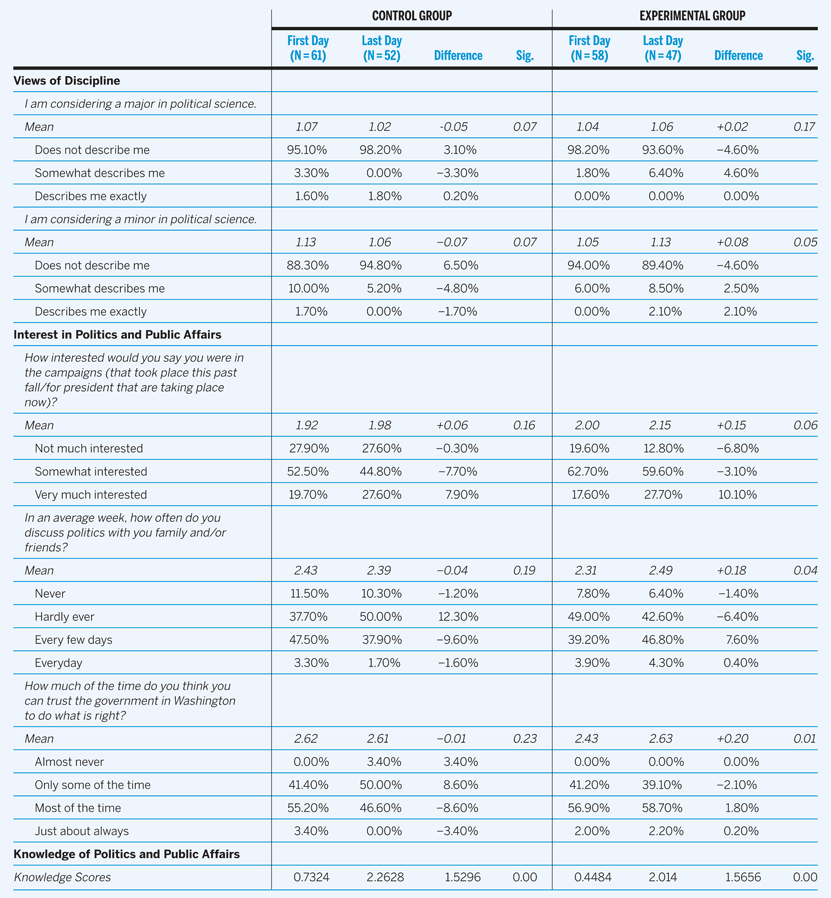
On the first and last days of class, students rated how well the statements “I am considering a major in political science” and “I am considering a minor in political science” described them. At the beginning of the semester, an overwhelming majority of both the control and experimental group reported that the statements did not or only somewhat described them (see Table 1). More than 95% of both groups reported that “considering a major in political science” did not describe them and substantial majorities of each group (88.3% of the control group and 94% of the experimental group) reported that “considering a minor in political science” did not describe them. Fewer than 2% of the control group and no one in the experimental group reported either statement exactly describing them.
Student Engagement by Group

Note: Data are from in class surveys. Probabilities are from independent samples t-tests and are one-tailed.
While large majorities of both groups retained these attitudes at the end of the semester, attitudes about the discipline of political science improved among members of the experimental group but declined among those in the control group. By the end of the semester, 4.6% more students in the experimental group reported that the statement “considering a major in political science” somewhat described them (with a parallel drop of 4.6% of students feeling the statement did not describe them). In contrast, consideration of political science as a major dropped among the control group. On the last day of class, 3.3% fewer students in the control group felt that “considering a major in political science” described them somewhat. Concurrently, there was a 3.1% increase in control group students feeling that the statement did not describe them at all.Footnote 11
Similar results emerge with regard to considering political science as a minor. The control group saw a drop in the proportion of students reporting “considering a minor in political science” as somewhat or exactly describing them while the experimental group saw an increase in students reporting these attitudes. Compared to the first day of class, 6.5% more students in the control group felt that “considering a minor in political science” did not describe them at the end of the semester. In contrast, 4.6% fewer students in the experimental group felt this way, with 2.5% more claiming that “considering a minor in political science” somewhat described them and 2.1% more saying it exactly described them. Importantly, the experimentalgroup witnessed a statistically significant improvement in attitudes while the control group saw a marginally significant decline in attitudes.
Thus, the visually enhanced slides appear to exert some influence over student attitudes about the discipline. Students exposed to the visually enhanced lecture material appear to become more likely to consider political science as a degree option and those exposed to the more traditional lecture material are less likely to consider either a major or a minor in the discipline.
Interest in Politics and Public Affairs
I asked students how often they discuss politics with their family and/or friends, how interested they were in the most recent political campaigns,Footnote 12 and how much they trusted the American government. As expected, students in the experimental group reported more greatly enhanced attitudes on all three measures than those in the control group over the course of the semester (see Table 1).
While both groups reported a gain in campaign interest, the experimental group's gain is greater. While about 8% more of the control group students reported being “very much interested” in the ongoing presidential nomination campaigns by the end of the semester, slightly more than 10% of the experimental group reported this level of interest. There was also a substantially greater drop among the experimental group in the proportion of students reporting that they were “not much interested” in the campaigns. Almost 7% fewer students in the experimental group said they were “not much interested” by the end of the semester while the drop for control group students was less than one-half of 1%. Again, the experimental group change exhibits stronger statistical significance than the control group, suggesting that the change among the experimental sample could be expected in the larger population.
For both political discussion and trust in government, the group effects are even more pronounced. The control group exhibits a more than 11% (statistically insignificant) drop in the proportion of students who reported discussing politics “every few days” or “every day,” while the experimental group shows a statistically significant 8% increase in discussing politics this often. Similarly, by the end of the semester a statistically insignificant 12% fewer of the control group students felt they could trust the government in Washington “most of the time” or “just about always,” while the experimental group saw a statistically significant 2% gain in these attitudes.
These results suggest that exposure to visually enhanced lecture material can lead to gains in political interest and activities outside the classroom. Students exposed to more visually appealing lecture material appear to make greater gains in levels of political discussion, campaign interest, and trust in government than their counterparts exposed to the more traditional lecture material.
Political Knowledge
Finally, I assessed student knowledge on four basic civics items at the beginning and end of the semester. Students were asked to identify the positions that Nancy Pelosi (speaker of the U.S. House) and Harry Reid (Senate majority leader) held, who succeeds the president and vice president (speaker of the House), and how many justices serve on the U.S. Supreme Court (nine). Students were scored 1 for each question they answered correctly and 0 for each question they failed to answer or answered incorrectly. I then summed these scores so they ranged between 0 and 4. I expected that student knowledge in both groups would increase, but that the knowledge gain would be greater for the experimental group.
As expected, students performed very poorly on the knowledge quiz on the first day of class. Neither group was able to average even 1 point on the 4-point scale. Students in the control group averaged about 0.73 correct answers while the experimental group averaged about 0.45 (see Table 1). By the end of the semester, however, both groups had improved markedly with the control group answering an average of 2.26 of the four questions correctly and the experimental group answering 2.01 questions correctly. While both groups improved and the control group started and ended higher than the experimental group, it was the experimental group that gained more ground. The control group increased its knowledge by about 1.53 questions and the experimental group increased by about 1.57 questions. It thus appears that exposure to the visually enhanced lecture material resulted in slightly greater knowledge gain than exposure to the more traditional lecture format.
SUMMARY AND DISCUSSION
Overall, these findings suggest that the use of simple visual images can engage typically unengaged students in a basic political science course. Students exposed to enhanced visual images expressed more positive assessments of majoring and minoring in political science, more frequent political discussion, more interest in political campaigns, more trust in government, and more political knowledge than those exposed to more traditional lecture materials. These findings hold promise for faculty members teaching typical general-education classes in political science. The findings presented here suggest a very low-cost way to engage typically unengaged students that can be applied in classes of large size.
The visual enhancements utilized in this study were simple, low- (or no-) cost computerized illustrations, photo crops, or clip art graphics inserted into PowerPoint presentations. Gathering and inserting these graphics took only a little more time and effort than creating the basic text-only slides. While the creation of these visually enhanced slides was a fairly simple process, the results they generated were impressive. Exposure to such simple visual images produced gains in student attitudes about the subject of political science in general, as well as student engagement in politics and public affairs outside the classroom. Thus, simple visual enhancements to lecture presentations offer a low-investment opportunity to improve the general-education experience of college students. Further, visual enhancements like these can be applied in classes with large enrollments as easily as they can in smaller classes. The same PowerPoint slide presentations I used in this study could be used in classes of larger or smaller size. As long as students are able to view the slides in a lecture setting, I expect the effects to be the same.
Overall, these findings suggest that incorporating simple visual images into the introductory political science classroom can benefit students, faculty, and the greater community. Students benefit from higher levels of classroom engagement and more positive views of political science in general. In turn, faculty members face happier and more interested classes. Beyond the classroom, students appear to be more civically engaged.
APPENDIX A: Sample Slides