One of the key challenges in preparing the population for emergencies is to draw enough of the public’s attention to cause behavioral change in the desired direction.Reference Snyder and Hamilton 1 Important tools used for this purpose are mass media awareness campaigns. Such a campaign intends to generate the desired outcomes in relatively large groups of people, usually within a specified period of time and through an organized set of communication activities.Reference Rogers and Storey 2
Awareness campaigns are carried out in many areas, including tobacco use,Reference Friend and Levy 3 road safety,Reference Williams, Lund, Preusser and Blomberg 4 , Reference Glider, Midyett and Mills-Novoa 5 and politics.Reference Abroms and Craig Lefebvre 6 The question of their effectiveness, however, is widely debated,Reference Noar 7 even though mass media campaigns were found to be able to produce positive changes or prevent negative changes in health-related behaviors across large populations.Reference Wakefield, Loken and Hornik 8 Marketing practitioners condition the effectiveness of campaigns by fulfillment of different quality parameters. Among these are strategic planning; being audience-centric with specific focus on key behavior determinants of the chosen audience; effective messaging of intended benefits, put in a right frame, and transferred through an optimal media mix; and an ability to benefit from evaluation and assessment feedback.Reference Noar 9 , Reference Atkin 10
Naturally, mass media campaigns are vastly implemented in the field of disaster preparedness, because individual preparedness for disasters such as earthquakes is known to have a significant effect on decreasing the loss of human life during the event.Reference Mulilis and Duval 11 Therefore, investments are made in educational efforts targeting public behavior and into inducing the undertaking of protective actions by the public.Reference Nathe, Gori and Mileti 12 The effectiveness of a preparedness campaign can be analyzed on the basis of many parameters: exposure to the campaign, its length, the ability to raise the public’s awareness and knowledge in regard to the core subject, and the ability to change people’s behavior.Reference Snyder and Hamilton 1 , Reference Rogers and Storey 2
In the field of risk communication, however, all of these parameters are important only as long as they increase the actual preparedness level of the population. Protection motivation theory states that on an individual level, 4 conditions must be met for the population to become motivated to prepare for emergencies: they should believe that the threat is likely to affect them, protective actions have to appear effective and not to involve excessive costs, and they have to believe that they are capable of performing the needed actions.Reference Maddux and Rogers 13 On the other hand, most individuals function as part of the community and therefore may perceive the communicated risk in a wider social context. Thus, diffusion of innovations theory views the change in behavior intended by the campaign planners as an innovation that could be diffused throughout the community by the whole multitude of members of the social system. Through both personal communications and exposure to media, the knowledge of the individuals about the issue in focus is increased, leading to additional stages of persuasion, decision, implementation, and confirmation.Reference Rogers 14 Of course, the reaction of the individuals to messages from different channels would be highly dependent on their levels of trust in the communicating agency.Reference Amanatidou and Psarra 15 The level of trust in the actual ability (at the specific moment in time) of the authorities to manage the involved risks is also known to influence the readiness of the populace to prepare for potential threats.Reference Amanatidou and Psarra 15
It therefore follows that we should consider ourselves not only with the campaign itself but with the whole complex of factors that could be influencing the outcomes, such as exposure to information about core issue-related actual events during the time of the campaignReference Wood, Mileti and Kano 16 (ie, an actual earthquake during an earthquake awareness campaign or an extensive media report on preparedness drills). Owing to the fact that individuals tend to prepare for disasters only if they believe that the disasters might actually affect them,Reference Quarantelli 17 their perception of the threat may drop as the event recedes in the public memory with passage of time.Reference Dynes 18 Additionally, when multiple campaigns target the core issue simultaneously or successively, a cumulative effect on the target population can be expected.Reference Abroms and Craig Lefebvre 6
In this study we had a perfect opportunity to analyze the influence of actual events and of different campaigns on the public’s awareness and knowledge. We were able to compare the impact of several successive earthquake awareness campaigns in Israel, while minding other relevant events that happened in the same time period. The goal of our study was to assess the relative level of impact of the campaigns on the populace and the ability of the campaigns to produce a cumulative effect throughout the whole study period. To achieve our goal, we were guided by the following objectives:
-
∙ To analyze the trend of preparedness-related knowledge throughout the study period.
-
∙ To analyze the possible impact of exposure to the awareness campaigns on this trend.
-
∙ To analyze the possible influence of the measurement period itself in order to view the influence of the campaigns in a broader context.
METHODS
Campaign Description
The last 2 severe earthquakes in Israel occurred almost 100 years ago in 1927 near Jericho and in 1837 north of the Sea of Galilee, causing enormous damage and a large number of injuries. 19 During the period of 2011 to 2013, the government of Israel implemented 3 earthquake awareness campaigns (Figure 1). The campaigns were prepared by leading Israeli advertising agencies. All of the campaigns took place during a 2-week period with television, radio, and Internet broadcasts. The greater part of the campaigns included video clips in Hebrew on the 3 major national TV channels. In addition to Hebrew, a few broadcasts were in several other languages including Russian, Arabic, and English. Radio and Internet were also used but less extensively. The first campaign in 2011 comprised 2 different video clips, each about 30 seconds long, concentrating on the intimidating aspect of the threat. The first video showed a room with a baby sleeping in a cradle that suddenly began to shake violently, after which the alarm clock fell on the floor and started to ring, followed by the voiceover message: “A strong earthquake in Israel is only a matter of time, don’t let it catch you unprepared!” 20 The second video clip showed a mother taking her baby out of his bed, hugging him, and leaving the room safely.
Timeline of Campaigns and Relevant Events in Israel, 2011–2013.

The second campaign in 2012 was carried out a few weeks before the massive week-long national earthquake drill “Turning Point 6,” which was also given extensive media coverage. The campaign included one video clip, 47 seconds long, presenting 2 well-known characters: a famous comedian and a doll from the “Puppets” show. 21 Here the message of the campaign about the need to prepare for an earthquake was delivered in a humorous context.
The third campaign in 2013 was launched immediately after several small-scale earthquakes shook the soil of Israel, with mass media covering the issue for several days. The message was, “This sequence of earthquakes might forebode a coming of a really strong earthquake!” 22 The campaign included one video clip, 28 seconds long. It showed a scrabble board filled with preparedness-related words violently shaking and the announcer verbalizing the list of actions to be done during an earthquake and mentioning where to get more information about the subject. 23
Survey and Analysis
To evaluate the effectiveness of the campaigns, 2 surveys were conducted: the first one 2 weeks after the first campaign and the second one 2 weeks after the conclusion of the third campaign. The surveys were based on a randomly selected representative sample of the Israeli adult population (aged 18 years and over). A sampled database of Israeli households was built that was based on official statistical areas characterized by sociodemographic characteristics. Areas were then matched with the computerized list of subscribers to the National Telephone Company (According to the Israeli Bureau of Statistics, 24 81% of the households in Israel have at least one phone line), and households were randomly chosen from the database. Excluded from the sample were fax numbers, disconnected numbers, voice mail, and “no answer.” The survey was conducted in Hebrew, although assistance was available in Russian or Arabic. During the first survey a total of 2545 telephone calls were placed (several attempts were made to reach the selected households if there was no answer). Disconnected numbers, faxes, voice mail, or “no answer” constituted 52% of the calls. Of the 1228 answered phone numbers of potential respondents, 630 interviewees (51%) agreed to participate. During the second survey, a total of 2076 telephone calls were placed with disconnected numbers, faxes, voice mail, or “no answer” constituting 34% of the calls. Of the 1370 answered calls, 532 interviewees (39%) agreed to participate.
Both surveys included the same 46 closed questions. Ten questions provided demographic information: gender, age, marital status, and the number of children (<18 years) and elderly (>65 years) living at home. The other questions related to knowledge and attitudes towards earthquake preparedness and utilized Likert-type scales with answers between 1 and 5. The responders could also indicate “don’t know” or “irrelevant.” Nine questions were intended only for those who were exposed to the campaign.
The 2 independent variables used for comparison in our study were “period” (2011 versus 2013) and exposure to the campaign (exposed versus not exposed). Important mediating variables that provided information about the informational context in both study periods were questions about the level of personal concern about different disasters (big fire, terror attack, earthquake, toxic material leak, epidemic, war), the level of perceived responsibility of different agents to prepare for an earthquake (government offices, dedicated emergency services, local authorities, citizens themselves), and the level of trust in the aforementioned agents (excluding the citizens) in case of actual earthquake.
Chi-square and Fisher’s exact tests were performed for comparison and examining the differences between the various groups. Logistic regression was performed to examine the effect of time and exposure to the campaign on preparedness-related knowledge (answers 4 and 5 on the scale of 1-5 to the question “To what extent do you know what to do in the case of a strong earthquake?”). The SPSS Statistical Application (version 15, Armonk, New York) was used for all data analyses in this paper.
RESULTS
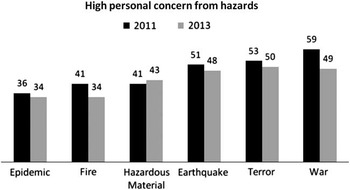
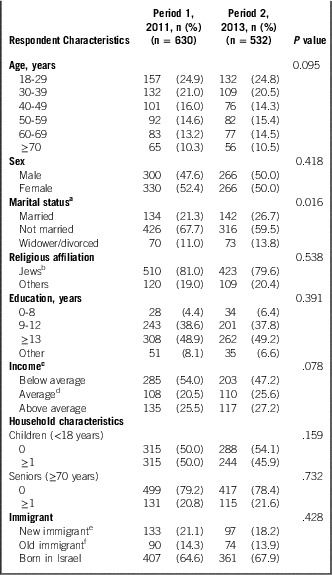
The sociodemographic characteristics of the 2 survey groups were found to be similar in most respects, thus enabling meaningful comparison of other factors (Table 1). In regard to the personal concern of the respondents from different hazards (Figure 2), a significant decrease was observed in all items except for the hazardous materials threat. The concern about a possible earthquake was almost as high as the more common security-related threats of war and terror and much higher than the concern about hazardous materials, epidemics, and fires.
High Personal Concern From Different Hazards, 2001 vs 2013 (%). All differences were significant (P<0.01), except for hazardous material.

Sociodemographic Characteristics of the Respondents to the 2 Surveys

a Missing=1 (0.1%).
b According to Israel’s Central Bureau of Statistics,Reference Cohen 27 Jews in Israel are 75.4% of the Israeli population.
c Missing=204 (17.5%).
d Average income was defined as 10,010 new Israeli shekels for a household per month as determined by the Israel Central Bureau of Statistics. 24
e New immigrant, after 1989.
f Old immigrant, prior to 1989.
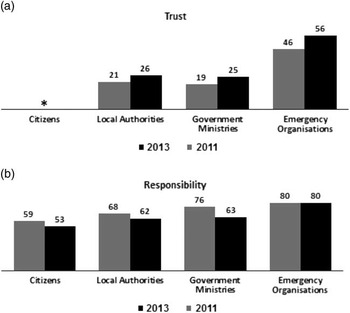
We also compared the public perception of responsibility and trust in different agents: government ministries, emergency organizations, local authorities, and the public itself (Figure 3). A huge gap of up to 40% between the levels of trust and the perceived responsibility of respective authorities was found in both surveys. Interestingly, the trust in the government and the emergency organizations increased in the later period.
Level of Trust Versus Perception of Responsibility, 2011 vs 2013 (%). Significant (P<0.01) difference between the years in trust in government ministries and emergency organizations. No significant differences in perceived responsibility.*No data (was not included in the survey).

The proportion of people stating high and very high levels of knowledge of what to do in the case of an earthquake was significantly higher in 2013 (40% versus 21%). To establish whether this improvement could be attributed to the campaigns, an adjusted logistic regression predicting knowledge as a function of exposure to campaign and the period of the study was conducted. The exposure to the campaign (even after being adjusted by the study period) proved to be a significant factor in increasing the knowledge of the respondents, giving a 1.5 times higher knowledge advantage to the respondents exposed to the campaign (odds ratio [OR]: 1.6; 95% CI: 1.27~2.12). However, the period of the assessment (after adjustment for exposure to the campaign) proved to be an even more significant factor, with knowledge in 2013 being 2.3 times that in 2011 (OR: 2.3; 95% CI: 1.81~3.02).
DISCUSSION
Earthquake is a type of disaster that cannot be predictedReference Geller, Jackson and Kagan 25 ; therefore, the only effective way of reducing damages and loss of human life is by pre-disaster preparedness. However, there is still no clear understanding of the factors that may increase the public preparedness for an earthquake. Therefore, the aim of our study was not only to assess the ability of a singular earthquake awareness campaign to increase preparedness-related knowledge, but to assess the potential longer-term cumulative impact of several successive campaigns dealing with the same issue and other related events, such as actual earthquakes and preparedness drills covered in the media.
In this study we have shown that even when the awareness campaigns themselves seemed to have a significant effect on the public’s knowledge about earthquakes, the cumulative effect over the years of the study was noted to have an even stronger influence. The public was found to be much more likely to react to the campaigns when continuously exposed to additional earthquake-related triggers. Multiple activities targeted the earthquake preparedness of the Israeli public during the years of the study: 3 awareness campaigns, increased accessibility of relevant information sources, school-based lessons and drills, national-level earthquake drills in 2012 with extensive media coverage, and a wide public risk communication debate in the mass media during 2013 in light of the several small-scale earthquakes that took place in the region. Nathe et alReference Nathe, Gori and Mileti 12 defined such sequences of events as “windows of opportunity” for increasing public preparedness. Images from earthquakes elsewhere could be useful for helping the public to better understand the consequences of such event. Furthermore, even being exposed to the small earthquakes that happened in the country may have helped the public to understand that earthquakes can happen.
The main reasons campaigns undertaken during such periods can be more effective are best understood through the lenses of protection motivation theory on a personal level and of diffusion of innovations theory on a higher social level. In accordance with protection motivation theory, 4 conditions must be met for the population to become motivated to prepare for emergencies: they should believe that the threat is likely to affect them, protective actions must appear effective and not to involve excessive costs, and they must believe that they are capable of performing the needed actions.Reference Maddux and Rogers 13 Naturally enough, these conditions are much easier to meet during “windows of opportunity.” For example, in our case, the level of concern from most hazards was found to be higher in the first survey, which in terms of timing was much closer to several local and global emergency events, such as the Carmel Fire,Reference Paz, Carmel and Jahshan 26 the military operation “Cast Lead”Reference Cohen 27 or “Protection Edge,”Reference Shenhar 28 and, of course, the Fukushima Daiichi nuclear power plant disaster.Reference Chino, Nakayama and Nagai 29 The level of perceived responsibility of the population itself was also found to be somewhat higher in 2011 (also still much lower than perceived responsibility of authorities), which suggests that the population see themselves as more capable to deal with an event when it is still fresh in their memory. On a more general level, in both surveys the respondents perceived earthquakes to be a significant threat, almost on the same level as the more familiar threats of war and terror, emphasizing the connection between the situational context and the timing of preparedness campaigns. In accordance with diffusion of innovations theory, when the issue has reached a certain level of importance in the public medium, people begin to voluntarily pass related messages to each other, thus enhancing the potential influence of awareness campaigns.Reference Rogers 14
The large gap between perceived responsibility of authorities in times of emergency and the public’s trust in their capabilities found in both surveys somewhat decreased in a later period because of the significant improvement in the levels of trust. This gap must be taken seriously by decision makers because it might have a big impact during future disasters. This finding seems to be also directly related to the improvement in knowledge about earthquakes, because the initially low levels of trust may have been related to limited knowledge.Reference Amanatidou and Psarra 15 Not knowing much about the actual scope of emergencies and the gap between resources and needs may result in unrealistically high expectations for performance of authorities as well as the perception of the preparedness level being generally inadequate. However, learning about earthquakes and their impact through educational effort and witnessing a stream of several very serious events (Haiti in 2010, Christchurch in 2011, Japan in 2011) while also being exposed to the level of governmental investment in the preparedness effort through coverage of drills and awareness campaigns may actually increase the levels of trust through learning about the relevant issues.Reference Covello, Peters and Wojtecki 30
The remaining question to answer is whether all this investment in public preparedness is worth the money, because each of the 3 described campaigns had a cost of more than 1 million dollars, which, theoretically, could have been invested in something else with greater benefit. However, in case of an actual earthquake, the potential risks of not communicating the related preparedness messages to the public beforehand may translate into much higher financial costs. Additionally, a significant impact on knowledge and behavior can be expected only of high-quality campaigns, with quality sensibly being conditioned by the level of investment.Reference Noar 9
In our study we found that exposure to the campaign had a significantly positive influence on the knowledge of the respondents about earthquakes. However, because the effect of time on knowledge was found to be higher than the actual exposure to the campaigns, we think that no immediate effect should be expected from a single media campaign or a preparedness drill. Instead, the whole continuous educational effort should be planned in accord with “windows of opportunity,” presented by the stream of events, in order to achieve a cumulative effect on the population.
CONCLUSIONS
This study found an improvement in public knowledge regarding earthquake preparedness over the 3 years of the study. This improvement could be attributed both to the awareness campaigns, which were directly tasked with increasing this knowledge, and also to the effect of other related events that the public was exposed to during the years of the study. This means that an awareness campaign does not stand by itself; it should be part of an integrated long-term process in order to have a lasting effect on the population. Furthermore, the timing of the campaign was found to be a very important factor. The campaign has to be prepared in advance and be executed during relevant events that are windows of opportunity for better communicating with the public.