At the population level, late adolescence and early adulthood are marked by rapid changes in substance use (Bachman et al., Reference Bachman, O'Malley, Schulenberg, Johnston, Bryant and Merline2002; Johnston, O'Malley, Bachman, & Schulenberg, Reference Johnston, O'Malley, Bachman and Schulenberg2009b). This time in the life course is also dense with regard to social role transitions (Shanahan, Reference Shanahan2000), which provide the dynamic context for individual developmental change. From a person–context interaction perspective, many of the individual-level changes can be viewed as a direct function of the social context transitions (Schulenberg, Maggs, & Hurrelmann, Reference Schulenberg, Maggs and Hurrelmann1997); likewise, individual characteristics contribute to selection into different post high school roles and contexts. Thus, it is not a coincidence that there are rapid changes in substance use at the same time in the life course as multiple social role changes. This emphasis on social role and context changes as they relate to changes in substance use and problem behaviors has a long history in the literature (e.g., Bachman et al., Reference Bachman, O'Malley, Schulenberg, Johnston, Bryant and Merline2002; Bachman, Wadsworth, O'Malley, Johnston, & Schulenberg, Reference Bachman, Wadsworth, O'Malley, Johnston and Schulenberg1997; Horney, Osgood, & Marshall, Reference Horney, Osgood and Marshall1995; Leonard & Homish, Reference Leonard and Homish2005; Yamaguchi & Kandel, Reference Yamaguchi and Kandel1985), but several key questions remain concerning issues of role selection versus socialization, of causal connections, of cascading effects from earlier risk and protective factors, and of mediation and moderation effects.
Using national longitudinal data from the Monitoring the Future (MTF) study (Johnston et al., Reference Johnston, O'Malley, Bachman and Schulenberg2009b; Johnston, O'Malley, Bachman, & Schulenberg, Reference Johnston, O'Malley, Bachman and Schulenberg2009a), we examine proximal links between changing social roles and substance use during the transition to adulthood, investigating the extent to which licit and illicit drug use rises and falls in tandem with changes in social roles in the domains of work, family, and school (socialization hypothesis; see Yamaguchi & Kandel, Reference Yamaguchi and Kandel1985). Because substance use and the timing of social role transitions vary consistently by gender and like most prior research on drug use during the transition to adulthood, we estimate separate models for women and men. Unlike most prior research, however, we eliminate potential bias because of unmeasured, stable individual differences by estimating the relationships of within-individual change in substance use to changes in work, school, and family roles (Raudenbush & Bryk, Reference Raudenbush and Bryk2002). Thus, our analysis strategy controls for all stable individual differences that could generate spurious relationships between social roles and substance use (selection hypothesis), as well as childhood and adolescent risk factors (e.g., low socioeconomic origins, lack of school readiness, early problem behaviors, academic failure, delinquent peer associations) that may have cumulative and indirect effects on long-term adult role attainment and substance use (i.e., cascading hypothesis; Masten et al., Reference Masten, Roisman, Long, Burt, Obradovic and Riley2005). In addition, we contribute to the relevant literature by not only considering how, within individuals, variation in school, work, and family roles and contexts relates to change in substance use, but also considering which of the roles and contexts are most consistently and uniquely predictive of changes in substance use. In weaving together concepts from life course development and developmental psychopathology, we hope to provide a fuller understanding of the course and causes of substance use and abuse across the transition to adulthood.
Social Role Transitions and Experiences and Substance Use
Rates of substance use and heavy drinking increase dramatically during the teenage years and young adulthood, and then decline into adulthood (e.g., Bachman et al., Reference Bachman, Wadsworth, O'Malley, Johnston and Schulenberg1997, Reference Bachman, O'Malley, Schulenberg, Johnston, Bryant and Merline2002; Johnston et al., Reference Johnston, O'Malley, Bachman and Schulenberg2009b; for a review, see Chassin, Hussong, & Beltran, Reference Chassin, Hussong, Beltran, Lerner and Steinberg2009). Earlier initiation and heavier use of alcohol and drugs during adolescence and young adulthood predict a higher likelihood of lifetime substance use and alcohol problems (e.g., Zucker, Reference Zucker, Cicchetti and Cohen2006), and pose a potential threat to successful negotiation of developmentally normative tasks during this transition (Krohn, Lizotte, & Perez, Reference Krohn, Lizotte and Perez1997; Maggs & Schulenberg, Reference Maggs, Schulenberg and Galanter2005; Newcomb & Bentler, Reference Newcomb and Bentler1988). However, most adults, even those who began substance use early, do not continue these harmful drinking and drug use patterns (Jessor, Donovan, & Costa, Reference Jessor, Donovan and Costa1991). This leads to the question, what are the specific social role changes that contribute to rises and falls in substance use during the transition to adulthood?
Postsecondary school attendance predicts higher rates of alcohol and substance use during the transition from adolescence to young adulthood (Bachman et al., Reference Bachman, Wadsworth, O'Malley, Johnston and Schulenberg1997, Reference Bachman, O'Malley, Schulenberg, Johnston, Bryant and Merline2002; O'Malley & Johnston, Reference O'Malley and Johnston2002; Paschall, Bersamin, & Flewelling, Reference Paschall, Bersamin and Flewelling2005), a relationship that reflects college students' delayed family role transitions (e.g., marriage, parenthood), unique living arrangements (i.e., residence in a dormitory, fraternity, or sorority), and positive attitudes toward drug and alcohol use (Bachman et al., Reference Bachman, O'Malley, Schulenberg, Johnston, Bryant and Merline2002; McMorris & Uggen, Reference McMorris and Uggen2000; Schulenberg & Maggs, Reference Schulenberg and Maggs2002). It is important that young people who postpone heavy alcohol use (and other drug use) until college also tend to relinquish it later as they get married and have children (Burton, Johnson, Ritter, & Clayton, Reference Burton, Johnson, Ritter and Clayton1996; Chilcoat & Breslau, Reference Chilcoat and Breslau1996; Gotham, Sher, & Wood, Reference Gotham, Sher and Wood2003; Mudar, Kearns, & Leonard, Reference Mudar, Kearns and Leonard2002; Sher, Bartholow, & Nanda, Reference Sher, Bartholow and Nanda2001). Bachman and colleagues (2002) found that family roles, such as engagement, marriage, pregnancy, and parenthood, predicted reduced use of alcohol, cigarettes, and illicit drugs in young adulthood, as “responsibilities to spouses and children appear to crowd out these kinds of recreation most likely to encourage substance use” (2002, p. 219). The authors showed that time spent hanging out with friends, religiosity, and positive attitudes toward alcohol use explained some, but not all, of the relationship between changing family, work, and school roles and alcohol use between ages 18 and 24. Nonetheless, these prior studies suggest that substance use declines with theses role transitions in part because the demands and constraints of adult work and family roles are generally incompatible with continued substance use.
Yet, when assessing links between role transitions and substance use, prior research has given insufficient attention to the quality of social roles. Age-graded social control theory (Laub & Sampson, Reference Laub and Sampson2003; Sampson & Laub, Reference Sampson and Laub1993) emphasizes the importance of work, family, and school roles that facilitate socialization and restrain substance use and deviant behaviors. In particular, high-quality employment and work stability indicate adult social bonds that may reduce substance use, law violation, and other problem behaviors in adulthood (Laub & Sampson, Reference Laub and Sampson2003; Uggen, Reference Uggen1999). By contrast, employment entailing low occupational status, part-time work hours, and temporary work arrangements may be less likely to lower substance use or reduce heavier use compared to work in more rewarding and permanent positions. Longitudinal samples extending into adulthood are especially needed to assess work effects on substance use given the lengthening of the school to work transition, as young people today are increasingly likely to continue their formal education into adulthood and delay the onset of career acquisition (Kerckhoff, Reference Kerckhoff, Mortimer and Shanahan2003; Mortimer, Vuolo, Staff, Wakefield, & Xie, Reference Mortimer, Vuolo, Staff, Wakefield and Xie2008). A key aim of our paper is thus not only to examine hypotheses about the effects of role transitions on substance use, but also to consider the quality of some of these age-graded social roles. For instance, do part- and full-time work have the same association with drug and alcohol use? Does the type of job matter?
Assessing the effects of family roles on substance use over the long term is increasingly important as the timing of marriage and fertility behavior both lengthens and diversifies. For instance, among recent cohorts of young people, marriage is delayed, cohabitation and nonmarital childbearing are more common, marital instability has risen, and increasing numbers of young people are not residing with their children (Amato, Booth, Johnson, & Rogers, Reference Amato, Booth, Johnson and Rogers2007; Bumpass & Lu, Reference Bumpass and Lu2000; Ventura & Bachrach, Reference Ventura and Bachrach2000). Moreover, although research has shown that married young adults are less likely to use licit and illicit substances than young adults who remain single, the transition from marriage to divorce coincides with increased substance use (Bachman et al., Reference Bachman, Wadsworth, O'Malley, Johnston and Schulenberg1997, Reference Bachman, O'Malley, Schulenberg, Johnston, Bryant and Merline2002). The recent increases in cohabitation and age of first marriage, the high divorce rate, and declining remarriage rate (Amato et al., Reference Amato, Booth, Johnson and Rogers2007) necessitate longitudinal samples of young people followed into adulthood to better understand how changes in fertility behavior and union formation and dissolution (i.e., divorce, separation, and widowhood) affect long-term patterns of substance use.
Role Selection, Cascading Effects, and Developmental Transitions
Transitions to adult work and family roles may reduce substance use and abuse because the constraints of adult roles are generally incompatible with continued substance use. For instance, role socialization (Yamaguchi & Kandel, Reference Yamaguchi and Kandel1985) suggests that alcohol and other drug use may decline with certain adult role transitions (i.e., full-time student to full-time worker, nonparent to parent, residential independence to cohabitation/marriage) by limiting unstructured leisure activities with friends, by providing norms and expectations against drinking and drug use, and by increasing conformity to conventional adult social norms (e.g., age-graded social control theory; Laub & Sampson, Reference Laub and Sampson2003). Conversely, role selection (Yamaguchi & Kandel, Reference Yamaguchi and Kandel1985) highlights selectivity issues regarding the relationship between social roles and substance use. For instance, precocious development theory (Newcomb & Bentler, Reference Newcomb and Bentler1988) contends that impulsive young people are more likely to use substances and select into adultlike situations that are more compatible with continued substance use, such as leaving school early, acquiring full-time work, and moving away from the parental home. Willis (Reference Willis1977) identified a similar process among working class boys in England, as heavy drinking was viewed by some of the youth as a claim to a more mature status that was more compatible with full-time work than continued schooling. Likewise, problem behavior theory (Jessor & Jessor, Reference Jessor and Jessor1977) views heavy drinking in adolescence as part of a syndrome of problem behaviors among transition-prone youth who are striving for a more “adultlike” status. It is important that each of these theoretical perspectives highlights unobserved or difficult to measure childhood and adolescent risk factors (e.g., low self-control, transition proneness, working-class masculinity) that are generally stable over time and predict both the onset and stability of adult role acquisition and substance use. Despite this rich theoretical tradition of role selection, little research has adequately controlled for such unmeasured, time-stable factors that no doubt affect the timing, sequencing, and stability of social roles and substance use behaviors.
The literature on cascading effects, where earlier difficulties in one domain (e.g., peer relations) contribute to subsequent difficulties in another domain (e.g., substance use), similarly highlights early childhood risk factors that are central to understanding how psychopathology accumulates across the life course (e.g., Dodge, Greenberg, & Malone, Reference Dodge, Greenberg and Malone2008; Masten et al., Reference Masten, Roisman, Long, Burt, Obradovic and Riley2005). For instance, Dodge and colleagues (Reference Dodge, Greenberg and Malone2008) demonstrate how an adverse economic and social context in childhood has cascading effects on adolescent violence through a sequence of diminished academic achievement, disengagement from school, reduced parental attachment and monitoring, and engagement with delinquent peers. Although economic disadvantage in childhood is not a consistent predictor of substance use and problem behaviors in adolescence (Wiles et al., Reference Wiles, Lingford-Hughes, Daniel, Hickman, Farrell and Farrell2007; Wright, Caspi, Moffitt, Miech, & Silva, Reference Wright, Caspi, Moffitt, Miech and Silva1999), youth from families of lower socioeconomic status (SES) are likely to enter the labor force at a younger age, have less connection to the educational system, and have greater job instability and nonstandard work arrangements than their more advantaged peers (Kerckhoff, Reference Kerckhoff, Mortimer and Larson2002). Thus, adolescents from more advantaged social class origins may complete college and obtain good jobs regardless of periodic or even serious alcohol and substance use infractions (Hagan, Reference Hagan1991), whereas adolescents whose parents have working-class jobs may be more vulnerable to the risks of heavy adolescent drinking and substance use because they have less access to psychosocial and financial resources (Hagan, Reference Hagan1993; Newcomb & Bentler, Reference Newcomb and Bentler1988). Other research has shown that difficult temperament, low cognitive ability, behavior problems, and lower school achievement in first grade predict both adult alcohol abuse and dependence (Zucker, Reference Zucker, Cicchetti and Cohen2006), as well as marriage instability, educational failure, and labor market problems (Caspi, Wright, Moffitt, & Silva, Reference Caspi, Wright, Moffitt and Silva1998; Flora & Chassin, Reference Flora and Chassin2005; Kandel, Davies, Karus, & Yamaguchi, Reference Kandel, Davies, Karus and Yamaguchi1986). These studies highlight how pivotal childhood and adolescent resources and experiences can contribute, in a cascading fashion, to the timing and ordering of adult role transitions and long-term trajectories of substance use.
Consistent with a cascading effects model, earlier characteristics and events clearly contribute in important ways to later substance use (e.g., Dodge et al., Reference Dodge, Malone, Lansford, Miller, Pettit and Bates2009), but more developmentally proximal effects also prove to be important, especially during the transition to adulthood (Laub & Sampson, Reference Laub and Sampson2003; Schulenberg & Zarrett, Reference Schulenberg, Zarrett, Arnett and Tanner2006). This global transition is rich with new opportunities and social contexts that can provide entries into and exits out of substance use, and the successes and difficulties one experiences with the many developmental tasks during this period can contribute to continuities and discontinuities in ongoing trajectories of substance use, health, and well-being (e.g., Masten et al., Reference Masten, Roisman, Long, Burt, Obradovic and Riley2005; Schulenberg, Bryant, & O'Malley, Reference Schulenberg, Bryant and O'Malley2004; Schulenberg, Sameroff, & Cicchetti, Reference Schulenberg, Sameroff and Cicchetti2004). To some extent, cascade models reflect continuity (e.g., bad circumstances contribute to subsequent bad circumstances); however, social role transitions can often interrupt the ongoing person–context interactions that underlie cascading effects and thus serve as turning points in the behavioral trajectory of interest (Schulenberg & Maslowsky, Reference Schulenberg and Maslowsky2009). This suggests that social role transitions provide a needed vantage point for testing for continuities and discontinuities in ongoing and even cascading behavioral trajectories (Cicchetti & Rogosch, Reference Cicchetti and Rogosch2002; Rutter, Reference Rutter1996).
The Current Study
We use the national MTF multiwave longitudinal data to examine how changes in social roles correspond with changes in substance use during the transition to adulthood. We advance the relevant literature in at least three ways. First, and of the most importance, we are able to isolate more definitively the effects of role socialization on alcohol and substance use by controlling for time-stable unobserved factors, such as self-control, temperament, and transition proneness, that may predict both adult role transitions and substance use. At the same time, we also contribute to the cascading effects literature by considering how, within individuals, variations in social roles and contexts relate to variations in substance use. Because each individual serves as his or her own control in the analyses, we are able to make stronger statements about causal connections than is typically possible from correlational longitudinal research. Often, within cascading effects analyses that focus on cross-lag effects, only stability within targeted characteristics is controlled, without addressing the possibility that the multitude of unmeasured and unobserved characteristics may set the stage for the smaller set of cascading effects under consideration. By controlling for all stable individual differences, we are able to rule out a multitude of selection effects, including early childhood and adolescent risk factors that may have long-term effects in adulthood. We control for selection into and out of social roles, and can therefore make statements about the extent to which the given connection with changes in substance use is because of social role transition influences.
Second, we consider an extensive and diverse set of family, school, and work roles, allowing us to determine the relative power of the various roles in contributing to changes in substance use. In particular, taking advantage of the large sample covering ages 19–28, we account for diverse types of union formation (e.g., marriage as well as various combinations of engagement and cohabitation), fertility behaviors (e.g., pregnancy, resident vs. nonresident parenthood), and singlehood (e.g., never married vs. currently divorced, separated, or widowed; residing alone vs. living with roommates). We also account for diversity in school roles and educational attainments (e.g., part-time vs. full-time status; residence in a dormitory, fraternity, or sorority; baccalaureate degree attainment vs. college dropout), as well as work roles (full-time vs. part-time status; homemaker) and job types (e.g., military, professional, nonprofessional). In isolation, most of these role transitions and experiences likely relate to changes in substance use, but they are typically intertwined, indicating the need to consider them together to determine which are more strongly related to changes in substance use. For example, research shows that, relative to marriage, cohabitation has little effect on substance use (Duncan, Wilkerson, & England, Reference Duncan, Wilkerson and England2006), but cohabitation in the context of an engagement provides norms and expectations that are similar to marriage in reducing substance use (Bachman et al., Reference Bachman, Wadsworth, O'Malley, Johnston and Schulenberg1997). Work roles may have little effect on substance use when we consider whether the young person is also attending school full-time or residing with his or her parents. The effects of some of these role combinations on substance use may differ by gender. For instance, full-time work may reduce substance use among men because it corresponds with family formation, whereas for women, full-time work may not have this effect because it is associated with reduced fertility behaviors (Budig, Reference Budig2003). We examine all of these social roles alone and simultaneously in order to consider their unique and combined effects.
Third, we include potential moderators and mediators of the relationship of social role transitions to substance use, both of which have implications for understanding cascading effects. Consideration of important moderators can illustrate variations in social role transition rates and effects on substance use, suggesting variations in underlying cascading effects. In addition to including gender as a predefined moderator (discussed above), we examine senior-year cohort, background SES, and adolescent drug use. Data consist of 22 senior-year cohorts (1977–1998) from the MTF panel data, followed to age 27–28, allowing us to determine whether social role effects on substance use have varied across two decades characterized by important changes in timings of social roles and by extensive variation in substance use rates (Bachman et al., Reference Bachman, O'Malley, Schulenberg, Johnston, Bryant and Merline2002; Johnston et al., Reference Johnston, O'Malley, Bachman and Schulenberg2009a, Reference Johnston, O'Malley, Bachman and Schulenberg2009b). Both background SES and adolescent drug use are important markers of constraints and opportunities for young adult roles and experiences (e.g., Maggs & Schulenberg, Reference Maggs, Schulenberg and Galanter2005; Newcomb & Bentler, Reference Newcomb and Bentler1988; Zucker, Donovan, Masten, Mattson, & Moss, Reference Zucker, Donovan, Masten, Mattson and Moss2008), and we are interested in how they relate both to the social role transition experiences as well as to how the social role transitions contribute to changes in drug use. As for mediators, we examine two that are potentially important mechanisms for social role transition effects: socializing (i.e., evenings out for fun and recreation) and religiosity (Bachman et al., Reference Bachman, O'Malley, Schulenberg, Johnston, Bryant and Merline2002). These mediators allow for the consideration of intraindividual cascading effects, that is, how within-individual variations in social roles relate to variations in these two constructs, which in turn relate to changes in substance use. By examining the effects of these potential moderators and mediators in a large, national multiwave longitudinal sample, we highlight their contributions to the cascading process that leads from social role transitions to changes in substance use.
Method
Sample
The data come from the MTF project, which is conducted by the Institute for Social Research at the University of Michigan. Large nationally representative samples of about 16,000 12th graders are drawn from about 135 public and private high schools each year (Johnston et al., Reference Johnston, O'Malley, Bachman and Schulenberg2009a, Reference Johnston, O'Malley, Bachman and Schulenberg2009b). We use longitudinal data from 22 consecutive 12th-grade cohorts who were initially sampled in 1976 through 1997. Approximately 2,400 high school seniors each year are selected for biennial follow-ups using mailed questionnaires. The biennial follow-up surveys begin 1 year after high school for one random half of each cohort and 2 years after high school for the other half. For purposes of these analyses, the two halves were combined. Individuals who used illicit drugs in high school were oversampled for the follow-up surveys. Corrective weighting was used in the analyses to compensate for the effects of unequal probabilities of selection. Note that additional information about the MTF design and methods is available in Johnston et al. (Reference Johnston, O'Malley, Bachman and Schulenberg2009a) and on the MTF website (www.monitoringthefuture.org).
Our longitudinal analysis is based on young adults who were in the sample during 12th grade and who completed at least one follow-up survey (at ages 19–20, 21–22, 23–24, 25–26, or 27–28). We restrict our longitudinal sample to those young people who provided information on the explanatory and outcome variables, although our strategy of analysis does not require observations across all waves of the study (Raudenbush & Bryk, Reference Raudenbush and Bryk2002). For our analyses, we follow 21,868 women and 18,555 men over approximately 125,000 respondent/wave measurements.
Measures
Substance use
To assess the robustness of the effects of school, work, and family roles on substance use, we consider a range of self-reported substance use indices. The measures of alcohol, marijuana, and cocaine use range on 9-point scales from no use in past year to 40 or more occasions in the prior month. Because less than 1% of respondents had used cocaine more than 10 times in the past month, we constrained this variable to range on a 6-point scale from no use in past year to 10 or more times in the past month. The measure of heavy drinking is based on the number of times respondents reported having five or more drinks in a row during the past 2 weeks. This measure ranges on a 6-point scale from none to 10 or more times. The cigarette use measure indicates how frequently the respondent smoked cigarettes in the past 30 days (ranging on a 6-point scale from not at all to about one and one-half packs or more per day). These items have been shown to have high validity and reliability (Johnston et al., Reference Johnston, O'Malley, Bachman and Schulenberg2009a). The measures of substance use had skewed distributions. Because the data are skewed, we transformed all of our outcome variables by first adding a constant of 1 to each variable, and then using the natural logarithm (Kirk, Reference Kirk1994).Footnote 1
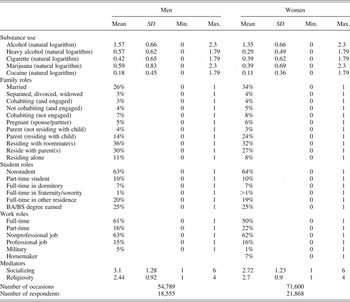
Table 1 provides descriptive statistics by gender for the substance use measures, as well as all our time-varying measures that we describe next. These descriptive statistics are based upon the pooled data set encompassing the five waves of data from ages 19–20 to 27–28.
Descriptive statistics

Family roles and experiences
At each wave, respondents were asked “what is your present marital status?” We created six dummy variables indicating whether the respondent was single, married, engaged and cohabiting, engaged and not cohabiting, cohabiting but not engaged, or separated/divorced/widowed at the time of survey administration. Respondents were also asked at each wave: “which of the following people live in the same household with you (mark all that apply)?” We used these variables to distinguish when respondents were living alone versus when they were residing with roommates other than their spouse, children, parents, or intimate partners. We also included a measure of whether the respondent resided with his/her parent(s). Regarding fertility, we included measures indicating whether the respondent had any children (including stepchildren and adopted children) and, if so, whether they were currently residing with their child. We also created a measure indicating whether the respondent (or the respondent's spouse or girlfriend) was currently pregnant. To best capture family complexity, only a few of the family roles listed above were coded as mutually exclusive and exhaustive (i.e., single, engaged [regardless of cohabitation], married, and separated/divorced/widowed), which is important given that simultaneous occupation of many family roles (e.g., marriage and parenthood, singlehood and residing with parents, union dissolution and nonresidential parenthood), as well as the blurred boundaries between some family transitions (e.g., cohabitation and singlehood; see Brown & Manning, Reference Brown and Manning2009; Manning & Smock, Reference Manning and Smock2005)
Table 1 shows the proportion of the five follow-up waves (from ages 19–20 to 27–28) in which each social role was reported by men and women. Note that these proportions are based upon number of observations, not individuals, and that one individual can contribute from one to five observations. Overall, men were less likely to report being married (26% vs. 34%, respectively), residing with their child (14% vs. 24%), and cohabiting (10% vs. 12%) than women during the observation period. Instead, men were more likely than women to report being single (64% vs. 53%), residing with their parents (30% vs. 27%), residing with roommates (36% vs. 32%), or residing alone (11% vs. 8%).
School roles and experiences
Respondents at each follow-up survey were asked “during March of this year, were you taking courses at any school or college?” We used this measure to distinguish those who were attending school part-time or full-time from others. As shown in Table 1, respondents were full-time students in approximately one-third of the assessed waves between ages 19 and 28, whereas they were part-time students at only 10% of the data occasions. Among respondents who were full-time students, we further distinguished whether or not they were residing in a dormitory, in a fraternity or sorority, or in some other type of residence. During the first follow-up survey, almost all of the full-time students resided in a dormitory, whereas in subsequent surveys full-time students branched out into various residential arrangements, including fraternities and sororities. In addition, we created a time-varying measure indicating whether they had received a baccalaureate degree or higher. Respondents held a baccalaureate degree or higher in approximately one-quarter of the follow-up observations.
Work roles and experiences
During each wave respondents were asked “which best describes your employment during the first full week in March?” We distinguished respondents who were not working from those working part-time or full-time. We also distinguished whether the respondent worked in a professional job (e.g., lawyer, physician, dentist, scientist, college professor, engineer, computer programmer, registered nurse, librarian, teacher, social worker, etc.) versus a nonprofessional job. Women reported working as a homemaker in approximately 7% of the waves. We did not distinguish homemaker status among men because only a handful of men identified this role. Finally, we created a measure of whether the respondent was in the military. In approximately 5% of the observations, men reported being in the military, compared to 1% of women; these differences reflect the different proportions of men and women who enlist, rather than differences in average length of service.
Mediating variables: Socializing and religiosity
As potential mediating variables for the effects of social roles and experiences on substance use, we include time-varying measures of socializing and religiosity. Socializing is a measure of the frequency of spending evenings out for fun and recreation (ranges on 6-point scale from less than 1 evening per week to 6 or 7 evenings per week). Religiosity is a composite measure of how often the respondent attended religious services (ranging on a 4-point scale from never to about once a week or more) and the importance of religion in their life (ranging on a 4-point scale from not important to very important). These two items were averaged (Cronbach α = 0.80).
Moderators: Historical context, adolescent substance use, and socioeconomic background
To determine whether social role effects on substance use have varied across two decades, we include a measure of cohort year, defined on year of high school graduation (a linear measure ranging from 1976 to 1997). To assess whether the effects of social roles vary by adolescent substance use, we included a dichotomous measure of whether the respondent had used marijuana at some point during the prior 12 months. We also included a measure of parental education to assess whether the effects of social roles vary by socioeconomic background. Parental educational attainment is based on the average educational level of the mother and father (ranging from 1 = completed grade school or less to 6 = graduate or professional school after college). The average educational level across all respondents' parents is a high school degree.
Analytic plan
We use a two-level hierarchical model (Raudenbush & Bryk, Reference Raudenbush and Bryk2002) to estimate relationships of within-individual change in alcohol and substance use to within-individual change in work, school, and family roles and other explanatory variables. This strategy of analysis has two primary advantages. First, this model more definitively addresses the selection versus socialization hypotheses (Yamaguchi & Kandel, Reference Yamaguchi and Kandel1985) by using an analysis of within-individual changes to control for all time-stable individual differences (see Halaby, Reference Halaby, Mortimer and Shanahan2003). Second, the hierarchical model is suitable for data sets in which some people provide data on some but not all occasions (Raudenbush & Bryk, Reference Raudenbush and Bryk2002). Thus, respondents who do not participate in all waves of the study still contribute to the analyses.
In our model, we treat multiple observations over time (i.e., person years, Level 1) as nested within individuals (Level 2). In the first level of the hierarchical model, we include time-varying measures of substance use as the criterion variable, as well as variables referencing time and time-varying covariates (e.g., family, work, and school roles) as predictors. In the second level, the Level 1 parameters become outcome variables. Thus, the Level 2 parameters address between-person variation in associations between social roles and substance use.
To account for unmeasured factors that may affect both changes in substance use and changing family, school, and work roles, we include the individual means from each time-varying covariate as predictors in the Level 2 intercept equation (Halaby, Reference Halaby, Mortimer and Shanahan2003; Raudenbush & Bryk, Reference Raudenbush and Bryk2002). The results for each social role thus represent the effect on substance use of being in that role versus not being in that role. Furthermore, the inclusion of the individual means of the explanatory variables to the intercept equation controls for selection effects by reducing the bias associated with unobserved, stable character traits that may influence both the time-varying covariates and the change over time in substance use (Halaby, Reference Halaby, Mortimer and Shanahan2003). Unlike most prior research, our analysis strategy thus accounts for both observed and unobserved stable differences between young adults, as well as potential mediators, when assessing the within-individual change in social roles and substance use during the transition to adulthood. This will allow us to draw stronger conclusions about effects of social contexts and social role transitions on substance use.
Results
We present our findings in two parts. First, we examine how changes in work, family, and school roles and experiences correspond with changes in alcohol, cigarette, marijuana, and cocaine use, as well as whether changes in the potential mediating variables account for any relationship between social roles/experiences and substance use. Second, we examine the extent to which socioeconomic background and adolescent substance use moderate these relationships.
Social roles and experiences: Predictors of change in substance use
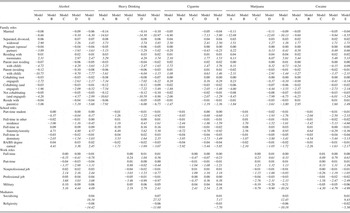
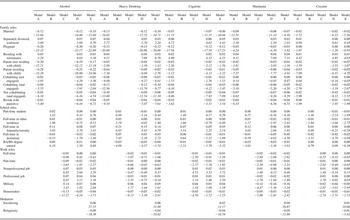
Table 2 and Table 3 present unstandardized regression coefficients and t values (in italics) from within-individual regressions of alcohol, marijuana, cigarette, and cocaine use, as well as heavy drinking, on social roles for men and women, respectively. For each of the five outcomes, we show five models: Model A includes only family roles, Model B includes only school roles, and Model C includes only work roles. In Model D, we include all of the roles, and Model E includes the mediators (e.g., socializing and religiosity). Our purpose in presenting and summarizing all five models is to show how findings vary when the scope is limited to single domains of social roles compared to when they are all viewed together (Models D and E). Although not shown in Tables 2 and 3, all of the models include the individual means of the explanatory variables to the intercept equation to produce within-individual relationships (Level 2 estimates available upon request). We also controlled for age in all of the models in order to address changing social roles, leisure patterns, religious involvement, and substance use as young people transition from adolescence to young adulthood (the age coefficients are also not shown in Tables 2 and 3 but available upon request). All of our outcome variables show nonlinear changes with age, as substance use initially rises and then falls during the transition to adulthood.
Unstandardized regression coefficients and t ratios from within-individual regressions of substance use on social roles for men

Note: The numbers in italics are t ratios. Sample size = 18,555 men followed over 54,789 occasions.
Unstandardized regression coefficients and t ratios from within-individual regressions of substance use on social roles for women

Note: The numbers in italics are t ratios. Sample size = 21,868 women followed over 71,600 occasions.
Family roles and experiences
As shown in Model A, after controlling for stable individual differences, family roles have powerful effects on alcohol and substance use, that is, entry and exit into family roles and experiences contributed to significant changes in levels of substance use. Heavy drinking, as well as alcohol, cigarette, marijuana, and cocaine use were significantly lower when men and women were married compared to when they were not. For instance, rates of substance use declined between 5% and 14% for men (for cocaine use, γ = −0.05, t = −9.7; for heavy alcohol use, γ = −0.14, t = −14.6) and between 2% and 13% for women (for cocaine use γ = −0.02, t = −5.7; for heavy alcohol use γ = −0.13, t = −19) when they were married compared to when they were single (the reference category). Union dissolution also contributes to substance use; rates of alcohol, heavy drinking, cigarette use, and marijuana (for women only) were significantly higher when respondents were separated, divorced, or widowed than when they were single. Rates of cocaine use were not significantly different. Substance use also declined when respondents were cohabiting, although these effects are weaker than for marriage. Engagement, irrespective of whether the respondent was cohabiting, significantly reduced substance use for men and women, although again the effects are not as strong as for marriage.
Rates of substance use also varied with fertility behaviors. For instance, when a woman was pregnant, her rate of alcohol use declined by approximately 20% (γ = −0.20, t = −23.3) compared to when she was not pregnant. Men drank alcohol on fewer occasions when their spouse or girlfriend was pregnant compared to when she was not (for alcohol use, γ = −0.04, t = −3.9; for heavy alcohol use, γ = −0.05, t = −5.2), although spouse pregnancy had little effect on male cigarette, marijuana, and cocaine use. The coefficients in Tables 2 and 3 also indicate that when women were parents they used substances less than when they were not parents, and these reductions in substance use were strongest when women were residing with their children. Rates of alcohol, marijuana, and cocaine use were significantly lower when men were residing with their children compared to when they were not (for alcohol use, γ = −0.12, t = −10.8; for heavy alcohol use, γ = −0.06, t = −5.6; for marijuana use, γ = −0.02, t = −2.3; for cocaine use, γ = −0.02, t = −3.3). Rates of alcohol use also declined for fathers not residing with their children (for alcohol use, γ = −0.07, t = −4.7; for heavy alcohol use, γ = −0.03, t = −2.3), although nonresidential fatherhood had little effect on cigarette, marijuana, and cocaine use.
Finally, the estimates shown in Model A suggest that substance use was significantly lower when women and men resided with their parent(s) compared to when they did not. In contrast, the frequency of substance use was higher when respondents resided with roommates compared to when they were single and resided by themselves. Compared to the other family roles, these roommate “effects” were generally small, although both men and women did report residing with someone other than a spouse, child, parent, or intimate partner on a third of the measured occasions.
School roles and experiences
With some notable exceptions, school roles and experiences (Model B) had weaker effects on changes in alcohol and substance use compared to family roles. Rates of heavy drinking were 19% higher for men (γ = 0.19, t = 6.5) and 21% higher for women (γ = 0.21, t = 6.9) when respondents attended school full-time and resided in a fraternity or sorority compared to when they were not attending school. Full-time students also consumed alcohol and used marijuana more frequently when they resided in a fraternity and sorority. Residence in a dormitory was also associated with more frequent heavy drinking, although the effects were weaker than residence in a fraternity or sorority (for men, γ = 0.04, t = 3.5; for women, γ = 0.07, t = 7.5). Moreover, full-time students were less likely to use cocaine when they resided in a dormitory. In general, cigarette, marijuana, and cocaine use declined after the receipt of a baccalaureate degree; alcohol use, but not heavy drinking, increased.
Work roles and experiences
Substance use did not significantly change when men acquired full-time work (Model C). When men worked in professional jobs, compared to when they did not, their rates of heavy drinking and marijuana use declined by approximately 5% and 4%, respectively (for heavy drinking, γ = −0.05, t = −3.5; for marijuana use, γ = −0.04, t = −2.8), although they tended to drink alcohol more frequently (γ = 0.05, t = 3.7). For women, substance use was lower when they worked in full-time or part-time jobs than when they were not working, although these differences were small in magnitude. Substance use was also significantly lower when women reported working as homemakers. Men drank and smoked cigarettes more frequently when they were in the military than when they were not; however, when men were in the military they were less likely to use marijuana and cocaine. Military service had similar, though weaker, effects on substance use for women.
Family, school, and work roles and experiences
In Model D, we include all the social roles to assess the extent to which each uniquely predicts substance use in the context of the others. It is striking that the effects of family roles on substance use remained virtually unchanged when we control for school and work roles, underscoring the importance of changes of family roles for changes in substance use. The effects of school and work on substance use, however, were reduced substantially when we controlled for family roles, although there were some notable exceptions especially for men. Military enrollment remained a strong predictor of reduced illicit drug use, regardless of family and school roles. Rates of alcohol use and binge drinking were also higher when respondents were residing in a fraternity or sorority.
Potential mediators
Finally, in Model E, we included religiosity and socializing as potential mediators of the effects of social role transitions and experiences on changes in substance use. As shown in Tables 2 and 3, for both men and women, changes in socializing and religiosity had strong associations with changes in substance use. Heavy drinking, alcohol, cigarette, marijuana, and cocaine use were all significantly higher when young adults spent more evenings out for fun and recreation, whereas all forms of substance use were significantly lower when young people placed more importance on religion and spent more time in religious activities. As shown in Tables 2 and 3, when comparing coefficients in Models E and D, the inclusion of these two mediators contributed to some decline in the coefficients for the social roles and experiences. For instance, as can be seen from the decline in the unstandardized regression coefficients from Model D to Model E, socializing and religiosity reduced the effects of residing with children on substance use by between 14% and 66% for women and between 21% and 51% for men. The coefficients for marriage and cohabitation in the context of an engagement for women were also reduced substantially (between 12% and 20% for marriage, between 16% and 49% for cohabitation and engagement). Among men, these same mediators reduced between 13% and 31% of the effects for marriage and between 20% and 75% for cohabitation and engagement. Comparing the results of Model D to Model E, we see that in general, these mediators accounted for more of the effects of family roles on substance use than the effects of work and school roles and experiences, which can be seen by comparing Model D to Models A–C (although this is partly because such effects were smaller to begin with). Nonetheless, family roles still had strong and statistically significant associations with substance use. Based on this consideration of potential mediators, the findings suggest that many of the social role transition effects on changes in substance use could be at least partially explained by changes in socializing and religiosity that come with many of the most salient social role transitions and experiences during the 20s.
Moderating factors
Although we controlled for between-person selection effects in the primary analyses, it is still likely that the effects of social role transitions and experiences in young adulthood on substance use are moderated by earlier pivotal experiences; that is, in a cascading fashion, earlier experiences may contribute to both social role transitions and experiences as well as the effects of the transitions and experiences on substance use. Thus, our second goal in the analyses was to examine potential moderators including socioeconomic background and substance use in adolescence. As part of this goal, we also considered whether senior-year cohort moderated the effects of the social roles and experiences on changes in substance use. Consistent with our prior work (Bachman et al., Reference Bachman, Wadsworth, O'Malley, Johnston and Schulenberg1997, Reference Bachman, O'Malley, Schulenberg, Johnston, Bryant and Merline2002), the current multilevel analyses revealed that there were few significant and no substantive differences by cohort in the effects, indicating that findings discussed above were robust with respect to historic variations across the past two decades in social role transition patterns and substance use.Footnote 2
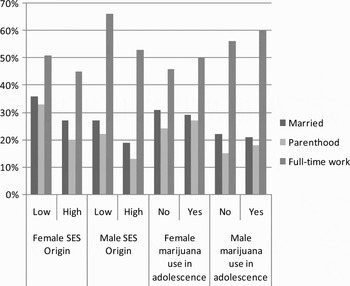
Next, we considered how the amount of time in the various social roles and experiences between ages 19 and 28, as indicated by the number of occasions within each role, varied by both adolescent substance use and socioeconomic background. As an example, Figure 1 shows the percentage of waves at which women and men reported being married, in parenthood (regardless of whether they were residing with their children), and in full-time work based upon whether the respondent's parent(s) had completed some postsecondary education (high SES) and whether they used marijuana at least once during the prior year in 12th grade. We chose these three roles to illustrate because they are among the most strongly associated with reductions in substance use during the transition to adulthood. As shown in Figure 1, senior-year marijuana use did not predict time spent in marriage. However, early drug users did spend more time in roles that would reduce subsequent substance use, such as in parenthood and working in a full-time job. Figure 1 also shows that socioeconomic origins relate to the number of occasions spent in these roles. For instance, women and men from lower SES backgrounds were married at approximately 10% more of measurement occasions compared to women and men from higher SES backgrounds. That is, women and men from low SES backgrounds spent more overall time in the roles that are strongly associated with reduced substance use in young adulthood compared to their more advantaged counterparts.
The percentage of time spent married, in parenthood, and in full-time work for women and men by adolescent marijuana use and socioeconomic origins. SES, socioeconomic status.

Next, we examined whether the effects of social roles and experiences on young adult substance use varied by the two moderators. To test the moderating influence of adolescent drug use, we estimated within-individual regression models of substance use separately for men and women who did and did not use marijuana in the 12th grade and who did and did not have at least one parent who had postsecondary education; we then used z tests to compare the equality of the coefficients (Clogg, Petkova, & Haritou, Reference Clogg, Petkova and Haritou1995). The pattern of results is convincingly clear: neither moderator had much impact on the effect of social role transitions and experiences on changes in adult substance use. Appendix A presents the findings for men in regard to 12th-grade marijuana use. Note that the coefficients that differed significantly by 12th-grade marijuana use are in bold font (p < .05). As shown, very few of the moderating effects are significant; this is especially noteworthy given that the expectation would be that high school use would set the stage for stronger role socialization effects given high school users likely would have larger declines in drug use after high school. Among the few significant findings, the effects of marriage, engagement, parenthood, and military involvement were stronger on changes in illicit drugs for adolescent marijuana users than for nonusers. For instance, among men who used marijuana in 12th grade, subsequent rates of marijuana use declined by 14% (γ = −0.14, t = −7.56) when they were married compared to when they were single and residing alone. Among nonusers in 12th grade, there was only an 8% decline with marriage (γ = −0.08, t = −8.3). Engagement similarly had stronger effects on rates of marijuana use in young adulthood for men who used marijuana in 12th grade compared to nonusers (for 12th grade users, γ = −0.12, t = −4.99; for nonusers, γ = −0.05, t = −4.95). However, except for these few significant findings, 12th-grade marijuana use did little to moderate the relationship between social role transitions and changes in drug use. For women for adolescent drug use moderation and for women and men for parent education moderation, even fewer significant effects were found (results not shown).
Thus, as we show, early substance use, and to a greater extent socioeconomic origins, predict the onset and stability of roles that in turn are associated with changes in substance use in adulthood. Nevertheless, we find little evidence that these two moderators serve to alter the extent of role socialization effects on changes in substance use.
Discussion
It is a fundamental truism in developmental psychopathology that difficulties accumulate over time, building on one another across domains in a cascading manner that serves to direct the course of development toward continued and increasing difficulties (e.g., Dodge et al., Reference Dodge, Greenberg and Malone2008; Masten et al., Reference Masten, Roisman, Long, Burt, Obradovic and Riley2005). Alternatively, competencies and successes can accrue with time and become self-perpetuating and self-reinforcing. These diverging cumulative, but not inexorable, courses within individual life courses have been described as straight and devious pathways (Robins & Rutter, Reference Robins and Rutter1990) and virtuous and vicious cycles (Bynner, Reference Bynner1998). It is important that such characterizations of the cumulative nature of development are not to suggest a closed system with few possibilities for changing course. Especially during major life transitions like the multidimensional transition to adulthood, opportunities for changing course for better or worse are abundant (Schulenberg & Zarrett, Reference Schulenberg, Zarrett, Arnett and Tanner2006). Our purpose was to examine how the numerous social role transitions and experiences during the period between the end of high school and early adulthood contribute to changes in substance use. Our hope was to bring more of a life course perspective to the understanding of cascading effects, focusing particularly on issues of selection and socialization and how the various social role transitions provide the big picture for viewing cascading effects across adolescence into adulthood.
We summarize the findings below, highlighting the unique empirical, methodological, and theoretical contributions of this study to the understanding of substance use and cascading effects across the transition to adulthood. We then consider the strengths and limitations of this study and offer a series of conclusions.
Summary of results
A long-standing debate in drug research is whether the well-documented association between adult family and work roles and reduced substance use results from role selection or socialization (Chassin et al., Reference Chassin, Hussong, Beltran, Lerner and Steinberg2009). Consistent with what others have shown, our results indicate that, among women and men, changes in family, school, and work roles are associated with changes in licit and illicit drug use during the transition to adulthood (e.g., Bachman et al., Reference Bachman, Wadsworth, O'Malley, Johnston and Schulenberg1997, Reference Bachman, O'Malley, Schulenberg, Johnston, Bryant and Merline2002; Leonard & Homish, Reference Leonard and Homish2005; Yamaguchi & Kandel, Reference Yamaguchi and Kandel1985). We extend these findings by showing that these findings remain true once any potential selection effects are controlled (i.e., by using within-individual comparisons to rule out many preexisting factors that might explain the relationship between social roles and substance use). Our findings are thus most consistent with the role socialization hypothesis (Yamaguchi & Kandel, Reference Yamaguchi and Kandel1985), and suggest that role transitions and experiences, along with the concomitant norms and expectations, contribute to changes in substance use. These findings suggest that social role transitions are part of the cascading mechanisms for reductions in substance use that typically come with the transition to adulthood.
Consistent with previous research (Bachman et al., Reference Bachman, Wadsworth, O'Malley, Johnston and Schulenberg1997, Reference Bachman, O'Malley, Schulenberg, Johnston, Bryant and Merline2002; Duncan et al., Reference Duncan, Wilkerson and England2006), our results also suggest that social roles involving family formation behaviors are highly influential in reducing substance use, and perhaps more influential than either school or work roles. In particular, substance use decreased substantially when respondents were married, cohabiting and engaged, residing with their children, and when they or their spouse or girlfriend was pregnant. One could argue that family formation roles generally occur later in the life course than work and school roles, and thus the family effects we show in this paper may just represent the well-documented drop in substance use and problem behaviors with age (Hirschi & Gottfredson, Reference Hirschi and Gottfredson1983). Yet, we control for the nonlinear effects of age in all of our analyses and we still find statistically significant effects of family behaviors on substance use. Why do family roles have consistent and stronger effects than work and school roles?
One primary reason is that family role transitions and experiences may engender changes in socializing and religiosity, both of which are associated with changes in substance use (Bachman et al., Reference Bachman, O'Malley, Schulenberg, Johnston, Bryant and Merline2002; Osgood, Wilson, O'Malley, Bachman, & Johnston, Reference Osgood, Wilson, O'Malley, Bachman and Johnston1996). It is clear that family roles involving time with loved ones contribute to less free time for socializing with others; likewise, such family roles tend to bring religious involvement more to the forefront. It may be useful to think of this as an intraindividual cascade, where within individual changes in family roles contribute to changes in socializing and religiosity, which in turn contribute to changes in drug use. In contrast, this intraindividual cascade has little effect for work and education transitions.
Another reason for the consistency of unique family role transition effects is that norms surrounding family behaviors almost always discourage substance use and may encourage healthier behaviors in multiple domains, as couples settle down to establish a shared household. In contrast, norms about substance use and other health behaviors within work and school domains are less clear, and in some cases may encourage or facilitate risk tasking. Family roles in young adulthood involve “settling down,” “growing up,” and limiting time in the “fast lane.” These norms against substance use are well established in marriage, whereas in cohabitation they are less clear (see Duncan et al., Reference Duncan, Wilkerson and England2006). Perhaps this is why our analyses show that cohabitation has weaker effects on substance use than engagement, because engagement serves as a transition and anticipatory period to marriage. Furthermore, the norms and expectations surrounding school and work roles are more diverse, which might account for the weak and generally inconsistent pattern of work and school effects on substance use. For instance, the stressors and demands of full-time and professional work may encourage more frequent alcohol use, and at the same time discourage illicit drug use. Likewise, postsecondary school roles may involve a mix of expectations and freedoms that simultaneously discourage and encourage substance use (e.g., studying, experimentation, role exploration).
Family roles also might matter more than school and work roles because family members are likely to monitor and enforce norms against substance use. Not only do family members have more opportunities to detect and discourage substance use (e.g., curfews, loss of privileges, etc.), but spouses and fiancés may also have a greater stake in the health and well-being of their significant other. Of course, caring for children directly and indirectly influences the parent(s)' own behavior, which might account for why we show generally weaker effects of nonresident parenthood on substance use in our analyses compared to when respondents were living with offspring.
Finally, family roles might matter more than school and work roles because there are more opportunities to establish meaningful adult family roles. For example, disadvantaged social origins and early substance use may make it difficult to establish high-quality work and school roles in young adulthood, as postsecondary school roles, college degrees, and “good” jobs that can serve as turning points in substance use trajectories may be more difficult to attain (Krohn et al., Reference Krohn, Lizotte and Perez1997; Newcomb & Bentler, Reference Newcomb and Bentler1988). Compared to work and school, high-quality family roles may be more attainable for these young people and thus may provide norms and expectations that can reduce substance use (Laub & Sampson, Reference Laub and Sampson2003). Military service did have a strong effect on illicit drug use, particularly for men. This is consistent with earlier findings by Bachman, Freedman-Doan, O'Malley, Johnston, and Segal (Reference Bachman, Freedman-Doan, O'Malley, Johnston and Segal1999), who suggest that the effect is likely because of the military's extensive use of testing for illicit drugs.
Strengths, Limitations, and Future Directions
An important strength of this study is the use of national panel data spanning a 10-year age interval between late adolescence and early adulthood. The use of large-scale representative multiwave panel data to examine the contributions of a comprehensive set of social role transitions to changes in substance use represents a powerful approach to understanding the etiology of substance use and abuse, reflecting an important integration of large-scale survey research and developmental science. Furthermore, the inclusion of multiple cohorts (22 consecutive senior-year cohorts) allows for the needed consideration of historical variation and robustness in the relationships between social role transitions and substance use changes. The analytic approach provides another strength of the study reported here: by controlling for potential between-person selection effects and including time-varying mediators, we are able to draw stronger conclusions about causal influence. We were also able to examine the simultaneous impact of social role transitions in several domains (school, work, and family), and to conclude that family roles exert the strongest influences on substance use. Moving beyond main effects, we examined the role of two mediating and two moderating variables that have been implicated in substance use in the literature. We demonstrated their contributions to use of specific substances in the context of particular social role transitions, opening the door for future studies to examine these cascades in further detail.
Of course, our study does have some limitations. Because the sample included only those who remained in school until at least the 12th grade, generalizability to those who dropped out of high school may be limited. Although the use of multiwave panel data represents an important strength, the 2-year lag between the waves may result in some lack of precision in capturing the link between social role transitions and changes in drug use. Future longitudinal research in this area would do well to start earlier in adolescence to gain a better “before” picture and to capture the ongoing cascades before young people begin their transition to adulthood.
In addition, future research should further examine more nuanced aspects of the quality of family and work roles. For instance, marital satisfaction and feelings of closeness to one's spouse predict lower rates of substance use (Heinz, Wu, Witkiewitz, Epstein, & Preston, Reference Heinz, Wu, Witkiewitz, Epstein and Preston2009; Thompson & Petrovich, Reference Thompson and Petrovich2009). Modeling changes in substance use as a function of changes in marital quality using a within-person design would make a major contribution to the literature. Moreover, our measures of job quality are based upon broad measures of occupational type. Future research should consider other dimensions of work that may affect substance use, such as wages, job satisfaction, advancement opportunities, and job stress. If measures of family and work role quality were demonstrated to show inverse within-person associations with substance use, this would further suggest the public health value of programs and policies designed to improve family and work life.
Conclusions
We found strong and robust evidence indicating that family roles and experiences during the 20s contribute to changes in substance use. More than the transitions and experiences in the work and education domains, family role transitions consistently contributed to both decreases and increases in drug use. What is especially meaningful here is that family role effects were pervasive: they were evident for both men and women across all five types of substance use considered here, and they did not vary much by background SES or adolescent history of marijuana use. Perhaps of the most importance, we can be confident that these effects are not because of between-person selection factors, as our analytic strategy controlled for stable individual differences. In other words, no matter what pathway one takes across adolescence and into young adulthood, our findings indicate that at the population level, most family role transitions serve as turning points resulting in declines in substance use. One's background no doubt contributes to the type of and time in social roles during the transition to adulthood. As we found here, for example, those from lower SES backgrounds tend to spend less time as a college graduate and more time married and in full-time work. Similarly, those who were marijuana users in high school tend to spend less time as college graduates and more time in full-time work. However, again, regardless of how one gets to the role transitions, once they happen, the effect on substance use is consistent across the moderators we considered here. Thus, at the population level during the transition to adulthood, regardless of earlier cascading influences, there are new pervasive cascading effects from social role transitions, particularly in the family domain, to changes in substance use.
Appendix A
Unstandardized regression coefficients and t ratios from within-individual regressions of substance use on social roles by 12th-grade marijuana use for men

Note: The numbers in italics are t ratios. Bold coefficients indicate a statistically significant (p < .05) difference between groups (based on z tests comparing the equality of coefficients).