Introduction
Population-based surveys have shown that around one in seven of the world’s population, or over 1100 million people, live in countries where 20% to more than 50% of marriages are contracted between couples related as second cousins or closer, with first cousin marriage the most common form of consanguineous union. The main regions in which consanguinity is favoured are North and sub-Saharan Africa, the Middle East and Central and South Asia, and intra-familial marriage continues to be practised among the many emigrant communities from these regions now resident in Europe, the Americas and Oceania (Bittles et al., Reference Bittles, Mason, Greene and Appaji Rao1991; Bittles & Black, Reference Bittles and Black2010). A large majority of these countries have a younger age group profile and a higher birth rate than world averages.
On average, first cousin offspring experience an additional 3.7% mortality from approximately 28 weeks gestation to 10–12 years of age. In terms of birth defects, they have an additional median risk of 3.3% (i.e. a total additional risk of ~7% morbidity or mortality) (Bittles, Reference Bittles2012, p. 227). This risk arises from the increased expression of deleterious recessive genes in the offspring of consanguineous unions. In terms of the Global Burden of Disease, worldwide declines in infant mortality, due to reductions in infectious diseases and nutritional disorders (UNICEF et al., 2014), can be predicted to lead to a proportional increase in morbidity caused by recessive disorders and other forms of non-communicable disease (Institute for Health Metrics and Evaluation, 2010).
In addition to consanguinity, in many communities marriage is also contracted within restricted sub-communities, e.g. between partners preferentially (and often obligatorily) drawn from the same clan, tribe or caste and therefore lineal descendants of a common male ancestor. This practice is important genetically, since endogamous subdivisions result in significantly greater intra-community genetic homogeneity and therefore an increased proportion of homozygotes in the population as a whole, as demonstrated in the final phase of the 1000 Genomes Project (Gazal et al., Reference Gazal, Sahbatou, Babron, Genin and Leutenegger2015). The resultant increased homozygous expression of recessive genes has often mistakenly been ascribed solely to consanguineous marriage (Bittles, Reference Bittles2012, p. 82).
Preference for consanguineous marriage and widespread endogamy are features of the socio-cultural context within which medical genetic services must work (Bittles, Reference Bittles2001; WHO, 2006). In terms of the epidemiology of recessive disorders and the community health implications of planning services to respond to them, in health promotion, health education services and in planning for the care of the morbidity that results, it is important to understand the changing picture of consanguinity and endogamy (Bittles, Reference Bittles2008).
Born in Bradford is a multi-ethnic longitudinal birth cohort study based in the north of England (Raynor & Born in Bradford Collaborative Group, Reference Raynor2008). A total of 12,453 pregnant women were recruited between 2007 and 2011 and they delivered 13,776 pregnancies. Questionnaire data were available for 11,396 babies. Of these, 5127 babies were of Pakistani origin with 59% of their mothers related to their partner as second cousins or closer (equivalent to a coefficient of inbreeding F≥0.0156) (Bittles, Reference Bittles2001; Wright et al., Reference Wright, Small, Raynor, Tufnell, Bhopal and Cameron2013). An increased risk for congenital anomalies from 2.6% in the progeny of unrelated couples to 6.2% in first cousin relationships was reported, but also a surprisingly high risk (5.3%) in the children of more distantly related parents (Sheridan et al., Reference Sheridan, Wright, Small, Corry, Oddie and Whibley2013). This similarity in risk at different levels of consanguinity indicates the need to investigate possible causative associations between consanguineous marriage and genetic disorders in the Bradford Pakistani community from a population stratification perspective. A key element in population stratification in Pakistani communities worldwide is the substructure of biraderi (literally ‘brotherhood’): traditional male lineages that primarily denote socio-occupational status (Bittles & Small, Reference Bittles and Small2015).
The present paper considers changes occurring in the patterns of marriages contracted within biraderi and additionally examines if individual biraderi have different patterns of consanguinity (Corry, Reference Corry2014). Longstanding consanguinity and biraderi endogamy could both play a part in the elevation of coefficients of relationship to levels higher than expected from the parental relationship alone (Bittles, Reference Bittles2013). Thus a community history characterized by continuity of intra-biraderi marriage would be expected to enhance genetic stratification within the UK Pakistani population, while any erosion of biraderi preferences in marriage choice would lead to a reduction.
Marriage within the biraderi complements consanguinity in cementing social solidarities. Taken together they constitute ‘a distinct socio-biological structure’ where consanguinity is both an intra-familial and intra-community practice (Jabeen & Malik, Reference Jabeen and Malik2014). The layers of significance can be considered genetically but, as marriage choice is also a social phenomenon, the role of biraderi also needs to be considered from sociological and anthropological perspectives.
A traditional role of the biraderi has been as a mutual social support system, e.g. assisting with employment or accommodation (Seebohm et al., Reference Seebohm, Henderson, Munn-Giddings, Thomas and Yasmeen2005) and as a welfare agency arranging loans, including financial help to members and their families in ill-health (Meulemans et al., Reference Meulemans, Mortelmans, Liefooghe, Mertens, Zaidi, Solangi and De Muynck2003). In providing these sorts of support biraderi may act as a buffer, building social capital to offset the adverse impact of deprivation (Uphoff et al., Reference Uphoff, Pickett, Cabieses, Small and Wright2013). Biraderi can also have a ‘political’ role. As in Pakistan (Hooper & Hamid, Reference Hooper and Hamid2003; Mohmand, Reference Mohmand2011), support for biraderi-endorsed candidates in elections has been an expectation within some sections of the UK Pakistani community, impacting on candidate selection and voting patterns (Michael, Reference Michael2004; Baston, Reference Baston2012).
Assistance with marriage arrangements, including contributions towards the dowries of poorer families within the membership (Zaman, Reference Zaman2008), is an especially important facet of biraderi activity. Within the UK Pakistani community the biraderi act as significant intermediaries in transnational marriage arrangements (Shaw, Reference Shaw2000, Reference Shaw2009). Indeed, it has been proposed that besides family obligations and cultural preferences, a major reason for the continuation of transnational marriages between the UK and Pakistan is the requirement to marry within the biraderi. If there is a shortage of potential UK-resident partners from whom to choose, families will look to Pakistan for partners (Samad & Eade, Reference Samad and Eade2002). Assistance provided in facilitating transnational marriages thus serves to maintain and strengthen links with the international network of members of the biraderi resident in different countries, especially Pakistan (Cameron, Reference Cameron2006). Shaw (Reference Shaw2014) summarized this role as ‘pivotal for many families in maintaining socioeconomic and emotional connections between transnationally divided kin’.
The aims of this article are: (1) to present detailed data on biraderi affiliation reported by women recruited to the Born in Bradford study for themselves, their partners, their parents, their partners’ parents and their maternal and paternal grandparents and (2) to determine whether there are differences in the prevalence and types of consanguineous marriage between biraderi.
Methods
Data on biraderi membership were collected as part of the Born in Bradford mother’s baseline questionnaire (Raynor & Born in Bradford Collaborative Group, Reference Raynor2008). This was an interviewer-administered questionnaire undertaken in the language chosen by the respondent at the hospital where women, who were between 26 and 28 weeks of pregnancy, were receiving antenatal care. Of the cohort total of 13,776 pregnancies, 11,396 included the mothers completing a baseline questionnaire, and of these 4629 mothers of Pakistani heritage supplied data about biraderi (Wright et al., Reference Wright, Small, Raynor, Tufnell, Bhopal and Cameron2013). These women were asked to identify their own biraderi, that of their partners, their own parents and the parents of their partners. They were also asked to identify their grandparents’ biraderi. The response to this question was a free text option. Some women indicated that they did not know their biraderi affiliations or did not wish to answer this question; this response ranged from 10.5% in relation to their own biraderi to 14.6% for the question about their maternal grandmothers.
Other respondents identified themselves by biraderi sub-group. Where possible these sub-groups were linked to the main biraderi groupings identified by respondents. A number of the reported biraderi sub-groups could not be so identified because the category under which they should have been entered was unclear. These were women who were clear about their biraderi membership and about that of their partners and parents, but the biraderi they identified was not one of the main groupings identified by others. These ‘non-grouped’ responses constituted between 9.9% and 11.1% of the total in the different generations.
Missing data are likely to primarily reflect the demands of completing the complex baseline questionnaire, where questions about biraderi were only a small section of an extensive interview that had to be completed within a limited time-period.
At the baseline interview women were asked if they were related to the father of their baby other than by marriage. If the response was in the affirmative, details of the relationship were ascertained and the mother was also asked whether their own parents and the baby’s father’s parents were related by blood. In addition, a detailed family tree was drawn up by the trained interviewer. It is important to note that in highly consanguineous populations, such as the UK Pakistani community, genomic studies have shown that even couples who declare themselves to be unrelated are homozygous at a proportion of gene loci, due to consanguineous unions in ancestral generations (Jalkh et al., Reference Jalkh, Sahbatou, Chouery, Megarbane, Leutenegger and Serre2015).
Ethical approval for the Born in Bradford baseline data collection was given by the Bradford local NHS Research Ethics Committee.
Results
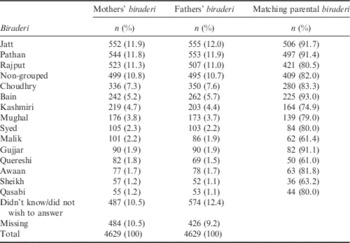
The numbers and frequencies of group membership for each biraderi were calculated, including the percentage of cases where the mother and father were from the same biraderi (Table 1). Intra-biraderi marriage is the norm for all groups of parents of Pakistani origin in the Born in Bradford study. The lowest percentage of intra-biraderi marriage in the present generation of mothers was in the Quereshi (61.0%), with slightly higher percentages in the Malik and Sheikh (61.4% and 63.2% respectively). In the other biraderi the equivalent percentages were >70% in the Kashmiri (74.9%) and Mughal (79.0%); ≥80% in the Syed and Qasabi (both 80.0%), Rajput (80.5%), Awaan (81.8%), ‘non-grouped’ (82.0%) and Choudhry (83.3%); and >90% in the Gujjar (91.1%), Pathan (91.4%), Jatt (91.7%) and Bain (93.0%).
Prevalence of intra-biraderi marriage between mothers and fathers, Born in Bradford study

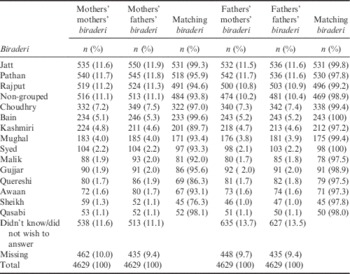
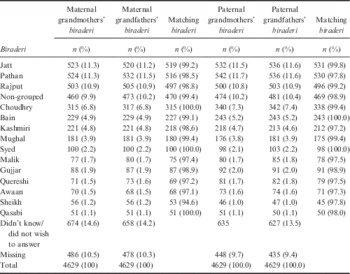
Despite these high levels of biraderi endogamy the current levels of intra-biraderi marriage indicate a significant downward shift from the previous parental and grandparental generations. Table 2 presents the prevalence of inter-biraderi marriages between mothers’ parents and fathers’ parents, and Table 3 shows the intra-biraderi marriage prevalence in the prior generation in the maternal line, i.e. the mothers’ grandparents.
Prevalence of intra-biraderi marriage between mothers’ parents and fathers’ parents, Born in Bradford study
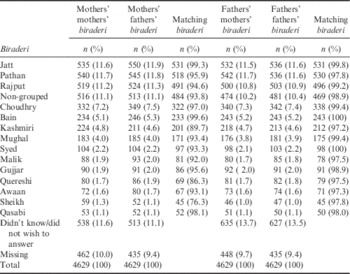
Prevalence of intra-biraderi marriage between mothers’ grandparents, Born in Bradford study

Among the maternal grandparents of the Born in Bradford babies the lowest rate of intra-biraderi marriage was in the Sheikh biraderi (76.3%), with the Quereshi and Kashmiri both >80% intra-biraderi, and the remaining twelve biraderi >90% endogamous. In the great-grandparental generation the lowest level of intra-biraderi marriage was once again in the Sheikh, but at 94.6%, and with 100% of Chaudhry, Syed and Qasabi marriages intra-biraderi.
Chi-squared tests were undertaken to determine if the proportion of intra-biraderi marriages over the different generational profiles had changed on the maternal side. The results of this analysis, conducted by examining marriage patterns across all biraderi groups, indicated that there was a highly significant difference in the prevalence of intra-biraderi marriages by generation (p<0.001).
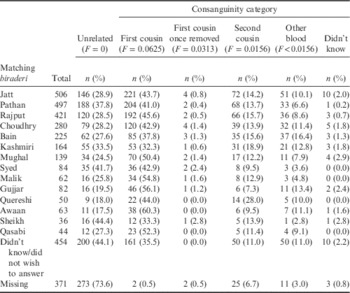
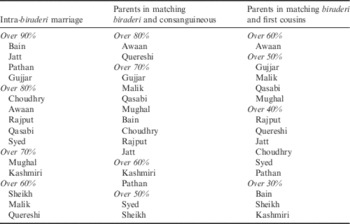
Table 4 includes only those parents of Born in Bradford babies who were members of the same biraderi. The percentage of women in each biraderi who reported they also were in consanguineous unions (F≥0.0156) is presented. The highest prevalence of consanguinity was found in the Awaan (82.5%), Quereshi (82.0%) and Gujjar (80.5%). Seven other biraderi had rates of consanguinity between 70% and 80%, two between 60% and 70% consanguinity, and the lowest prevalence of consanguinity was in the Sheikh (55.6%) and Syed (58.3%).
Consanguinity with mother and father in matching biraderi, Born in Bradford study

First cousin marriage predominated but, as in Tables 1–3, differences were apparent across biraderi. The lowest rates of first cousin marriage were reported in the Kashmiri (32.3%), Sheikh (33.3%) and Bain (37.8%), and the highest was in the Awaan, where 60.3% of intra-biraderi marriages were between first cousins. As a result, the mean coefficient of inbreeding across all biraderi was α=0.0297, ranging from α=0.0233 in the Kashmiri biraderi to α=0.0392 in the Awaan. The ‘non-grouped’ category was excluded from Tables 4 and 5 since it was unclear whether all were members of the same biraderi.
Prevalence of intra-biraderi marriage and consanguinity for Born in Bradford participants, from high to low

Table 5 summarizes the different biraderi-specific relationships between endogamy, consanguinity in general and first cousin unions observed in the present generation. A number of biraderi had a high prevalence of intra-biraderi marriage, high consanguinity and high first cousin marriage, e.g. the Gujjar, whereas some, such as the Sheikh, were low on all three measures. Others, e.g. the Jatt and Pathan, had high levels of within-biraderi marriage but a comparatively low prevalence of consanguinity. Not surprisingly, there was greater consistency between overall consanguinity and the percentages of first cousin marriage.
Discussion
Providing a summary of cross-generational biraderi membership illuminates both the resilience of the biraderi as a social institution and variation in adherence to biraderi membership in the choice of marriage partners. While there has been a community-wide decline in intra-biraderi marriage through time, with a particularly marked decline in some, such as the Sheikh, its overall significance within the Bradford Pakistani community remains high. A large majority of marriages are still contracted within biraderi in the current parental generation, reaching 91.7% in the Jatt (which has the largest membership in the Born in Bradford cohort). There has, however, been a significant overall decline, most notably in the present parental generation.
If this trend continues it would seem probable that a decline in intra-biraderi marriage in Bradford would be accompanied, or even exceeded, by a reduction in the prevalence of consanguineous marriages within the Pakistani community. A reduction in consanguinity also would be accelerated by smaller family sizes, resulting in fewer marriageable cousins (Bittles, Reference Bittles2012). To some extent any such local shortage of potential marriage partners could be overcome via transnational unions. However, UK immigration rules changed in July 2012 (after recruitment to the Born in Bradford cohort was complete), and new income thresholds that a UK spouse has to meet before an overseas marriage partner can be admitted to the country are likely to have a significant impact on transnational marriage. Changes to immigration laws can create rapid shifts in an area that is otherwise principally characterized by generational change (Grjibovski et al., Reference Grjibovski, Magnus and Stoltenberg2009; de Koning et al., Reference de Koning, Storms and Bartels2014). From a genetic perspective, the net effect of reductions in family size, together with restrictions on transnational marriage, predictably would be a decline in the prevalence of specific recessive disorders in future generations (Bittles, Reference Bittles2008, Reference Bittles2012; Campbell et al., Reference Campbell, Rudan, Bittles and Wright2009; Bittles & Black, Reference Bittles and Black2010; Hamamy et al., Reference Hamamy, Antonarakis, Cavalli-Sforza, Temtamy, Romeo and ten Kate2011; Barakat & Basten, Reference Barakat and Basten2014).
There is some evidence of positive social effects of consanguineous marriage for women and that these effects are in domains that can impact on their own and their families’ health (Bhopal et al., Reference Bhopal, Petherick, Wright and Small2014). Effects of this nature need to be considered alongside adverse health outcomes associated with consanguinity to achieve a balanced picture of the health outcomes of changing marriage patterns. Likewise the continuing significance of biraderi in the UK Pakistani community in economic, political, cultural and emotional domains is also likely to have relevance for health as manifestations of a community-specific form of social capital (Uphoff et al., Reference Uphoff, Pickett, Cabieses, Small and Wright2013). A reduction in intra-biraderi marriage therefore may result in a decline in its salience in these areas.
As specific rare recessive disorders may be unique to individual biraderi (Bittles, Reference Bittles2009, Reference Bittles2012), knowledge of variations in marriage practice could assist in planning genetic counselling, health promotion and health education programmes. More accurately targeted interventions are likely to have enhanced efficacy, not least through improved acceptability within the Pakistani community (Darr et al., Reference Darr, Small, Ahmad, Atkin, Corry, Benson, Morton and Modell2013, Reference Darr, Small, Ahmad, Atkin, Corry and Modell2015). More nuanced knowledge could also help to defuse the emotional and often ill-informed ‘consanguinity debate’, based on generalized assumptions that have dogged health care within the UK Pakistani population since the 1980s. These assumptions and debates have also had a negative recent resonance in many other countries and communities (Bhopal et al., Reference Bhopal, Petherick, Wright and Small2014; de Koning et al., Reference de Koning, Storms and Bartels2014; Liversage & Rytter, Reference Liversage and Rytter2015).
Questions as to the stability of biraderi affiliation through time, why reductions in marriage within biraderi have occurred and why there are continuing and expanding differences between biraderi need to be investigated using qualitative methods. A comparative study of the geographical, social, educational and occupational profiles of each biraderi would provide valuable information on the contemporary characteristics of these long-standing but changing social groupings. Given the difference between rates of intra-biraderi marriage and consanguinity – for example, in the Jatt and Pathan – a key aim would be to explore if knowledge of one’s past health in terms of congenital anomalies or other health issues could be shaping community choices about consanguinity within intra-biraderi marriage. In overall terms, recognizing the complexity of marriage choice allows us to question facile assumptions that a preferred marital practice in one community will necessarily be shaped in the same way and to the same extent in others.
Several possible limitations apply to the findings of the present study. First, Bradford’s Pakistani origin community comes predominantly from Azad Kashmir province, with a considerable proportion from its rural Mirpur district. Different marriage patterns may exist in Pakistani communities that originated from other provinces (Shaw, Reference Shaw2014; Bittles & Small, Reference Bittles and Small2015). Secondly, Biraderi membership and consanguinity status were identified by maternal self-report, where respondents were identifying relationships on behalf of generations of their own relatives and those of their partners. Thus there is a possibility that the attributions supplied were inaccurate. It might be that social desirability biases attribute greater homogeneity to biraderi membership given the importance of these networks to people’s sense of identity. However, the rates of completion of the relevant question were high and the interviewers were trained and experienced. Thirdly, the numerical size of each biraderi in the cohort varied: the largest was the Jatt (n=552) and the smallest the Qasabi (n=55). Population effects of any changes in marriage practices have to be considered with respect to these numbers; for example, the apparently distinct marriage preferences and practices of the Sheikh biraderi have been quite extensively cited, but this biraderi was represented by just 57 couples. Lastly, there also is the possibility of inaccuracy or bias in the data on consanguineous marriage, but in this case adverse publicity about consanguinity and genetic risk may lead to under-reporting. Again, the interviewers were trained and experienced and they had prompts at their disposal helping them to clarify what constituted blood relationships, e.g. what is a second cousin? Collecting questionnaire data and a family tree provided some measure of verification of attribution, and there was considerable accord between the data collected by these two routes.
Acknowledgments
Born in Bradford is only possible because of the enthusiasm and commitment of the children and parents who make up BiB. Gratitude is due to all the participants, health professionals and researchers who have made BiB happen and, for this paper, to Qamar Zaman from the Born in Bradford Data Management Team who shared insights about biraderi structures and roles in contemporary Bradford. Born in Bradford is supported by funding from the National Institute for Health Research Collaboration for Applied Health Research and Care (NIHR CLAHRC) implementation grant and an NIHR Applied Programme Grant (RE-PG-0407-10044). Core support is also provided by the Wellcome Trust (grant number WT101597MA). Full details of other sources of support for specific projects is available at www.borninbradford.nhs.uk. This paper draws on baseline data collected for Born in Bradford; funders have not had an input on the design of this paper or on publication plans.