Brief Introduction to Aotearoa/New Zealand, its Indigenous Māori and its bicultural context
Aotearoa/New Zealand is situated in the South Pacific Ocean in Oceania and is made up of two main Islands. The North Island or Te-ika-a-Maui which means ‘The Fish of Maui’ and the South Island, or Te-Wai-Pounamu, meaning ‘The Waters of Greenstone’. Its total land mass of around 268,680 square kilometres makes it slightly larger than the United Kingdom but smaller than Italy or Japan. The Cook Islands, Niue and Tokelau, while self-governing, are included in the realm of Aotearoa/New Zealand. Geographically isolated, some 2000 km southeast of Australia, the country's nearest neighbours are: New Caledonia, Fiji and Tonga (Oliver et al., Reference Oliver, Dalziel, Sinclair, Moran, Vowles and Blyth2019).
Being one of the more recently settled major landmasses, it is thought that the first people to arrive in Aotearoa/New Zealand may have originated from Eastern Polynesia, and arrived in a series of migrations sometime between 700 and 2000 years ago. Over time these settlers developed into a distinct culture divided into tribes (iwi) and sub-tribes (hapu) now known as Māori (King, Reference King2003).
The first wave of European explorers visited the Pacific in the 17th century with the Dutch explorer, Abel Tasman being the first to reach Aotearoa/New Zealand in 1642. In 1769 the English explorer James Cook rediscovered the country and mapped most of the coastlines of both islands. Following Cook's rediscovery, the country was visited by many European and North American whalers and sealers and became a significant stop for trading ships which traded food and goods with the local Māori tribes. Christian missionaries began to settle in the early nineteenth century, converting many of the Māori population to Christianity (King, Reference King2003).
Queen Elizabeth II is the country's Head of State. However, she has no real political influence. Political power is held by a democratically elected parliament under the leadership of a Prime Minister who is the Head of Government. New Zealand is a member of the Commonwealth of Nations, an evolutionary outgrowth of the British Empire (The Editors of Encyclopaedia Britannica, nd).
Māori also have their own ‘monarchy’ formed in the nineteenth century under the Kingitanga movement which hoped to achieve unity for Māori under a Māori King (King, Reference King2003). The colonial government viewed the Kingitanga movement as a threat to the British Crown and attempted to disestablish it. Nevertheless, it survived albeit as a symbolic movement. The current King, Te Arikinui Tuheitia Paki, is the seventh Māori monarch since its investiture (Origins of the Māori King Movement, 2008).
In Aotearoa/New Zealand, the term bicultural acknowledges Māori as tangata whenua (people of the land) and Pākehā (European) as the original colonial settlers. The term is closely aligned with Te Tiriti o Waitangi (the Treaty of Waitangi) and the partnership between the British Crown and the Indigenous Māori.
Within the context of Aotearoa/New Zealand, biculturalism challenges mono-culturalism, the genesis of which was embedded within discourses of cultural superiority, assimilation and, to some extent, discourses of philanthropy, which underpinned the doctrines of the British Colonial Office. The discourse of philanthropy was linked to the Great Reform Act of 1832 which brought about a large number of reforms to protect the well-being of the poor and underprivileged in Britain. The aspirations of reform also extended to the Indigenous peoples of the British colonies, albeit, paternalistic and patriarchal. The following quote, by the Rev. W. Whewell in his sermon to the Trinity board, quoted in the Report from The Select Committee on Aborigines (1837, p. 76) exemplifies the attitudes espoused by the British Colonial office:
Can we suppose otherwise than that it is our office to carry civilisation and humanity, peace and good government and, above all, the knowledge of the true God, to the uttermost ends of the earth?
The ‘civilizing’ mission of colonisation via christianisation and commerce expected to bring about what Europeans in the nineteenth century called the amalgamation of the races (Sorrenson, Reference Sorrenson1975, p. 97). At Waitangi in 1840 Governor Hobson had announced, ‘We are now one people’, and the colonial government and settlers assumed Māori would become brown Pākehā (European). Amalgamation polices produced a mono-cultural society until the Māori Renaissance, a social movement of the late 1970s and early 1980s set about reviving te reo Māori (Māori language), and tikanga Māori (Māori culture) and agitated for recognition of the Treaty of Waitangi (Keegan, Reference Keegan, Dattaray, Halder and Bhattacharya2017).
Biculturalism reflects the distinctive historical trajectories within Aotearoa/New Zealand. Highlighting the relationship between Māori and Pākehā (European) and Tau iwi (non-Māori), biculturalism acknowledges the history of colonisation and challenges mono-culturalism. It also reaffirms the commitment to Te Tiriti o Waitangi (Treaty of Waitangi, the founding document of Aotearoa/New Zealand) which guaranteed tino rangatiratanga (self-determination) to Māori with its kaupapa (philosophy) of partnership between Māori and Pākehā. In contemporary New Zealand society, biculturalism also includes Tau iwi (non-Māori migrants who arrived later). The notion of biculturalism within Aotearoa/New Zealand is unique in the world as it puts Indigenous people and colonisers in a partnership which ensures equal rights and sovereignty. It also ensures appreciation and respect of all cultures that arrived later without diminishing primacy and sovereignty of Indigenous people that often happens in countries that pride themselves in being ‘multicultural’.
Biculturalism forms a foundational base within the diverse, multi-cultural communities that make up the population of Aotearoa/New Zealand. Rather than focusing on multiculturalism which bypasses Indigenous rights, discourses around biculturalism emphasise cultural and ethnic differences, between Māori, Pākehā and Tau iwi within wider debates about ethnicity, colonisation and political struggles in Aotearoa/New Zealand (Napan and Connor, Reference Napan and Connor2014).
To discuss the concept of biculturalism within the context of a campfire session is conceivably contentious. The history of colonisation and its impact on Māori language and culture has left an uncomfortable legacy and talking about the colonial past can bring up many painful memories for Māori and indeed Tau iwi (non-Māori). Biculturalism is also viewed by some as being irrelevant as New Zealand society is multi-cultural with diverse communities. Dialogue around these types of issues is not for the faint-hearted. Nevertheless, we saw the opportunity to talk about biculturalism within the context of a campfire session as being potentially productive and constructive.
Defining the campfire session
As the name suggests, campfire sessions are small, intimate sessions with a focus on conversation. In contrast to a speaker delivering a PowerPoint presentation in a large lecture theatre, campfire sessions are designed to foster group discussion and peer-to-peer learning. Typically, a facilitator or group leader will speak for 10–15 min on a specific topic and then facilitate dialogue within the group (Mumford, Reference Mumford2018).
The format of a campfire session is relatively easy to implement. Nevertheless, it is important to plan the event to ensure discussion and engagement occur unimpeded. To ensure dialogue flows and an intimate ambience is created, the campfire sessions need to limit attendees to 10–20 persons. Pre-registration for the session is recommended to ensure the session is not over-subscribed (Mumford, Reference Mumford2018).
Mumford (Reference Mumford2018) suggests facilitators can take literal inspiration from the ‘campfire’ namesake and set up the space to be as figuratively warm and cosy as practical. It may be as simple as setting up chairs in a circle and to drape the room to resemble a tent. A video of a campfire playing on a screen could also be utilised, or if the weather permits, the campfire session could be held outside, around an actual campfire.
A further consideration suggested by Mumford (Reference Mumford2018) is to forgo technology during a campfire session and ask participants not to bring their laptops, tablets, smart phones and the like. Productive, engaging dialogue will develop in much more depth if everyone focuses on the conversations without incessantly checking emails and texts.
In summary, campfire sessions allow attendees to drive their own learning, listen to multiple perspectives on an issue, and share experiences. Campfire sessions also lend themselves to networking and further dialogue (Smart and Sustainable Campuses Conference, n.d.). Being such an ancient practice, it accesses old archetypes and enables people across various cultures and ages to relax, absorb and engage with a sense of comfort, wonder and mystique.
Theoretical underpinnings of the method align with the work of several indigenous scholars including the stories of Jo-Ann Archibald also known as Q'um Q'um Xiiem (Reference Archibald2008) and Davis' (Reference Davis2017) and his work on creative pedagogy. Theoretically, it resonates with the work of Linda Tuhiwai Smith and her decolonising methodologies reflected in the ways Indigenous higher education and research can contest Western pedagogy and research methods (Tuhiwai Smith, Reference Tuhiwai Smith2008; Hokowhitu et al., Reference Hokowhitu, Oetzel, Reddy, Smith, Simpson, Nock and Johnston2017). The campfire pedogeological method can also enhance the importance of the tuakana-teina (elder mentor to younger mentee) relationships and the power of collaborative peer education in contexts outside of traditional classrooms.
Preparing the campfire session: walking the bicultural talk in Aotearoa/New Zealand
Preparation for the campfire session primarily focused on the topic of biculturalism and how we would honour both Māori and Tau iwi participants within the structure of the campfire session. We also spent some time considering the teaching space and how we could emulate an actual campfire, as suggested by Mumford (Reference Mumford2018). To create a sense of sitting around a campfire, we dimmed the lights, pulled the curtains and organised seating in a circle. We decided to employ some technology and had a virtual campfire, complete with the crackling sound of burning wood, playing discreetly on an iPad in the centre of the circle. We also prepared a PowerPoint with key points on templates with campfire images in the background. PowerPoint slides were printed in colour and placed in a circle so every participant could view a slide with the image of a campfire and they could easily follow the Campfire session process regardless of where in the circle they were seated.
The metaphor of a campfire brought many nations together, evoking mostly positive memories. The metaphorical warmth of fire and the mystique of the dimmed lights enabled alterative views to be accepted, valued and explored in depth, in a context that can be relatively light and relaxing.
Most of the participants in our campfire session understood the context of biculturalism within Aotearoa/New Zealand. The majority were teachers and lecturers within higher education who were well acquainted with the principles of Te Tiriti o Waitangi and the discourses on biculturalism which advocate partnership. Although several of the participants were Australian and were not entirely familiar with the meaning of biculturalism within Aotearoa/New Zealand and the education sector, they were, nevertheless, eager to learn and many engaged in dialogue with us after the campfire session.
As we wanted to have plenty of time for talking, discussion and ‘yarning’ (Shay, Reference Shay2019), we requested a 55-min time slot and we asked at the registration desk to limit the number of participants to twelve. This was an important consideration as the majority of conference presentations were limited to 20 min and there were no restrictions on participants. Ultimately, our campfire session attracted more than the planned twelve participants. As it was not in the spirit of the topic to turn late-comers away we ended up with 20 participants and, while accepting everyone was about ‘walking the talk’, the session would have given participants more time to dialogue if limited to the planned twelve. Right on the spot, the session needed to be slightly modified which in a way reflected what happens in bi and multicultural educational sessions. The process becomes more important than the content.
Both presenters are passionate about walking the bicultural talk in Aotearoa and intended this session be literally about ‘walking the talk’ by presenting in partnership (Māori and Pākehā) and enabling all voices around the campfire to be heard. Two prominent Māori academics participated in the session and while their presence was viewed as a great honour it also imposed considerable responsibility on the facilitators to ensure that correct tikanga (custom, protocol) was observed and followed.
Beginning the campfire session
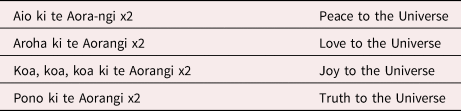
Participants were welcomed into the space and seated in a circle. Once everyone had found a seat and has settled into the room, a brief outline of the campfire session was provided. We then invited everyone to stand and stretch in preparation for singing an opening himene (sacred song). The rationale for this was two-fold. Firstly, it acknowledged Māori as tangata whenua (people of the land) and secondly, it created the tone for the campfire session. The himene also evokes the sentiments of peace, love, joy and truth, all of which were central to the kaupapa (underpinning philosophy) of the campfire session. We provided the words to the himene via a PowerPoint slide (table 1).
Lyrics to the Himene [Sacred Song] Written by Pere (Reference Pere1990)

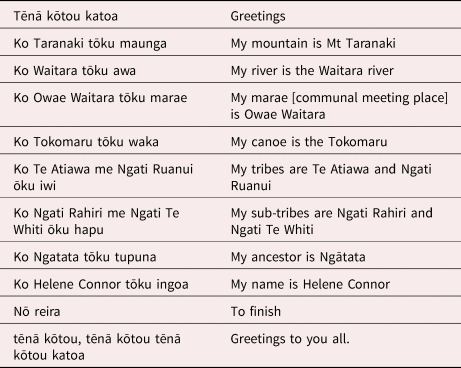
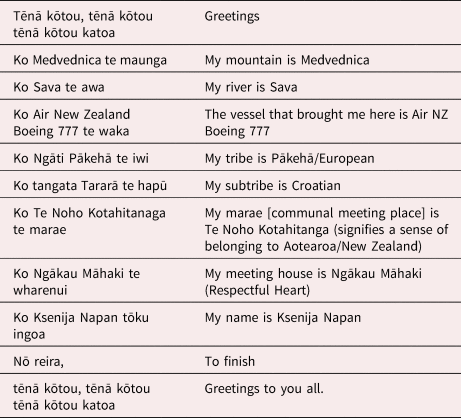
By singing this beautiful sacred song together, we invoked the spirit of peace to encourage participants to freely share their experiences of walking the bicultural talk in their classes. On completion of the himene we asked the group to be seated and then we introduced ourselves by utilising the pepeha (Māori process for introducing the Self). The pepeha contains genealogy and geographical reference points for the different iwi (tribes) and hapu (sub-tribes) throughout the country (Mutu, Reference Mutu2001). Many Pākehā and Tau iwi learn their own pepeha as they embark on their bicultural journeys. The pepeha is central to one's identity and helps foster whanaungatanga (connections). It is also used to teach te reo Māori (Māori language) and is a central element to Māori language revitalisation (Mutu, Reference Mutu2001). The pepeha for both Helene and Ksenija are included in this paper to acknowledge our whakapapa (genealogy) and cultural identities and as a way of positioning ourselves in relation to the subject of this paper (table 2).
Pepeha (Māori Device for Introducing the Self) of Helene Connor

Self—positioning—Helene
On my maternal side I am Māori affiliated to the tribes Te Atiawa and Ngati Ruanui. My papakainga (home place) is in Taranaki, situated on the west coast of the lower half of the North Island of Aotearoa/New Zealand. Although I grew up in Auckland, I consider Taranaki as my turangawaewae (place to stand). This is the place my whakapapa (genealogy) links me to and this is where the emotional landscape my Māori grandmother created for her tamariki (children) and mokopuna (grandchildren) connects me.
On my paternal side I am descended from Irish immigrants. The location of an Irish immigrant identity within my own sense of self is intrinsically linked with the bond I had with my Irish grandmother. My grandmother's Irishness was symbolised by her distinctly Irish form of Catholicism and her pride in her Irish roots. I was very close to both my grandmothers and consider myself to be both Māori and Pākehā (table 3).
Pepeha (Māori Device for Introducing the Self) of Ksenija Napan

Self—positioning—Ksenija
Aotearoa is my country of choice. It is my second home. I arrived in 1995 after realising that my home country, Croatia, would take too long to recover after the senseless nationalistic war of 1991–1995. I have chosen Aotearoa/New Zealand because of its image of a peaceful country where colonisation has not done as much damage as in other colonised countries. When I arrived I was hungry for Indigenous knowledge and have strongly resonated with Māori universal wisdom and an appreciation of Papatūānuku (Earth mother) acknowledging her as a living being. I have also became aware of the damages of colonisation and counterfeit image of Aotearoa as being clean, green and non-racist. Being a social worker and an advocate for social justice and also a teacher I am keen and enthusiastic to support Indigenous initiatives yet I am aware of my place as Tau iwi. Through learning Māori culture, I continuously reflect on my position in relation to Māori and position myself as an ally.
A round of introductions sharing memories of campfire experiences (check-in round)
The campfire session was then opened up for everyone to introduce themselves. Many of the participants, both Māori and Tau iwi, knew their pepeha, and introduced themselves using this format. Others introduced themselves in English. The emphasis was on whanaungatanga, inclusivity and getting to know one another. We intentionally asked people to introduce themselves through their memories of being around a campfire to further invoke the atmosphere of comfort and sharing that campfires bring. Facilitators participated in this personal sharing as well, mirroring the egalitarian essence of this method.
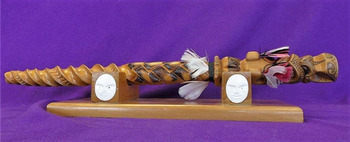
Talking about biculturalism in Aotearoa/New Zealand can be a challenging and contested topic and invoking the context of sharing, collaboration and peace was essential. Once the round of introductions was completed, our third facilitator, Tokotoko (Talking stick) Te Rangimarie (peace) was introduced (figure 1).
Te Rangimarie, carved tokotoko, Massey University, Auckland. December 3, 2018.

The tokotoko (talking stick) is a carved stick used by speakers which can be passed from one speaker to the next. When we planned our campfire session, we felt it would be appropriate to use a tokotoko to both acknowledge the traditional Māori custom and to ensure participants only spoke when they had the tokotoko. This ensured no-one spoke out of turn or interrupted other speakers.
The beautiful tokotoko we used was named Te Rangimarie and was carved by Gus Shortland. It was presented to Massey University Centre for Peace and Justice Development at the ‘Just peace’ Conference on the 26th of April 2000. This tokotoko has as its figurehead Io Matua (the supreme being). He holds three feathers representing the three baskets of knowledge for humanity. The plait represents the intertwining of different cultures. The four spirals represent the journey of humankind. The three un-surfaced spirals represent the esoteric knowledges which are passed between Ranginui (Sky Father), Papatuanuku (Earth Mother) and human beings. The surfaced spiral is Te Ara Tika (the spiritual path). The four white feathers symbolise Rangimarie, thus giving the name to the tokotoko of Te Rangimarie. The four bone faces on the stand are those of the four winds carrying the message of peace in all directions.
From the beginning of humanity, people have gathered together to tell ‘yarns’ using a ‘message stick’ (Stasiuk and Kinnane, Reference Stasiuk and Kinnane2010). As with the Māori of Aotearoa/New Zealand, a talking stick is also used across a range of other Indigenous cultures including the Australian Aboriginal and Native American cultures.
In traditional Māori society pūrākau (story-telling) generally referred to Māori myths and legends. Yet, as Lee (Reference Lee2009) argues pūrākau can also be viewed as a traditional form of Māori narrative, rich in philosophical thought and epistemological constructs that are fundamental to Māori world views and identity. Utilising the tokotoko or talking stick added a layer of authenticity to the campfire session and created space for pūrākau to emerge where Māori world views could be legitimised and validated.
In our campfire session, we informed participants that when their time to speak arose they could either speak about what they found important to share in terms of their experiences of ‘walking the bicultural talk’ in Aotearoa/New Zealand or allow themselves to be a mouthpiece of the talking stick and let him speak through them. It appeared that everyone was keen to engage as holding Te Rangimarie and exploring his curves and carvings was something everybody wanted to do. Participants also tended to be focussed and brief, keeping in mind the larger number than planned and allowing everyone to speak.
Sharing experiences of walking the bi-cultural talk
Having created a sense of connection through our introductions, we then focussed on our aspirations and the importance of embedding biculturalism into tertiary teaching while outlining potential challenges. This part of the campfire session represented the heart of the fire and our individual stories kept the fire ablaze.
Helene's story focused on developing bicultural partnerships with Pākehā and Tau iwi colleagues and students. She spoke about the importance of being able to acknowledge her bicultural identity as having both Māori and Pākehā whakapapa (genealogy). She described what it means to her personally to be a woman of mixed Māori and Pākehā descent identifying with a dual heritage and trying to establish a sense of belonging in both ethnic groups. Her story emulates what Webber (Reference Webber2008), calls the ‘in-between’ position, where people of mixed descent are rethinking assumptions about culture and identity and acknowledging not only differences but also connections (Webber, Reference Webber2008, p. 31). For Helene, as with many people of mixed Māori/Pākehā descent, her ability to construct and articulate a hybrid identity of being Māori and Pākehā has enabled her to occupy that space of in-between-ness, while retaining a strong Māori cultural identity. Maintaining a cultural identity as Māori has been central to the formation of bicultural relationships with Pākehā and Tau iwi.
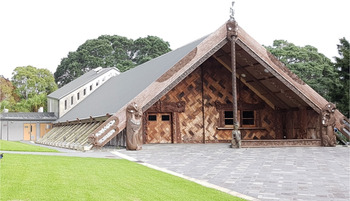
Ksenija shared a story of teaching in Ngākau Māhaki wharenui (Unitec, Institute of Technology carved meeting house) and her sense of Ngākau Māhaki (the carved meeting house), being alive and co-teaching with her (figure 2).
Ngākau Māhaki, the Whare Whakairo (carved meeting house), Te Noho Kotahitanga Marae, Unitec, Auckland. July 14, 2017.

In that alternative teaching space, students' stories came to the surface and a deeper level of learning occurred. Students were fully engaged, attentive and did not miss any classes. Everybody completed the course. Students learned about Māori culture but at the same time they learned about themselves and how they related to Māori culture within their minds, bodies and spirits. In Aotearoa/New Zealand, Tau iwi have an important role to play as being allies and continuous learners as the damage of colonisation is still felt and is visible in the country.
In another campfire session (Stewart, Reference Stewart2018) at the same conference, the dialogue about Pākehā paralysis developed emphasising the difficulty Pākehā sometimes have when trying to articulate bicultural relationships. Our campfire session expanded on Stewart's session by reflecting on Māori and Tau iwi paralysis that prevents people from engaging and becoming aware of their unconscious bias or assumptions imposed by colonisation. The campfire context proved to be an appropriate site to address these issues in a non-adversarial way. Opening the session with an invocation of peace and passing around a talking stick spread the sense of joy and harmony around the imaginary campfire. One participant talked about Aotearoa/New Zealand's deep and profound spiritual capital and the importance of sustainability and Indigenous wisdom. One story followed another and there were numerous threads that enabled participants to learn from one another and weave ideas of various practical ways of embedding biculturalism into their teaching practice. Several participants mentioned the importance of the sense of belonging and the grief they experienced when they stopped learning and expanding their knowledge. A strong critique of the neoliberal academia and the ‘tick box’ approach to cultural competence was voiced. Some committed to specific practical actions like asking a Māori friend to carve a talking stick for them to get their students to start talking about their experiences of walking the bicultural talk. Several participants emphasised the importance of sharing feelings, arguing that they are as important as thoughts in a process of learning. This was an important aspect of the campfire session, creating space for the Indigenous Māori pedagogy of ako (teaching and learning) to emerge. Ako is grounded in the principle of reciprocity and proposes that the learner and teacher are simultaneously juxtaposed, so that the learner is at the same time the teacher, and vice-versa (Macfarlane, Reference Macfarlane2015). The campfire session show-cased the elements of ako and the fluidity of learning that happens in the space in-between and often in a realm beyond cognitive reasoning.
Ako is more than teaching and learning. It describes a meaningful relationship characterised by reciprocity, respect and the notion of integrative, whole people learning. It transcends the individualistic notions of learning outcomes achieved by the learner by understanding that learner cannot be separated from their environment, culture, belief system, family and group he or she affiliates with. It acknowledges that new understanding and being in the world grows out of shared learning experiences (Pere, Reference Pere1982).
In the context of a campfire session ako can be conceptualised as the unconditional shared pathway of disseminating knowledge through teaching and learning. Both the kaiako (teacher) and akonga (learner) contribute to stories and learning. Their koha (gifts) when given with aroha (unconditionally) and mana (integrity) can increase the engagement of participants and create ‘new knowing’ or moments where epiphanies may occur. This happened for several participants in our campfire session who suddenly realised the importance of biculturalism and became aware of their idiosyncratic understanding of it. There was a realisation that Māori are invisible in monoculturalism and multi-culturalism, whereas in biculturalism they are not only visible but also represent equal partners firmly grounded in Indigenous wisdom that brings forth the world in a way that amplifies connectivity between people and the ground on which they stand. There was also a realisation for many, that biculturalism does not diminish diversity and multiculturalism. Rather it creates a foundational base or platform for diversity.
Weaving the strands and participants' reflections
At the conclusion of our kōrero (dialogue), we wove the strands of everyone's contributions together. Our goal was to bring together the collective knowledge around creating effective teaching/learning examples and ways of walking the bicultural talk. We also wanted to provide participants with an opportunity to expand their teaching/learning repertoire and connect with their bicultural selves.
The most visible strand was the importance of connecting with one another and providing space and a process where it is safe to do so. In an anonymous feedback form, we asked four simple questions and framed them in an image of the campfire, the first question was placed in the heart of the fire.
1. What resonated with your heart?
2. What have you learned?
3. What can you use in your teaching?
4. What would you do differently or how would you improve this session?
There was not one negative comment and the only idea for improvement was that participants wanted it to be longer. Below is a selection of comments we received. We have omitted the repetitive ones:
‘This was so genuine, I think you should take the talking stick on more trips!’
‘I loved the emotion in the room’.
‘I learned more about the history of my marae’.
‘It gave me more to talk with my team about’.
‘I learned that I stopped learning and that I need to get back on it’.
‘One can walk in a bicultural world, you do not have to be Māori or Pākehā’.
‘I will use this in my teaching’.
‘Our bicultural learning is transferable to other countries’.
‘Important to continue to be brave in territory that is not always easy and a combat zone’.
The stories felt cosy, like silk, and were interwoven like a spider web. Dr Joseph (Joe) Te Rito currently, Deputy-Director/Kaihautū Mātauranga Māori with Ako Aotearoa, the National Centre for Tertiary Teaching Excellence, and one of our participants, closed our campfire discussion with a beautiful waiata (song) about pungawareware (spider). Ostensibly, Joe created this waiata, as the pungawareware, spins her web. As the session progressed, he took notes, weaving the strands of our dialogue together. When the campfire concluded, he had created a web of words which he duly sang.
Drawing the campfire session to its conclusion
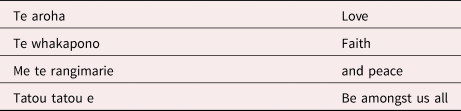
We concluded the campfire with a rousing waiata, Te Aroha (unknown.d.). Many of the participants were familiar with this waiata, though we also provided the words via a PowerPoint slide (table 4).
Lyrics to the waiata, Te Aroha. Lyrist and date unknown

Concluding comments
As facilitators of our first campfire session, we both agreed this innovative teaching and learning method has considerable potential to foster dialogue and develop deep and authentic networks of practice. We were also mindful that storytelling or pūrākau were integral to traditional Indigenous societies and elements of traditional Indigenous society had been woven into our campfire session. Stasiuk and Kinnane, (Reference Stasiuk and Kinnane2010, p. 87) discussing storytelling for Indigenous Australians state:
Gathered around the campfire in the evening, elders, matriarchs, leaders and children would bed down for the night and stories were shared and passed from one generation to the next. Traditionally, the storyteller was born into the role. There was also the opportunity for the storytellers to earn their position—learning and telling the stories—this was the traditional way stories were passed on. These stories were based on the land and surrounding environments of the ‘tribe’.
Our campfire session evoked some of the elements of traditional Indigenous storytelling. Dr Joseph (Joe) Te Rito a Māori leader and born story teller shared stories from his past that related to the whenua (land) of his tupuna (ancestors). We drew on traditional waiata (song) and karakia (invocations) and we used stories to learn about each other's bicultural journeys and what being bicultural can mean in contemporary Aotearoa/New Zealand. From this perspective, campfire sessions as pedagogy can be viewed as a new twist on the Indigenous art of story-telling, particularly when utilising an Indigenous teaching philosophy such as ako.
Campfire sessions in contemporary educational contexts are however, confined by timetables, student numbers and curriculum content. As with Mumford's (Reference Mumford2008) observations, it is essential to plan and structure a campfire session prior to its implementation. Limiting participants to no more than 12 is also an essential ingredient. A good number would be between 8 and 12. We also observed that dialogue will flow more readily without imposing a set of rigid questions. Several of the other campfire sessions at the conference focused on specific questions where participants had to write up their answers on sheets of paper and report back to the main group. From our observations this approach tended to inhibit dialogue and participation.
The ritual of opening with an invocation, a brief round of introductions and by sharing something participants may have in common created a solid common ground that enabled a dialogue about a challenging topic to flow. The act of introducing a talking stick as a third facilitator, passing him around and allowing participants to either take responsibility for what they were saying or allow the Tokotoko Te Rangimarie to speak through them added playfulness as well as a spiritual dimension to our session. Unplanned closing through an impromptu poem made by a well respected Māori academic affirmed our session and a waiata Te Aroha (Love) appeared most appropriate for closing. The campfire session was well suited to focus on experiences of dancing the bicultural talk. It provided an interactive pedagogy where effective communication and reciprocal learning took place. From our experience, a minimum of 55 min is required. A longer session of 2–2½ hours would be even better as it would enable all voices to be heard and deeper levels of conversation to unravel. More movement and catering for body and mind refreshments would be needed in a longer session. These could be incorporated in the topic, namely, eating food related directly or metaphorically to the topic or doing exercises related to the topic.
Restricting numbers who can participate in a campfire session could be viewed as a limitation or alternatively as one of its benefits. Certainly, in a small master's class or in a small group of colleagues the method works very well. There is strong scientific support for the benefits of small groups in educational setting (Rosenwald et al., Reference Rosenwald, Smith, Bagnoli, Riccelli, Ryan, Salcedo and Seeland2013; Chiriac, Reference Chiriac2014), yet more and more students are crammed in each class, put in tiered lecture theatres to sit and listen while discussions and debates have been outsourced to cyberspace. However, there is something special that happens when people share space, air, ideas, feelings and worldviews while sitting in a circle. It is the oldest and probably most sustained teaching and learning method that transcends culture, age and worldviews. Gersick et al. (Reference Gersick, Bartunek and Dutton2000) researched relationships in academic work and discovered through stories told by their participants how essential it is to talk beyond differences. Their research found that story telling not only provides a way to develop relationships but also contributes to mutual learning. Campfire sessions can provide a useful method not only for teaching and learning but also for team building and creating respectful relationships in a workplace.
Campfire sessions are more likely to generate rich discussion if the participants have a shared topic of interest, collegial or vocational. Being in accord and passionate about a particular issue is also likely to bring about deeper dialogue. Our campfire session created a safe space for participants to talk about their own bicultural journey. Commitment to biculturalism and the principles of partnership, participation and protection which are espoused in the discourse of Te Tiriti o Waitangi was expressed by most participants together with sharing of examples how this commitment transformed into social action in their respective classrooms. Facilitating a campfire session with participants who are in discord and opposition is not impossible, though. However, such a scenario would require very skilled facilitators to run the session, otherwise there is a risk that the fire could burn out of control, or simply become ashes.
Reflecting on the specific content of our campfire session revealed that the spirit of peace permeated throughout. From the opening himene which both expressed and evoked peace (led by the heart opening resonance of the voice of one of presenters) through to the introduction of Te Rangimarie, the tokotoko and his peaceful contribution, to the waiata sang by Joe Te Rito. It is not coincidental that the spirit of peace happened in a context of virtual fires burning from an iPad, printed slides of campfires and projected images of campfires, while addressing a very ‘hot topic’. That contrast was reflective of our theme. It also showed the power and responsibility we have as teachers to address these issues in our classrooms as the ethos of peaceful collaboration is particularly relevant to the topic of ‘walking the bicultural talk’ in Aotearoa/New Zealand. Peaceful dialogue does not imply that hurts from the past are forgotten or reconciled. It enables Māori and Tau iwi partners to enter a conversation in a calm but open way with the intention of living in harmony. Our campfire highlighted that it is possible to utilise contemporary technology while simultaneously respecting and learning from Indigenous wisdom to facilitate connection with one another in profoundly deep and significant ways.
To conclude the instructional aspect of this paper, we have written some tips for running a campfire session, using an acrostic.
-
Create a literal or metaphorical campfire and include singing or poetry.
-
Attention to space and seating will help participants to relax.
-
Manage time. Campfire sessions need a minimum of one hour.
-
Participants in a campfire session need to be restricted. No less than 10, no more than 20.
-
Focus on one substantial topic
-
Include everyone. Consider using a talking stick, a ball of wool or a Koosh ball to ensure everyone gets a turn at talking.
-
Reiterate and bring the strands of the campfire together and close with a song or a poem.
-
Evaluate the campfire session at its conclusion and act on feedback.
In summary, the campfire session is a valuable teaching method where participants can discuss issues of importance and substance. The campfire session also provides a forum for people to talk and listen to one another, a rarity in the digital age. The following whakatauki (proverb) captures the importance of these sentiments.
Korero kia rongo i te reo rangatira
Speak so that we may hear the divine essence in your voice.
Helene Connor (PhD) is a Senior Lecturer in the Faculty of Education and Social Work, the University of Auckland. Helene is of Māori and Irish descent. She has whakapapa (genealogy) links to Te Atiawa and Ngati Ruanui iwi (tribes) and Ngati Rahiri and Ngati Te Whiti hapu (sub-tribes). Helene's research interests include: issues related to women and gender, ethnicity and cultural representation; narrative and auto/biographical research and bicultural practice in education and social services.
Ksenija Napan (PhD) is an Associate Professor at School of Social Work, Massey University in Auckland. Ksenija completed her Bachelor (BSW) and Masters (Master of Social Psychiatry) in Zagreb, Croatia and her PhD at Massey University, New Zealand. The main focus of her research is the integration of theory, practice and personal experience in order to develop healthier and more connected communities.