Introduction
Several of the metabolic diseases that develop in adulthood have been shown to have their origins in early life, especially in cases related to nutritional insults, through maternal undernutrition,Reference de Oliveira, Gomes and Miranda1 maternal obesityReference Gomes, Bueno and Schamber2 or early overfeeding,Reference Perng, Oken and Dabelea3 or maternal treatment with synthetic glucocorticoids,Reference Chen, He, Chen, Liu and Wang4 among other factors, such as chemical exposure,Reference Czajka, Matysiak-Kucharek and Jodlowska-Jedrych5 that perturb physiological processes and organ and neuronal circuitry maturation in early development.
One of the serious metabolic disturbances that has as one of its origins maternal food restriction, since both in utero and lactation periods are critical windows for offspring endocrine pancreas development and maturation,Reference Holness, Langdown and Sugden6 is type 2 diabetes mellitus (T2DM).
The low-protein malprogrammed rat model has long been used to study metabolic dysfunctions that are diagnosed in diabetic patients.Reference Berends, Dearden, Tung, Voshol, Fernandez-Twinn and Ozanne7–Reference Moura, Carpinelli, Barbosa, Gravena and Mathias11 In this rat model, the role of the autonomic nervous system, especially the cholinergic pathway, in the endocrine pancreas has been reported to be affected later in life,Reference Gravena, Andreazzi, Mecabo, Grassiolli, Scantamburlo and Mathias12 whereas adult rat offspring secreting low amounts of insulin also present a smaller parasympathetic signalling response in the endocrine pancreatic islets of Langerhans.Reference de Oliveira, Miranda and Barella13,Reference de Oliveira, Scomparin and Andreazzi14 However, whether these features in cholinergic signalling develop throughout life due to the other metabolic derangements, or whether they are imprinted already in early life, is not yet elusive. As previously shown, the tonus of the parasympathetic nervous system is affected in rats malnourished due to a low-protein diet in different ways, hypoactive or hyperactive, at different ages, which contributes to metabolic dysfunction, including endocrine pancreas responses (low or high) and opposing body mass phenotype (lean or obese).Reference de Oliveira, Scomparin and Andreazzi14–Reference Leon-Quinto, Magnan and Portha17
There are two branches of the autonomic nervous system controlling glucose homeostasis; while the parasympathetic nervous system potentiates, the sympathetic nervous system attenuates insulin secretion by pancreatic β-cells in the islets of Langerhans.Reference Ahren18,Reference Thorens19 In light of the developmental origins of health and disease (DOHaD), to bring to mind that the endocrine pancreas in critical developmental stages is influenced by neuroendocrine signals such as metabolic hormones and autonomic nervous system stimuli, connecting them to maternal-environmental conditions in both pregnancy and nursing periods is important. Pancreatic autonomic nervous system branching happens in critical stages when there is rapid cell growth, differentiation and maturation,Reference Jorgensen, Ahnfelt-Ronne, Hald, Madsen, Serup and Hecksher-Sorensen20 which points out that these autonomic branches are critical for pancreatic islet growth and maturation. In this regard, studies focusing on vagus nerve activity and muscarinic function in the endocrine pancreas have reported the pivotal role of cholinergic signalling in influencing the proliferative ability of pancreatic β-cells and in the maintenance of pancreatic islet function.Reference Malta, Souza and Ribeiro21–Reference Ito, Kaji, Sakamoto and Terauchi24
In the literature, studies report that low-protein diet insults, specifically, in the early suckling phase, trigger metabolic imprinting in adult rats, resulting in high peripheral insulin sensitivity associated with functional impairment of the pancreatic islets in the secretion of insulinReference Moura, Carpinelli, Barbosa, Gravena and Mathias11–Reference de Oliveira, Scomparin and Andreazzi14; however, none of these studies have focused on early stages of development. Therefore, we were interested in assessing glucose–insulin homeostasis and the effects of vagus nerve action and cholinergic responsiveness in pancreatic islets on insulin secretion ability in weaned rat offspring whose dams were fed a low-protein diet in the first 2 weeks of the suckling phase.
Material and methods
Maternal dietary manipulation and animal groups
Lactating Wistar rat dams (n = 6 rat dams from each experimental group) were fed either normal rodent chow containing 20.5% protein (Nuvital®, Curitiba, PR, Brazil) throughout lactation or an isocaloric low-protein diet containing 4% protein from delivery until the 14th day of lactation, returning to a normal diet for the remaining third part of the lactation period. The diet composition was the same as that previously published.Reference Malta, de Moura and Ribeiro25 At birth, the litter size was adjusted to six pups per lactating dam, and rat offspring were weighed every 2 days during the lactation period. Preferentially, male pups were used, unless the number of male pups was not reached; female newborns were kept to normalise the litter size number to six.Reference de Oliveira, Scomparin and Andreazzi14
The male rat offspring were randomly divided into an NP group (rat offspring from dams fed a normal-protein diet) and an LP group (rat offspring from dams fed a low-protein diet for the first 2 weeks of lactation). At 21 days of age, at the end of the light cycle, the pups were weaned and fasted overnight, and only male rat offspring were used in the experiments.
Throughout the experimental period, the rats were kept under controlled conditions of temperature (22 ± 2°C), humidity (55 ± 5%) and light (07:00–19:00 h), with water and food ad libitum.
Intraperitoneal glucose tolerance test
After overnight fasting (19:00–07:00 h), a glucose load (2 g/kg bw) was intraperitoneally injected into conscious rat offspring (n = 12 rats from six different litters), and blood samples were collected immediately before the glucose load (0 min, basal) and at 30, 60, 90 and 120 min. All blood samples were obtained from the tail vein, and the glucose concentration was determined by a digital glucometer (Accu-Chek® Performa, Roche).
Intraperitoneal insulin tolerance test
Another batch of rats (n = 12 rats from 6 different litters) was fasted for 6 h and then subjected to an intraperitoneal insulin tolerance test (ipITT, 1 IU/kg bw). Samples for blood glucose measurements were collected immediately before the insulin injection (0 min, basal) and at 5, 15, 30 and 45 min after insulin injection. Thereafter, the rate of glucose tissue uptake or the rate constant for plasma glucose disappearance (Kitt) was calculated by the formula 0.693/(t 1/2). The plasma glucose half-life was calculated from the slope of the least-square analysis of the plasma glucose concentrations during the linear phase of decline.Reference de Oliveira, Scomparin and Andreazzi14
Electrophysiological activity of the vagus nerve
After overnight fasting, a batch of weaned rat offspring (n = 20 rats from 6 different litters) was anaesthetized (thiopental, 45 mg/kg bw) to perform a surgical longitudinal incision on the anterior cervical region, as previously described.Reference de Oliveira, Scomparin and Andreazzi14
Under a dissection microscope, the nerve bundle of the left vagus superior branch was severed from the carotid artery, close to the trachea. The nerve trunk was pulled with a fine cotton line, and a pair of recording silver electrodes (0.6 mm diameter) was placed under the nerve. The nerve was covered with silicone oil to prevent dehydration, and the electrode was connected to an electronic device (Bio-Amplificator, Insight®, Ribeirão Preto, Brazil) that amplified the electrical signal up to 10,000 times. To exclude low and high frequencies, recordings in the range 1–80 kHz were filtered. The neural signal output was acquired by an Insight interface (Insight®), viewed online and stored by personal computer running software developed by Insight (Insight®). During all data acquisition, animals were placed in a Faraday cage to avoid any electromagnetic interference.
The nerve activity was analysed by the number of spikes over the course of 5 s. All the spikes were characterised by depolarization that surpassed 0 mV. After the stabilisation of the signal over the course of 2 min, 20 record frames of 15 s were randomly chosen from each animal for spike counting. Average numbers of spikes were used to calculate the rate of nerve firing for each rat.
Pancreatic islet isolation
Pancreatic islets (n = 9 rats from 3 different litters) were isolated by a collagenase technique as described previously.Reference de Oliveira, Lisboa and de Moura15 Weaned rat offspring were decapitated, and the abdominal wall was opened for the injection of 3 mL of Hank’s buffered saline solution [HBSS, (mmol/L): NaCl, 136.9; KCl, 5.4; MgSO4.7H2O, 0.81; Na2HPO4, 0.34; KH2PO4, 0.44; CaCl2.2H2O, 1.26; NaHCO3, 4.16; glucose, 0.06; bovine serum albumin (BSA) 15; and (v/v; 95% O2 + 5% CO2, mixed)/10 min, pH 7.4] containing (w/v; 0.1% collagenase type XI plus 5% BSA and 0.6% N-(2-hydroxyethyl-piperazine)-N′-(2-ethanesulphonic acid) (HEPES)] (Sigma-Aldrich®, St. Louis, MO, USA) into the rat’s common bile duct. The pancreas, swollen with the collagenase solution, was quickly excised and incubated at 37°C in a glass beaker for 10–12 min. The suspension was then discarded and the pancreas was washed with HBSS in three continuous washings. The islets were collected with the aid of a stereomicroscope.
Pancreatic islet insulin secretion stimulation
To adapt the isolated pancreatic islets to a baseline glucose concentration (5.6 mmol/L), the pancreatic islets (four islets per well) were pre-incubated for 60 min in 1 mL of normal Krebs–Ringer solution (composition in mmol/L: NaCl, 115; NaHCO3, 24; KCl, 1.6; MgCl.6H2O, 1; CaCl2.2H2O, 1; BSA, 15) at pH 7.4 that contained 5.6 mmol/L glucose. This solution was gassed with 95% O2 mixed with 5% CO2 to maintain pH 7.4.
Increasing glucose concentrations [(mmol/L): 5.6; 8.3; 11.1; 16.7; 20.0 and 24.0] were used to evaluate the glucose-induced insulin secretion response in pancreatic islets. In addition, the M3 subtype of the acetylcholine muscarinic receptor (M3mAChR) response in pancreatic islets was assessed using 4-diphenylacetoxy-N-methylpiperidine methiodide (4-DAMP, 100 µmol/L), a selective M3mAChR antagonist, in the presence of glucose 8.3 mmol/L and acetylcholine 10 µmol/L.
All of the drugs described above for the study of pancreatic islet function were purchased from Sigma-Aldrich (Sigma-Aldrich®, St. Louis, MO, USA).
The levels of insulin were determined using a radioimmunoassayReference Scott, Atwater and Rojas26 with a gamma counter (Wizard2 Automatic Gamma Counter, TM-2470, PerkinElmer®, Shelton, CT, USA). The other reagents used were human insulin as a standard, an anti-rat insulin antibody (Sigma-Aldrich®, St. Louis, MO, USA) and 125I-labelled recombinant human insulin (PerkinElmer®, Shelton, CT, USA).
The intra- and interassay coefficients of variation were 12.2% and 9.8%, respectively, for insulin. The insulin level detection limit was 1.033 pmol/L.
Measurement of the visceral fat pad stores
At the completion of all experimental procedures, the weaned rat offspring (n = 25 rats from 6 different litters), after being euthanized, underwent the removal of visceral (retroperitoneal, periepididymal and mesenteric) and subcutaneous (inguinal) white adipose tissue samples, which were weighed to assess the fat mass as representative measures of fat pad stores.
Hormone plasma level detection
The plasma levels of corticosterone (catalogue number ADI-900-097, Enzo® Life Sciences, Plymouth Meeting, PA, USA) and leptin (catalogue number ADI-900-015A, Enzo® Life Sciences, Plymouth Meeting, PA, USA) were quantified by commercial ELISA kits following the manufacturer’s recommendations. The intra- and interassay coefficients of variation were 7.7% and 9.7%, respectively, for corticosterone and 5.9% and 7.2%, respectively, for leptin. The hormone level detection limits were 74.46 pmol/L for corticosterone and 4.20 pmol/L for leptin.
Ethical approval
All experimental protocols were approved by the Ethical Committee for the Animal Use and Experiments of the State University of Maringá (CEUA/UEM; process number 8981290814), which adheres to the Brazilian Federal Law 11.794/2008.
Statistical analyses
The results are given as the mean ± the SEM and were subjected to Student’s t-test, where P < 0.05 was considered statistically significant. Tests were performed using GraphPad Prism version 7.0 for Windows (GraphPad Software Inc., San Diego, CA, USA).
Results
Body weight composition
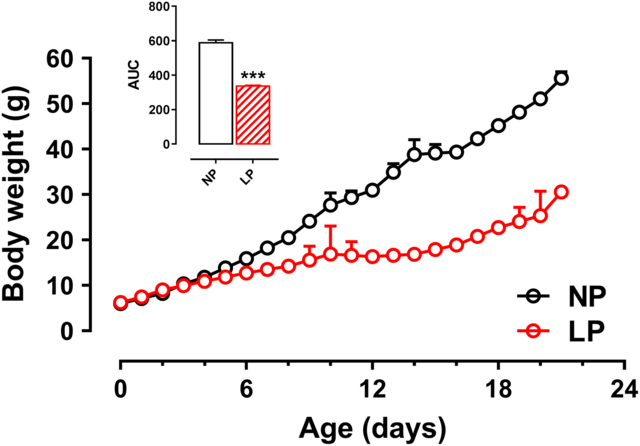
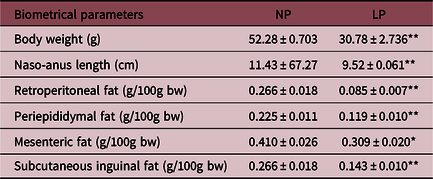
At birth, as expected, the body weight of LP rats was similar to that of NP rats (P > 0.05, n = 25). Throughout lactation, the LP rat body weight was reduced by 43% (P < 0.001, n = 25, Fig. 1). Weaned LP rats displayed smaller body weight (41%), naso-anus length (17%), and retroperitoneal (68%), periepididymal (47%), mesenteric (25%) and subcutaneous inguinal fat pads (46%) than weaned NP rats (P < 0.01, n = 25, Table 1).
Changes in body weight during the suckling phase. Data are given as the mean ± the SEM of 25 rats from 6 different litters. The inset in the upper right panel in the figure represents the area under the curve (AUC) of the change in body weight. ***P < 0.001 based on Student’s t-test. NP, rat offspring from the normal-protein-diet group; LP, rat offspring from the low-protein-diet group.

Biometrical parameters from weaned rat offspring of mothers fed a low-protein diet at the first 2 weeks of lactating period

NP, rat offspring from the normal-protein-diet group; LP, rat offspring from the low-protein-diet group.
Data are given as mean ± the SEM obtained from 25 weaned rats of the 6 different litters. The statistical analyses were obtained by Student’s t-test.
* P < 0.01.
** P < 0.001.
Biochemical parameters in fasting conditions
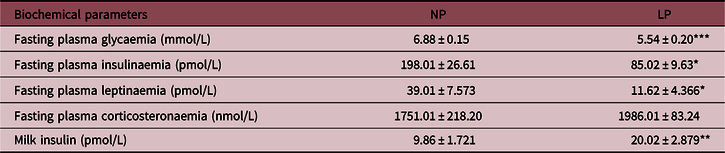
In comparison with weaned NP rats, in fasting conditions, weaned LP rats were hypoglycaemic, hypoinsulinaemic and hypoleptinaemic (P < 0.05, n = 8–12, Table 2) without changes in levels of corticosterone (P > 0.05, n = 8, Table 2). In addition, the levels of insulin present in the milk sample from LP rat mothers were increased twofold in relation to the levels of insulin in the milk sample from NP rat mothers (P < 0.001, n = 6, Table 2).
Biochemical parameters from weaned rat offspring from mothers fed a low-protein diet at the first 2 weeks of lactating period

NP, rat offspring from the normal-protein-diet group; LP, rat offspring from the low-protein-diet group.
Data are given as mean ± the SEM of 8–12 samples from weaned rats of the six different litters and six samples for milk. The statistical analyses were obtained by Student’s t-test.
* P < 0.05.
** P < 0.01.
*** P < 0.001.
Glucose–insulin homeostasis assessment
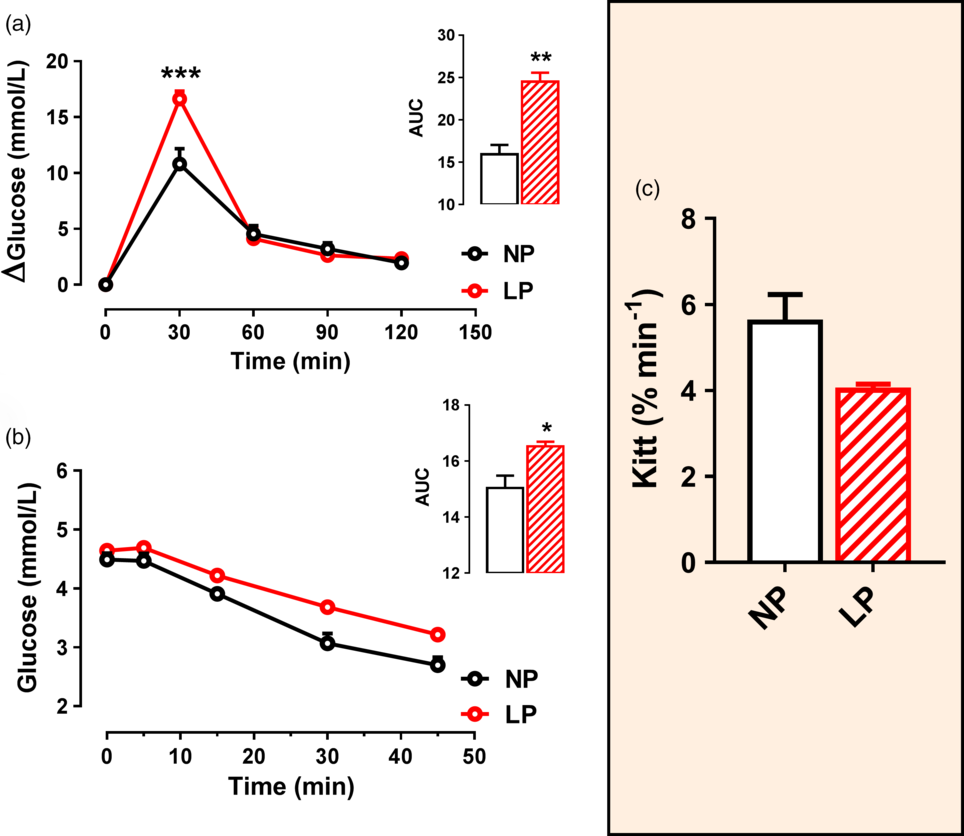
As shown in Fig. 2, glucose–insulin homeostasis was altered in weaned LP rats. The increment of glycaemia displayed in the LP rat group during the intraperitoneal glucose tolerance test (ipGTT) was increased by 54% (P < 0.01, n = 12, Fig. 2a). As such, the area under the curve of glycaemia during the ipITT was 10% higher in LP rats than in NP rats (P < 0.05, n = 12, Fig. 2b). Although not significantly different, the rate for plasma glucose disappearance (Kitt) was 28% smaller in weaned LP rats than in weaned NP rats (P > 0.05, n = 12, Fig. 2c).
Plasma glycaemic and insulinaemic homeostasis. Data are given as the mean ± the SEM of 12 rats from 6 different litters. (a) Glycaemia increase during the intraperitoneal glucose tolerance test (ipGTT. (b) Glycaemia decrease during the intraperitoneal insulin tolerance test (ipITT). The insets in the upper panels each show the area under the curve (AUC) of the values that were calculated from the ipGTT and ipITT. (c) Rate of plasma glucose disappearance per minute during the ipITT (from 5–30 min). *P < 0.05, **P < 0.01, ***P < 0.001 based on Student’s t-test. NP, rat offspring from the normal-protein-diet group; LP, rat offspring from the low-protein-diet group.

Pancreatic islet function
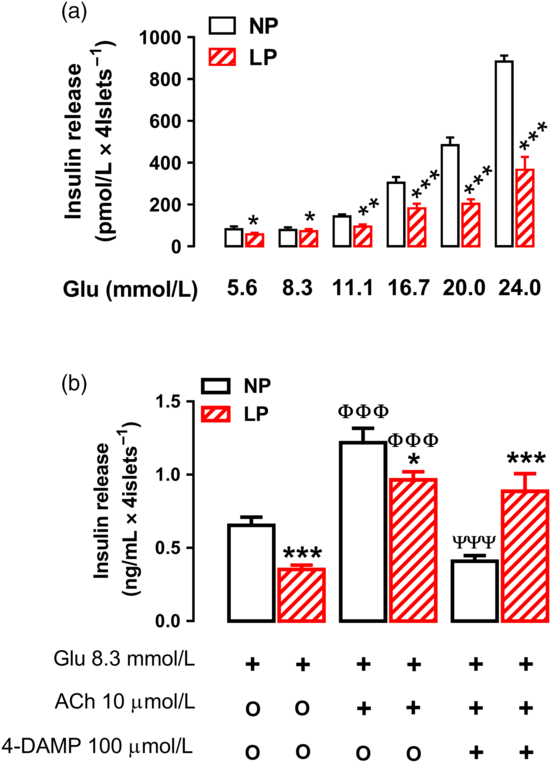
In relation to the function of pancreatic islets from weaned NP rats, under the same conditions, pancreatic islets from LP rats were less responsive to insulin secretion at all studied glucose concentrations (P < 0.05, Fig. 3a). Additionally, the insulinotropic effect of acetylcholine was 21% smaller in pancreatic islets from LP rats than in those from NP rats (P < 0.05, Fig. 3b).
Insulin secretion under the insulinotropic effects of glucose and a selective antagonist for the M3 subtype of the muscarinic acetylcholine receptor (M3mAChR). (a) Data represent the mean ± the SEM of pancreatic islet insulin release, which was stimulated by increasing glucose concentrations (5.6, 8.3, 11.1, 16.7, 20.0 and 24.0 mmol/L) or (b) by insulin secretagogue agents (glucose, 8.3 mmol/L, only; acetylcholine, 10 µmol/L, or 4-DAMP, 100 µmol/L). Pancreatic islets were obtained from nine rats from three different litters of each experimental group. The statistical analyses were obtained by Student’s t-test (a) and one-way ANOVA followed by the Bonferroni test (b). *P < 0.05, **P < 0.01 and ***P < 0.001 for direct comparison between NP and LP data; ΦΦΦP < 0.001 for comparison between acetylcholine (10 µmol/L) and glucose (8.3 mmol/L); and ΨΨΨP < 0.001 for comparison between 4-DAMP (100 µmol/L) and acetylcholine (10 µmol/L). NP, rat offspring from the normal-protein-diet group; LP, rat offspring from the low-protein-diet group; Glu, glucose; ACh, acetylcholine; 4-DAMP, 4-diphenylacetoxy-N-methylpiperidine methiodide.

In addition, the insulinostatic effect of 4-DAMP (a selective M3mAChR antagonist) on pancreatic islets from NP rats was 46% that of acetylcholine (P < 0.001, Fig. 3b). On the other hand, in pancreatic islets from LP rats, the insulinostatic effect of 4-DAMP was not different from that of acetylcholine in the same pancreatic islets (P > 0.05).
Vagus nerve electrical activity
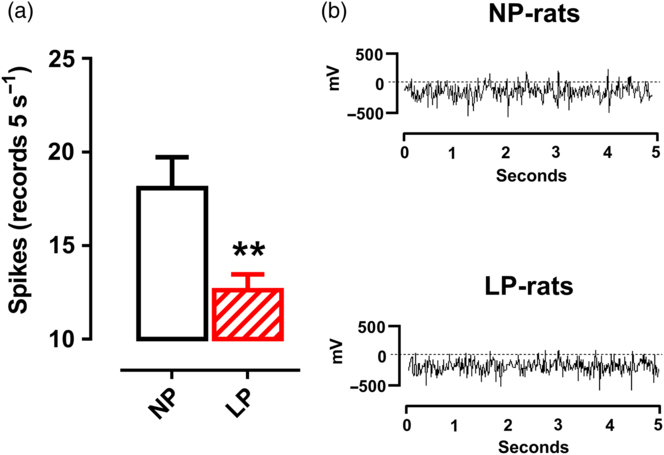
The electrical activity of the superior vagus nerve from weaned LP rats was 30% less active than the tonus from vagus nerves of the NP rats (P < 0.01, n = 20, Fig. 4).
(a) Electrical activity of the cervical superior vagus nerve. Data represent the mean ± the SEM of the vagus nerve firing rate obtained from 20 rats from 6 different litters for each experimental group. (b) Depicts the representative records of each nerve discharge, which illustrate the data for each experimental group. **P < 0.01 by Student’s t-test. NP, rat offspring from the normal-protein-diet group; LP, rat offspring from the low-protein-diet group.

Discussion
The current study describes the endocrine function of pancreatic islets in the secretion of insulin and the role of the vagus nerve as a pivotal insulin secretion potentiating branch in male weaned rat offspring in a well-established early malprogramming rat model.Reference Moura, Carpinelli, Barbosa, Gravena and Mathias11,Reference Gravena, Andreazzi, Mecabo, Grassiolli, Scantamburlo and Mathias12,Reference Barbosa, Capito, Kofod and Thams27 This malprogrammed rat model has been well characterised by the display, in adulthood, of a weak capacity of pancreatic β-cells to secrete insulin and a more prominent insulin sensitivity in peripheral tissues as long-term consequences.
Interestingly, our data show that male weaned LP rats were glucose-intolerant, which corroborates the reduced peripheral insulin sensitivity found herein. Nevertheless, in the current study regarding glucose–insulin homeostasis, we did not observe a significant difference in the values of Kitt, which does not deny the absence of the characteristic higher peripheral insulin sensitivity, long reported to be found in this rat model into adulthood.Reference Moura, Carpinelli, Barbosa, Gravena and Mathias11,Reference Gravena, Andreazzi, Mecabo, Grassiolli, Scantamburlo and Mathias12,Reference Barbosa, Capito, Kofod and Thams27 This suggests that insulin resistance, in this LP rat model, turns into peripheral high insulin sensitivity as a secondary malfunction, possibly due to metabolic changes such as poor insulin secretion already established in early stages of life.
Similarly, the levels of adiponectin in blood or milk may be another parameter impaired in these male weaned LP rats and thus influence insulin sensitivity, since this rat model displays a lean phenotype (smaller white fat stores) already in the weaned stage. Even though we did not quantify adiponectin in plasma or in milk in the current study, we did find normal adiponectinaemia in this same rat model (LP rats into adulthood, data not published yet, P = 0.311, n = 12). Human milk adiponectin levels have been shown to change in a sex-dependent manner, where milk from gestational diabetic women presented higher adiponectin in mothers of female babies than in mothers of male babies.Reference Galante, Lagström and Vickers28
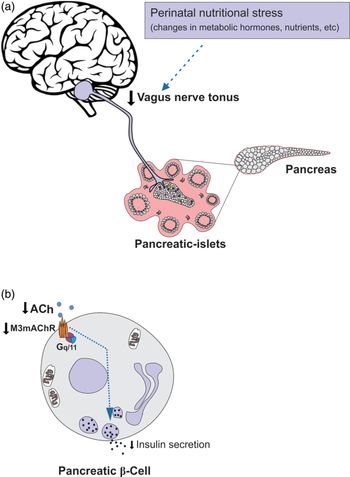
In addition, we identified a reduced tonus of the superior vagus nerve and a decreased insulinotropic response by muscarinic potentiation and the insulinotropic role of M3mAChR in dysfunctional pancreatic islets from male weaned LP rats, as depicted in the schematic in Fig. 5. This study compounds a body of data reporting, to our knowledge, for the first time, these metabolic changes in male weaned rat offspring from malnourished mothers in the first two-thirds of the lactating period. However, with regard to the effects of a low-protein diet in pregnancy and/or lactation on modifying fasting insulinaemia and glucose–insulin homeostasis in adult rat offspring, it is known to happen in a sex-specific manner.Reference Chamson-Reig, Thyssen, Hill and Arany9,Reference Zambrano, Bautista and Deas29 Additionally, sex dimorphism in regard to human milk composition has been shown to be associated with maternal and infant characteristics as well pathophysiological factors.Reference Galante, Lagström and Vickers28
Schematic figure depicting early malprogramming and impairment of vagus nerve tonus and pancreatic β-cell insulin secretion. Stressful insults, herein induced by maternal low-protein diet during the first 2 weeks of the suckling phase, malprogramme the vagus nerve to reduced tonus (a) and the M3 subtype muscarinic acetylcholine receptor (M3mAChR) in the pancreatic β-cells to low responsiveness in weaned rat offspring, which are imprinted to secrete a reduced amount of insulin (b) from an early age.

Although measurements were performed only 1 week after the maternal low-protein diet exposure, in the present study, the male weaned LP rats did not show changes in corticosterone plasma levels. High levels and/or local action of glucocorticoids in early life (cortisolReference Salvante, Milano, Kliman and Nepomnaschy30,Reference Niwa, Kawai, Kanazawa, Okanoya and Myowa-Yamakoshi31 in humans and corticosteroneReference Somm, Vauthay and Guerardel32 in rodents) have been shown to programme, among other diseases, metabolic malfunction later in lifeReference Chen, He, Chen, Liu and Wang4,Reference Moisiadis and Matthews33 . Therefore, we did not quantify the pancreatic islet expression or function of 11 β-hydroxysteroid dehydrogenase (11 β-HSD) types 1 and 2 to assess the direct effect of glucocorticoids on pancreatic islet function. This is one of the limitations of our study, since tissue-specific changes in glucocorticoid metabolism have been associated with metabolic dysregulation.Reference Rask, Walker and Soderberg34
Seeking to answer the hypothesis that a maternal low-protein diet in the suckling period malprogrammes weaned LP rats to have pancreatic islets with a weak ability to secrete insulin in early life, we studied isolated pancreatic islets by assessing their responsiveness under increasing glucose concentrations and parasympathetic signalling through acetylcholine and selective M3mAChR antagonists as insulin secretagogues.
Here, weaned LP rats poorly secreted insulin, already at an early age, which can take pancreatic islet weakness imprinting over as early as in the suckling period. These observations are remarkable and suggest a role of maternal nutritional insults in the suckling period and their negative effects on cholinergic pathways in the endocrine pancreas derangement seen in LP rats. Herein, we found that islets from weaned LP rats were weakly capable of secreting insulin under glucose and cholinergic-insulinotropic effects, and the M3mAChR function in weaned LP rats was found to be disrupted, as has been shown in adulthood.Reference Gravena, Andreazzi, Mecabo, Grassiolli, Scantamburlo and Mathias12–Reference de Oliveira, Scomparin and Andreazzi14 Beyond this, our data suggest that a higher responsiveness and/or expression of M2mAChR in the weaning period can already be detected, as the presence of 4-DAMP in the pancreatic islets from weaned LP rats did not reduce insulin secretion any more than the presence of the physiological signal acetylcholine. Another limitation in the present work was that neither the tonus of the sympathetic nervous system nor the sympathetic signalling pathway in pancreatic islets was studied because their direct influence on pancreatic islet function in weaned LP rats cannot be discarded.Reference Davani, Portwood and Bryzgalova35,Reference Prates, de Oliveira and Malta36 In line, we found that weaned LP rats had less vagus nerve tonus, which can support pancreatic islet signal weakness contributing to less insulin secretion.
Thus, weaned LP rats were not only hypoinsulinaemic but also hypoleptinaemic. These metabolic hormones play important roles by potentiating neuroendocrine signalling and tissue maturation and by establishing a healthy function of energy metabolism in critical stages of life development.Reference Badillo-Suarez, Rodriguez-Cruz and Nieves-Morales37,Reference Palou, Pico and Palou38 As elegantly demonstrated, intracerebroventricular leptin exposure in the embryonic brain permanently programmed reduced cholinergic innervation of pancreatic β-cells, as well as long-term impairment in glucose homeostasis.Reference Croizier, Prevot and Bouret39 Interestingly, the authors showed an embryonic inhibitory effect of leptin on the growth of cholinergic neurites in the hindbrain that influences parasympathetic signalling upon the endocrine function of the pancreasReference Croizier, Prevot and Bouret39; in our study, we found low parasympathetic tonus associated with hypoleptinaemia.
In our study, the intrauterine environment of the rat offspring was not insulted; any alterations imprinted in the weaned LP rats were due to changes during the suckling phase, since these dams were suckling mothers fed a low-protein diet during the first 2 weeks of the nursing period. This highlights the importance of adequate milk nutrient and metabolic hormone composition.Reference Palou, Pico and Palou38 Additionally, leptin administered in high doses during the first 2 postnatal weeks was associated with obesity in adulthood,Reference Palou, Pico and Palou38 while physiological doses of leptin administered throughout the suckling period were associated with a lean phenotype and improved insulin sensitivity.Reference Sanchez, Priego, Palou, Tobaruela, Palou and Pico40
Beyond changes in plasma metabolic hormones in weaned LP rats, insulin levels in milk from mothers of LP rats were found to be increased. These findings suggest that this alteration can address changes in the neuroendocrine circuitry that act by regulating energy metabolism through cell maturation not only in the hypothalamus but also in the pancreas. However, we do not have a deep explanation for the high milk insulin content found here; the function of milk insulin in the newborn, although not totally established, seems to have a pivotal role in infant functional development.Reference Badillo-Suarez, Rodriguez-Cruz and Nieves-Morales37 Although the consumption and provision of inappropriate foods, such as high-sugar and high-fat diets, exceeding the ideal nutritional guidelines contribute to the accelerated increase in obesity (maternal obesity and infant obesity) seen worldwide, inadequate food intake below the ideal nutritional guidelines is also a problem that affects people around the world, affecting hormone milk composition and maternal physiology and, thus, pups’ health.
In fact, our data reinforce the importance of breastfeeding together with the optimal milk nutrient and hormone composition for infant health, which must be associated with adequate maternal nutrition, since adequate healthcare for pregnant and lactating mothers does not happen fully and equally for all people.Reference Uauy, Kain and Corvalan41
Conclusion
Low tonus of the vagus nerve, early pancreatic islet dysfunction in response to insulinotropic agents and impaired muscarinic response to secrete adequate insulin amounts are imprinted in weaned rat offspring from mothers fed a low-protein diet in the suckling period. In addition, the low-protein maternal diet in the suckling period increases milk insulin levels and reduces plasma levels of critical metabolic hormones, insulin and leptin, for neuroendocrine circuitry development in weaned rat offspring.
Financial support
This work was funded by the Brazilian Federal Research Foundation, Conselho Nacional de Desenvolvimento Científico e Tecnológico (CNPq; process number 478098/2013-8) and Coordenação de Aperfeiçoamento de Pessoal de Nível Superior (CAPES), and by the State Research Foundation, Fundação de Amparo à Pesquisa do Estado do Paraná (Fundação Araucária) and Fundação de Amparo à Pesquisa do Estado de Mato Grosso (FAPEMAT; process number 227871/2015).
Conflict of interest
The authors declare no conflicts of interest.
Ethical standards
The authors assert that all procedures contributing to this work comply with the ethical standards of the relevant national guides on the care and use of laboratory animals (Conselho Nacional de Controle de Experimentalção Animal, CONCEA, http://www.mctic.gov.br/mctic/opencms/institucional/concea/index.html, which adheres to the Brazilian Federal Law 11.794/2008) and has been approved by the institutional committee (Comitê de Ética no Uso de Animais da Universidade Estadual de Maringá, CEUA/UEM; process number 8981290814).