

1. Introduction
In the US, intermarriage between native- and foreign-born individuals has accounted for an increasing share of both new marriages and of married couples since the 1960s [Livingston and Brown (Reference Livingston and Brown2017)]. Intermarriage plays a role in assimilation and in achieving better labor market outcomes for immigrants [Furtado and Trejo (Reference Furtado and Trejo2013)]. In part, improved labor market outcomes for intermarrying immigrants can be attributed to the procurement of legal status. Recent bills proposed under President Biden would provide an alternate route to citizenship, which could alter intermarriage rates for eligible immigrants.Footnote 1 The extent to which legal status through amnesty impacts intermarriage rates in the US is an important consideration.
To this point, no research has explored how amnesty impacts intermarriage in the US. Related work examining intermarriage rates in Italy following additional countries' admittance to the European Union (EU) find a decrease in intermarrying [Adda et al. (Reference Adda, Pinotti and Tura2020)]. Findings on intermarriage from the EU expansions may not be generalizable to changes in US immigration policy. To provide insight into how future US amnesty policies may impact intermarriage, I explore potential changes in intermarriage after a natural experiment that granted legal status to a large group of illegal aliens.
Specifically, I exploit the enactment the Immigration Reform and Control Act of 1986 (IRCA). IRCA resulted in roughly 2.7 million illegal immigrants gaining permanent resident status [US Department of Justice (1997)], making IRCA the largest amnesty program in United States history. In part due to the size of the program, the effects of IRCA on the newly legalized population, immigration flows, and domestic population have been the focus of a large body of scholarly work. The goal of this study is to examine how IRCA affected intermarriage rates.
Specifically, I use marriage license data to examine changes in gains to marriages (defined later) involving a foreign-born spouse following IRCA. Relative to native-native marriages, I find that legalization led to a decrease in gains to marriage involving a foreign-born spouse. I find the largest effects for marriages involving native brides, which is plausible considering the majority of immigrants impacted by IRCA are male [Rolph (Reference Rolph1992)]. When effects are allowed to vary by spousal nativity, I find the decrease is driven by changes in gains to marriage involving a Mexican spouse or a spouse who was born outside the US, Canada and Mexico.
The paper proceeds as follows. In Section 2, the institutional details of IRCA are discussed. Section 3 provides a discussion of the role incentives play in marriage, previous related research, and mechanisms through which legalization could affect marriage rates. Section 4 outlines the data and methods used to analyze the impact of legalization on marriage, and Section 5 presents the analyses' findings. Finally, in Section 6, I discuss this paper's findings and conclude.
2. Institutional background
To address the large number of illegal immigrants residing in the United States, IRCA was passed granting amnesty to two groups of illegal immigrants. The first group offered amnesty was legally authorized workers (LAWs)—aliens that entered the United States before 1982 and continuously resided as an illegal resident until applying for legal status beginning in May 1987 under IRCA. Following application, the alien receives temporary status which may be converted to permanent resident status in 18 months if the alien is able to demonstrate a minimal understanding of English and civics.
The second group offered amnesty was special agricultural workers (SAWs). SAWs had to show a history of working in season agriculture for at least 90 days in the last 12 months prior to May 1984, 1985, and 1986. Once the work requirement was demonstrated, the alien gained temporary status. Because of the lack of a continuous residence requirement, SAWs could apply for temporary legal status even while residing abroad. In the case of SAWs, temporary status could be converted to permanent resident status after 2 years with no additional conditions required.
IRCA granted legal status to approximately 1.6 million LAWs and 1.1 million SAWs [US Department of Justice (1997)]. Over 90% of the immigrants gaining legal status came from Mexico, Central America, the Caribbean, or South America [Rolph (Reference Rolph1992)]. The LAW population consisted of over 40% women and a relatively young population while the SAW population consisted of less than 20% women and mainly working-age adults [Rolph (Reference Rolph1992)].
3. Theoretical framework
Under the framework of Becker (Reference Becker1973), individuals who marry do so because the utility derived from being married exceeds the utility obtained from remaining single. This leads to a clear prediction that changes in the costs or benefits of marriage should affect those on the margins. Existing literature on tax penalties, public assistance and economic conditions support this hypothesis. Tax penalties, which raise the cost of marriage, have been found to have significant, but small, deterrent and postponement effects on marriage [Alm and Whittington (Reference Alm and Whittington1995, Reference Alm and Whittington1997, Reference Alm and Whittington1999), Gelardi (Reference Gelardi1996), Sjoquist and Walker (Reference Sjoquist and Walker1995)]. Increased public assistance, which lowers the costs to remain single and rear a child, has also been found to decrease or delay marriage [Hutchens (Reference Hutchens1979), Moffitt et al. (Reference Moffitt, Reville and Winkler1998), Schultz (Reference Schultz1994), Winkler (Reference Winkler1995), Grogger and Bronars (Reference Grogger and Bronars2001)].Footnote 2 Consistent with good employment conditions increasing the opportunity cost of marriage, Blau et al. (Reference Blau, Kahn and Waldfogel2000) and Preston and Richards (Reference Preston and Richards1975) find a negative relationship between sex-specific employment conditions and marriage. The two primary channels I consider that affect the newly legalized population's incentive to marry are a change in the path to naturalization and changes in their labor market environment.
For illegal aliens, marrying a citizen may aid in obtaining legal status. Aliens who have legally entered the United States and married a citizen—even if they have overstayed their legal limit—can adjust their status. Aliens that have illegally entered the United States and marry a citizen have a more difficult path to status adjustment: the alien must return to their country of origin and remain abroad for at least 3 years before being eligible for legal entryFootnote 3. The benefit of marrying for legal status is considerable—contractual marriage fraud payments, where an alien pays a citizen to participate in a sham marriage, have been over $20,000 [Lynskey (Reference Lynskey1986)].Footnote 4 Those newly legalized under IRCA have an alternative path to gaining legal status besides through marriage. With marriage no longer having the benefit of being a path to legal status, there should be a decreased incentive for IRCA-eligible foreigners to marry citizens. This change in incentive to marry could result in a delay in marriage, resulting in cohabitating couples choosing to remain unmarried due to the decreased urgency imposed by illegal status. This simple analysis yields the prediction that following IRCA there should be a decrease in the rate of marriage between citizens and non-citizens.
The second channel considered in this paper is legalization's effect on the labor market environment resulting in a change in marriage decisions. IRCA has been found to provide high skilled immigrants access to better jobs and ensure low skilled immigrants receive at least the minimum wage after legalization.Footnote 5 The increased returns to skill among legalized immigrants should result in an increased incentive to obtain additional education or training, and an anticipation of future higher earnings. For immigrants who receive higher wages following legalization, they should have a decreased gain to marriage. Notably, Chi (Reference Chi2017) finds that the intermarriage earnings premium for Mexican immigrants is rendered insignificant for those eligible for IRCA—providing support that incentives, in the form of earnings premiums, decline for those impacted by IRCA. This decreased incentive to marry may result in fewer immigrants seeking to marry, delaying marriage, or changing the search process for a potential spouse.Footnote 6
4. Empirical approach
4.1 Data
Information on marriages is obtained from the 1981 to 1988 Marriage Data, Detail, from the National Center for Health Statistics.Footnote 7 The data is based on official marriage certificates provided by states in the marriage registration area. During this period, all recorded marriages are heterosexual. Some statesFootnote 8 are excluded as they were not in the marriage registration area for the full sample. The data contains the date, location, and information about the two individuals at the time of marriage. Detailed information on the birthplace of the bride and groom are included in most state records. The data has the advantage of recording outcomes at the time of marriage, rather than relying on recall among respondents later in life.
Unfortunately, the marriage data does not report an individual's citizenship status. Rather, the data reports the individual's place of birth. To identify who is potentially affected by immigration reform, I rely on United States birthright citizenship. Anyone born in the United States is a natural-born citizen. I treat those born outside the United States as an immigrant who is potentially treated by immigration reform. Foreign-born individuals that have been naturalized, legally reside in the United States, or have legally entered and overstayed are not affected by IRCA. Foreign-born populations that have illegally entered but have not been present for a long enough duration to be IRCA-eligible are also unaffected by the reform. By treating all foreign born as treated, I likely underestimate IRCA's effects.
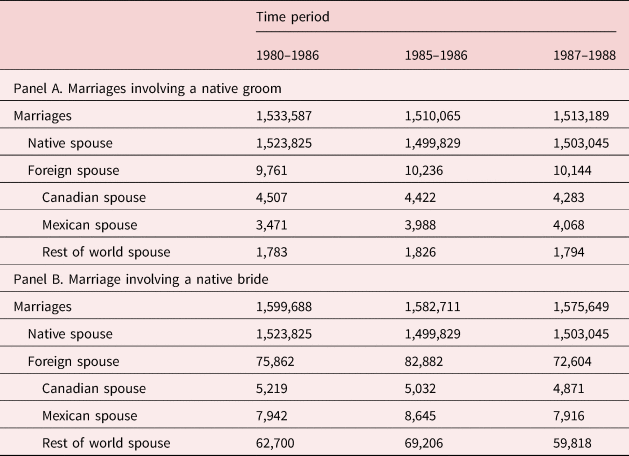
Table 1 shows the mean total number of marriages, those involving a native spouse, and those involving a foreign spouse, separately for native grooms and native brides. I report means for the pre-IRCA period (1980–1986), the 2 years immediately preceding IRCA (1985–1986), and the post-IRCA period (1987–1988). There are roughly 1.5–1.6 million marriages annually throughout the period of analysis. There are considerably fewer marriages between a native groom and a foreign spouse, roughly 10,000 per year, relative to marriages between a native bride and a foreign spouse, over 70,000 per year.
Marriage descriptive statistics, 1980–1988

Note: The data used is the 1980 to 1988 detail marriage data. Only marriages among individuals aged 18 to 59 are included and estimates are weighted for states-year cells reporting less than 100% of marriages. Rest of world includes all individuals born outside the US, Canada, or Mexico.
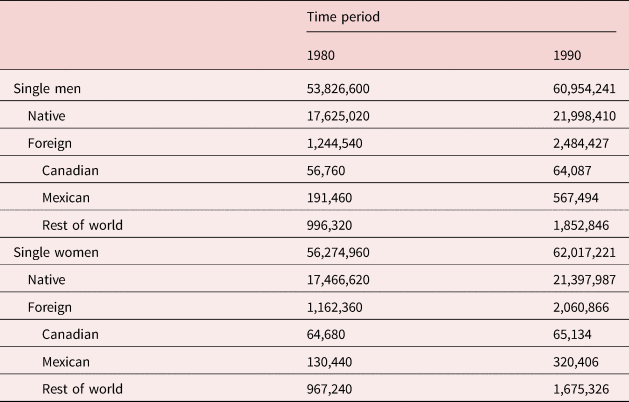
Population data is obtained from the IPUMS-USA 1980 and 1990 5% state samples. I create state totals of single men and women aged 18–59, overall and by nativity. In Table 2, I report the totals for the 1980 and 1990 samples. The composition of singles by nativity is similar for both men and women in each sample. The largest share of foreign singles comes from countries other than Canada and Mexico. However, Mexico, a single country, accounts for around one fifth of foreign-born singles.
Singles by sex and nativity, 1980 and 1990
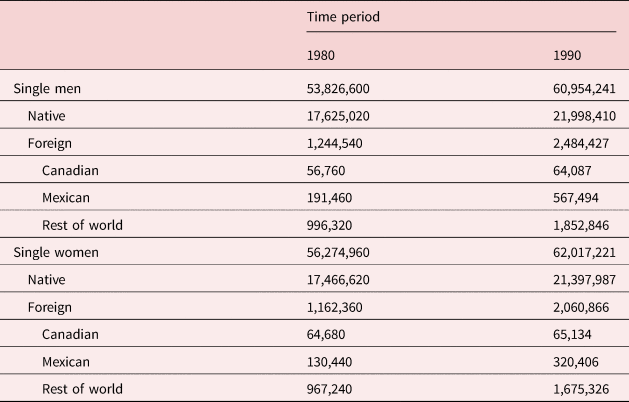
Note: The data used is the IPUMS-USA 1980 and 1990 5% state samples. Only individuals aged 18 to 59 are counted and estimates are weighted using IPUMS person weights. Rest of world includes all individuals born outside the US, Canada, or Mexico.
4.2 Methods
To evaluate the impact of IRCA on marriage rates, I follow Adda et al. (Reference Adda, Pinotti and Tura2020) and use a formulation of Choo and Siow's (Reference Choo and Siow2006) measure of gains to marriage. Under this approach, gains to marriage are measured by the square of marriages occurring among pairings of spousal nativities relative to the geometric average of singles of the same sex and nativity. Using the geometric average of singles factors in changes in the availability of singles of different nativities; this method accounts for the possibility that naturally more marriages may occur involving a particular nativity when there are more singles of that nativity present. Gains to marriage should be interpreted as the gains relative to the individuals next best option—remaining single or being a partner in a less-formal relationship such as cohabitation—after obtaining legal status through IRCA. In this paper, I examine gains occurring among couples with a native-born groom and native-born bride separately.
To illustrate, the gains to marriages consisting of a couple with a native-born groom are calculated as follows:

The numerator, ${\rm marriage}{\rm s}_j^2$ , is the square of the total number of marriages occurring between a native-born groom and a bride with nativity j, where j indicates if the bride is born in the US, Canada, Mexico, or the rest of worldFootnote 9. The denominator is the geometric average of the total number of native-born single men, singles, and single women with nativity j, singlesj. Πj is calculated for each state-quarter in the sample. Analogous rates are calculated for couples with a native-born bride. To address the problem of some state-quarters having no marriages or no singles, I add one to each state-quarter cell's marriages and measures of singles.Footnote 10 This ensures that Πj is defined for each state-quarter cell. I test the sensitivity to this, in Appendix B, where results are reported using the original state-quarter measures.
Unlike the marriage data, which is available by month, population data is available only in 1980 and 1990. To compute number of native-born singles available in intercensal years, I use linear interpolation. To compute the number of foreign-born singles available in intercensal years, I employ two approaches. First, I use the same linear interpolation method as used for the native-born estimates. Immigration rates to the US were not constant in the 80s, meaning that linearly calculated estimates may not accurately capture changes in immigrants present in the US. To account for this, I use a second method to estimate intercensal immigrant populations using Immigration and Naturalization Service (INS) data. Using INS data on immigration, I divide each year's total immigration by the sum of immigration occurring between 1980 and 1990 to obtain a measure of the percent of immigration change in that decade occurring within that calendar year. Next, I multiply each year's percent of immigration change by the total change in foreign-born population occurring between 1980 and 1990 as measured by the IPUMS-USA data. These steps are done separately for immigrants from Canada, Mexico, and rest of world. This approach assumes the pattern of immigrant growth in states follows the national immigration patterns, rather than a linear trend.
I estimate the following equation to estimate gains to marriage occurring between a native groom (native bride) and foreign-born bride (foreign-born groom) relative to homogenous native-native marriages:

where Foreignj is an indicator taking a value of one for marriages with a foreign-born spouse; Postt is an indicator for the period after IRCA went into effect (January 1, 1987 and onward)Footnote 11; Yeart, Quartert, and States are fixed effects for calendar year, quarter, and state; X st contains at minimum controls for the number of single males and females, the availability of opposite sex singles of the same foreign-nativityFootnote 12, and, when indicated, controls for sex ratios; and ε jst is the error term.
The coefficient of interest, β, measure the change gains to marriages to a foreign-born spouse relative to marriages to a native-born spouse before and after IRCA's effective date. I estimate equation (1) separately for marriages involving native-born brides and grooms. It is unlikely that each nativity is uniformly impacted: of all immigrants admitted between 1980 and 1990, the percent admitted due to IRCA is 4% for Canadians, 73% for Mexicans, and 11% for rest of world. To assess potential differences across nationalities, I estimate a model where Foreignj is replace by indicators for Canadian, Mexican, and rest of world nativity. This allows for heterogenous effects by spousal nativity. For all estimates, I weight by state population and cluster standard errors by state.Footnote 13
5. Results
5.1 Main results
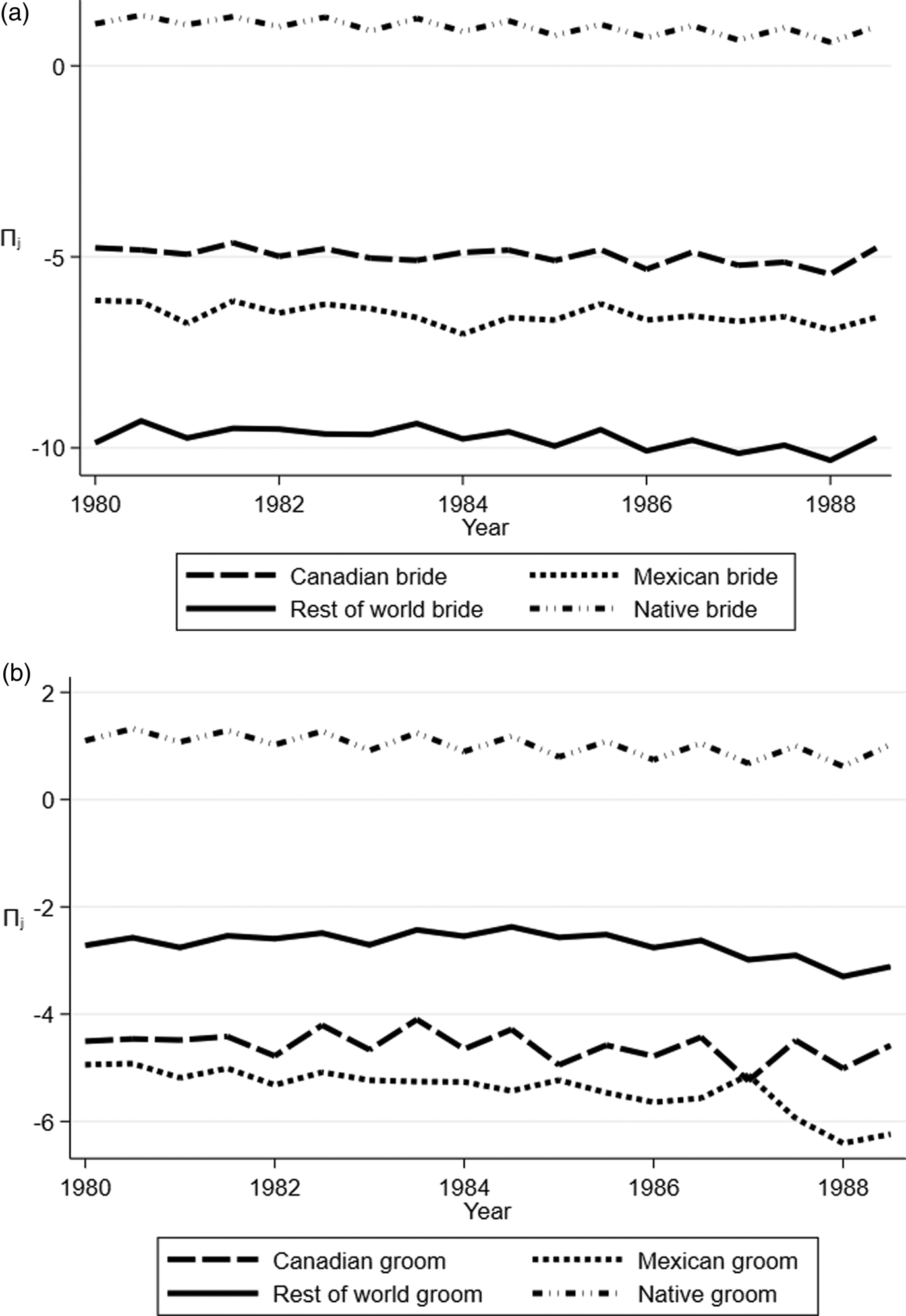
Gains to marriage by spouse's nativity, Πj, are presented in Figure 1. Figure 1a, presents the gains to marriage involving a native groom. Over the sample period, Π is relative stable for marriages to a Canadian, Mexican, native, or rest of world bride. There is no notable change following IRCA going into effect in 1987. Figure 1b, presents the gains to marriage involving a native bride. Before 1987, Π appears relatively stable for all spousal nativities. After 1987, there is an apparent decline in the share of marriages to Mexican grooms. There also appears to be a less drastic decline in the share of marriages to rest of world grooms. There is no noticeable decline in marriages to Canadian or native grooms.
Gains to marriage. (a) Native grooms. (b) Native brides.
Note: Panel A shows the gains to marriage for marriages involving a native groom. Panel B shows the analogous gains for marriage involving a native bride.

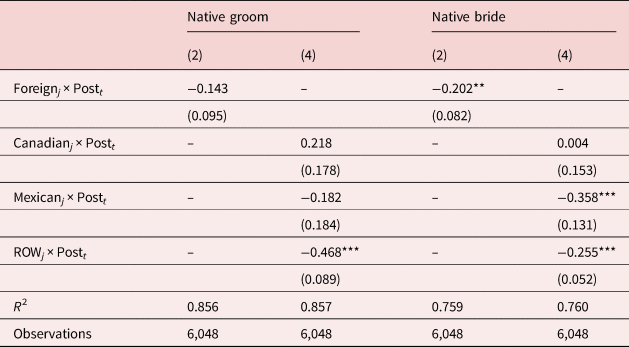
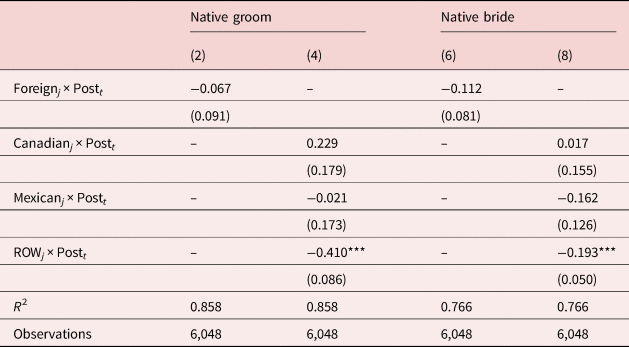
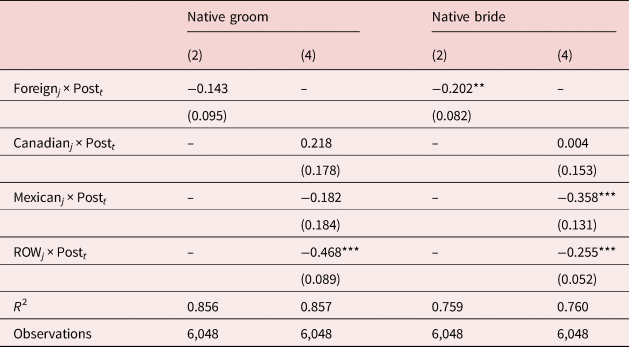
I provide non-graphical evidence of changes in the gains to marriage by estimating equation (1). In Table 3, I present results using linearly interpolated population values separately for marriages involving a native groom and native bride. Columns 1 and 3 report results using a single indicator for all foreign-born spouses. Columns 2 and 4 report results from a model allowing effects to vary by spousal nativity. R-squared and observations are reported for each estimation.
Gains from marriage
Notes: All regressions include an indicator for the nativity of a foreign-born spouse, year fixed effects, quarter fixed effects, state fixed effects, the log of single males, the log of single females, and the log of available opposite sex singles of the same nativity as the foreign-born spouse. Observations are by quarter, state, and spouse's nativity. Estimates are weighted by state population and standard errors clustered by state are presented in parentheses. Significance levels of 0.10, 0.05, and 0.01 are denoted by *, **, and ***, respectively.
For marriages involving a native groom, I find no overall change in gains to marriages with foreign spouses. When the effect is allowed to vary by spousal nativity, I find a significant 0.47 log point decrease in gains to marriage between native grooms and rest of world brides. For marriages involving a native bride, I find a significant 0.20 log point decrease in gains to marriages with foreign spouses. There is no significant change in gains to marriages between a native bride and Canadian groom. The overall decrease in gains to marriage with foreign grooms is due to a 0.36 log point decrease in gains to marriages with a Mexican groom and a 0.26 log point decrease in gains to marriages with a rest of world groom.
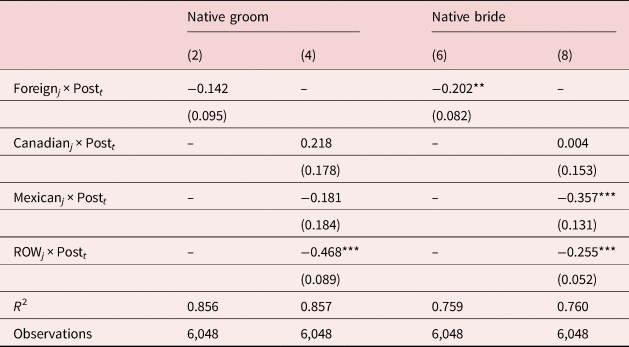
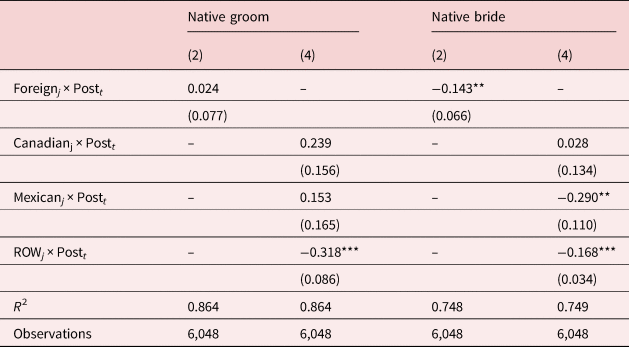
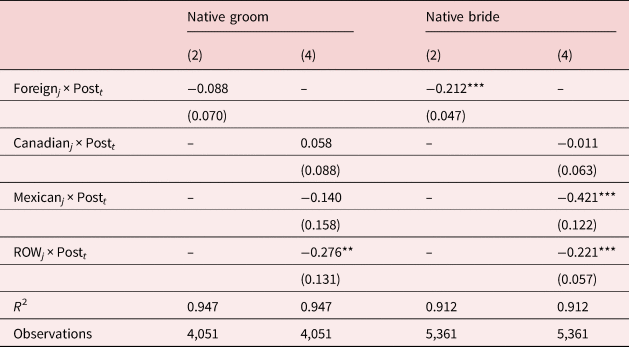
Next, I explore the sensitivity of results to a variety of changes in Appendix B. First, I explore the sensitivity of results to the inclusion of a control for sex ratios and weighting. In Table B1, I report results for regressions including a control for the sex ratio of single males to single females. Controlling for sex ratios does not cause any statistically meaningful changes in results. In Table B2, I report the results from an unweighted regression. The results do not lose significance in an unweighted regression, with point estimates being slightly smaller than those in Table 3.
I further explore the sensitivity of the findings to the use of alternative intercensal estimates and gains to marriage. First, I report results using intercensal estimates based on calendar year immigration admittances. Estimates using the non-linear immigrant population estimates are reported in Table B3. Coefficients are similar signed under this specification, with many being smaller in magnitude. The results for marriages involving rest of world spouses retain significance, while the results for marriages between a native bride and foreign groom or Mexican groom, lose significance. In Table B4, I present results using original counts of populations and marriages rather than those with one added to each cell. Any cells with 0 marriages will drop out from the estimates.Footnote 14 Results are generally consistent. The estimated decrease in gains to marriages between native grooms and rest of world spouses is larger, and the estimated decrease in gains to marriages between native brides and foreign spouses is larger. The estimated decrease in gains to marriage between native brides and Mexican grooms is larger in magnitude.
5.2 State heterogeneity and immigrant spousal preferences
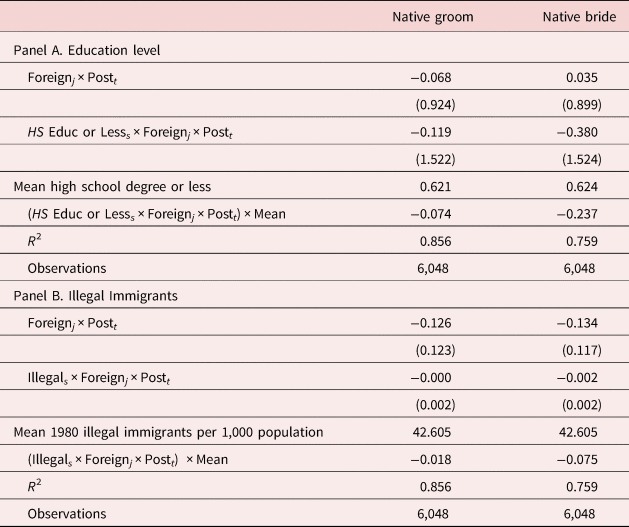
To further understand the impacts of IRCA, I perform additional analyses exploring heterogenous effects by state characteristics and look for evidence of changes in immigrants' spousal preferences. First, I construct state-level measures of the 1980s proportion of single adults with a high school education or less and of illegal immigrants, as estimated by Passel and Woodrow (Reference Passel and Woodrow1984), per thousand population. I then estimate equation (1) with the inclusion of a term interacting either the education or illegal immigration measure with Foreignj and Postt. In Table 4, I present the results by education level (Panel A) and illegal immigration per thousand population (Panel B). For education, the coefficient is negatively signed but insignificant. For illegal immigrants per thousand population, the coefficients are again negatively signed, but small and insignificant.
Heterogenous gains from marriage by state 1980s education and illegal immigrant levels

Notes: All regressions include an indicator for the nativity of a foreign-born spouse, year fixed effects, quarter fixed effects, state fixed effects, the log of single males, the log of single females, and the log of available opposite sex singles of the same nativity as the foreign-born spouse. Observations are by quarter, state, and spouse's nativity. Estimates are weighted by state population and standard errors clustered by state are presented in parentheses. Significance levels of 0.10, 0.05, and 0.01 are denoted by *, **, and ***, respectively.
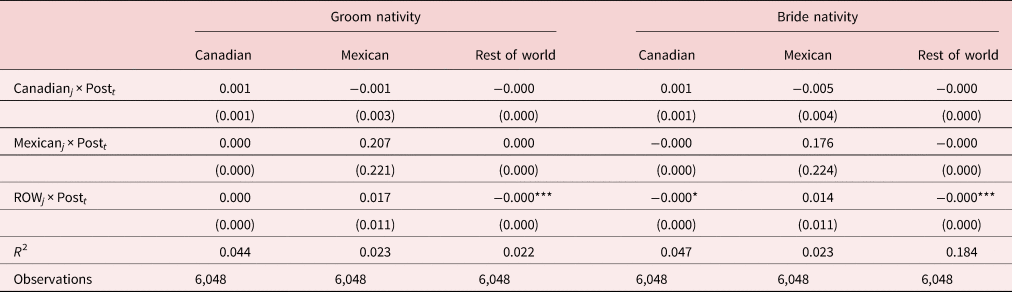
Lastly, I estimate a version of equation (1) where I examine gains to marriage for foreign-born grooms and brides. I calculate the Choo-Siow statistics for marriage involving a Canadian, Mexican, and rest of world groom separately. I run a regression for each groom nativity, measuring the gains to marriage to a Canadian, Mexican, or rest of world bride relative to marriages to native brides. I repeat the same analysis for foreign-born brides. If foreign-born individuals prefer to marry foreign-born spouses, but were marrying native spouses to gain legal status, IRCA would result in gains to marriages among foreign couples.
I present the results in Table 5. For all analyses, the estimated effects are small. Coefficients and errors are scaled up by 1,000 for convenience. For grooms, the only significant effect is a decrease in gains to marriages involving a rest of world groom and rest of world bride. For brides, there are significant decreases in gains to marriage between Canadian brides and rest of world grooms; and rest of world brides and rest of world grooms. Like the other effects, the significant estimates are of such a magnitude that the results are inconsequential. Overall, the lack of significance and small magnitudes suggest that the legal environment was not inducing foreign individuals to replace foreign spouses with native spouses.
Gains from marriages involving a foreign-born spouse, coefficients scaled up by 1000

Notes: All regressions include an indicator for the nativity of a foreign-born spouse, year fixed effects, quarter fixed effects, state fixed effects, the log of single males, the log of single females, and the log of available opposite sex singles of the same nativity as the spouse. Observations are by quarter, state, and spouse's nativity. Estimates are weighted by state population and standard errors clustered by state are presented in parentheses. Significance levels of 0.10, 0.05, and 0.01 are denoted by *, **, and ***, respectively.
6. Conclusion
This study examined the effects of the Immigration Reform and Control Act of 1986 on intermarriage. I find that the policy led to a reduction in gains to marriage involving a native bride and foreign-born groom. When gains to marriage are allowed to vary by spousal nativity, I find evidence of a decline in gains to marriage involving a native groom and a rest of world bride; for native brides, I find a decrease in gains to marriage involving a Mexican groom and rest of world groom. These findings are concentrated among the groups most affected by IRCA: males and Mexican-born individuals. Among foreign-born individuals, those born in Mexico are the most likely to have entered the United States illegally (Chiswick, Reference Chiswick1982). This means that the share of Mexican-born individuals who could obtain legal status through marriage is smaller than other foreign-born individuals—making the finding of a significant decline in gains to marriage among couples with a Mexican-born individual more compelling. I find no significant difference in effect by states' proportion with a high school degree or less or illegal immigrants per thousand population. Focusing on marriages involving a foreign-born groom or bride, I find no evidence of meaningful increases in marriages to other foreign-born spouses. The findings of this paper support the hypothesis that marriage becomes less attractive to the newly legalized population, as they now have a non-marital path to legal status.
This paper has several limitations of note. First, the findings in this paper document a decline in intermarriage for only 2 years following IRCA. For the third year and onward, birthplaces are not reported. This limitation does not lend itself to exploring whether IRCA delayed intermarriage rates among those affected or resulted in a lasting decrease in propensity to intermarry. Secondly, no conclusions about the specific motivation for marriage can be inferred outside of the entire bundle of benefits that are conferred with legal status. Research using novel data, or new natural experiments, would provide additional insight. Further research relating to how IRCA impacted marriage stability, childbearing, and later-life outcomes would provide further insight into the effects of US amnesty programs.
Appendix A
Immigration Marriage Fraud Amendments
The Immigration Marriage Fraud Amendments of 1986 (IMFA) was passed just days after IRCA. IMFA intended to deter marriage fraud and prevent immigrants from circumventing the normal visa process. It is not clear how pervasive marriage fraud was among marriages involving a non-citizen; estimates from the Immigration and Naturalization Service (INS) suggest fraud may play a role in up to 8% of marriagesFootnote 15 whereas the president of the American Immigration Lawyers Association suggests marriage fraud only plays a role in 2% of marriages [Lynskey (Reference Lynskey1986)].
Marrying a citizen allows an alien to avoid visa limitations by becoming an immediate relative of a citizen. IMFA imposes a 2-year period of conditional permanent resident status which may be converted, upon application of the alien and the alien's spouse, to permanent resident status (an upgrade to permanent status) after the conditional period ends and the marriage is demonstrated to be bona fide.
The effects, if any, of IMFA are hard to quantify. In 2007, an audit of marriage fraud was conducted but only one page of the 656 page report was not blacked out upon release [Bernstein (Reference Bernstein2010)]. Further complicating matters is the arbitrary nature of what constitutes a bona fide marriage. The determination is largely at the discretion of the individual INS officer interviewing the couple applying for permanent resident status. A criticism of IMFA is that the law effectively put the alien's status at the mercy of the alien's spouse. This exacerbated domestic abuse, particularly among alien women, ultimately leading to the Immigration Act of 1990, which added conditions for battered spouses [Anderson (Reference Anderson1993), Jones (Reference Jones1996)]. Unfortunately, the battered spouse waivers require a nearly unobtainable level of proof that had to be provided by the abused spouse [Anderson (Reference Anderson1993)].
Appendix B
Gains from marriage including sex ratio

Gains from marriage, unweighted

Gains from marriage using nonlinear immigrant populations

Gains from marriage, raw counts