Introduction
In 2001 Hans Weisethaunet published an article in this journal titled ‘Is there such a thing as the “blue note”?’. The article poses a legitimate challenge to those scholars who attempt to theorise blues music. The central claim of Weisethaunet's argument is that ‘the concept “blue note” is derived from Western musicology’ (Weisethaunet Reference Weisethaunet2001, p. 100). Such a derivation is seen to entail certain problems, which can be explained in terms of a number of related points. First, the concept of ‘blue note’ may be at odds with a notional emic theory of the blues.Footnote 1 Secondly, such a theory may distort the reality of blues performance because in practice ‘every note of the twelve-tone chromatic scale may appear in a blues tune’ (Weisethaunet Reference Weisethaunet2001, p. 101). Thirdly, the emphasis upon structure, particularly harmonic structure, from which the notion of the blue note arguably derives, can be described as a ‘ruling ideology of Western musicology’ (Weisethaunet Reference Weisethaunet2001, p. 100).Footnote 2 This last point may not only distort our understanding of blues music but may also lead us to suspect that, in Weisethaunet's words, ‘the “blue note” may have been one of many stereotypes created by the “white” to make and sell “black culture”, i.e. “the blues” as commodity of the suffering black’ (Weisethaunet Reference Weisethaunet2001, p. 113).
One of the difficulties with Weisethaunet's challenge is that it leaves little room for manoeuvre for the music theorist wishing to engage blues music. This point is perhaps best illustrated by the way in which the theoretical portions of Weisethaunet's own article still fall back upon standardised Western analytical terminology, such as the convention of using Roman and Arabic numerals to refer to chords and scale degrees (a practice that I also adopt in this paper).Footnote 3
The difficulties presented by Weisethaunet's arguments go much of the way towards explaining why recent theoretical work on the blues and blues-related musics has largely ignored the issues he raises. The most important work in this regard is that of Nicholas Stoia (Reference Stoia2010, Reference Stoia2013), whose thorough and rigorous work on blues music uses methods closely related to those dominating analytical approaches to music in the classical tradition.Footnote 4 Alongside such approaches Stoia does cite the work of ethnomusicologists such as David Evans and Gerhard Kubik, a fact that suggests some sensitivity to the kinds of issues highlighted by Weisethaunet. However, in its central concern to develop normalised formal types and a related concern to reduce both pitch and rhythm in the blues to the grid-like framework of Western music theory, Stoia's work might be seen to exacerbate the issues raised by Weisethaunet as much as to ameliorate them. (This is the case in spite of some outstanding scholarship, particularly in the clear handling of music-theoretical issues and the deployment of compelling examples drawn from a substantial body of recordings.)
If we are to take Weisethaunet's challenge seriously we should, perhaps, be more concerned by recent developments in rock scholarship. Walter Everett, one of the world's leading popular music analysts, in what is otherwise a compelling survey of rock's tonal systems, describes blues harmony as ‘minor-pentatonic-inflected major-mode systems’ where ‘[c]ommon-practice harmonic and voice-leading behaviours [are] not always emphasised at the surface, but may be articulated at deeper levels and/or in accompaniment’ (Everett Reference Everett2004, Table 1).Footnote 5 Such an account subsumes the blues under the basic constructs of Western tonal theory and, it seems to me, could impair our appreciation of the blues as a distinctive practice.
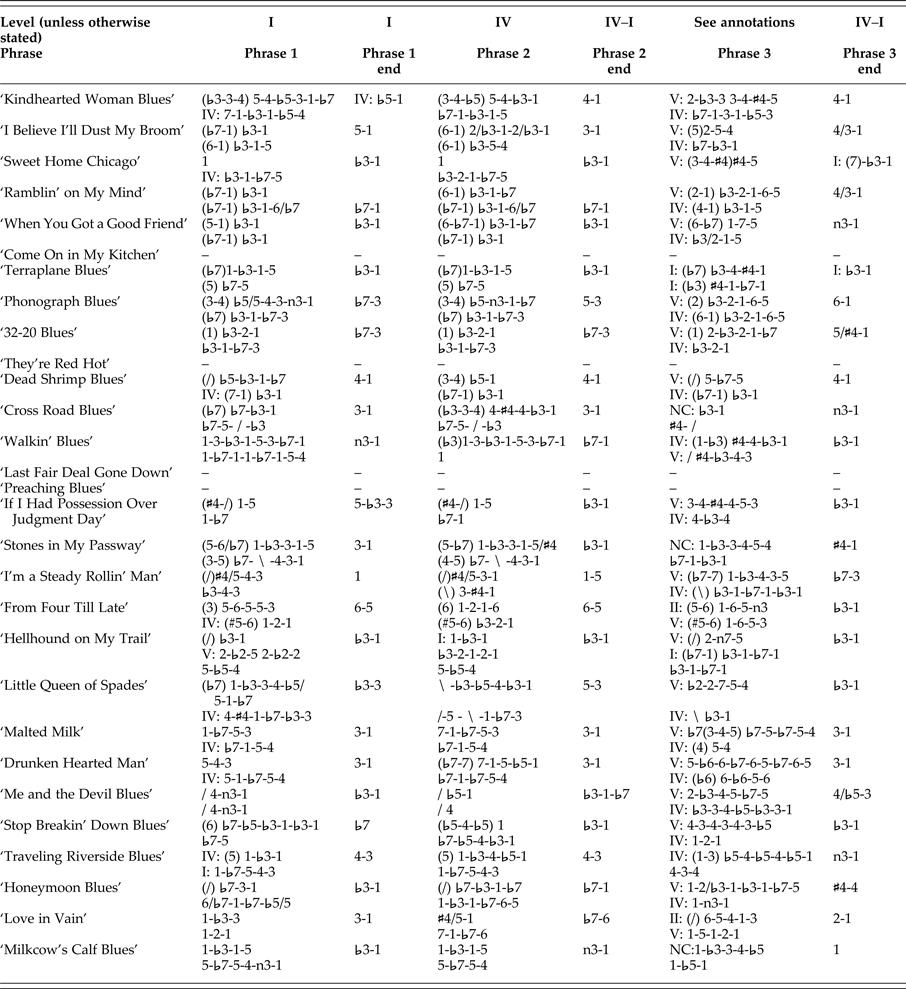
Scale degrees used in the first verse of Johnson's 12-bar blues recordings.

In this paper I too develop a theory of the blues that engages music-theoretical ideas and models that have grown out of traditional Western musicology. I also, not unlike Stoia, draw on recent developments in the analysis of classical music. One key proposal in this regard is that neo-Riemannian theory provides certain advantages in theorising blues harmony, giving points of contact with the work of Guy Capuzzo on pop-rock music (Reference Capuzzo2004) and jazz (2006). Despite this reliance upon recent music-theoretical technologies I have endeavoured to develop an approach that pays close attention to the concerns and insights of some of the most prominent figures in blues scholarship, Jeff Todd Titon, David Evans and, in particular, Gerhard Kubik. All have a background in ethnomusicology and have shown a deep appreciation of the issues raised by Weisethaunet. All three have shown a willingness to engage the blues using aspects of Western notation and analysis, and their work is carefully qualified in this regard. The work of Kubik, in particular, provides insight into ways of avoiding the rigid grid-like thinking that characterises equal temperament and Western rhythmic notion when theorising the blues, and his innovations in this area form a key point of reference for the ideas I set out. I have also drawn on Peter van der Merwe's influential book, The Origin of the Popular Style. Van der Merwe's hypothesis that the blues can be fruitfully conceived in relation to a ladder of thirds, which is also picked up in Stoia's recent articles, is an important point and goes some way towards explaining the efficacy I claim for neo-Riemannian theory in addressing the blues.Footnote 6
This paper focuses on a relatively small set of recordings, those of Robert Johnson made in the 1930s. While it is recognised that the blues is a diverse and complex field of study that cannot be reduced to a single figure, it is also surely the case that the recordings of Robert Johnson have been some of the most influential of all blues musicians', and this alone makes his music a better candidate than most in the extrapolation of a broadly applicable theory of the blues. Furthermore, Johnson's carefully thought out arrangements and perfectionism, it has been argued, suggest an attitude to the creation and recording of music that sits more comfortably with the idea of the fixed ‘work’, thereby leaving his music better suited to detailed analysis – or at least less easily misrepresented.Footnote 7 More generally (and perhaps more personally), this paper develops from a belief that the blues, in the hands of Robert Johnson, is a sophisticated and highly integrated music and that to understand it more fully we need to think in fresh ways about its music-theoretical underpinnings. Johnson's music articulates solidified approaches to formal patterns but, at the same time, has a high level of chromaticism and pitch nuance that highlights the inadequacy of certain assumptions about blues music. For these reasons Johnson's blues recordings serve as the primary point of reference in developing the theories that follow. It is hoped that what is lost by limiting the number of blues recordings considered will, at least partly, be balanced by the insights gained into this extraordinary body of blues recordings.
Approaches to the ‘blue note’
The complexities of understanding so-called ‘blue notes’ from a (Western) music-theoretical standpoint have been recognised by writers for many years. Indeed, in certain respects the issues raised by Weisethaunet have been a primary concern for blues scholarship throughout the 20th century. It is somewhat ironic, then, that so much blues music-theoretical scholarship since Weisethaunet's article has done so little to engage these complexities.
The complex issue of how to understand the blue note is negotiated insightfully as early as 1926 by Abe Niles in his critical commentary for Handy's Blues: An Anthology (Handy Reference Handy1972[1926]). Niles describes the blue note as the ‘typical slurring of the third note of the scale, which was a peculiarity of Negro folk singing generally’, noting later that the ‘seventh is similarly treated, though to a lesser extent’.Footnote 8 The difficulties faced by a theoretical tradition premised on the notating of music is addressed more directly when Niles states that ‘[o]ne cannot reproduce on paper what a Bessie Smith would do to this [blue third] note’ (in Handy Reference Handy1972[1926], pp. 27–8). Niles' notion of a tendency to ‘worry’ the variable third degree of the scale is also useful, albeit unhelpfully explained in terms of ‘the untrained Negro voice’.
Other key texts that provide insight into blue notes and their place in a larger scale pattern include Winthrop Sargeant's Jazz: Hot and Hybrid (Reference Sargeant1959[1946]) and Jeff Todd Titon's Early Downhome Blues A Musical and Cultural Analysis (Reference Titon1994[1977]). Sargeant draws on Niles and despite certain problematic racial undertones shows some sensitivity to the potential problems of a wholesale application of Western musicological models to the blues. In discussing blues notes in ‘dirty’ hot jazz he states that:
Notes are ‘worried’ and twisted from their normal intonation, and a number of purely Negroid scalar characteristics enter into the scheme. The result is a more authentically ‘African’ type of utterance, an utterance quite consistent in its own structural peculiarities, and one whose scalar relations may be traced […] deeply into the well-spring of racial musical habit.
That we can speak of a purely Negroid music scale in this connection there can be no doubt. However related to European equivalents, the pentatonic, major, minor ‘gypsy’ [harmonic minor with an additional raised fourth] and other scales of sweet and published Negro music may be, there is no European precedent for the system of intonations to which these passages of hot jazz respond. (Sargeant Reference Sargeant1959[1946], p. 158)
We begin to see here how questions concerning the inadequacy of Western music theory for the blues can become intertwined with questions as to whether and to what extent distinctive practices in the blues should be explained with reference to African models.Footnote 9 The interaction of these issues will be a feature of a number of the points addressed in this paper.
Jeff Todd Titon's work is still some of the most systematic in the field of blues scholarship. Titon adds an additional layer of sophistication to our conception of blue notes by suggesting that it is not only the case that notes around a third, fifth or seventh above the tonic might be slurred or ‘worried’, but that any articulation of these scale degrees might be better conceived as one of a number of distinct possibilities. This leads Titon to propose the model in Figure 1, where we conceive the third, fifth and seventh not as single scale degrees but as three complexes of pitches. (The numbers below each note head indicate the number of times these pitches are counted within a body of blues songs analysed by Titon.)
Jeff Todd Titon's downhome blues scale.
David Evans' study of the folk blues, Big Road Blues, is similar to Titon's work in the scale of its achievement. It, like Titon's, is a work of ethnomusicology and although there is a less overt engagement with the blues in music-theoretical terms, Evans offers many insights. With regard to the blues scale he gives a more flexible conception. For the variable third and seventh degrees he suggests the term area or tonal area, and encourages the notion of a neutral third to be understood in these loose terms:
Often the major, minor, and neutral third or seventh are all used in the same performance. In fact, ‘neutral’ probably would best represent an area between major and minor where notes can be sung, rather than any specific point between them. (Evans Reference Evans1982, p. 24; original emphasis)
Evans also accepts that there may be an area around the fifth scale degree but notes further that he has heard ‘several folk singers regularly use pitches between the major sixth and minor seventh and between the major second and the minor third.’ (Evans Reference Evans1982, p. 25).Footnote 10 Similarly, Evans makes a case for a more flexible conception of the number of degrees in a blues scale. The blues scale could be regarded as pentatonic, hexatonic, heptatonic or octatonic depending on what is left in or out in any performance and on how one conceives the tonal areas. This leads Evans to call for a pluralistic understanding, suggesting that ‘there is no single “blues scale” but many blues scales’ (Evans Reference Evans1982, p. 24).
Evans' work provides, I think, one of the most useful accounts of variable pitch content in the blues and gives some indication of the melodic tendencies of blues scale components – although this is more thoroughly worked through in Titon's study. The theories I develop in the next two sections of this paper pay close attention to the variability of pitch content in the blues system while proposing further ways of understanding its coherence and logic.
Ladder and level
The work of Evans and Titon is insightful and important, but both writers have stopped short of proposing a systematic means of rethinking the theoretical underpinning of the blues. There are, of course, advantages to such an approach and Evans' pragmatic but subtle way of addressing theoretical questions is clearly a virtue. In this paper, however, I will build more directly on the work of two scholars who do offer a more fundamental rethinking of music-theoretical models for the blues. These are Gerhard Kubik and Peter van der Merwe.Footnote 11
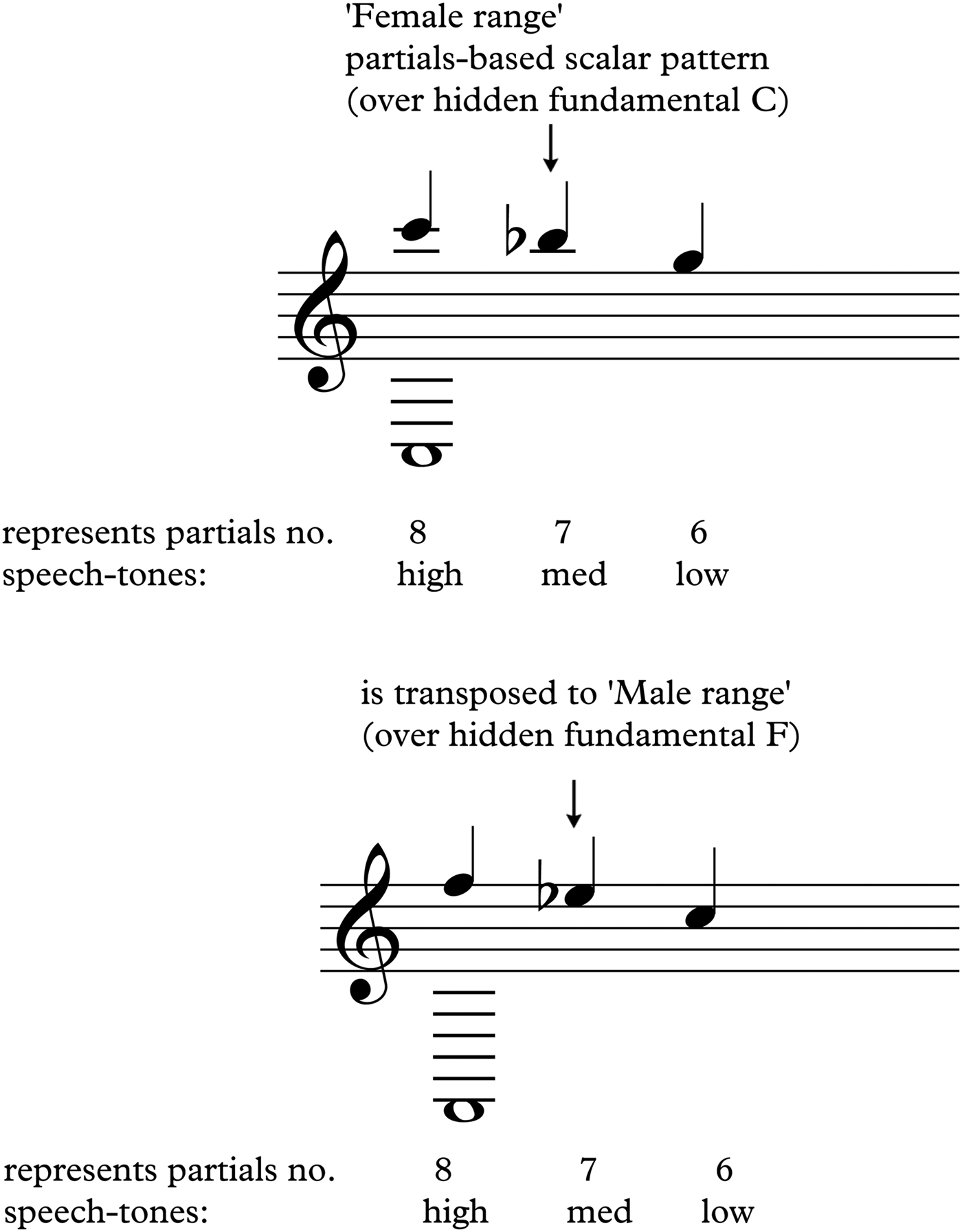
Kubik's book Africa and the Blues contains a fascinating chapter concerning the blues system.Footnote 12 In it, Kubik considers how the blues scale might relate to practices he observed in the west central Sudanic belt in which two Kutin musicians performed on two double bells. Kubik argues that the bells had been manufactured so that each reflects one of two adjoining ranges a fifth apart. If for the first double bell the lowest note were C, this would give the range C up to F and, directly above that, the range G up to C for the second double bell. When these ranges are articulated by voices (possibly male and female, respectively) they may be filled out, in accordance with the harmonic series, with E♭ and B♭ respectively (see Figure 2).
Kubik's simple model of harmonics-based scalar patterns that provide a framework for much solo vocal music in west central Sudan.
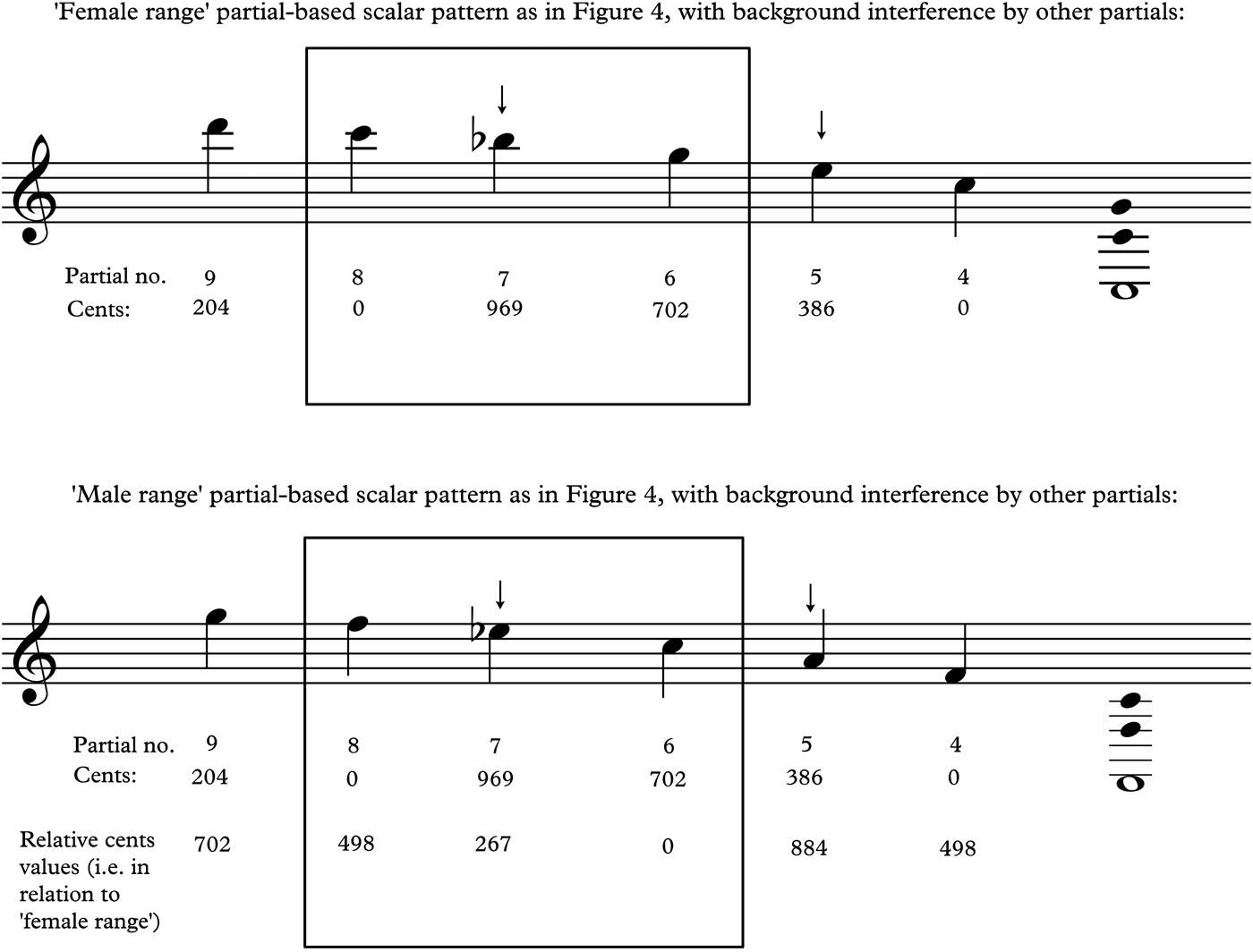
Further filling out of notes derived from the harmonic series gives the notes (F-C)-F-A-C-E♭-F-G for the first range and for the second (C-G)-C-E♭-G-B-C-D (see Figure 3). The combination of these two ranges gives what Kubik terms an integrated model that ‘encompasses the melodic repertoire of the blues’. A further important point is that Kubik insists we recognise a fundamental difference between equally tempered instances of these pitches and instances derived from the harmonic series, which involves considerable discrepancies that he indicates by cents – a practice adopted in places in this paper.Footnote 13
Kubik's more detailed model of partial-based scalar patterns.
The scalar model Kubik posits is not unlike that of other theorists, but the amount of detail given and his means of explaining its development is original and compelling. His notion of two ranges also has important harmonic implications. Kubik suggests that each range has a different fundamental: F and C in the example diagrammed above. The upper range is given greater primacy by Kubik with the lower range being conceived as a transposition, down a fifth, of the upper range. This gives us a quite different way of conceiving harmonic contrast in the blues. Rather than thinking in terms of contrasting major triads, we have the notion of two contrasting ranges that overlap/interlock. This approach to the blues leads Kubik to give an explanation for the importance of the subdominant in the blues. In listing the benefits of his model he notes that it explains ‘why in many blues accompanied with Western chords, the progression from tonic to subdominant is taken with ease, but the dominant is often avoided, circumscribed, or totally neglected’ (Kubik Reference Kubik1999, p. 142). In what follows, I suggest that what is usually termed chord V is important in the music of Robert Johnson, but I will theorise this notion of the chord to bring it into closer accord with Kubik's contrasting ranges.
Kubik's notion of overlapping and interlocking ranges can be usefully compared with the claim of Peter van der Merwe, in Origins of the Popular Style, that the blues system is based around a ladder of thirds,Footnote 14 and indeed in presenting his related notion of levels van de Merwe cites Kubik's work on the ‘Harp music of the Azande’ (van der Merwe, p. 209, n. 6).
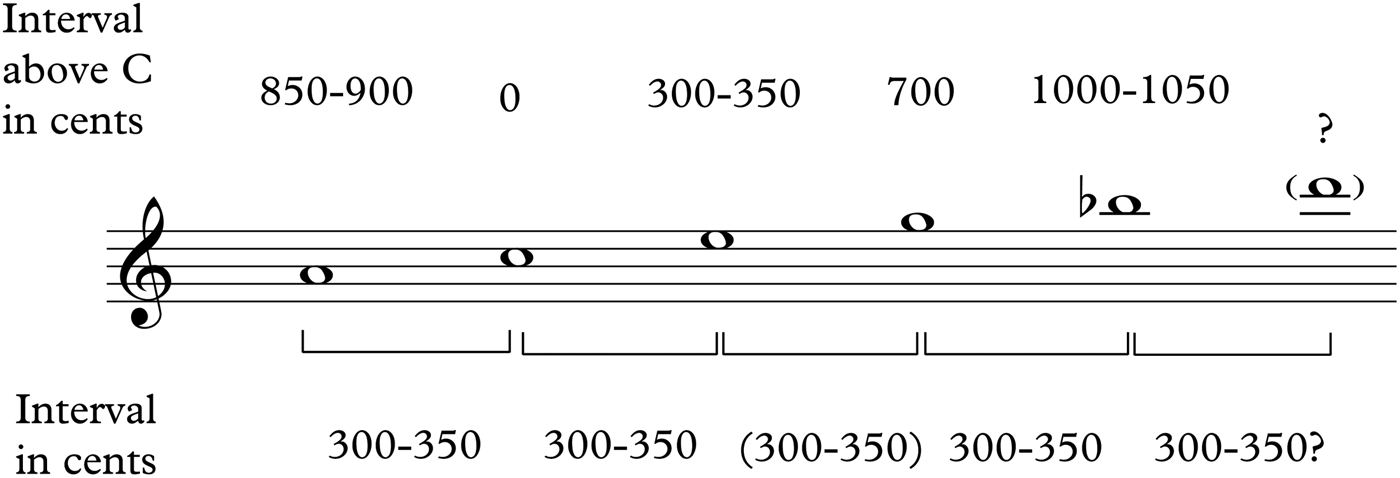
In outlining the ladder of thirds, van der Merwe first emphasises the importance of the minor third in forming the basis of the blues system. However, he goes on to point out that this third can vary between a minor and a neutral third (an interval that can, in this context, be taken to be approximately half-way between an equally tempered major and minor third). One way to map this out is to assume that a note a fifth above the tonic note will be very close to that found in equally tempered systems, a point suggested by van der Merwe's notation. I have attempted to formalise van der Merwe's model in Figure 4.
Diagrammatic account of van de Merwe's model notion of the ladder of thirds in blues music.
The question marks and parentheses in Figure 4 indicate certain ambiguities in van der Merwe's description of the ladder of thirds. The parenthesised 300–350, for example, indicates the uncertainty around this interval because if the G in the model were approximately a perfect fifth (equally tempered or justly intoned) above the tonic (C in this instance), then both the interval between C and E and the interval between E and G would need to be around 350 cents. Neither interval could drop below this (towards the interval of a minor third) in the manner van der Merwe suggests without the other interval becoming greater than a neutral third.Footnote 15 It is also unclear whether the D at the top of the ladder occurs or whether a return to C is intended as the ladder extends. I would suggest the latter, as van der Merwe considers notes between these thirds as passing notes and C is unlikely to be regarded as a passing note in this context.
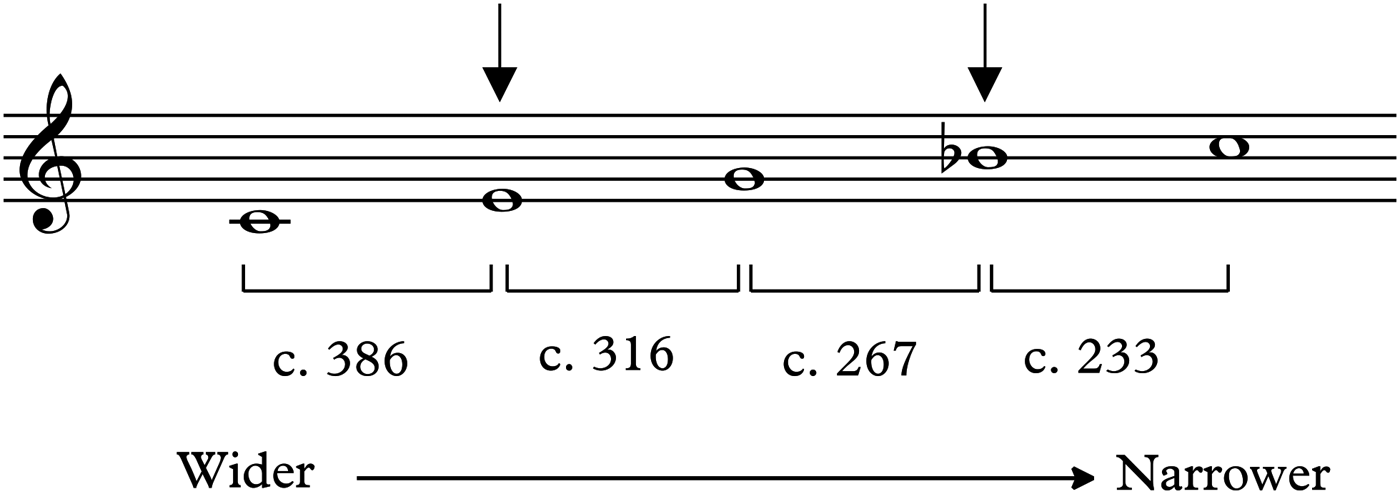
These points are addressed if we devise a model that takes account of the use of intervals derived from the harmonic series as in Kubik's work. This model is given in Figure 5. Whereas van der Merwe suggests an interval of a third somewhere between a minor third (300 cents) and neutral third (350 cents), another model that retains the notion of a ladder of thirds might outline a basic patterning that involves a gradually reducing interval between each third in line with the intervals proposed in Kubik's integrated model of the melodic repertoire of the blues. The use of Kubik's model, in this way, means that the underlying logic of the model derives from the harmonic series, and involves, therefore, an increase by the same number of Hz each time you move up the ladder.Footnote 16
The ladder of thirds adapted in accordance with Kubik's partial-based model bringing it in line with the logic of the harmonic series. Arrows indicate flatness in relation to equal temperament.
The logic of narrowing thirds needs to be conceived flexibly in relation to melodic practice because the tendency to articulate intervals close to 300 cents (the equally tempered minor third), highlighted by van der Merwe, is common. Or, to put this in Kubik's terms, the interval between G and B♭ in Figure 5 when transposed down a fifth forms a far narrower interval between C and E♭.Footnote 17 For Kubik the ‘E-386 and E[♭]-267 constitute a frame. They are marginal values. The blue note will fluctuate with more frequency between these two borderline values’ (Kubik Reference Kubik1999, p. 139). Further insight on this point is found in Titon because his account of the preponderance of melodic pitches in the blues suggests that while ♭3 (E♭) and 7 (B) do occur, the more common pitches are 3 (E) and ♭7 (B♭).Footnote 18 Another significant point with the model in Figure 5 is that the interval of 233 cents between B♭ and the C above it can be conceived as a species of third that has a logical relationship with the intervals forming other parts of the ladder because it shares an identical value when each interval is measured in Hz. Because the model in Figure 5 follows the logic of the harmonic series, the pitches scored as C, E G, B♭ and C could have the following Hz values respectively: 260, 325, 390, 455 and 520. In each case the interval between each rung of the ladder is 65 Hz.
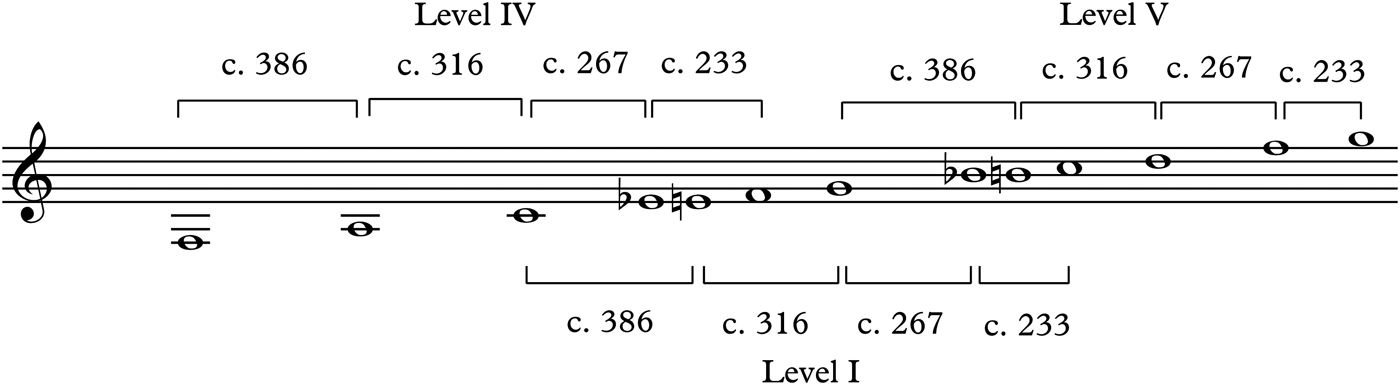
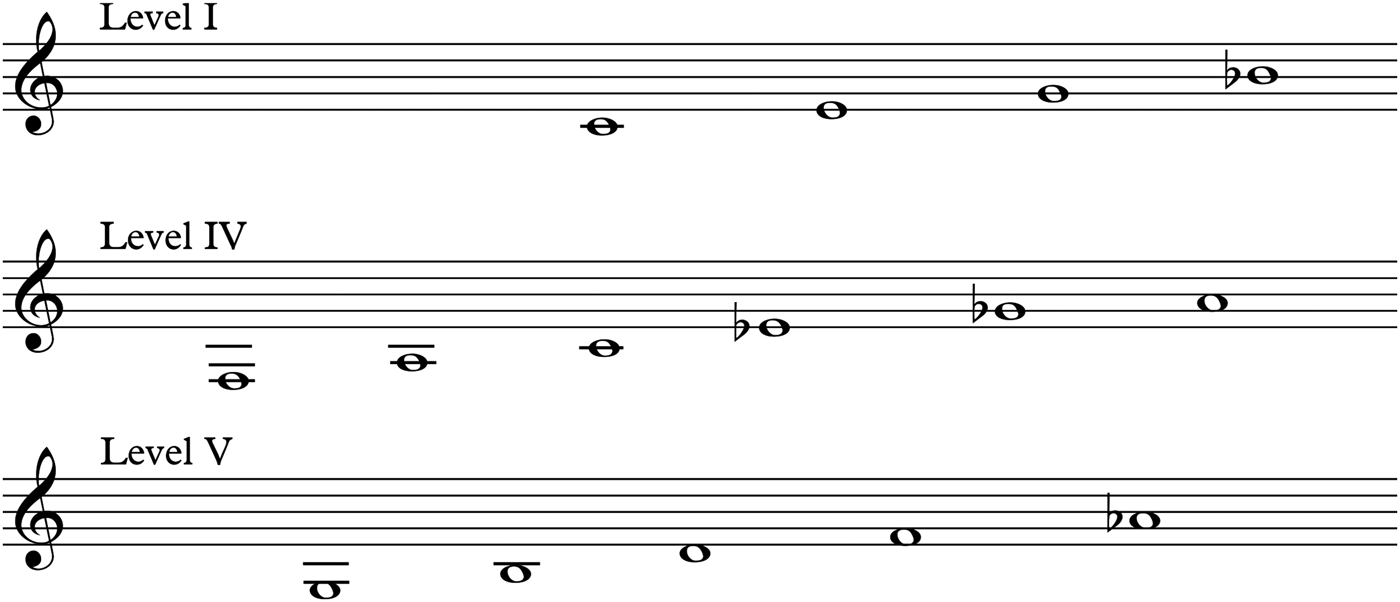
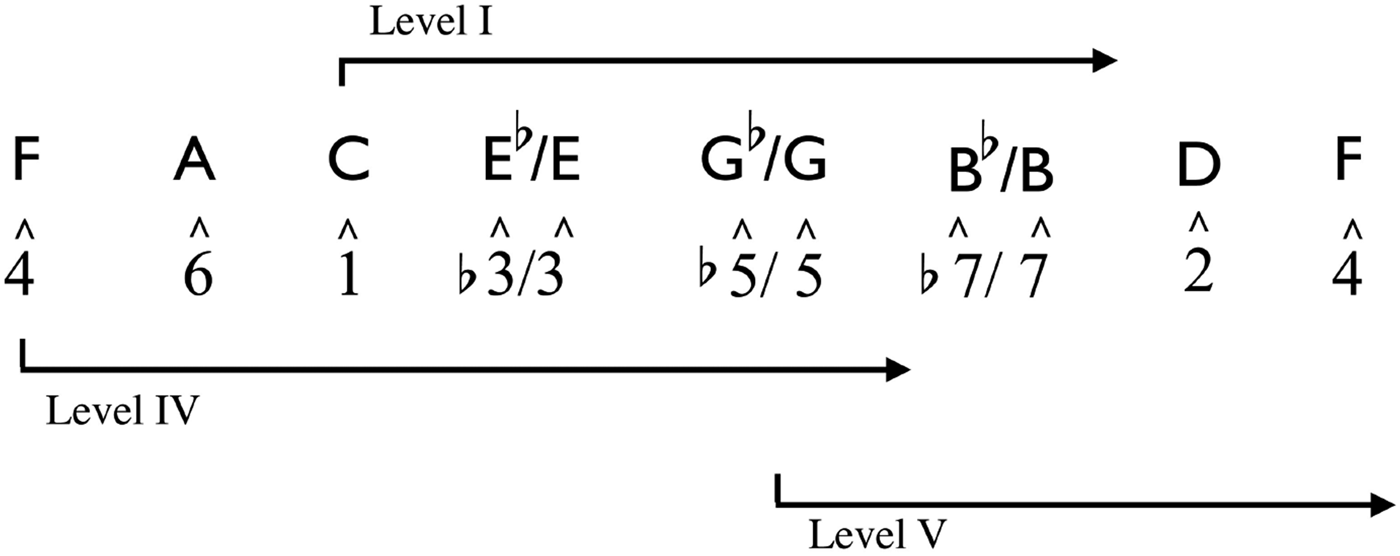
For the purposes of this section of this paper, the more vital point to derive from van der Merwe's ladder of thirds, adapted here in line with Kubik's insights on cent values, is that it allows us to conceive the harmonic resources of the blues without resorting to the logic of the extended Western triad. The seventh of the chord can now be conceived as part of the basic framework of the blues and not as a colouring or extension of Western primary chords. Similarly, the notion of levels found in both Kubik and van der Merwe helps us to rethink the idea of a progression involving chords I, IV and V (Figure 6).
Levels I, IV and V construed in accordance with the partial-based model in Figure 5 above.
The changes in the blues can be thought of as changes of level. The ladder of thirds can be transposed/extended downwards to form what is usually construed as IV7 or transposed/extended upwards to form what is usually construed as V7.Footnote 19 Important here is the interchangeability of the notions of transposition and extension. The reconfiguring of the pattern of thirds, such that the wider-to-narrower patterning is reapplied, creates a shift close to the Western notion of transposition. However, the variability of notes within the ladder of thirds at any given point (despite the wider-to-narrower tendency) means that any such transposition can also be construed as an extension of the same ladder.
This last point goes a considerable way towards explaining why the melody and harmony of the blues are often construed as somehow independent of one another. A shift in level is, in some ways, more fundamental than a chord progression because it implies the transposition of the microtonal framework in Figure 5. However, the flexibility of this framework also allows for extensive overlap between levels so that levels I and IV, in particular, will often be articulated with/through the same melodic material – a point to be considered in more detail later.
The move towards conceiving the blues system as governed by ladders of variable but generally decreasing third-like intervals will provide a useful means to approach the music of Robert Johnson. Similarly important, if not more important, however, for an understanding of Johnson's music is the role of chromaticism, and it is to this area that we now turn.
Chromatic cycle
Chromatic, stepwise, descending melodic motion is very common in much blues music. As we will see, it is an important feature of Robert Johnson's songs. It is also important in the music of blues artists who began recording before Johnson such as Leroy Carr and Kokomo Arnold. These chromatic motions and the harmonies they create or imply are often taken to be rooted in Western harmonic practices despite their importance in African American musics. This assumption is perhaps reinforced further by the role of descending chromatic motions in articulating one of the most characteristic features of ragtime – the so-called ragtime progression (see Example 1), because it appears to articulate more clearly than other African American idioms a goal-directed motion through the cycle of fifths. We will begin by looking at ragtime before focusing upon a related African American tradition that might also be said to feed into the blues.
The ‘ragtime’ progression in C.
In Origins of the Popular Style, Van der Merwe handles this area in a chapter entitled ‘Parlour harmony’ and begins with a somewhat extreme claim that, while veiled with a modicum of rhetorical distance, highlights the kinds of problems that are liable to arise when assuming a predominantly European origin, especially when framed as ‘high-cultured’ European origin, for important aspects of vernacular musics:
The old libel about popular composers using worn-out cast-offs of their musical betters comes closest to the truth with harmony. In the nineteenth and early twentieth centuries, at any rate, popular harmony is usually an echo of what serious composers had been doing several decades before. The lush Romantic chromaticism of the years between 1830 and 1850 took half a century to reappear in parlour ballads of the 80s and 90s, just as in the next century, Impressionist harmonies turn up a few decades later in jazz.Footnote 20 (van der Merwe Reference van der Merwe1989, p. 243)
Van der Merwe goes on to cite the beginning of Liszt's ‘Liebestraum’, No. III, which is structured around the cycle of fifths progression (III7–VI7–II7–V7–I, i.e. the progression outlined in Example 1), and appears to view this work as evidence for the claim above in stating that this pattern ‘was to become a great favourite in the popular music of about half a century later, not only in the parlour style but in ragtime as well’ (van de Merwe Reference van der Merwe1989, p. 251).Footnote 21 This point, that ragtime is demonstrably derived from European traditions, is not easily dismissed. Stearns' view on this matter is not entirely implausible, despite what I would read as some problematic racial undertones:
Ragtime represents a deeper and more complete blending of West African and European musical elements, with a greater borrowing from the European, than anything that had gone before. It is no accident that ragtime originated in the Midwest and not in New Orleans, and that there were first-class white as well as Negro composers and performers. The greatest of them all, Scott Joplin, who happened to be a Negro, studied classical music long and well, as the form of ragtime attests. (Stearns Reference Stearns1956, pp. 140–1)
It may be, then, that there are clear factors pointing to the importance of a European tradition in the formation of ragtime; furthermore the ragtime progression itself may indeed map quite comfortably onto a progression commonly deployed in the classical tradition since the baroque era. However, more recent scholarship has suggested that the role of the piano and the classical tradition may have been overemphasised in the development of ragtime. Gage Averill, in his authoritative work in this area, begins to suggest a somewhat different picture when he states that ‘[c]ontrary to the Joplincentric theories of a few years back, ragtime was probably very much a vocal as well as an instrumental form, developing in the “sporting” districts of Mississippi River cities’ (Averill Reference Averill2003, p. 54).Footnote 22 It seems fair, then, to develop an understanding of the chromaticism of this progression from another perspective, one which emphasises the importance of African American musics in its formation and logic.Footnote 23
Averill's study concerns barbershop harmony and it is work in this area that I will consider in exploring the African American origins of chromatic blues harmony. Following Lynn Abbott's ground-breaking article of 1992 entitled ‘“Play that barber shop chord”: a case for the African American origin of barbershop harmony’ (Abbott Reference Abbott1992), some interest has developed in recognising the African American origins of barbershop harmonic patterns, which, of course, are often characterised by chromatic motions, including the ragtime progression. In 2000 Jim Henry completed a PhD thesis on barbershop that looked to map the detail of early barbershop recordings and arrangements onto African American idioms. The thesis contains a plethora of useful examples and, in addressing the assumption that the ragtime progression is fundamentally European, invites a less essentialist and more syncretic account of barbershop harmony in relation to African American musical practices.
An important initial point here is that the so-called ‘barbershop seventh’ can be understood to be approximated in equal temperament by a dominant seventh chord, which, in this context, is probably better termed a major minor seventh chord. As Averill notes, barbershop singers have (at least since the 1940s) self-consciously tuned the major minor seventh chord to achieve a highly resonant effect, a practice known as ‘ringing’ chords. This barbershop seventh or ‘meat ’n' taters chord' is formed when the fundamental of each voice is an integer multiple of a given frequency, thereby reflecting the logic of the harmonic series (Averill Reference Averill2003, pp. 163–4).Footnote 24 This is precisely the logic of each of the levels outlined in Figure 6. The apparent complexity of the different cent values belies the fact that each pitch, in the case of, say, level I, will be a consistent value in Hz (say, 65) above the note below it in that level. This point may lead us to doubt whether the use of major minor seventh chords is necessarily or even primarily the result of European influence.
Of course, in the ragtime progression it is not only the deployment of major minor seventh chords that might lead us to assume a European origin; it is the root movements of a fifth, in particular, that seem to derive from European models. But if we consider Figure 6 again in the context of Kubik's claims concerning fifth-related regions, could not this root movement be adequately explained from an African American perspective? Henry suggests some useful backup in this area when he points out that, although there are many examples of the ragtime progression in barbershop, the progression IV7–I7 is also very common, as is the tendency to conclude the ragtime progression with I7 (Henry Reference Henry2000, pp.179 ff.).Footnote 25 Such harmonic patterns are not at all common within the classical European tradition but might be considered a logical outcome from the notions of level and ladder developed in this paper.
It would, of course, be wrong to suggest that chromatic motions articulating a cycle of fifths do not draw on European habits at all. Equal temperament, it seems to me, has played an important role in the development of African American musics, and ragtime in particular often exhibits the pull of tritone action that is particularly characteristic of Western tonal discourse. Having said this, recent scholarship on barbershop and the notions of ladder, level and cycle explored here may help us recognise more fully the syncretic origins of African American harmonic practices.Footnote 26 We perhaps need to consider a reversal of emphasis that is comparable to that suggested by Kubik with regard to blue notes and the notion of inflection:
In the literature blue notes have been described as a ‘microtonal lowering of the 3rd, 7th and (to a lesser extent) 5th scale degrees’ […], and various theories for their origin have been proposed […], all proceeding from the standpoint that the blue notes are ‘derivations’ or ‘inflections’ of the standard pitches (i.e. European diatonicism) […].
However, we who have worked in African cultures with the most diverse tonal systems cannot help but see the ‘inflections’ on the other side. (Kubik Reference Kubik1999, p. 118)
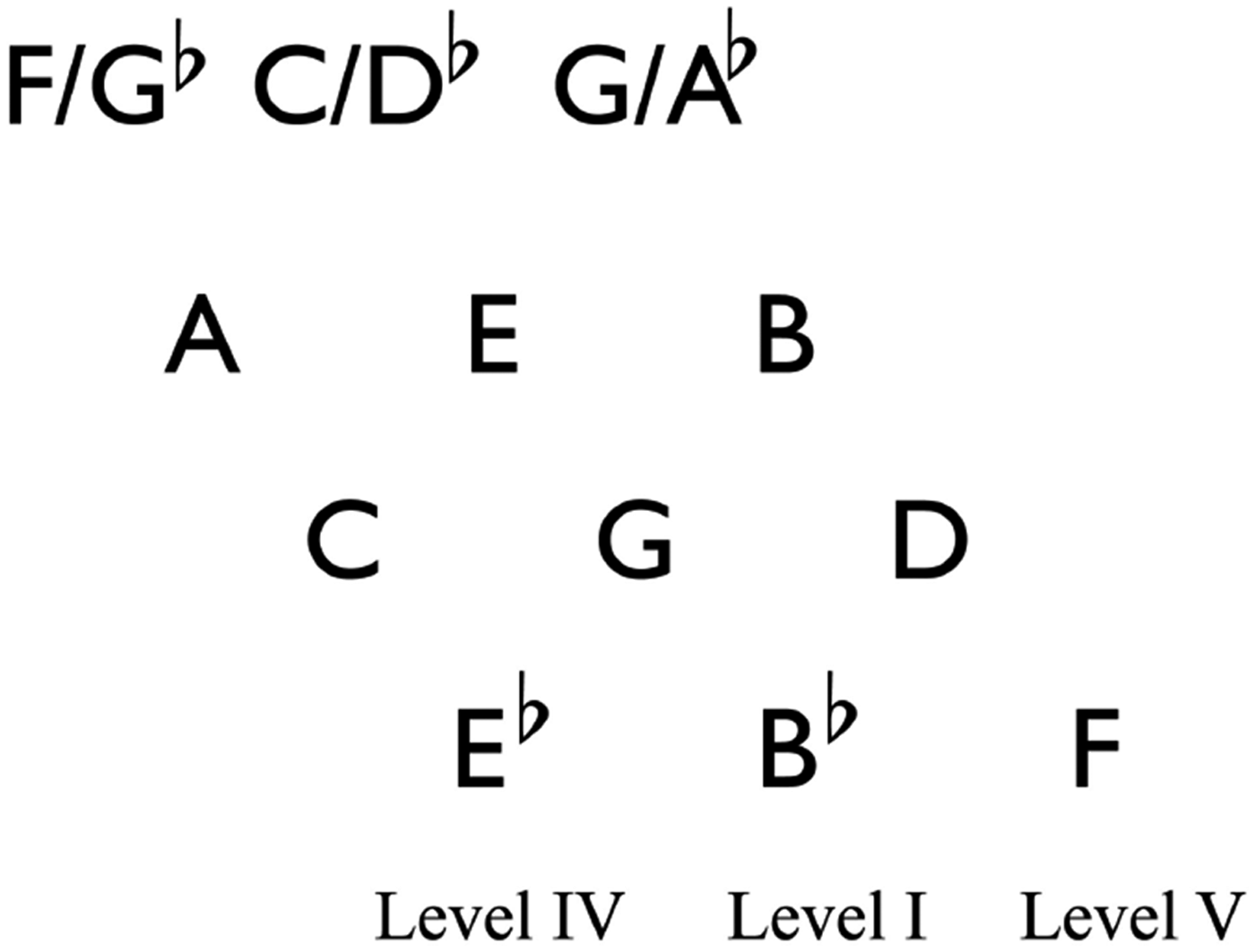
Just as blue notes can be taken as an integrated and logical extension of African musics, it strikes me that the manipulation of tonal space articulated in certain chromatic motions can be considered an integrated and logical extension of the African American musics that developed through the 19th century. To develop this point further, consider the network formed by the levels introduced earlier in Figure 6 as they appear in Figure 7.
Simple notated pitch network of levels I, IV and V.
The pitches given in Figure 7 are conceived in closer accord with equal temperament. Thus, each level is not so readily bound by the logic of interval increases of a fixed number of Hz and a diminishing number of cents (as was the case in Figure 6). Instead, the logic of equal temperament has become more conspicuous and the majority of intervals now conform to a fixed number of cents – 300 cents or an equally tempered minor third. This results in the addition of a minor ninth above what we might term the root of the level, and generates a matrix of possible chromatic motions when moving between levels I, IV and V (e.g. B♭–A–A♭ when moving down through the notes on the far right of the network).
Similarly, common chromatic progressions can be discerned from this network, such as the descending diminished chords that are characteristic of barbershop, the music of Johnson and, what van der Merwe terms, parlour music.
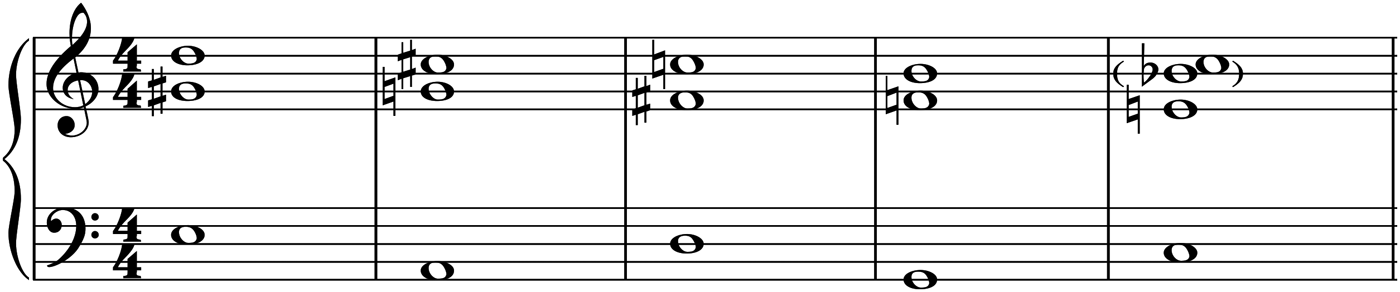
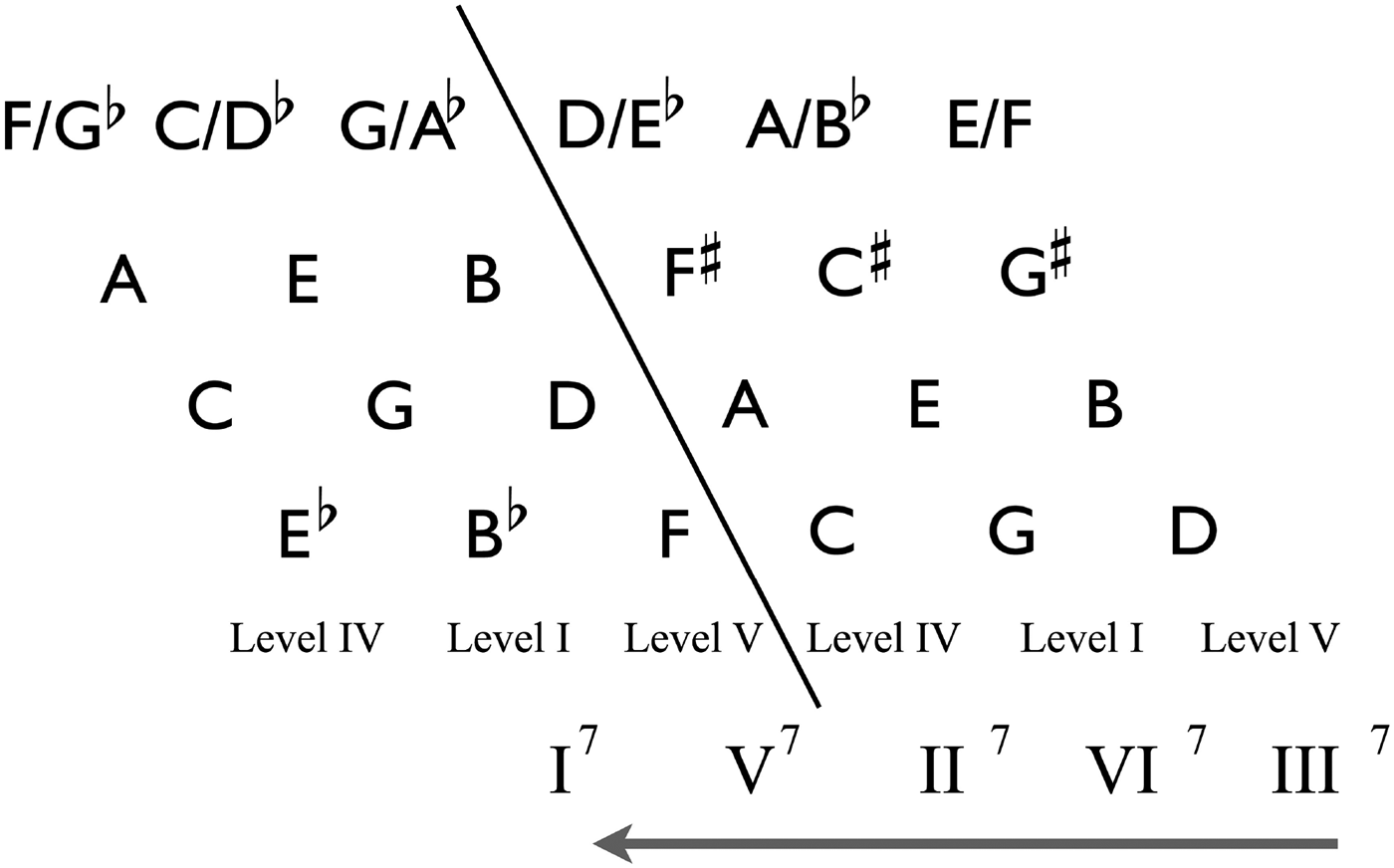
The chromatic motion of the chord E-G-B♭ moving through two other diminished chords to C-E-G in the last bar of Example 2 can be diagrammed on the notated network as shown in Figure 8.Footnote 27 Note also the way in which level V cycles back to level I.
Simple notated pitch network of levels I, IV and V with dotted arrows to indicate chromatic motions between levels.
‘Ain't You Coming Back to Old New Hampshire’.
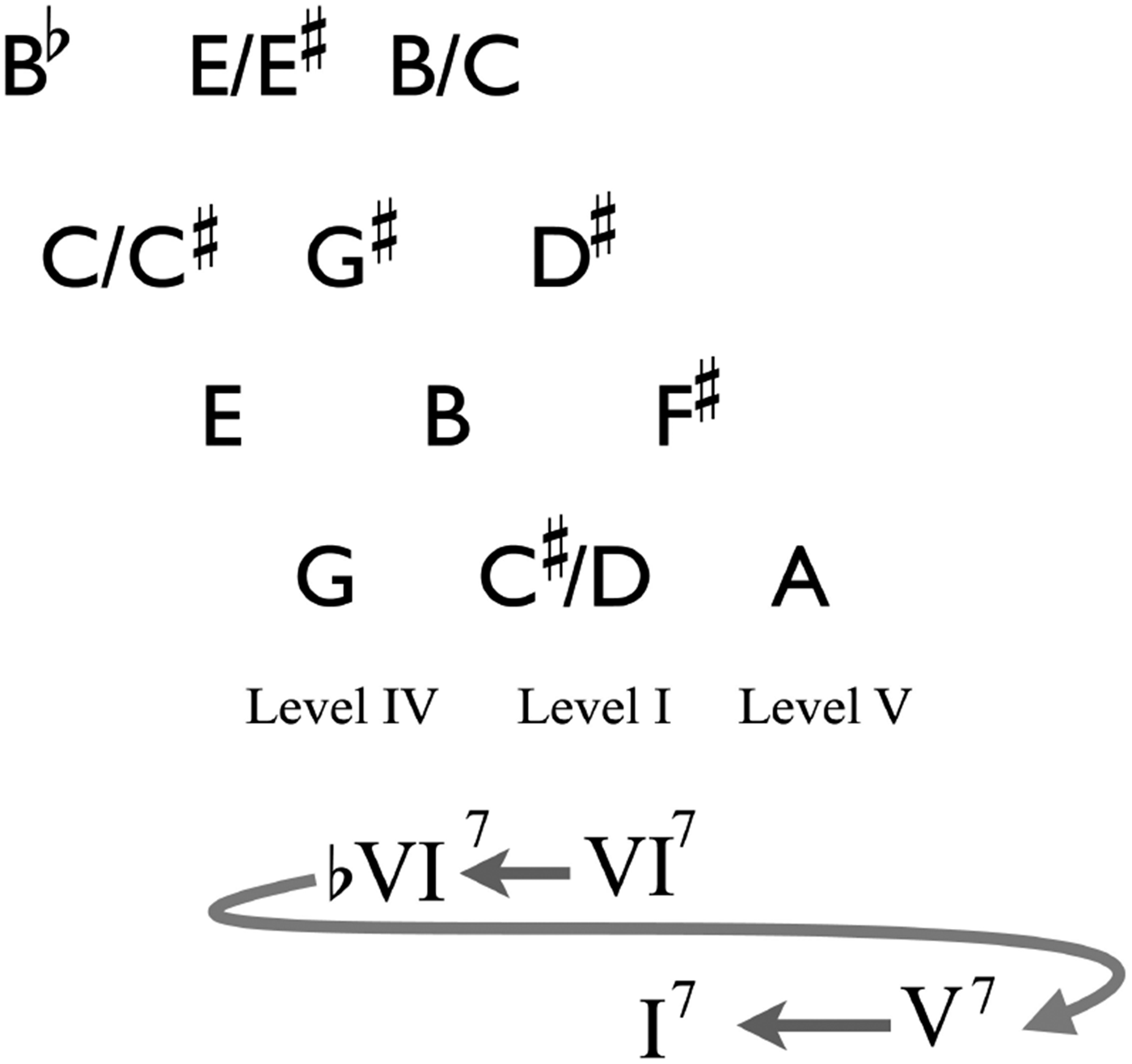
Now that equal-temperament has become a governing principle of this network it seems a reasonable step to bring it in line with a network that has come to dominate much thinking around triadic but chromatic music, that is, the Tonnetz, so often encountered in neo-Riemannian theory. This allows us to explain more readily further chromatic motions. Figure 9 presents a portion of the Tonnetz.Footnote 28 It is the same pitch network given in Figure 8 but the minor ninth above the root now appears in each level. When it appears it is given next to the ‘root’ of the ladder to indicate the way in which an ambiguity is formed around these points of the ladder on each level. That is to say, the sense of ladder is maintained on each level but, in order to achieve a fit between equal-temperament and the basic ladder model with narrowing interval structure outlined in Figure 5, the ‘root’ and minor ninth above it can be construed as two possible options in articulating a single rung of the ladder.
Pitch network of levels I, IV and V now presented in accordance with the patterning of the Tonnetz with root/minor ninth given as interchangeable options in each level.
Removing the roots from the network in Figure 9 gives the full chromatic,Footnote 29 where each diagonal can be conceived as forming a circle. Thus the diagonal for each level (southeast to northwest) constitutes a diminished seventh chord cycle, and the each cycle running between levels (southwest to northeast) constitutes an augmented chord.
The so-called ragtime progression can now be explained by shifting the root/minor ninth ambiguity to a different rung of the ladder as shown in Figure 10.
The ragtime progression as a consequence of movement through the pitch network in which minor-ninth/root substitution is shifted systematically.
The line running diagonally through the middle of the network indicates the way in which the levels loop back on themselves to articulate a cycling motion. Thus the progression III7–VI7–II7–V7–I7 can be construed as running through levels V, I and IV, back around to V and then closing on I. Cycling in this direction around the network is common, but it is important to note that the standard blues chord changes put as much emphasis upon cycling in the opposite direction, and to note again Henry's observation that IV7 to I7 is similarly common in the closely related musical tradition of barbershop.
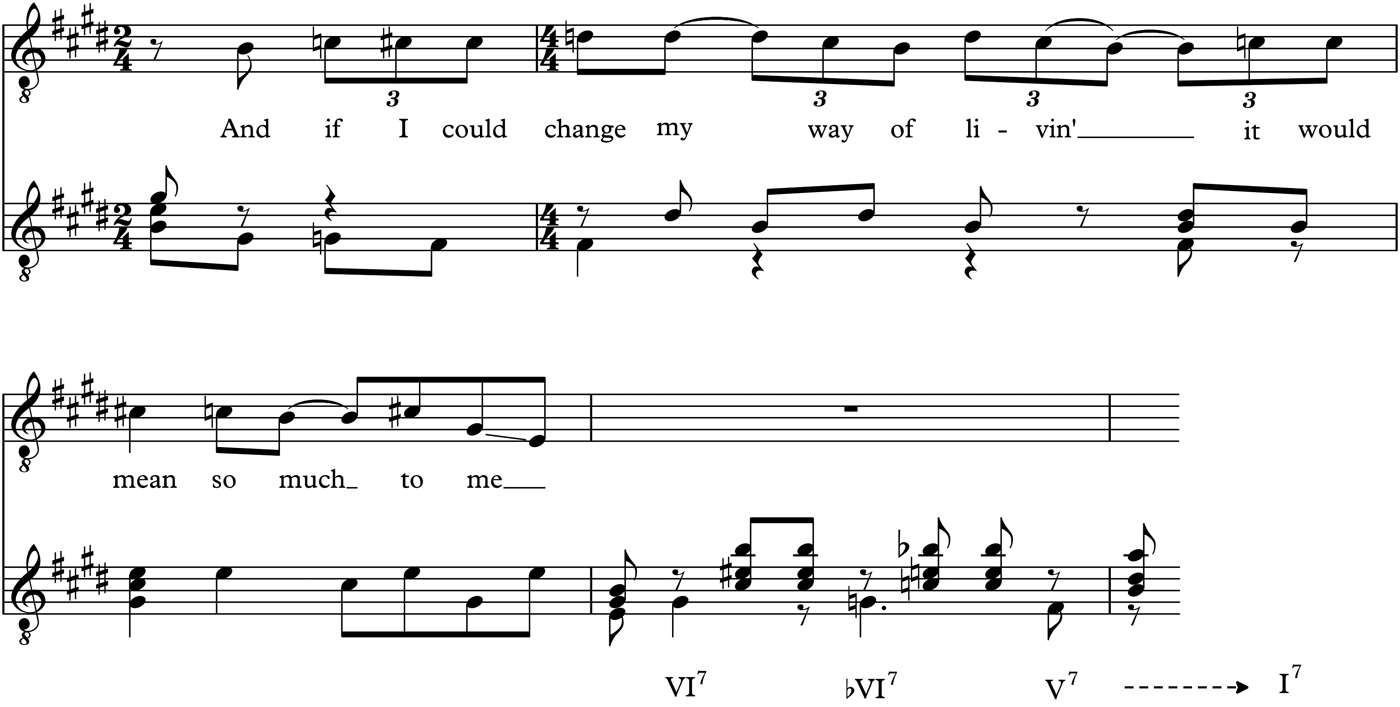
The theory of a shifting root/minor ninth ambiguity also helps us to explain other chromatic motions found in the blues such as that sounding at the end of each verse of Robert Johnson's ‘Drunken Hearted Man’, where a major minor seventh on VI simply slips down by half steps, through ♭VI7, to V7. A simple harmonic idea, but one that sounds thoroughly integrated with Johnson's harmonic palette as a whole (see Example 3 and Figure 11).
The chromatic progression at the end of each verse of ‘Drunken Hearted Man’ as cycling motion through the pitch network, now in E.
Transcription of Robert Johnson's ‘Drunken Hearted Man’, end of verse 1.
Viewed in terms of a cycling around a network derived directly from the laddered levels of the blues, chromatic motions no longer appear as a European superimposition on ‘more African’ aspects of blues practices. Instead, these chromatic cycles can be understood as a logical outgrowth from African and African American traditions. Such growth, it seems to me, derives in part from the use of equally tempered instruments and the kinds of musical thinking this entails, but it is also a growth that has its own internal logic and recognising this point helps us to appreciate more fully the integrity and sophistication of this rich and highly influential music. The notions of level, ladder and chromatic cycle developed in this survey of blues theory will allow us further insight into the music of Robert Johnson.
The music of Robert Johnson
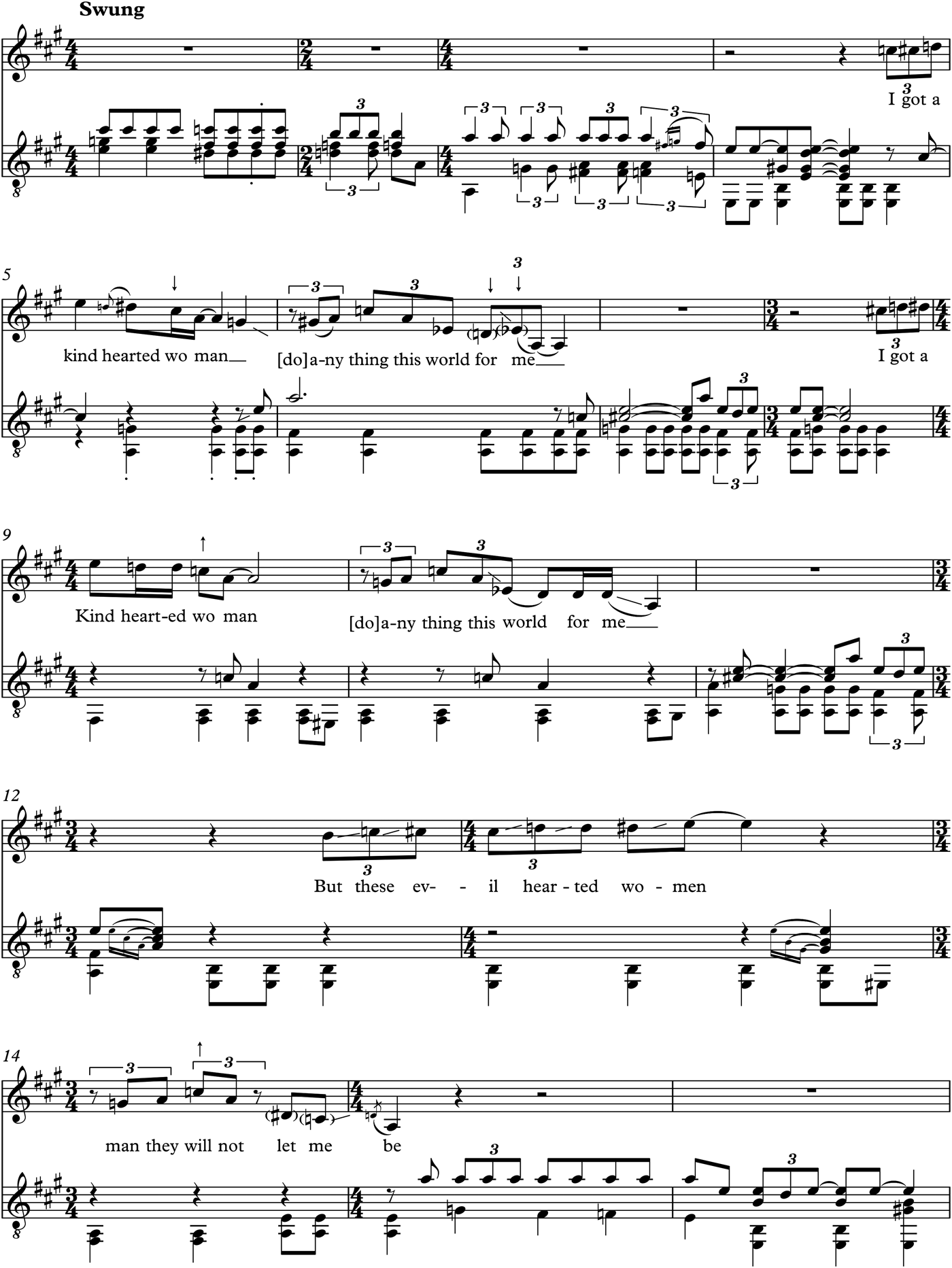
The first sounds committed to record by Robert Johnson form a series of diminished seventh chords performed effortlessly by shifting a fixed handshape down the guitar fretboard (Example 4, bars 1 and 2). This use of a ‘moveable fingering position’ is highlighted by David Evans as a ‘particularly interesting’ feature of the music of Mott Willis (Evans Reference Evans1982, p. 204), and Evans goes on to point out its use by a number of other prominent folk blues musicians, such as Charley Patton, Tommy Johnson and Willie Brown, as well as Robert Johnson (Evans Reference Evans1982, p. 248).
Transcription of Robert Johnson's ‘Kindhearted Woman’ (version originally released), introduction and verse 1.
This figure appears in seven of Johnson's 29 recordings. The harmonic patterning it exhibits is precisely that already cited in the last bar of Example 2 (‘Ain't You Coming Back to Old New Hampshire’) and explicated in terms of ladder, level and cycle in Figure 8. The harmonic process instantiated in this succession of chords is also suggested by an even more common figure in Johnson's recordings, the figure shown in bar 3 of Example 4. This figure, with slight variation, is deployed in all of Johnson's recordings with the exception of ‘They're Red Hot’ – a song that is formed around the ragtime progression and which is not, as such, a blues.Footnote 30
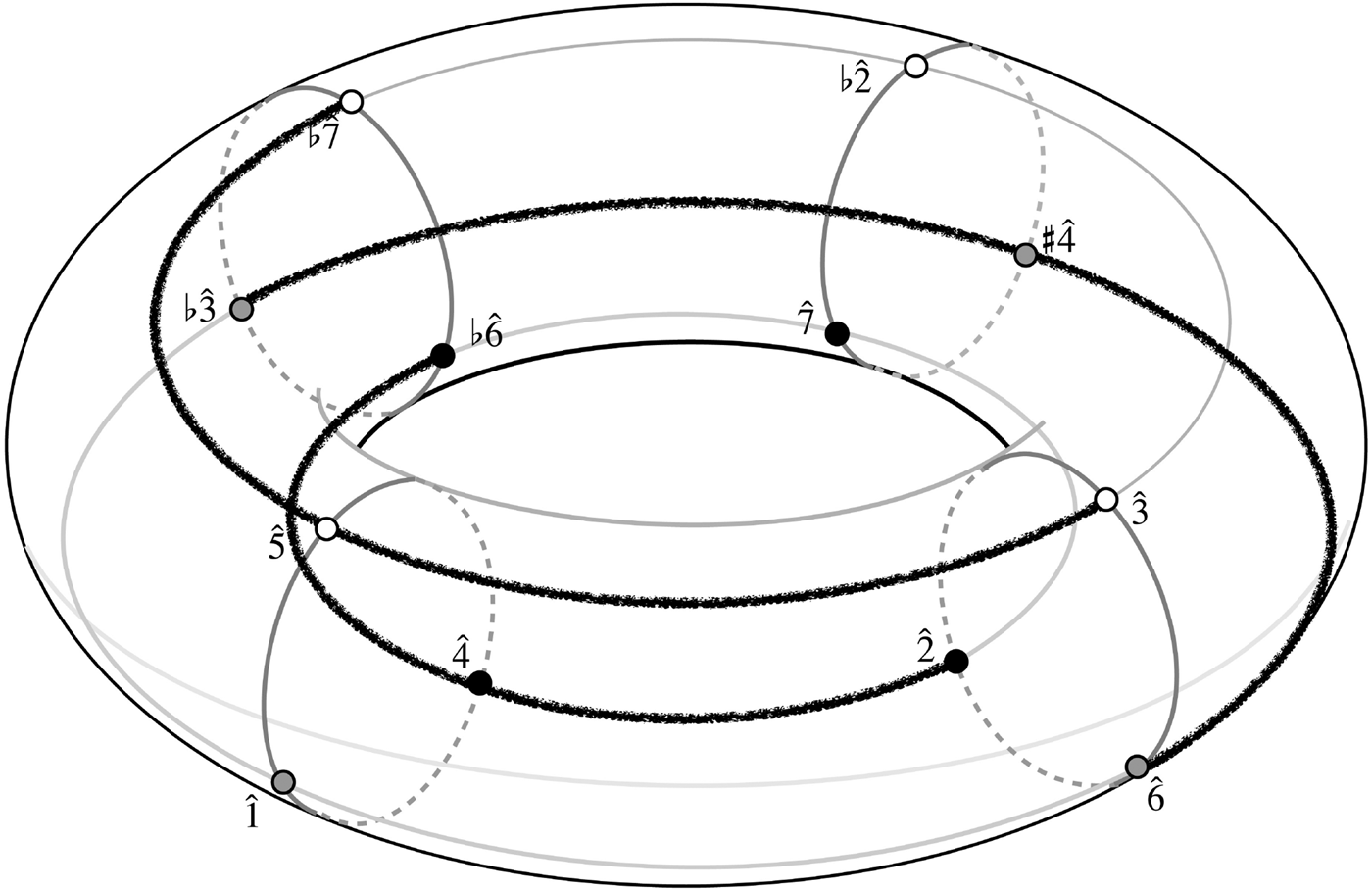
It is important, I think, to emphasise the sense of cycling that the opening harmonic succession articulates in relation to the tonal space of equal temperament. This point is addressed by considering the way in which the diagonals in Figure 9 loop around to form rings. We can diagram this more explicitly if we present the chromatic network as points on a hypertorus. In Figure 12, the diagonals of Figure 9 have become rings with the diagonal for each level (the diminished seventh chords) on the horizontal plane and the diagonal running between levels (the augmented triads) on the vertical plane. Letter names for notes are now replaced by scale-degree numbers as Example 4 is in A. The succession that opens ‘Kindhearted Woman’ can now be diagrammed so as to demonstrate the way it cycles around on both planes simultaneously. This is indicated by the fuzzy black semi-circular lines in Figure 12. The diagram presents the succession as starting at the top of the hypertorus; it then cycles around 180 degrees on the horizontal plane and, simultaneously 120 degrees on the vertical plane to give the line on the outer surface of the torus. The same cycling process then gives the line on the inner surface of the torus. Recognising this patterning offers important insight into the elegance of the musical logic Johnson deploys and helps us to draw out the powerful sense of cycling that characterises so much of his music.
Chromatic pitch network forming a hypertorus with cycling process of diminished chords that open ‘Kindhearted Woman’ indicated by fuzzy black semi-circular lines.
Elijah Wald, in discussing the recurrent use of this chromatic figure in Johnson's music, suggests that its ubiquity may have had a commercial function comparable to a ‘similar mannerism’ in the music of Peetie Wheatstraw. The use of the same idea at the beginning of different songs meant that ‘fans could instantly recognise his records, and this would have obvious advantages when it came to selling new material’ (Wald Reference Wald2004, p. 141).
Wald is probably right on this point, but I think it is also important to recognise the function of this idea in relation to musical structure. Johnson deploys two musical ideas at the beginning of ‘Kindhearted Woman’ and other tracks as a means of mapping out tonal space, that is, as a means of drawing a set of musical relationships, the logic of which can be most effectively demonstrated in the spatial terms set out in Figure 12. The declamatory manner in which Johnson executes this mapping at the start of his songs is significant, as is his command of a sophisticated treatment of tonal space that, as I have demonstrated, is deeply rooted in African American musical traditions.
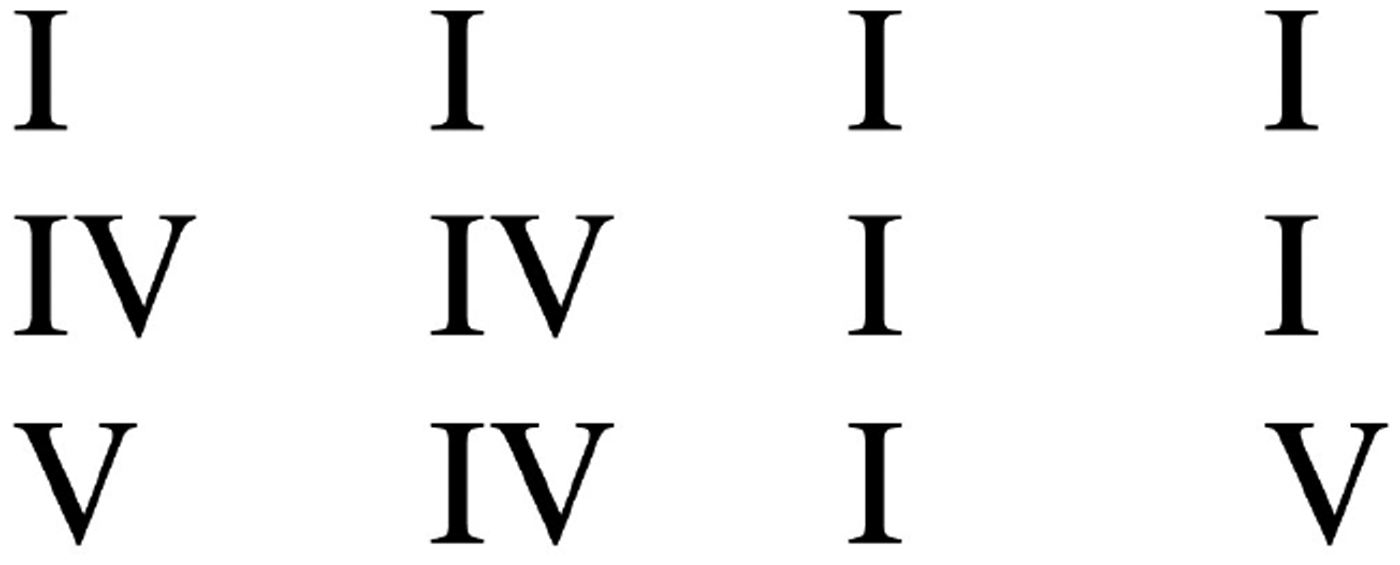
The large-scale harmonic structure in Johnson's blues songs follow, more or less closely, the 12-bar blues pattern that became one of the most common (if not the most common) in the decades that followed . It differs a little from the pattern Stoia gives as the ‘Standard 12-bar Blues’ in that bar 12 is articulated by level V and bar 10 is articulated by level IV (Stoia Reference Stoia2010, para 3). Johnson will sometimes substitute I for IV in bar 2 as he does in the first verse but not subsequent verses of ‘Kindhearted Woman’.Footnote 31 The most common succession for Johnson is given in Figure 13.
The large-scale harmonic structure favoured by Johnson in most of his blues recordings.
In conceiving what are usually termed the ‘chords of the blues’ as levels, we are better equipped to recognise the cycling quality of the structure as a whole. Once we understand the circular patterning of both the levels themselves and the way in which they relate to each other (a point drawn out in Figure 12), we can recognise the balanced cycling pattern of the large-scale structure Johnson favours in his blues recordings.
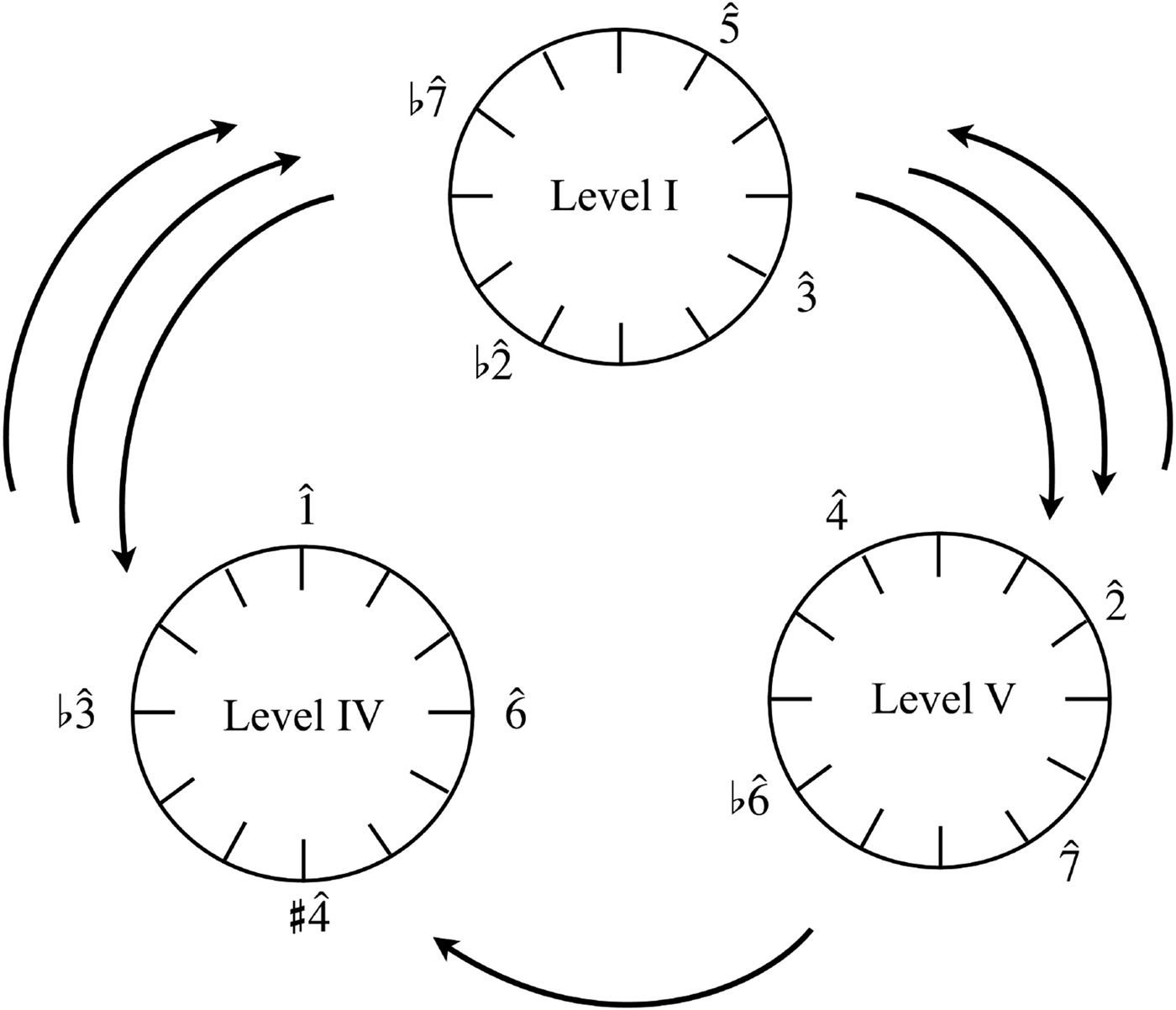
Representing this cycling pattern using a single hypertorus, as in Figure 12, is difficult to achieve. A simpler two-dimensional approach is appropriate here. Figure 14 presents each level on a circle with the levels themselves also arranged in a circle. Johnson's most common approach to the 12-bar pattern can now be seen to involve a balanced set of movements, back, forth and around tonal space.
Diagram of large-scale structure of 12-bar blues succession favoured by Johnson with two-dimensional circles indicating planes of the hypertorus.
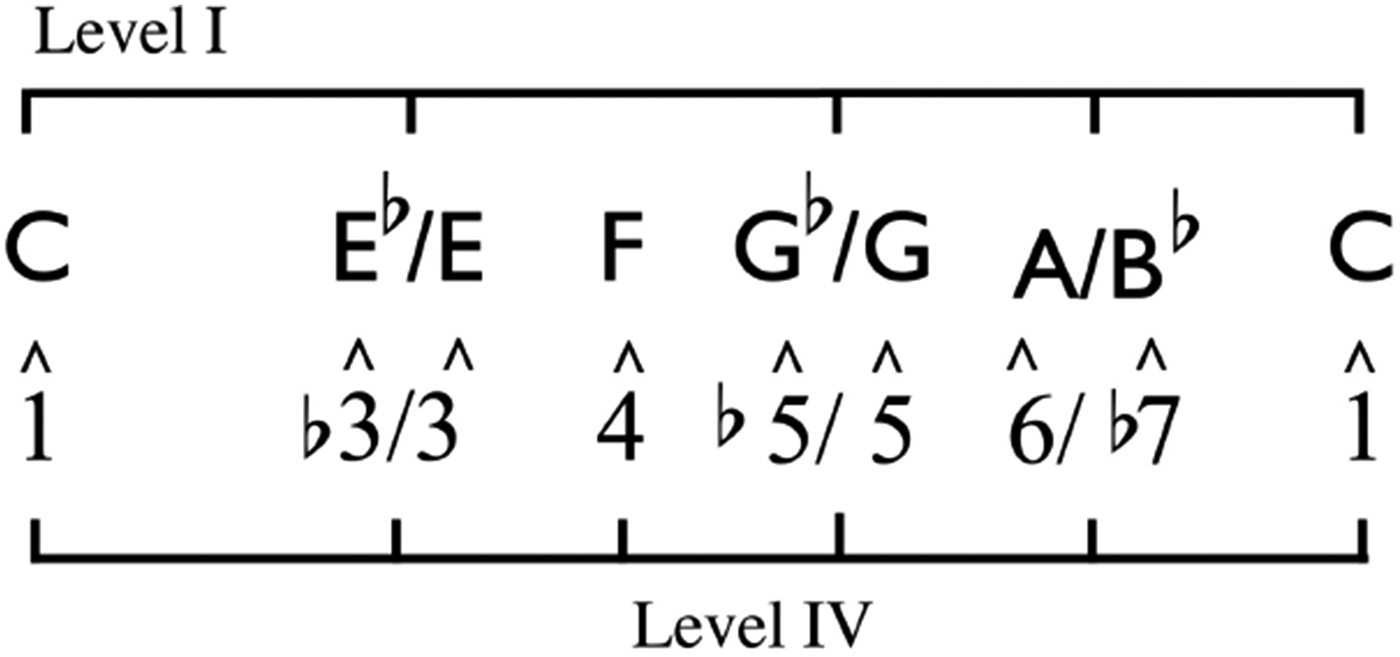
The levels of the blues interlock to form a network (Figures 9–11) and overlap to form a series (Figures 8 and 15). The former reflects an emphasis on equal temperament, with greater fixation of pitch allowing chromatic movement between levels, while the latter reflects an emphasis on the harmonic series with differing pitches between levels, resulting in a framing of tonal areas around ♭3/3, ♭5/5 and ♭7/7.Footnote 32 I will draw on Titon's terminology in calling these areas the 3 complex, the 5 complex and the ♭7 complex.
Levels I, IV and V of the blues as an overlapping series.
Whereas the network of interlocking levels of the blues is more pertinent to a theory of Robert Johnson's blues accompaniments, particularly those accompaniments that do not use slide guitar, the series of overlapping levels is more useful to an understanding of the vocal melodies of Johnson's recordings.
Table 1 outlines the scale degrees used in the first verse of all of Johnson's blues recordings that follow more or less closely the pattern of level changes set out in Figure 13. The scale degree in all cases is a simplified representation of the micro-tonally detailed workings of Johnson's voice. When I have found it impossible to summarise a given vocal articulation, I have resorted to showing the general direction of travel of the voice using ‘/’ for motion generally upwards and ‘\’ for motion generally downwards. When Johnson's voice is pitched such that it is particularly difficult to decide between two scale degrees I have given both degrees, e.g. ♭5/5. Neutral thirds above the tonic are given as ‘n3’ and the one scale degree I analyse in terms of neutral third above the dominant is given as n7. Parenthesised scale degrees indicate an anacrusic rhythmic quality. Songs that do not follow a 12-bar blues pattern of some sort have not been detailed and alternative takes are also not included.
It is often claimed that the melody and accompaniment of the blues tend towards independence.Footnote 33 There is undoubtedly some truth in this claim. Stoia has highlighted a good number of blues recordings where vocals and accompaniment can be usefully theorised as articulating contrasting levels simultaneously or, to use Stoia's preferred term, as articulating contrasting modes simultaneously. However, in understanding Robert Johnson's music, Middleton's point that ‘[♭]lues melody is harmonically conscious to the extent that it usually fits the chord when it is first sounded’ should be given special emphasis and perhaps even expanded because, in the music of Johnson at least, there is usually a sense of a single level for both voice and guitar at any given point in his songs (Middleton Reference Middleton1972, p. 36).
A tendency to hear and conceive blues melodic and harmonic material as independent comes, primarily, from a tendency for blues musicians to derive the second four-bar phrase of the vocal from the first. In articulating these two phrases, Johnson most commonly deploys scale degrees that comfortably overlap between the levels, that is, scale degrees 1, ♭3, n3 and 3. The data in Table 1 suggest that 1 appears slightly more often than the 3 complex, and that within that complex ♭3 occurs a little more often than 3. n3 is less common, although such labels are not straightforward to apply as much depends on how one summarises and differentiates the pitch motions within a given complex.
The next most common occurrence is the 5 complex with 5 far more common than ♭5 and ♯4.Footnote 34 This complex can still be considered part of level IV, however, when scale degrees are subjected to what might be described as the loosening effect of level overlap. Consider, for example, the first phrase of ‘Kindhearted Woman’, which begins with 5 (discarding anacrusic elements). When a shift of level occurs in the fifth bar of the verse (bar 9 of Example 4) we can recognise a process whereby melody and harmony articulate level IV with the level slightly reconfigured to accommodate the reuse of 5 in the vocal melody, thereby forming the ladder 6, 1, ♭3, 5, instead of the 1, ♭3, ♭5 (with 6 implied) that is heard in bar 1.Footnote 35 It is notable that this prominent use of 5 in the opening of both phrases one and two is not representative of Johnson's recordings. The vast majority of first verses with closely related first and second phrases start with 1 or the 3 complex – the two entities that sit most comfortably within levels I and IV. Despite this stretching of level IV in ‘Kindhearted Woman’, there are other points in that song when the vocal melody and accompaniment clearly articulate level IV as it is outlined in Figure 9. This is the case in the second bar of the first verse of ‘Kind-Hearted Woman’ (bar 6 of Example 4), with the scale degrees 4, 6, 1, ♭3 and ♭5 all articulated.
♭7 is also a common occurrence during the first two lines of Johnson's 12-bar recordings and, like 5, this scale degree might be considered to lie outside level IV. However, when ♭7 is sounded over level IV it might be conceived as a further extension of this level. Such an argument might be taken to stretch level IV so far across the ladder of thirds that the distinction between levels is drawn into question but, before rejecting this proposal altogether, consider a number of related points regarding the use of ♭7. First, ♭7 is rarely given a structurally prominent position over level IV. Table 1 shows three verses that begin with ♭7 (ignoring anacrusic melodic elements), but in these verses the second line is usually altered so that a scale degree that sits more comfortably within level IV is deployed (‘Cross Road Blues’ and ‘Stop Breakin’ Down Blues'). Johnson's ‘Honeymoon Blues’ does begin lines one and two with what might be interpreted as ♭7, but it is notable that this scale degree, when articulated over IV for the second line, is characterised by a glissando up and gives the impression of straining to 1; thus Ainslee and Whitehall's very careful transcriptions of Johnson's melody give 1 as the first structurally significant scale degree of phrase two (Ainslee and Whitehall Reference Ainslee and Whitehall1992, p. 113). Similarly, when, in Johnson's recordings, ♭7 occurs over I for the first phrase, it may be reinterpreted as 6, as is the case for the anacrusis of phrases one and two of ‘I Believe I'll Dust my Broom’ and ‘Rambling on my Mind’. This interchangeability of 6 and ♭7 does not only derive from the differing harmonic contexts, it is also part of a broader tendency in the blues to use interchangeably the different third intervals outlined in Figure 5 as well as gradations between these. This is not only the case between 1 and the rung of the ladder above it, but also between 1 and the rung below it as well as other third intervals (e.g. 5 to ♭7). The narrowest third in Figure 5 is actually closest to an equally tempered major second and thus, when equal temperament becomes a factor (as it does in most instrumentally accompanied songs), the interval between ♭7 and 1 can be conceived as a narrower version of the interval between 6 and 1.
When 6 and ♭7 are conceived as two versions of the same rung of the ladder, and the 5 complex is recognised as an extension of level IV, we can stipulate the ladder in Figure 16. This accounts for almost all of the vocal material in phrases one and two of the songs outlined in Table 1.
Level I and IV with ambiguity between 6 and ♭7 now emphasised.
It is important to note that this theoretical ladder does not allow any note to be considered part of any level. 2 occurs over level I only as what might be termed a passing note or a neighbour note. 4 also occurs over I only as a passing note and as a neighbour note. 4 can occur as a more structurally significant note over IV as in the second phrase of the first verse of Cross Road Blues.
These points regarding the melody and harmony in the first and second phrases of Johnson's blues recordings suggest that, while similar melodic resources can occur over both levels I and IV, this can be explained as much in terms of the overlap between levels as a tendency towards independence. Furthermore, these two explanations – melodic/harmonic relative independence on the one hand and overlapping levels with variable tonal areas on the other – are not necessarily contradictory and taken together may offer a fuller insight into the language of the blues.
Considering Johnson's vocal material over level V as summarised in the fifth column of Table 1 also helps us to gain a fuller understanding of vocal practices in the blues. In the first verse of ‘Kindhearted Woman’ (Example 4), for example, the voice articulates a chromatic ascent from 2 to 5. This ascent echoes the chromatic motions of the accompaniment but it also articulates 2 and 5 as structurally significant over level V. ‘Little Queen of Spades’ articulates level V more clearly in the vocal with the sounding of degrees 2–7–5 and 4. More generally, by simply scanning down the ‘Phrase 3’ column of Table 1 it is clear that 2 is a far more common pitch over level V than it is over level I or IV.
4 is also a common degree over level V in Johnson's music with Table 1 suggesting that it is more common in this context than 1. ♭7 also occurs regularly over level V, because just as 3 and ♭3 have an interchangeability over I, 7 and ♭7 have interchangeability over V. A pitch somewhere between these also occurs, as one might expect. The phrase over V in ‘Hellhound on My Trail’, for example, is summarised in Table 1 as 2-n7-5, that is, as articulating the lower portion of level V but with a neutral 7 (note that this is a summary of the pitch; as with the majority of Johnson's pitching this scale degree is dynamic in the sense that it involves sliding quickly around the tonal area in question but n7 is given as the best summary of this note).
There are instances where Johnson articulates a portion of the ladder of thirds (taken as a whole as in Figure 15) that indicate quite a strong deviation from the tendency, identified here, for voice and guitar to articulate the same level at a given point. However, the only clear instances of such a deviation, to my mind, are ‘Honeymoon Blues’ and ‘From Four Till Late’. These examples support Stoia's point that differing levels, which he terms modes, can be articulated simultaneously by melody and accompaniment (Stoia Reference Stoia2010, para 10). The general tendency in Johnson's music, however, is for voice and guitar to articulate level V together when it occurs at the first half of the third phrase of his blues recordings.
Ladder, level and cycle, then, are not only relevant to the guitar parts of Johnson's music. His vocal parts are similarly important in articulating and elaborating the complex structural patterns of his songs. This results not only from the importance of level in Johnson's vocal parts but also through the echoing of the chromatic motions that invariably open his songs through sliding with his voice within and around the tonal areas or pitch complexes that form the structural ladders of his music. Furthermore, by emphasising the overlap, rather than the interlock, of levels, Johnson's voice articulates a further dimension of pitch-space organisation that enriches his music while retaining an intense sense of integration and sophistication.
Conclusion
Ladder level and cycle, when conceived flexibly, in accordance with Kubik's insights on microtonal structure, provide a more convincing theory of blues music than those theories more thoroughly rooted in equal temperament and diatonic thinking. From the interlocking potentiality of levels we can recognise a chromatic network which maps onto a portion of the Tonnetz and which provides important insights into the chromatic and large-scale structure of Robert Johnson's songs. The potentiality of this network to be reconfigured as a series also provides an important means of theorising the subtle and complex organisation of blues melody without resorting to misleading conceptions of inflection of, or deviation from, a major-mode structural underpinning.Footnote 36
The arguments I have developed in pursuing these points have drawn on some complex music theoretical ideas that may be alienating for some readers who look to understand the blues. But while I would want to defend the need for sophisticated theory in understanding blues music, it is worth noting too that the ideas discussed in this paper are based on a quite simple conviction that the music of Robert Johnson sounds highly integrated. His music in no sense has the sound of a simple diatonic structure decorated by pitch inflection or chromatic passing notes. The chromaticism that almost invariably begins a song by Robert Johnson sets out a sophisticated understanding of musical space, and the intricate vocal lines and guitar voicings that follow explore and elaborate this space such that a strikingly balanced and integrated larger scale structure is formed. Recognition of these points can be addressed, at least in part, through a judicious use of analytical technologies as long as these technologies have sufficient flexibility and subtlety to avoid misleading reductions or generalisations.
Similarly, I would suggest that such technologies should not be taken to run contrary to the culturally informed insights of ethnographic research. By drawing certain insights from Kubik's work into a neo-Riemannian framework I hope to have gone some way towards demonstrating the complementary potential of ‘hard’ analytical and ethnomusicological approaches. It is perhaps by such means that we may yet address the issues raised by Weisethaunet without leaving ourselves unable to comment upon the details of musical structure. Music analysis certainly has the potential to misconstrue the blues, but carefully qualified music-theoretical work may yet allow us to understand and appreciate this extraordinary musical tradition more fully.