INTRODUCTION
Consumers are becoming increasingly aware of the relationship between diet and health. It is widely recognized that the saturated fatty acid (FA) content of most Western-type diets should be reduced and the polyunsaturated fatty acid (PUFA) content increased (World Health Organization (WHO) 2003). Within dietary PUFA, it is recommended that the intake of FA of the n−6 series (e.g. linoleic acid; 18:2n−6) should remain constant whilst that of the n−3 series (e.g. α-linolenic acid; 18:3n−3) and in particular the very-long-chain n−3 FA eicosapentaenoic acid (20:5n−3) and docosahexaenoic acid (22:6n−3) should be increased, as these are associated with a reduction in coronary heart disease (Department of Health 1994; Scientific Advisory Committee on Nutrition (SACN)/Committee on Toxicity (COT) 2004) and improvements in brain and visual development (Dijck-Brouwer et al. Reference Dijck-Brouwer, Hadders-Algra, Bouwstra, Decsi, Boehm, Martini, Boersma and Muskiet2005). The recommended daily intake of 20:5n−3 and 22:6n−3 is 450 mg/day (SACN/COT 2004), but intake in the UK averages 244 mg/day, a figure that falls to 113 mg/day if those who consume oily fish are excluded (Givens et al. Reference Givens, Kliem and Gibbs2006). The declining consumption of fish allied with concerns over the sustainability of fish supply result in limited opportunities to increase the intake of very-long-chain n−3 PUFA from this source (Williams & Burdge Reference Whittington, Dunn, Nute, Richardson and Wood2006). Sheep meat is characterized as having a high fat content and a low ratio of PUFA to saturated FA (P:S), although the ratio of 18:2n−6:18:3n−3, total n−6:n−3 ratio and content of very-long-chain n−3 PUFA are favourable (Enser et al. Reference Enser, Hallett, Hewitt, Fursey and Wood1996). The low P:S ratio is principally attributable to the process of biohydrogenation within the rumen. Despite the apparently negative effects of this process it is often incomplete, resulting in the production and absorption of intermediaries (e.g. trans-11 18:1 and conjugated linoleic acids (CLA)) some of which have been shown to have metabolic and health-promoting properties (Ip et al. Reference Ip, Banni, Angioni, Carta, Mcginley, Thompson, Barbano and Bauman1999; Bauman et al. Reference Bauman, Corl, Baumgard, Griinari, Garnsworthy and Wiseman2001). The objective of the present review is to summarize recent research that has been conducted with the aim of altering the FA composition of sheep meat through nutrition in order to improve its food health properties, and to discuss future areas of research.
DIETARY FA SOURCES
Dietary manipulation is the most effective means of improving the FA composition of sheep meat. Grass is a naturally rich source of 18:3n−3 with new growths of perennial ryegrass and cocksfoot having concentrations as high as 748 g/kg total FA, whilst white clover has a higher content of 18:2n−6 and lower content of 18:3n−3 than red clover (see review of Givens et al. Reference Givens, Cottrill, Davies, Lee, Mansbridge and Moss2001). The concentration of FA in grasses and legumes appears to be higher in spring than autumn, with lowest values around flowering during summer, although this may be mediated by manipulation of the cutting/grazing frequency (Dewhurst et al. Reference Dewhurst, Scollan, Lee, Ougham and Humphreys2003). Other factors that may influence the FA content and composition of grass include variety and ensiling conditions such as wilting, and additive use (Dewhurst & King Reference Dewhurst and King1998). For example, an extended wilting period prior to harvest decreased 18:3n−3 content in perennial ryegrass proportionally by 0·4, whilst shading the crop prior to cutting reduced levels by 0·28 (Dewhurst & King Reference Dewhurst and King1998). Drying and storage of forages also appears to decrease 18:3n−3 and increase 16:0, especially under conditions of high humidity (Noble Reference Noble and Christie1981). Dewhurst et al. (Reference Dewhurst, Scollan, Lee, Ougham and Humphreys2003) reviewed the process of leaf senescence and stress on changes in FA composition of grasses and concluded that selection for reduced activity of lipoxygenases and other enzyme activities (including lipases), or production of more resilient chloroplasts may provide future opportunities to reduce storage loss of PUFA. There is also evidence of quantitative trait loci in grass for concentrations of a number of FA offering the opportunity for more rapid genetic selection of FA content and profile (Dewhurst et al. Reference Dewhurst, Scollan, Lee, Ougham and Humphreys2003). Within grazing pastures, there has been recent interest in the FA profile of botanically diverse pastures such as semi-natural and alpine pastures (Ådnøy et al. Reference Ådnøy, Haug, Sørheim, Thomassen, Varszegi and Eik2005; Cabiddu et al. Reference Cabiddu, Decandia, Addis, Piredda, Pirisi and Molle2005), whose lower production may be compensated by a higher PUFA content and may be of particular interest to more extensive or organic systems of production.
Linseed is a particularly rich supplementary source of 18:3n−3, contributing over 500 g/kg of total FA (Givens et al. Reference Givens, Cottrill, Davies, Lee, Mansbridge and Moss2001). The inclusion of whole linseed compared with linseed oil has the added advantage of supplying natural anti-oxidants, although disruption of the seed coat, either physically or chemically, is generally required. Alternative vegetable oil sources such as soya, rape and sunflower are rich sources of 18:2n−6, whilst dietary sources of 20:5n−3 and 22:6n−3 include fish oils and fishmeals (Givens et al. Reference Givens, Cottrill, Davies, Lee, Mansbridge and Moss2001). The FA profiles of fish products are, in turn, dependent on the FA composition of the marine algae that they consume, which have also been used as a very-long-chain n−3 PUFA source in sheep diets (Cooper et al. Reference Cooper, Sinclair, Wilkinson, Hallett, Enser and Wood2004). Future studies should investigate the range in PUFA content and composition of different botanical species with the opportunity to select for FA profile and content as well as reduced activity of enzymes such as lipoxygenases. The impact of management techniques of forages and oil seeds on their FA profile and content also warrants further study, as does the identification of plant-based compounds that may reduce ruminal biohydrogenation of dietary PUFA.
RUMINAL BIOHYDROGENATION OF PUFA
The initial step in the ruminal biohydrogenation of dietary lipids is the hydrolysis of ester linkages by microbial lipases, as the presence of a free carboxyl group is a pre-requisite (Harfoot & Hazelwood Reference Harfoot, Hazlewood, Hobson and Stewart1997). This is then followed by isomerization and hydrogenation. Both positive and negative FA flows from the rumen have been reported; in the 91 studies summarized by Doreau & Ferlay (Reference Doreau and Ferlay1994), the majority of the negative balances were associated with diets containing more than 50 g FA/kg dry matter (DM). Negative balances have, however, been reported with dietary concentrations as low as 20 g FA/kg DM. Theoretically, dietary FA can be catabolized or absorbed across the rumen epithelium although the true extent to which these two processes occur in vivo is unclear. There is, however, ample evidence to suggest that free FA are catabolized to ketone bodies by the rumen epithelium in vitro, and Doreau & Chilliard (Reference Doreau and Chilliard1997) proposed that this oxidative catabolism of FA might be accomplished by micro-organisms that adhere to the rumen wall and derive their oxygen from epithelial cells. Absorptive losses of unesterified long-chain FA across the rumen epithelium are generally thought to be insignificant (Moore & Christie Reference Moore, Christie and Wiseman1984), as the majority of free FA are associated with particulate digesta (Harfoot et al. Reference Harfoot, Noble and Moore1973). However, Doreau & Ferlay (Reference Doreau and Ferlay1994) suggested that it is possible for significant absorption of unesterified FA to occur if large amounts of FA are available in the rumen. De novo synthesis of microbial long-chain FA may contribute up to 30 g/100 g of FA flow at the small intestine, although this process tends to diminish as the amount of exogenous lipid increases (Demeyer et al. Reference Demeyer, Henderson and Prins1978). This is due to rumen micro-organisms preferentially assimilating lipids of dietary origin at the expense of de novo synthesis, as this is an energetically more efficient strategy (Demeyer & Van Nevel Reference Demeyer and Van Nevel1995).
The level of biohydrogenation of ruminally unprotected dietary sources of 18:2n−6 and 18:3n−3 has been consistently reported to be in the region of 900–950 g/kg when determined in sheep (Wachira et al. Reference Wachira, Sinclair, Wilkinson, Hallett, Enser and Wood2000; Chikunya et al. Reference Chikunya, Demirel, Enser, Wood, Wilkinson and Sinclair2004) or in vitro (Sinclair et al. Reference Sinclair, Cooper, Chikunya, Wilkinson, Hallett, Enser and Wood2005b). Following hydrolysis, the generally accepted initial step in the biohydrogenation of 18:2n−6 is isomerization to cis-9, trans-11 CLA, although this isomer is transient and often unaffected by dietary 18:2n−6 supply (Sinclair et al. Reference Sinclair, Cooper, Chikunya, Wilkinson, Hallett, Enser and Wood2005a). Duodenal flow of trans-11 18:1 is elevated by the dietary inclusion of sources of 18:2n−6 and 18:3n−3, and may also be enhanced by the simultaneous introduction of strains of Butyrivibrio fibrisolvens and Bifidobacterium adolescentis which have a high capacity to hydrogenate 18:2n−6 to trans-11 18:1 and incorporate trans-11 18:1 respectively (Fukuda et al. Reference Fukuda, Suzuki, Murai, Asanuma and Hino2006). The implications of an enhanced duodenal flow of trans-11 18:1 on muscle FA composition will be returned to later.
There are conflicting reports in the literature on the level of ruminal biohydrogenation of 20:5n−3 and 22:6n−3. Early studies conducted in vitro (Ashes et al. Reference Ashes, Siebert, Gulati, Cuthbertson and Scott1992) concluded that there was negligible biohydrogenation of these very-long-chain n−3 PUFA, whereas more recent studies conducted in sheep (Wachira et al. Reference Wachira, Sinclair, Wilkinson, Hallett, Enser and Wood2000; Chikunya et al. Reference Chikunya, Demirel, Enser, Wood, Wilkinson and Sinclair2004; Sinclair et al. Reference Sinclair, Cooper, Chikunya, Wilkinson, Hallett, Enser and Wood2005a) have indicated levels of up to 926 g/kg. This anomaly may partly be explained by the inclusion rate of 20:5n−3 and 22:6n−3 in vitro, with higher inclusion rates resulting in negligible loss, and very low rates resulting in levels of biohydrogenation approaching that recorded in sheep (Gulati et al. Reference Gulati, Ashes and Scott1999; Dohme et al. Reference Dohme, Fievez, Raes and Demeyer2003; Sinclair et al. Reference Sinclair, Cooper, Chikunya, Wilkinson, Hallett, Enser and Wood2005b). Additionally, acclimatization of ruminal microbes to fish oil may explain some of the differences, as most studies in vitro are associated with short-term exposure (12–48 h) compared with medium-term exposure (3–4 weeks) in vivo.
Future work to increase the duodenal flow of n−3 FA to the small intestine should focus on the modification of ruminal fermentation or some form of protection of dietary FA from microbial activity, although there appears to be considerable variation in the efficacy of protection techniques currently available. For example, formaldehyde treatment of whole linseed did not improve duodenal flow of 18:3n−3 above that of untreated linseed (Chikunya et al. Reference Chikunya, Demirel, Enser, Wood, Wilkinson and Sinclair2004), although pre-treatment of the seed coat prior to formaldehyde treatment significantly reduced the level of biohydrogenation (Sinclair et al. Reference Sinclair, Cooper, Chikunya, Wilkinson, Hallett, Enser and Wood2005b). By contrast, a low level of biohydrogenation of 22:6n−3 has been reported in vitro (Sinclair et al. Reference Sinclair, Cooper, Chikunya, Wilkinson, Hallett, Enser and Wood2005b) and in vivo (Sinclair et al. Reference Sinclair, Cooper, Chikunya, Wilkinson, Hallett, Enser and Wood2005a) when protected fish oil or unprotected marine algae were fed, therefore representing suitable dietary sources by which the tissue supply of this FA may be increased. Alternative means to reduce ruminal biohydrogenation have included polyphenol oxidase (PPO) which is involved in the browning reaction in leaves when they are damaged and exposed to air. PPO reduces lipolysis, which is a pre-requisite for biohydrogenation, with greatest activity in red clover, but is also favourable in certain grass species including cocksfoot (Lee et al. Reference Lee, Colmenero, Winters, Scollan and Minchin2006). Studies in cattle (Lee et al. Reference Lee, Harris, Dewhurst, Merry and Scollan2003) appear to support these observations, as biohydrogenation of 18:3n−3 in animals fed mixtures of grass and clover silages was significantly lower when fed a grass/red clover silage mix (790 g/kg) compared with grass silage alone (920 g/kg). Grazing red clover also generally results in an increased DM intake which can reduce retention time in the rumen and may contribute to a greater flow of PUFA to the small intestine.
DIETARY MANIPULATION OF TISSUE FA COMPOSITION
The proportion of neutral lipids contained in sheep meat can vary from <10 to >300 g/kg tissue, although for UK meat an intramuscular content of 50 g/kg is rarely exceeded (Wood & Enser Reference Wood and Enser1997). By contrast, the content of phospholipids is relatively constant, comprising 5–10 g/kg muscle weight, and have a high content of PUFA. Adipose tissue has a low content of very-long-chain n−3 PUFA reflecting the low incorporation of these FA in the triacylglycerol fraction, as well as the low content of phospholipids in this tissue (Ashes et al. Reference Ashes, Siebert, Gulati, Cuthbertson and Scott1992). Heavier, fatter carcasses therefore not only have a greater lipid content, but also a lower P:S ratio. In general, lamb liver contains lower concentrations of 18:3n−3 and higher concentrations of the very-long-chain PUFA 20:5n−3 and 22:6n−3 than muscle or beef liver (Enser et al. Reference Enser, Hallett, Hewett, Fursey, Wood and Harrington1998), and a higher P:S ratio and total n−6:n−3 ratio than muscle (Demirel et al. Reference Demirel, Wachira, Sinclair, Wilkinson, Wood and Enser2004).
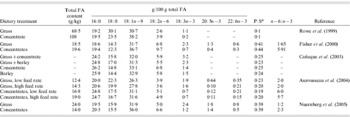
Compared with diets based on grazed grass, those of concentrates do not appear to have a consistent effect on total intramuscular fat content (Table 1), with other factors, particularly live weight at slaughter, having a greater influence. Where increases in triacyglycerol content have been reported in lambs receiving concentrates compared with grass, this may be attributed to a stimulation of fat deposition as a consequence of rumen fermentation pattern or a reduction in energy expenditure (Aurousseau et al. Reference Aurousseau, Bauchart, Calichon, Micol and Priolo2004). Lambs reared and finished on grass compared with concentrates generally have a 1–3-fold increase in muscle 18:3n−3, and reduced 18:2n−6 concentrations, with changes occurring in both neutral lipids and phospholipids, but are more noticeable in the phospholipids (Aurousseau et al. Reference Aurousseau, Bauchart, Calichon, Micol and Priolo2004). Compared with concentrates, grass feeding also results in a lower content of the saturated 16:0, but a higher content of 18:0 (mean values for 16:0 of 21·0 and 23·0 g/100 g FA and for 18:0 of 19·3 and 16·4 g/100 g FA for grass- and concentrate-fed lambs respectively) and a 0·12 lower proportion of 18:1n−9 (Table 1). This results in an improvement in the n−3:n−6 ratio but has little consistent effect on the overall P:S ratio, which averages 0·26. The modification of the PUFA profile from grazing is a reflection of the high concentration of 18:3n−3 in grass and that concentrate feeding generally involves supplementation with lipid or protein sources that are high in 18:2n−6, although results can be confounded if different feed sources are used. Increases in the proportion of 18:3n−3 in meat is of particular interest, not only for its health-related attributes but also because an oxidation product of this FA has been related to a more ‘pastoral’ flavour of the meat (Young & Baumeister Reference Young and Baumeister1999).
Summary of some recent studies designed to manipulate the PUFA content, P:S ratio and the n−6:n−3 ratio in lamb muscle (neutral lipids and phospholipids) by feeding grass or concentrates

* P:S=polyunsaturated to saturated FA ratio.
Within forages, grazing legumes such as lucerne or red clover compared with perennial ryegrass increase muscle content of both 18:2n−6 and 18:3n−3, with a proportionally greater increase in 18:2n−6 (Table 2). Additional benefits to grazing legumes include a reduction in the days to finish as a consequence of an increased intake and live weight gain (243, 305 and 184 g/day for lambs grazed on lucerne, red clover and perennial ryegrass respectively; Fraser et al. Reference Fraser, Speijers, Theobald, Fychan and Jones2004). A number of studies have also investigated the effect of grazing unimproved mountain or salt marsh pasture on muscle FA content, as these pastures have been reported to have a higher PUFA content (Whittington et al. Reference Whittington, Dunn, Nute, Richardson and Wood2006). Increases in muscle n−3 and n−6 PUFA and an increase in the P:S ratio, particularly in lambs from heather-based pastures, have been reported (Ådnøy et al. Reference Ådnøy, Haug, Sørheim, Thomassen, Varszegi and Eik2005; Whittington et al. Reference Whittington, Dunn, Nute, Richardson and Wood2006), although other variables such as breed, rearing system and slaughter weight often make the results difficult to interpret. Despite changes in muscle 18:2n−6 and 18:3n−3 concentrations from grazing different pastures, the very-long-chain PUFA 20:5n−3 and 22:6n−3 are often little affected, although interestingly, reducing the grazing allowance of lambs increased the proportion of 20:4n−6 and 20:5n−3 in muscle substantially, despite neutral lipid and phospholipid concentrations of 18:2n−6 and 18:3n−3 remaining unaltered (Aurousseau et al. Reference Aurousseau, Bauchart, Calichon, Micol and Priolo2004). Grazing heather or moorland was also associated with an increase in the very-long-chain n−3 and n−6 PUFA in the systems study of Whittington et al. (Reference Whittington, Dunn, Nute, Richardson and Wood2006), and it was suggested that this could form the basis of premium quality marketing schemes.
Forage type and effects on tissue FA composition (g/100 g FA)

* Tissue=subcutaneous fat.
† All forages were grazed, tissue=longissimus dorsi.
Feeding starchy concentrates results in an increase in the muscle concentration of branch-chain fatty acids (BCFA), particularly 4-methyloctanoic acid which is related to particular pastoral and species flavour characteristics in sheep meat and tends to be higher in rams than castrates (Table 3; Young et al. Reference Young, Lane, Priolo and Fraser2003). These BCFA are derived from the oxidative deamination of branched-chain amino acids or by the utilization of methylmalonyl-CoA, the carboxylation product of propionate, instead of malonyl-CoA, in FA synthesis and are therefore associated with ruminal fermentation patterns that lead to the production of propionate (i.e. starchy concentrate-type feeds; Duncan & Garton Reference Duncan and Garton1978). Compared with pasture, feeding lucerne was also reported to significantly increase the concentration of BCFA in subcutaneous fat in lambs slaughtered at 232 days of age, although it is worth noting that tissue concentrations of BCFA vary widely between and within experiments (Young et al. Reference Young, Lane, Priolo and Fraser2003).
Mean concentration (μg/g melted fat) of two branched-chain FA in subcutaneous fat (from Young et al. Reference Young, Lane, Priolo and Fraser2003)

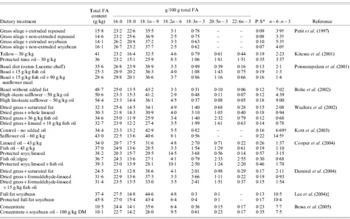
The majority of studies that have had the objective of improving the FA profile of sheep meat have supplemented with an oil source. In general, feeding dietary ingredients that are high in 18:2n−6 such as safflower oil, rapeseed oil and soya oil increase muscle concentrations of this FA by approximately 0·5-fold, but generally have a neutral effect on the saturated FA content with a decrease in muscle 16:0 and either a neutral or small increase in 18:0, depending on the level of biohydrogenation in the rumen (Table 4). Increases in 18:2n−6 are generally accompanied by a decrease in muscle content of the monounsaturated FA 18:1n−9, although several other factors may influence tissue levels of 18:1n−9 including dietary supply and endogenous synthesis (Wachira et al. Reference Wachira, Sinclair, Wilkinson, Enser, Wood and Fisher2002; Daniel et al. Reference Daniel, Richards, Salter and Buttery2004a). Supplementation with oil sources rich in 18:2n−6 also results in an improvement in the P:S ratio with ratios as high as 0·35 being reported (Bessa et al. Reference Bessa, Portugal, Mendes and Santos-Silva2005), but have a negative impact on the n−6:n−3 ratio with values well in excess of the desired value of 4·0.
Summary of some recent studies designed to manipulate the PUFA content, P:S ratio and n−6:n−3 ratio in lamb muscle (neutral lipids and phospholipids) by supplementation with dietary oil sources rich in n−6 or n−3 FA

* P:S=polyunsaturated to saturated FA ratio.
† 18:2n−6:18:3n−6.
‡ Neutral lipids in the longissimus dorsi.
Feeding unprotected linseed as an n−3 PUFA source has a beneficial effect on muscle 18:3n−3 concentrations, with improvements of more than 1-fold being reported (Wachira et al. Reference Wachira, Sinclair, Wilkinson, Enser, Wood and Fisher2002). This apparently greater response to supplementation on muscle 18:n−3 than 18:2n−6 (1·0-fold v. 0·5-fold increase respectively) cannot be explained by ruminal biohydrogenation rates alone, as this tends to be higher for 18:3n−3, but may be explained by the difference in lipid class distribution as 18:3n−3 is mainly found in muscle triglycerides and 18:2n−6 in phospholipids (Enser et al. Reference Enser, Hallett, Hewitt, Fursey and Wood1996). Feeding a ruminally protected source of 18:3n−3 increased muscle neutral lipid and adipose tissue levels to approximately 4 g/100 g FA, double that obtained when linseed oil was fed, despite dietary levels being approximately one-third (Cooper et al. Reference Cooper, Sinclair, Wilkinson, Hallett, Enser and Wood2004). This concentration is in excess of the 3 g/100 g FA that is considered to be the maximum acceptable to maintain good meat-eating qualities (Sheard et al. Reference Sheard, Enser, Wood, Nute, Gill and Richardson2000), and demonstrates that there is the potential to markedly alter the n−3 PUFA content of sheep meat. A balance therefore needs to be achieved between duodenal supply and tissue FA profile to avoid sheep meat having an excessive content of n−3 PUFA, although such situations will currently only arise by the use of ruminally protected PUFA sources whose use will be sensitive to product price and market return for nutritionally enhanced sheep meat.
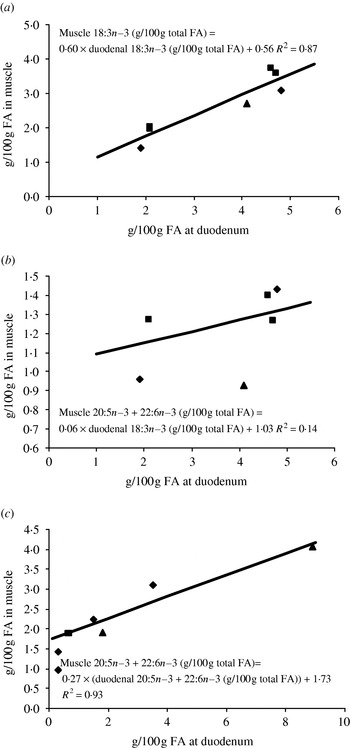
There is considerable evidence of elongation and desaturation of 18:3n−3 in growing lambs, with a greater increase in 20:5n−3 than 22:6n−3 (e.g. Wachira et al. Reference Wachira, Sinclair, Wilkinson, Enser, Wood and Fisher2002), although the efficiency of conversion is low. For example, there was a 0·5-fold increase in the muscle content of 20:5n−3 as a consequence of feeding linseed in the study of Wachira et al. (Reference Wachira, Sinclair, Wilkinson, Enser, Wood and Fisher2002), but only a 0·13-fold increase in the study of Demirel et al. (Reference Demirel, Wachira, Sinclair, Wilkinson, Wood and Enser2004). In three studies where duodenal FA flow and muscle content (polar and neutral lipids) were measured, the relationship between the two could be calculated (Fig. 1). There was a good relationship between duodenal and muscle 18:3n−3 proportion, but a poor and non-significant relationship between duodenal 18:3n−3 and muscle 20:5n−3+22:6n−3. One factor that influences the conversion is the ratio of 18:2n−6 to 18:3n−3 since these FA compete for the same enzymes during chain elongation and desaturation (Brenner Reference Brenner, Vergroesen and Crawford1989). Indeed, diets that have a higher ratio of 18:2n−6 to 18:3n−3 result in lower tissue levels of 20:5n−3+22:6n−3 (Raes et al. Reference Raes, De Smet and Demeyer2004). Additionally, increased tissue supply of long-chain n−3 PUFA acts to down-regulate their synthesis from 18:3n−3, possibly by inhibition of Δ6 desaturase (Burdge & Calder Reference Burdge and Calder2006). Considering these factors in combination, improvements in tissue concentrations of 20:5n−3 than 22:6n−3 can more effectively be obtained by feeding preformed sources than encouraging chain elongation from 18:3n−3. For example, feeding unprotected fish oil increased muscle concentrations of 22:6n−3 by approximately 0·3 to 3·7-fold (Ponnampalam et al. Reference Ponnampalam, Sinclair, Egan, Blakeley, Li and Leury2001; Wachira et al. Reference Wachira, Sinclair, Wilkinson, Enser, Wood and Fisher2002; Demirel et al. Reference Demirel, Wachira, Sinclair, Wilkinson, Wood and Enser2004), whilst feeding marine algae along with fish oil resulted in a 10·6-fold enhancement of 22:6n−3 levels (Cooper et al. Reference Cooper, Sinclair, Wilkinson, Hallett, Enser and Wood2004; Table 4), possibly due to a natural protection of the oil from biohydrogenation by virtue of the structure of the algal cell wall. Increased muscle concentrations of 20:5n−3 has also been reported in lambs fed diets containing marine algae that was absent in this FA but high in 22:6n−3. Retro-conversion of 22:6n−3 to 20:5n−3 that has been reported in both rats and humans (Sprecher et al. Reference Sprecher, Luthria, Mohammed and Baykousheva1995) provides the most plausible explanation for this observation. There appears to be little consistency between the reported effects of very-long-chain PUFA on muscle phospholipid 18:0 levels. This was attributed by Demirel et al. (Reference Demirel, Wachira, Sinclair, Wilkinson, Wood and Enser2004) to the different FA composition of individual phospholipids, with an increase of 20:5n−3 in phosphatidyl ethanolamine increasing 18:0, whereas in phosphatidyl choline it would raise 16:0 since 18:0/20:5n−3 and 16:0/20:5n−3 are the major 20:5n−3-containing molecular species in sheep muscle.
Relationship between duodenal and muscle FA content (g/100 g total FA): (a) duodenal 18:3n−3 and muscle 18:3n−3; (b) duodenal 18:3n−3 and muscle (20:5n−3+22:6n−3); (c) duodenal (20:5n−3+22:6n−3) and muscle (20:5n−3+22:6n−3). Data from Wachira et al. (Reference Wachira, Sinclair, Wilkinson, Hallett, Enser and Wood2000), Chikunya et al. (Reference Chikunya, Demirel, Enser, Wood, Wilkinson and Sinclair2004), Sinclair et al. (Reference Sinclair, Cooper, Chikunya, Wilkinson, Hallett, Enser and Wood2005a), Wachira et al. (Reference Wachira, Sinclair, Wilkinson, Enser, Wood and Fisher2002), Demirel et al. (Reference Demirel, Wachira, Sinclair, Wilkinson, Wood and Enser2004) and Cooper et al. (Reference Cooper, Sinclair, Wilkinson, Hallett, Enser and Wood2004).

The principal energy source in the diet (fibre or starch) can also affect carcass FA composition through supply of precursors for de novo FA synthesis or metabolic control, for example through the action of insulin on stearoyl-CoA desaturase (SCD). Additionally high inclusion rates of starchy feeds (e.g. barley or maize) can lead to high incorporation of 17:0 and 18:0 whilst dietary protein source has been shown to alter the FA profile of adipose tissue (Bas & Morand-Fehr Reference Bas and Morand-Fehr2000). It is important, however, to distinguish between the direct effects of the FA supply from the supplement and that of the protein supply. It is clear, therefore, that supplementation with oil sources can markedly influence the FA profile of sheep meat, but a more successful strategy is to supplement with ruminally protected oil sources, and that increases in muscle content of 20:5n−3 and 22:6n−3 are best achieved by feeding a preformed source.
DESATURATION OF FA
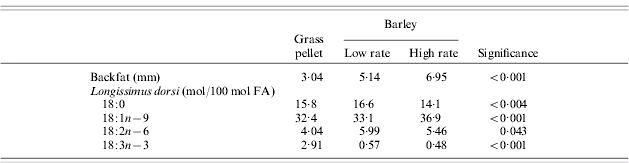
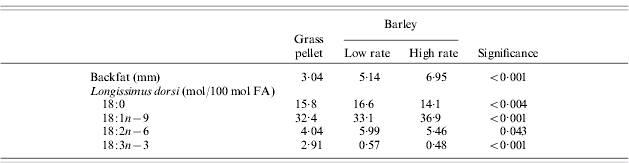
An alternative means to reduce the saturated FA content of sheep meat is to increase the levels or activity of SCD. In growing sheep, adipose tissue is the principal site for de novo FA synthesis, with palmitic acid being the main end product, which can further be elongated to stearic acid and then desaturated to oleic acid by SCD, a step that is generally regarded as rate-limiting. Ward et al. (Reference Ward, Travers, Richards, Vernon, Salter, Buttery and Barber1998) demonstrated that, in sheep, SCD is produced from a single gene whose expression is under hormonal control, independent of total fat synthesis and whose activity varies with fat depot, being higher in subcutaneous than internal depots. As sheep meat contains approximately 20 g/100 g FA as 18:0, there is considerable opportunity to reduce the content of this saturated FA. Insulin has been shown to increase SCD mRNA levels above that of lipogenesis, resulting in an increase in the ratio of monounsaturated to total FA, whilst dexamethasone alone had the opposite effect but potentates the effect of insulin when administered in combination (Daniel et al. Reference Daniel, Richards, Salter and Buttery2004a). Feeding concentrates compared to forage to lambs therefore results in an elevated SCD mRNA to acetyl CoA carboxylase mRNA ratio, resulting in an increased 18:1n−9 content in adipose tissue (Daniel et al. Reference Daniel, Richards, Salter and Buttery2004 c; Table 5). By contrast, dietary PUFA, particularly 18:3n−3, appear to suppress SCD, possibly due to an inhibition of SCD expression (Daniel et al. Reference Daniel, Richards, Salter and Buttery2004c). Supplementation with vitamin A was also shown to induce SCD mRNA gene expression in sheep adipose tissue and liver (Daniel et al. Reference Daniel, Richards, Salter and Buttery2004b) resulting in an increase in 16:1n−7 and 18:1n−9 compared with their precursors, with the liver being more responsive. The effect, however, was small and it was concluded that this was not a suitable strategy to increase the unsaturated FA content of sheep meat.
Effect of basal diet on backfat thickness and muscle FA composition (from Daniel et al. Reference Daniel, Richards, Salter and Buttery2004c)
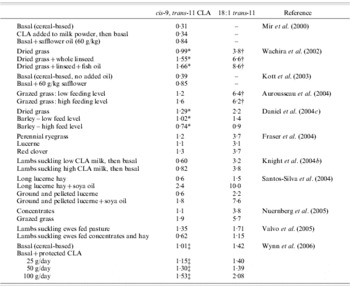
Dietary strategies to increase tissue content of cis-9, trans-11 CLA have included increasing supply directly from the rumen (e.g. supplementation with 18:2n−6 or protected CLA), increased tissue supply of trans-11 18:1 (by supplying diets rich in 18:2n−6 or 18:3n−3) which may then be converted by SCD to cis-9, trans-11 CLA, or through upgrading tissue SCD levels or activity. A summary of a number of experiments to increase muscle cis-9, trans-11 CLA content in sheep meat is presented in Table 6. Mathematical modelling to partition the contribution of ruminal and endogenous synthesis of cis-9, trans-11 CLA in lamb muscle reveals that proportionally 0·28 of trans-11 18:1 is desaturated, and that endogenous synthesis of cis-9, trans-11 CLA accounts for 0·87 of tissue content (Palmquist et al. Reference Palmquist, St-Pierre and McClure2004). In general therefore, the content of cis-9, trans-11 CLA in the intramuscular lipid of sheep meat follows the pattern for trans-11 18:1 and fits a product:precursor pattern with diets high in 18:3n−3 or 18:2n−6 increasing ruminal production of trans-11 18:1 and subsequently muscle CLA levels (Wachira et al. Reference Wachira, Sinclair, Wilkinson, Enser, Wood and Fisher2002). For example, Bessa et al. (Reference Bessa, Santos-Silva, Ribeiro and Portugal2000) demonstrated a curvilinear increase in the concentration of CLA in the longissimus dorsi from soyabean oil inclusion up to 70 g/kg DM, although a concentration of 2–3 g/100 g FA would appear maximal (Table 6). Unfortunately, diets that promote the greatest activity of SCD (i.e. starchy concentrate-type diets) are also associated with a lower duodenal flow of the trans-11 18:1 precursor (Daniel et al. Reference Daniel, Richards, Salter and Buttery2004c), with forage-based diets resulting in the highest flow of this FA from the rumen. Mixing linseed and fish oil in the diet also increased daily 18:1 trans flow at the small intestine to approximately one-third of total FA flow, but muscle CLA levels were similar to those in lambs fed linseed alone (Wachira et al. Reference Wachira, Sinclair, Wilkinson, Enser, Wood and Fisher2002), and it would appear that fish oil depressed the level of CLA relative to trans 18:1.
Strategies to manipulate cis-9, trans-11 CLA and 18:1 trans-11 in lamb muscle (g/100 g FA unless otherwise stated)

* Total CLA.
† Reported as mix of trans-11 18:1, predominately n−7.
‡ Reported as mol/100 mol FA methyl ester.
Manipulation of ruminal conditions can also modify tissue CLA supply, with a reduction in ruminal pH generally increasing total trans 18:1 and CLA supply, particularly if a dietary source of 18:2n−6 is provided (Loor et al. Reference Loor, Ueda, Ferlay, Chilliard and Doreau2004). Concentrate-type diets can also result in a shift towards trans-10, cis-12 CLA in the rumen and subsequently in the muscle (Bessa et al. Reference Bessa, Portugal, Mendes and Santos-Silva2005). By contrast, high dietary vitamin E levels that are often included as a means to enhance the shelf life of sheep meat, appear to reduce ruminal production of trans-10, cis-12 CLA (Pottier et al. Reference Pottier, Focant, Debier, De Buysser, Goffe, Mignolet, Froidmont and Larondelle2006). Additionally, certain pastures may contain species with a higher content of 18:2n−6 or with significant quantities of secondary plant compounds which may result in an increase in the content of CLA in sheep products, possibly due to their inhibition of biohydrogenation or increase in tissue SCD activity (Cabiddu et al. Reference Cabiddu, Addis, Pinna, Spada, Fiori, Sitzia, Pirisi, Piredda and Molle2006).
Feeding CLA to pre-ruminant lambs or the provision of ruminally protected sources of CLA (usually mixtures of cis-9, trans-11 and trans-10, cis-12 CLA) are alternative strategies to increase their content in sheep meat. Feeding a milk replacer high in CLA for 21 days pre-weaning did not alter muscle CLA content when the lambs were slaughtered 80 days later, although the adipose lipid concentration was lower in the CLA-supplemented lambs, suggesting a difference in the induction of fibroblasts to adipocytes (Mir et al. Reference Mir, Rushfeldt, Mir, Paterson and Weselake2000). By contrast, Valvo et al. (Reference Valvo, Lanza, Bella, Fasone, Scerra, Biondi and Priolo2005) reported a 1-fold increase in cis-9, trans-CLA when lambs were reared exclusively on milk from ewes grazing grass compared with concentrates and hay and slaughtered at 14 kg live weight, whilst Knight et al. (Reference Knight, Knowles, Death, Cummings and Muir2004b) reported a 0·37 higher muscle concentration of CLA in the L. dorsi of lambs reared by ewes selected for high milk CLA content and slaughtered 12 weeks post weaning. Interestingly, feeding a ruminally protected lipid source containing trans-10, cis-12 CLA to growing lambs did not alter muscle mass or decrease fat levels in the study of Wynn et al. (Reference Wynn, Daniel, Flux, Craigon, Salter and Buttery2006), despite duodenal flow of this fatty acid increasing from 0 g/d in the control to 6·2 g/d in the supplemented animals. This finding is in contrast to that observed in milking ewes by Lock et al. (Reference Lock, Teles, Perfield, Bauman and Sinclair2006) and Sinclair et al. (Reference Sinclair, Lock, Early and Baumanin press), who reported that supplementation with a similar protected CLA led to a proportional reduction in milk fat content of between 0·20 and 0·25. Feeding a protected source of mixed isomers CLA to growing lambs did, however, result in a 2–5-fold increase in the proportion of cis-9, trans-11 CLA and 3–20-fold increase in trans-10, cis-12 CLA in the liver and all the adipose tissue depots studied, and a 30-fold increase in trans-10, cis-12 CLA in muscle (Wynn et al. Reference Wynn, Daniel, Flux, Craigon, Salter and Buttery2006). Such a change in the FA profile would enhance the potential functional food properties of sheep meat. Offset against this, supplementation with CLA was associated with a reduction in the monounsaturated FA content across tissues (Wynn et al. Reference Wynn, Daniel, Flux, Craigon, Salter and Buttery2006), which was suggested to be consistent with an inhibition of SCD activity, as SCD mRNA levels were unaffected.
SYSTEM×BREED EFFECTS
The effect of genetics on muscle FA composition is considerably smaller than that of diet. Despite this when fed the same diet and slaughtered at a similar proportion of mature live weight, the proportion of 18:2n−6 and 18:3n−3 was higher in muscle from Soays than Suffolks in the studies of Wachira et al. (Reference Wachira, Sinclair, Wilkinson, Enser, Wood and Fisher2002) and Fisher et al. (Reference Fisher, Enser, Richardson, Wood, Nute, Kurt, Sinclair and Wilkinson2000), whilst Suffolk cross lambs had elevated muscle levels of 18:3n−3 compared with Scottish Blackface lambs in the study of Demirel et al. (Reference Demirel, Wachira, Sinclair, Wilkinson, Wood and Enser2004). Interestingly 20:5n−3 levels were the highest in the Blackface lambs in the study of Demirel et al. (Reference Demirel, Wachira, Sinclair, Wilkinson, Wood and Enser2004), which may indicate greater FA desaturation and elongation in this breed, although it may also have been due to the diet that the lambs received prior to the finishing period. In the study of Fisher et al. (Reference Fisher, Enser, Richardson, Wood, Nute, Kurt, Sinclair and Wilkinson2000) the semimembranosus muscle was examined and Soays had a very low concentration of total FA (17 g/kg) which would have been partly responsible for the high proportions of PUFA since the phospholipid fraction was more significant. The ratio of phospholipid to neutral lipid is also greater in red muscles such as semimembranosus than white muscle such as longissimus (Turkki & Campbell Reference Turkki and Campbell1967). It has been suggested that ambient temperature may be an important factor regulating tissue FA composition, with cold temperatures promoting the degree of unsaturation to maintain the fluidity of tissue membranes. However, Moibi & Christopherson (Reference Moibi and Christopherson2001) reported that decreasing ambient temperature from 23 to 0°C had a minimal effect on tissue FA composition, but suggested that a greater period of acclimatization than the 5 weeks employed may have resulted in a larger effect.
Soays have been shown to have higher muscle concentrations of CLA than Suffolks or Frieslands, although the concentration of trans 18:1 was not significantly different (Wachira et al. Reference Wachira, Sinclair, Wilkinson, Enser, Wood and Fisher2002). Regression of the proportion of CLA on CLA+trans 18:1 across feeds within breeds resulted in similar values for Soay and Friesland lambs, although Suffolk lambs had a lower content at higher substrate levels (Wachira et al. Reference Wachira, Sinclair, Wilkinson, Enser, Wood and Fisher2002). Since the proportion of 16:1n−7 was also lower in the Suffolk lambs in both muscle and adipose tissues, then breed differences in SCD activity could produce such an effect. By contrast, Daniel et al. (Reference Daniel, Hammond, Dawson, Salter and Buttery2005) reported little difference between breeds in SCD mRNA levels.
NUTRITIONAL INDICES
There are three factors that are generally considered to be important when judging the nutritional value of fatty foods: (1) total fat content; (2) the P:S ratio; and (3) the n−6:n−3 ratio. Total fat content is affected by a variety of factors including age and weight at slaughter, sex, genetics, breed and nutrition. If the visible fat content is removed, however, then most sheep meat has a lipid content below 50 g/kg, a value generally considered to characterize a low-fat food, although it must be acknowledged that values can be as high as 510 g/kg (Enser et al. Reference Enser, Hallett, Hewitt, Fursey and Wood1996).
It is recommended that the P:S ratio for the human diet as a whole is above 0·45 (Department of Health 1994), and it is clear that sheep meat falls well short of this value. Despite this there are instances when lambs have been finished off grass when the ratio has approached 0·40 (Table 1), although most data in the literature, whether from surveys of lamb at retail or controlled experiments, have reported P:S ratios nearer 0·20. Increasing the PUFA content of the diet, by including sources high in either n−6 or n−3 FA, generally improves the P:S ratio, although the effect is often small due to the process of biohydrogenation in the rumen. Only in studies that have included some form of ruminally protected source of PUFA have significant improvements in tissue P:S ratio been reported. For example, feeding a protected linseed/soyabean mixture in the study of Cooper et al. (Reference Cooper, Sinclair, Wilkinson, Hallett, Enser and Wood2004) improved the muscle P:S ratio to 0·57, whilst the combination with marine algae resulted in a beneficial ratio of 0·46. Similarly, Kitessa et al. (Reference Kitessa, Gulati, Ashes, Scott and Fleck2001) reported an improvement in the P:S ratio from 0·19 in the muscle of lambs fed tallow, to 0·35 in those fed a source of ruminally protected fish oil.
Sheep meat has a beneficially low total n−6:n−3 ratio, with lamb finished off grass having values less than 2·0, considerably lower than the value of 4·0 recommended by the Department of Health (1994). Feeding concentrate-type diets, particularly if they contain oil sources rich in 18:2n−6, generally result in higher ratios of around 6·0 (Fisher et al. Reference Fisher, Enser, Richardson, Wood, Nute, Kurt, Sinclair and Wilkinson2000), whilst a very low n−6:n−3 ratio of 0·68 was obtained in lambs fed a combination of fish oil and marine algae (Cooper et al. Reference Cooper, Sinclair, Wilkinson, Hallett, Enser and Wood2004). The P:S and n−6:n−3 ratios in sheep meat have, however, been presented in a number of ways, and doubts have been raised about the validity of these ratios without definition of the effects of their constituent FA (SACN/COT 2004). For example, the limited conversion of 18:3n−3 to the more beneficial longer chain n−3 FA, and the lack of evidence of a direct effect of 18:3n−3 in ameliorating cardiovascular disease risk factors and inflammatory markers in humans, appear to question the benefit of a higher intake of this FA (Sanderson et al. Reference Sanderson, Finnegan, Williams, Calder, Burdge, Wooton, Griffin, Millward, Pegge and Bemelmans2002; Burdge & Calder Reference Burdge and Calder2006). By contrast, an increased intake of 18:2n−6 by humans has recently been associated with the promotion of adipogenesis and increase in obesity, probably through its effects on arachidonic acid and prostacyclin production (Ailhaud et al. Reference Ailhaud, Massiera, Weill, Legrand, Alessandri and Guesnet2006), suggesting a beneficial effect of a decreased 18:2n−6:18:3n−3 ratio. The effects of long-chain n−3 PUFA on reducing coronary heart disease are well established, and it has been recommended that the daily intake of 20:5n−3 and 22:6n−3 be increased to 450 mg/day (SACN/COT 2004). A 100 g serving of lamb from sheep fed a combination of a protected n−3 lipid source and marine algae or fish oil and algae (Cooper et al. Reference Cooper, Sinclair, Wilkinson, Hallett, Enser and Wood2004) was predicted to supply 132 and 179 mg respectively of 20:5n−3+22:6n−3, representing a significant contribution to the daily target.
Lambs fed diets high in PUFA may also have higher muscle levels of trans FA. In humans, certain trans FA may have an undesirable effect on plasma low- and high-density cholesterol, lipoprotein(a) and coronary heart disease mortality (Department of Health 1994). As part of a complete diet, however, the intake of trans FA from a daily serving of lamb would contribute proportionally less than 0·0014 of daily energy intake (Wachira et al. Reference Wachira, Sinclair, Wilkinson, Enser, Wood and Fisher2002; Cooper et al. Reference Cooper, Sinclair, Wilkinson, Hallett, Enser and Wood2004), considerably less than the daily limit of 0·01 recommended by the WHO (WHO 2003). There is also evidence of beneficial effects of trans-11 18:1, the major trans FA in lamb, on human health as a consequence of conversion to cis-9, trans-11 CLA (Ip et al. Reference Ip, Banni, Angioni, Carta, Mcginley, Thompson, Barbano and Bauman1999; Corl et al. Reference Corl, Barbano, Bauman and Ip2003; Lock et al. Reference Lock, Parodi and Bauman2005), although some studies that have supplemented the diet of humans with dairy products high in both cis-9, trans-11 CLA and trans-11 18:1 have reported detrimental effects on blood lipids, an effect that was suggested to be related to the increased intake of trans-11 18:1 (Yaqoob et al. Reference Yaqoob, Tricon, Williams, Grimble, Burdge and Calder2006).
FA CONTENT, FLAVOUR AND EATING CHARACTERISTICS
FA also have important effects on the shelf life, colour, flavour and eating quality of sheep meat. Available literature mainly describes the FA content of raw meat with more limited information on the effect of cooking on the content and profile. Knight et al. (Reference Knight, Knowles, Death, Cummings and Muir2004a), however, reported only a small effect of cooking on the proportion of trans-11 18:1, CLA, 20:5n−3 and 22:6n−3 in sheep meat, particularly if cooked trimmed of bone and fat. Both n−6 and n−3 PUFA are important contributors to the odour of lambs fed grain or forage respectively, with the perception and ranking of favourable taste and eating quality being influenced by tradition and previous experience. For example, some studies suggest that odours and flavours associated with grain feeding are less intense and more preferred (Kemp et al. Reference Kemp, Mahyuddin, Ely, Fox and Moody1980; Larick & Turner Reference Larick and Turner1990). By contrast, studies that have compared consumers that have a tradition of consuming grass-fed lambs rate their flavour higher than grain-fed lambs, whilst those that have a tradition of consuming grain-fed lambs have the opposite ranking (Sañudo et al. Reference Sañudo, Enser, Campo, Nute, Marĭa, Sierra and Wood2000). Further evaluation revealed that there was a positive correlation between 18:0, 18:1n−9 and 18:3n−3 and sensory scores, and a negative correlation with 18:2n−6, when determined in consumers who preferred grass-finished lamb (Sañudo et al. Reference Sañudo, Enser, Campo, Nute, Marĭa, Sierra and Wood2000). The longer chain 20:5n−3 is associated with a fishy flavour whilst 22:6n−3 appears to be associated with a reduced lamb flavour and increased abnormal lamb flavour (G. Nute, personal communication), with breakdown products of n−3 PUFA produced on grilling including aldehydes and ketones which have been suggested to generate free radicals that catalyse the breakdown of less unsaturated FA such as 18:1n−9 which is present in much larger amounts (Elmore et al. Reference Elmore, Cooper, Enser, Mottram, Sinclair, Wilkinson and Wood2005). Within sward type, small but significant differences in sensory quality have been reported in lambs when finished on extensive mountain pastures or salt marshes compared with improved grassland (Ådnøy et al. Reference Ådnøy, Haug, Sørheim, Thomassen, Varszegi and Eik2005; Whittington et al. Reference Whittington, Dunn, Nute, Richardson and Wood2006), although other factors such as slaughter weight, rearing system and breed may have also had a bearing on the results. By contrast, a number of studies have reported that sward type, including legumes, had little effect on the flavour of meat (Young et al. Reference Young, Cruickshank, Maclean and Muir1994; Vipond et al. Reference Vipond, Marie and Hunter1995; Fraser et al. Reference Fraser, Speijers, Theobald, Fychan and Jones2004). Manipulation of the FA profile, along with other components such as BCFA, skatole and vitamin E, offers the potential of modifying the flavour characteristics of lamb to more closely meet market requirements for individual countries, and warrants further research.
CONCLUSION
Sheep meat is generally considered as a high-fat food with a low P:S ratio. Offset against this is the low fat content if the visible fat is removed, and the beneficial ratio of n−6:n−3 FA. Substantial improvements in the P:S ratio can be obtained, but rely on protecting PUFA from biohydrogenation or manipulation of ruminal fermentation. Additionally, increasing tissue supply of 18:3n−3 will result in a small improvement in muscle 20:5n−3 and 22:6n−3 content, with dietary supply of a protected source of these very-long-chain PUFA being the preferred option. Despite the apparent negative impact of ruminal metabolism on muscle FA content, the process of biohydrogenation is often incomplete and several of the intermediaries can have positive effects on human health. Within these intermediaries, future increases in tissue content of cis-9, trans-11 CLA may be obtained by increasing tissue supply directly, although a greater response may be obtained by maximizing tissue supply of trans-11 18:1 and elevating the action of SCD. Production of a FA profile in sheep meat to enhance its nutritional properties and result in flavour and eating characteristics commensurate with market requirements is a suitable area for research.