


INTRODUCTION
While the judicialization of politics in recent decades has seen the powers of courts increase significantly around the world, the United States Supreme Court remains arguably the most powerful judicial body in the world. A variety of constitutional protections, including life tenure, afford the justices considerable independence from the elected branches. As a result, the justices have wide latitude to craft legal policy as they best see fit. Accordingly, a vacancy on the nation’s highest court necessarily creates a political event of great importance for both the president who must choose the exiting justice’s replacement, and for senators who must decide whether to affirm or reject this choice. Understanding the selection process is critical for understanding any judicial institution. The stakes, however, are particularly high when we consider powerful and policy-making courts at the top of a judicial hierarchy, such as the U.S. Supreme Court.
What, then, actually drives the politics of Supreme Court appointments? In particular, what determines the president’s choice of a nominee and what determines senators’ subsequent voting, including the Senate’s confirmation or rejection of the nominee? Scholars have produced a wealth of empirical studies of the Supreme Court’s appointment and confirmation process.Footnote 1 But it seems fair to say that political scientists have produced only one integrated theory of appointment politics that connects both the nomination and confirmation decisions: move-the-median (MTM) theory.
The core idea of MTM theory is extremely simple, indeed elegant: if a multimember body uses a Condorcet-compatible procedure when making policy, the key attribute of the body is the ideological location of its median member. Therefore, the politics of appointments to the body should turn on altering (or preserving) the ideology of the median member—“moving the median.” In the context of Supreme Court nominations, MTM theory suggests that a senator should vote against a nominee who moves the Court’s new median justice farther from the ideal point of the senator than the reversion “status quo.” And if this is true for a majority of senators, the Senate should reject the nominee. Finally, the president should nominate a confirmable individual who moves the new median justice as close as possible to the president’s own ideal point. This means that, when facing a distant Senate, the president should be constrained in his choice of nominee—which, in turn, limits the ideological range of nominees that will serve on the nation’s highest court.
To the best of our knowledge, MTM theory was first formulated and applied to Supreme Court nominations in the late 1980s in two unpublished papers by Lemieux and Stewart (Reference Lemieux and Stewart1990a; Reference Lemieux and Stewart1990b). Since then, several attempts have been made to evaluate whether this stark framework can actually account for Supreme Court appointment politics. Most notable of these efforts was Moraski and Shipan (Reference Moraski and Shipan1999), who developed a MTM theory of nominations and found support for its predictions regarding the type of the nominee the president should appoint. More recently Krehbiel (Reference Krehbiel2007) developed a different variant of MTM theory and found support for its predictions about how the Court should move ideologically following different types of nominations. Finally, Rohde and Shepsle (Reference Rohde and Shepsle2007) presented a formal model that focuses on the role of possible filibusters in a MTM game—they conclude that failed nominations should be common (even though empirically they are rare).Footnote 2
Despite these valuable efforts, the extent to which we should consider Supreme Court confirmations a move-the-median game remains unclear. First, existing models have implicitly assumed different preferences for the president and senators, resulting in distinct models that make different predictions about selection and voting. As it turns out, all of these models are special cases in a more generalized framework that can encompass a range of different versions of MTM theory. Second, it is not clear how broad-based the empirical support for the move-the-median models really is. For one, the theory’s predictions with respect to senators’ voting choices have never been directly tested. In addition, with respect to presidential choice, Moraski and Shipan (Reference Moraski and Shipan1999) test only one version of the theory and employ now-outdated measures of interinstitutional preferences.
In this article, we conduct a new and more complete theoretical and empirical re-evaluation of MTM models of Supreme Court nominations, assessing how well they capture the dynamics of nomination and confirmation politics during the last 80 years. We develop a generalized framework that encompasses all of the models in the literature. Although the key idea of MTM theory is extraordinarily simple, its implementation in a well-specified game can be surprisingly complex. Our key theoretical contribution is that we formalize the extent to which presidents and senators care about the ideology of the median of the Supreme Court versus the ideology of the nominee. This distinction is critical, since the confirmation of many nominees would result in no change in the median. We develop four variants of the models, which produce substantively different predictions about the types of nominees that presidents should select and the range of nominees that senators (and the overall Senate) should confirm or reject.
We then take advantage of advances in scaling and measurement, which now make it possible to place presidents, senators, justices, and Supreme Court nominees in the same ideological space. Using these measures, we conduct extensive tests of the theory’s predictions regarding the selection of nominees by the president and the voting behavior of senators. We go beyond the existing literature in several ways. First, we conduct extensive tests of the theory’s predictions regarding both individual senatorial voting decisions and confirmation decisions. Second, we conduct direct tests of the theory, arraying its crisp point predictions against the actual choices of senators and presidents. Such tests have never been undertaken, due presumably to the difficulty of placing presidents, senators, justices, and Supreme Court nominees in the same ideological space. Third, we conduct tests of “robust” predictions—those that hold up across all variants of MTM theory. Thus we can test how well MTM theory as an overarching theory (and not just particular variants) explains confirmation politics. Finally, unlike almost all existing work (Anderson, Cottrell, and Shipan (Reference Anderson, Cottrell and Shipan2015) is an exception), we incorporate uncertainty into our empirical evaluations whenever feasible.
We evaluate all 46 Supreme Court nominations from 1937 to 2010Footnote 3 . We find very little support for MTM theory. First, senators often voted for nominees the theory predicts they should have rejected, and concomitantly the Senate as a whole confirmed many nominees the theory predicts should have been rejected. We find two kinds of errors with respect to presidential selection. First, presidents have sometimes nominated individuals who moved the median on the Court away from the president’s ideal point. Second, and more prevalently, presidents have nominated individuals who were much more extreme than predicted by the theory, given the location of the Senate median. Moreover, these nominees have usually been confirmed by the Senate, contra the theory’s predictions. Thus, the president has been far less constrained in his choice of nominees than MTM theory would predict. Our findings thus dovetail with those of Anderson, Cottrell, and Shipan (Reference Anderson, Cottrell and Shipan2015), who find that the location of the median justice (in terms of the Court’s voting behavior) moves in the direction of the president even following nominations where the president should be constrained. Taken together, our results raise serious questions about the adequacy of MTM theory for explaining confirmation politics and have important implications for assessing the ideological composition of the Supreme Court.
A GENERALIZED MOVE-THE-MEDIAN FRAMEWORK
In this section we develop a generalized move-the-median framework, which allows us to present an overview of MTM theory and its empirical predictions. In the interest of clarity, we present a relatively nontechnical version of the theory here. In Online Appendix B, we provide a complete description of the game; all proofs are gathered there.
The players in the game are the president and k senators. It is convenient to index the players and members of the Court by their ideal points, which are simply points on the real line. (For all actors, larger values indicate increasing conservatism.) Thus, the president has an ideal point
 $p\in \mathbb {R}$
. Similarly senator i has ideal point si
, i = 1, . . .k. Denote the ideal point of the median senator as sm
(i.e., the “Senate median”).Footnote
4
In addition to the president and the senators, there is an “original” (or “old”) Court comprising nine justices. Denote the ideal points of the justices on the original court as j
0
i
, i = 1, 2, . . ., 9, with
 $j_{i}^{0}\in \mathbb {R}$
. Following a confirmation, a new nine-member natural Court forms; denote the ideal points of the members of the new Court by j
1
i
, i = 1, 2, . . ., 9. That is, superscripts distinguish the old and new courts. Order the justices by the value of their ideal points; for example j
0
1 < j
2
0 < . . . < j
0
9. The ideal point of Justice 5 (j
0
5) is the ideal point of the median justice on the original Court; the ideal point of the median justice on the new Court is thus j
1
5. The appointment moves the median justice if and only if j
0
5 ≠ j
5
1.
The sequence of play is simple, as we focus on a one-shot version of the model. First, Nature selects an exiting justice, meaning a vacancy or opening occurs on the nine-member Court; let e denote the ideal point of the exiting justice. Second, the president proposes a nominee with ideal point n. Third, the senators vote to accept or reject the nominee; let vi
∈ {0, 1} denote the confirmation vote of the ith senator. If
 $\sum v_{i}\ge \frac{k}{2}$
the Senate accepts the nominee; otherwise, it rejects the nominee. Denote the “reversion policy” for the Court as q. Following Krehbiel (Reference Krehbiel2007), we assume the reversion policy is the ideal point of the old median justice on the Court, j
0
5.Footnote
5
Thus, the outcome of the game is as follows. If the nominee is rejected, policy remains at the location of the old median justice. If the nominee is confirmed but the nominee does not move the median, policy also remains at the location of the old median justice; policy moves to the location of the new median justice if a confirmed nominee does move the median.
Median-equivalent nominees versus utility-equivalent nominees
Crucial to understanding the outcomes of MTM games is the relationship between three quantities: first, the ideal point of the exiting justice (e); second, the ideology of the nominee (n); and third, the resulting ideal point of the new median justice (j 1 5), conditional on confirmation. Importantly, the location of the new median justice j 1 5 can only be j 0 4, j 0 5 (the old median justice), j 0 6, or n itself, with n bounded within [j 0 4, j 6 0]. The nominee can become the median justice only when the opening and the nominee lie on opposite sides of the old median justice and n lies between j 0 4 and j 0 6.
Because the new median justice is restricted to just a few values, many different appointees can have the same impact on the Court’s median. For example, if the opening is between j 0 1 and j 0 4 then all nominees n ⩽ j 0 5 induce no change in the median. Thus, these nominees are median equivalent. A critical question then is: should senators and the president view median-equivalent nominees as utility equivalent? Or, should they distinguish among otherwise median-equivalent nominees? To put it another way, do senators and the president care at least somewhat about the nominee’s ideology per se, irrespective of her immediate impact on the Court’s median?
The answer to this question is surely yes, for several reasons. First, nominee ideology may have direct political import. For example, a conservative senator may find it distasteful or politically inexpedient to vote for a liberal nominee even if the nominee would not move the Court’s median. Similarly, the president may gratify ideological allies by selecting the most proximate nominee from among a large group of median-equivalent ones (Nemacheck Reference Nemacheck2008; Yalof Reference Yalof2001). Second, a nominee who may not be the median today may become the median in the future. Hence, future-oriented actors may see more-proximate nominees as more attractive. Finally, the Court may not be a fully median-oriented body; rather, nonmedian justices may have some impact on policy (Carrubba et al. Reference Carrubba, Friedman, Martin and Vanberg2012; Lauderdale and Clark Reference Lauderdale and Clark2012). If so, presidents and senators may prefer more proximate nominees even if they are median equivalent. Indeed, with respect to the Senate, the literature on Supreme Court nominations has demonstrated a strong and persistent relationship between the likelihood of a vote for confirmation and the ideological distance between a senator and the nominee (Cameron, Cover, and Segal Reference Cameron, Cover and Segal1990; Epstein et al. Reference Epstein, Lindstadt, Segal and Westerland2006).
To capture the tradeoffs between the nominee’s ideology versus the median justice, we assume that the president and senators’ evaluation of the impact of a nominee (if confirmed) reflects a weighted sum of two quantities. The first is the ideological distance between each actor’s ideal point and the location of the new median justice. The second is the distance between each actor’s ideal point and the confirmed nominee’s ideal point. Formally, let λ p and λ s respectively denote this weight for the president and senators, with 0 ⩽ λ p ⩽ 1 and 0 ⩽ λ s ⩽ 1. For simplicity, we assume that all senators share the same value of λ. While this assumption is surely false, and relaxing it would be a worthy endeavor for future work, for our purposes its costs are not great since we can observe neither λ p or λ s . (We do, however, conduct tests for senator voting that are robust to any value of λ s for a given senator.)
What are the substantive implications of differing values of λ p and λ s ? If λ p = 1, the president is purely median oriented (that is, oriented around the outcome of the Court’s collective decision making). If λ p = 0, the president is purely nominee oriented—note, however, that he compares his utility with the appointment against his utility without the appointment. The same holds true for a senator; when λ s < 1 she is also interested in the nominee’s ideology per se, perhaps because of position taking or an orientation toward the future. Alternatively, one may see λ s < 1 as reflecting a belief that, with some probability, the nominee will prove pivotal on some issues.
Thus, if the nominee is confirmed, the president receives − λ p |p − j 1 5| − (1 − λ p )|p − n| in utility. If the nominee is rejected, he receives − |p − q| − ε, where ε > 0 is a turn-down cost (this may reflect public evaluation of the president). For senators, we adopt the standard convention that voting over two one-shot alternatives is sincere, so each senator evaluates her vote as if she were pivotal. If a senator votes to confirm, she receives − λ s |si − j 1 5| − (1 − λ s )|si − n|. If she votes no, she receives − |si − q|.
Varieties of move-the-median models
The values of the parameters λ p and λ s create different variants of MTM models. We display the four key model variants in Table 1:
Variants of Move-the-Median Games

-
• Court-outcome based. In this variant, considered in Rohde and Shepsle (Reference Rohde and Shepsle2007), the president and senators care only about the impact of the nominee on the ideological position of the new median justice (both λ p and λ s = 1); i.e., presidents and senators only care about the outcome of the Court’s policy. Given the median equivalence of many nominees noted above, presidents are often indifferent over a wide range of possible nominees.
-
• Nearly court-outcome based. This variant, considered in Moraski and Shipan (Reference Moraski and Shipan1999), is almost identical to the court-outcome based model, but allows the president to put at least some weight on nominee ideology per se (λ s = 1, but λ p < 1). Even a small such weight, however, has significant consequences on the president’s nominating strategy, as it prescribes a specific nominee for the president rather than a range of nominees.
-
• Position-taking senators. In this variant, considered in Krehbiel (Reference Krehbiel2007), senators (and possibly the president) care only about the nominee’s ideology, and not her impact on the median justice (λ s = 0). Thus, we characterize the senators as being purely interested in position taking with respect to the confirmation of the nominee himself, and not on the outcome of the Court’s policy following a successful nomination. However, the players continue to use the reversion policy q in their evaluation of the nominee. The strategies in the game are isomorphic to the standard one-shot take-it-or-leave-it Romer-Rosenthal (Reference Romer and Rosenthal1978) game.
-
• Mixed-motivations model. In this variant, which is original to this article, senators and the president put some weight on both nominee ideology and nominee impact on the median justice (0 < λ p < 1, 0 < λ s < 1).Footnote 6
While our focus is squarely on the context of the Supreme Court, the theoretical step of allowing λ to vary in [0, 1] is quite general—it can encompass a wide variety of theories in several literatures that allow for tradeoffs between purely policy-outcome-oriented behavior (λ = 1) and purely position-taking behavior (λ = 0). Such theories include voter selection of candidate in multiparty elections (see, e.g., Austen-Smith Reference Austen-Smith1992) and theories of representation and elections in which members benefit from both policy information conveyed through party labels and position taking in individual roll call votes (Snyder and Ting Reference Snyder and Ting2003).
Model Results and Predictions
We now turn to empirical predictions about the choice of nominee made by presidents and the voting decisions of individual senators and the Senate as the whole. In doing so, we focus on two types of tests. First, we present “direct test” predictions, which compare the choices predicted by a model (i.e., point predictions) with the actual, observed choices made by the relevant actors. For example, was a senator’s actual vote on a nominee predicted by a given model?
Second, our generalized framework allows us to make “robust” predictions (see, e.g., Banks Reference Banks1990): those that hold across all variants of the model, under any particular values of λ p and λ s . These predictions are not specific to a particular family of models, but emerge from all extant versions of MTM theory. Therefore, lack of support for robust predictions would reject all versions of the theory. We derive such predictions for both senators’ voting and the president’s choice of nominees.Footnote 7
Model Predictions: Senators’ Vote Choice
We begin with predictions about the voting behavior of individual senators and the Senate as a whole, before turning to the president. We separately describe the predictions of each model variant, before turning to the robust predictions.
Court-outcome based and nearly court-outcome based models
In the court-outcome based and nearly court-outcome based models, senators compare the ideology of the new median justice on the Court induced by the appointment of the nominee with the ideological position of the old median justice. Thus, under these models a senator should vote for the nominee if and only if |si
− j
1
5| ⩽ |si
− j
0
5|—that is, if the new median justice’s ideal point is as close or closer to the senator’s ideal point than is the ideal point of the old median justice. To conduct a direct test of this prediction, we calculate the cutpoint
 $\frac{j_{5}^{0}+j_{5}^{1}}{2}$
. All senators with ideal points at or on the new median justice’s side of this cutpoint are predicted to vote “yea;” all senators with ideal points on the old median justice’s side of this cutpoint are predicted to vote “nay.”
Position-taking senators model
In the position-taking senators model, senators compare the ideology of the nominee with the reversion policy (the old median justice) and vote for nominee if and only if |si
− n| ⩽ |si
− j
0
5|; that is, if the nominee’s ideal point is closer to the senator’s ideal point than that of the old median justice. For conducting a direct test of the position-taking senators model, the relevant cutpoint is the midpoint between the old median justice and nominee
 $\frac{n+j_{5}^{0}}{2}$
. Under the position-taking senators model, the Senate’s acceptance region will always be (weakly) smaller compared to the court-outcome based model, as the former model predicts rejection even in some instances where the median justice either does not move or is in the Senate’s acceptance region. If, for example, j
0
5 < sm
, under the position-taking senators mode the Senate should reject any nominee who is more conservative than 2sm
− j
0
5, even if such a nominee does not move the median.
Mixed-motivations model
In the mixed-motivations model, senators compare a weighted average of the distances to the nominee and the new median justice, with the distance to the old median justice. They vote for the nominee if and only if
 $\lambda _s |s_{i}-j_{5}^{1}|+(1-\lambda _s )|s_{i}-n|\text{ }\le |s_{i}-j_{5}^{0}|$
. That is, if the weighted average of the two distances (to the nominee and the new median justice) is less than the distance to the old median justice.
We cannot observe the weight (λ
s
) in each senator’s evaluation of the new median justice and the nominee, which complicates the creation of direct tests. However, because λ
s
is bounded by 0 and 1, some votes are necessarily incorrect for some ranges of senators’ ideal points. Consider Figure 1, which considers the case when j
0
5 ⩽ j
5
1 < n (there is a similar mirror case, j
0
5 ⩾ j
5
1 ⩾ n). Senators with ideal points between the cutpoints
 $\frac{ j_{5}^{0}+j_{5}^{1}}{2}$
and
 $\frac{n+j_{5}^{0}}{2}$
could vote either yea or nay, depending on their value of λ
s
. But all senators with ideal points less than
 $\frac{j_{5}^{0}+j_{5}^{1}}{2}$
must vote “nay” while all those with ideal points greater than
 $\frac{n+j_{5}^{0}}{2}$
must vote “yea,” irrespective of the size of λ
s
. These unambiguous predictions allow a direct evaluation of the mixed-motivations model, focusing on senators in those two ranges.
Predicted Votes in the Mixed-Motivations Model. See text for details

Robust predictions
There are two robust predictions for senators’ voting. First, recall that under the court-outcome based model, the senator should vote to reject whenever the new median justice is farther away from the senator than the old median justice. In fact, this prediction is robust. Why? By construction, this condition can only hold if the nominee is farther away from the senator than the old median, since the new median is bounded by j 0 4 and j 0 6. Thus, the court-outcome based model’s prediction about when to reject a nominee is robust: any time a senator should vote no under the court-outcome based model, he should also do so under any model. We call this robust prediction the too much movement prediction—the median justice moves too much for the Senate.
Second, recall that the position-taking senators model predicts a yes vote by a senator whenever the nominee is closer to the senator than the old median justice. This prediction is also robust, because in all models senators are (weakly) better off when this condition holds, and should vote yes. We call this robust prediction the attractive nominee prediction.
Model Predictions: Presidential Selection of Nominee Ideology
We turn now to analyzing the president’s choice of nominee. While the calculations differ across the model variants, in each the president makes his selection by choosing a confirmable nominee who moves the median justice as close as possible to the president. Thus, in all variants the relationship between the location of the president and the Senate median is crucial for determining whether and to what extent the president is constrained in his choice of nominee. In all but the position-taking senators model, the location of the opening on the Court and the location of the new median justice is also critical.
We present the president’s selection strategies in Figure 2. To illustrate these strategies, it proves convenient to group possible Senate medians into four types, moving from most liberal to most conservative, as depicted in the bottom panel of Figure 2. For example, “Type A” medians are the most liberal, as they fall to the left of the midpoint between j 0 4 and j 0 5. Throughout the discussion of the top panels in the figure we assume that p > j 0 5 (i.e., the president is more conservative than the old median justice); the results are symmetric. In each panel, the horizontal axis corresponds to the type of Senate median. Given the assumption of p > j 0 5, Senate medians in categories A and B are opposed to the president (relative to the old median justice), while Senate medians in categories C and D are aligned with the president. In panels (A), (B), and (D), the vertical axis denotes which justice departed from the Court, relative to the president. Given p > j 0 5, vacancies created by e ∈ {j 0 6, . . ., j 9 0} are what Krehbiel (Reference Krehbiel2007) calls “proximal” vacancies, as they are on the president’s “side” of the court. Conversely, vacancies created by e ∈ {j 0 1, . . ., j 5 0} are what Krehbiel (Reference Krehbiel2007) calls “distal” vacancies, as they are on the opposite side of the president. The horizontal dashed lines in panels (A), (B), and (D) thus divide proximal and distal vacancies. (We discuss below why distal versus proximal vacancies do not play a role in the predictions for presidential selection under the position-taking senators model.)
The President’s Nomination Strategy in the Four Variants of the Model. Each panel assumes p > j
0
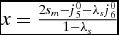
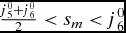
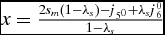
5. The bottom plot depicts the types of Senate median; the conservatism of the median is increasing from left to right. In panels (A), (B), and (D), the vertical axis denotes which justice departed from the Court, relative to the president, and thus whether a proximal or distal vacancy occurred—see the text for discussion of the vertical axis in panel (C). For each panel, each “box” indicates the president’s equilibrium choice of nominee under various combinations of the departing justice and/or the location of the Senate median. For panel (D),
 $x = \frac{2s_m - j_{5}^{0} - \lambda _s j_{6}^{0}}{1-\lambda _s}$
if
 $\frac{j_{5}^{0} + j_{6}^{0}}{2} < s_m <j_{6}^{0}$
;
 $x= \frac{2s_m (1-\lambda _s) - j_{5^{0}} + \lambda _s j_{6}^{0}}{1-\lambda _s}$
if sm
> j
0
6.

For each model, each “box” in Figure 2 indicates the president’s equilibrium choice of nominee under various combinations of the departing justice and/or the location of the Senate median. Importantly, the way to interpret this figure is not as giving a predicted location in a two-dimensional space; instead, this combination creates various nomination “regions” (or “regimes,” in the parlance of Moraski and Shipan Reference Moraski and Shipan1999). In each region we both give the regime a substantive label and denote either the point prediction for the nominee or range of possible nominees.
Choice of nominee in the court-outcome based model
We begin with the president’s selection strategy in the court-outcome based model, which is presented in Figure 2(A). A proximal vacancy creates what we call a “restoring” nomination. Because the president cares only about the median justice in this model, and all nominees n ⩾ j 0 5 result in an unchanged median justice, the president is indifferent among all such nominees. Hence, the court-outcome based model produces a range of possible nominees given such a nominee, and not a point prediction (see Rohde and Shepsle Reference Rohde and Shepsle2007).
Next, consider “distal” vacancies under the court-outcome based model. First, if the Senate median is on the other side of the old median justice, relative to the president, the result is what we call a “gridlock” nomination. Here the best the president can do is choose n = j 0 5, since the Senate will reject any nominee the president prefers more. Since the president and the Senate lie on opposite sides of the old medians, movement in the median is gridlocked.
On the other hand, if a distal vacancy occurs and the Senate median is on the same side of the old median justice as the president, he can move the median. The extent of this movement, however, depends on the relative locations of the Senate median and the president. If the Senate median is closer to the old median justice (type C), then the president offers what we call a “smaller shift” nominee that is the minimum of the president’s ideal point (p) and the indifference point of the Senate median around the old median (2sm − j 0 5). If the Senate median is farther from the old median justice (type D), the president can make what we call a “maximum shift” nomination that moves the median justice as far as possible. Finally, if p > j 0 6, the court-outcome based model also predicts a range of possible nominees—all of which move the median justice to j 0 6, and thus similarly induce a maximum shift in the median justice.
Choice of nominee in the nearly court-outcome based model
Figure 2(B) indicates the president’s equilibrium choice of nominee in the nearly court-outcome based model. As discussed above, in this model the voting strategy of senators is exactly the same as in the court-outcome based model. But because the president is no longer indifferent over nominees who yield the same median justice, the ranges in the restoring and maximum shift nomination collapse to point predictions—in each the president nominates someone who mirrors his own ideology. Whether the president has a choice among (median-equivalent) nominees or is constrained to a single point has implications for work that evaluates how the president chooses among the “short list” of potential nominees—nominees who may look similar ideologically but differ on other important characteristics that the president may value (see, e.g., Nemacheck Reference Nemacheck2008).
Choice of nominee in the position-taking senators model
The nomination strategy for the position-taking senators model is shown in Figure 2(C). For ease of comparison with the rest of the panels, Figure 2(C) arrays nominating strategies for the same types of Senate medians. However, because senators do not care about the location of the new median justice and the president cares at least somewhat about the nominee’s ideology, whether a nomination is distal or proximal is irrelevant for determining the location of the nominee.Footnote 8 Rather, the president nominates a confirmable individual as close to his own ideal point as possible. When the median senator is opposed to the president, we again see a gridlock nomination. When the Senate median is on the same side as the president, the president can move the median justice. Again, he accomplishes a “smaller shift” in the median justice by appointing a nominee n = p or by choosing a nominee at 2sm − j 0 5, depending on the relative locations of the Senate median and the president.
Choice of nominee in the mixed-motivations model
Finally, Figure 2(D) depicts the nomination strategy in the mixed-motivations model. The strategy here is similar to that seen in the position-taking senators model, except now there is a “maximum shift” region; here the president chooses a nominee either at his ideal point or a location (x, defined in the caption of Figure 2) that depends on λ s , but which leaves the median senator indifferent between the nominee and the old median justice.
Robust predictions across models
Using Figure 2, we can discern four robust predictions for presidential choice that hold across all the models:
-
1. Own goals. Looking at all the variants of presidential strategies in Figure 2, it is clear that regardless of the regime, the president should never choose a nominee on the opposite side of the old median justice from himself. The worst-case scenario for the president is a gridlock nomination; across all model variants, in the gridlock scenario the president should choose a nominee exactly at the old median justice. Thus, if a president chooses a nominee on the opposite side of the old median justice, in soccer parlance he would be committing an “own goal.”
-
2. Aggressive mistakes. Recall that a robust prediction for the Senate is that it should never confirm a nominee who moves the median justice farther away from the Senate than the old median justice. Accordingly, the president should never choose such an nominee, since she would be rejected. Such a nominee would thus constitute an “aggressive mistake.”
-
3. Median locked. From Figure 2, it is clear that the “lower left quadrant” of each panel predicts that the president should choose a nominee exactly at the location of the old median justice. In this region, the president and Senate are on opposite sides of the old median justice, and hence the Senate would reject any nominee that would move the median in the president’s direction. We thus say that the president is “median locked.”
-
4. Smaller shift. Finally, it can be seen that the “smaller shift” nomination regions of the court-outcome based and nearly court-outcome based models also apply to the position-taking senators and mixed-motivations models. Whenever the Senate is on the president’s side but is not too “extreme,” and the vacancy is opposite the president, each variant predicts a nominee at the minimum of the president’s ideal point and 2sm − j 0 5.
DATA AND RESULTS
We analyze the 46 nominees who were nominated between 1937 and 2010, 39 of whom were ultimately confirmed. Testing these predictions of MTM theory requires measures of the ideal points of Supreme Court justices, nominees, senators, and the president that exist on the same scale. Fortunately, recent advances in measurement mean that this endeavor is much more feasible than in years past.
We employ two sets of measures, one based on NOMINATE scores (Poole and Rosenthal Reference Poole and Rosenthal1997) and one based on the ideal points developed by Michael Bailey (Reference Bailey2007). Before turning to specifics, we note the relative strengths and weaknesses of each measure. One difference is the manner in which the justices are placed in the same ideological space as presidents and senators. A strength of the Bailey scores is that they are truly interinstitutional: Bailey uses actions taken by members of Congress and the president to “bridge” the gap between the elected branches and the Supreme Court. The resulting ideal points are thus derived from an integrated model of decision making across all three branches.Footnote 9 Moreover, because the Bailey scores are based on position taking by presidents and members that is specifically linked to Supreme Court decisions, the scores exist in a dimension that can be characterized as fundamentally “judicial.” In contrast, no such interinstitutional scores exist for the justices in terms of NOMINATE scores (as described below, to accomplish this transformation we use the president’s ideal point as a bridge). Moreover, NOMINATE measures are based on many types of roll call votes, and not just those related to the judiciary.
The NOMINATE measures, however, carry several advantages. The Bailey scores begin in 1951, preventing us from using them to study nominations during the Roosevelt and Truman administrations. In contrast, the NOMINATE-based measures begin in 1937 and include the 13 nominations by these two presidents—a not insignificant proportion of the 46 nominees in our overall data. In addition, we go beyond nearly all existing work by incorporating uncertainty into our analyses. Because the Bailey scores are based on a far smaller number of observations compared to NOMINATE, which uses all scalable roll call votes, there is far more uncertainty in the former (i.e., the confidence interval for a given actor is wider using her Bailey score than her NOMINATE score). Thus, our ability to make more confident conclusions about our empirical predictions is enhanced with the NOMINATE measures.
Ideal points of presidents, senators, and justices
For the NOMINATE-based measures, we place all relevant actors in the Senate DW-NOMINATE space (Poole and Rosenthal Reference Poole and Rosenthal1997). For senators and presidents, we employ their relevant DW-NOMINATE score at the time of a nomination. To place the justices on the same scale, we follow the lead of Epstein et al. (Reference Epstein, Martin, Segal and Westerland2007) and begin with the Martin-Quinn (Reference Martin and Quinn2002) scores of the justices, which are based on the justices’ voting records. We transform these scores into DW-NOMINATE by using the DW scores of the appointing presidents as a bridge. While the specifics of this procedure are given in Online Appendix A.2, it worth noting that to conduct this bridging, Epstein et al. (Reference Epstein, Martin, Segal and Westerland2007) only use presidents who were seemingly unconstrained in their choice of nominees, based on the results in Moraski and Shipan (Reference Moraski and Shipan1999). Because this choice assumes that MTM predicts presidential selection well, which is exactly what we evaluate, it does not make sense for us to use the same set of presidents. Instead, we use all presidents to estimate the transformation, which means that our choice of observations is not endogenous to MTM theory.Footnote 10 Recall that the Bailey scores include estimates of presidents, senators, and justices on the same scale. Thus, for both sets of measures, it is straightforward to identify the median of the existing court (that is, the status quo), at the time of any given confirmation. To do so, we simply take the median of the ideal points of the nine justices (in the most recent Supreme Court term prior to a given nomination).
Estimated ideal points of nominee
Our next step is to place the location of the nominee into the same space as the other actors. Here we follow prior research and use the Segal-Cover scores (Reference Segal and Cover1989) as a proxy for the ideology of each nominee (Epstein et al. Reference Epstein, Lindstadt, Segal and Westerland2006; Moraski and Shipan Reference Moraski and Shipan1999). These scores are based on contemporaneous assessments of nominees by newspaper editorials. While not flawless, this measure is exogenous to the subsequent voting behavior of the confirmed nominees and it is not based on the president’s measured ideal point, which are both virtues. To place these scores into the same space as NOMINATE or Bailey scores, we regress the respective first-year voting score of each confirmed nominee on their Segal-Cover score. We use the linear projection from this regression to map the Segal-Cover scores into the relevant space. Because every nominee has a Segal-Cover score, this procedure results in comparable scores even for unconfirmed nominees.Footnote 11 With this measure in hand, we can calculate the location of the new median justice (assuming the nominee would be confirmed), as well as necessary distances between a senator and the nominee, and the senator and the new median justice.
Incorporating uncertainty
As with any ideal point measure, both the NOMINATE and Bailey scores are measured with error, and it is important to account for this when testing MTM theory. To do so, we use the relevant ideal points and their corresponding standard errors to generate 1,000 random draws of each actor’s ideal point. With these distributions in hand, we can simulate the location of the existing median justice on the Court 1,000 times, as well as the location of every senator and the Senate median. Thus, for every nominee, we can run empirical tests of nominee location and senatorial voting decision 1,000 times, and use variation within those simulations to make probabilistic estimates of “correct” decisions, depending on the theory’s predictions. (The actual implementation depends on a given test and quantities of interest.Footnote 12 ) This allows us to generate uncertainty in all the measures and tests based on the location of the nominee. (Figure A-1 in Online Appendix A.2 depicts the estimates of the nominees’ ideal points, while Figure A-2 depicts the estimates of the extent to which each nominee moves the median justice, assuming they are confirmed. Both figures include estimates of uncertainty for these quantities.)
The Voting Choices of Senators
Voting by Individual Senators
We begin our empirical analysis with direct tests of the Senate’s roll call voting on nominees, comparing the predictions of each MTM variant with actual voting behavior.Footnote 13 (We exclude from these analyses the three withdrawn nominees—Homer Thornberry, Douglas Ginsburg, and Harriet Miers—whose nominations thus created no Senate voting record.) Recall that under the court-outcome based and nearly court-outcome based models, a senator should vote for the nominee if and only if |si − j 1 5| ⩽ |si − j 0 5|, while under the position-taking senators model a senator should vote yes if and only if |si − n| ⩽ |si − j 0 5|. Finally, for the mixed-motivations model, as described in Figure 1, we identify observations where the predictions are unambiguous, and then compare those predictions to actual votes. For simplicity, we treat voice votes as votes to confirm.Footnote 14
The top part of Table 2 displays the results of this analysis, across both the NOMINATE and Bailey measures. Each “model-measure” pair depicts a two-by-two table of cell proportions, with 95% confidence intervals in brackets (based on the simulations). The results are very similar across the two different measures. For reference, the shaded portions of a given two-by-two table depict where the robust tests can be evaluated. We return to these below.
Predicted versus Actual Votes by Individual Senators (top), and the Senate as a Whole (bottom), in Different Versions of the MTM Theory.

Note: For each two-by-two table, cell proportions are displayed, along with 95% confidence intervals in brackets. The shaded regions indicate the tests of the robust predictions for senatorial voting.
Our direct tests are simple. Given the structure of the two-by-two tables, correct classifications occur on-the-main diagonal, while errors occur off-the-main diagonal. The table reveals that voting errors were very numerous in all three models, but particularly so in the position-taking senators and mixed-motivations models. For the position-taking senators model, in nearly half of all senator observations the model predicted a “no” vote when the senator actually voted yes. The court-outcome based model performs best, correctly predicting about 68% of votes correctly. However, this means that a third of votes were incorrect, according to this variant.
Where do the model’s predictions go wrong? A striking feature across Table 2 is the asymmetry in errors across predicted yes and no votes. Across all three models, if a senator’s vote was predicted to be a “yea,” most votes were in fact “yeas.” Indeed, in the position-taking senators and mixed-motivations models, the percentage of instances in which a senator votes no when he is predicted to vote yes is less than five percent. However, if a senator was predicted to vote no, for each model errors outnumber correct classification by a ratio of at least 3:1. The conclusion is inescapable: historically, senators have been much more accommodating of the president’s nominee than MTM theory would suggest.
We now evaluate the robust predictions for Senate voting. Recall that the court-outcome based model’s prediction of when to reject is robust (the “too much movement” prediction). Due to the asymmetry in errors, this prediction does not perform well. As seen in the shaded area of the court-outcome based model tests in Table 2, when the model predicts a no vote, meaning that the new median justice is farther away from the senator than the old median justice, the senator is still three times more likely to vote yes. Next, recall that the position-taking senators model’s prediction of when to confirm is robust (the “attractive nominee” prediction). As seen in the shaded regions of the position-taking senators model tests, this prediction is supported: when the nominee is closer to a senator than the old median justice, senators almost always vote yes.
Confirmation Decisions
How consequential are these errors for MTM theory in terms of which nominees actually make it to the Supreme Court? One benign possibility is that nonpivotal senators engage in position taking by voting to support nominees even when they are inclined to oppose them for ideological reasons—especially high quality nominees, or nominees with public support in their home states (Kastellec, Lax, and Phillips Reference Kastellec, Lax and Phillips2010; Overby et al. Reference Overby, Henschen, Walsh and Strauss1992). If this were true, MTM theory would fail across many individual votes, but the Senate as a whole might still conform to the theory’s predictions.
This is not the case, however. The bottom part of Table 2 examines predicted versus actual confirmation decisions, using the predicted votes of the Senate median and comparing it to whether the Senate actually confirmed a nominee. (We omit the mixed-motivations model from this analysis because for some nominations the predicted vote of the Senate median is ambiguous.) The results for confirmation decisions are generally very similar to the individual voting analysis. For both measures, the court-outcome based model classifies only about 60% of confirmations correctly. The performance of the position-taking senators model is even more dismal. The former classifies only about 40% of confirmation decisions correctly. Again, when all model variants predict rejection, confirmation is the much more likely outcome.
Because the court-outcome based model’s prediction of when to reject is robust, this means that in nearly one of out every three nominations, the Senate is approving nominees that all variants of MTM theory predict should be rejected. If presidents are selecting nominees to further their own ideological interests on the Court, the Senate’s behavior means the president has much more leeway than MTM theory would suggest.
Presidential Selection of Nominees
In this section we test the first three robust predictions from MTM theory with respect to presidential selection. (Too few nominees fall into the “smaller shift” region to test the fourth robust prediction systematically.)
Own goals
The first two robust predictions are independent of the model-specific regions seen in Figure 2 and hence are straightforward to test. Recall that the president should never commit an “own goal” by choosing a nominee on the “opposite” side of the old median justice, since the worst the president can do is to select a nominee exactly at the location of the old median justice. Figure 3 depicts the distance between the old median justice and the nominee, scaled in the direction of the president, for both the NOMINATE and Bailey measures. The points show the median estimate across simulations for each nominee, along with 95% confidence intervals. Thus, positive values mean that the nominee is on the “correct” side of the president, while negative values (those in the shaded region) indicate an own goal. For nominees in the latter category, the numbers depict the probability that the estimate is statistically less than zero.
Evaluation of “Own Goals” by Presidents. See text for details

Figure 3 reveals that, in general, presidents have avoided scoring “own goals.” In fact, according to the Bailey measures, zero nominees display a statistically significant probability that the nominee was on the wrong side of the old median justice. For the NOMINATE measure, however, for eight nominees the probability that the nominee was on the wrong side of the old median justice is highly statistically significant. This means that in more than 15% of nominations from 1937 to 2010, presidents did make self-induced errors. Moreover, of these nominees, five potentially had the effect of moving-the-median justice in the opposite direction. Thus, in these instances presidents failed to clear the easiest hurdle of MTM theory: do not move the median away from you.
Notably, all such nominations were made by Presidents Roosevelt, Truman, and Eisenhower—including perhaps the most famous own goals, Eisenhower’s nominations of Earl Warren and William Brennan. This means that the last own goals occurred more than six decades ago. This fact accords with the conventional wisdom that presidents have shifted over time towards a policy-making focus in their Supreme Court appointments (Yalof Reference Yalof2001), and means that the modern threat to MTM theory is presidents selecting nominees that move-the-median too far in the direction of the president, rather than away.
Aggressive mistakes
The second robust prediction is that the president should never make “aggressive mistakes”—selecting a nominee who moves the median father away from the Senate median than the old median justice. Before evaluating this prediction, we first examine the incidence of the necessary condition for such a mistake to occur: that the nominee himself is farther from the Senate median than the old median justice. Recall that under the position-taking senators model, the president should not select such a nominee. Thus, for the robust prediction to fail, the position-taking senators prediction must first fail, such that the nominee has the potential to move the median justice too far (relative to the Senate median).
Figures 4(A) and 4(B) depict estimates of the absolute value of the distance between the nominee and the Senate median, minus the absolute value of the distance between the old median justice and the Senate median, along with 95% confidence intervals. Positive values thus indicate that the nominee is father away from the Senate median than the old median justice, while negative values (the shaded regions) indicate that the nominee is closer. Solid dots indicate confirmed nominees, while open dots indicate failed nominees. The plots show that, using the NOMINATE measure, 33 out of 46 (72%) of nominees were “too extreme” relative to the Senate median (i.e., have positive values). For the Bailey measure, some 23 out of 33 (70%) of nominees were too extreme. Moreover, these conclusions generally hold even when accounting for uncertainty. Using the NOMINATE measure, 22 of 33 nominees with positive values have at least a 95% probability of being too extreme (i.e., their confidence interval does not include zero). Under the Bailey measure, 17 of 23 nominees with positive values have at least a 95% probability of being too extreme. Thus, the prediction of the position-taking senators model frequently fails, as the president nominated someone more extreme than the model would predict.
Evaluation of “Aggressive Mistakes” by Presidents. Top: In terms of the nominee. Bottom: In terms of the new median justice. See text for more details

Having established this result, we now evaluate the robust prediction of no aggressive mistakes. Figures 4(C) and 4(D) depict the absolute value of the distance between the new median justice and the Senate median minus the absolute value of the distance between the old median justice and the Senate median, for both measures. Because many nominations do not provide presidents with an opportunity to move the median, the number of nominations in which nominees actually move the median too far is smaller than the number of nominees who themselves are too extreme. But, using the NOMINATE measure, 20 of 46 nominees (43%) moved the median too far, relative to the Senate median. Notably, and consistent with the Senate voting results above, fully 16 of these nominees were confirmed by the Senate, rather than rejected. Out of these 20 nominees, for 11 there exists at least a 95% probability that they moved the median too far (i.e., the point estimate is significantly greater than zero). The results are similar under the Bailey measure: 17 out of 33 nominees moved the median too far; however, only five of these nominees have statistically significant positive values (due in large part to the greater uncertainty in the Bailey measures).
Is the president ever median locked?
The prevalence of aggressive mistakes shows that presidents often select nominees who are too extreme under all variants of MTM theory. But it does necessarily mean that the Senate cannot act as as a greater constraint across different types of nomination. Specifically, recall the third robust prediction, which we denoted “median locked”: for all gridlocked nominations, meaning the vacancy falls on the opposite side of the presidency, the president must select a nominee at the location of the old median justice. Conversely, in other regions, he is free to move the nominee either to his ideal point, or least closer to it, depending on the model variant. A complication arises in evaluating regime-specific predictions given the uncertainty in the data. For some nominations, the predicted location of a nominee (for a given model variant) will not vary significantly across simulations. For other nominations, there exists much greater variance. For instance, in the vacancy that led to Stephen Breyer’s nomination, 100% of simulations result in “restoring” nominations in the court-outcome based and nearly court-outcome based models. Conversely, for Hugo Black, 35% of his simulations place him as a “smaller shift” nomination, 43% as a gridlock nomination, and 21% as a maximum shift nomination. For such nominees, the data are simply too noisy for us to make firm point predictions.
Accordingly, to test the median locked prediction, we select nominees where we are at least 50% confident that the nomination falls into the median locked category—that is, nominees where a majority of simulations place them in this region. (Below we conduct a more systematic regression analysis in which we both use all nominees and distinguish among the different predicted locations across different nomination regimes.) For each of these nominees, we then estimate the difference between the nominee’s estimated ideal point and the old median justice, and well as 95% confidence intervals around that distance. The robust prediction is that the confidence intervals for median locked nominees should include zero (meaning the nominee is located at the old median justice, accounting for uncertainty).
Figure 5(A) depicts the results of this analysis using the NOMINATE-based measures, Figure 5(B) using the Bailey-based measures. (Note that the set of nominees across the two measures differ based on whether the data place them in the gridlock region.) The point estimates show the median difference between the nominee and the old median justice (the confirmed and unconfirmed nominees have, respectively, solid and open circles). Thus, positive (negative) values indicate that the nominee was more conservative (liberal) than the old median justice. We order the nominees by party—Democratic appointees appear in the shaded regions—and then by decreasing differences.
Evaluation of the “Median Locked” Prediction. See text for details

Two strong patterns emerge from Figure 5. First, the robust median-locked prediction fails much more often than not: only rarely do the confidence intervals around the difference between the nominee and the old median justice include zero. For the NOMINATE measures, this occurs in only four out of 21 nominees; for the Bailey measures it occurs in five out of 14. Second, the errors are not random: presidents tend to choose nominees on “their side” away from the old median justice. This is particularly noticeable among Republican appointees, who across both measures are almost always significantly more conservative than the old median justice (the exceptions are Eisenhower’s appointments of Warren, Harlan, and Brennan, using the Bailey scores). To be sure, many of the nominees were ultimately rejected by the Senate. But many aggressive mistakes by Republican presidents nevertheless resulted in confirmation.
For Democratic appointees, the picture is less clear cut. The Bailey measures place only three nominees in the median-locked region—the confidence interval for each includes zero. Under NOMINATE, four Democratic appointees are significantly more liberal than the old median justice, while three Roosevelt appointees are more conservative (Burton, Stone, and Byrnes). Interestingly, the last time a Democratic president was clearly median locked was in 1967, when Lyndon Johnson nominated Thurgood Marshall. This means that the asymmetric polarization among nominees that Cameron, Kastellec, and Park (Reference Cameron, Kastellec and Park2013) document, where Republican nominees have become increasingly conservative over time, has come even as Republican presidents have tended to face greater theoretical constraint from the Senate, in terms of MTM theory.
Regression analysis of presidential selection
Despite the failure of these robust predictions, it could still be the case that presidents are more constrained when they do face gridlock nominations than when they do not. To evaluate this possibility, we conduct a more systematic (but weaker) test of presidential location: does the ideology of the nominee move in accordance with the predictions of MTM theory? Because the court-outcome based model predicts a range of possible nominees under certain conditions, and because the predicted location is sometimes unobservable in the mixed-motivations model, we can only conduct tests of the nearly court-outcome based and the position-taking senators models. We follow the switching regression approach of Moraski and Shipan (Reference Moraski and Shipan1999), in which the predicted location varies across a given region. From Figure 2, it can be seen that for both models, there are three possible predicted locations: the ideal point of the president, the Senate’s indifference point (or “flip” point) around the old median (2sm − j 0 5), and the old median justice. The key difference across the models, of course, is that they will often place the same nominee in a different region, and thus create a different prediction under the same configuration of preferences across actors. Thus, let G denote a gridlock nomination, F a “flip” nomination (where the predicted location is 2sm − j 0 5), and P denote a nomination where the president can appoint someone at his ideal point (which, recall, is denoted with a lowercase p). For each model, we can then estimate the following linear model, which we call the “main” regression:
 $$\begin{eqnarray}
n&=&\alpha + \beta _{1}*G*j_{5}^{0}+ \beta _{2}*P*p\nonumber\\
&& +\, \beta _{3}*F*(2s_{m}-j_{5}^{0}).
\end{eqnarray}$$
Under MTM theory, the predicted coefficients for β1, β2, and β3 is 1, while the predicted coefficient for the constant is 0. In addition, testing each model requires evaluating whether each respective quantity (j 0 5, p, and (2sm − j 0 5)) does not predict nominee location in the regions where it is not supposed to. Let Not G, Not P, and Not F denote instances where a nominee is not in those respective regions. We then fit the following “placebo” regression:
 $$\begin{eqnarray}
n&=&\alpha + \beta _{1}*\text{\emph {Not G}}*j_{5}^{0}+ \beta _{2}*\text{\emph {Not P}}*p\nonumber\\
&& +\, \beta _{3}*\text{\emph {Not F}}*(2s_{m}-j_{5}^{0}).
\end{eqnarray}$$
The predicted coefficients for β1, β2, and β3 is 0.
Table 3 presents eight models—the dependent variable in each is the nominee’s estimated location. Each regression accounts for the uncertainty in the independent variables; the brackets under each estimate depict 95% confidence intervals.Footnote 15 There are four regressions each for the nearly court-outcome based and position-taking senators models: the models alternate between the NOMINATE- and Bailey-based measures.
Linear Regression Models of Presidential Selection

Notes: In each model the dependent variable is the estimated location of the nominee. 95% confidence intervals in brackets, which are estimated via simulation. The R 2 values presented are the mean R 2 estimate across all simulations, for a given model.
Beginning with the nearly court-outcome based model, Models (1) and (2) present the main regressions. While the coefficients on the Gridlock × j 0 5 are in the predicted direction, the confidence interval for each includes 0 (though they both also include 1). In contrast, the coefficients on President predicted × p are both statistically larger than 0; however, they are statistically less than 1, meaning nominee location does not vary as strongly with presidential ideology as MTM theory would predict. Finally, the coefficients on Flip × 2s − j 0 5 are indistinguishable from both 1 and 0 (the confidence intervals are much larger due to the small number of observations that fall into the flip region). Thus, the main regressions show at best weak support for the nearly court-outcome based model.
The next key question is whether a given actor’s ideology does not predict nominee location in the regions where it is not supposed to. Models (3) and (4) test the placebo regression for the nearly court-outcome based model. The coefficients on Not gridlock × j 0 5 are statistically indistinguishable from zero. However, the coefficients on Not president predicted × p are positive and significantly different from zero, meaning that presidents choose nominees based on their own ideology even when they should not be able to. Moreover, the magnitude of the effect of the president’s ideal point is statistically indistinguishable when we compare the coefficient on President predicted × p in the main regressions to the coefficient on Not president predicted × p in their placebo counterparts.
Turning to the position-taking senators model, the results tell mostly a similar story. The main regressions in Models (5) and (6) show that Gridlock × j 0 5 is both positive and either statistically distinguishable from 0 or very close to it (the confidence interval in Model (6) only barely includes 0). The coefficients on President predicted × p are both positive, although under NOMINATE the confidence interval includes 0. (Recall that the president is much more constrained in the position-taking senators model, since the Senate evaluates the nominee against the old median justice; this means that there are many fewer observations in which the predicted location is at the ideal point of the nominee, thereby increasing the uncertainty of the estimate.) Both coefficients, however, are also statistically indistinguishable from 1, as the theory predicts. Finally, the coefficients on Flip × 2s − j 0 5 are indistinguishable from both 1 and 0.
As with the nearly court-outcome based model, these results provide weak support at best for the position-taking senators model. Moreover, when we turn to the placebo models in Models (7) and (8), we again see that the president’s ideal point predicts nominee location even under conditions when it should not. Thus, combining these results with our robust tests above, it is clear that the president has much more influence over the location of Supreme Court nominees than MTM theory would predict.
DISCUSSION
We combined a generalized theoretical framework with new empirical tests of move-the-median theory that exploit recent advancements in interinstitutional scaling. We found that MTM theory—while providing an elegant, concise, and integrated theoretical account of presidential selection choices and Senate confirmation decisions—does a poor job of capturing the actual politics of Supreme Court nomination. First, individual senators and the Senate as a whole have been far too accommodating of the president than all variants of MTM theory would predict, leading to the confirmation of many nominees who should have been rejected. Second, while earlier presidents occasionally suffered “own goals,” the more persistent pattern is that presidents have been far more aggressive in their nominations that MTM theory would predict. Thus, using more nominations and superior measures, we reach a different conclusion about presidential choices than Moraski and Shipan (Reference Moraski and Shipan1999). In particular, where they find the president to be constrained by the location of the Senate median at times, we generally do not. Our results thus accord with the findings of Anderson, Cottrell, and Shipan (Reference Anderson, Cottrell and Shipan2015), who show that the outputs of the Court (i.e., the location of the median justice, as inferred by the Court’s voting behavior) shifts much more substantially when the president makes a “constrained” nomination than MTM theory would predict.
What explains these failures of MTM theory? We conclude by discussing a variety of potential explanations. Our discussion is informed by the specific patterns in the data we documented above, by our reading of the broader literature on Supreme Court confirmations, and, in some cases, supplementary analyses that we present in Online Appendix A.
The multiple motivations of presidents and senators
MTM theory posits a bargaining environment in which presidents and senators care solely about ideology. While our mixed model allows for each to care both about the policy outputs of the Supreme Court and the ideological characteristics of the nominee herself, the world of MTM theory is a circumscribed one that rules out other motivations for presidents and senators in the confirmation process. In reality, presidents and senators have multiple goals they seek to achieve through the nomination and confirmation process—goals that have varied across contexts and time.
Consider the pattern of “own goals” we find by some presidents. From the perspective of MTM theory, such self-induced mistakes are incomprehensible—at the bare minimum, the president should be able to keep the median justice from moving in the wrong direction. Yet, once we consider the fact that earlier presidents emphasized a number of criteria in their selection of nominees, such “mistakes” become more explicable.
First, historically presidents have frequently used Supreme Court nominations to repay political favors. Such motivations were more often present in earlier eras, before presidents focused more intensely on policy considerations in nominations. President Franklin Roosevelt, for example, nominated James Byrnes—a conservative Southern Democrat—because he had been a loyal New Dealer and a friend of the president (Abraham Reference Abraham2008, 181). More famously, it is often alleged that Eisenhower selected Earl Warren as repayment for Warren’s support in the 1952 Republican convention, which helped Eisenhower secure the nomination (Yalof Reference Yalof2001, 44). We suspect that if our data were extended backwards to cover earlier nominees, we would find more “own goals” of this type.
Second, presidents have often considered the demographic composition of the Court, and used nominations to secure a justice with a particular characteristic. Perhaps most famously, President Johnson nominated Thurgood Marshall with the intent of selecting the first African-American justice, and President Reagan nominated Sandra Day O’Connor with the intent of selecting the first female justice. Neither of these nominees constituted own goals in our analysis because they were sufficiently liberal and conservative, respectively. However, President Truman nominated Harold Burton explicitly because he was a Republican. Truman, along with some Democratic members of Congress, believed it would be inappropriate to have only one Republican appointee on the Supreme Court; in addition, Truman and Burton were good friends (Yalof Reference Yalof2001, 23). And, in perhaps the most famous “own goal” of all time, Eisenhower selected William Brennan in part because he wanted to reinstate the “Catholic seat” on the Court, as Catholics were an important part of Eisenhower’s reelection constituency. And, similar to the Burton nomination, Eisenhower thought selecting a Democratic appointee would enhance his bipartisan appeal (Yalof Reference Yalof2001, 55–61). Thus, in many nominations that were clearly ideological own goals, presidents satisfied multiple political goals.
The importance of nominee characteristics and Senate deference
While the existence of own goals is problematic for MTM theory, it is not (necessarily) problematic for senators, since a president’s own goal may work to the advantage of the majority of the Senate, should the two be in opposition. However, the more persistent pattern we document with respect to presidential selection is that the president has been far more aggressive in his nominations than MTM theory would predict. Under MTM theory, this is a significant problem for senators, since (a) the president, in equilibrium, should not be making such nominations, and (b) if he does so, the Senate should always reject. We have shown that (b) is not the case. One way to summarize this pattern of results is that senators appear to exhibit a general tendency of deference toward’s the president’s nominees—senators vote to confirm them even when the stark ideological-based prediction of MTM theory is rejection.
How might multiple motivations among senators explain such deference? To answer this question, we can turn to the extensive literature on roll call voting on Supreme Court nominees, which shows that the legal qualifications of a nominee (i.e., their “quality”) is an important predictor of Senate voting, with higher quality nominees more likely to be favored by senators, ceteris paribus (see, e.g., Cameron, Cover, and Segal Reference Cameron, Cover and Segal1990; Epstein et al. Reference Epstein, Lindstadt, Segal and Westerland2006). The story here is that quality adds a valence characteristic that all senators value, regardless of their ideological assessment of a particular nominee, because having high quality justices is generally desirable. (This desire is also connected to the idea that the Supreme Court is different from other institutions, to which we turn shortly.) Thus, a confirmed “aggressive mistake” such as Lewis Powell becomes more understandable once we consider the fact that Powell was a highly accomplished attorney who was universally believed to be qualified for the Supreme Court (Abraham Reference Abraham2008, 246).
Similarly, party loyalty appears to weigh on senators’ confirmation votes, and induces senatorial deference to the president: senators of the president’s party are more likely to support a nominee, ceteris paribus. To the extent that ideology and partisanship overlap, this poses little problem for MTM theory. However, in some instances the theory will predict that a moderate senator of the president’s party should reject a nominee who is too extreme (in the direction of the president). Nevertheless, party loyalty may push such a senator to confirm the nominee.
To confirm the role of quality and party in the senator voting errors we found above, we conducted an analysis of the “false yeas” in our data. For each observation where senators were predicted to vote no, we regressed their actual vote choice on the senator’s same-party status and on the nominee’s perceived legal quality, using the standard newspaper-based measure of quality (Cameron, Cover, and Segal Reference Cameron, Cover and Segal1990), while also controlling for the distance between the nominee and the senator. The results, which are presented in Table A-2 in Online Appendix A, are clear: across all models, voting errors in the yes direction—i.e., voting yes when MTM theory predicts no—are more likely when the senator is of the president’s party, and when a nominee’s legal quality is higher (see Section A.3.1 for details). These results confirm that Senate deference to the president along at least two dimensions—favoring high quality nominees and loyalty to the president—contribute significantly to the pattern of senator voting errors we have documented.
Is the Supreme Court different?
While our empirical analysis focuses solely on a single institution, it is worth speculating whether MTM theory might fare better in a different institutional context. For example, would the theory better capture the politics of nominations and confirmations on regulatory agencies (cf. Snyder and Weingast Reference Snyder and Weingast2000)?
One place to start this inquiry is to consider the assumption that Supreme Court nominations are a one-shot game. This is obviously false, but the way in which it is false matters for how we consider the implications of our findings. Certainly the game continues in the event of a rejection of a Senate, but repetition will only change the strategic consideration of the players if something changes over time—for example, the ideal points of the players. Thus, the two-period model in Jo, Primo, and Sekiya (Forthcoming) analyzes how MTM theory changes if the presidency probabilistically changes parties following a rejection of a nominee by the Senate. Under some conditions, presidents are incentivized to make “compromise” appointments that the Senate will accept to preempt the possibility that the Senate rejects a more extreme nominee and a president of the opposite party is able to appoint the justice.
Another possibility, and one that might be more consistent with our results, is based not on changing preferences, but rather on differences between the president and the Senate in terms of the costs of rejection. MTM theory envisions a tough Senate willing to reject nominees who are too extreme, relative to the status quo, leaving a vacancy on the Court. But would an extended vacancy, arising from (say) repeated rejections of well-qualified but somewhat extreme presidential nominees, or a flat refusal to even consider such a nominee, be politically tenable? It is well documented that courts tend to have greater legitimacy and are more respected than other political institutions (Gibson Reference Gibson2012). The Supreme Court in particular is a salient and well-known institution—and during nomination battles, even a nonattentive public is likely to cast its eyes on the proceedings (Kastellec, Lax, and Phillips Reference Kastellec, Lax and Phillips2010). Because of the Court’s extraordinary legitimacy and high visibility, senators may pay an electoral price from rejecting well-qualified albeit somewhat extreme nominees. The president, on the other hand, may pay little or no electoral cost from offering well-qualified but somewhat extreme nominees. In other words, the interaction between president and senators may implicitly have some elements of a war of attrition, one with a presidential advantage. If this is true, then the president would enjoy a nominating advantage substantially greater than that envisioned in MTM theory.
By contrast, nonjudicial institutions like independent regulatory agencies do not enjoy the same reservoir of institutional legitimacy as courts, particularly the Supreme Court. In addition, nominations to such agencies are typically low salience affairs. Hence, the president may enjoy no war-of-attrition advantage. If so, the strategic situation may correspond more closely to the assumptions of MTM theory. Certainly, while extended vacancies on the Supreme Court are rare, vacancies in other multimember bodies can and do persist for years. For example, the board of the Federal Reserve—whose power surely rivals that of the Supreme Court—has had at least one vacancy for more than 60% of the time over the past two decades. To give another example, between January 2008 and July 2013, the National Labor Relations Board never had its full slate of five members. Thus, it is clear the Senate is capable of tolerating extended vacancies on these agencies, implying presidential deference to the Senate if the chief executive really wants to fill the vacancy.
It is also striking that delays in confirmations are much more prevalent for lower federal court judges than for Supreme Court nominees, with some lower court nominees waiting years for a floor vote. MTM theory does not translate immediately to the district courts and the Courts of Appeals, since cases are heard by either a single judge (in the former) or a panel of three (in the latter), chosen among the judges in a given jurisdiction. Still, considering that both presidents and senators care about the ideological makeup of the federal judiciary, similar MTM theory dynamics could be at play in lower court confirmations. And, the relatively low salience of these courts may mean that an extended vacancy on a federal district or circuit court may seem quite tenable to senators. Seemingly, senators pay little cost for obstructing lower court nominees. A worthwhile endeavor would be to apply our theoretical and empirical framework to both independent agencies and other multimember courts in order to determine whether MTM theory systematically fares better in these settings than it does for the Supreme Court.
The evolution of Supreme Court confirmation politics over time
Finally, recent scholarship on Supreme Court confirmation politics suggests that we may be witnessing a significant change in the underlying dynamics of the nomination and confirmation process. Epstein et al. (Reference Epstein, Lindstadt, Segal and Westerland2006) show that ideological considerations have played an increasingly larger role in senatorial evaluations of Supreme Court nominees—with a notable shift following the Senate’s rejection of Robert Bork in 1987. In addition to confirming this trend, Cameron, Kastellec, and Park (Reference Cameron, Kastellec and Park2013) note the growing influence of elite polarization on the confirmation process. As is well known, the Senate has grown increasingly polarized since the middle of the 20th century, to the point where there is almost no overlap between Democrats and Republicans. Less well known is that nominees themselves have become increasingly ideologically extreme—this is due primarily to Republicans appointing more conservative nominees. While nominee quality and party loyalty still play an important role in confirmation politics (Epstein et al. Reference Epstein, Lindstadt, Segal and Westerland2006; Shipan Reference Shipan2008), nomination politics have become increasingly contentious, as measured by the likelihood that senators will vote to reject a nominee (Cameron, Kastellec, and Park Reference Cameron, Kastellec and Park2013).
This growing contentiousness suggests that, even as MTM theory performs poorly across our sample of nominees dating back to 1937, its performance may have improved over time. To evaluate whether this is the case, in Online Appendix A we present an analysis in which we evaluate the accuracy of MTM predictions with respect to Senate voting over time, in two ways. First, for each nominee we calculate the probability of a mistake by the full Senate—that is, if the Senate confirms when the theory predicts rejection and vice versa. Next, we examined errors at the level of individual roll call votes. As noted above, most errors are “false negatives”—instances where senators are predicted to vote no but actually vote yes. We thus focus on these errors, and calculate the proportion of false negatives for each nominee. For both analyses, we evaluated both the court-outcome based and position-taking senators models. (See Online Appendix Section A.4 for more details.)
These analyses reveal that the incidence of mistakes by the full Senate was high in early decades, particularly using the position-taking senators model. Indeed, the probability of mistaken confirmations was exactly one for the majority of nominees through the 1960s. In addition, we find that even today, significant classification errors still persist. For example, under the position-taking senators model, both Roberts and Alito should have been rejected, while the court-outcome based model predicts that neither Souter nor Thomas should have been confirmed. However, we show that the likelihood of MTM mistakes under both models has declined considerably in recent decades. MTM theory envisions bare-knuckle, bruising, intensely ideological, and highly strategic contests. We have shown that overall this picture does not seem to capture the politics of confirmations and nominations very well. However, if Supreme Court nominations shift more permanently in the direction of high stakes ideological fights, then surely MTM theory will do a better job than it has done to date.
SUPPLEMENTARY MATERIAL
To view supplementary material for this article, please visit http://dx.doi.org/10.1017/S0003055416000496
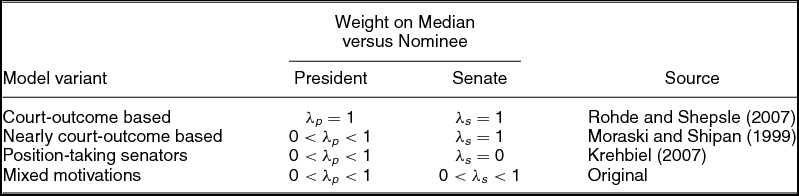
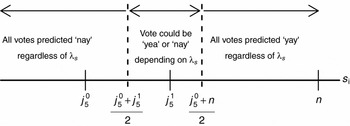
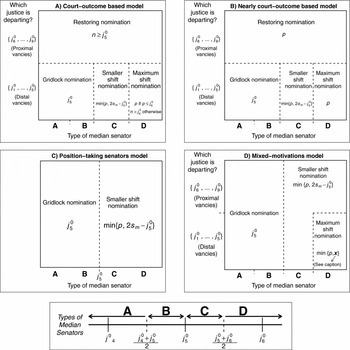
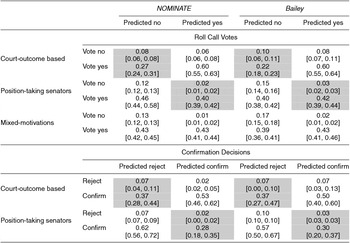
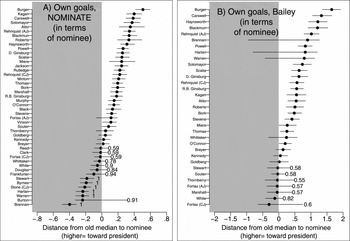
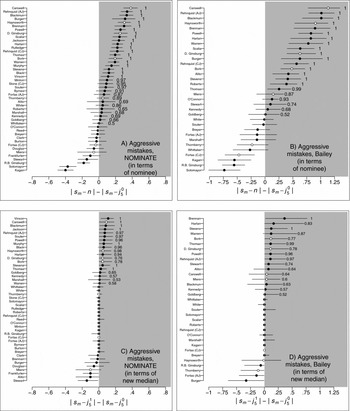
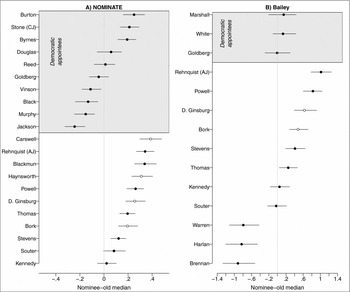
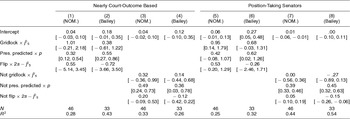




Comments
No Comments have been published for this article.