Introduction
Much research has been published on awareness of deficits in dementia, especially in Alzheimer's disease (AD), and studies show that impaired awareness is a common symptom even in the earliest stages of AD (Starkstein et al., Reference Starkstein1997;Vogel et al., Reference Vogel, Stokholm, Gade, Andersen, Hejl and Waldemar2004). During the last decade, studies have contributed to a better understanding of how awareness may present (Clare et al., Reference Clare2012), but most studies were cross-sectional. In cross-sectional studies, lower Mini-Mental State Examination (MMSE) can be found in patients with impaired awareness than in patients with high awareness (Vogel et al., Reference Vogel, Waldorff and Waldemar2010), and patients with low awareness have more neuropsychiatric symptoms than patients with intact awareness which may lead to increased caregiver distress (Aalten et al., Reference Aalten, van, Clare, Kenny and Verhey2005;Vogel et al., Reference Vogel, Waldorff and Waldemar2010).
Awareness is unlikely to be stable over time; however, very few longitudinal studies on awareness in dementia have been conducted. The methods and findings from the six longitudinal studies published before 2006 have previously been described (Clare and Wilson, Reference Clare and Wilson2006). Briefly summarized, some of these studies showed that the discrepancy between patients’ and informants’ ratings of the patients’ memory was larger when rated 1 to 2 years after a baseline evaluation (Starkstein et al., Reference Starkstein1997;Vasterling et al., Reference Vasterling, Seltzer and Watrous1997; Derouesne et al., Reference Derouesne, Thibault, Lagha Pierucci, Baudouin Madec, Ancri and Lacomblez1999). This has also been found in more recent studies (Akai et al., Reference Akai, Hanyu, Sakurai, Sato and Iwamoto2009). Larger patient–caregiver discrepancies over time may reflect lower level of awareness; however, most studies studying discrepancies have found that informants’ ratings of the patients’ memory declined over time while patients’ ratings of their own memory were more stable. Studies using clinician-based ratings of awareness found that some patients had higher awareness level over time, others declined, and a relatively large proportion remained stable (McDaniel et al., Reference McDaniel, Edland and Heyman1995). Most of these studies have included a relatively small number of patients, and in some cases most of the included patients had moderate dementia (McDaniel et al., Reference McDaniel, Edland and Heyman1995; Starkstein et al., Reference Starkstein1997). Recent studies on longitudinal change of awareness in AD include a detailed multimodal study of 12 mild AD patients over one year where the overall finding was that (at a group level) there were no significant changes, but individual profiles showed small changes in the different awareness domains. In a sample of mild dementia patients (51 patients with AD, vascular dementia, or mixed dementia) followed for 20 months, no significant change in awareness was found at a group level despite progression of cognitive impairment (Clare et al., Reference Clare2012). These findings indicate that awareness does not necessarily decrease in the mild stages of dementia although cognitive deficits increase.
To summarize, very few studies on longitudinal changes in awareness in patients with mild AD have been conducted, and some of these studies had small populations or included patients with different dementia diseases. These limitations together with the different methodological approaches which have been used to measure awareness make the current understanding of longitudinal trajectories of awareness in AD limited. The present study aimed to investigate changes in clinician-rated awareness in patients with mild AD over a 3-year period. Further, we wished to investigate if longitudinal changes in awareness were associated with cognitive decline and an increase in neuropsychiatric symptoms.
Methods
Data from this study were based on data from a Danish longitudinal multi-center study (the Danish Alzheimer Intervention Study, DAISY), which investigated the efficacy of an intensive structured intervention program with counseling and support to patients with mild phase AD and their caregivers. It was designed as a multi-center, rater-blinded randomized controlled trial with randomization to an intensive program or to usual care (Waldemar et al., Reference Waldemar2011). At baseline and at follow-up, all patients and their primary caregiver were interviewed using separate structured questionnaires. The interviews were performed by a local project coordinator.
Data in this study were from the baseline examination (T1) and follow-up visits at 12 (T2) and 36 months (T3).
Participants
The DAISY study included 330 home-living patients with a recent clinical diagnosis (within less than 12 months of inclusion) of probable AD, mixed AD (defined as patients meeting the criteria for probable AD with minor vascular lesions, which could not explain the cognitive impairment), or dementia with Lewy Bodies (DLB), confirmed by the local specialist referral unit (memory clinic). In this study focusing on AD, patients with DLB (N = 9) were excluded. All AD patients met the NINCDS-ADRDA criteria for probable AD (McKhann et al., Reference McKhann, Drachman, Folstein, Katzman, Price and Stadlan1984). Further inclusion criteria were age ≥50 years and MMSE score of 20 or above. Further, patients should have a primary caregiver with contact at least once per week that were willing to participate in the study. Exclusion criteria were severe somatic or psychiatric comorbidity (including impaired hearing or vision), which would significantly impair cooperation in the program. Patients with severe psychiatric comorbidity were excluded because participants should be able to follow a counseling program, which was the primary aim of the DAISY study. The number of excluded patients with psychiatric comorbidity has not been recorded, but it was low (less than 10). Also, patients participating in other intervention studies were excluded. Patients were recruited from local memory clinics, local specialists in psychiatry, neurology and geriatrics, as well as from general practitioners.
The DAISY study was an intervention study and for the investigation of longitudinal change in awareness of deficits we only included participants from the usual care (“control”) group to exclude potential confounding of the DAISY intervention. In total, 95 patients were assessed with the awareness scale in this study at all three time points, and data from these participants were included in this study.
The DAISY project was approved by Danish Data Protection Agency (j. nr. 2003-41-3178), by the Ethical Committee (j. nr. (KF) 02-005/04) and the trial was registered in Current Controlled Trials number ISRCTN74848736. All patients and caregivers gave informed consent to participation in the study. The results from the intervention study have been published (Waldorff et al., Reference Waldorff2012; Phung et al., Reference Phung2013).
Assessment of awareness
Anosognosia rating scale
A categorical three point scale from Reed et al. (Reference Reed, Jagust and Coulter1993) was used. This scale has high inter-rater reliability (Reed et al., Reference Reed, Jagust and Coulter1993) and corresponds well with other measures of awareness (Vogel et al., Reference Vogel, Stokholm, Gade, Andersen, Hejl and Waldemar2004). Based on cognitive testing and interviews with the patient and the caregiver, a clinician rated the patient's level of awareness. Awareness was classified into the following categories: “Full awareness,” “shallow awareness,” and “no awareness,” For a detailed description, see Reed et al. (Reference Reed, Jagust and Coulter1993).
Assessment of cognition and neuropsychiatric symptoms
mmse
MMSE is used to identify cognitive impairment, to assess the severity of cognitive problems, and to monitor cognitive changes over time. The scores range from 0 to 30, higher scores indicate better cognitive functions (Folstein et al., Reference Folstein, Folstein and McHugh1975). Change from baseline was assessed at 12 months (MMSE 12) and at 36 months (MMSE 36).
Neuropsychiatric inventory (npi-q)
NPI-Q is a clinical interview-based instrument that has been designed to evaluate neuropsychiatric symptoms in dementia. It measures 12 categories of symptoms and is administered to the informant/caregiver in an interview format. The caregiver provides a retrospective account (last one month) of the presence of neuropsychiatric symptoms of the patient. For each of the symptoms present, the caregiver was then asked to rate the severity of the symptom on a scale from 1 to 3 with 3 being the most severe. The NPI-Q yields a total severity score (0–36), with higher scores indicating more pronounced symptom severity (Kaufer et al., Reference Kaufer2000). Change from baseline was assessed at 12 months (NPI-Q 12) and at 36 months (NPI-Q 36).
Cornell scale for depression in dementia (csdd)
This is a 19-item depression scale that has been designed to measure depression in dementia (Alexopoulos et al., Reference Alexopoulos, Abrams, Young and Shamoian1988). The interviewer administers the scale in two steps. First, the caregiver is asked about the patient's depressive symptoms based on observations of the patient during the last week before the interview. Following this, the rater interviews the patient, and based on his judgment from the two interviews, marks each of the items. The total score range is 0 to 38, with higher score indicating more pronounced depressive symptoms. A score below 6 as a rule is associated with absence of significant depressive symptoms; scores above 10 indicate probable major depression. Change from baseline was investigated at 12 months (CSDD 12) and at 36 months (CSDD 36).
Statistical analysis
Change from baseline in MMSE, NPI-Q, and CSDD was investigated by paired samples t-test. To evaluate the association between a change in the Anosognosia Rating Scale at 12 and 36 months and a change in other clinical variables, changed scores were calculated. Patients were grouped in three groups based on their awareness ratings at 12 and 36 months as compared to baseline score: same awareness score, higher awareness, or lower awareness. The significance of differences between the three groups as divided by change from baseline on the Anosognosia Rating Scale was assessed by One Way analysis of Variance (ANOVA). The Kruskall–Wallis test was used when inhomogeneity of variances were found. Post hoc comparisons were performed using the Dunnett t-test (2-sided) (to adjust for multiplicity). The γ test was used on ordinal variables. The χ2 test was used on nominal variables. The level of significance was set at p < 0.05.
Results
Baseline patient characteristics and awareness ratings
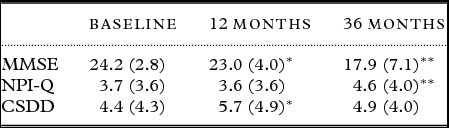
Of the 95 included patients, 40 (42%) were men and 55 (58%) women. The mean age of the patients (at baseline) was 75.7 ± 6.3 years (range 58–88 years). Patients’ mean MMSE at baseline was 24.2 ± 2.8. Education was measured on a five-point scale describing the post school educational level of the patients (all people in Denmark have at least 7 years of formal schooling). In this sample, 45% had low education (up to two years), 18% had three years post school education, and 37% had longer education. The results from MMSE, NPI-Q, and CSDD at the three points of assessment are shown in Table 1. Over three years there was a mean decline in MMSE of 6.3 points. The results from NPI-Q remained relatively stable over three years, indicating that the frequency of neuropsychiatric symptoms was low in this patient group. Caregivers/informants were spouses for 64.4% of the patients, 28.4% were children, and the remaining caregivers (7.4%) had other relation to the patient. There were no professional caregivers.
MMSE score and rating on NPI-Q and CSDD (baseline and follow-up visits). Results are shown as mean (SD)

*Significant difference from baseline (p < 0.05).
**Significant difference from baseline and 12 months follow-up (p < 0.05).
In Table 2, awareness rating results are shown for the baseline rating and for the 12 months follow-up. At baseline, 32.6% were rated with “full awareness,” 54.7% with “shallow awareness,” and 12.6% were rated with “no awareness.”
Awareness ratings at baseline (T1) and at 12 months follow-up (T2)

Change in awareness rating
Table 2 shows the ratings for T1 and T2. A total of 25 (26%) of the patients were rated with lower awareness rating at T2 as compared to T1. The large majority of these (N = 22) were rated with “full awareness” at baseline, whereas three patients were rated with “shallow awareness” at baseline. At T2, 15 patients (16%) had a higher awareness rating when compared to results at baseline, and 13 out of the 95 patients who were rated with “shallow awareness” or “no awareness” at baseline were rated with “full awareness” at T2.
The ratings from T1 and T3 can be seen in Table 3. Lower ratings were found for 37 patients (39%) at T3 as compared to T1 and higher ratings were found in 15/95 patients (16%). Results comparing T2 and T3 are shown in Table 4. Over these two years, 25 patients had lower awareness ratings and 13 had ratings indicating higher awareness.
Awareness ratings at baseline (T1) and at 36 months follow-up (T3)

Awareness ratings at 12 months follow-up (T2) and at 36 months follow-up (T3)

Change in awareness rating and association with change in other clinical symptoms
Table 5 shows change in clinical variables (at 12 months) compared for groups based on change in awareness ratings (12 months as compared to baseline). ANOVA showed no significant effect of group for MMSE 12 (F(2,94) = 0.63, p = 0.54), NPI-Q 12 (F(2, 94) = 0.26, p = 0.77), or CSDD 12 (F(2,94) = 0.56, p = 0.58). Thus, awareness ratings at 12 months as compared to baseline were not associated with significant change in any of the clinical variables that were measured.
Change in clinical variables (12 months) compared for groups based on change in awareness ratings (12 months as compared to baseline). Results are presented as mean (SD)

Note: Negative scores indicate worse results.
Table 6 shows change in clinical variables (36 months) compared for groups based on change in awareness ratings (36 months as compared to baseline). There was a significant effect of group for MMSE 36 (F(2,90) = 6.08, p = 0.003). Group comparisons showed that patients with lower awareness as compared to baseline had a significant decline in MMSE as compared to patients with improved awareness (p = 0.002) but not to patients with stable awareness (p = 0.517). There was a significant effect of group for NPI-Q 36 (χ2 (2) = 12.9, p = 0.002). Group comparisons showed that patients with lower awareness as compared to baseline had significantly NPI-Q 36 as compared to patients with stable (p = 0.041) or improved awareness (p = 0.025). The NPI-Q total score at 36 months was primarily driven by scores on apathy (48%) followed by disinhibition (33%), agitation (33%), and depression (31%). However, the presence of these symptoms was not significantly associated with the level of awareness. Low awareness at 36 months was significantly associated with the presence of both delusions (γ = −0.59, p = 0.001) and hallucinations (γ = −0.55, p = 0.03).
Change in clinical variables (36 months) compared for groups based on change in awareness ratings (36 months as compared to baseline). Results are presented as mean (SD)

*Significant effect of group (p < 0.01).
Note: Negative scores indicate worse results.
There was no significant effect of group for CSDD 36 (F(2,93) = 0.14, p = 0.87). There was no significant effect of gender (χ2 = 0.05, p = 0.97), education level (γ = −0.04, p = 0.77), or age (F(2,94) = 0.31, p = 0.73) on change in awareness from baseline to 36 months (data not shown).
Discussion
The results from this study show that despite overall cognitive decline, awareness was stable over three years in many cases and in some cases even improved awareness was found. After 12 months, 25% had a lower awareness rating as compared to baseline, and about 40% of the mild AD patients had lower awareness after three years as compared to baseline. During the first year, a decline in awareness score was not associated with change in any of the variables at study, but patients with lower awareness at 36 months (as compared to baseline) had a more rapid increase in neuropsychiatric symptoms as compared to patients with improved or stable awareness over 36 months. The most frequently occurring neuropsychiatric symptoms primarily driving this association were apathy, disinhibition, agitation, and depression. A more rapid decline in MMSE score was observed for patients with lower awareness at 36 months (as compared to baseline) but only when compared to patients in whom awareness improved over time.
To our knowledge, this is the first study to investigate awareness over a three-year period in a large group of mild AD patients. Awareness can be investigated using different methods, and in this study, a crude clinician-based rating was used. Awareness is a very complex construct and may be very difficult to measure for scientific purposes. Previous studies using clinician-based ratings of awareness also found that some patients improved in awareness level over time, that some declined, and that a relatively large proportion remained stable (McDaniel et al., Reference McDaniel, Edland and Heyman1995; Starkstein et al., Reference Starkstein1997). In these previous studies, most of the included patients had moderate dementia, relatively small patient samples were included, and the follow-up period was typically about one year. The results from our study are in accordance with the results from previous studies based on clinician-based ratings by showing that awareness may remain stable or even improve over longer periods. Our results extend these findings to mild stage AD and also show that even in mild stage dementia awareness is impaired in many patients. A limitation of studies using a simple categorical scale to measure awareness is that this type of rating captures awareness at a very global level not specifically defined. Categorical awareness ratings may concern different aspects of awareness at different times (e.g. memory problems may be the largest problem in the earliest phase, but after some time adaptation to impaired memory may occur and other symptoms may be more problematic). Thus, this method gives no specific information about the type of changes in awareness. In our study, we also used a relative simple measure of cognition (MMSE), and the global instruments used in our study may have muted any correlations between cognitive decline and decline in awareness if such exits. Thus, studies using more comprehensive measures for both awareness and cognition should be conducted to explore this possible relation in more detail. In mild AD, issues of practice effects and ceiling effects will be more prominent than in a more severely affected group. Such issues may have affected the 12-month data.
Another way of measuring awareness is by using discrepancy ratings between patients and informants on questionnaires (e.g. concerning memory). Some longitudinal studies have used this approach over time and these have typically investigated specific aspects of functioning such as memory. The studies show that the patients’ ratings of their memory decline more than caregiver ratings of the patients’ memory over time which may indicate a more impaired awareness in a longitudinal perspective (Vasterling et al., Reference Vasterling, Seltzer and Watrous1997; Akai et al., Reference Akai, Hanyu, Sakurai, Sato and Iwamoto2009). However, more recent studies with longer follow-up intervals and more comprehensive methods for examining awareness show stability in awareness over time despite an increase in dementia-related symptoms and progressing cognitive decline (Clare et al., Reference Clare2012). This later study used discrepancy-based methods for awareness relating to many functions including memory, everyday activities, and socio-emotional functioning. In accordance with our results, this longitudinal study showed that extensive changes in awareness over time are infrequent and that awareness may improve or decline over time. On a group level, the 51 patients followed for up to 20 months declined in MMSE score but the patient group in this study included AD patients and patients with vascular dementia. Patients with vascular dementia may not have progressing cognitive deficits as found in AD, and some patient (e.g. with posterior left-sided lesions) may not have impaired awareness. Thus, these findings are not representative for a pure AD group. In a prospective longitudinal study following 12 AD patients for 12 months with detailed awareness measures, different longitudinal trajectories of awareness were found in mild/moderate stage dementia, with some showing no change, other decline, and other had improved awareness over time (Clare and Wilson, Reference Clare and Wilson2006).
Although different longitudinal studies on trajectories of awareness in mild dementia and AD have used different methodological approaches, the general picture from this and the previous studies is that some mild AD patients decrease in awareness over time, especially when measured over three years. However, there seems to be no straightforward association between a cognitive decline and decreased awareness. This lack of clear relationship may to some degree be explained by the fact that awareness is dependent of dysfunctions in particularly right hemisphere functions and frontal regions (Vogel et al., Reference Vogel, Hasselbalch, Gade, Ziebell and Waldemar2005; Salmon et al., Reference Salmon2006).
Attrition may be a problem in longitudinal studies but to examine changes of awareness in a larger patient group we chose to include only patients followed for 36 months. This, together with the fact that the patients had been selected for an intervention study (but were randomized to a no intervention group), may have led to an overrepresentation of better functioning patients, and the results may not be representative for the entire mild AD population. In our sample, CSDD and NPI-Q scores remained relatively low over the three-year period indicating that this may be a better functioning sample than AD patients in general.
Assessment of awareness is important for several reasons. Patients with the highest level of awareness may be the patient group who may profit the most from counseling, cognitive training, and rehabilitation. It may be more difficult to provide adequate counseling and support to patients with limited awareness, and since impaired awareness may be associated with increased caregiver burden and more neuropsychiatric symptoms, the identification of impaired awareness (and over time changes in awareness) is important. This study also suggests that approximately three years after an AD diagnosis, patients with very limited awareness may represent a challenging subgroup as they more frequently have delusions and hallucinations than patients with higher levels of awareness. The longitudinal trajectories of awareness is still a rather unexplored area, and future studies with large patient (and homogeneous) groups and comprehensive methods for examining awareness seem to be necessary for a better understanding of the longitudinal changes in the complex construct awareness.
Conflict of interest
None.
Description of authors’ roles
A. Vogel was responsible for conceptualization, design, data analysis, and writing the paper. G. Waldemar and F. B. Waldorff were responsible for the DAISY program, participated in the study design, and gave valuable suggestions and comments that helped in conceptualizing the paper. All authors have read and approved the manuscript.
Acknowledgments
The DAISY was supported by the National Board of Social Services, the Ministry of Social Affairs with contributions from the Ministry of Health, the Danish Health Foundation, and the Danish Alzheimer Research Foundation.
The authors thank 128 volunteering raters and assistants from 68 municipalities and 5 counties who have contributed to DAISY.
The following hospitals took part in the DAISY study:
Ribe County: Esbjerg Hospital, Department of Psychiatry (Anna Marie Hansen, Johanne Christensen, Jørgen Jensen).
Ringkoebing County: Herning Hospital, Department of Psychiatry (Marianne Refslund, Birgitte Aagaard, Palle Lund) and Holstebro Hospital, Department of Psychiatry (Inge Lund Petersen, Finn Andersen).
Roskilde County: Roskilde Hospital, Department of Geriatrics (Dorte Dyre, Lisbeth Petersen, Birgitte Frølund, Lise Korbo, Ellen Holm) and Department of Neurology (Kurt Lüdorff).
Vestsjaelland County: Korsoer Hospital, Department of Geriatrics (Mette Lassen, Lars Laugesen) and Dianalund hospital, Department of Psychiatry (Thye Jensen, Ole Bjørn Skausig).
Copenhagen Capital area: Hvidovre Hospital, Department of Geriatrics (Lillian Moerck Joergensen), Amager Hospital, Department of Geriatrics (Suzanne Sanders), Bispebjerg Hospital, Department of Geriatrics (Claus Moe), Frederiksberg Community Health Care Center (Ingrid Lauridsen), Frederiksberg Hospital, Department of Psychiatry (Rene Klysner), Glostrup Hospital, Department of Neurology, (Jens Feilberg), Rigshospitalet, Department of Neurology (Ane Eckerman, Eva Illemann, Susanne Rishoej, Lisbeth Villemoes Soerensen, Peter Johannsen).