Introduction
On the morning of 22 January 1936, Erasmo Rodríguez Jaac rode out on horseback from the city of Papantla to the archaeological site of El Tajín. A local guard employed by Mexico’s heritage-management administration, Rodríguez may have otherwise supervised workers as they cleared vegetation, checked for fallen stones around the few excavated buildings, or collected monthly visitor statistics. Today, however, he stood at the base of the hill just east of the famed Pyramid of the Niches and observed as the Compañía Stanford began construction of the oil well dubbed Ojital-1. In his report, rendered to Ignacio Marquina of the Departamento de Monumentos Prehispánicos, Rodríguez described the Compañía’s activities: levelling an area of 121 squere metres for the drilling of the well, digging out a 12 × 34 metre reservoir 100 metres to the south and constructing four wooden houses. ‘I ordered the Company to construct a semi-bridge to save a small mound that could have been run over by the tractors’, he noted, and he recalled that he had done the same for ‘a bridge, to permit free passage to the monuments found on the opposite side of the current that could be formed from the mud produced by the drilling’ (ADDMP, Exp. El Tajín, Ref. B/311.32(z61-2)/1, leg. 1, s/f).
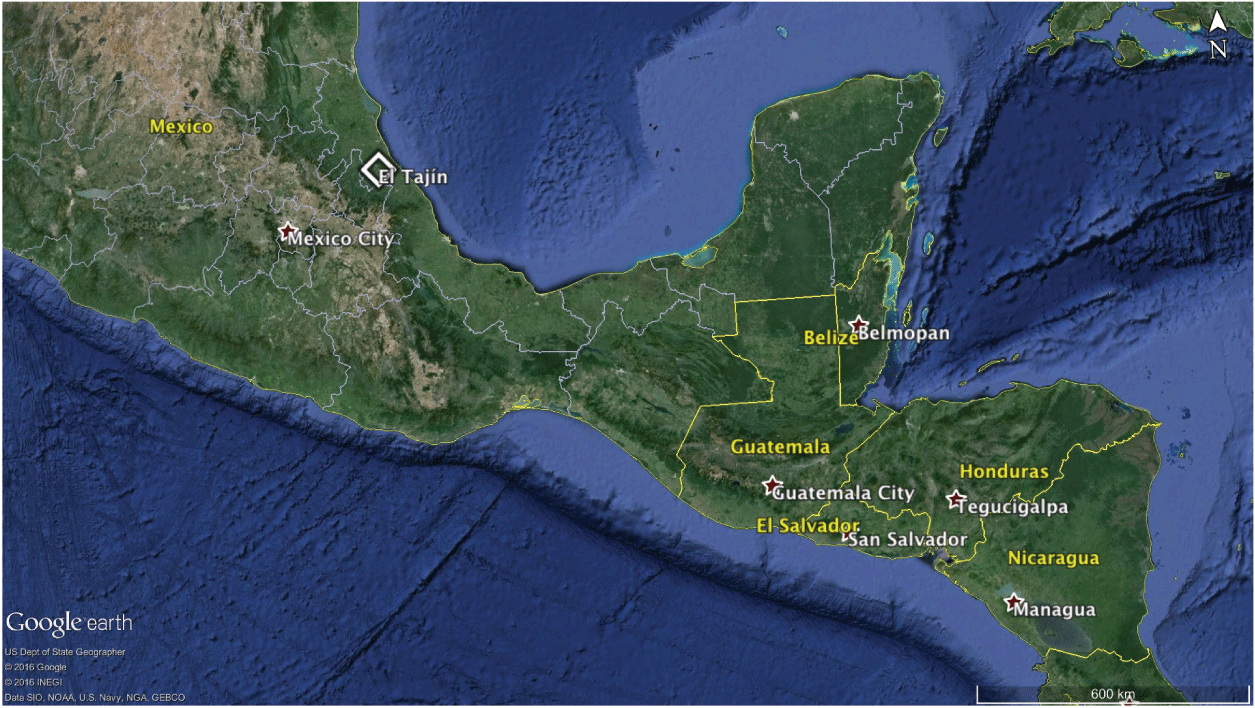
Located in the modern municipality of Papantla in the state of Veracruz (see Figure 1), El Tajín is best known as a site of national patrimony, a UNESCO World Heritage site, and a tourist destination. For most archaeologists, the site is a Classic Veracruz urban centre characterized by the architectural co-occurrence of niches and flying cornices, along with a naturalistic low-relief carving style (Wilkerson Reference Wilkerson and Kowalski1999). Authorities do not agree on the questions of El Tajín’s origins and the ethnic affiliations of its builders; these are, historically, among the most contested in Veracruzan archaeology. Most authors opt for either an Early Classic (c.300 A.D.) foundation based on regional chronologies (Pascual Soto Reference Pascual Soto2009; Wilkerson Reference Wilkerson1979), or a Late Classic (c.600 A.D.) origin based on excavations in the site centre (Brueggemann Reference Brueggemann1993). Historically attributed to the ancestors of the Totonac-speaking groups living in the region today, more recent research prefers an ethnically neutral Tajín Culture designation (Brueggemann Reference Brueggemann1991) or considers the probable multi-ethnicity of the city’s inhabitants (Pascual Soto Reference Pascual Soto2009). Contemporary research in El Tajín has moved away from these cultural-historical questions to projects focusing on the interpretation of the site’s famous low-relief carvings (Koontz Reference Koontz2009) and LIDAR mapping of its landscape (Castillo Peña Reference Castillo Peña2011).
El Tajín relative to Mexico City, in the context of broader Central America. Source: the author, after Google Maps.

Focused on debates over interpretations put forth by archaeologists, this normative introduction to the site (compare Brueggemann Reference Brueggemann and Brueggemann1992; Ladrón de Guevara Reference Ladrón de Guevara1999, 123–136) excludes the likes of Erasmo Rodríguez, the Compañía Stanford, and others outside the remit of traditional archaeology. Yet the Compañía Stanford’s drilling produced material effects for the site – and its co-occurrence with nascent archaeological research provokes the question of how these nominally separate actors related to one another. In this article, I make three interrelated arguments. First, understanding ‘the ways in which archaeology works in the world’ (Meskell Reference Meskell2005, 84) requires examining the discipline’s historical relationships with social and political contexts outside the well-studied themes of nationalism and colonialism. Second, a close, contextual examination of archaeology and industry in El Tajín indicates that neither is unitary or entirely separate. Third, a shared pool of practices related to infrastructure, equipment, expertise and labour better characterizes the relations between ‘archaeology’ and ‘extractive industry’ in 1930s El Tajín. While previous scholarship has linked archaeology’s relationships with extractive industries to the growth of neo-liberalism in the late 20th century, I argue that a historical approach reveals that the cross-cutting and contingent relationships between these spheres pre-date the present political–economic situation. I conclude by arguing that it is more reasonable to assume association than exclusivity, and that studies of archaeology and industry should consider the specific ways in which the mega-projects with which archaeologists currently contend are novel.
This article draws on archival research conducted between 2016 and 2018. I focused primarily on Tajín-related materials held in two rarely consulted administrative archives managed by Mexico’s federal heritage-management agency, the Instituto Nacional de Antropología e Historia (INAH): the Archivo de la Dirección del Departamento de Monumentos Prehispánicos and the Archivo Histórico Institucional. To a lesser extent, I consulted materials held in the Archivo Técnico and Fototeca Nacional of the same institution. The other principal source for these materials is the Archivo Histórico de Petróleos Mexicanos, the state-owned oil company whose archival holdings include files expropriated from foreign-owned industries in 1938. Translations of documents originally written in Spanish are mine.
Archaeology beyond the Mexican nation state
Since the 1980s, the relationships between archaeology and nationalism have been a popular research topic. As ‘imagined communities’ (Anderson Reference Anderson2006), nation states appropriate the material remains of the past to legitimize their current territories, linking contemporary political-economic systems to the distant past (Díaz-Andreu Reference Díaz-Andreu2007; Trigger Reference Trigger2006). In so doing, states come into conflict with other users of archaeological sites, particularly Indigenous or local communities. In Latin America, archaeology has often been analysed along these lines (see, for example, Ardren Reference Ardren2002; Breglia Reference Breglia2006; Gnecco and Hernández Reference Gnecco and Hernández2008; Joyce Reference Joyce, Habu, Fawcett and Matsunaga2008; Oyuela-Caycedo Reference Oyuela-Caycedo and Oyuela-Caycedo1994).
The Mexican case has been the subject of sustained scholarly attention. In the aftermath of the Mexican Revolution (1910–1920), government-sponsored archaeologists sought to reconstruct monumental sites to create a shared national heritage and attract foreign tourism. As José Luis Lorenzo (Reference Lorenzo1981, 201) put it, ‘the Mexicans must be given the idea of a past of their own, as part of national integration and the formation of historical awareness, while the outsiders must be shown the glories … [and] be induced to part with more foreign exchange’. Much critical research from the Mexican archaeological community has focused on how the nationalist orientation of ‘official Mexican archaeology’ (Gándara Reference Gándara1992) has led to theoretical conservatism, an overriding focus on the reconstruction of monumental architecture, and a disinclination to engage with local and indigenous communities – among other consequences (see Breglia Reference Breglia2006; Rozental Reference Rozental2012; Salas Landa Reference Salas Landa2015; Vásquez León Reference Vásquez León2003). In these and a variety of other studies, the scientific and political effects of Mexican archaeology’s links with the nation state are drawn out in detail. More recent research has questioned the recency of these links, exploring the dynamics of archaeology during the Porfiriato, the 1876–1911 dictatorship of Porfirio Díaz, and before (Achim Reference Achim2017; Bueno Reference Bueno2016; Kelly Reference Kelly2011; Ruiz Reference Ruiz2016; Rutsch Reference Rutsch2007; Valiant Reference Valiant2017).
While Mexican archaeologists have done much to explore the effects of the nationalist orientation of the discipline after the Revolution, and the Mexicanist historians cited above have begun to explore the dynamics and legacies of archaeology before the Revolution, the Mexican nation state generally remains the frame of reference. The Porfirian or Revolutionary nation state, driven by particular ideas of modernity, developed a bureaucratic apparatus to employ disciplinary specialists who investigated and appropriated the pre-Hispanic past in order to fulfil certain ideological objectives (though see Rutsch Reference Rutsch2007 on the Escuela Internacional de Arqueología y Etnología Americana, and Ruiz Reference Ruiz2016 on foreign archaeological expeditions). Here, two critical commentaries on studies of archaeology and nationalism are worth considering.
First, an overriding focus on nationalist (and colonialist) uses of archaeology tends to downplay other significant factors in the constitution of the discipline (Moro Abadía Reference Moro Abadía2010). This point is well illustrated by a number of studies that have begun to explore modern archaeology’s imbrications with a variety of social, political and economic spheres that transcend national frontiers – among them extractive industries (see Coombe and Baird Reference Coombe, Baird, Logan, Craith and Kockel2016). In the contemporary African context, Chirikure (Reference Chirikure2014) argues, the dichotomy of good research archaeology and bad commercial extractivism does not adequately describe the cross-cutting relations between the two. The ExxonMobil-sponsored Chad Export Project illustrates the complexity of these relations: it generated important archaeological research, but risked marginalizing African archaeologists and supported resource-extraction enclaves (MacEachern Reference MacEachern2010). In South Africa, the Mapungubwe National Park was inscribed by UNESCO as a Cultural Landscape in 2003, but between the sidelining of culture in favour of nature, and the cross-purpose workings of a variety of state agencies, the park’s archaeological heritage is now under threat by coal mining interests (Meskell Reference Meskell, Brumann and Berliner2016). In Argentina, Jofré (Reference Jofré2015) argues, contract archaeologists and mining interests work in concert to appropriate and patrimonialize Indigenous landscapes in favour of the state. Along similar lines, Plets (Reference Plets2016b) argues that the multinational natural-gas company Gazprom funded a repatriation project and the construction of a museum as a means of coopting local politicians in order to build a pipeline through the Indigenous Altai Republic in Russia.
Second, focusing on the ideological and discursive relationships between archaeology and the nation state may obscure the more mundane, practical dimensions of their entanglements (Plets Reference Plets2016a; compare Salas Landa Reference Salas Landa2018). In Breglia’s (Reference Breglia2006) account, Mexico’s de jure control over archaeology was never so complete as both legislation and scholarship implied; examining historical transformations in land tenure and usufruct at Chichén Itzá shows that de facto private control has been a facet of daily life at the site for the past century. Luke’s (Reference Luke2019) research on extractive industries, archaeology and international diplomacy in the Izmir region of Turkey explores the complex, nondeterministic ways in which the discipline has intervened in the relationships between state-supported resource development and rural communities.
In what follows, I draw out these critiques in the context of El Tajín in the 1930s. In the next section, I discuss the histories of archaeological research and oil exploration in Papantla. In the following section, I will focus on the bureaucratic processes and conflicts involved in constructing Ojital-1, emphasizing the non-unitary nature of both archaeology and oil extraction. Then I explore the vectors along which archaeology and oil extraction were related, focusing on the sharing of infrastructure, equipment, expertise and labour. I conclude by arguing for assumptions of cooperation, conflict and general association in analyses of archaeology in relation to extractive industries.
Oil exploration and archaeological research in Papantla
At a practical level, both field archaeology and oil exploration involve bringing subsurface materials to light, whether the material culture of the past or petroleum. This linkage appears early in Papantla. A scarce decade after the 1859 drilling of the Drake Well inaugurated the first oil boom in the United States (see Yergin Reference Yergin1990), Confederate refugee Lawrence W. O’Bannon and Scot Dr Henry P. Manfred formed the Compañía Explotadora del Golfo Mexicano to exploit surface seepages in the region now known as Furberos, Papantla (about 20 kilometres west of El Tajín). Though a well was drilled, the company failed by 1872; in 1880, Papantla resident and company associate Dr Adolpho Autrey claimed the abandoned installations, setting up a small-scale kerosene refinery in Papantla (Gerali and Riguzzi Reference Gerali and Riguzzi2013). In an 1892 letter, Autrey recalled that ‘everywhere that the Company dug or broke the earth in any form in the vicinity of the [oil] springs, idols, broken pottery, &c., were constantly encountered, all of which goes to show that in this vicinity a past race had their place of abode’ (AHP, Fondo Expropiación, c. 3091, exp. 79548, f. 33).
This period also saw incipient efforts to legally safeguard, excavate and manage the pre-Hispanic past through the institutionalization of archaeology (Bueno Reference Bueno2016). El Tajín, which had first been documented in 1785 (López Luján Reference López Luján2008), was no exception to this trend. Shortly before the 1891–1892 expedition of the Comisión Científica de Cempoala (Galindo y Villa Reference Galindo y Villa1912), local vanilla merchant Agapito Fontecilla y Vidal filed a report on the condition of El Tajín’s monuments and recent tourist visits, apparently in response to an official query. By the first planned architectural intervention of the Pyramid of the Niches in 1924, officials and guards like Fontecilla y Vidal had been employed to safeguard and maintain the site for more than two decades (see ADDMP, exp. El Tajín, Ref. B/311.32(z61-2)/1). The labour and responsibilities of these guards appear to have been quite broad (Bueno Reference Bueno2016, 91–112), and the archival materials related to El Tajín reflect this flexibility. Erasmo Rodríguez’s predecessor, Honorato Méndez, filed regular, formulaic reports attesting to the well-conserved status of the monuments. Rodríguez, by contrast, kept records and inventories, stopped the quarrying of a local mound, requested updates on the status of archaeological sites in neighbouring municipalities, and carried out excavations himself – even to the chagrin of his superiors. Between the isolation of sites like El Tajín, and the intermittent presence of bureaucratic superiors and scholars, men like Rodríguez functioned as nearly autonomous intermediaries between the state and archaeological sites (Bueno Reference Bueno2016, 206, 97; Kelly Reference Kelly2011, 112–114)
At the regional scale, both oil development and archaeological research would continue over the course of the 20th century. The 1930s saw the development of the Poza Rica fields, whose eponymous city would be founded some 20 kilometres north-west of El Tajín. By 1936, these fields accounted for 33.45 per cent of all national production (Gobierno del México 1940, 131). A region that had been characterized by Totonac subsistence cultivators living in a dispersed settlement pattern became one of oil extraction and increasing socio-economic stratification (Quintal Avilés Reference Quintal Avilés1981; Santiago Reference Santiago2009). The Mexican oil industry was famously expropriated in 1938. As Rodríguez García (Reference Rodríguez García2016) points out, the expropriation brought oil into the same legal concept as the material remains of the pre-Hispanic past: both were subsurface resources considered property of the nation. While oil production would eventually shift elsewhere, residents of Poza Rica would continue to grapple with the production and failure of oil infrastructure in the region (Salas Landa Reference Salas Landa2016). As I will discuss below, that state-sponsored monumental reconstruction in El Tajín began with the 1934–1938 efforts of Agustín García Vega (Reference García Vega1939; see Salas Landa Reference Salas Landa2018) and continued with José García Payón’s career-long engagement with the site, which lasted until his death in 1977 (Ruíz Gordillo Reference Ruíz Gordillo2002).
Constructing Ojital-1
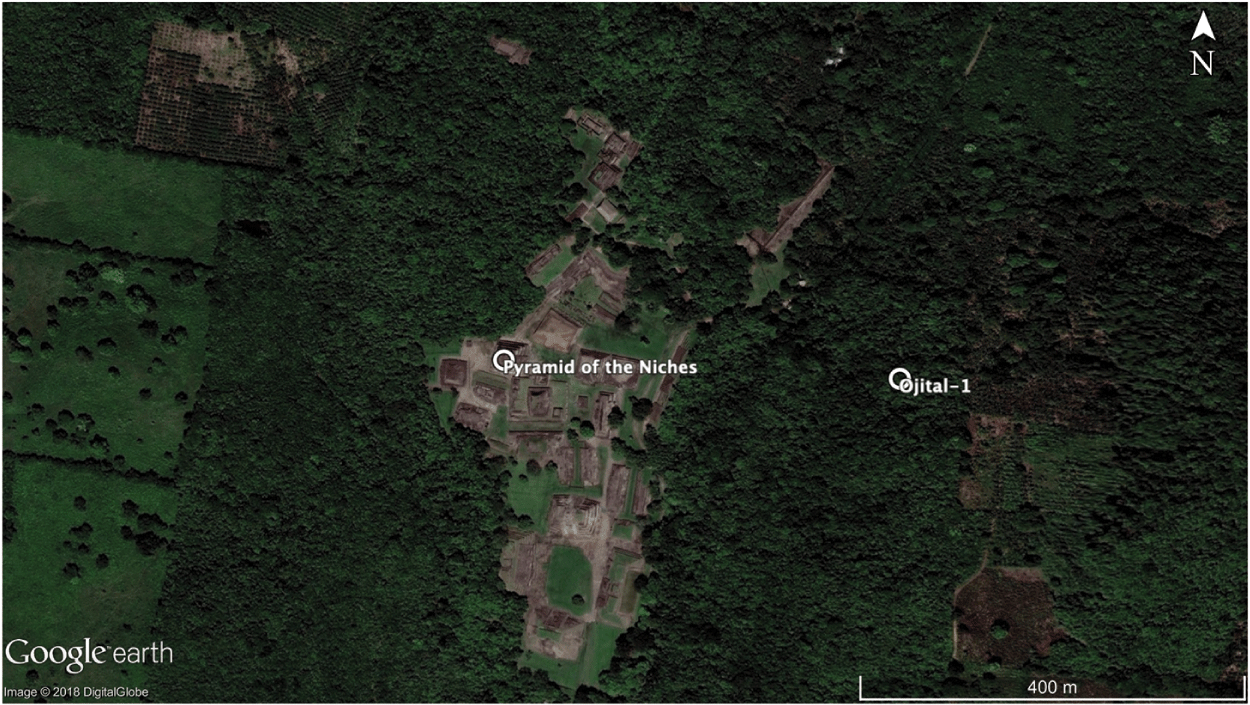
Between 1935 and 1939, the Compañía Stanford sought to drill an exploratory well, Ojital-1, approximately 100 metres north-east of the Pyramid of the Niches in El Tajín (see Figure 2). A fine-grained exploration of these efforts vis-à-vis post-Revolutionary heritage management will demonstrate that, though the ideological necessity of preserving the material remains of Mexico’s pre-Hispanic past was well established, differing state agencies and their associated departments did not always work together in practice when it came to questions of subsurface resources.
Ojital-1 relative to the Pyramid of the Niches and the currently excavated structures of El Tajín's monumental core. Source: the author, after Google Maps.

The 1930s saw an explosion of interest in oil exploration, as well as speculation in land and subsurface resource rights, in Papantla. By 1938, some 727 legal operations – sales, transfers, purchases, leases and the like – had been completed in 195 (or 95 per cent) of the 205 parcels that comprised Ojital y Potrero, the lot where El Tajín is located (Brizuela Abasalón, Reference Brizuela Abasalónn.d.). Among these was a concession (Number 1308) to drill for oil in Parcel 76; it had been solicited by engineer Eduardo Prieto y Souza in 1929, as the representative of a number of landholders in Ojital y Potrero and the adjacent lots (see AGN, Fondo Departamento de Petroleo, c. 206, exp. 4, leg. 1). In August of 1935, that title was transferred to Stanford y Compañía, a Tampico-based company that formed part of the American Sinclair conglomeration (AHP, Fondo Expropiación, c. 1570, exp. 44170, f. 5).
Tracing the flows of paperwork – memos, letters, reports and telegrams – between the government and industry figures involved in this process demonstrates the extent to which specific, on-the-ground concerns overrode broader ideological objectives. By late 1935, Parcel 76 and drilling rights were held by the Compañía Stanford. After acquiring these rights, the company set to surveying the parcel to locate the well. These first efforts, however, were thwarted: on 16 December 1935, Erasmo Rodríguez sent an urgent telegram to his superiors in Mexico City. He had surprised Luis Galvin Parker and Emilio Alvarez of the Compañía Stanford, who, under orders from engineer Juan La Riviere, had been measuring and marking the boundaries of Parcel 76 – and suspended their unauthorized work accordingly (ADDMP, Exp. El Tajín, Ref. B/311.41(z61-2)/1, leg. 1, f. 97-102). The Departamento de Monumentos Prehispánicos, then in charge of heritage management at the federal level, contacted both the municipal government of Papantla and the federal Secretaría de la Economía Nacional to notify them of the intended drilling and the suspension, and to remind them of the relevant laws protecting pre-Hispanic material culture. On 21 December 1935, Rodríguez reported that the Compañía had again violated the law, clearing foliage with the objective of installing an oil pipeline (ADDMP, Exp. El Tajín, Ref. B/311.41(z61-2)/1, leg. 1, f. 106).
Annoyed, the company contacted the Secretaría de la Economía Nacional, from which the company had already received permission to survey. On 23 December 1935, Monumentos Prehispánicos directed Rodríguez to allow the survey to continue under his supervision. Importantly, because the spatial extension of the site was still in question, the questions of what, exactly, constituted the monuments to be supervised, or the damage to be evaluated, seem to have been worked out in practice. On 31 December 1935, Monumentos Prehispánicos granted the company permission to conduct a topographical survey, with the stipulation that ‘it should not execute any work in places where there are archaeological ruins of any class, advising for all drilling or preliminary work close to the archaeological site’ (AHP, Fondo Expropiación, c. 1520, exp. 44170, f. 126). The survey was evidently completed, and Monumentos Prehispánicos duly notified.
In January 1936, the office commissioned architect Luis R. Ruiz to inspect the proposed location of the well. The Compañía Stanford contracted a plane to fly Ruiz over Tajín before landing in nearby El Chote; from there, he accompanied company officials on horseback to inspect the proposed location (ADDMP, Exp. El Tajín, Ref. B/311.41(z61-2)/1, leg. 1, f. 142). It appears that Ruiz was especially sympathetic to the company: according to correspondence between company officials, ‘he insisted in the convenience of the Company to build an embankment or a terreplein on the road which leads to this well and right over the archaeological platforms which can be easily appreciated at simple sight’. Rodríguez was ‘very much reluctant on giving the company the necessary permit, considering those platforms’, but Ruiz convinced him that ‘the Company would do all in its power to prevent any harm to those platforms’ (AHP, Fondo Expropiación, c. 1520, exp. 44170, f. 96).
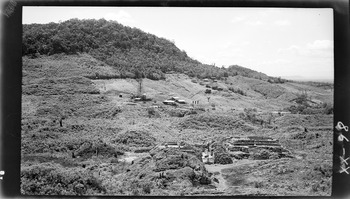
The following day, Ruiz wired Monumentos Prehispánicos to say that ‘on the indicated point and around it there are no problems for drilling authorize work’ (AHP, Fondo Expropiación, c. 1570, exp. 44170, f. 104). On 11 January, Monumentos Prehispánicos proceeded to notify the Secretaría de Economía Nacional of the authorization, but Rodríguez again stopped the operations, charging violations of the law. The company’s reaction was emphatic: ‘please see him immediately show him official telegram from engineer Ruiz to his chief in Mexico and have him immediately desist from bothering us’ (AHP, Fondo Expropiación, c. 1520, exp. 44170, f. 101). Rodríguez evidently did so, and by 27 January 1936, the Secretaría de Economía Nacional’s Departamento del Petróleo had granted the drilling permit. Construction proceeded accordingly (see Figure 3).
Ojital-1 and the associated encampment, after the beginnings of excavation in the buildings of Tajín Chico (shown in the foreground). Source: Fototeca Nacional, Colección Prehispánico, inventory number 301995. SECRETARIA DE CULTURA.-INAH-.MEX, reproduction authorized by the Instituto Nacional de Antropología e Historia.

It might be expected that where oil and archaeology before the expropriation of the oil industry in 1938 are concerned, a nationalist archaeology striving to exalt the pre-Hispanic past in the service of national identity and economic development would inevitably come into conflict with foreign corporate interlopers seeking to exploit the nation’s subsurface resources: oil ‘was a “sacred symbol” of national identity and independence; conversely, the [foreign] oil companies represented a perverse, parasitic imperialism’ (Knight Reference Knight, Brown and Knight1992, 280). In this case, both Rodríguez and Ruiz were functionaries of Mexico’s heritage-management bureaucracy – but neither their structural positions nor the state’s ideological orientation predetermined their interactions and relations with the Compañía Stanford. Rodríguez stopped operations based on his understanding of the regulations on at least two occasions, while Ruiz approved the Compañía Stanford’s drilling plan and attempted to convince Rodríguez of its utility. The office that had commissioned Ruiz accepted his report – until the Secretaría de Educación Pública’s head saw photographs of Ojital-1’s construction and its proximity to El Tajín, and had the inspector fired.
The fact that different state agencies – even those that formed part of the same heritage-management administration – worked at cross-purposes vis-à-vis their functionaries and subordinates provokes the question of where, exactly, one might find the unitary state capable of instituting the ideological and practical projects of a nationalist archaeology. As Abrams (Reference Abrams1988, 79) famously put it, ‘the state is the unified symbol of an actual disunity’. From this point of view, the drilling of Ojital-1 appears as less the failure of the state to protect its pre-Hispanic patrimony than a contingent outcome of the practical engagements between national authorities, site guards, federal inspectors and oil company officials. As I will show, this continues to be the case when field archaeology and architectural reconstruction begin.
Infrastructure, equipment, expertise and labour across boundaries
Here, with some idea of the negotiations required to construct Ojital-1, it is worth stepping back to examine the historiographic position of these events. In the histories of El Tajín discussed earlier, the 1930s and the work of Agustín García Vega (discussed below) are considered precursors to the long-running and extensive research conducted by later archaeologists. One quotation from García Payón reproduced in a variety of media (including at the site itself) can be considered representative:
I arrived at Tajín around 1938, to the jungle that it was back then, the clearing efforts of Agustín García Vega a few years before notwithstanding … there were no roads except mule trails, one had to arrive at Papantla and, from there, between the serranía and forest, travel by horse and mule, with materials and everything, equipment, [and] food (García Payón and Ruiz Gordillo Reference García Payón and Ruiz Gordillo1993, 55).
This perspective – along with the narrative of discovery and inevitable scholarly advancement that it implies – requires the omission of Ojital-1. For the same reason, Figure 3’s appearance in García Payón’s corresponding report is labelled ‘view of “Tajín chico” from the building of the columns’ (AT-DMP, Tomo CXXVI, Estado de Veracruz, Tajín, Vol. II, 1936–1940, informe 944.-5-, s/f). Though pictured, Ojital-1 is rendered invisible by this emphasis.
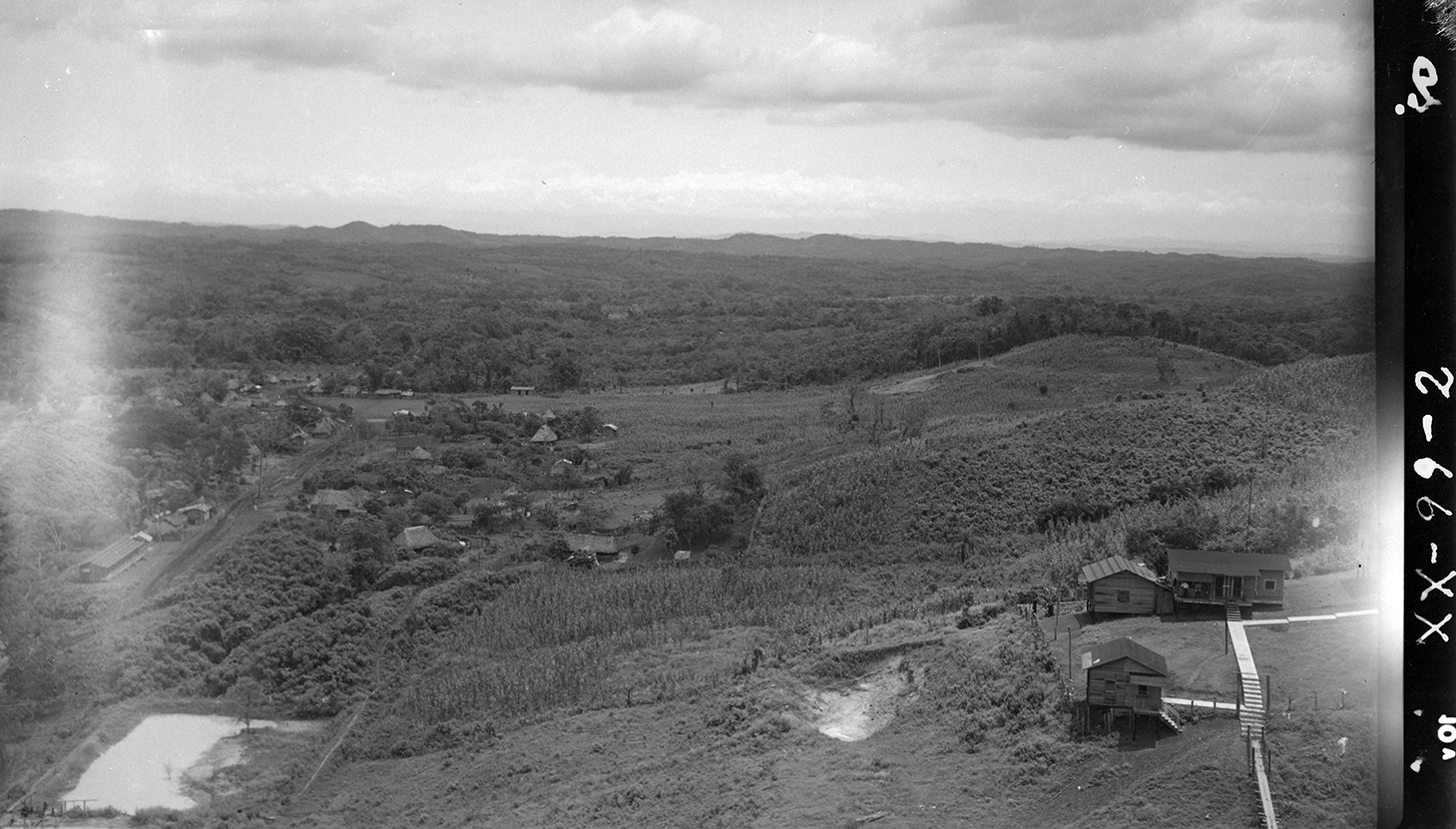
However, the archival documents discussed here provide for more than the simple reinstatement of a neglected episode in the site’s history; rather, they speak to a degree of negotiation between archaeology and extractive industry that continued beyond the bureaucratic procedures and conflicts involved in the planning and drilling of the well. Beyond the contingent collaborations necessary to carry out their respective objectives, state-sponsored archaeology (in the form of García Vega’s pioneering reconstructions) and the foreign oil industry (represented by the Compañía Stanford) both shared and drew upon similar infrastructure, equipment, expertise and labour. During his fieldwork in the 1930s, García Vega would have multiple occasions to interact with the Compañía Stanford in El Tajín (see Figure 4).
The labourers’ settlement (left), and the unexcavated mounds of El Tajín’s Plaza del Arroyo (right). Source: Fototeca Nacional, Colección Prehispánico, inventory number 325636. SECRETARIA DE CULTURA.-INAH-.MEX, reproduction authorized by the Instituto Nacional de Antropología e Historia.

The first had to do with the construction of access routes to the archaeological site. On this, it seems, all were in agreement. Rodríguez had allowed the company to cut a path to the south boundary of Parcel 76 in 1935 (ADDMP, Exp. El Tajín, Ref. 311.41(z61-2)/1, leg. 1, f. 106). As Ruiz put it, ‘the construction of the road … would take men of science and tourists to these places so that they will be better studied and known … the cooperation and conciliation of archaeological and petroleum interests is easy to carry out with mutual benefit’ (ADDMP, Exp. El Tajín, Ref. B/311.41(z61-2)/1, leg. 1, f. 143). It eventually fell to García Vega to carry out the task. As he wrote in a June 1936 report, the construction of the site entrance to the road that connected El Tajín to nearby El Chote (where Ruíz had landed and, until the early 2000s, the only way to get from Papantla to El Tajín via automobile) had been done ‘thanks to the help lent by the oil company El Águila and Stanford, assuring now that their road will be of great use’ (AT-DMP, Vol. 29-177, Agustín García Vega to Ignacio Marquina, 26 June 1926). A month later, García Vega wrote that he had solicited aid from the companies, and received $500.00 (approximately MXN$26,000, or USD$1,400, adjusted for inflation) for the construction of the road, as well as fencing material to line it such that cattle in the adjacent pastures would not cross and muddy the road. The same companies donated water pipes and allowed García Vega to connect them to their water sources in the site (AT-DMP, Tomo CXXVI, Estado de Veracruz, Tajín, Vol. II, 1936–1940, informe 941.-2-).
One may speculate about the motives for this collaboration. Perhaps the Compañía sought to build goodwill with García Vega to avoid problems, and perhaps García Vega sought to take advantage of a novel funding source to better facilitate research and tourist access. Regardless, to the extent that both field archaeology and oil exploration had similar basic infrastructural requirements – access and water – practical collaboration won out over apparent ideological opposition.
The second occasion had to do with the architectural reconstruction and conservation of the site. In the same report cited above, García Vega credits the government for the care of these monuments, and continues,
I began the construction of a small post, a crane, rather, for which I counted on the help of the head of the camp of the oil company that is drilling in El Tajín, who gallantly facilitated me the necessary material: three two-inch tubes, one four-inch tube, a half-inch round iron and a U-shaped iron, and as well he permitted that part of the construction be carried out in his workshops, though most of said work was carried out in Papantla (AT-DMP, Tomo CXXVI, Estado de Veracruz, Tajín, Vol. II, 1936–1940, informe 941.-2-.)
This crane, García Vega continued, enabled him to ‘raise two large stone slabs that constituted the cornice of the lowest group of niches on the central staircase of the Pyramid, as well as the reconstruction of seven niches of the lower body of the same Pyramid on the North side’; without the crane, he adds, the work would have been very difficult indeed, given the weight of the stones (AT-DMP, Tomo CXXVI, Estado de Veracruz, Tajín, Vol. II, 1936–1940, informe 941.-2.).
In a context of nationalist archaeology and statist tourism development, one might expect that projects like road building and monumental reconstruction would be the exclusive purview of the state – and García Vega (Reference García Vega1939, 87) takes credit for as much. In a material sense, however, the basic labour of reconstructing a pre-Hispanic structure depended on the presence of oil infrastructure and the willingness of its owners to share tools. The materials and equipment necessary to drill for and extract petroleum were repurposed to the ends of archaeological research and tourism development.
A third occasion came with the sharing of expertise. In the initial stages of their respective endeavours, both García Vega and the Compañía Stanford conducted topographical surveys of the site. The Compañía’s January 1936 well localization report records not only the location of the well, the parcel boundaries and proposed roads, but also archaeological mounds – numbered and ranked according to a four-tier system whose criteria are unfortunately not documented (ADDMP, Exp. El Tajín, Ref. B/311.41(z61-2)/1, leg. 1, f. 123-125). June 1937 saw García Vega begin surveying the site with the objective of drafting a plan. During that month, Compañía Stanford engineer Juan La Riviere sent his superiors notes on a meeting he had with García Vega.
According to La Riviere, García Vega was tasked with surveying the site not to determine the spatial distribution of Tajín’s pre-Hispanic structures but to determine a polygon for expropriation. García Vega’s polygon included most of Parcel 76, as well as Ojital-1; La Riviere attempted to convince García Vega to leave the well out, but García Vega ‘felt that he could not do it without contravening his instructions. He remembers that Inspector Ruiz of his Dept., who made the report favorable to us … was asked to resign as a consequence’ (AHP, Fondo Expropiación, c. 1570, exp. 44170, f. 59). García Vega evidently provided La Riviere with a copy of the Tajín stadia survey, which the latter revised. Finding a small error, La Riviere wrote to García Vega to arrange a meeting so that they could compare notes. Other company officials were suspicious of the apparent collaboration, given that the Compañía was in the process of formulating legal defences against expropriation. La Riviere evidently clarified that García Vega ‘had given him the measurements only with the understanding that we would give the engineer a copy of our plan when it is prepared … in other words, we are not helping the engineer in any way’ (AHP, Fondo Expropiación, c. 1570, exp. 44170, f. 45).
One offshoot of the Compañía’s goal to drill Ojital-1 in the planned location was nothing less than the determination, numbering and categorization of El Tajín’s unexcavated pre-Hispanic structures – one of the very objectives for which García Vega had been commissioned to begin research in El Tajín (García Vega Reference García Vega1939). At the same time, one result of García Vega’s mapping was the determination of the site’s boundaries for the purposes of expropriation (which was never carried out) and site management – goals that, though antithetical to the Compañía’s interests, resulted from the practices and expertise that García Vega shared with La Riviere. At a basic level, while the Compañía’s objectives were clear – the development of Ojital-1 for the production and commercialization of oil – they did not predetermine the Compañía’s interactions vis-à-vis state-sponsored archaeology in El Tajín.
Though much of the documentation discussed here deals with correspondence between company lawyers, government officials and archaeologists, the fourth occasion for collaboration between the nominally separate spheres of archaeology and extractive industry deals with those who did the actual work of clearing, reconstructing, drilling and maintaining: labourers. As for the workers of Ojital-1, they numbered at least 100, and they belonged to the Local 19 of the Sindicato de Trabajadores Petroleros de la República Mexicana (Capitanachi Luna Reference Capitanachi Luna1983). If Ojital-1 was similar to the Huasteca (Santiago Reference Santiago2009) or neighbouring Coatzintla (Quintal Avilés Reference Quintal Avilés1981), these workers were probably a regionally diverse and socio-economically stratified group. American engineers and skilled workers were better paid, and had access to higher-quality housing; Mexican workers, whether skilled or unskilled, tended to be paid less and exposed to precarious living and working conditions. For Ojital-1, these differences are visible in the houses depicted in Figures 3 and 4. Despite this disparity in pay and treatment, work at the oil well appears to have been a preferable option for some inhabitants of the region. El petróleo de México gives the pay range for an unskilled labourer (peón) as between one and five pesos daily in the Totonac Region (Gobierno del México 1940, 52).
As for the workers of El Tajín, most tended to be Indigenous Totonac residents of the agricultural communities around the archaeological site; skilled labourers, like masons, were brought in from Papantla. In contrast to the wages paid by the oil company, the approximately 40 unskilled labourers who worked for García Vega in 1936 were each paid $1.50 daily (ADDMP, Exp. El Tajín, Ref. B/311.41(z61-2)/1, leg. 1, f. 169). García Vega noted that that his conservation work had slowed, ‘for the lack of construction workers that cannot be found in the region, because they are occupied with work in the oil companies that pay a much higher daily wage’ (AT-DMP, Tomo CXXVI, Estado de Veracruz, Tajín, Vol. II, 1936-1940, informe 942.-3).
There are relatively few accounts of interactions between these oil workers and the Totonac agriculturalists of El Tajín. At first glance, these would appear to be mutually exclusive kinds of labour. Comparing the Local 19 personnel list published by Capitanachi Luna (Reference Capitanachi Luna1983, 11–13) with the available payrolls from García Vega’s 1936 and 1937 field seasons yields only four concurrences between the 122 workers employed by García Vega and the 146 workers listed in Capitanachi Luna. It may be the case that the Tajín residents employed by García Vega worked in a non-union capacity: ‘the Totonac, it is said, had little direct contact with the [company] outsiders, and their efforts were confined to work on the trails’ (Kelly and Palerm Reference Kelly and Palerm1952, 74).
Nevertheless, there are some hints that labour, too, crossed these boundaries. In 1940, Inspector Donaciano Espinosa of the Departamento de Monumentos Prehispánicos was dispatched to investigate complaints made against Erasmo Rodríguez in El Tajín (see AHI-INAH, Colección CNRH, Serie Personal, c. 42, exp. 1158, f. 156–160). In his report, sent to Ignacio Marquina, Espinosa reported on interviews he had conducted with workers of the Local 19:
when the encampment still belonged to the Company [before the 1938 expropriation], we knew that Erasmo [Rodríguez], with the workers from the site, carried out work in the encampment, charging their value to the management of this encampment, without having given a single cent to the workers that he used in the service of the Company (AHI-INAH, Colección CNRH, Serie Personal, c. 42, exp. 1158, f. 157).
Interestingly, this was not the conflict that Espinosa had been sent to investigate. Here, the fact that both state-sponsored field archaeology and the oil industry (whether before or after the expropriation) drew from the same labour pool, and that workers seem to have been able to work in archaeological reconstruction, clearing vegetation and operating the oil installations alike, is taken for granted.
Infrastructure, equipment, expertise and labour were four axes along which archaeology and extractive industry worked together in El Tajín. The organization of the archival sources from which this paper derives speaks to the porosity of the boundaries between these nominally separate spheres. Rodríguez’s complaints, Ruiz’s inspection and García Vega’s survey are found in a file compiled by the Compañía Stanford and currently housed in the Archivo Histórico de Petróleos Mexicanos, which expropriated the files along with the company in 1938. Rodríguez’s accounts of the well’s construction and García Vega’s reports on the requests he made of the company are found in the technical and administrative archives of the INAH. Figure 4, as filed in the INAH’s Fototeca Nacional, is titled ‘panorama of the site during exploration’; its keywords refer exclusively to field research, but the ambiguity of the term ‘exploration’ perhaps unintentionally speaks to the co-occurrence of archaeological research and extractive industry. The writing, filing, recovery and organization of these files attest to the same permeability between archaeology, society (the oil industry more specifically) and the nation state whose interactions they chronicled.
Conclusion
In March 1938, the government of Lázaro Cárdenas nationalized the foreign-owned oil industry (Gobierno del México 1940). Ojital-1, along with its installations, passed into the hands of Petróleos Mexicanos (PEMEX), the national oil company. PEMEX and the Local 19 took over the drilling and operation of the well, and Parcel 76 became the company’s property. Ojital-1 was sealed in August 1939, having produced little oil; an Ojital-2 was planned but never drilled. This would not be the end of cooperation and conflict between archaeology and oil interests in 20th-century El Tajín. While there would be conflicts over access, drilling and heavy machinery passing though the archaeological site, PEMEX would be repeatedly solicited for funding, equipment and labour – and, on a few occasions, they obliged (e.g. García Payón Reference García Payón1955, 5–6). Today, too, PEMEX’s efforts to develop the Chicontepec basin’s oil reserves have resulted in much regional-scale archaeological research. Castillo Peña’s (Reference Castillo Peña2011) regional LIDAR survey description is jointly funded and published by INAH and PEMEX. Given the patrimonial value of both oil and the pre-Hispanic past in the post-Revolution nationalist imaginary, perhaps this kind of cooperation is expected. However, it emerges from an unexpected precedent: a sharing of practices between nationalist archaeology and foreign oil interests.
The local social relations engendered by the oil well’s operations – such as they were – quickly faded. The workers relocated and were given plots of land in Poza Rica’s Colonia Argüelles neighbourhood. It was renamed Colonia Tajín in commemoration of the fact that its first settlers had worked in El Tajín, and it retains the name to this day (Capitanachi Luna Reference Capitanachi Luna1983). The Local 19 would merge with the Local 30, representing the workers of Poza Rica, in 1940 (ibid., 7). While older residents of El Tajín and San Antonio Ojital recall the presence of non-Totonac workers and novel infrastructure in the area, none appear to have stayed permanently (see also Brizuela Abasalón, Reference Brizuela Abasalónn.d.). By 1947, considering ‘this intrusive petroleum element’, Isabel Kelly wrote that ‘little trace remains in Tajín … the ruins of the old camp are effectively hidden by dense vegetation; and, culturally, the enterprise seems to have left surprisingly few scars’ (Kelly and Palerm Reference Kelly and Palerm1952, 74).
The presence of extractive industry would prove to have effects on scholarship outside archaeology as well. In her seminal monograph of the Totonac community of El Tajín (located a kilometre south of the archaeological site), Kelly considered the utility of the oil industry’s operations in the region: ‘only for this reason has it been possible to obtain local maps to large scale’ (Kelly and Palerm Reference Kelly and Palerm1952, 74). These maps, which allowed Kelly to collect parcel-level data on cultivation and landownership, would likewise prove useful for later scholars (e.g. Kasburg Reference Kasburg1992; Holley-Kline Reference Holley-Kline2019). More than a little anthropological literature on the lowland Totonac region thus finds itself indebted to extractive industries or their legacies.
This account of a non-productive oil well, the ephemeral social relations it engendered, and its apparent abandonment belies the complex set of relations between nationalist archaeology and the extractive industry it represents. In the academic historiography and the public sphere more broadly, El Tajín is an archaeological site, the material remains of an Epiclassic urban centre of the Classic Veracruz culture and pre-Hispanic Mesoamerica writ large. The making of this site, however, entailed the obscuring of other histories and processes (see also Salas Landa Reference Salas Landa2018). In this paper, I have sought to highlight one such element: the relationships between field archaeology and the oil industry in 1930s Papantla. Following scholars who seek to rethink the nation state as a privileged site for the analysis of the sociopolitical contexts of archaeology and who strive to complicate straightforward accounts of the interactions between archaeology and its ‘contexts’, I have argued that field archaeology and the oil industry in El Tajín were themselves neither separate nor unitary.
For the case of El Tajín, there are shared practices related to infrastructure, equipment, expertise and labour. This is not to ignore the role of the state in either the management of archaeology or extractive industries, but it does point the analysis in an understudied direction. Erasmo Rodríguez, Luis Ruíz, Agustín García Vega and José García Payón were all employees of an archaeological administration elsewhere noted for its nationalist orientation, but the nature and extent of their relationships with Ojital-1 and its materials varied considerably. By the same token, the agencies with which archaeologists and Compañía Stanford officials interacted – the Secretaría de Educación Pública, the Departamento de Monumentos Prehispánicos, the Secretaría de Economía Nacional and the Departamento del Petróleo – worked together, independently and at cross-purposes in relation to different actors. At a basic level, an analysis proceeding from assumptions of a unitary ‘nationalist archaeology’ or ‘extractive industry’ may fail to distinguish between the elements that compose these categories, and thus assume that they have intention and direction that are more apparent than real (see Abrams Reference Abrams1988).
In some sense, the relationships between a scientific discipline and a commercial sector should come as no surprise to historians and sociologists of science, who have long studied science in such contexts (e.g. Latour Reference Latour1987). So too have archaeologists grappled with the discipline’s professional and ethical responsibilities vis-à-vis extractive industries and commercial archaeology (e.g. Chirikure Reference Chirikure2014; Jofré Reference Jofré2015; MacEachern Reference MacEachern2010; Meskell Reference Meskell, Brumann and Berliner2016). The growth of transnational capitalist enterprises and discourses of corporate social responsibility focused on cultural heritage have raised important questions about archaeology’s relationships with extractive industries – especially mining (e.g. Plets Reference Plets2016b; Baird Reference Baird, Hillerdal, Karlström and Ojala2017). Nevertheless, the present analysis provokes the question of how, exactly, contemporary debates on corporate social responsibility and heritage management differ from the long-running imbrications of archaeology and extractivism.
Assessing these differences would allow for a finer-grained analysis of how the mega-projects of today are, or are not, novel. For example, the case of Ojital-1 does not appear to have formed part of a ‘corporate heritage discourse’ (Coombe and Baird Reference Coombe, Baird, Logan, Craith and Kockel2016, 340) for the companies involved – unlike the more recent PEMEX activities cited above. This, too, may yet prove to have unexpected antecedents: in 1934, El Águila solicited permission from the SEP to photograph archaeological monuments for a tourist pamphlet to circulate in the United States and Canada – ‘with the sole objective of cooperating in the work of attracting tourism towards Mexico and of advertising something of the many interesting things we have’ (see AHP, Fondo Expropiación, c. 1750, exp. 51722). While I have not been able to determine whether the pamphlet was ever published, the existence of the file again provokes us to question the antecedents of heritage processes generally associated with more contemporary trends.
The case of El Tajín and Ojital-1 demonstrates that concerns about archaeology, extractivism, heritage and tourism are not limited to the early 21st century. Assuming association rather than separation when it comes to field archaeology and extractive industries opens the door to contextual, site-specific analyses that may allow us to see how past actors grappled with such challenges – and how we may deal with the same today.
Acknowledgements
Mexico-based field research was supported by the Stanford University Department of Anthropology, a Stanford University School of Humanities and Sciences Graduate Research Opportunity Award, and a Fulbright-Hays Doctoral Dissertation Research Abroad grant (P022A1600-33). Writing was supported by a Stanford Humanities Center Geballe Dissertation Prize and a Stanford Institute for Research in the Social Sciences Dissertation Fellowship. Portions of this paper were presented at the 8th Annual South-Central Conference on Mesoamerica, the Stanford Archaeology Center, and the Centro Cultural Teodoro Cano (Papantla, Veracruz). The author would like to thank Lynn Meskell, Gertjan Plets, Mónica Salas Landa and two anonymous reviewers for their feedback.
Sam Holley-Kline is a Dean's Postdoctoral Scholar in the Department of History at Florida State University. His current research project focuses on indigenous Totonac histories silenced in processes of archaeological excavation and reconstruction. Along with regional interests in the Mexican Gulf Coast, his broader theoretical concerns include cultural-heritage studies, the politics of archaeology, materiality and landscape. Holley-Kline holds a Ph.D. and M.A. in anthropology from Stanford University, and a B.A. in Spanish and anthropology from DePauw University.