Introduction
A large proportion of people with alcohol and other drug disorders have a history of mental disorders (Allan, Reference Allan1995; Kessler et al. Reference Kessler, Nelson, McGonagle, Edlund, Frank and Leaf1996; Armstrong & Costello, Reference Armstrong and Costello2002; Grant et al. Reference Grant, Stinson, Dawson, Chou, Dufour, Compton, Pickering and Kaplan2004a; Chan et al. Reference Chan, Dennis and Funk2008). This has significant implications, as co-morbid cases often require more intensive treatment and have a poorer clinical course than other cases (Brooner et al. Reference Brooner, King, Kidorf, Schmidt and Bigelow1997; Swendsen & Merikangas, Reference Swendsen and Merikangas2000; White et al. Reference White, Xie, Thompson, Loeber and Stouthamer-Loeber2001). The reasons for this co-morbidity are unclear (Kessler, Reference Kessler, Tsuang, Tohen and Zahner1995; Waldman & Slutske, Reference Waldman and Slutske2000; Willoughby et al. Reference Willoughby, Chalmers and Busseri2004). Although some studies suggest that substance disorders possibly precipitate mental disorders (e.g. Crum et al. Reference Crum, Storr and Chan2005; Lukassen & Beaudet, Reference Lukassen and Beaudet2005; Semple et al. Reference Semple, McIntosh and Lawrie2005), reports of the reverse order predominate, with mental disorders typically found to begin at earlier ages than substance disorders (Merikangas et al. Reference Merikangas, Mehta, Molnar, Walters, Swendsen, Aguilar-Gaziola, Bijl, Borges, Caraveo-Anduaga, DeWit, Kolody, Vega, Wittchen and Kessler1998; Costello et al. Reference Costello, Erkanli, Federman and Angold1999; Kessler, Reference Kessler2004; Falk et al. Reference Falk, Yi and Hilton2008) and to predict subsequent onset of substance disorders (Armstrong & Costello, Reference Armstrong and Costello2002; King et al. Reference King, Iacono and McGue2004; Cohen et al. Reference Cohen, Chen, Crawford, Brook and Gordon2007; Pardini et al. Reference Pardini, White and Stouthamer-Loeber2007; Wilens et al. Reference Wilens, Biederman, Adamson, Henin, Sgambati, Gignac, Sawtelle, Santry and Monuteaux2008). The variability in findings probably reflects variability in temporal order, strength and pattern of association of particular mental disorders with substance disorders (Weinberg & Glantz, Reference Weinberg and Glantz1999; Compton et al. Reference Compton, Cottler, Phelps, Ben Abdallah and Spitznagel2000; Zilberman et al. Reference Zilberman, Tavares, Blume and el-Guebaly2003; Sung et al. Reference Sung, Erkanli, Angold and Costello2004; Jane-Llopis & Matytsina, Reference Jane-Llopis and Matytsina2006; Costello, Reference Costello2007), as externalizing disorders and early-onset anxiety disorders typically precede and predict substance disorders, whereas the temporal-predictive relationships of substance disorders with mood disorders are more variable (Glantz, Reference Glantz2002).
To the extent that mental disorders have a causal influence on later substance disorders, prevention or early successful treatment of mental disorders might reduce subsequent substance disorders (Glantz & Leshner, Reference Glantz and Leshner2000; White et al. Reference White, Xie, Thompson, Loeber and Stouthamer-Loeber2001; Kendall & Kessler, Reference Kendall and Kessler2002). Such an impact would presumably be greatest for youth, as the risk of severe secondary substance disorders is highest when mental disorders begin during childhood/adolescence (Kessler et al. Reference Kessler, Aguilar-Gaxiola, Andrade, Bijl, Borges, Caraveo-Anduaga, DeWit, Kolody, Merikangas, Molnar, Vega, Walters, Wittchen and Üstün2001). It is unknown, however, how large a proportion of substance disorders might be prevented in this way. Randomized controlled trials could be used to answer this question, akin to studies of effects of school-based randomized prevention trials for primary prevention of socially maladaptive behavior problems on subsequent drug use (e.g. Kellam & Anthony, Reference Kellam and Anthony1998; Furr-Holden et al. Reference Furr-Holden, Ialongo, Anthony, Petras and Kellam2004). Given the enormous difficulty and expense of carrying out such interventions, however, a prudent first step is to estimate likely effects with non-experimental data. Preliminary estimates of this sort are routinely calculated in public policy research prior to implementing broad policy-based interventions (e.g. Jeffery, Reference Jeffery1989; Dube et al. Reference Dube, Anda, Felitti, Chapman, Williamson and Giles2001; Wilson et al. Reference Wilson, D'Agostino, Sullivan, Parise and Kannel2002; Cook et al. Reference Cook, Ludwig and Braga2005) to assess whether the intervention might be cost-effective.
To this end, the current report presents estimates of the possible effects of intervening to treat mental disorders on prevention of secondary substance dependence. We focus on dependence rather than abuse because mental disorders are known to predict the dependence more strongly than abuse (Roberts et al. Reference Roberts, Roberts and Xing2007). The estimates reported here are not intended to be realistic estimates of intervention effects, as the latter can be obtained only from intervention studies, but upper-bound estimates. As described below, these estimates are based on simulations that use survival models from a general population survey on the associations of temporally primary mental disorders with subsequent nicotine dependence, alcohol dependence, and dependence syndromes involving cannabis, cocaine and other internationally regulated drugs (hereinafter, ‘substance dependence’). A series of predicted prevalence estimates of substance dependence was generated from the model based on different hypothetical scenarios where we assumed one or more mental disorders could either be prevented or cured. Comparisons of prevalence estimates across scenarios were used to estimate possible treatment effects.
Method
Sample
The data came from the National Comorbidity Survey Replication (NCS-R; Kessler & Merikangas, Reference Kessler and Merikangas2004), a nationally representative face-to-face survey of people aged ⩾18 years in the US household population interviewed between February 2001 and April 2003. The response rate was 70.9%. The current analysis focuses on respondents aged 18–44 years for reasons described below. The interview was in two parts. Part I included a core diagnostic assessment administered to all respondents (n=9282). Part II included questions about correlates and additional disorders administered to all Part I respondents with any lifetime core disorder plus a probability subsample of other Part I respondents (n=5692). Externalizing disorders that typically begin in childhood, including attention deficit hyperactivity disorder (ADHD), oppositional-defiant disorder (ODD) and conduct disorder (CD), were assessed only among Part II respondents in the age range 18–44 years (n=3199) because of concern about long-term recall bias among older respondents. In addition, there were major secular changes in illegal drug use and dependence after the 1950s. Consequently, only Part II respondents aged 18–44 are included in the current report. This subsample was weighted to adjust for differential probabilities of selection, oversampling of Part I cases, and residual discrepancies between the sample and the population. More details on NCS-R weighting are reported elsewhere (Kessler et al. Reference Kessler, Berglund, Chiu, Demler, Heeringa, Hiripi, Jin, Pennell, Walters, Zaslavsky and Zheng2004).
Assessment
DSM-IV mental and substance disorders were assessed with the World Health Organization (WHO) Composite International Diagnostic Interview Version 3.0 (CIDI; Kessler & Üstün, Reference Kessler and Üstün2004). In addition to nicotine, alcohol and other drug dependence, the CIDI assessed anxiety disorders [panic disorder, generalized anxiety disorder (GAD), phobias, post-traumatic stress disorder (PTSD)], mood disorders (major depressive disorder, bipolar disorder, dysthymic disorder), and the externalizing disorders noted above in addition to intermittent explosive disorder (IED). In addition to lifetime history, retrospective age-of-onset (AOO) reports obtained for each disorder were used to establish temporal order in the sequencing of disorder onset.
In the CIDI substance use module, respondents were asked if they ever used: alcohol, tobacco (cigarettes, cigars or pipes), cannabis (marijuana, hashish), cocaine, prescription drugs (sedatives, tranquilizers, painkillers, stimulants) either without the recommendation of a health professional or for any reason other than what a health professional said they should be used, and any other illegal drugs (heroin, opium, glue, LSD, peyote, or other substances). In the case of tobacco use, the CIDI then went on to assess features of smoking history (e.g. age of first use, age of first regular use, number of years used, etc.) and DSM-IV criteria for lifetime dependence. AOO was assessed for the first symptom of dependence, not the full dependence syndrome. In the case of alcohol and other drugs, questions were asked about smoking history and lifetime history of substance abuse. Abuse was assessed only once for illegal drugs, not separately for each type of illegal drug used. AOO was assessed for the first symptom of abuse. Respondents who reported any lifetime symptom of abuse were then assessed for history of dependence, but no additional questions were asked about AOO of dependence symptoms.
Respondents who denied any history of abuse, in comparison, were not assessed for dependence. This approach to the assessment of dependence only among respondents with a history of abuse focuses attention on dependence syndromes that have clinical significance in the form of a socially maladaptive or hazard-laden pattern of use. This approach undercounts mild alcohol dependence cases (Grant et al. Reference Grant, Stinson, Dawson, Chou, Dufour, Compton, Pickering and Kaplan2004a; Degenhardt et al. Reference Degenhardt, Bohnert and Anthony2007a), but does not seem to appreciably undercount dependence on illegal drugs (Degenhardt et al. Reference Degenhardt, Cheng and Anthony2007b, Reference Degenhardt, Bohnert and Anthony2008). Moreover, satisfactory concordance was found in NCS-R methodological research that compared dependence diagnoses based on blinded clinical reappraisal interviews using the Structured Clinical Interview for DSM-IV (SCID; First et al. Reference First, Spitzer, Gibbon and Williams2002) ) with those based on the CIDI (Haro et al. Reference Haro, Arbabzadeh-Bouchez, Brugha, de Girolamo, Guyer, Jin, Lepine, Mazzi, Reneses, Vilagut, Sampson and Kessler2006).
As retrospective AOO reports played an important part in these analyses, it should be noted that previous research has shown aggregate AOO distributions of lifetime DSM disorders in community surveys to have an implausible shape that seems to be generated by AOO being reported as occurring more recently than it actually did (Simon & Von Korff, Reference Simon and Von Korff1992, Reference Simon and Von Korff1995). Analysis of question-wording experiments has shown that this problem of ‘telescoping’ AOO reports can be corrected using AOO question probes that make respondents aware that AOO questions are difficult to answer accurately, encourages respondents to think carefully before answering, and accepts upper-bound estimates (i.e. the earliest age the respondent feels confident in saying that an episode occurred) when exact AOO cannot be recalled (Knauper et al. Reference Knauper, Cannell, Schwarz, Bruce and Kessler1999). This sophisticated AOO question-probing strategy was used in the NCS-R to improve the accuracy of AOO reports.
Sociodemographic correlates
Six sociodemographic controls were included in the analyses. Three were time invariant: age at interview (cohort), gender and race-ethnicity (Non-Hispanic White, Non-Hispanic Black, Hispanic, Other). The other three were time varying, which means that we coded them at different values in different years of each respondent's life: person-year (each year of life of each person in the sample), education (the respondent's level of educational attainment to date at each year of risk) and marital status (whether the respondent was never married, married, or previously married at each year of risk).
Analysis methods
Associations of mental disorders with substance dependence were examined in four stages. First, we calculated odds ratios (ORs) of cross-sectional associations between lifetime mental disorders and lifetime substance dependence to obtain basic descriptive information.
Second, we compared AOO reports of mental and substance disorders among respondents with a history of both to assess typical temporal sequencing.
Third, we used discrete-time survival analysis (Efron, Reference Efron1988) to examine associations of mental disorders (which were treated as time-varying predictors) with subsequent first onset of substance dependence. Mental disorders were defined as temporally primary only if their AOOs were reported to be earlier than the AOO of the respondent's first substance problem. The limitations of this approach to assessing AOO sequencing are discussed below. A dummy predictor variable for active presence of each mental disorder was coded (A), beginning at the reported AOO of that disorder to the age of most recently having the disorder. A separate dummy predictor variable for each remitted mental disorder (R) was created for the years after offset of the most recent episode. Comparison of survival coefficient for active versus remitted cases in a multivariate model that included all disorders as predictors along with basic sociodemographic controls was used to make provisional inferences about the potential effects of successfully treating mental disorders.
Fourth, we carried out simulations to estimate the potential effects of both prevention and successful treatment of mental disorders in reducing subsequent substance dependence. The simulations, described below, evaluated the extent to which the estimated (based on the survival models) prevalence of substance dependence would decrease if one or more mental disorders were either prevented or successfully treated. These simulation results implicitly assumed that the survival coefficients represent causal effects of mental disorders. To the extent that this assumption is incorrect, the simulated effect estimates will tend to have an upward bias.
We simulated three scenarios. Scenario 1 was the case of no mental disorders ever occurring. The rationale for this was that it represents a best-case scenario. This simulation was implemented by setting the prevalence estimates of all the mental disorders in the model to zero. Scenario 2 was the case of remission of all mental disorders that had onsets during the school years (i.e. prior to age 18) within 2 years of onset. The rationale for this was that a 2-year treatment-recovery period was considered a best-case scenario for timely detection, treatment and cure. This simulation was implemented by recoding all active mental disorders with onsets prior to age 18 as remitted 2 years after onset. Scenario 3 was the case of remission of all mental disorders within 3 years of onset no matter what their AOO. The rationale for this was that a 3-year treatment-recovery period was considered a best-case scenario for timely detection, treatment and cure of mental disorders in the absence of ongoing monitoring during the school years. This simulation was implemented by recoding all active mental disorders as remitted 3 years after onset.
There were a total of 100 069 person-years in the lives of the 3199 18- to 44-year-old Part II NCS-R respondents (an average of 31 years of life per respondent). Each survival analysis used person-year as the unit of analysis and focused on the subset that began with the year of first use of the substance in question and continued up to and including either (i) the year of interview for respondents who never had dependence or (ii) the year of first onset of dependence for respondents who had dependence. The year of onset of dependence was coded 1 and all earlier years 0 on the dependent variable. Each person-year included information about time-invariant characteristics (gender, race-ethnicity, age at interview) and time-varying characteristics (age, education, and marital status at that time in the respondent's life; and history of mental disorders as of that time in the respondent's life). Dummy variables were included for each active and remitted mental disorder assessed in the survey.
Simulation results were summarized by two descriptive statistics: the Population Attributable Risk Proportion (PARP; Walter, Reference Walter1978) and the Number Needed to Treat (NNT; McQuay & Moore, Reference McQuay and Moore1997). PARP is the proportion of observed cases of substance dependence estimated not to occur in the absence of the disorders included in the simulation based on the assumption that the coefficients in the model are due to causal effects of the disorders. NNT is the number of mental disorders that would be needed to prevent or treat in order to prevent one case of secondary substance dependence. Standard formulas exist to calculate both PARP (Walter, Reference Walter1978) and NNT (McQuay & Moore, Reference McQuay and Moore1997). We needed to examine both PARP and NNT because there is no one-to-one relationship between the two measures. PARP is a population-level measure whereas NNT is an individual-level measure. NNT will be larger in a situation where the predictor is highly prevalent and the survival coefficient is relatively weak than in a situation that generates the same PARP based on a smaller proportion of the population having the predictor and the survival coefficient being stronger.
The simulations were carried out by using the coefficients in the final survival equations to generate a conditional probability of first onset of each outcome for each year of life of each respondent using the actual values of the predictor variables for each person-year. The actuarial method (Halli et al. Reference Halli, Rao and Halli1992) was used to cumulate these conditional probabilities across the lifespan of each respondent using the formula

where CuPt+1 is the cumulative probability of having a first onset of the disorder up to the end of year t+1 and CoPt+1 is the conditional probability of having a first onset in year t+1 among people with no history of the disorder as of year t. The mean of CuP for respondents as of their age at interview was then calculated to estimate the proportion of respondents expected to have the outcome based on the actual data. The process of calculating CoPt for each person-year and then cumulating these estimates for person-level estimates of CP was repeated three more times, each time using the same survival coefficients but modifying the input data to impose simulated scenario constraints. In scenario 1, all values of A and R for all mental disorders were recoded N. In scenario 2, all values of A were recoded R after the first 2 years of onset when the mental disorder occurred before age 18. In scenario 3, all values of A were recoded R after the first 3 years of onset.
Because the NCS-R sample design used weighting and clustering, all analyses were carried out using the design-based Taylor series linearization method (Wolter, Reference Wolter1985) implemented in the SAS software system (SAS Institute, 2002). Multivariate significance was estimated in logistic regression equations using Wald χ2 tests based on design-corrected coefficient variance–covariance matrices. Statistical significance was evaluated using two-sided 0.05 level tests.
Results
Prevalence and co-morbidity
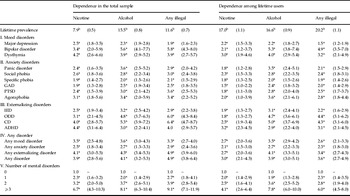
Lifetime prevalence estimates of DSM-IV substance dependence among respondents in the 18–44 age range were 7.9% for nicotine, 15.5% for alcohol and 11.6% for other drugs (Table 1). Substance dependence is strongly associated with mental disorders. All 39 bivariate ORs of the 13 DSM-IV mental disorders with the three types of substance dependence are statistically significant. Across mental disorders, the ORs are lower for DSM-IV nicotine dependence than other types of dependence. Across substances, the ORs are highest for externalizing disorders and lowest for anxiety disorders.
Lifetime co-morbidity (odds ratios) between DSM-IV substance dependence and DSM-IV mental disorders among Part II NCS-R respondents aged 18–44 (n=3199)Footnote a

GAD, Generalized anxiety disorder; PTSD, post-traumatic stress disorder; IED, intermittent explosive disorder; ODD, oppositional-defiant disorder; CD, conduct disorder; ADHD, attention deficit hyperactivity disorder.
Values are given as % (standard error) or odds ratio (95% confidence interval).
a Controlling for age, gender and race-ethnicity.
b Lifetime prevalence of DSM-IV substance dependence among Part II respondents aged 18–44 years.
* Significant at the 0.05 level, two-sided test.
Temporal order
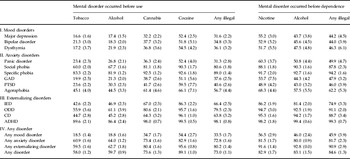
AOO distributions show that first symptoms of substance disorders typically occur in young adulthood, with medians (25th–75th percentiles) of 21 (19–32) for nicotine, 21 (18–28) for alcohol and 28 (20–40) for other drugs (Kessler et al. Reference Kessler, Berglund, Demler, Jin, Merikangas and Walters2005). Comparison of AOO reports for individual mental–substance pairs (Table 2) shows that externalizing disorders are most likely to precede nicotine dependence (91.6%), alcohol dependence (92.8%) and other drug dependence (90.9%). Anxiety disorders are also highly likely to precede nicotine dependence (81.5%), alcohol dependence (80%) and illegal drug dependence (81.7%). Mood disorders, in comparison, are only slightly more likely to precede nicotine dependence (56.5%) than the reverse and somewhat less likely to precede alcohol dependence (46%) and other drug dependence (45.9%) than the reverse.
Temporal priority of DSM-IV mental disorders in relation to first onset of either substance use or DSM-IV substance dependence among Part II NCS-R respondents aged 18–44 with specific mental–substance co-morbiditiesFootnote a

GAD, Generalized anxiety disorder; PTSD, post-traumatic stress disorder; IED, intermittent explosive disorder; ODD, oppositional-defiant disorder; CD, conduct disorder; ADHD, attention deficit hyperactivity disorder.
a Each entry to the table is based on the subsample of respondents with lifetime co-morbidity of the mental disorder in the row and the substance use or dependence in the column. Values are given as % (standard error), where % represents the percentage of respondents in the cell who reported that first onset of the mental disorder occurred at an earlier age than first onset of substance use or first symptom of substance dependence.
Active and remitted mental disorders predicting onset of substance dependence
Several different multivariate models were tested to arrive at a final model to predict each type of dependence. Only summary results are reported here (detailed results available on request). We began by estimating multivariate models that distinguished the predictive effects of the 13 active [χ2(13)=265.9–628.7, p<0.001) versus remitted [χ2(10–11)=38.0–148.7, p<0.001) mental disorders. The number of coefficients in the models for remitted disorders varied across outcomes because sparse data made it impossible to estimate coefficients for some less common remitted disorders for some outcomes. Disorder-specific comparison showed that the survival coefficients for active versus remitted mental disorders did not differ from each other as a set in a global test in predicting nicotine dependence [χ2(11)=17.5, p=0.095], but did differ in predicting alcohol [χ2(9)=52.7, p<0.001] and other drug [χ2(10)=60.1, p<0.001] dependence. Individual disorders differed significantly in their prediction of nicotine dependence once active and remitted disorders were combined [χ2(12)=56.0, p<0.001]. There were also differences among active [χ2(12)=161.5, p<0.001] but not remitted [χ2(9)=15.3, p=0.083) disorders in predicting alcohol dependence, and among both active [χ2(12)=437.2, p<0.001] and remitted [χ2(9)=32.8, p<0.001] disorders in predicting other drug dependence. Again, the number of coefficients in the models varied because we were unable to estimate coefficients for some less common disorders in all models.
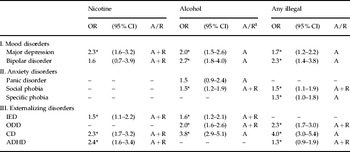
The final trimmed models retained only mental disorders with statistically significant or substantively meaningful (i.e. OR ⩾1.5) survival coefficients. All retained predictors were either active disorders or combinations of active and remitted disorders (Table 3). Externalizing disorders were both the strongest and most consistent predictors in these final models. The coefficients did not differ, as a set, either by respondent gender [χ2(5–7)=6.9–10.6, p=0.439–0.155] or life stage [defined in terms of person-years 1–19, 20–29, 30–44; χ2(10–14)=7.9–230, p=0.794–0.060].
Survival coefficients of temporally primary DSM-IV mental disorders predicting the subsequent first onset of substance dependence among Part II NCS-R respondents aged 18–44 (n=3199)Footnote a

IED, Intermittent explosive disorder; ODD, oppositional-defiant disorder; CD, conduct disorder; ADHD, attention deficit hyperactivity disorder; OR, odds ratio; CI, confidence interval; A, the predictor is the active mental disorder; R, the remitted mental disorder; A+R, the predictor is a combination of either the active or the remitted mental disorder.
a Based on multivariate equations including all mental disorders to predict dependence, controlling for person-year, age, gender and race-ethnicity.
* Significant at the 0.05 level, two-sided test.
Estimated effects of mental disorders on substance dependence
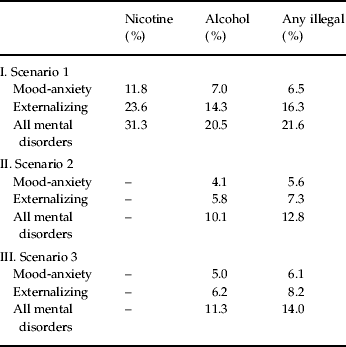
Simulations based on the coefficients in the final trimmed survival models generated PARP estimates for the first scenario (i.e. prevention of all mental disorders) of 31.3% for nicotine dependence, 20.5% for alcohol dependence, and 21.6% for other drug dependence (Table 4). The second and third scenarios were simulated only for alcohol and illegal drug dependence based on the fact that active and remitted mental disorders did not differ in predicting onset of nicotine dependence. PARP estimates for the second scenario were 10.1% for alcohol and 12.8% for illegal drugs, and those for the third scenario were 11.3% for alcohol and 14.0% for illegal drugs. NNT was calculated only for scenarios 2 and 3, as scenario 1 involves prevention rather than treatment. NNT was in the range 19–44 for anxiety-mood disorders and 10–12 for externalizing disorders in these two scenarios respectively.
Population Attributable Risk Proportions (PARP) of lifetime substance dependence associated with temporally primary mental disorders based on three simulation scenarios

Scenario 1: The estimated effects of preventing any of the mental disorders from ever occurring. Scenario 2: The estimated effects of recovery/successfully treating within 2 years of onset all mental disorders with onsets prior to age 18. Scenario 3: The estimated effects of recovery/successfully treating within 3 years all mental disorders irrespective of their age of onset. In each of the three scenarios, separate simulations were carried out for preventing or treating only mood and anxiety disorders, only externalizing disorders, and all three types of mental disorders.
Discussion
Several study limitations should be noted. First, the analyses used retrospective AOO reports to reconstruct temporal order. Differential recall error could bias results. Second, we excluded respondents without a history of abuse from a diagnosis of dependence, leading to a restriction in the coverage of dependence to those with socially maladaptive or hazardous use. However, this restriction is likely to be small (Degenhardt et al. Reference Degenhardt, Cheng and Anthony2007b, Reference Degenhardt, Bohnert and Anthony2008). Third, the only AOO information recorded was AOO of first symptom of abuse (alcohol, illegal drugs) or dependence (nicotine). To the extent that mental disorders that begin subsequent to these first symptoms predict subsequent progression to dependence, we will have underestimated the overall predictive effects of these disorders in our analysis. Fourth, as we focused only on time-lagged predictive associations, we also underestimated the predictive effects of mental disorders on subsequent onset of substance dependence in the year of onset of the mental disorders.
Within the context of these limitations, the lifetime prevalence estimates of DSM-IV substance dependence reported here are broadly consistent with other general population surveys (Helzer et al. Reference Helzer, Canino, Yeh, Bland, Lee, Hwu and Newman1990; Kessler et al. Reference Kessler, McGonagle, Zhao, Nelson, Hughes, Eshleman, Wittchen and Kendler1994; Grant et al. Reference Grant, Stinson, Dawson, Chou, Ruan and Pickering2004b). The strong associations of many mental disorders with lifetime substance dependence are also consistent with previous studies (Regier et al. Reference Regier, Farmer, Rae, Locke, Keith, Judd and Goodwin1990; Kessler et al. Reference Kessler, McGonagle, Zhao, Nelson, Hughes, Eshleman, Wittchen and Kendler1994; Grant & Harford, Reference Grant and Harford1995; Grant et al. Reference Grant, Stinson, Dawson, Chou, Dufour, Compton, Pickering and Kaplan2004a). The finding that temporally primary mental disorders significantly predict subsequent substance dependence, with the greatest risk associated with externalizing disorders, is also consistent with previous epidemiological studies based on both retrospective (Kessler et al. Reference Kessler, Aguilar-Gaxiola, Andrade, Bijl, Borges, Caraveo-Anduaga, DeWit, Kolody, Merikangas, Molnar, Vega, Walters, Wittchen and Üstün2001, Reference Kessler, Aguilar-Gaxiola, Andrade, Bijl, Borges, Caraveo-Anduaga, DeWit, Kolody, Merikangas, Molnar, Vega, Walters, Wittchen, Bukoski and Sloboda2003) and prospective (Lewis et al. Reference Lewis, Rice and Helzer1983; Dembo et al. Reference Dembo, Allen, Farrow, Schmeidler and Burgos1985; Schuckit & Hesselbrock, Reference Schuckit and Hesselbrock1994; Kranzler et al. Reference Kranzler, Del Boca and Rounsaville1996; Kushner et al. Reference Kushner, Sher and Erickson1999) data. The finding that the weakest predictive relationships are with mood disorders is also consistent with previous research (e.g. Patton et al. Reference Patton, Coffey, Carlin, Degenhardt, Lynskey and Hall2002; Degenhardt et al. Reference Degenhardt, Hall and Lynskey2003).
The simulated PARP estimates are broadly consistent with those in the one earlier simulation study of this type ever undertaken, in a series of cross-national WHO surveys (Kessler et al. Reference Kessler, Aguilar-Gaxiola, Andrade, Bijl, Borges, Caraveo-Anduaga, DeWit, Kolody, Merikangas, Molnar, Vega, Walters, Wittchen and Üstün2001). These earlier estimates, however, focused exclusively on active disorders and considered a narrower range of externalizing disorders than the NCS-R.
It is important to recognize that the PARP and NNT estimates are based on two unrealistic assumptions: that the observed associations between mental disorders and later substance dependence are entirely due to causal effects of mental disorders; and that it would be possible to prevent or cure all of these mental disorders with treatment. The first assumption is unrealistic in that mental and substance dependence are almost certainly influenced by common causes (Glantz et al. Reference Glantz, Conway, Colliver and Sloboda2005; Krueger et al. Reference Krueger, Markon, Patrick, Benning and Kramer2007). The second assumption is unrealistic because no intervention for mental disorders approaches 100% effectiveness (Connor et al. Reference Connor, Carlson, Chang, Daniolos, Ferziger, Findling, Hutchinson, Malone, Halperin, Plattner, Post, Reynolds, Rogers, Saxena and Steiner2006; Sartorius et al. Reference Sartorius, Baghai, Baldwin, Barrett, Brand, Fleischhacker, Goodwin, Grunze, Knapp, Leonard, Lieberman, Nakane, Pinder, Schatzberg, Svestka, Baumann, Ghalib, Markowitz, Padberg, Fink, Furukawa, Fountoulakis, Jensen, Kanba and Riecher-Rossler2007; Gilchrist & Arnold, Reference Gilchrist and Arnold2008; Nelson, Reference Nelson2008).
We might have attempted to estimate the latter effect, as we have information on age of first seeking treatment for mental disorders. However, cases that seek treatment are typically more severe than those that do not, often leading treatment to be associated with increased rather than decreased risk of subsequent persistence, severity and onset of secondary disorders. Because of this problem, we made no attempt to estimate the extent to which treatment of mental disorders predicted subsequent risk of substance dependence.
In light of the above considerations, the actual effects of real treatment of primary mental disorders would probably be smaller than the upper-bound estimates reported here. For example, if only half the mental disorders treated were cured (a reasonable upper bound based on the results of published treatment effectiveness studies) and if only half the predictive effects of mental disorders on later substance dependence are causal, then the actual PARP associated with real-world interventions might be no more than 25% as large as the PARP estimates reported here and the NNT would be four times as large as the NNT estimates reported here. NNT is the most important statistic here, as cost-effectiveness is judged in terms of costs per effectively treated case. Based on reasonable best-case assumptions, NNT would be in the range 76–177 for anxiety-mood disorders and 40–47 for externalizing disorders. Numbers of this size are well outside the range considered cost-effective to prevent a single case of substance dependence. Therefore, even though we found that mental disorders significantly predict subsequent substance dependence, we cannot conclude that prevention or early successful treatment of mental disorders would have a cost-effective impact in preventing subsequent substance dependence in the general population.
At the same time, the NCS-R data show clearly that people with mental disorders have a meaningfully elevated risk of substance dependence. This means that information about mental disorders might be useful as part of a risk formula to target preventive interventions even if the focus of the interventions was on risk factors other than on the mental disorders themselves. Externalizing disorders might be especially important risk markers in this regard (Hicks et al. Reference Hicks, Krueger, Iacono, McGue and Patrick2004; Glantz et al. Reference Glantz, Conway, Colliver and Sloboda2005; Verona & Sachs-Ericsson, Reference Verona and Sachs-Ericsson2005), as they are the most strongly predictive of later substance dependence and the only class of disorders for which no difference was found in the magnitude of survival coefficients associated with active and remitted disorders.
It is also noteworthy that the effects of mental disorder treatment interventions in preventing onset of secondary substance dependence, although too small to provide a primary justification for these interventions, might be considered important secondary outcomes in evaluating such interventions. Follow-up over a period of several years might be needed to detect these effects, so the addition of a long-term follow-up component to experimental interventions to treat mental disorders could be valuable in documenting secondary benefits such as this (Kessler et al. Reference Kessler, Pecora, Williams, Hiripi, O'Brien, English, White, Zerbe, Downs, Plotnick, Hwang and Sampson2008). Furthermore, even if interventions to treat mental disorders would not completely avert cases of substance dependence, they might mitigate the severity, course or collateral problems associated with substance dependence and, in particular, cases of co-morbidity.
Conclusions
The estimates reported here suggest that interventions to prevent or treat temporally primary mental disorders would, even under optimistic assumptions, have effects in preventing subsequent substance dependence that are apt to be too small to justify these interventions primarily on the grounds of preventing substance dependence. Thus, although the development of early intervention programs for mental disorders remains an important goal in its own right, the role of such interventions in preventing secondary substance dependence should be considered a potential side-benefit rather than a primary rationale. At the same time, it might prove valuable to use information about mental disorders to help target high-risk groups for substance abuse preventive interventions aimed at common underlying causes of both mental disorders and substance use disorders.
Acknowledgments
The National Comorbidity Survey Replication (NCS-R) is supported by the National Institute of Mental Health (NIMH) (U01-MH60220) with supplemental support from the National Institute on Drug Abuse (NIDA) (J.C.A.: K05DA015799; R01DA016558; R.C.K.: R01DA011121), the Substance Abuse and Mental Health Services Administration (SAMHSA), the Robert Wood Johnson Foundation (RWJF; Grant 044780), and the John W. Alden Trust. Collaborating NCS-R investigators include Ronald C. Kessler (Principal Investigator, Harvard Medical School), Kathleen Merikangas (Co-Principal Investigator, NIMH), James Anthony (Michigan State University), William Eaton (The Johns Hopkins University), Meyer Glantz (NIDA), Doreen Koretz (Harvard University), Jane McLeod (Indiana University), Mark Olfson (New York State Psychiatric Institute, College of Physicians and Surgeons of Columbia University), Harold Pincus (University of Pittsburgh), Greg Simon (Group Health Cooperative), Michael Von Korff (Group Health Cooperative), Philip Wang (Harvard Medical School), Kenneth Wells (UCLA), Elaine Wethington (Cornell University), and Hans-Ulrich Wittchen (Max Planck Institute of Psychiatry, Technical University of Dresden). The views and opinions expressed in this report are those of the authors and should not be construed to represent the views of any of the sponsoring organizations, agencies, or the U.S. Government. A complete list of NCS publications and the full text of all NCS-R instruments can be found at www.hcp.med.harvard.edu/ncs. Send correspondence to ncs@hcp.med.harvard.edu.
The NCS-R is carried out in conjunction with the World Health Organization (WHO) World Mental Health (WMH) Survey Initiative. We thank the staff of the WMH Data Collection and Data Analysis Coordination Centres for assistance with instrumentation, fieldwork and consultation on data analysis. These activities were supported by the NIMH Health (R01 MH070884), the John D. and Catherine T. MacArthur Foundation, the Pfizer Foundation, the US Public Health Service (R13-MH066849, R01-MH069864, and R01 DA016558), the Fogarty International Center (FIRCA R03-TW006481), the Pan American Health Organization, Eli Lilly and Company, Ortho-McNeil Pharmaceutical Inc., GlaxoSmithKline, and Bristol–Myers Squibb. A complete list of WMH publications can be found at www.hcp.med.harvard.edu/wmh/.
The viewpoints expressed in this article do not necessarily represent those of the National Institutes of Health or the United States Department of Health and Human Services.
Declaration of Interest
Professor Kessler has been a consultant for GlaxoSmithKline Inc., Pfizer Inc., Wyeth–Ayerst, Sanofi-Aventis, Kaiser Permanente, and Shire Pharmaceuticals; has served on advisory boards for Eli Lilly & Company and Wyeth–Ayerst; and has had research support for his epidemiological studies from Eli Lilly & Company, Pfizer Inc., Ortho-McNeil Pharmaceuticals Inc., and Bristol–Myers Squibb.