Introduction
As far back as the 1950s, engaging in meaningful activities was posited as important to both successful ageing and wellbeing in later life (Havinghurst and Albercht Reference Havinghurst and Albercht1953). A large body of work has since provided supporting evidence. This includes studies and reviews suggesting a link between physical activity in later life and health benefits, such as lower rates of cardiovascular disease, diabetes, cancer and falls (Bherer, Erickson and Liu-Ambrose Reference Bherer, Erickson and Liu-Ambrose2013; Sherrington et al. Reference Sherrington, Whitney, Lord, Herbert, Cumming and Close2008; Warburton, Whitney Nicol and Bredin Reference Warburton, Whitney Nicol and Bredin2006). There is also work which emphasises the positive impact of physical activity on mental health and wellbeing (Smith et al. Reference Smith, Blumenthal, Hoffman, Cooper, Strauman, Welsh-Bohmer, Browndyke and Sherwood2010) and cognitive impairment (Baker et al. Reference Baker, Frank, Foster-Schubert, Green, Wilkinson and McTiernan2010). Evidence also suggests that meaningful activity, other than physical activities, has a range of benefits for older people (Han et al. Reference Han, Radel, McDowd and Sabata2016) and is valued by older people (Bowling Reference Bowling2008; Stenner, McFarquhar and Bowling Reference Stenner, McFarquhar and Bowling2011; Wilhelmson et al. Reference Wilhelmson, Andersson, Waern and Allebeck2008). For older adults living with dementia, activity and occupation can help maintain self-esteem and feelings of belonging (Brod et al. Reference Brod, Stewart, Sands and Walton1999; Lawton Reference Lawton1994) and enable greater awareness of one's condition (Ohman, Josephsson and Nygard Reference Ohman, Josephsson and Nygard2008). Other studies show the value that people living with dementia place on engaging in activities they enjoy (Phinney, Chaudhury and O'Connor Reference Phinney, Chaudhury and O'Connor2007).
Most of the evidence around the importance of meaningful activity for older people comes from studies of people living in the community, but there is some evidence to show that meaningful activity in residential settings is associated with greater levels of happiness, improved mobility and higher survival rates (Mozley Reference Mozley2001; Schreiner, Yamamoto and Shiotani Reference Schreiner, Yamamoto and Shiotani2005). Studies of engagement in activity have noted that residents are often, due to a high level of impairments such as dementia (Prince et al. Reference Prince, Knapp, Guerchet, McCrone, Prina, Comas-Herrera, Wittenberg, Adelaja, Hu, King, Rehill and Salimkumar2014), dependent on support from staff to engage in activities (Schreiner, Yamamoto and Shiotani Reference Schreiner, Yamamoto and Shiotani2005; Tak et al. Reference Tak, Kedia, Tongumpun and Hee Hong2015). In this way, engagement in meaningful activity becomes a reflection of the quality of care provided by the home.
Research on the levels of engagement in meaningful activity in homes paints a consistent picture. From Townsend's (Reference Townsend1962) seminal The Last Refuge onwards, studies have noted the high levels of resident inactivity. Research which has used qualitative methods to understand the everyday experience of those who live in care homes has consistently found very low rates of residents engaging in activity in a number of countries, including the United Kingdom (UK), the Republic of Ireland and the United States of America (Cahill and Diaz-Ponce Reference Cahill and Diaz-Ponce2011; Hearle, Rees and Prince Reference Hearle, Rees and Prince2012; Popham and Orrell Reference Popham and Orrell2012; Shippee et al. Reference Shippee, Henning-Smith, Kane and Lewis2015; Tak et al. Reference Tak, Kedia, Tongumpun and Hee Hong2015). Quantifying residents’ engagement in activity in older adult homes is complex but studies that have mapped daily activities show that around half of residents’ waking time is spent being inactive or dozing (Mozley Reference Mozley2001; Schreiner, Yamamoto and Shiotani Reference Schreiner, Yamamoto and Shiotani2005) and engagement in activities is very low. Smit et al. (Reference Smit, de Lange, Willemse, Twisk and Pot2016) found that residents with dementia in Dutch nursing homes spent only two and a half hours over three days engaged in activities. An equally low figure was found by Ballard et al. (Reference Ballard, Fossey, Chithramohan, Howard, Burns, Thompson, Tadros and Fairbairn2001) who looked at residents with dementia in care homes based in the UK. During a six-hour observational period, only 12 minutes (3%) was spent on meaningful activities, a figure which doubled if watching television was included. Research using quality of life or needs assessment tools have also illustrated residents’ lack of engagement in activities. Both Hancock et al. (Reference Hancock, Woods, Challis and Orrell2006) and Netten et al. (Reference Netten, Beadle-Brown, Trukeschitz, Towers, Welch, Forder, Smith and Alden2010, Reference Netten, Trukeschitz, Beadle-Brown, Forder, Towers and Welch2012b) found that around three-quarters of older adults living in residential care in England had unmet needs in activity and occupation. In both studies the level of unmet need was higher in occupation and activity than in any other area of the residents’ lives.
This paper explores meaningful activity in care homes for older people in England with a policy and practice lens. It attempts to answer two related questions: (a) Why do people in older adult care and nursing homes not engage in meaningful activities? and (b) How can these homes enable and encourage their residents to engage in meaningful activity?
Methods
The data presented in the paper draw on a study which looked at the quality of life of older adults in care and nursing homes. Details of the main study can be found in Towers et al. (Reference Towers, Smith, Palmer, Welch and Netten2016). The study and its pilot included six self-selected homes, of which two provided nursing care. The homes, which included a large national chain and a smaller independent provider, were located in two local authorities in the south-east of England. All homes accepted people living with dementia and had between 29 and 64 beds. Two of the residential care homes only accepted female residents.
All permanent residents were invited to take part in the research, including people with dementia, other cognitive impairments and communication difficulties. In accordance with the Mental Capacity Act (2005), residents assessed as lacking the capacity to consent to take part in the research were recruited via the advice of a personal consultee, usually a relative. Researchers spent time in each home talking to residents, explaining the study and assessing their capacity to consent. Once initial consent had been obtained, the researchers continuously monitored whether or not residents wished to participate (Ramcharan and Cutcliffe Reference Ramcharan and Cutcliffe2001).
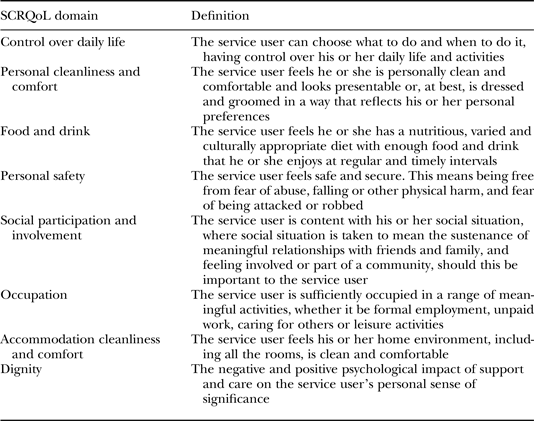
Data collection took place in the homes between January 2013 and March 2014. Data from residents were collected using the mixed-method version of the Adult Social Care Outcomes Toolkit (ASCOT CH3) (Beadle-Brown et al. Reference Beadle-Brown, Towers, Netten, Smith, Trukeschitz and Welch2011; Netten et al. Reference Netten, Trukeschitz, Beadle-Brown, Forder, Towers and Welch2012b). ASCOT aims to measure social care-related quality of life (SCRQoL), which is those areas of a person's quality of life that can reasonably be attributed to social care services. The care home version of ASCOT has been used the UK, Austria, Denmark, Finland and Australia (Rostgaard, Brünner and Fridberg Reference Rostgaard, Brünner and Fridberg2012; Towers et al. Reference Towers, Smith, Palmer, Welch and Netten2016; Trukeschitz Reference Trukeschitz2011). In ASCOT, SCRQoL is comprised of eight conceptually distinct domains, including a domain that focuses upon activities and occupation. The ASCOT domains are outlined in Table 1. Occupation in ASCOT is defined as being occupied in a range of meaningful activities. This is interpreted in the tool and in this study as being any activities that the resident values or enjoys.
Adult Social Care Outcomes Toolkit (ASCOT CH3) domains of social care-related quality of life (SCRQoL)

Three measures can be derived from the ASCOT toolkit. The first, current SCRQoL, reflects the person's currently experienced SCRQoL (with services in place) and is the one that features most prominently in this paper. The second, expected SCRQoL, is a method for estimating the counter-factual and reflects the SCRQoL that would be expected in the absence of services. By subtracting expected SCRQoL from current SCRQoL, we can calculate the SCRQoL gain, which reflects the total benefit of the intervention or service (Netten et al. Reference Netten, Burge, Malley, Potoglou, Towers, Brazier, Flynn, Forder and Wall2012a). ASCOT CH3 is designed for evaluating outcomes in residential care settings. It uses a multi-method approach to overcome the well-documented difficulties that the most impaired populations, such as those living in long-term care, have using self-completion questionnaires and participating in structured interviews (Hellstrom et al. Reference Hellstrom, Nolan, Nordenfelt and Lundh2007; Hubbard, Downs and Tester Reference Hubbard, Downs and Tester2003).
The care home version of ASCOT combines observations of residents’ lived experience in the ASCOT domains with interviews involving staff, family members and, where possible, residents. ASCOT CH3 takes a flexible approach towards resident interviews, containing both a structured and a qualitative interview schedule to encourage residents to talk about their lives within the care home (Smith et al. Reference Smith, Caiels, Forder and Beadle-Brown2015). A growing body of work has suggested that qualitative interviews are a promising method for enabling people living with dementia to directly participate in studies looking at their lives (Beusher and Grando Reference Beusher and Grando2009; Hellstrom et al. Reference Hellstrom, Nolan, Nordenfelt and Lundh2007; Lloyd, Gatherer and Kalsy Reference Lloyd, Gatherer and Kalsy2006; Matchwick et al. Reference Matchwick, Domone, Leroi and Simpson2014; Moore and Hollett Reference Moore and Hollett2003; Robertson Reference Robertson2014; Steeman et al. Reference Steeman, Tournoy, Grypdonck, Godderis and Dierckx2013). Evidence is strongest for those who have mild to moderate dementia (Novella et al. Reference Novella, Ankri, Morrone, Guillemin, Jolly and Jochum2001; Nygard Reference Nygard2006; Sands et al. Reference Sands, Ferreira, Stewart, Brod and Yaffe2004), but for people with more severe dementia using a range of methods, including observation alongside interviews, may more appropriate (Beusher and Grando Reference Beusher and Grando2009; Brooker and Surr Reference Brooker and Surr2010).
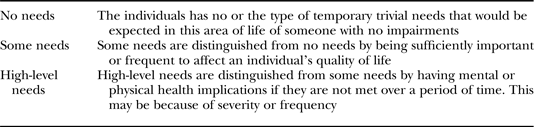
In ASCOT CH3, the researcher rates each domain based on all the evidence gathered, in the case of this study using written notes from the observation and responses, notes and transcripts of the interviews. For each rating one of three levels is chosen – no needs, some needs, high-level needs (see Table 2).
Levels of social care-related quality of life in the Adult Social Care Outcomes Toolkit (ASCOT CH3)

Staff and managers were asked to reflect on our findings about residents’ SCRQoL in feedback sessions. Nine sessions were held in the six homes and all staff who had contact with residents were invited. The sessions were used to share findings and discuss how the residents’ lives could be improved. By holding group rather than individual sessions we hoped to create a dialogue in which staff could respond to one another and drive the discussion (Krueger and Casey Reference Krueger and Casey2000). Four home managers also participated in one-to-one feedback sessions.
The majority of interviews with residents and feedback sessions with staff were recorded and transcribed verbatim. In a few cases participants did not wish to be recorded but agreed to researchers making notes of the interview or session. NVivo 10 was used to manage and code the data which consisted of interview and feedback session transcripts, and interview and observational notes. The analysis was carried out by the first author, supported by the second and fourth authors.
Chosen for its flexibility and ability to provide analyses that can inform policy development, the analysis broadly followed the six phases outlined in Braun and Clarke's (Reference Braun and Clarke2006) guidelines for thematic analysis. The first phase consisted of becoming familiar with the data via multiple re-readings of the transcripts and field notes. The second phase involved generating the initial coding framework, which was a deductive or top-down semantic framework based on the ASCOT domains (see Table 1). These first two stages, and the concurrent quantitative analysis, suggested that material on occupation would benefit from further investigation. Additional coding focused on sections of the data that were related to the ASCOT domain of occupation. The flexibility of thematic analysis allowed this later coding to switch from a ‘top-down’ deductive approach to a more inductive one which allowed codes to emerge from the data (Thomas Reference Thomas2006). The third phase of the analysis concentrated on searching for themes. The multiple re-reading of the data and reflection on the codes generated in the previous stage suggested a set of themes that addressed the low level of engagement in meaningful activity amongst residents. During the fourth and fifth phases of the analysis these themes were reviewed and revised, this included further re-readings of the original material. During these phases the themes were reviewed by two other authors (AT, JB) for their coherence and credibility, and definitions and titles for the themes were generated. The sixth phase of the analysis consisted of selecting the most appropriate extracts and writing the Findings section. All authors were involved in reviewing this final stage, with the fourth author reviewing and advising on a number of drafts.
Findings
Residents’ characteristics
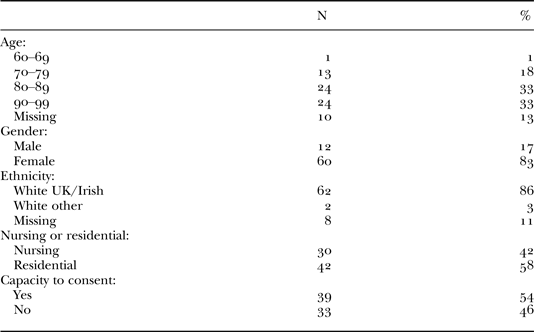
Across the six homes, a total of 72 residents participated in this study. Response rates ranged from 23 per cent in one of the nursing homes to 54 per cent in one of the residential care homes. This is consistent with previous research involving care homes for older adults in the UK (Netten et al. Reference Netten, Bebbington, Darton and Forder2001). Our sample was dominated by those aged over 80 (see Table 3), reflecting the national picture in care homes (Office for National Statistics 2014). The study also included more female residents than are typical of the care home population, reflecting the inclusion of two homes that only supported female residents. We also experienced a higher level of participants who were judged to lack the capacity to consent to take part in this research compared to earlier studies (Netten et al. Reference Netten, Beadle-Brown, Trukeschitz, Towers, Welch, Forder, Smith and Alden2010, Reference Netten, Trukeschitz, Beadle-Brown, Forder, Towers and Welch2012b).
Residents’ characteristics

Note: N = 72.
All of the residents who participated in the study were observed and, where possible, took part in a face-to-face interview. A total of 34 residents took part in the interviews, 13 of whom spoke to us twice, always on separate days. We also interviewed a member of staff about each of the participants.
Being occupied in care and nursing homes
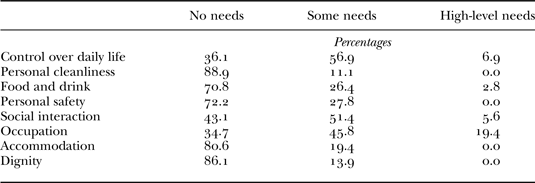
Table 4 describes what participants’ current SCRQoL was like at the time of the data collection (with all the help and support they receive from the care home in which they live). From these ratings a clear pattern emerges: SCRQoL varies across the different domains. Moreover, this variation is not random. In domains we call basic, as they are essential to life (personal cleanliness, food and drink, personal safety, accommodation), we find the prevalence of no needs ratings to be between 70 and 90 per cent. This means that most residents’ needs in these areas are met. When we look at the higher-order domains (control over daily life, social interaction, occupation), the prevalence of no needs ratings is noticeably lower, ranging from around 35 to 43 per cent, indicating that SCRQoL is much lower in these domains. Looking more closely at the SCRQoL in the higher-order domains, it is the occupation domain in which there is the lowest occurrence of no needs but also the greatest occurrence of high-level needs ratings. Nearly one in five residents experienced unmet needs in occupation so severe that there was the potential for negative physical or mental health consequences.
Residents’ current social care-related quality of life (SCRQoL) ratings by Adult Social Care Outcomes Toolkit (ASCOT CH3) domain

Note: N = 72.
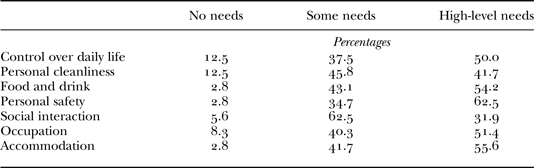
From the expected domain ratings (see Table 5), a very different picture emerges. Without help and support from the homes, the quality of life of residents would be worse in all of the domains. The occurrence of high-level needs is much greater and the difference between basic and higher-order domains less noticeable. This suggests that help and support makes a positive difference to the lives of residents but it has a greater impact on the basic domains.
Residents’ expected social care-related quality of life (SCRQoL) rating by Adult Social Care Outcomes Toolkit (ASCOT CH3) domain

Note: N = 72.
Understanding occupation in care homes: a natural part of ageing?
One of the ways in which care staff explained the lower levels of SCRQoL found in the occupation domain was to see activity as something that naturally declined in later life. This view was most evident in the account of a unit manager who suggested that the lower levels of occupation observed in her unit were not because of a lack of available opportunities but dependent on whether the residents were awake, ‘as older people like to sleep a lot’ (Unit manager, national chain nursing home 2, feedback session).
Other data, however, challenge this view. Our observations found that light sleeping or ‘dozing’ was common amongst residents in the middle of the day:
Helen is a female resident who is aged 87. She is wearing a stripy pink dress and is sat in the main lounge. There are four other female residents in the lounge. A TV is on in the background, nobody seems to be watching it. Helen is looking around the room. This goes on for a few minutes. Nobody is talking, nobody enters the room. Helen has closed her eyes and her head has dropped. She alternates between looking around the room and dozing. She seems bored when looking around the room. As time goes on the time spent dozing increases. Eventually she falls asleep. (Observation at national chain nursing home 2)
The observational note suggests that sleeping was often related to being bored, a point some care workers were keen to share in the feedback sessions, as in this example about a resident who did not take part in organised activities:
Care worker 1: …she gets left in her room or left in her chair, and what does she do? She sleeps. So when her niece … comes in and she's asleep. So her family are coming in to see her, ask how she is and she's just asleep because she's just so bored.
Care worker 2: They always say, don't they, when you go to a care home you always see residents in the lounge asleep? It's not because they're tired it's ’cause they're bored, it's boredom I think a lot of the time.
Care worker 1: There's nothing keeping their mind going.
Care worker 2: Exactly, what do you do? You sleep when you're bored. (National chain nursing home 3, feedback session)
Although the need to sleep explanation was rare amongst staff, a variation on it, that the lower levels of occupation can be explained by resident choice, was more common:
They [the residents] don't particularly like doing anything. (Care worker 1, independent care home 1, feedback session)
Later in that same session another care worker made reference to residents choosing not to engage in activities. They also noted that a resident's abilities also impacted on being occupied:
Facilitator: There were a couple of residents who pretty much did nothing, you know, didn't really engage in anything.
Care worker 2: But then sometimes you might ask them [the residents] if they want to do something, ‘no, no, I'm alright, no I don't want to do anything’, yeah…
Care worker 3: It's like the activities, you can try and do things but it's their ability to be able to do those things and their willingness to do those things. (Independent care home 1, feedback session)
This combination of choice and ability was found in other staff feedback sessions:
Care worker 4: But given sometimes the nature of their [residents’] illnesses, their abilities, their wishes, because, you know, we don't ever say, ‘Well no, you must –, you must attend –.
Care worker 1: No, it's their choice.
Care worker 4: …Or, ‘You must do whatever’, because that's not what we're – you know, we're not about that. It is their choice at the end of the day…
Care worker 2: It's up to them. (National chain nursing home 4, feedback session)
The claims that residents choose not to engage in activity was also challenged by what residents told us during interviews. Most commonly residents stated that they did not engage in a specific activity because they either did not enjoy or were not very good at it:
Brenda: I'm not too keen on that [painting]. I can't draw, I can't draw for toffee nuts (laughs).
Interviewer: No I'm not very good at that.
Brenda: I'm not keen at all no. Well, I suppose I can't do it and that's why I don't like it. (Brenda, resident, independent care home 2)
Residents’ accounts also showed examples of making choices around how they engaged in an activity. One resident talked of how she did not participate in the organised craft activities provided by the care home because she had her own craft-based hobby:
Interviewer: I think they do run activities here, do you join in them at all?
Janice: They do, yes. They have I think twice or three times a week, they have somebody coming in and doing pottery and painting and all sorts, it's sitting down jobs.
Interviewer: Do you go to any of those or?
Janice: No, I don't, no … I'd rather do –, I've got –, I've been illuminating most of my life, so I can, you know, I've got the sort of knowhow to paint. So I paint cards. (Janice, resident, independent care home 1)
Although there are clear instances of residents exercising choice around occupation, residents point to this choice being whether or not to participate in a specific activity, rather than, as some staff suggest, choices not to engage in any activities. This research provides some finer detail around residents’ choice as an explanation for lower levels of SCRQoL in the occupation domain.
During interviews residents revealed how they felt about the lack of activity and occupation they experienced. Not surprisingly, it was always presented negatively:
…to me if you're sitting in one room all the time –, all the time like this, you –, there's just nothing to do. You just sit –, I only said the other day to … one of the carers, I said if they just have a bit of, you know, music going in the day, or say if they had [radio station] going. I don't mean blasting out, but going so that you could keep up with your local news … but there's just nothing, it's just dead quiet all the time … Sometimes I'm in here, I'm the only one in here and, erm, I think to myself, oh, I've been to sleep. Must have been … and perhaps an hour has gone and, er, I don't know, it's just as though you're sort of fed, watered and dumped till next time, you know, because the people that come to and fro, they haven't got time to stop and chat to you, they're busy doing something every time. And it does get very, very bored … It's just, you're in here and it's a dead silence sort of thing. (Diana, resident, independent care home 1)
This account also notes that the resident had suggested an activity that might go some way to occupying her, in this case having the radio playing. These interviews showed that residents could identify a range of activities that were meaningful to them and that they would like to do. For example, several residents talked about card games, while one resident talked about some of the different games they would like to play, including dominoes. Lots of residents expressed a desire to do activities outside the home, such as day trips, trips to the shops or going into the garden. Reflecting other work (Lorenz et al. Reference Lorenz, Freddolino, Comas-Herrera, Knapp and Damant2017), the use of technology, such as laptops or tablets, was not mentioned by residents, and there was no such equipment visible in any of the homes.
These accounts provide a challenge to the notion that older people living in care homes are choosing not to engage in activities. Not only are these interviews characterised by lack of evidence of older people making an explicit choice to do nothing, they show residents talking of their unhappiness about doing nothing and their desire to engage in activities of their choice.
Much like staff, residents also talked about increasing levels of impairment and the impact it has on their own activity. For example, one resident talked about how she had always enjoyed reading but problems with her eyesight had meant in the past six months she had stopped reading books altogether. Another resident talked about knitting:
Lucy: I'm knitting a hat for a child.
Interviewer: Is that a relative?
Lucy: No, no it's just a, you know, I like knitting.
Interviewer: And do you do a lot of knitting?
Lucy: I used to do but I haven't got the energy really to do it now. (Lucy, resident, national chain nursing home 4)
It is interesting to note the difference in staff and resident attitudes to impairments in higher-order domains, compared with the more basic, and their expectations of how unmet needs might be addressed. For example, if somebody were unable to feed themselves, this would not be a sufficient reason to leave them hungry. Yet, both staff and residents seem to accept that reduced ability to engage in meaningful activity means that residents will simply ‘do less’ with their time. Our research suggests two broad explanations of why engagement in meaningful activities is not very well supported in care homes for older people.
Alternative explanation (1): too much to do
One way in which care workers explained poorer outcomes in the occupation domain was to point out how hard staff worked and how they were often over-stretched during shifts:
Care worker 2: You know, we don't slack at all … we just want more time, if there were more hours in the day or more of us then it would be so much better for us, for their [the residents’] quality of lives, we wouldn't be so stressed…
Care worker 1: It's a nightmare. Everyone does work hard, but like I said, just nicer for an extra someone who can just walk around and say, ‘You all right?’ And that's it, that's all they want, ‘Are you all right? Do you want a cup of tea?’
Care worker 3: [A resident] upstairs looking for someone, I mean she wants us to stay with her but I cannot stay. I said, ‘…I cannot stay ’cause we've got a lot of people’. (National chain, nursing home 3, feedback session)
Care workers’ accounts also suggested that residents were aware of how busy staff were. One care worker recounted how a resident had told them that all she had to do was ‘blink and we're [the care worker] gone’ and that the care workers were just a ‘blue blur’ (care worker, national chain nursing home 3, feedback session), a sentiment echoed during resident interviews:
I miss somebody of my own age who I can talk to, the nurses are good but they're usually very, very busy here. There's always a crisis of some sort, with these oldies. (Janice, resident, independent care home 1)
Some residents’ accounts went further, noting that it was not just the crises, or as one resident described them, the ‘difficult moments’, in a home that made staff so busy, but that care workers were ‘low in numbers’ (Elizabeth, resident, independent care home 1).
Home managers present in the feedback sessions were able to place these discussions into a wider context of funding. One manager suggested that in their home the ratio between care staff and residents was good, while acknowledging that funding levels meant that the needs of all residents could not be met:
We work on a ratio at the moment of one to five, … which is a very good ratio. I know other homes work on one to seven and one to eight. For us to be able to ensure that all of our residents’ needs were met 24 hours a day you'd be talking possibly one to two, which is impossible, couldn't be done, it just couldn't be done. Financially it couldn't be done … the staffing ratios, and it's just not possible. As much as I'd love to be able to say to everybody, right, you've only got two residents to look after today throughout the whole day and they are yours and you don't have to worry about anybody else. But it just couldn't be done. (Home manager, national chain nursing home 3, feedback session)
Alternative explanation (2): working practice in care homes
The data collected in this study pointed to another explanation of why outcomes were poorer in the occupation domain, compared to other ASCOT domains: working practice. The earlier section showed that staff are busy and feel over-stretched and that managers have little opportunity to address this due to low levels of funding. It is within this context that choices must be made concerning work priorities. This discussion between care workers reveals how they see priorities regarding care provision:
Care worker 1: …more staff would help.
Care worker 5: Yeah, because the morning is taken up, isn't it, by settling everybody?
Care worker 1: Yeah, totally.
Care worker 5: Washing, you know, and then it's lunchtime and then toileting and all those things that come and then in the afternoon it's all simpler, you know, and then it's time to go to bed. So it is a very structured day, isn't it?…
Care worker 4: It is, yeah, but it has to be because obviously if we don't look after all their basic opt–, you know, their basic needs or what they need … because I know I've got 12 people that I've got to wash, dress and do with what needs to be done, 12 people toileting they're going to take priority. (National chain nursing home 4, feedback session)
As illustrated by this quote, the priority in care homes is to ensure that people are washed, dressed, toileted and fed. Basic health needs must be met. Indeed, most of the staff interactions that we witnessed during the two-hour observational periods tended to focus on exactly these aspects of people's lives. This following extract is from our observational notes and follows a single resident's interactions with care workers over a two-hour period during the morning.
Susan is sitting in a flower-patterned armchair in one of three small lounges located downstairs in the care home. She is wearing a yellow cardigan, brown dress, slippers and a necklace. In front of her sits a walker. She seems to be dozing, whilst the four residents in that lounge are having drinks provided by a member of staff. She wakes and a member of staff comes over, and using her name, gives her a hot drink. The staff member leaves, Susan proceeds to drink from the cup. It is 25 minutes before the member of staff returns. She asks if she can take the now empty cup away. The care worker is polite and uses the resident's name before leaving. Ten minutes later the resident manages to attract the attention of a care worker who is passing, they have a quick chat and the care worker goes off and then shortly returns with another member of staff. Together they help the resident to stand, holding the walker. Still supported, gently, by the care workers, the resident moves slowly in the direction of the toilet. Five minutes later the resident and the two staff return from the toilet. The care workers and the resident talk intermittently. As they get near to me and help the resident to sit down it seem that most of the conversation is about the current task of moving and sitting. Half an hour later, two staff help the resident to make her way to the dining room. Most of the conversation is around processing the resident through the task. When seated, another member of staff brings around a glass of water, and some medication. A few minutes later soup arrives, a care worker put in front of the resident with a few polite words. (Observation, independent care home 2)
During the feedback sessions, care workers sometimes raised the topic of activity co-ordinators. All of the participating homes employed a person to run activities. Some staff suggested that poorer outcomes were partially due to this role being under-resourced:
Each house has one activity staff … She's only part time … I mean so –, it is a lot. I mean if that –, say if we had a full house, that's 39 residents she's got to try and sort of, like, do activities for, you know. They could have a game –, they could have a games afternoon where they're doing, sort of, like playing cards or dominoes. (Care worker 2, national chain nursing home 2, feedback session)
While this does provide another reason why SCRQoL may be lower in the occupation domain, it also emphasises that occupation is often seen as separate from the main role of caring within homes. Rarely did we observe staff finding ways to increase levels of occupation in residents’ everyday lives. The only examples came from two homes. The first home had two residents who were involved in everyday activities; one who liked to help out with the laundry and another who liked to lay the tables. In the other home, a group of residents worked together to set the tables for lunch. Importantly, in the first home those involved in these activities were the most able, while in the second, the activity was found in the higher-dependency unit. The feedback sessions with staff raised the possibility of getting residents more involved in everyday activities. Responses were mixed; some felt that safety concerns and the level of residents’ impairments meant that it was not an option. However, most care workers and managers responded positively:
Care worker 1: It's like we've got this urn and there are plenty of people that are very capable of making a cup of tea … if they leave the key in there they might burn themselves. All they have to do is touch it and they've burnt themselves. But so many go, ‘I just want a cup of tea’. Well let them make a bloomin’ cup of tea.
Care worker 2: Or even if one of us was just in there just to supervise, just to stand there while they –, watch them, you know. (National chain nursing home 3, feedback session)
Changes in the way staff work that may enhance residents’ occupation identify high-quality support as a highly skilled role. Managers noted that to provide high-quality support would involve ensuring that staff were able to access training and other mechanisms such as coaching and time management. One manager decided that they needed specialist help to put together activities for residents with dementia and so employed a company with experience of providing activities for people with cognitive impairment to develop their activities schedule and provide training for staff.
Discussion
The findings presented in this paper attempt to answer two related questions: (a) Why do people in older adult care and nursing homes not engage in meaningful activities? and (b) How can these homes enable and encourage their residents to engage in meaningful activity? The paper explores these questions by drawing on data from observations, interviews with residents, and interviews with staff and managers.
Regarding the first question, a number of possible explanations are presented by the findings. The first, that lack of engagement in activity is either a ‘natural’ part of the ageing process or an explicit choice made by residents, is simply not supported by the evidence. Instead, greater credence is placed on the two alternative explanations emerging from the data. Firstly, that care homes are under-resourced, meaning that staff feel over-stretched and unable to meet both higher-order and basic needs. Secondly, that activity and meaningful occupation in care homes is seen as something distinct and special, not part of everyday routine, and so requires the support of additional staff whose job it is to co-ordinate activities within the home.
It is as we consider these two explanations that the second question comes to the fore. Staff described low staff–resident ratios as a significant barrier to better engagement in meaningful activities. However, higher ratios would be associated with significant increases in staff costs and individual homes have little control over the funding they receive from commissioners. Only around 40 per cent of placements in English care and nursing homes come from people who self-fund their care, the rest are funded by local authorities (52%) and the National Health Service (8%) (Bäumker and Netten Reference Bäumker, Netten, Dening and Milne2011; Forder and Allen Reference Forder and Allen2014). Austerity measures have meant that since 2010 local authorities have seen their spending power decrease by 27 per cent in real terms (Hastings et al. Reference Hastings, Bailey, Bramley, Gannon and Watkins2015). It is, therefore, unlikely that fees paid by councils are like to rise very much in the near future. These near-static funding levels are very likely to be compounded by the introduction of the National Living Wage in April 2016. This obligatory minimum wage increase for those aged over 25 is projected to affect at least half of all those employed in care homes (Ingham, Bamford and Jones Reference Ingham, Bamford and Jones2015).
A more positive note is struck by our finding that changes in how staff work may offer a way to improve residents’ engagement in meaningful activities. Accounts in this study suggested that staff prioritise the more ‘basic’ aspects of care and support – keeping people clean and fed, for example – at the expense of those aspects of care and support that ASCOT would call ‘higher order’, such as occupation. Re-prioritising some aspects of care and support might be a way to improve engagement in meaningful activities during everyday tasks. However, while preference studies highlight the importance of being occupied for both the general population and those supported by social care (Netten et al. Reference Netten, Burge, Malley, Potoglou, Towers, Brazier, Flynn, Forder and Wall2012a), re-prioritising higher-order domains will be difficult. The needs of care home residents are often profound and complex. Previous studies using ASCOT have shown that many residents would, without the care and support provided by homes, have unmet needs in the basic domains that may have a negative impact on their health (Netten et al. Reference Netten, Trukeschitz, Beadle-Brown, Forder, Towers and Welch2012b). Reducing support in these domains would be unethical and breach their duty of care. Furthermore, relatives, who are often seen as the voice of care home residents, tend to focus on making sure their relatives’ basic needs, such as being clean and fed, are met properly, rather than demanding support for higher-order needs, such as occupation (Lopez et al. Reference Lopez, Mazor, Mitchell and Givens2013; Welch et al. Reference Welch, Palmer, Towers and Smith2017).
The feedback from managers and staff in this study do, however, point to a possible way forward: changing the way that care is organised within staff teams. One home, for example, tried dividing care staff into teams who were responsible for smaller numbers of residents. Rather than trying to keep all residents fed, toileted and clean, these smaller teams were responsible for all aspects of fewer residents’ lives, including occupation and social participation. Two homes were already trying to involve residents in everyday activities, such as folding laundry or laying the tables for lunch. Both of these strategies involve reconfiguring what occupation usually means in homes. It is about ensuring that activity is not seen as special, that supporting occupation is not something that care staff leave to specialist activity co-ordinators but that it is part of their caring role too. It is about broadening the understanding of ‘activity’ to include not just the ‘special’ event, such as bingo, but also the everyday tasks, such gardening and table-laying. This approach reflects the development of person-centred care and active support found more commonly in the support of people living with learning disabilities (Mansell and Beadle-Brown Reference Mansell and Beadle-Brown2012). Active support recognises that care staff shape whether people do or do not engage in activities throughout the day. It proposes an enabling relationship between care workers and the people they support where there is not only an expectation that people are able to participate in the activities of daily life but are provided with enough support to enable them to do so. Although gradually moving more into mainstream care for people with learning disabilities, proponents suggest that the approach may bring benefits for older adults with dementia as well (Mansell and Beadle-Brown Reference Mansell and Beadle-Brown2012).
A shift towards different ways of working does, however, require a number of other things to be in place. Managers in the study recognised that staff may require training to support change. Indeed, observational aspects of this study illustrated that high-quality support was a highly skilled activity. Whilst training has been shown to be successful in improving aspects of residents’ lives in some instances (Clare et al. Reference Clare, Whitaker, Woods, Quinn, Jelley, Hoare, Woods, Downs and Wilson2013), the evidence overall is mixed. Nolan et al. (Reference Nolan, Davies, Brown, Wilkinson, Warnes, McKee, Flannery and Stati2008) suggest that, like increased resources, training alone is not sufficient to improve residents’ quality of life.
This study found a mixed picture when it came to how both staff and managers viewed meaningful activity. In the feedback sessions, there were staff who both acknowledged the importance of meaningful activity and suggested that they would like to see their roles changed to include this and other higher-order ASCOT domains. However, there were a small number of staff whose accounts portrayed a view of older people, or at least older people living in care, as not wanting or able to engage in meaningful activities. While this paper rejects the idea that there is something ‘natural’ about care home residents not taking part in activities, the belief suggests that staff attitudes many pose a barrier to increasing engagement in meaningful activities.
This resonates with work on cultural change in care homes. Ronch (Reference Ronch2004), for example, argues that a cultural change should begin with a re-evaluation of how older people are seen and advocates a relationship-based approach to care practices. While cultural change needs to be collaborative, involving and giving voice to all stakeholders, it also requires strong leadership. Care home managers are often identified as leaders who can drive such change and movements such as My Home Life provide programmes to support managers of homes (My Home Life 2016). Drivers of change, however, need to be reinforced by support outside the home. One such external pressure for cultural change is the independent regulator of all social care services in England, the Care Quality Commission. The Care Quality Commission's new inspection regime aimed to put the experiences of service users at the centre of their inspections (Care Quality Commission 2016). Using Key Lines of Enquiry (KLOE), services, including care and nursing homes, are rated on being safe, effective, caring, responsive and well-led. Some areas of quality of life are emphasised, such as food and drink, control and dignity, by having their own sections with the KLOE. However, being occupied in meaningful activities is subsumed within other sections, such as people's needs being met by the adaption, design and decoration of the services (E5) or how people receive personalised care that is responsive to their needs (R1). These broader KLOE are clearly important, as evidenced by the link between the built environment and not just quality of life (Burton and Sheehan Reference Burton and Sheehan2010) but also occupation (Torrington Reference Torrington2009). However, if we are to improve engagement in meaningful activities in care homes, inspection regimes must afford them more importance.
Conclusion
There are a number of limitations to this study. The research was based on a small number of self-selecting homes so the residents’ voices are not necessarily representative of the population more broadly. Despite attempts to make the interviews with residents as flexible and inclusive as possible (Smith et al. Reference Smith, Caiels, Forder and Beadle-Brown2015), they reflect the accounts of those who were able to verbalise their experiences, while the lived experience of those with the most profound impairments is represented by observation and proxy reporting. Nonetheless, given that the observational data support the accounts provided by residents and staff, we feel that these limitations do not detract from the study's findings. The low levels of meaningful activity among the residents of care and nursing homes were found to be a result of not only homes being under-resourced but also a reflection of how staff work, and occasionally, their attitudes towards resident engagement. Our discussion of how homes might address residents’ engagement in meaningful activity draws directly on these explanations and the data that support them. This paper also argues for greater emphasis on meaningful activity in the Care Quality Commission inspection process to reinforce the importance of facilitating and supporting residents to be occupied throughout the day, every day. In turn, this will encourage changes within the sector that will improve resident's overall quality of life.
Acknowledgements
We thank the National Institute for Health Research (NIHR) School for Social Care Research, the members of the project advisory group, the residents, relatives, staff and management of all the homes that took part in the study. The research on which this paper is based was funded by the NIHR School for Social Care Research (award number T976/EM/KentAN4) and the Department of Health Policy Research Unit in Quality and Outcomes of Person Centred Care. The views expressed in this presentation are those of the authors and not necessarily those of the NIHR School for Social Care Research or the Department of Health/NIHR. This study was given a favourable ethical review from the Social Care Research Ethics Committee (12/IEC08/0051) who confirmed it complied with the requirements of the Mental Capacity Act (2005). NS was the co-applicant on the original study, conceived the study design, conducted the focus groups/observations and interviews, conducted the analysis and drafted the paper. AT was the principle investigator for the larger study, contributed to the planning of the article, conducted focus groups, advised on analysis and commented on drafts of the paper. SP contributed to the planning of the article, conducted the observations and interviews, and commented on drafts of the article. JB contributed to the planning of the article, advised on analysis and commented on drafts of the article. EW contributed to the planning of the article and commented on drafts. There are no conflicts of interest.