Introduction
Mg-Fe-Al-chlorites, which are members of the clinochlore–chamosite solid-solution series, with the simplified general formula (Mg,Fe,Al,□)6(Si,Al)4O10(OH)8, are characterized by wide compositional variations and polytypism, IIb-2n being the most common kind of trioctahedral chlorite module (Durovic et al. Reference Durovic, Dornberger-Schiff and Weiss1983; Bailey Reference Bailey and Bailey1988; Chukhrov Reference Chukhrov1992). The Al2O3 content typically varies in the range from ~12 wt.% in chamosite (Fe,Al,Mg)6(Si,Al)4O10(OH)8 to ~52 wt.% in donbassite, ideally Al4.33(Si3Al)O10(OH)8 (Hey Reference Hey1954; Bondi et al. Reference Bondi, Morten and Rossi1976; Shikazono & Kawahata Reference Shikazono and Kawahata1987; Bailey Reference Bailey and Bailey1988; Bailey & Lister Reference Bailey and Lister1989; Hillier & Velde Reference Hillier and Velde1991; Prieto et al. Reference Prieto, Dubessy and Cathelineau1991; Zane & Sassi Reference Zane and Sassi1998; López-Munguira et al. Reference López-Munguira, Nieto and Morata2002; Deer et al. Reference Deer, Howie and Zussman2009; Tang et al. Reference Tang, Shi, Jiang, Zhou and Shi2017; Bobos et al. Reference Bobos, Noronha and Mateus2018; Wu et al. Reference Wu, Pan, Xia, Huang and Lai2019). Smaller Al2O3 contents (down to 4 wt.%) have been found in some varieties of so-called “hydroferrichlorites,” which are insufficiently investigated components of sedimentary iron ores of the Kerch iron-ore basin where chlorites are intimately intergrown with other minerals including smectites and mixed-layered phyllosilicates (Strakhov Reference Strakhov1966; Chukhrov Reference Chukhrov1992).
Unlike trioctahedral chlorites, Al-free trioctahedral serpentines, including those with Fe3+ having tetrahedral coordination [cronstedtite Fe2 2+Fe3+(SiFe3+)O5(OH)4 (Hybler Reference Hybler2014, Reference Hybler2016; Hybler et al. Reference Hybler, Sejkora and Venclík2016, Reference Hybler, Števko and Sejkora2017; Pignatelli et al. Reference Pignatelli, Mugnaioli and Marrocchi2018) and guidottite Mn2 2+Fe3+(SiFe3+)O5(OH)4 (Wahle et al. Reference Wahle, Bujnowski, Guggenheim and Kogure2010)] are common in Nature. This fact may be an indication of the important role of aluminum at the tetrahedral sites in the stabilization of the chlorite-type structure. Recent data, however, indicated the existence of exceptions from this general trend.
The purpose of this study was to characterize the very unusual trioctahedral Fe-rich chlorites containing no more than ~0.7 wt.% Al2O3 (i.e. <0.1 Al atoms per formula unit = apfu) from dolomite carbonatites of the Kovdor ultramafic-alkaline complex, Kola Peninsula, Russia, to understand better the anomalously large Ti content of these minerals. In the current nomenclature of Fe-Mg chlorites (unlike the nomenclature schemes of micas and some other phyllosilicates), the population of separate octahedral and tetrahedral sites is not taken into account. For this reason minerals described here were considered to be Al-depleted varieties of chamosite, the general formula of which is (Fe,Al,Mg)6(Si,Al)4O10(OH)8 (Back Reference Back2018; see IMA list of minerals https://www.ima-mineralogy.org/Minlist.htm - http://cnmnc.main.jp/IMA_Master_List_(2020-01).pdf).
EXPERIMENTAL
Materials
The chlorite samples investigated in this work originated from dolomite carbonatite veins uncovered by open pit working at the Zheleznyi (Iron) Mine situated in the western part of the Kovdor complex of ultramafic, alkaline rocks, and carbonatites. The Kovdor complex is a central-type multiphase intrusion (with prevailing olivinites in the central part and alkaline rocks in peripheral zones) emplaced into Archean gneisses. Dolomite carbonatites form veins up to 2 m thick which are confined to a concentric zoned stock of phoscorites and magnetite-carbonate rocks which form the so-called Kovdor Iron-Ore Complex (Ivanyuk et al. Reference Ivanyuk, Yakovenchuk and Pakhomovsky2002).
Two chlorite samples were investigated. In Sample 1, chlorite forms compact crusts (up to 0.2 mm thick) and rare aggregates (up to 30 μm across) of thin lamellae (Fig. 1). The associated minerals are dolomite, ilmenite, anatase, sphalerite, pyrite, hydroxycalciopyrochlore, and labuntsovite-Mg. In Sample 2, chlorite forms aggregates (up to 0.3 mm across) consisting of thin lamellae (up to 10 μm×200 μm×200 μm, see Fig. 2) in association with dolomite and labuntsovite-Mg. In both assemblages chlorites are the latest minerals to have formed.
Aggregates of chlorite (Sample 1) from dolomite carbonatite of the Kovdor complex. Back-scattered electron BSE image.

Aggregates of chlorite (Sample 2) from dolomite carbonatite of the Kovdor complex. BSE image.

Methods
Chemical data were obtained on polished samples embedded in epoxy resin using a Tescan VEGA-II XMU INCA Energy 450 (Tescan Orsay Holding, Brno, Czech Republic, https://www.tescan.com) microprobe instrument (EDS mode, 20 kV, 190 pA, 180 nm beam diameter, excitation zone of 3–4 μm) housed in the Institute of Experimental Mineralogy RAS, Chernogolovka, Russia. Five spot analyses were carried out for each sample. The following standards were used: MgF2 for F, MgO for Mg, wollastonite for Ca, albite for Na, synthetic Al2O3 for Al, orthoclase for K, quartz for Si, and pure Mn, Fe, and Ti for these corresponding elements. Contents of other components were below detection limits of electron microprobe analysis. H2O could not be determined because of insufficient amounts of monomineral fractions. The presence of OH groups was confirmed by means of infrared (IR) spectroscopy.
In order to obtain IR absorption spectra, powdered samples were mixed with anhydrous KBr (with the KBr to sample ratio of 200:1), pelletized, and analyzed using an ALPHA FTIR spectrometer (Bruker Optics, Karlsruhe, Germany) housed in the Institute of Problems of Chemical Physics RAS, Chernogolovka, Russia. The measurements were carried out at a resolution of 4 cm–1 and 16 scans per sample. The IR spectrum of an analogous pellet of pure KBr was used as a reference.
Powder X-ray diffraction data of both samples were collected at St Petersburg State University, with a Rigaku R-AXIS Rapid II diffractometer equipped with a cylindrical image plate detector (radius 127.4 mm) using Debye-Scherrer geometry, CoKα radiation (rotating anode with VariMAX microfocus optics), 40 kV, 15 mA, and an exposure time of 10 min. Data were integrated using the software package Osc2Tab (Britvin et al. Reference Britvin, Dolivo-Dobrovolsky and Krzhizhanovskaya2017).
The unit-cell and the full-profile refinement of the XRD patterns were performed with the program package Topas 5 (Bruker AXS 2014). The details of the structure refinement by the Rietveld method using data for clinochlore-IIb-4 from Zanazzi et al. (Reference Zanazzi, Comodi, Nazzareni and Andreozzi2009) as a starting model are shown in Table 1.
Structure refinement details and crystallographic data for Sample 1.

Results
Chemical Composition
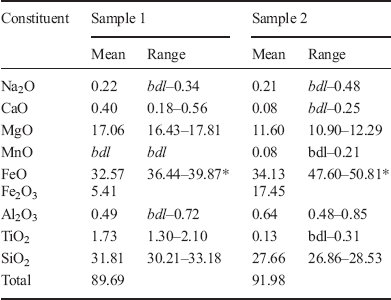
Analytical data are given in Table 2. Additionally, IR spectra (see below) revealed the presence of trace amounts of H2O molecules in Sample 1 and the absence of H2O in Sample 2. The empirical formulae calculated on the basis of O10(OH)8 and 10 Mg+Mn+Fe+Al+Ti+Si apfu, taking into account the charge-balance requirement are:
Chemical composition of Al-deficient chlorites (wt.%).

bdl = below detection limit.
*The ranges are given for total Fe contents calculated as FeO which was apportioned between FeO and Fe2O3 based on the charge-balance requirement for the empirical formulae calculated on the basis of O10(OH)8 and 10 Mg+Mn+Fe+Al+Ti+Si apfu.
Na0.05Ca0.05(Fe2+3.01Mg2.01Ti0.14Fe3+0.04)Σ6.00[(Si3.53Fe3+0.41Al0.06)Σ4.00O10](OH)8·nH2O (Sample 1);
Na0.05Ca0.01(Fe2+3.26Mg1.97Fe3+0.75Mn0.01Ti0.01)Σ6.00[(Si3.16Fe3+0.75Al0.09)Σ4.00O10](OH)8 (Sample 2).
Infrared Spectroscopy
IR spectra of the Al-deficient chlorite Samples 1 and 2 (Fig. 3) were similar. The strongest bands were observed in the ranges 3300–3700 cm–1 (O–H stretching vibrations), 950–1050 cm–1 (stretching vibrations of the tetrahedral sheet), 640–650 cm–1 (O–Si–O bending vibrations), and 400–500 cm–1 (lattice modes involving Si–O–Si bending and (Fe,Mg)–O stretching vibrations). Additional weak bands at 1640 and 561 cm–1 in the IR spectrum of sample 1 were due to H–O–H bending and libration vibrations of trace amounts of H2O molecules, respectively.
Infrared absorption spectra of a Sample 2 and b Sample 1.

Bands of O–H stretching vibrations in the IR spectrum of Sample 2 were shifted toward the low-frequency region relative to analogous bands in the IR spectrum of Sample 1. The lowering of the former may be due to a rather strong polarization of OH groups coordinated by Fe3+ and, as a result, stronger hydrogen bonds formed by Fe3+(Mg,Fe2+)2O–H groups as compared with (Mg,Fe2+)3O–H groups. Shifts in these bands towards lower frequencies with the enhancement of the VIFe content was a general trend for trioctahedral chlorites (Prieto et al. Reference Prieto, Dubessy and Cathelineau1991).
According to Libowitzky (Reference Libowitzky1999), the correlation between the O···O distance d O···O (i.e. the distance between O atoms of the OH group and H-bond acceptor, in Å) and wavenumber νOH (in cm–1) of a band of O–H stretching vibrations is described by the equation d O···O = 0.1321[26.44–ln(3592–νOH)]. The d O···O distances estimated using this equation were 2.726 and 3.118 Å for Sample 1, and 2.809 and >3.23 Å for Sample 2.
The band of stretching vibrations of the tetrahedral sheet in the IR spectrum of Sample 1 was observed at 960 cm–1 whereas an analogous band of Sample 2 had an absorption maximum at a smaller wavenumber value of 953 cm–1. This agrees with the general trend for silicates, according to which weighted average frequency of [4](Si,Al,Fe3+]–O stretching vibrations decreases as the fraction of trivalent species among cations with octahedral coordination increases (Chukanov Reference Chukanov2014).
X-ray Diffraction Data and Crystal Structure
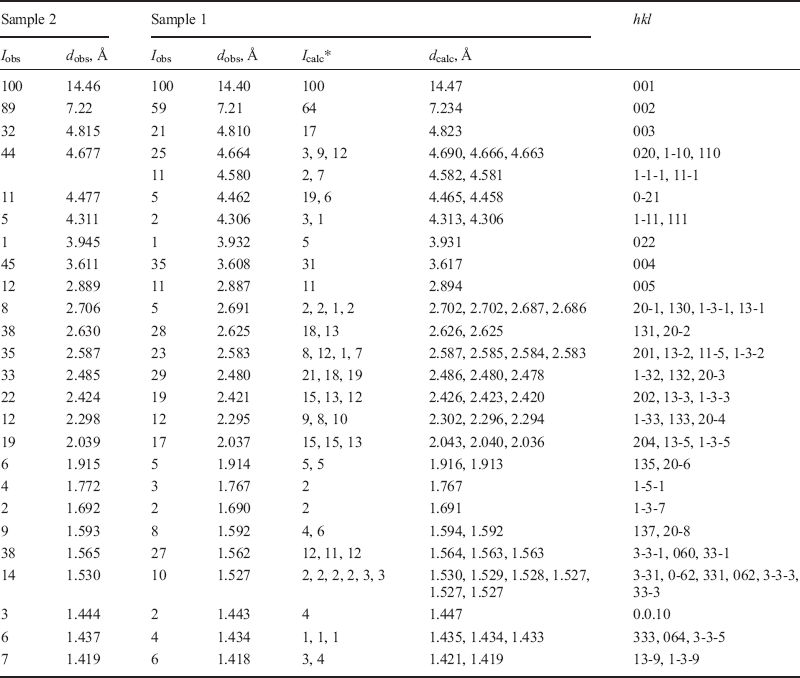
Powder XRD patterns of the Samples 1 and 2 (Fig. 4, Table 3) were similar and corresponded to IIb-4-module trioctahedral chlorites with cronstedtite-1T impurities (~10 and 30%, respectively; see Hybler Reference Hybler2014, Reference Hybler2016; Hybler et al. Reference Hybler, Sejkora and Venclík2016, Reference Hybler, Števko and Sejkora2017; Pignatelli et al. Reference Pignatelli, Mugnaioli and Marrocchi2018). Parameters of the triclinic unit cell for Sample 1 are given in Table 1. Unit-cell parameters of Sample 2 calculated based on the same model were: a = 5.42(1), b = 9.41(2), c = 14.55(4) Å, α = 90.02(4), β = 97.05(7), γ = 90.04(4)°, and V = 736(1) Å3.
Powder X-ray diffraction patterns of Sample 1 (upper trace) and Sample 2 (lower trace). Diagnostic peaks of the cronstedtite-1T admixture are indicated with asterisks.

Powder X-ray diffraction data of Al-depleted chlorites from Kovdor.

*For the calculated pattern, only reflections with intensities ≥1% are given.
Reflections belonging to cronstedtite are not included.
Rietveld refinement for Sample 2 could not be carried out correctly because of a pronounced texture. Structural data were obtained, therefore, only for the chlorite component in Sample 1. The final Rietveld plot is shown in Fig. 1S.
Atomic coordinates were refined for all sites except M1 and M4, which are special positions (Table 4). Isotropic displacement parameters B iso were used for all the atoms; B iso were constrained for the groups of atoms (Si1–Si2, M1–M4, and O1–O9). The restraints for the Si–O bonds and O–Si–O angles in tetrahedra, as well as selected distances in (Fe,Mg)O6 octahedra, were realized using Topas 5 Launch mode with the weighting factor for penalties K = 3. A polyhedral image of the crystal structure of Al-deficient chlorite (Sample 1) is given in Fig. 5. Selected bond lengths are listed in Table 5.
The atomic coordinates, site occupation, and isotropic displacement parameters (Å2) of chlorite in Sample 1.

General view of the crystal structure of Al-deficient chlorite (Sample 1). The unit cell is outlined. The M1 and M2 sites are Fe2+-dominant, and the M3 and M4 sites are enriched in Mg.

Selected bond lengths (Å) in Al-deficient chlorite (Sample 1).

Variations in bond lengths in tetrahedra ranged from 1.59 to 1.67 Å, with average values of 1.625 Å for Si1O4 and 1.63 Å for Si2O4, which are slightly longer than the typical value for chlorites of 1.62 Å (Liebau Reference Liebau1985) and may be due to the Fe3+ admixture at the tetrahedral sites. The angles O–Si1–O and O–Si2–O varied in the ranges 102.9–115.9° and 100.8–115.1°, respectively.
In the structure of the chlorite component in Sample 1, iron concentrated in the M1 and M2 sites belonging to the TOT triple block whereas M3 and M4 sites of the simple octahedral layer were Mg-dominant (Table 4) and, correspondingly, were characterized by shorter M–O distances (Table 5). The chlorites under study have the largest unit-cell volumes of any chlorites presented in the ICSD database (2017), which is apparently due to the large total Fe content and the presence of significant amounts of Fe3+ in the tetrahedral sites.
Discussion
The formation of Al-depleted chlorites in dolomite carbonatites is associated with a small total Al content in these rocks. Other minor (non-carbonate) minerals of the Kovdor dolomite carbonatites are represented predominantly by Al-free amphiboles (mainly, richterite), Al-free serpentines, Al-deficient trioctahedral micas (namely IVFe3+-bearing phlogopite KMg3[Si3(Al,Fe3+)O10](OH)2 and tetraferriphlogopite KMg3[Si3Fe3+O10](OH)2), magnetite, zircon, minerals from the labuntsovite-Mg-labuntsovite-Fe series Na4K4(Mg,Fe2+)2(Ti,Nb)8(Si4O12)4(OH,O)8·10H2O, Al-free phosphates, pyrrhotite, and pyrite. Consequently, even phlogopite, which is the main concentrator of Al in these rocks, is Al-depleted because of the large Fe3+ content.
Both chamosite samples investigated in this work contain admixed cronstedtite-1T. This fact, along with the extreme rarity in Nature of Al-depleted chlorites with Al2O3 contents of <1 wt.% (unlike Al-depleted serpentines), is an indirect indication of a small area of thermodynamic stability of Al-free chlorites compared to Al-bearing chlorites. The data above, however, show that the existence of Al-depleted trioctahedral chlorites is a reliably established fact.
The presence of significant amounts of Ti is not typical of chlorites. The largest TiO2 contents (up to 1.2 wt.%) have been detected in Fe-rich chlorites: chamosite from gabbro of the Pechenga region, Kola Peninsula (Chukhrov Reference Chukhrov1992), and Al-poor chamosite (with 14.64 wt.% Al2O3) forming pseudomorphs after biotite from granite of the Monzoni intrusive complex, Italy (Bondi et al. Reference Bondi, Morten and Rossi1976). The relatively large amount of Ti in Sample 1 (locally, up to ~2 wt.% TiO2) confirms this tendency. On the basis of the available data, drawing an unambiguous conclusion as to whether this tendency has a crystal chemical or a genetic origin is impossible. Another problem to be solved (maybe, based on experimental data from synthesis) is how stable are Al-free chlorites belonging to the clinochlore–chamosite solid-solution series and whether their transformation into serpentines is possible.
The presence of pyrite in Sample 1 indicates reducing conditions in which this mineral association was formed. This, along with a deficiency of aluminum, may have caused Ti, rather than Fe3+, to be the main charge-balancing, high-valence octahedral cation.
SUMMARY
Results obtained during the present study confirmed the existence of extremely Al-depleted trioctahedral chlorites (with Al2O3 contents of <10 wt.% and, in particular, <1 wt.%) in Nature, as well as the possibility of the occurrence of significant amounts of Fe3+ and Ti in the tetrahedral and octahedral sites, respectively, of these minerals. The extreme rarity of Al-depleted chlorites (unlike Al-depleted serpentines) and the presence of cronstedtite intimately associated with such chlorites at Kovdor suggest that the structure of Al-poor chlorite may be unstable and can easily transform into the serpentine structure.
Specific conditions for mineral formation in the dolomite carbonatites of Kovdor, including a deficit of Al and reducing conditions during mineral formation, contributed to the formation of Al-poor chlorites in which Fe3+ rather than Al is the major trivalent cation in the tetrahedral sheet and Ti may be the major high-valency octahedral cation.
Electronic supplementary material
The online version of this article (https://doi.org/10.1007/s42860-019-00055-8) contains supplementary material, which is available to authorized users.
Acknowledgments
This work was performed in accordance with the state task, state registration No. 0089-2019-0013. The authors thank the X-ray Diffraction Centre of Saint-Petersburg State University for instrumental and computational resources.
Compliance with ethical standards
Conflict of interest
On behalf of all authors, the corresponding author states that there is no conflict of interest.