Introduction
Acute blood loss represents a leading cause of civilianReference Cothren, Moore, Hedegaard and Meng1–Reference Kauvar, Lefering and Wade3 trauma-related deaths and is the leading cause of death from potentially survivable injuries on the contemporary battlefield,Reference Eastridge, Mabry and Seguin4, Reference Eastridge, Hardin and Cantrell5 despite the prioritization of massive hemorrhage control in Advanced Trauma Life Support (ATLS),6 Tactical Combat Casualty Care (TCCC),Reference Butler7, 8 Tactical Emergency Casualty Care (TECC),9 and the Stop The Bleed initiative.10 The primary causes of potentially survivable battlefield death include the under-performance of life-saving interventions, when required; and the combination of uncontrollable major hemorrhage and prolonged evacuation to hemostatic surgical intervention, the latter condition being the proximate cause for over two-thirds of these deaths.Reference Gerhardt, Strandenes and Cap11
On the battlefield, controlling a compressible hemorrhage is one of the most commonly applied battlefield treatments.Reference Kotwal, Montgomery and Kotwal12 Prior to contemporary conflicts, potentially survivable fatalities due to exsanguination from a compressible extremity wound was estimated at upwards of 60%.Reference Bellamy13 The broad adoption of TCCC principles prioritizing the liberal and early use of tourniquets to control compressible extremity hemorrhageReference Butler7, 8 has significantly reduced potentially survivable fatalities.Reference Kotwal, Montgomery and Kotwal12, Reference Gerhardt, Berry and Blackbourne14, Reference Mabry, Apodaca, Penrod, Orman, Gerhardt and Dorlac15 Between October 2001 and June 2011, only 120 (13.5%) of potentially survivable fatalities died due to extremity hemorrhage prior to reaching a military treatment facility. These successes have been translated into the civilian sector’s TECC and the Stop The Bleed initiatives.Reference Jacobs, McSwain and Rotondo16 Even while hemorrhage control techniques have improved, the 120 (13.5%) fatalities due to potentially survivable extremity hemorrhage demonstrates a potential for improving and expanding hemorrhage control options in high-risk environments.
Currently, techniques used in civilian and military medicine for controlling extremity hemorrhage include digital pressure, mechanical compression, plain gauze pressure dressings, hemostatic agent impregnated pressure dressings, wound packing with or without hemostatic agents, tourniquets, and soft-tissue clamps.Reference Rossaint, Bouillon and Cerny2, Reference Kauvar, Lefering and Wade3, 6, 8, Reference Kotwal, Montgomery and Kotwal12, Reference Butler, Hagmann and Butler17, Reference Rossaint, Bouillon and Cerny18 Despite the relatively large number of choices available to control hemorrhage, current TCCC and TECC guidelines continue to recommend the application of a tourniquet to treat life-threatening, anatomically amendable extremity hemorrhages during Care Under Fire.8, 9 While extremely effective at reducing the risk of death due to exsanguination,Reference Kragh, Littrel and Jones19, Reference Kragh, Walters and Baer20 the proper application of a tourniquet is associated with severe pain, impaired limb function, and potential neurovascular damage with prolonged use.Reference Kragh21–Reference Walters and Mabry24 In a battlefield setting, transient loss of limb function could limit mobility for self-extrication or combat effectiveness through ineffective weapons system employment.
Innovative Trauma Care (San Antonio, Texas USA) has developed an external soft-tissue hemostatic clamp that provides an alternative option for massive hemorrhage control, which may not cause ischemic pain and loss of functionality in the injured extremity. The external soft-tissue hemostatic clamp’s specific mechanism of hemorrhage control (via approximation of the wound edges) is via the creation of a hematoma that mitigates further hemorrhage.25 Implicit in this scheme is the requirement for effective coagulation and subsequent clot formation; what is left to inference is whether such a device would remain efficacious in the face of acute traumatic coagulopathy. Acute coagulopathy occurs in 24%-56% of patients who sustain serious traumatic injuries,Reference Niles, McLaughlin and Perkins26–Reference Brohi, Singh, Heron and Coats30 effectively limiting an injured patient’s intrinsic coagulability following a major trauma, as acknowledged within the external soft-tissue hemostatic clamp’s training materials.Reference Care31
The study was designed to objectively evaluate this device’s effectiveness at abating a massive traumatic extremity hemorrhage, 24%-56% of which are complicated by acute traumatic coagulopathy, to the current gold standard in TCCC and TECC, the tourniquet.32, 33 To accomplish this, the study sought to compare the external soft-tissue hemostatic clamp’s performance in controlling fluid loss after damage to the femoral and popliteal arteries in a normotensive, coagulopathic, cadaveric lower-extremity flow model using an inert blood analogue, as compared to a compression tourniquet.
Materials and Methods
Expedited study approval was obtained through the University of Texas Health Science Center San Antonio Office of Institutional Research IRB (San Antonio, Texas USA) before initiation of the study.
Study Design
This was a randomized, balanced two-treatment, two-period, two-sequence, crossover experimental study comparing the iTClamp50 (Innovative Trauma Care; San Antonio, Texas USA) and the Combat Application Tourniquet (C-A-T) Gen 6 (C-A-T Resources, LLC; Rock Hill, South Carolina USA). Study cadavers were randomized into one of two sequences: application of the compression tourniquet followed by the external soft-tissue hemostatic clamp; or application of the external soft-tissue hemostatic clamp followed by the compression tourniquet.
Outcomes
The primary outcome of this study was measured fluid loss (hemorrhage) from the intravascular space.
Hemorrhagic Flow Model
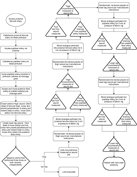
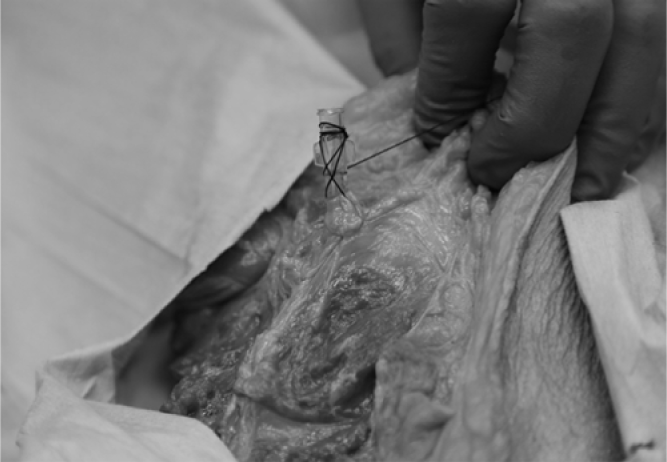
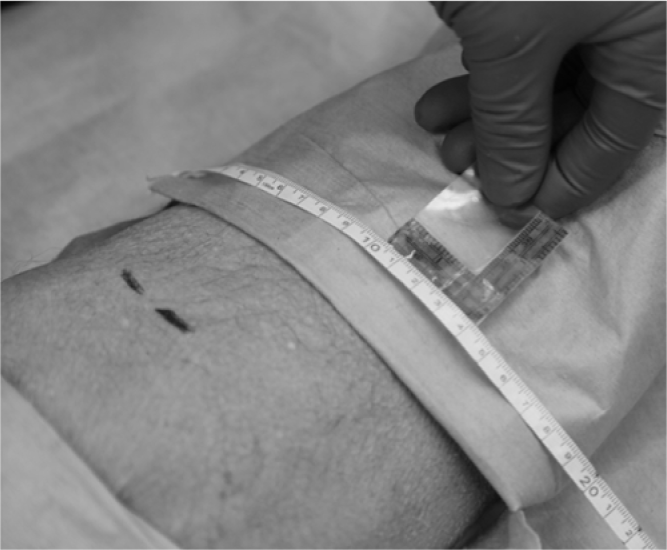
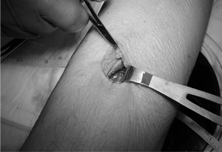
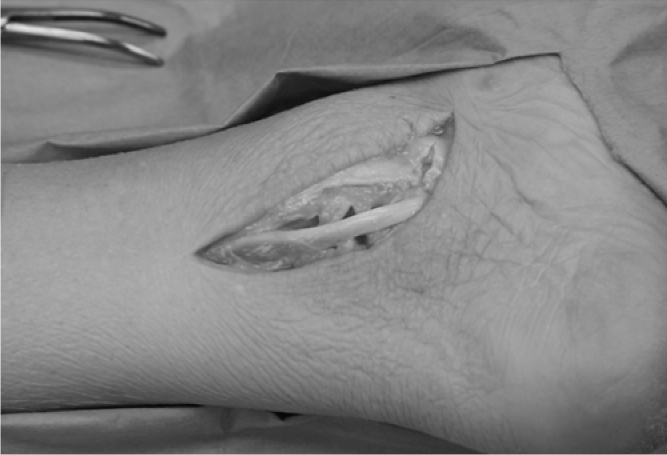
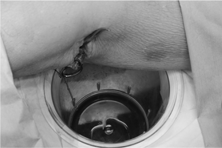
A series of two lower-extremity wounds were created using surgical instrumentation, as detailed in Figure 1. Each limb was prepared identically with simulated arterial hemorrhages in two separate locations: the lower extremity’s thigh and lower leg’s femoral and tibial arteries, respectively. The proximal femoral artery was catheterized at the level of the inguinal ligament, allowing for infusion of the blood analog into the femoral artery and vascular bed proximal to the site of the simulated thigh wound (Figure 2). The simulated thigh wound was created by incising into the femoral artery. The popliteal artery was accessed and incised for two purposes: fluid collection distal to the thigh wound for measurement of distal vascular flow volume and as an infusion point for the lower leg wound trial (Figure 3). The lower leg wound was created identically by incising the posterior tibial artery mid-lower leg (Figure 4 and Figure 5). The posterior tibial artery was accessed for fluid collection distal to the lower leg wound for measurement of distal vascular flow volume (Figure 6). A colored blood analog solution was pressure infused into the flow model’s vasculature, which was chosen to mimic the viscosity and sheer force of whole blood within large arteries.Reference Brookshier and Tarbell34 The blood analog was infused at a constant pressure of 92mm Hg (the mean arterial pressure of a patient with a blood pressure of 120/80). Fluid draining from the wounds and distal arterial sites was collected separately and measured (Figure 7). A non-pulsatile flow model was chosen as the investigators felt this would reflect the most extreme possible example of near-exsanguination and eliminate hemodynamic pulsation’s adverse effect on coagulation as a potential confounding variable which could affect device performance results.
Method Flowchart.

Proximal Femoral Access Point.

Access and Drainage Point in Popliteal Fossa.

Simulated Wound Creation.

Simulated Wound Creation.

Posterior Tibial Artery Drainage Site.

Popliteal Drainage Site with Blood Analog Draining During Study Iteration.

Known peripheral vascular disease was the only exclusion criteria for this study. A total of 17 pairs of fresh, human cadaver legs were included in the study, and one pair of legs were excluded due to severe atherosclerosis that prevented fluid from perfusing the limb during the control flow. This exclusion provided the sample of 16 pairs of fresh, human cadaver legs required by the sample size calculations.
Study Protocol
A fresh, cadaveric lower-extremity, perfused with a non-coagulating blood analog, was used to simulate a hemorrhaging arterial wound in a coagulopathic trauma patient, as diagramed in Figure 1. As previously stated, a model simulating the coagulopathy of trauma was chosen since acute traumatic coagulopathy is concurrently present in 24%-56% of patients with a severe traumatic injury, and the investigators felt this would reflect the most extreme possible example, thus eliminating clotting as a potential confounding variable which could affect device performance results.Reference Niles, McLaughlin and Perkins26–Reference Brohi, Singh, Heron and Coats30
A measured volume of blood analog was made available and infused into the injured artery. Fluid draining distal to the injury was collected and measured, and thus blood volume lost from the intravascular space was calculated by subtracting the volume collected distal of the injury from the total volume infused. This method not only captured the intravascular fluid lost externally from the wound site, but also the fluid lost from the intravascular space into the limb’s soft tissues.
A baseline control experiment was conducted on every wound prior to tourniquet or clamp usage to determine both flow rate and change in limb circumference during an unabated hemorrhage. Fluid was perfused into each wound’s proximal catheter for two minutes without a hemorrhage control device. Fluid was collected and measured from the wound site and the exposed, distal artery during this control phase hemorrhage. The thigh and lower leg’s circumferences were measured at the wound site and recorded before and after infusion, as another method to assess intravascular fluid loss into the wound cavity or potential space within the limb. All limbs underwent three baseline control hemorrhages described above at both injury locations to determine both flow rate and change in limb circumference during an unabated hemorrhage. Data from the control hemorrhages were deemed “No Device” in the results.
With each limb, the thigh wound was the first to be tested. Each study device (external soft-tissue hemostatic clamp or compression tourniquet) was placed per the manufacturer’s instructions and the blood analog was made available to be perfused into the proximal femoral artery access point. The volume of fluid perfused into the limb (total volume minus the remaining fluid) either exsanguinated from the wound or was collected from the distal arterial collection point. Fluid volumes were collected and measured as the primary variable of interest. The circumference of the leg at the wound site was re-measured and recorded before removing the external soft-tissue hemostatic clamp or compression tourniquet. This process was repeated on the wound with the other test device (external soft-tissue hemostatic clamp or compression tourniquet). The same procedure was repeated in the lower leg.
Statistical Methods
All measurements are summarized as with the mean and standard deviation (SD). The statistical significance of treatment comparisons was assessed with paired t-tests and mixed effects linear models with adjustment for period and sequence and the control bleed; paired t-tests are reported because both methods gave consistent results. All treatment comparisons were preceded with an assessment of the effect of limb side (left limb, right limb); no differences were found and so treatment comparisons were based on measurements at the thigh and lower leg averaged over the side. All statistical testing was two-sided with a significance level of five percent. The software used was SAS Version 9.3 for Windows (SAS Institute; Cary, North Carolina USA), used throughout.
Results
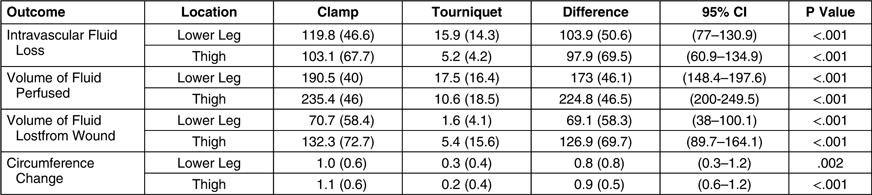
The mean intravascular fluid loss was increased with the external soft-tissue hemostatic clamp compared to the compression tourniquet at the lower leg and thigh: Lower Leg Clamp 119.8mL (SD = 46.6mL), Tourniquet 15.9mL (SD = 14.3mL), difference 103.9mL (SD = 50.6mL), 95% CI (77-130.9 mL), P <.001; Thigh Clamp 103.1mL (SD = 67.7mL), Tourniquet 5.2mL (SD = 4.2mL), difference 97.9mL (SD = 68.5mL), 95% CI (60.9-34.9mL), P <.001. Similar increases with the external soft-tissue hemostatic clamp were found at both locations for volume of fluid perfused (P <.001), volume of fluid lost (P <.001), and circumference change (P <.001; Table 1).
Clamp versus Tourniquet

Comparisons with “No Device” (Table 2) revealed no significant difference between the external soft-tissue hemostatic clamp and “No Device” at both locations: Lower Leg Clamp 119.8mL (SD = 46.6mL), “No Device” 132.1mL (SD = 50.4mL), difference −19.4mL (SD = 38.8mL), 95% CI (-44.1 to 5.2mL), P = .11; Thigh Clamp 103.1mL (SD = 67.7mL), “No Device” 107.2mL (SD = 73.6mL), difference −4.3mL (SD = 55.8mL), 95% CI (-39.8 to 31.1mL), P = .79. Whereas the compression tourniquet exhibited less fluid loss than “No Device” at both locations: Lower Leg Tourniquet 15.9mL (SD = 14.3mL), “No Device” 132.1mL (SD = 50.4mL), difference −116mL (SD = 54.3mL), 95% CI (-150.5 to −81.5mL), P <.001; Thigh Tourniquet 5.2mL (SD = 4.2mL), “No Device” 107.2mL (SD = 73.6mL), difference −102mL (SD = 74.2mL), 95% CI (−149.2 to −54.9mL), P <.001.
Clamp and Tourniquet versus No Device with Regard to Intravascular Fluid Loss

Discussion
To the authors’ knowledge, there exist no clinical trials or observational studies to date comparing the hemostatic effect of the external soft-tissue hemostatic clamp versus a gold standard (in this case, a compression tourniquet). Given the regulatory and ethical constraints associated with human subject research, the investigators of this study believe that prospective clinical trials to be untenable. Likewise, a clinical trial in an animal model, which would likely require terminal exsanguination and/or sacrifice of an extremity leading ultimately to sacrifice of the animal would meet with significant obstacles while not creating a translatable data set to human casualties. An animal model’s extremities do not offer potential spaces equivalent to those found on a human extremity. These observations formed the logical underpinning for this study’s design.
This study demonstrated that in a normotensive, hemorrhagic, coagulopathic, cadaveric-extremity flow model, intravascular fluid loss was substantially and significantly greater from the arterial wounds treated with the external soft-tissue hemostatic clamp versus a compression tourniquet.
The authors of this manuscript would offer by conjecture that this observed difference resulted from the innate characteristics of the respective devices. Presumably, the external soft-tissue hemostatic clamp should maintain distal perfusion to the affected limb as long as the initial trauma did not disrupt the collateral vessels and soft tissue vascular bed. While this presumption would seem far more likely to preserve viable tissue through continued perfusion, it may also limit the pain and mobility concerns previously mentioned, secondary to ischemia from tourniquet use. The concern raised at least in the short-term (ie, the “Care Under Fire” or “Hot Zone” phases of TCCC or TECC, respectively), the external soft-tissue hemostatic clamp might merely contain ongoing arterial hemorrhage by preventing its exit through the now-closed wound, filling a potential space during periods of coagulopathy. In the case of thigh wounds, in particular, the potential for hemorrhage volumes in excess of two units have routinely been cited.Reference Dawson, Naga, Atassi, Moore, Feliciano and Mattox35 Put another way, such an intervention is simply converting an external hemorrhage into an internal one, with the associated potential for further contribution to hypovolemic shock and coagulopathy due to a now “internal” extravasation of intravascular volume into an extravascular hematoma contained by a surface wound closure.
In comparison, and as expected, the tourniquet accomplished hemostasis by near-complete interruption of any perfusion distal to the application site. Not surprisingly, there was a minimal accumulation of extravasated fluid in the tourniquet group. In contrast, fluid extravasation into the wound cavity and potential space were significantly greater with the external soft-tissue hemostatic clamp. Comparisons with “No Device” found consistent results, indicating that fluid loss with the external soft-tissue hemostatic clamp was not different from the loss with “No Device,” whereas fluid loss with the compression tourniquet was significantly less than with either clamp or “No Device.”
A decade of experience with tourniquets in combat has demonstrated that these devices are highly effective in effecting hemostasis in compressible extremity wounds, and thereby effective in preventing death in casualties sustaining such wounds.Reference Kragh, Littrel and Jones19–Reference Kragh and Dubick22, Reference Lakstein, Blumenfeld and Sokolov36 That said, such efficacy comes at the price of significant pain, limited limb function (at least in the short-term), and possibly long-term neurovascular injury and disability.Reference Kragh21–Reference Walters and Mabry24 As such, this experiment was approached with the sincere hope that the external soft-tissue hemostatic clamp might hold promise, at least as a stop-gap solution for hemostasis in lieu of a tourniquet within the TCCC, TECC, and the Stop The Bleed guidelines. Despite these hopes, and while admittedly not definitive, this study’s observations lead the investigators to question in their minds whether the external soft-tissue hemostatic clamp could serve as a viable alternative to placement of a tourniquet. After an examination of the results, the available evidence would not support such use.
Future studies should examine this devices’ effectiveness using a model of exsanguinating hemorrhage with whole blood to demonstrate if clotting as a variable would improve this device’s effectiveness in replacing the tourniquet as a primary hemorrhage control device. The pain reduction from the external soft tissue hemostatic clamp as compared to a tourniquet has not yet been independently tested on human models. Naturally, such a trial would be contingent logically on a demonstration of clinical efficacy before assessing ergonomics. Anecdotally, an experimental study funded in 2015 by the manufacturer of the external soft-tissue hemostatic clamp demonstrated its potential utility when used to augment wound packingReference St John, Wang, Lim, Chien, Stern and White37 in place of manual compression, which may illustrate another viable application of this device.
Limitations
There are several study limitations, including the use of a non-coagulating blood analog and the use of cadaveric legs that lack biochemical and physiologic activity of live tissue. A model of early coagulopathy and non-pulsatile flow to simulate a “worst case scenario” and to remove potential confounders from the analysis. The surgically created arterial injuries of the flow model do not simulate the severity or hydrostatic injury of high-velocity penetrating wounds such as those generated by small arms fire. However, a substantial proportion of contemporary wounds result from low- to moderate-velocity penetrating injuries, such as those produced by stabs, flying shrapnel resulting from mortar or rocket-propelled grenade detonations, and secondary blast injuries from improvised explosive devices. The study’s investigators believe that their injury model replicates these injuries with reasonable fidelity.
It is unknown whether the study time interval was too short to fully expand the limbs’ potential space and slow or cease intravascular fluid loss. This limitation is mitigated by the fact that this study’s model sought to replicate immediate care of life-threatening compressible extremity hemorrhage, which defines “Care Under Fire.” Realistically, such intervention will be contemplated, executed, and will be over (for better or worse) within minutes. This scenario was precisely the reason that the investigators were excited at the prospect of the external soft-tissue hemostatic clamp’s efficacy – quick to deploy and apply, and less invasive than hasty tourniquet placement. The only thing lacking was the demonstration of efficacy.
A final limitation is related to the effects of age and atherosclerosis. The mean age of the experimental cadaveric lower extremities was 57 years; in contrast, the average age of a US service member is 28.5 years,38 which could potentially influence tissue factors and flow rates accounted for by the normal aging process in humans.
Conclusion
In this hemorrhagic, normotensive, coagulopathic, cadaveric lower-extremity model using an inert blood analog, application of the external soft-tissue hemostatic clamp as a hemostatic device was associated with substantially and significantly greater intravascular fluid loss than with application of the compression tourniquet. As such, this evidence is insufficient to recommend the use of the external soft-tissue hemostatic clamp in lieu of a tourniquet for hasty hemostasis in a lower-extremity arterial injury.
Acknowledgements
The authors would like to thank Alison Burkett, Iona Williams, and the Bulverde Spring Branch Centre For Emergency Health Sciences (Spring Branch, Texas USA).
Disclaimer
This work was previously presented at the National Association of EMS Physicians Scientific Assembly, San Diego, California USA 2016. Work was supported by the US Department of Defense Telemedicine and Technology Research Center, US Army Medical Research and Materiel Command (Fort Detrick, Frederick, Maryland USA). All assertions are those of the authors alone and do not represent the US Department of Defense or the United States Army.