Implications
This study explores the sociocultural sustainability of livestock farming. The sociocultural aspects of sustainability have been studied far less than the economic and ecological ones, although they deserve more attention, especially given the increasing demands and more influential position of citizens in terms of livestock farming. The sociocultural pillar of the sustainability of livestock farming is a relatively new research area within animal sciences and requires the input of social sciences. This study reviews the key findings of earlier published interdisciplinary research on the social perceptions of dairy farming in the Netherlands and Norway (Boogaard et al., Reference Boogaard, Oosting and Bock2006, Reference Boogaard, Oosting and Bock2008, Reference Boogaard, Bock, Oosting and Krogh2010a and Reference Boogaard, Oosting and Bock2010b) and synthesises the implications for the sociocultural sustainability of livestock farming.
Introduction
Over recent decades, Dutch agriculture has shifted from an activity that is almost wholly rural to one that is more subject to urban influences: the mechanisation and intensification of agriculture have greatly reduced the agricultural labour force (Bieleman, Reference Bieleman1998). For example, the number of farms in the Netherlands decreased from about 145 000 in 1980 (Centraal Bureau voor de Statistiek (CBS), 2009a) to about 73 000 in 2009 (CBS, 2009b). This has contributed to a decline in farmers’ dominance in rural institutions such as municipal councils, water boards, church boards and cooperative banks and an increase in the influence of non-farming citizens in such institutions (Frouws and Leroy, Reference Frouws and Leroy2003). Urban employment and social opportunities have encouraged farmers’ children to leave agriculture and rural areas (Mak, Reference Mak1996).
At the same time, urban people have increasingly started to use the countryside for recreation, and some have acquired homes in rural areas to escape from the crowded cities (Van Dam et al., Reference Van Dam, Heins and Elbersen2002; Van der Ziel, Reference Van der Ziel2003). As a result, non-farming citizens have become increasingly important in influencing the general view on agriculture and in decision-making over rural and agricultural affairs. Yet, most non-farmer citizens have little knowledge of, and direct experience with, farming (Fauconnier et al., Reference Fauconnier, Van Woerkum and Marck1992; Frouws, Reference Frouws1998; Cloke, Reference Cloke2003). These ‘lay people’ have an image of agriculture and the countryside that is associated with farmers, food production, landscape and animals (Frerichs and De Wijs, Reference Frerichs and De Wijs2002). People's perceptions of farming and the countryside are influenced by many factors, such as the region where they live, their relation to agriculture, the information provided by media and collective representations of how farming was or should be.
Consequently, livestock farming does not have the same meaning to every non-farmer citizen and images of livestock farming may vary from the highly idyllic to the very shocking. Conventional livestock farming is searching for ways to deal with the complexity of these often dissonant images, but that is easier said than done. This search raises a number of important questions: what images are associated with livestock farming? What does society consider acceptable in livestock farming? And which trade-offs do people find acceptable? Such questions are central to the debate about the sustainability of livestock farming and answering them will help improve our understanding of sociocultural sustainability. Sociocultural sustainability has been far less studied than economic and ecological sustainability and, given the increasing demands and more central position of citizens, deserves more attention.
The aim of this study is to provide insights into the sociocultural sustainability of livestock farming. This study is divided into six sections. After the introduction, we elaborate the concept of sociocultural sustainability in relation to livestock farming. Sections ‘Meanings of livestock farming: qualitative approach’, ‘Public perceptions of livestock farming: quantitative approach’ and ‘Collaboration between animal sciences and social sciences’ review the key findings of qualitative and quantitative studies on social perceptions of dairy farming in the Netherlands and Norway (Boogaard et al., Reference Boogaard, Oosting and Bock2006, Reference Boogaard, Oosting and Bock2008, Reference Boogaard, Bock, Oosting and Krogh2010a and Reference Boogaard, Oosting and Bock2010b) and reflect on their implications for the sociocultural sustainability of livestock farming. This study ends by summarising the main conclusions and discussing the implications for debate about the sustainability of livestock farming.
Sociocultural sustainability
The concept of sustainability has been much discussed and debated over recent decades – in many different scientific, political and public areas. The concept is contested, and is defined and used in many different ways. As such, sustainable development is not an objective concept with one ‘objective truth’, but is a subjective concept with multiple meanings (Rigby et al., Reference Rigby, Woodhouse, Young and Burton2001). This study does not seek to elaborate on the different definitions, as many studies already provide insights into this (for a comprehensive overview, see Hansen, Reference Hansen1996). Instead, it focuses on the operationalisation of sustainability by means of the ‘EES concept’, which views sustainability as having three pillars: the economic, the ecological and the social. Ecological sustainable development refers to the maintenance of natural resources (natural capital) such as water, air and land, which provide the ecosystems for the present and future generations (Russell, Reference Russell1995; Dubois et al., Reference Dubois, Mahieu and Poussard2002). Economic sustainable development refers to maintaining the system of economic production through the generation of sufficient (economic, monetary) benefits (Shearman, Reference Shearman1990; Hansen, Reference Hansen1996; Dubois et al., Reference Dubois, Mahieu and Poussard2002; McKenzie, Reference McKenzie2004). Although there is less agreement about the definition of social sustainable development (McKenzie, Reference McKenzie2004), it generally refers to the regeneration of the social system and its continued ability to achieve social objectives such as social cohesion, social mobility, empowerment and equity, institutional development (Assefa and Frostell, Reference Assefa and Frostell2007). It also refers to values and norms which are important fundaments of a cultureFootnote 1 (Hofstede, Reference Hofstede1980; Inglehart, Reference Inglehart1977).
A number of studies on the sustainability of livestock systems have been conducted based on this three pillar model (e.g. Cornelissen, Reference Cornelissen2003; Mollenhorst, Reference Mollenhorst2005; Van Calker, Reference Van Calker2005; Thomassen, Reference Thomassen2008), adopting the premise that a sustainable livestock farming system should be ‘economically viable, environmentally sound and socially acceptable’ (Mollenhorst, Reference Mollenhorst2005: p. 85; Harrington, Reference Harrington1995). One criticism of such studies is that they ‘are mainly directed at ecological aspects, some incorporating economic aspects, but generally neglecting social aspects’ (Mollenhorst, Reference Mollenhorst2005: p. 90). Another criticism is that there is limited knowledge about socially sustainable livestock farming systems.
The sociocultural sustainability of livestock farming is dependent on people's perceptions, e.g. of farmers, experts or lay people. This study presupposes that it is appropriate to include citizens in sustainable development research (Thompson, Reference Thompson2006) and departs from the premise that it is important to ‘allow people to speak for themselves’ (Jones, Reference Jones1995: p. 41). Many studies about lay people's perceptions of livestock farming view people primarily in their role as consumers. This seems justified because food can be considered as people's most important relationship to livestock farming. An underlying assumption of such studies is that citizens do, and should, express their concerns about livestock farming through their consumer behaviour (e.g. Weatherell et al., Reference Weatherell, Tregear and Allinson2003; European Commission, 2005; Frewer et al., Reference Frewer, Kole, Van de Kroon and De Lauwere2005). Although it is probably true that people who are willing to pay more for environmental or animal welfare-friendly livestock products will be concerned about these issues, studies show that the reverse – people who are unwilling to pay more for livestock products are unconcerned about the environment or farm animal welfare – is not necessarily true. Many people do not express their concerns as citizens through their behaviour as consumers (Aarts et al., Reference Aarts, Te Velde and Woerkum2001; Dagevos and Sterrenberg, Reference Dagevos and Sterrenberg2003; Kanis et al., Reference Kanis, Groen and De Greef2003). This study describes lay people's perceptions about livestock farming by identifying how they perceive the key sociocultural issues associated with livestock farming systems. It also explains the background to the issues, that is, collective meanings that livestock farming has.
The studies reviewed focused on dairy farming and empirically studied sociocultural sustainability, making use of qualitative and quantitative methods. The qualitative method consisted of farm visits with citizen panels in the Netherlands and Norway (Boogaard et al., Reference Boogaard, Oosting and Bock2008 and Reference Boogaard, Bock, Oosting and Krogh2010a). The quantitative studies consisted of two national surveys in the Netherlands – one on animal welfare (Boogaard et al., Reference Boogaard, Oosting and Bock2006) and one on the social acceptance of dairy farming (Boogaard et al., Reference Boogaard, Bock, Oosting, Wiskerke and Van der Zijpp2010b).
There were three reasons for focusing on dairy farming. First, people's ideas and images of animal farming vary according to the livestock system (Aarts et al., Reference Aarts, Te Velde and Woerkum2001) and it was expected that people would be likely to have fewer prejudices against, or fixed concerns about, dairy farming than other more intensive livestock farming systems – such as pig or poultry farming. The visibility of dairy cows in the landscape and the more extensive character of dairy farming were both thought to play a role here. This study's aim was to identify a range of concerns and it was expected that dairy farming would raise a wider range of concerns than intensive livestock farming systems, for which the public debate is dominated by one or two concerns (e.g. animal welfare and environmental pollution). Moreover, dairy farming is representative of livestock farming, in the sense that many people associate livestock farming with cows (Frerichs and De Wijs, Reference Frerichs and De Wijs2002). Finally, dairy farming has a major influence on the landscape, as it accounts for a high proportion of land use (about 60% of the Dutch agricultural land area, LEI, 2007). As dairy farming is highly visible and embedded in the landscape (and culture), it is more likely that people will have views about it than other forms of livestock farming, which are often less visible.
Meanings of livestock farming: qualitative approach
Modernity, traditions and naturality of livestock farming
In order to gain insights into people's perception of dairy farming, we conducted farm visits with citizen panels. From these qualitative data, we identified the main ‘sociocultural issues’ surrounding dairy farming. A sociocultural issue was defined as an aspect of livestock farming which ‘evokes societal concern at the present time or is expected to do so in the future’ (Boogaard et al., Reference Boogaard, Oosting and Bock2008: p. 25). Respondents were concerned about issues such as hygienic farming practices, the housing of the animals, the farmers’ workload and income, a ‘peaceful and quiet’ countryside, family farming and grazing cows. The issues were clustered into 10 themes (see also Boogaard et al., Reference Boogaard, Oosting and Bock2008), namely: food production, the way of farming, farmers’ income, the handling and living environment of the animals, the preservation of landscape, nature and environment, the preservation of farming culture and national identity and services for society (e.g. education or green care). This wide variety of identified themes confirmed that people's concerns about livestock farming extend beyond a concern for animal welfare (McGlone, Reference McGlone2001) and that society appreciates dairy farming for more than just food production.
The qualitative data provided insights not only into the aspects that people found valuable and were concerned about, but also into people's explanations about why they find such issues important. In doing so, we followed Greider and Garkovich (Reference Greider and Garkovich1994: p. 5), who stated that ‘in order to better understand sociocultural issues an interpretative framework is needed including meanings that reflect the definitions which people construct themselves’. We extracted the collective meanings about livestock farming. Such meanings represent general ideas about the characteristic features of livestock farming and how people evaluate the positive and negative aspects of livestock farming. They consist of peoples’ images of, and expectations about, livestock farming, based on general ideas about what livestock farming looks like, what it should look like, and why.
The analysis gave insights into how respondents evaluated what they saw and the collective evaluative or normative schemes that they used for livestock farming. These evaluative schemes could be classified as falling into three ‘angles of vision’ – modernity, tradition and naturality – with each having two different faces.
Modernity in farming refers to a continuing process of rationalisation and searching for the most productive and efficient farming systems by making use of high levels of technology. Modernity represents the values of progress, efficiency and prosperity, the positive face of modernity. For example, modern innovations reduce heavy work burdens. As one Dutch respondent stated, ‘Farm work has become easier on modern farms. The sheds are more spacious and allow the farmers to work more efficiently. There are computer-controlled feeding boxes and the milking parlour is adjusted to the farmers’ way of working.’ (Boogaard et al., Reference Boogaard, Bock, Oosting and Krogh2010a). But modernity also has a negative face, in which modern developments are seen as destructive – a threat to natural and traditional values (see also Boogaard et al., Reference Boogaard, Bock, Oosting, Wiskerke and Van der Zijpp2010b).
Traditions refer to customary ways of doing things, such as the involvement of family members in the farm. On the positive side, tradition is seen as romantic, idyllic and nostalgic. This side of livestock farming is often used to depict a situation in which humans and animals live in harmony. Studies on rurality and the countryside often refer to this as the pastoral myth or rural idyll. But, on the negative side, tradition can be regarded as dull, backward, old-fashioned and static (see e.g. Rye, Reference Rye2006).
Naturality in farming refers to interactions with nature, such as the soil, the animals, plants and the weather. On the one hand, nature represents the wilderness, which is seen as benign and Arcadian, to be left undisturbed, free from human interference. On the other hand, nature can also be a threat to people and needs to be dominated (or at least managed) by human agency. Agriculture is a prime example of humanity's success in dominating and cultivating nature for human progress. However, the very success of this process of domination puts nature under pressure, giving rise to social concerns about preserving naturality.
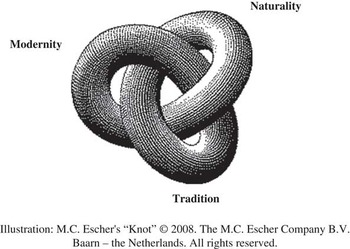
People experienced tensions between these three angles of vision and their wishes were sometimes contradictory, as they were trying to reconcile the three; they wanted farms to be simultaneously modern, traditional and natural. The three angles of vision cover the perspectives from which people look at dairy farming and also shape the tensions in people's perceptions. A threefold knot (Figure 1) is a useful way of illustrating this field of tension, for a number of reasons. First, the knot ‘reflects that the three angles of vision are complementary parts of the whole. Each component influences another.’ (Boogaard et al., Reference Boogaard, Bock, Oosting and Krogh2010a: p. 39). Second, the knot ‘avoids notions of hierarchy or priority – all three angles of vision are equally important’ (Boogaard et al., Reference Boogaard, Bock, Oosting and Krogh2010a: p. 39). And third, the knot ‘shows the complexity of the inter-relations better than a ‘standard triangle’; the relationships appear less linear and the angles of vision are not represented by a single dot but by a more diffuse and flexible shape, that can represent transitions between, for example, modernity and tradition or naturality and modernity.’ (Boogaard et al., Reference Boogaard, Bock, Oosting and Krogh2010a: p. 39).
Three angles of vision underlying social perceptions of livestock farming: modernity, tradition and naturality (Boogaard et al., Reference Boogaard, Bock, Oosting and Krogh2010a).

Respondents experienced different dilemmas between the three angles of vision, for example, between modern farming practices and the preservation of farming traditions. One Dutch respondent described this in the following way: ‘This is a picture with a wheelbarrow. It is a very traditional image. It is nice that this can still be found on the farm. It is a tool of authentic manual labour. Of course not everything can stay authentic, this is the dilemma. You also have to be able to survive financially otherwise you cannot realize your ideals. I understand that very well, this is a frequently occurring dilemma’ (Boogaard et al., Reference Boogaard, Bock, Oosting and Krogh2010a). In addition, many Dutch respondents experienced a dilemma between modernity and naturality in dairy farming. This was expressed through concerns about the separation of the calf and dam, calves being fed with milk powder rather than their mothers’ milk, the use of artificial insemination instead of natural mating, the short lifespan of farm animals and the ‘unnaturally’ high milk production per cow, which one Dutch respondent described as ‘Production comes first. I understand that a farm has to function like a business and that the milk production needs to be as high as possible. But I feel a bit of resentment too. Because what is best for the animals? As humans where are we going?’ (Boogaard et al., Reference Boogaard, Bock, Oosting and Krogh2010a). In general, farmers were considered as being at the centre of all of these dilemmas and respondents looked to them to handle these dilemmas, resolve the conflicts and maintain a desired balance between modernity, tradition and naturality.
To conclude this section, people have different concerns and dilemmas about livestock farming and the collective meanings of livestock farming are characterised by multiple ambivalences: they are polyvalent. As such, people's ideas about livestock farming are not as black and white as is sometimes suggested: the respondents did neither condemn modern livestock farming, nor merely longed for a rural idyll. Instead, they simultaneously appreciated different aspects of modernity, traditions and naturality and were aware of the tensions and dilemmas between these three angles of vision. People were also aware that their wishes were difficult to put into practice and were willing to consider compromises.
Implications for the sociocultural sustainability of livestock farming
The findings of the qualitative studies have three important implications for the sociocultural pillar of sustainability. First of all, the findings showed that there are three angles of vision: modernity, traditions and naturality (the MTN concept) that influence the sociocultural sustainability of livestock farming – and each has two different faces. Respondents were aware of the tensions and dilemmas between these three angles of vision and were willing to accept compromises between them. In general, respondents did not condemn modern livestock farming and did not favour seeking to just maintain or recreate the rural idyll of the past. This suggests that livestock farming needs to combine ‘the best’ of these three worlds in order to be sustainable from a sociocultural perspective.
In addition, the sociocultural sustainability of livestock farming is influenced by the social and cultural context in which the farming system functions. The context may vary according to the country, culture or region. Consequently, sociocultural sustainability is context dependent. As such, people's views about ‘the best’ modern developments, important farming traditions and valuable aspects of nature may vary between countries and regions. For example, in the Netherlands, it includes not only grazing cows from the naturality and tradition angles of vision but also automatic feeding devices from the modernity angle of vision. Hence, ‘the best’ is socially and culturally constructed.
Finally, the MTN concept – illustrated in Figure 1 – shows that sociocultural sustainability is a dynamic concept: the three angles of vision are interconnected, and if one changes something in one of the angles of vision (e.g. in the modernity angle by implementing new technologies for higher efficiency), this inevitability has an effect on another angle of vision (e.g. loss of traditions). Hence, one should not approach sociocultural sustainability by focusing on one of the angles of vision independently. Instead, sociocultural sustainability involves trade-offs and dilemmas between the three angles of vision.
Public perceptions of livestock farming: quantitative approach
Explanatory factors of people's perception
People ascribe meanings to phenomena in order to categorise and make sense of the world around them (Fauconnier et al., Reference Fauconnier, Van Woerkum and Marck1992; Aarts and Van Woerkum, Reference Aarts and Van Woerkum2006). Through such subjective meanings, an ‘object’ is no longer an object as such, but acquires a specific meaning in a specific context (Van der Ziel and Steenbekkers, Reference Van der Ziel and Steenbekkers2006). As shown in the section ‘Meanings of livestock farming: qualitative approach’, people ascribe different meanings to livestock farming. Such meanings may differ not only between countries but also between different groups of people within the same country. Such differences are influenced by the ‘frame’ through which people look at the world around them, which is in turn influenced by several factors, such as values, convictions, knowledge and experiences. The influence of these factors on people's perceptions of livestock farming was studied in two Dutch national surveys. The first survey (n = 1074) concerned the welfare of dairy cows (Boogaard et al., Reference Boogaard, Oosting and Bock2006), and the second survey (n = 1178) was about social acceptance (Boogaard et al., Reference Boogaard, Bock, Oosting, Wiskerke and Van der Zijpp2010b). In this section, we discuss the key findings on the basis of people's knowledge about and experience with farming, their value orientations and their convictions.
The first survey on animal welfare showed that, in general, respondents agreed slightly with the statement that most farmers consider their animals too much as means of production for economic purposes, but that in general respondents had a slightly positive view of the quality of life of dairy cows. The overall results of the second survey on social acceptance implied a lack of acceptance of modernity in dairy farming at the cost of animals’ naturalness – such as zero-grazing and the separation of the calf and dam. In general, respondents considered the developments set out in the survey – increasing the number of animals, decreasing the farmer–animal contact, decreasing the number of family farms, putting economic interest above that of the animals– to be unacceptable ways of improving efficiency and profitability.
Both survey studies showed that people's knowledge and experience had an effect on their perception of livestock farming. The first survey showed that people with a connection to agriculture had a more positive image of farmers and of the farm animals’ quality of life. It also showed that more information – (provided, e.g. by a leaflet) – could influence people's image of farmers, but not their perception of animals’ quality of life. The second survey showed that people with more experience of farming – who lived in or had grown up in a rural area, had experience of working in agriculture or had made a farm visit – were more positive about contemporary dairy farming and more accepting of modernity in the treatment of farm animals than those with less experience of farming. These people found the trade-off between animals’ naturality and modernity to be more acceptable.
Values provide the basis on which people make evaluations. As values are not directly observable at the individual level, we classified values through value orientations Footnote 2. A value orientation is formed by a set of ranked and clustered values (e.g. Rokeach, Reference Rokeach1973). At the societal level, it is possible to distinguish between different value orientations. The Dutch WIN (‘Waardensegmenten in Nederland’, value orientations in the Netherlands) model, for example, distinguishes eight value orientations. The analysis of both surveys confirmed that people's value orientation influenced their opinions about livestock farming. The first survey showed that professionals and broadminded people perceived the quality of life of farm animals as worse than that of the caring, faithful and conservative. The second survey showed that progressive people – that is, professionals and (to a lesser extent) materialists – had a preference for more modern, and less traditional and natural dairy farms, and were more accepting of modern approaches towards farm practices and farm animals. By contrast, socially minded people and (to a lesser extent) conservative, caring and faithful people and hedonists expressed stronger preferences for traditional and natural dairy farms and were less accepting of modern approaches and developments towards farm practices and farm animals. The second survey also showed that value orientations provide an indication of people's preferred solutions to farming dilemmas. In general, progressive people appeared to believe that technological solutions had a potential to improve the quality of life of farm animals, whereas conservative people preferred a more traditional and natural farm. The latter group is more averse to modernity and unlikely to favour solutions that rely upon technological innovations.
Convictions are generally accepted and not easily questioned basic ‘truths’, which can influence ideas about people's relationship with nature and animals (based on Aarts and Van Woerkum, Reference Aarts and Van Woerkum1994). The findings of the second survey showed that most Dutch respondents (83%) believed that humans should live in harmony with nature, and only a minority believed that humans should dominate nature (17%). This study also showed that there is a majority opinion among Dutch citizens (65%) that humans are superior to animals and that human life is of more value than animal life. However, a significant proportion of Dutch citizens – the remaining 35% – consider animals to be of equal (or higher) importance than humans. These latter findings have been subsequently confirmed by Cohen (Reference Cohen2010). These convictions influence people's level of acceptance and perceptions of dairy farming: people who believe in harmonious human–nature relationships and egalitarian human–animal relationships showed a preference for more traditional and natural dairy farms and were less accepting of modernity in farm practices and the treatment of farm animals.
Implications for the sociocultural sustainability of livestock farming
The findings of the quantitative studies have three important implications for the sociocultural sustainability of livestock farming. First, they show that different groups of people hold different perceptions and views about livestock farming. People's values, convictions, knowledge and experiences can lead them to favour more modern, more traditional or more natural farms. Different (groups of) people make different trade-offs between modernity, traditions and naturality, which vary according to their knowledge, experiences, values and convictions. Consequently, there is not one ‘ideal’ livestock farming system, which is accepted and appreciated by everybody. These results suggest the need for a variety of farming systems within a region or country, which can offer ‘something for everybody’.
Second, the quantitative findings also showed that people's perceptions and acceptance of livestock farming were influenced by their value orientations. Hence, the sociocultural sustainability of livestock farming is influenced by their underlying values – it is a value-laden concept. Disputes over sustainability often come down to (deep) value differences (Sumner, Reference Sumner2005). It is therefore important for anyone engaged in research on (sociocultural) sustainability to make their underlying values explicit, even though values are implicit – that is, not directly observable (Rokeach, Reference Rokeach1973).
Third, it has often been stated that the public lacks knowledge about (animal) farming and should be better informed about the realities of contemporary animal farming (Fraser, Reference Fraser2001; Holloway, Reference Holloway2004; Kanis et al., Reference Kanis, Groen and De Greef2003). The general line of such arguments is that more information would make livestock farming more socially acceptable, that is, more socioculturally sustainable. Nevertheless, informing the general public about livestock farming is not as easy or self-evident as it may seem at first glance. Quantitative findings from these surveys showed that people with more knowledge about and/or experiences with farming indeed have more positive perceptions of animal farming and are more accepting of modern ways of treating farm animals. However, the first survey showed that supplying people with factual information did not have much effect on their opinions about animal welfare. Hence, supplying factual knowledge – through information campaigns or newslettersFootnote 3 – might have only a limited impact. General information campaigns can also backfire: they might lead people to become more concerned or have less positive perceptions about the issue at hand.
Equally, and possibly more importantly, an unbalanced approach to information provision can smack of propaganda or manipulation (Termeer and Koppenjan, Reference Termeer and Koppenjan1997) and can lead people to question the motive or intended purpose of supplying more information: is it to inform people about where their food comes from or is it to correct presumed misperceptions about animal farming? The latter implicitly assumes that lay people's perceptions are incorrect. On the basis of these studies, one cannot say that lay people's perceptions of livestock farming are wrong or unrealistic. Lay people might perceive livestock farming differently and ascribe different meanings to it than experts do, but their ‘reality’ is just as real. As such, reality is always (subjectively) perceived and constructed ‘by the men in the street’ (Berger and Luckmann, Reference Berger and Luckmann1967). Consequently, there is not one ‘objective’ reality, but reality is socially and culturally constructed, resulting in multiple realities that exist side by side (e.g. those of animal right organisations, farmers’ organisations, research institutes or policy-makers). The debate about sustainable livestock farming is therefore not only about ‘how can public perceptions be influenced?’ but rather ‘which presentations of farming realities coexist?’ and ‘where do these realities overlap, differ or even clash?’
Collaboration between animal sciences and social sciences
This study adopted an interdisciplinary approach and entailed an intense collaboration between animal sciences and rural sociology. This section elaborates on the potential and limitations of collaboration between the two disciplines when studying the sociocultural sustainability of livestock farming systems.
Social acceptance of livestock farming
As shown in the section ‘Public perceptions of livestock farming: quantitative approach’, lay people's reality of livestock farming may differ from experts’ reality, but should not be seen as ‘incorrect’. This raises the question of how (animal) scientists can deal with increasing questions and demands from society about contemporary livestock farming. Animal sciences are traditionally expert oriented (Hodges, Reference Hodges2006). Lay people's views are often excluded from this point of view. Yet it is often stated that the lay public should be better informed about the realities of contemporary farming in order to get livestock farming socially accepted (see Fraser, Reference Fraser2001; Kanis et al., Reference Kanis, Groen and De Greef2003). As such, there is a demand for social scientists to study the social perceptions of livestock farming, often with the aim of positively influencing social acceptance of contemporary livestock farming systems. This involvement of social scientists contains an implicit element of ‘social engineering’. Social scientists are being asked to study how new technologies can be implemented without (too much) public resistance (Callon et al., Reference Callon, Lascoumes and Barthe2009) and provide possible solutions for changing ‘society’ (i.e. public opinion).
But instead of adjusting public opinion, one could also consider adjusting or redesigning the livestock farming system in accordance with societal demands (Kanis et al., Reference Kanis, Groen and De Greef2003). To do this, it is essential to gain insights into social perceptions, underlying dilemmas and the trade-offs that people are prepared to condone. In such studies, the role of the social scientist extends beyond ‘social engineering’; rather than seeking to change public opinion, the purpose of the research is to identify livestock systems that are more in line with what society desires and perceives as sustainable. Social perceptions, concerns, appreciations, meanings and values then become the departure point for the (re)design of livestock farming systems. As such, social scientists bring their methodological expertise in studying social concerns and involve the general public. Animal scientists contribute with innovations and (technological) knowledge about different farm animals and types of farming systems that are in line with what society desires and perceives as sustainable.
Sustainable development as a social construction
The social and animal sciences are marked by historical and deeply rooted differences in theories, methods and ways of thinking. For example, animal science is a natural science firmly based on technological and material knowledge in the search for one ‘objective truth’ about different aspects of livestock farming, such as animal nutrition, breeding and health. Social sciences, by contrast, depart from multiple, socially-constructed realities (e.g. Berger and Luckmann, Reference Berger and Luckmann1967). Hence, collaboration between these two scientific fields implies a shift in thinking for disciplines.
Sections ‘Meanings of livestock farming: qualitative approach’, and ‘Public perceptions of livestock farming: quantitative approach’ of this study have shown that the sociocultural sustainability of livestock farming – the ‘S’ of the EES concept – is context dependent and value laden. These findings also apply to economic and environmental sustainability: views about ‘the best’ economic and environmental aspects of livestock farming differ, and are culturally defined and context dependent. As such, the concept of sustainable development is culturally defined and time- and place-specific and its meaning may differ depending on the context in which it is defined (Brown et al., Reference Brown, Hanson, Liverman and Meredeth1987; Dahlberg, Reference Dahlberg1988; Shearman, Reference Shearman1990; Fresco and Kroonenberg, Reference Fresco and Kroonenberg1992; Roe, Reference Roe1996; Rigby et al., Reference Rigby, Woodhouse, Young and Burton2001; Giddings et al., Reference Giddings, Hopwood and O'Brien2002). Hence, sustainable development itself is socially and culturally constructed. The social construction of sustainability – whether of livestock farming or of other phenomena – is derived from a set of collective meanings that define what (groups of) people consider to be sustainable and unsustainable (e.g. Redclift and Woodgate, Reference Redclift and Woodgate1997; Klostermann and Cramer, Reference Klostermann and Cramer2007). This constructivist line of thought has (at least) two implications for the way (animal) scientists approach sustainable development: (i) it implies acknowledging that sustainable development is a subjective, value-laden concept in which ‘one objective truth’ does not exist; and (ii) it implies acknowledging that sustainable development has different meanings, which need to be evaluated according to the local context.
It is not easy for scientists to change their thinking, due to deeply rooted values and years of professional training (Van Eijk, Reference Van Eijk1998; Hodges, Reference Hodges2003 and Reference Hodges2006). Yet, changes are gradually taking place in both scientific fields. For example, within rural sociology, studies on human–animal relationships and animal welfare are opening up new lines of interest. Within animal sciences, the social and cultural meanings of animal farming are increasingly being acknowledged as important components in the sustainable development of livestock farming systems. We argue that there is a need for future research to involve more collaboration between social and animal scientists, whose world views can complement each other and jointly contribute to the sustainable development of livestock farming.
Conclusions
The aim of this study has been to give insights into the sociocultural sustainability of livestock farming. On the basis of the key findings of qualitative and quantitative studies on social perceptions of dairy farming in the Netherlands and Norway, we argue that the (sociocultural) sustainable development of livestock farming is socially and culturally constructed by people in specific contexts. In this section, we summarise the arguments and their implications for future research on the sociocultural, sustainable development of livestock farming systems.
First of all, the ‘S’ of the EES sustainability model can be described by use of the MTN knot, which describes the fields of tension between modernity, traditions and naturality – with each having two different faces. The sociocultural sustainability of livestock farming is about the trade-offs and dilemmas that exist between the three angles of vision. In order to be sustainable from a sociocultural perspective, livestock farming needs to combine ‘the best’ of these three worlds.
The sociocultural sustainability of livestock farming is influenced by the social and cultural context in which the farming system functions. As such, people's views about ‘the best’ modern developments, important farming traditions and valuable aspects of nature may vary between countries and regions. Hence, sociocultural sustainability is context dependent and needs to be evaluated according to its local meaning. This research was bound by a specific context: dairy farming in the Netherlands and Norway. Future research, focused on other contexts, such as more intensive farming systems (e.g. pigs and poultry), or in other countries and cultures, might reveal different criteria, tensions and balances when evaluating sustainability.
Sociocultural sustainability is about people's perceptions of livestock farming. Lay people might perceive livestock farming differently than experts, and ascribe different meanings to it, but their ‘reality’ is just as real. The debate about socially acceptable livestock farming should therefore not only be about ‘how can public perceptions be influenced?’ but also about ‘which presentations of farming realities coexist?’ and ‘where do these realities overlap, differ or even clash?’ Disputes over sustainability often come down to (deep) value differences and it is important for anyone engaged in research on (sociocultural) sustainability to make underlying values explicit, that is, to make the implicit explicit.
Finally, an ongoing collaboration between social and animal scientists is a prerequisite to develop (sociocultural) sustainable livestock farming. Such collaboration implies a shift in thinking for both social and animal scientists who have deeply rooted differences in theories, methods and ways of thinking. Nevertheless, we are optimistic about future collaboration as changes are gradually taking place in both scientific fields.
Acknowledgements
For the fieldwork in the Netherlands and Norway, we are thankful to the dairy farmers who were willing to receive us, and the respondents, on their farms. In addition, we are grateful to Dieter Verhue, Martin de Bruin and Maud Adriaanse of ‘Bureau Veldkamp’ and Fokje Steenstra and Daniël de Jong at Wageningen University for their assistance in the organisation of the fieldwork in the Netherlands. We would also like to thank Erling Krogh of the University of Life Sciences (UMB) and Odd Jarle Stener Olsen for their contribution to the fieldwork in Norway. We gratefully acknowledge the Section for Learning and Teacher Education at the UMB and the Wageningen Institute of Animal Science for their financial contribution to this research project. We are also grateful to Nicholas Parrott of Textual Healing for his English language editing.