The management of patients with a single ventricle has continued to improve since the first successful complete separation of systemic and pulmonary circulations in 1968 by Francis Fontan.Reference Fontan and Baudet 1 Despite the wide variation in morphology and presentation, the initial palliative procedures may be grouped into modified Blalock–Taussig shunt, pulmonary artery band with or without concomitant arch repair, and Norwood procedures. Numerous advances in preoperative patient selection, surgical and cardiopulmonary bypass techniques, and in the understanding of single-ventricle physiology have resulted in improved survival.
Immutable patient-associated factors like gestational age, weight, genetic abnormalities, non-cardiac anomalies, and type of ventricular dominance have, however, been shown to influence the outcome in many recent studies.Reference Alsoufi, McCracken and Ehrlich 2 – Reference Costello, Pasquali and Jacobs 4 In addition, the timing of stage 1 palliation has also been shown to influence the outcome.Reference Alsoufi, Manlhiot and Al-Ahmadi 5 Against this background, we investigated the factors that affected the outcome of single-ventricle patients following stage 1 palliation at our institution.
Materials and methods
We conducted a retrospective study of all patients who had undergone single-ventricle palliation at our institution from January, 2008 to December, 2015. Patient information was obtained from the Society of Thoracic Surgeons Congenital Heart Surgery database and from electronic medical records. Stage 1 palliation included modified Blalock–Taussig shunt, pulmonary artery band with or without concomitant arch repair, and Norwood procedures. Patients with a single ventricle who had undergone a hybrid procedure or had undergone bidirectional Glenn as the initial procedure were excluded from this study. The hospital’s Institutional Review Board approved the study.
Data collection
Information collected through the Society of Thoracic Surgeons database and electronic medical records included patient demographics like age, gender, birth weight, weight at the time of stage 1 palliation, gestational age, genetic abnormalities, and non-cardiac anomalies. Data regarding the time and type of stage 1 palliation, ventricular morphology, operative details, requirement of ventilator support, length of hospital stay, unplanned cardiac reinterventions and catheterisation interventions, postoperative complications, and the need for extracorporeal membrane oxygenation were also obtained. Postoperative complications were defined as the occurrence of at least one of the following: chylothorax, necrotising enterocolitis, sternal wound infection, mediastinitis, renal failure requiring replacement therapy, and neurological complications. The requirements for extracorporeal membrane oxygenation and unplanned cardiac or catheter interventions were not included among the postoperative complications.
Follow-up
Follow-up data were obtained from electronic medical records or from direct correspondence with paediatric cardiologists. The median follow-up time after stage 1 palliation was 32 (interquartile range (IQR): 14–62) months, and follow-up had been completed in 94% of cases.
Statistical analysis
Survivors and non-survivors were compared using the Mann–Whitney U-test for continuous variables and Fisher’s exact test for proportions. Receiver operating characteristic curve analysis with the Youden index and area under the curve was applied to identify an optimal weight cut-off value at stage 1 palliation to provide optimal predictive accuracy for mortality.Reference Zhou, McClish and Obuchowski 6 Kaplan–Meier curves for patient survival stratified by body weight were compared using the log-rank test with Greenwood’s formula for constructing 95% confidence intervals (CI). Spearman’s correlation was used to assess whether lower body weight at stage 1 palliation was associated with a longer time to stage 2 palliation. Independent predictors of mortality were identified using multivariable Cox regression, and hazard ratios were computed for significant risk factors.
We tested weight at stage 1 palliation, presence of non-cardiac anomalies, and prematurity as covariates, limiting them to avoid over-saturating the model as there were only 13 deaths in this cohort. Continuous data are presented as medians and IQRs. Statistical analysis was performed using IBM SPSS Statistics (version 23.0; IBM Corporation, Armonk, New York, United States of America). Two-tailed values with p<0.05 were considered statistically significant.
Results
Over an 8-year period, between 2008 and 2015, a total of 72 patients with single-ventricle physiology underwent stage 1 palliation in the form of a modified Blalock–Taussig shunt, Norwood procedure, or a pulmonary artery band with or without concomitant arch repair at our institution. They comprised 28 female (39%) and 44 male (61%) patients. The mean birth weight was 3.1±0.8 kg (range: 1.9–6.2 kg). In all, 11 (15%) patients were born prematurely – that is, at <37 weeks of gestational age. Of the patients, 12 (17%) had genetic abnormalities and 23 (32%) had non-cardiac anomalies. The non-cardiac anomalies included malrotation, anal atresia, small left colon, left diaphragmatic hernia, tracheoesophageal fistula, single kidney, Dandy–Walker syndrome, HIV, etc. Our single-ventricle patients included those with hypoplastic left heart syndrome (n=22, 31%), tricuspid atresia (n=13, 18%), double-outlet right ventricle (n=13, 18%), double-inlet left ventricle (n=3, 4%), unbalanced atrioventricular canal (n=3, 4%), pulmonary atresia with intact ventricular septum (n=8, 11%), heterotaxy syndrome (n=8, 11%), and single ventricle not otherwise specified (n=2, 3%). The types of initial palliation were modified Blalock–Taussig shunt (n=35, 48%), pulmonary artery band with or without concomitant arch repair (n=12, 17%) and the Norwood procedure (n=25, 35%). The mean weight at the time of surgery was 3.1 kg (range 1.9–6.2 kg). The median age at the time of initial palliation was 5 (IQR: 3–7) days, for the entire cohort. A total of 41 patients (57%) required cardiopulmonary bypass as part of the initial palliative procedure. The average duration of cardiopulmonary bypass was 110±50 minutes. Myocardial arrest was used in 34 patients and circulatory arrest in 25 patients. Concomitant cardiac surgical procedures included repair of total anomalous pulmonary venous return in two patients and repair of atrioventricular valve for severe insufficiency in two other patients.
Overall, there were 13 deaths after various stages of palliation: 12 patients died after stage 1 palliation and there was one death after stage 2 palliation from a non-cardiac cause. The 13 patients who died had the following types of CHD: hypoplastic left heart syndrome: five (38%), tricuspid atresia: two (16%), pulmonary atresia with intact ventricular septum: two (16%), heterotaxy syndrome: two (16%), and double-outlet right ventricle: two (16%). A single patient who had undergone total anomalous pulmonary venous return repair at the time of initial palliation died after the initial palliative treatment; however, the other concomitant procedures were not associated with mortality. There were seven 30-day mortalities and eight in-hospital mortalities. There were four interstage mortalities. Among the interstage mortalities, two of the patients who had undergone a modified Blalock–Taussig shunt procedure developed acute decompensation at home after discharge, presumably from shunt occlusion. An additional two patients had complex social situations, and the exact cause of their death could not be determined. There was no hospital mortality following Glenn or Fontan procedures.
Various factors known to influence survival following the initial palliative procedure were compared between the survivors and non-survivors (Table 1). On univariate analysis, low weight at the time of stage 1 palliation and prematurity were found to be predictors of mortality between stages 1 and 2 palliations. However, multivariable Cox regression analysis revealed that weight at stage 1 palliation and presence of non-cardiac anomalies were strong predictors of mortality following stage 1 palliation. The type of stage 1 palliation did not have any influence on the outcome.
Univariate analysis of survivors and non-survivors.

CPB=cardiopulmonary bypass; MBT=modified Blalock–Taussig shunt; PAB=pulmonary artery band; S1P=Stage 1 palliation
Continuous data are expressed as medians and interquartile ranges
* represents statistical significance
Initially, we analysed the effect of body weight at the time of initial palliation on mortality. The area under the curve shows that body weight demonstrates excellent predictive accuracy for mortality (area under the curve=0.795, 95% CI: 0.667–0.922, p<0.001). Among the non-survivors after stage 1 palliation (n=12), the median weight was 2.3 kg (IQR: 2.1–3.00 kg) and among the survivors (n=60) the median weight was 3.2 kg (IQR: 2.7–3.8 kg) (p=0.002, Mann–Whitney U-test). The difference in median weight between survivors and non-survivors was found to be almost 1 kg. Multivariable Cox regression analysis confirmed that independent predictors of mortality included weight at stage 1 palliation⩽2.6 kg (hazard ratio: 7.8, 95% CI: 2.4–25.6, p<0.0001) and presence of non-cardiac anomalies (hazard ratio: 3.2, 95% CI: 1.1–9.5, p=0.043).
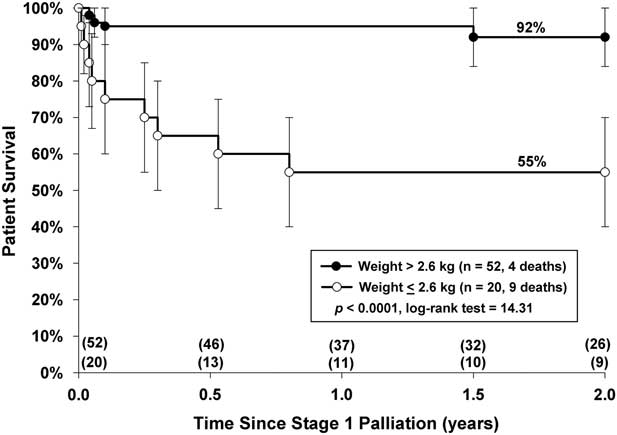
Prematurity added no additional prediction (p=0.21) as this was highly correlated with birth weight. The Kaplan–Meier 1-year freedom from mortality was 83% for the entire cohort of patients with a single ventricle (95% CI: 75–91%). On comparing the 20 patients with body weight ⩽2.6 kg with the other 52 patients with weight >2.6 kg, the Kaplan–Meier curves were found to be significantly different (log-rank test=14.31, p<0.0001) indicating that smaller patients have a higher rate of mortality as well as an earlier time to mortality (Fig 1).
Kaplan–Meier curves showing that weight<2.6 kg at the time of stage 1 palliation is a highly significant risk factor for mortality among single-ventricle patients (log-rank test=14.31, p<0.0001). The numbers in parentheses at the bottom indicate the numbers of patients in the two groups still alive and being followed up – that is, number at risk – at baseline and at each 6-month interval over 2 years. Patients with weight<2.6 kg are shown in the top row and those with weight>2.6 kg in the bottom row.

The median age at the time of initial palliation was 5 (IQR: 3–7) days, for the entire cohort, whereas the median age at the time of initial palliation for patients⩽2.6 kg was 5 (IQR: 2–7) days, and the median age at the time of initial palliation for patients>2.6 kg was 5 (IQR: 3–8) days (p=0.60).
We then analysed the effect of weight on mechanical ventilation, unplanned reinterventions, need for extracorporeal membrane oxygenation, postoperative complications, and length of hospital stay.
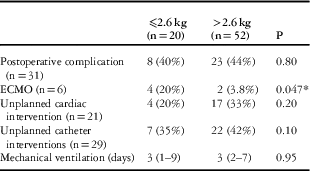
Mechanical ventilation was initiated preoperatively in 35 (49%) patients. The median duration of postoperative ventilation was 3 (IQR: 2–8) days, for the entire cohort. The median duration of postoperative ventilation for patients⩽2.6 kg was 3 (IQR: 1–9) days, whereas the median duration of postoperative ventilation in patients with weight> 2.6 kg was 3 (IQR: 2–7) days (p=0.95).
Overall, 41 patients had undergone cardiac reintervention after the initial palliation. This included both surgical- and catheter-based interventions. Unplanned cardiac reinterventions were performed in 21 infants (29%), which included four (20%) out of 20 patients who weighed⩽2.6 kg (p=0.14). Cardiac reinterventions included aortic arch obstruction repair, shunt revision, mediastinal exploration for cardiac tamponade, thoracic duct ligation, diaphragm fenestration, thrombectomy of the superior caval vein, and repair of laceration of the left atrium. Unplanned cardiac catheter interventions were performed in 29 infants (40%), which included seven (35%) out of 20 patients who weighed⩽2.6 kg (p=0.10). Cardiac catheter interventions included angioplasty of the Sano shunt, branch pulmonary arteries, coarctation of aorta, modified Blalock-Taussig shunt, pulmonary vein confluence and right superior vena cava and stent placements in the Sano shunt, branch pulmonary arteries and coarctation of aorta.
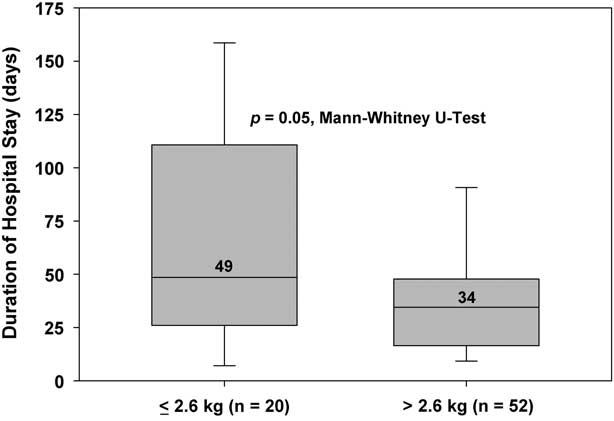
A total of six patients required extracorporeal membrane oxygenation following stage 1 palliation, of whom four had hypoplastic left heart syndrome and two had pulmonary atresia with an intact ventricular septum. In all, four out of six (67%) patients with extracorporeal membrane oxygenation and 16 of 66 without extracorporeal membrane oxygenation (24%) weighed⩽2.6 kg (p=0.047). Overall, five of the six (83%) patients who had been on extracorporeal membrane oxygenation died. A single patient with hypoplastic left heart syndrome who survived to stage 2 palliation weighed 3 kg (Table 2). On the whole, postoperative complications occurred in 31 patients (43%); this included eight (40%) out of 20 patients who weighed ⩽2.6 kg and 23 (44%) of 52 patients weighing>2.6 kg (p=0.80). The median duration of hospital stay for patients⩽2.6 kg (n=20) was 49 (IQR: 27–111) days versus 34 (IQR: 16–48) days, for patients weighing>2.6 kg (n=52) (p=0.05) (Fig 2). Next, we analysed the effect of weight on progression to subsequent stages. Out of the cohort of 60 patients who survived the stage 1 palliation, 56 patients (93%) progressed to stage 2 palliation. In all, two patients were lost to follow-up and two patients had elevated pulmonary vascular resistance. Among the 56 patients, one patient had undergone a Kawashima procedure, whereas the rest had undergone a bidirectional Glenn procedure. There was no hospital mortality after stage 2 palliation. There was only one death 6 months after stage 2 palliation from a non-cardiac cause.
Box-and-whisker plot showing a longer median duration of hospital stay in patients with body weight<2.6 kg, compared with those weighing>2.6 kg (49 versus 34 days, p=0.05).

Comparison of single-ventricle patients ⩽2.6 and >2.6 kg.

ECMO=extracorporeal membrane oxygenation
* represents statistical significance
When we analysed weight at stage 1 palliation as a continuous variable, we found that a lower body weight was associated with a longer time in days to stage 2 palliation (Spearman’s correlation=−0.32, p=0.02) although there was no difference when the two groups were compared. Among the 56 patients who had undergone stage 2 palliation, the median time to stage 2 palliation was 145 (IQR: 120–202) days; the median time to stage 2 palliation for 11 patients⩽2.6 kg was 160 (IQR: 132–217) days, compared with 145 (IQR: 118–193) days for 45 patients>2.6 kg (p=0.50). Out of 56 patients who had undergone stage 2 palliation, 28 have undergone a stage 3 palliation so far. Among the 28 patients who had undergone the Fontan procedure, the median time to stage 3 palliation was 25 (IQR: 20–35) months. The median time to stage 3 palliation for nine patients ⩽2.6 kg was 36 (IQR: 22–52) months, compared with 23 (IQR: 20–28) months, for 19 patients >2.6 kg (p=0.50). There has been no death after stage 3 palliation to date. A single patient ended up undergoing one and half ventricle repair, whereas the remaining 23 are awaiting the third-stage palliation procedure. In all, two patients were not considered candidates for the Fontan procedure because of other comorbidities, and two patients were lost to follow-up.
Discussion
CHD, in general, is associated with low birth weight. This could be related to the higher incidence of prematurity and associated genetic and extracardiac anomalies in patients with CHD. In addition, neonates with CHD are frequently small for gestational age, independent of prematurity or genetic syndromes. In a study on more than 1000 infants with single-ventricle physiology, Williams et alReference Williams, Ravishankar and Zak 7 found that the rates of prematurity (16%), low birth weight (18%), and small for gestational age (22%) were significantly higher compared with that in the general population or in newborns with other forms of CHD. Potential mechanisms of low birth weight in neonates with single-ventricle physiology include poor fetal growth in response to abnormal circulatory patterns or abnormal development of the heart as a result of intrinsic growth abnormalities.Reference Rosenthal 8
In our study, prematurity and weight at stage 1 palliation emerged as significant factors on univariate analysis, and there was a strong trend for non-cardiac anomalies. Prematurity has long been known as a risk factor affecting the outcome after treatment for CHD.Reference Jenkins, Gauvreau, Newburger, Spray, Moller and Iezzoni 9 In a study on 971 consecutive neonates at a single institution, Costello et alReference Costello, Polito and Brown 10 stratified neonates requiring congenital heart surgery based on gestational age and found that gestational age <39 weeks was associated with greater mortality, morbidity, and resource utilisation. These findings were later confirmed in a multi-institutional study by Costello et alReference Costello, Pasquali and Jacobs 4 Both studies, however, did not attempt to separate patients with single-ventricle repair from those with two-ventricle repair in the neonatal period. Although none of the studies have been able to establish causality, the differences in outcomes between preterm and term neonates are likely to be related to the maturational differences in organ systems such as the respiratory and immune systems.Reference Tita, Landon and Spong 11 A third factor that often comes into play between prematurity and low birth weight is the presence of genetic and non-cardiac anomalies. Studies have shown that the presence of non-cardiac and genetic anomalies negatively affects outcomes in neonates undergoing corrective or palliative cardiac procedures independent of prematurity or low weight.Reference Patel, Hickey and Mavroudis 3 , Reference Alsoufi, Gillespie and Mahle 12 – Reference Alsoufi, Manlhiot and Ehrlich 15
Weight at the time of stage 1 palliation emerged as the single most important risk factor affecting outcome in our group of patients. Weight as a risk factor affecting outcome after two-ventricle repair has been well established.Reference Reddy, McElhinney, Sagrado, Parry, Teitel and Hanley 16 – Reference Curzon, Milford-Beland and Li 18 Multi-stage palliation is now an established management protocol for patients with a single ventricle. The type of initial palliation depends on the anatomy and physiology of the cardiac defect, and hence could be the Norwood procedure, pulmonary artery band with or without aortic arch augmentation, or the modified Blalock–Taussig shunt procedure. Low weight at the time of surgery has been consistently shown to be a risk factor for mortality after the Norwood procedureReference Gelehrter, Fifer, Armstrong, Hirsch and Gajarski 19 , Reference Pizarro, Davis, Galantowicz, Munro, Gidding and Norwood 20 and following the modified Blalock–Taussig shunt procedure.Reference Myers, Ghanayem and Cao 21 , Reference Petrucci, O’Brien, Jacobs, Jacobs, Manning and Eghtesady 22
Pulmonary artery band surgery in low-weight patients is a high-risk procedure because of lung immaturity and elevated pulmonary vascular resistance.Reference Alsoufi, Manlhiot and Ehrlich 15 In addition to affecting the outcome following stage 1 palliation, low weight has also been shown to deleteriously affect the progress of patients with a single ventricle through subsequent stages and late survival.Reference Alsoufi, McCracken and Ehrlich 2 , Reference Gelehrter, Fifer, Armstrong, Hirsch and Gajarski 19 , Reference Pizarro, Davis, Galantowicz, Munro, Gidding and Norwood 20 , Reference Alsoufi, Manlhiot and Mahle 23 Although other studies have used the traditional value of 2.5 kg to define low birth weight and compare patients, we analysed weight as a continuous variable and used area under the curve to define the inflection point of 2.6 kg between survivors and non-survivors. In a decade-long study on 530 infants with a single ventricle, Alsoufi et alReference Alsoufi, McCracken and Ehrlich 2 found that low weight at the time of stage 1 palliation was associated with increase in both hospital mortality and interstage attrition. The increased mortality risk among patients with a single ventricle and low birth weight persisted for a year after the initial palliation. In our study, low weight at the time of stage 1 palliation was a risk factor for death before stage 2 palliation. However, the deleterious impact of low weight on survival was mitigated following stage 2 palliation.
Our results demonstrate that the rate of successful anatomical correction was not different between the two groups in terms of unplanned procedures for residual lesions, suggesting that the worse outcome in infants with low weight was not related to surgical technical errors or to consequent inadequate repair. It is also important to note that there was no difference between the two groups in terms of the duration of cardiopulmonary bypass or myocardial ischaemic time that could potentially have accounted for poorer survival in one group.
We found that the rate of extracorporeal membrane oxygenation requirement was higher in the low-weight group. All four patients in the low-weight group who were on extracorporeal membrane oxygenation died. This trend is in keeping with the other reports demonstrating worse survival in lower-weight patients requiring postoperative extracorporeal membrane oxygenation support.Reference Ades, Johnson and Berger 24 We also found no difference between the two groups in terms of postoperative complications or mechanical ventilation, which reflects the advances in postoperative care in the cardiovascular ICUs as intensivists gain more experience in the care of CHD patients. However, the length of hospital stay was significantly longer among patients with low weight. This could be a result of other medical issues such as feeding problems.Reference Alsoufi, McCracken and Ehrlich 2
There continues to be a debate regarding the timing of intervention in patients with low weight. The potential advantages of delayed intervention include mitigation of some of the harmful effects of cardiopulmonary bypass on immature organs, whereas a delayed approach with the persistence of abnormal physiology is fraught with risks for end-organ dysfunction such as necrotising enterocolitis, renal dysfunction, sepsis, and neurological complications; moreover, the goal of adequate weight gain is infrequently met because of the ongoing abnormal physiology.Reference Chang, Hanley, Lock, Castaneda and Wessel 25 An additional risk in delaying intervention in patients with a single ventricle is the elevation of pulmonary vascular resistance.Reference Alsoufi, Manlhiot and Al-Ahmadi 5 Our own approach has been to offer early intervention for patients with a single ventricle. There was no difference noted between survivors and non-survivors with regard to the timing of the intervention (Table 1). Another interesting finding of our study was that lower weight at the time of stage 1 palliation did not result in longer time to bidirectional Glenn or Fontan procedures.
A point we would like to emphasise through our study is that, although weight<2.5 kg is a known risk factor, this cut-off value may vary depending on the local institutional policies and practices. In our study, we found that weight⩽2.6 kg among patients with a single ventricle was a risk factor for death before stage 2 palliation; thus, using the traditional cut-off value of 2.5 kg may not hold true for all institutions. One may have to look at each population separately to evaluate the specific risk factor in that population managed by the institution. In addition, this is one of the few studies validating the findings of a bigger institution.Reference Alsoufi, McCracken and Ehrlich 2
Our study indicates that weight at the time of initial palliation has the strongest influence on outcome; however, we take other factors into consideration to define the risk profile of the patient. These include gestational age and associated comorbidities. If the patient is considered low risk – for example, a full-term infant with no other comorbidities and weighing>2.6 kg – the patient would undergo a traditional stage 1 palliation. On the other hand, if the patient is considered high risk – for example, a premature infant with associated comorbidities and weighing<2.6 kg – an alternative strategy is employed to improve the patient’s condition before surgery. In this regard, a patient considered at too high a risk for the stage 1 Norwood procedure would undergo palliative bilateral branch pulmonary artery banding with either continuous prostaglandin infusion or a ductal stent until the risk profile improves. Similarly, a patient considered at too high a risk for the Blalock–Taussig shunt procedure would be palliated with prostaglandin infusion or a ductal stent. We usually do not delay pulmonary artery banding for high-risk patients. We are trying to develop an algorithmic approach based on well-recognised risk factors for single-ventricle palliation at our institution.
Limitations
The findings from this study reflect the experience of a single institute and may not be generalisable. This is a retrospective study and hence suffers from the inherent weaknesses of a retrospective design. The patient sample is relatively small compared with that of other series. We could include only three selected covariates in the multivariate model because of the small number of deaths. Associated cardiac anomalies like total anomalous pulmonary venous return, atrioventricular valve regurgitation, and ventricular dysfunction – known to influence outcome – could not be analysed because of the limited study population. The follow-up time is limited, and hence the long-term consequences of low weight at stage 1 palliation may be underestimated.
Conclusion
Low weight at the time of stage 1 palliation is a risk factor for survival following stage 1 palliation and is associated with longer duration of hospital stay. Stage 2 palliation mitigates this risk. The type of stage 1 palliation itself has no bearing on the outcome.
Acknowledgements
None.
Financial Support
This research received no specific grant from any funding agency, commercial, or not-for-profit sectors.
Conflicts of Interest
None.
Ethical Standards
This study does not involve human and/or animal experimentation.
Disclosures
None of the authors have any financial disclosures to report. All authors had freedom of investigation and full control of the design of the study, methods used, outcome parameters, results, analysis of data, and production of the written report.