




No CrossRef data available.
Article contents
- Abstract
- THEORETICAL ASSUMPTIONS ABOUT THE CONSEQUENCES OF CROSS-CUTTING EXPOSURE
- THE ROLE OF CROSS-CUTTING EXPOSURE IN EMPIRICAL RESEARCH
- THE SOCIAL PSYCHOLOGICAL PLAUSIBILITY OF BENEFICIAL CONSEQUENCES
- SURVEY DESIGN
- EFFECTS ON AWARENESS OF RATIONALES FOR OWN AND OPPOSITIONAL VIEWS
- CONSEQUENCES OF POLITICAL TOLERANCE
- AN EXPERIMENTAL CONFIRMATION
- DISCUSSION
- References
Cross-cutting Social Networks: Testing Democratic Theory in Practice
Published online by Cambridge University Press: 03 March 2004
Article contents
- Abstract
- THEORETICAL ASSUMPTIONS ABOUT THE CONSEQUENCES OF CROSS-CUTTING EXPOSURE
- THE ROLE OF CROSS-CUTTING EXPOSURE IN EMPIRICAL RESEARCH
- THE SOCIAL PSYCHOLOGICAL PLAUSIBILITY OF BENEFICIAL CONSEQUENCES
- SURVEY DESIGN
- EFFECTS ON AWARENESS OF RATIONALES FOR OWN AND OPPOSITIONAL VIEWS
- CONSEQUENCES OF POLITICAL TOLERANCE
- AN EXPERIMENTAL CONFIRMATION
- DISCUSSION
- References
Abstract
Exposure to conflicting political viewpoints is widely assumed to benefit the citizens of a democratic polity. Nonetheless, the benefits of exposure to heterogeneous political viewpoints have yet to be demonstrated empirically. Drawing on national survey data that tap characteristics of people's political discussion networks, I examine the impact of heterogeneous networks of political discussion on individuals' awareness of legitimate rationales for oppositional viewpoints, on their awareness of rationales for their own viewpoints, and on levels of political tolerance. Finally, utilizing a laboratory experiment manipulating exposure to dissonant and consonant political views, I further substantiate the causal role of cross-cutting exposure in fostering political tolerance.
Information
- Type
- Research Article
- Information
- Copyright
- © 2002 by the American Political Science Association
Recent social and political theory has elevated political conversation among democratic citizens to new heights. Political talk is central to most current conceptions of how democracy functions (Schudson 1997). According to many prominent social theorists, democracy has a future only if “citizens come back out of their bunkers and start talking” (Gray 1995, 1; see also Elshtain 1995; Lasch 1995). The quantity and quality of political conversation have become “a standard for the accomplishment of democracy” (Sanders 1997, 347). Theorists extol the virtues of political talk, foundations spend millions of dollars to encourage it, and civic journalists and others plan special meetings to foster more of it. Yet what do we really know about beneficial outcomes of political talk as it occurs in day to day life?
For the most part, arguments for the centrality of political discussion among ordinary Americans have been highly theoretical in nature. In other words, the contributions to democratic ends that political conversations are supposed to make depend critically on whether such talk reaches the standards necessary to be deemed “deliberation,” “discourse,” or, in Habermas' (1989) terms, an “ideal speech situation.” It is one thing to claim that political conversation has the potential to produce beneficial outcomes if it meets a whole variety of as yet unrealized criteria, and yet another to argue that political conversations, as they actually occur, produce meaningful benefits for citizens (Conover and Searing 1998). Because the list of requirements for deliberation tends to be quite lengthy,1
For example, to qualify, political discussion must take place among citizens of equal status who offer reasonable, carefully constructed, and morally justifiable arguments to one another in a context of mutual respect (Gutmann and Thompson 1996). Such interactions must exclude no one or, at least, provide “free and equal access to all” (Knight and Johnson 1994). In addition, the opinions of participants in deliberative encounters must all weigh equally (e.g., Fishkin 1991), and all participants must be free of the kinds of material deprivations that hinder participation, such as a lack of income or education.
If one limits the political communication phenomena worthy of study to those conversations that meet the necessary and sufficient conditions invoked by democratic theorists, then one is left with a near-empty set of social interactions to study. Instead, the goal of this research is to examine a very minimalist conception of political discussion, but one that may, nonetheless, have significant consequences for the citizens who engage in it. For these purposes I relax many of the requirements invoked in discussions of deliberation and focus strictly on the extent to which political conversations expose people to dissimilar political views. My results suggest that although cross-cutting exposure is disappointingly infrequent in the contemporary United States, it may—even in its highly imperfect manifestations—hold some beneficial consequences for democratic citizens.
THEORETICAL ASSUMPTIONS ABOUT THE CONSEQUENCES OF CROSS-CUTTING EXPOSURE
Perhaps the most often cited proponent of communication across lines of difference is John Stuart Mill (1859, 21), who pointed out how a lack of contact with oppositional viewpoints diminishes the prospects for a public sphere: “If the opinion is right, they are deprived of the opportunity of exchanging error for truth; if wrong, they lose what is almost as great a benefit, the clearer perception and livelier impression of truth produced by its collision with error.” Likewise, Habermas (1989) assumes that exposure to dissimilar views will benefit the inhabitants of a public sphere by encouraging greater interpersonal deliberation and intrapersonal reflection.
Exposure to conflicting political views is also said to play an integral role in encouraging “enlarged mentality,” that is, the capacity to form an opinion “by considering a given issue from different viewpoints, by making present to my mind the standpoints of those who are absent.… The more people's standpoints I have present in my mind while I am pondering a given issue, and the better I can imagine how I would feel and think if I were in their place, the stronger will be my capacity for representative thinking and the more valid my final conclusions, my opinion” (Arendt 1968, 241). Interactions with others of differing views is assumed to be “essential for us to comprehend and to come to appreciate the perspective of others” (Benhabib 1992, 140).
Cross-cutting exposure also is assumed to promote greater awareness of oppositional views because no individual person thinking in isolation can foresee the variety of perspectives through which political issues may be perceived (Manin 1987). Thus political deliberation “teaches citizens to see things they had previously overlooked, including the views of others …” (p. 351). Awareness of rationales for oppositional views is a particularly important type of political knowledge because of its close ties to legitimacy. One purpose served by conveying rationales for oppositional views is to help render the ultimate decision or policy legitimate in the eyes of others (Manin 1987). If rationales are not made public, the losers in a given controversy will not know what reasons or arguments the winners judged to be stronger in deciding the merits of the case: “Hence discussion rather than private deliberation would be necessary to ‘put on the table’ the various reasons and arguments that different individuals had in mind, and thus to ensure that no one could see the end result as arbitrary rather than reasonable and justifiable, even if not what he or she happened to see as most justifiable” (Fearon 1998, 62).
Exposure to diverse political views is obviously tied to a wide range of outcomes that are valued in democratic systems. But it would be quite naive to suggest that only good can flow from cross-cutting interactions; conversations among those of differing views also have the capacity to result in bitter arguments, violence, and/or a hostile and uneasy silence (Scorza 1998). Thus Kingwell (1995) has stressed the importance of civility or politeness in maintaining conversations across lines of political difference. To sustain relationships that make cross-cutting discourse possible, discussants must at times refrain from saying all they could say in the interests of smooth social interaction. This type of civility via “not-saying” … “contributes to smooth social interaction, makes for tolerance of diversity and conditions a regard for the claims and interests of others” (Kingwell 1995, 219). In this view, exposure to differing views holds the potential for tremendous benefits, but only if it occurs in a context in which the collective project of getting along with one another in society is primary and the elucidation of differences secondary.
THE ROLE OF CROSS-CUTTING EXPOSURE IN EMPIRICAL RESEARCH
In addition to the assumptions of political theory, many empirical relationships have been credited to exposure to dissonant views. For example, in his classic study of tolerance, Stouffer (1955, 127) suggested that exposure to conflicting views was the main reason that education and tolerance were so closely connected:
… Schooling puts a person in touch with people whose ideas and values are different from one's own. And this tends to carry on, after formal schooling is finished, through reading and personal contacts.… To be tolerant, one has to learn further not only that people with different ideas are not necessarily bad people but also that it is vital to America to preserve this free market place.… The first step in learning this may be merely to encounter the strange and the different. (original italics)
Interpretations of tolerance levels have stressed the diversity of people's contacts, but this concept has seldom been directly measured. Nonetheless, closely related concepts support the likelihood of such an impact. For example, a personality dimension known as “openness to experience” is strongly positively related to tolerance (Marcus et al. 1995), and authoritarians have been found to live relatively sheltered lives with little exposure to alternative lifestyles and beliefs (Altemeyer 1997). In a recent study of Russian social networks, Gibson (1999) also found that support for democratic institutions was correlated with the number of “weak ties” (i.e., nonrelatives) in a person's social network.
Finally, the popularity of specially organized deliberative forums also rests on the assumption that cross-cutting exposure is particularly beneficial. Although such events may successfully educate people on public policy issues (for a review, see Gastil and Dillard 1999; Cook et al. 1999), it is unclear from research to date whether learning is influenced by the cross-cutting interactions themselves or some other aspect of the forums such as the educational materials given to participants by organizers. Americans report that they are very unlikely to talk about politics at public meetings (Conover and Searing 1998) so the generalizability of findings from specially orchestrated forums to everyday political life is also an open question.2
Experimental studies using small groups in contexts outside of political decision-making have suggested that an emphasis on controversy over concurrence-seeking promotes greater mastery and retention of information (Lowry and Johnson 1981; Smith et al. 1981) and greater epistemic curiosity, that is, interest in and commitment to the immediate search for more information about a problem (Smith et al. 1992; Lowry and Johnson 1981; Smith et al. 1981).
The most important point to be gleaned from analyzing the role that the political diversity of social networks has played in political science research to date is that outside of work on persuasion, cross-cutting exposure typically has been an unmeasured concept, one offered in post hoc explanations for other relationships rather than as the central focus of research. Despite the important role that cross-cutting exposure plays in political theory, little empirical research has examined its consequences.
THE SOCIAL PSYCHOLOGICAL PLAUSIBILITY OF BENEFICIAL CONSEQUENCES
Embedded in these assertions are hypotheses about at least three potential beneficial effects of cross-cutting networks. Communication environments that expose people to non-like-minded political views have been assumed to promote (1) greater awareness of rationales for one's own viewpoints, (2) greater awareness of rationales for oppositional viewpoints, and (3) greater tolerance. How plausible are such benefits from the perspective of what is known about the social psychology of human interaction?
The first hypothesis rests on the assumption that confronting differences prompts people to reflect on the reasons for their own beliefs. This process is assumed to occur either in preparation for defending one's own positions or as a result of an internal need to rationalize or explain why one's own views differ from others'. Studies of cognitive response generally support the plausibility of such a reaction; exposure to counter-attitudinal advocacy enhances the production of counter-arguments, particularly for highly involving topics (e.g., Petty and Cacioppo 1977, 1979).3
Consistent with this argument, Green, Visser, and Tetlock (1999) found that people became more aware of and able to balance valid arguments on both sides of an issue when they were exposed to strong arguments on both sides of an issue and anticipated having to justify their views to opinionated representatives of the conflicting sides, an experimental condition that simulates a cross-cutting personal network.
The second hypothesis, that cross-cutting exposure promotes greater awareness of oppositional viewpoints, simply assumes that exposure to dissimilar views imparts new information. Psychologically this hypothesis demands nothing more than a straightforward learning process whereby rationales are transmitted from one person to another. The greatest limitation on its plausibility is the infrequency with which political conversations are likely to reach the level of depth in which rationales are articulated. But a good deal of this process may occur at the intrapersonal rather than the interpersonal level. In other words, when exposed interpersonally to political views noticeably different from their own, people may be prompted to think intrapersonally about the reasons that may have led those others to hold such views (Mutz 1998). This mental rehearsal of thoughts and search for rationales may occur even when the discussants do not explicitly articulate such reasons themselves (Burnstein and Sentis 1981; Burnstein, Vinokur, and Trope 1973).
The third hypothesis embedded in arguments about the importance of cross-cutting exposure is that it should lead to greater political tolerance. On initial consideration, this assertion sounds very similar to Allport's (1954) classic intergroup contact hypothesis, which suggests that face-to-face interaction among members of different groups can, under certain conditions, reduce prejudice. Although the contact hypothesis has been known for producing mixed evidence at best (see, e.g., Amir 1969, 1976), more recent assessments suggest that intergroup contact usually does have positive effects, even when the situation does not meet all of the conditions enumerated by Allport and subsequent researchers (see Pettigrew 1998, Pettigrew and Tropp 2000).4
Moreover, many of the additional necessary conditions tacked on in subsequent research turn out to be facilitating but not essential conditions (Pettigrew 1998; Pettigrew and Tropp 2000).
On the other hand, the kind of people or groups one is asked to tolerate on civil libertarian grounds are seldom exactly the same as the people of opposing views that one encounters at work or in the neighborhood. Nonetheless, within the large literature on intergroup contact, a smaller group of studies of “generalized intergroup contact” confirms that contact across group lines can generalize to reduce prejudice even toward outgroups that are not part of the intergroup contact (e.g., Reich and Purbhoo 1975; Cook 1984; Pettigrew 1997; Weigert 1976). In other words, these findings support the possibility that exposure to everyday differences of political opinion may translate to an appreciation of the need to tolerate differences of political opinion among disparate groups within the larger society. People who have had to learn how to “agree to disagree” in their daily lives better understand the need to do so as a matter of public policy. For example, in support of the generalizability of contact effects, the extent of interpersonal contact across lines of religion, race, social class, culture, and nationality predicted nonprejudicial attitudes toward groups not involved in the contact, even when taking into account potential reciprocal influences (Pettigrew 1997). Moreover, the extent of contact across lines of difference also generalized to immigration policy preferences, a more policy-oriented outcome similar to tolerance measures. Although studies of intergroup contact have tended to use prejudicial attitudes as their dependent variables, their findings also appear to generalize to perspective-taking ability (see Reich and Purbhoo 1975); that is, cross-cutting contact improves people's abilities to see issues from the perspectives of others, even when they personally do not agree.5
Changing prejudice is clearly not the same thing as altering levels of tolerance, because the former involves altering negative attitudes toward groups and the latter involves support for civil liberties in spite of ongoing negative attitudes toward groups. Nonetheless, there is sufficient conceptual overlap for these literatures to be relevant to one another.
As illustrated in Fig. 1, there are at least two mechanisms by which exposure to oppositional political viewpoints might lead to political tolerance.6
Kuklinski and colleagues (1991) and Theiss-Morse and colleagues (1993) identify a similar distinction between “cognitive and affective bases of political tolerance judgments,” but in their experiments the cognitive basis means that people are induced to think about tolerance judgments, as opposed to thinking specifically about rationales for the opposite view as suggested by the cognitive mechanism in this study.

In addition to this cognitive mechanism for translating cross-cutting exposure to political tolerance, a second potential mechanism emphasizes affect over cognition. To paraphrase Stouffer (1955), one could learn from personal experience that those different from one's self are not necessarily bad people. According to this mechanism, the content and extent of people's political discussions are less important than the quality of the personal relationships that develop. It is not important that they learn about the rationales for one another's political views, but it is important that they develop close relationships with those they know to hold quite different political viewpoints. Once formed, these cross-cutting relationships make it less likely that people will support restrictions of the civil liberties of those of differing views. The bottom half of Fig. 1 illustrates how exposure to people of differing political views may lead to more intimate cross-cutting associations, and thus greater tolerance.
To summarize, interactions involving exposure to conflicting views have been assumed to benefit people largely (1) by encouraging a deeper understanding of one's own viewpoint, (2) by producing greater awareness of rationales for opposing views, and (3) by contributing to greater tolerance. With respect to the third hypothesis, if exposure to cross-cutting political views increases tolerance via its effects on awareness of rationales for oppositional points of view, then this would lend credibility to the cognitive interpretation of the benefits of cross-cutting contact. If close personal relationships across lines of political difference influence tolerance levels, then this provides support for the affective mechanism.
SURVEY DESIGN
To examine these hypotheses, I utilized data from a representative national telephone survey sponsored by the Spencer Foundation and executed by the University of Wisconsin Survey Center in the fall of 1996, immediately preceding the presidential election in November.7
Each number was screened to verify that it was associated with a household. The person selected for the interview was randomly chosen from among household members at least 18 years old, with no substitutions allowed. The response rate was 47% when calculated as the proportion of completed interviews divided by the total sample (which includes those who never answered and all other nonresponses and refusals) minus the nonsample numbers. This is virtually identical to the rate obtained in similar telephone surveys (see, e.g., Huckfeldt et al. 1995). Interviews averaged 25 minutes. A maximum of 30 calls was made to each unresolved telephone number.
For each of the three political discussants named, these items scaled relatively well, with Cronbach's α's for Exposure to dissonant views of 0.77, 0.80, and 0.81, for the first, second, and third named discussants, respectively, and for Exposure to consonant views, α's of 0.73, 0.83, and 0.85, respectively.
Although the impact of discussions with like-minded others is not the central focus of this study, I include this variable in the analyses to sort out effects that may be attributed to political discussion in general, as opposed to discussions that cross lines of political difference in particular. Moreover, since political discussion of all types is likely to characterize those more politically interested, knowledgeable, and involved, controls are included for these predispositions. To the extent that the effects of exposure to dissonant views are unique and not attributable to contact that involves political agreement or to political interest and involvement more generally, then the benefits suggested by so many theorists gain support. In addition to the frequency of consonant and dissonant contact, the survey also included items that made it possible to tap the level of intimacy within dyads (see Appendix A). For each respondent, separate measures were created to represent levels of intimacy with consonant, dissonant and politically neutral discussion partners.9
Consistent with previous research on social and political networks (e.g., Huckfeldt and Sprague 1995), the political discussants in this sample may be characterized as fairly homogeneous. For example, respondents reported that only 14% of their discussants were of a different political party, and only 13% favored a different presidential candidate than the main respondent. Only 11% of discussants held views “very different” from the respondent's own, compared to 61% whose views were described as “much the same.” Finally, 60% of discussants were said to share most of the main respondents' views, while only 10% were opposed to their views. The relationships among the independent variables also were as expected based on past research: close relationships and frequent interactions tended to be among those who agreed, while cross-cutting exposure characterized weak ties and less frequent political discussion.
To tap the dependent variables for the first and second hypotheses, awareness of legitimate rationales for own and for opposing views, open-ended questions were used to solicit issue-specific rationales for three separate controversies including preferences among the 1996 presidential candidates, opinions about affirmative action for women and minorities, and opinions about state versus federal control of the welfare system.10
Based on a pretest, these issues were chosen because they were current at the time the survey was done, and formed a likely basis for tapping awareness that could result from recent political discussions. They are also issues for which substantial controversy exists, so respondents with differing views on both sides of the issues were available.
Analyses showed no significant difference between the two orderings in the number of rationales offered for either own or opposing positions, and thus the order variables were dropped from further analyses.
Volunteered rationales for own and opposing views were taken at face value and not evaluated by any external standards of sophistication. But coders did eliminate from their counts rationales that served to delegitimize the other viewpoint. For example, if a respondent explained why others supported Clinton with reference to negative personal traits of the opinion holder (“Other people might vote for him because they are stupid”) or negative traits of Clinton (“He's so slippery and slick and a good puppet”), then these were not counted as acknowledgments of a legitimate basis for the oppositional viewpoint. To test the reliability of coding, two independent coders both coded a subsample of 105 of respondents' answers to the open-ended awareness of rationales for own and opposing views questions. The correlation between the measures produced by the two coders ranged from 0.74 to 0.89 across the six open-ended questions, with an average of 0.80. For respondents who held no opinion on a given issue, their rationales for the two questions were divided equally between awareness of own and oppositional views.
As expected, the number of rationales that people could give for their own positions were, on average, significantly higher than those they could give for why someone might hold an opposing view (p < 0.001 in all three cases). As shown in Table 1, the measures of rationales for the two sides of a given issue were, also not surprisingly, significantly correlated with one another, thus indicating general knowledge of or interest in politics or in these specific issues. Three issues were used to get a broader sense of a given person's knowledge of dissimilar viewpoints than one issue alone would make possible and were then combined into two additive indices representing a person's overall awareness of rationales for oppositional views and overall awareness of rationales for their own viewpoints.

Political tolerance was measured using Sullivan Piereson and Marcus's (1982) content-controlled method whereby respondents first volunteer their “least-liked” group and are then asked a series of six questions about extending civil liberties to these particular groups, including the extent to which they should be banned or outlawed, be allowed to hold rallies in their city, be allowed to teach in public schools, and be subject to government phone tapping.13
The index produced a Cronbach's α of 0.83.
EFFECTS ON AWARENESS OF RATIONALES FOR OWN AND OPPOSITIONAL VIEWS
The first hope of advocates of greater network diversity is that exposure to conflicting views will benefit citizens either by familiarizing them with legitimate reasons for holding opposing viewpoints or by deepening their understanding of their own views by having to defend them to others and/or to themselves. The first 2 columns of data in Table 2 show regression equations examining these two questions,14
To prevent loss of cases due to listwise deletion in the multivariate analyses (i.e., Tables 2 and 3), Amelia was used to impute missing values for several variables. In no analysis did this procedure change the substantive findings of the study. For details on this procedure, see King et al. (2001) and Honaker et al. (1999).
For these variables, one need not assume a specific causal direction between awareness of rationales for own and others' views. The purpose is to conduct a stringent test of the key hypothesis but to avoid confounding results with characteristics that may be specific to the three issues used to create measures of awareness of rationales for own and others' views.

For purposes of evaluating the first two hypotheses, what is important in Table 2 is the coefficient corresponding to exposure to dissonant political views. As shown in column 1, counter to the first hypothesis, exposure to dissonant views does not appear to have a significant impact on awareness of rationales for people's own political views. Even when examined among the most likely subgroups within the population (such as those with strongly held views or high levels of education), there is no evidence that those with cross-cutting political networks have more rationales in mind in support of their viewpoints.
However, consistent with the second hypothesis, column 2 shows that exposure to oppositional viewpoints increases awareness of legitimate rationales for opposing views. The highly significant positive coefficient supports the hypothesis that exposure to oppositional viewpoints is particularly important for purposes of familiarizing people with legitimate reasons for viewpoints that differ from their own. Nonetheless, to make a solid case for this hypothesis, it is essential to determine that it is exposure to dissonant views, and not just political discussion in general, that is driving awareness of rationales for oppositional views. Comparing the coefficients for exposure to consonant and dissonant views lends additional support to this hypothesis because the consonant coefficient is negative and significantly different from the coefficient for exposure to dissonant views.
With cross-sectional data how confident can one be that exposure to conflicting political views actually brings about greater awareness of rationales for opposing views? Because a person knows a lot about politics, he/she may be more confident of defending his/her own views, and thus be more willing to engage in cross-cutting interactions (see Conover and Searing 1998). I have attempted to rule out the most obvious spurious influences by including controls for general political knowledge, interest, and awareness specific to these issues, but reverse causation remains a possibility. The problem with this rival interpretation is that, if true, it ought to apply equally well, if not more so, to knowledge of rationales for one's own views; the more deeply committed one is to his/her position, and the more rationales in one's arsenal, the less threatened one should be by oppositional viewpoints. Table 2 shows that awareness of rationales for one's own views is not related to exposure to conflicting views in one's personal network. Although this represents a null finding with respect to the first hypothesis, ultimately this pattern strengthens the case for the idea that exposure to conflicting views contributes to greater awareness of legitimate rationales for opposing views.
How large is the effect of exposure to dissimilar views on awareness of legitimate rationales for oppositional views? To provide a general idea, I calculated the predicted values of awareness of legitimate rationales for oppositional views for those with the highest and lowest levels of exposure to dissonant political views. On average, those with high levels of exposure to dissonant views should be expected to be familiar with just over two additional rationales compared to a similar person with a homogeneous network. Given that the mean number of oppositional rationales that people in this sample could generate was 1.46, the increase due to cross-cutting networks could have quite significant consequences for the perceived legitimacy of political outcomes.
Finally, in the third column in Table 2, I test Kingwell's suggestion about the importance of civility in generating beneficial outcomes from cross-cutting political dialogue. Drawing on a scale widely used to classify patterns of communication within families, I operationalized the “civil” orientation to conflict as one that combines acknowledgment of the importance of expressing dissenting views with an emphasis on social harmony.16
In this study as in many previous studies using these items (see McLeod and Chaffee 1972; McLeod et al. 1982), the two dimensions of communication patterns within the family (known as the social harmony and concept orientations) were independent (r = 0.03, p = 0.46), thus it was possible to identify a quarter of the sample in which differences of opinion were valued along with the need for social harmony; in other words, those with a civil orientation toward conflict (see the Appendix A for wording).
As shown in the third column in Table 2, people with a civil orientation toward conflict are particularly likely to benefit from exposure to dissonant views. Although the inclusion of an interaction between Orientation to conflict and exposure to dissonant views slightly reduces the size of the original coefficient corresponding to exposure to dissonant views, the interaction significantly strengthens the overall model (p < 0.05), thus indicating that those who value both frank opinion expression and social harmony learn the most from their cross-cutting interactions. The size of the effect among members of this group is more than twice the size of the effect on the population as a whole.
To summarize, exposure to cross-cutting views does not appear to play a significant role in deepening people's knowledge of their own issue positions, but it does have an important impact by familiarizing them with legitimate rationales for opposing viewpoints. This impact is particularly pronounced among people who value the expression of dissenting opinions, but simultaneously care about social harmony; in other words, those who would engage in cross-cutting conversations but who would remain silent rather than risk conflict that might end a cross-cutting association altogether.
CONSEQUENCES OF POLITICAL TOLERANCE
The first column in Table 3 takes a first pass at evaluating Fig. 1's proposed mechanisms for translating exposure to dissonant views into political tolerance. If the affective ties between people are what is important for purposes of translating cross-cutting ties into political tolerance, then one would expect closeness within dissonant relationships to be particularly important to political tolerance. If the cognitive benefits are primary, then people's awareness of rationales for those views should be most predictive of political tolerance.

Consistent with the expectations in Fig. 1, exposure to dissonant views has no direct effects on political tolerance, but awareness of rationales for oppositional views and intimacy within dissonant dyads are both significantly related to tolerance. Closer relationships across lines of difference and greater knowledge of rationales for these differences both predict tolerance, even after controlling for political knowledge, political interest, extremity of issue opinions, and so forth. Notice, in contrast, that awareness of rationales for own views does not contribute significantly to political tolerance. Despite the fact that the two measures are highly correlated (see Table 1), awareness of rationales for own and opposing views represent distinctly different types of knowledge with very different consequences.
The problem with a causal interpretation of these relationships is that tolerance may have reciprocal effects on these variables. More tolerant people may be more likely to form close relationships with those of differing political views and/or may be more likely, as a result of their tolerance, to be open to learning about reasons for others' views. Although I do not carry out an analysis of the full simultaneous system, 2SLS provides a useful means of obtaining less biased estimates of the strength of the key causal relationships examined here. Fortunately, there are variables available that predict awareness of rationales for oppositional views and that predict Intimacy within dissonant dyads but that do not predict tolerance, thus making them ideal as instrumental variables in a 2SLS analysis. For example, as shown in Table 2, awareness of rationales for oppositional views is predicted by exposure to dissonant views and by awareness of rationales for own views, but they are unrelated to tolerance. Likewise, intimacy within dissonant dyads is predicted by exposure to dissonant views, exposure to consonant views, and Number of discussants in the network, but none of these variables is significantly related to tolerance judgments (see Appendix B).17
Exposure to dissonant views turned out to be a stubbornly exogenous independent variable, predicted by virtually nothing within the data set except two structural characteristics that alter a person's supply of available discussion partners—whether they work outside the home and if their parents were of differing political parties.
The first-stage equations are shown in Table A1 (Appendix B) for Intimacy within dissonant dyads and are almost identical to the third column in Table 2 for awareness of rationales for opposing views. The analysis used for the first-stage 2SLS is different only in that it omits the intimacy variables to avoid potential endogeneity problems.
In the second column in Table 3, the endogenous variables produced by the first-stage estimations are used in a 2SLS model treating both intimacy within dissonant dyads and awareness of rationales for opposing views as endogenous. As shown in the second column, the coefficients are virtually identical when taking potential reciprocal causation into account, thus lending additional support to the proposed pathways in Fig. 1. Most interestingly, they confirm that both cognitive and affective mechanisms are at work simultaneously in translating exposure to dissonant views to greater political tolerance. If one generally perceives those opposed to one's own views to have some legitimate, if not compelling, reasons for doing so, then one also will be more likely to extend to disliked groups the rights of speech, assembly, and so forth. Likewise, close ties with those who hold differing political views can increase tolerance. It should also be noted that this effect is not a mere function of attitude extremity or general or issue-specific forms of political knowledge, as variables of this kind are already included in the model.
Given that these findings only indirectly relate exposure to dissonant political views to political tolerance, what is the size of the net impact of cross-cutting exposure in the network on political tolerance? Using the coefficients in Tables 2 and 3 as a basis for estimating the size of the impact of the cognitive mechanism suggests that, if all else remained constant, a person at the high end of the exposure to dissonant views index would score just over 4% higher on the tolerance scale than someone with the lowest levels of exposure to dissonant views.19
The range for the index of exposure to dissonant views was from −1.97 to 6.73.
From a technical standpoint, there are two ways one might view the strength of these findings. On the one hand, two of the three hypotheses have sustained extensive controls for plausible rival interpretations, the implementation of instrumental variables to take into account simultaneity bias, and a relatively small sample size. On the other hand, the effects that emerge are modest, though they are clearly statistically significant and thus lend some credibility to the many claims of democratic theorists about the benefits of cross-cutting exposure.
The relationships may be viewed in a more impressive light if one takes into consideration the crudeness of some of the operational measures relative to the concepts they represent. For example, ideally one would like a measure of awareness of legitimate rationales for oppositional views that takes into account all potential controversies. Instead this larger concept is represented in this study by only three political controversies. Likewise, the measure of the extent to which people's networks involve cross-cutting exposure has been limited by constraining respondents to only three discussants, when a more extensive network battery might generate a more valid measure including a greater number of weak ties, people with whom politics is discussed very seldom but who are politically dissimilar to the main respondent. The type of contact I examine in this study is by its very nature infrequent and often fleeting and, thus, difficult to measure. In addition, if better first-stage predictors of the endogenous variables were available, then a stronger pattern of relationships might be visible.
From a theoretical perspective, it is also worth noting that I do not make stringent assumptions about the kind of exposure to cross-cutting views that is tapped by these items. When exposed to conflicting views, I do not assume that people are truly “deliberating” according to any particular theoretical definition, nor is it assumed that when people are exposed to conflicting views the context is one in which people have equal status, reciprocity, and so forth. In this study exposure to dissonant political views requires only that people talk politics with someone who has political views that are, to some recognizable degree, different from their own (and vice versa for exposure to consonant views). Even though this is a far cry from what theorists and others envision as ultimately the most beneficial, exposure to conflicting views—even at the level defined here—appears to have the capacity to produce some beneficial effects. In short, there is undoubtedly a great deal of noise in these measures, and this needs to be taken into account in evaluating the more general theories these relationships represent. Although replication of these analyses on other data sets would be a natural next step to increase confidence in these findings, unfortunately there are few, if any, additional national surveys addressing the constitution of Americans' political networks that also measure political tolerance.20
The General Social Surveys have at times included both tolerance measures and network measures, but there is no information available about political agreement or disagreement among discussion partners. Several data sets make it possible to examine political agreement within networks (e.g., Huckfeldt and Sprague 1995; Dalton, Beck, and Huckfeldt 1998), but they do not make it possible to connect these network characteristics to tolerance judgments. Although data on U.S. networks and tolerance are lacking, see Gibson (1999) for similar data on Russia.
AN EXPERIMENTAL CONFIRMATION
Recognizing that statistical techniques can only go so far in strengthening causal inferences in survey data, I subjected part of this model to an experimental test. Ideally, one could test all of the relationships shown in Fig. 1 in a controlled laboratory environment, manipulating exposure to cross-cutting political views and observing the consequences. However, for the bottom half of Fig. 1, that is, the affective mechanism translating cross-cutting exposure into political tolerance, an experimental design is not feasible. At least within the context of a short-term laboratory experiment, one cannot forge cross-cutting friendships and evaluate the effects of their intimacy.
Nonetheless, the cognitive mechanism shown in the top half of Fig. 1 is amenable to experimentation. Although it is not possible to simulate the effects of ongoing, accumulated exposure to cross-cutting political viewpoints in a lab, even a large, one-time exposure to the rationales behind multiple views different from one's own could be adequate. If one learns from such an experience that those with views different from one's own have their reasons, despite the fact that one may disagree with them, such exposure should promote support for the general principle of tolerance.
Using a simple, three-group design in which 82 student subjects21
Students were undergraduates attending classes in the political science department at Ohio State University.
These included the death penalty, same sex marriage, the use of mammals in medical research, affirmative action for women and minorities, the emphasis in sex education programs on abstinence versus birth control/STD prevention, vouchers for private and parochial schools, stricter environmental policies, and hate crime laws.
The perspective-taking scale represents a cognitive, nonemotional form of empathy and is not related to empathy's emotional components (Davis 1983).
After the pretest, each subject was exposed to rationales for dissonant or consonant views or to nothing at all. Because the cognitive mechanism in Fig. 1 hypothesizes a purely informational effect from cross-cutting exposure on tolerance, the manipulation was limited to simply conveying information about arguments behind oppositional positions, without any face to face contact with another human being. Further, because this hypothesis is about the effects of generalized exposure to contradictory views on tolerance, and not about effects from exposure to any one topic or area of controversy, each subject was exposed either to multiple rationales for multiple political viewpoints that matched their own, rationales for views they were known to oppose, or no new information. To strengthen the manipulation, exposure to consonant or dissonant views was carried out by exposing respondents to consistently agreeable or disagreeable arguments for three separate issues. A randomized schedule dictated for which of eight pretest issue controversies each subject received stimuli and in which order.24
If a subject chose the midpoint on the scale, another issue was substituted according to a random schedule.
In the dissonant and consonant exposure conditions, three brief “assignments” provided a context for exposing people to rationales in support of, or in opposition to, their own views. For each assignment, subjects were given a stack of five cards, each bearing a rationale in support of an issue position.25
A sample of what the stacks of cards were like is as follows for two different sides of just one of the 8 issues. Death Penalty, Pro: 1) The death penalty is a fair and appropriate form of justice for the most severe crimes against human lives. 2) The death penalty sometimes provides grieving families with the closure they need after the death of a loved one. 3) Most violent criminals can't be rehabilitated and the costs of life imprisonment are higher per year than the costs of many colleges. 4) It is unfair to expect the American public to pay higher taxes out of their own pockets in order to pay the costs of building more prisons and feeding, clothing, and providing medical care for criminals who make no useful contribution to society. 5) Most Americans support the use of the death penalty in some situations, so it should continue to be legal. Death Penalty, Con: 1) It is immoral to take a human life, no matter what the circumstances. 2) Sometimes innocent people are convicted, and there is no way mistakes can ever be corrected when innocent people are put to death. 3) Most studies show that the death penalty does not reduce crime rates. 4) Because death sentences are usually appealed many times in court, it ends up being more expensive than life imprisonment. 5) Government should not condone violence against human life under any circumstances. It makes us as bad as the criminals we want to stop.
The assignments read as follows. Assignment 1/3: “Please take the stack of cards supporting a particular issue position and read them carefully. Next sort them by how strong an argument for the issue position you think each reason is. After you have sorted them into a pile from strongest argument to weakest argument, start with the strongest reason, and copy it onto line 1 below. Continue ranking the arguments from 1 to 5 with the strongest argument at the top, the weakest at the bottom of the page.” Assignment 2: “You work for a member of congress and have been asked to write part of his speech for a talk he will give to a large group of people, some of whom support his issue positions and many who do not. Use the stack of arguments for the issue position that you have been given in order to write a few paragraphs of the speech justifying his position on this one controversial issue. All the facts have already been checked by your staff for accuracy. We realize this may or may not be your personal position. Nonetheless, please make the speech as convincing as possible!”
Cronbach's α for the six-item index of political tolerance was 0.80.
The raw mean comparisons resulting from this experiment were in the expected direction with lower tolerance in the control condition (
) relative to the dissonant views condition (
), but these differences were not statistically significant among any of the three groups. However, when the efficiency of the model was improved by including covariates and taking into account subjects' perspective-taking ability and dogmatism, significant effects on tolerance were evident among those respondents with high perspective-taking ability. As predicted, perspective-taking ability was directly related to political tolerance, but it also served as an important contingent condition for the effects of cross-cutting exposure. In contrast, analyses revealed no significant differences or interactions in analyses comparing the control condition to subjects exposed to rationales for consonant views.28
The significant differences between subjects in the dissonant condition and the control condition were confirmed using an analysis of variance with two between-subject factors (experimental condition and high or low perspective-taking ability), plus covariates for strength of Republican/Democratic party identification, income, parental education levels, ideology, and dogmatism. Dogmatism was a significant predictor of tolerance levels (F = 2.99, p < 0.05), as was perspective-taking ability (F = 5.39, p < 0.05). Those accustomed to thinking about controversies from more than one perspective also tended to be more tolerant. But the interaction between experimental condition (control versus exposure to dissonant views) and perspective-taking ability (low versus high) also confirmed that those with high perspective-taking ability benefited significantly from exposure to rationales for cross-cutting views (F = 2.96, p < 0.05).
As Fig. 2 demonstrates, among those high in perspective-taking ability, mean levels of tolerance were higher when subjects were exposed to rationales for dissonant views. However, among those low in perspective-taking ability, tolerance levels were lower when subjects were exposed to dissonant views, although the higher variance among this group makes this a suggestive, though not significant difference.29
This may result from the fact that exposing people to counter-attitudinal arguments when they are not able to see things through another's eyes causes them to counter-argue and strengthen their resolve, believing perhaps even more ardently that those who disagree with them are unworthy opponents.

To assess the size of this effect while taking other variables into account, Table 4 presents these results as regression equations. Column 1 in Table 4 shows that among those with high perspective-taking ability, those receiving exposure to rationales for dissonant views on three issues scored about 14% higher on the tolerance scale. Although the small, relatively homogeneous student sample used in this experiment is by no means a representative one, it is impressive that an effect of this size was generated by one single disembodied exposure to cross-cutting political views. As the second column in Table 4 shows, exposure to viewpoints consonant with the subject's own views produced no such effects, thus confirming that it is exposure to dissonant views that is encouraging tolerance rather than simply exposure to political viewpoints more generally.

DISCUSSION
Exposure to dissimilar views has been deemed a central element—if not the sine qua non—of the kind of political dialogue that is needed to maintain a democratic citizenry: “Democratic public discourse does not depend on preexisting harmony or similarity among citizens … but rather on the ability to create meaningful discourses across lines of difference” (Calhoun 1988, 220). The extent to which people are exposed to cross-cutting political viewpoints has become of increasing concern to observers of American politics as a result of trends toward increasing residential balkanization (e.g., Harrison and Bennett 1995; Frey 1995). If people self select into lifestyle enclaves with similar-minded others, their exposure to dissimilar political views should suffer.
To the extent that residential balkanization and other trends translate to a decline in communication across lines of political difference, one of its adverse effects may include fewer opportunities for people to learn about legitimate rationales for oppositional viewpoints. Particularly when policies or candidates other than one's own top preferences carry the day, the findings of this study suggest that the perceived legitimacy of the winning people and policies may be hindered by a lack of awareness of legitimate reasons for opposing views. If people are surrounded by people who think much like they do, they will be less aware of the legitimate arguments on the other side of contemporary political controversies.
Beyond legitimacy, the extent of exposure to dissonant political views may also be important for its indirect contributions to political tolerance. The capacity to see that there is more than one side to an issue, that a political conflict is, in fact, a legitimate controversy with rationales on both sides, translates to greater willingness to extend civil liberties to even those groups whose political views one dislikes a great deal.
This cognitive mechanism is augmented by influence that flows through the affective ties that people maintain across lines of political difference. Close personal ties with those of differing political views contribute to greater political tolerance. It is interesting to note that, from this perspective, the fact that Americans so seldom discuss politics in any depth is probably a feature, not a liability. Because politics is such a small part of people's day-to-day lives, when they come into contact with people of opposing views, it is relatively easy for them to ignore this dimension of difference or to discover it late enough that a friendship of some kind has already been initiated or established. Political views need not be at the forefront of daily life or daily conversation to produce beneficial consequences.
Moreover, the positive role played by affective ties to politically dissimilar others suggests a need to reconsider the role of emotion in democratic judgment. Particularly in research on political tolerance, there is a tendency to think of emotion as something that promotes intolerance and prejudicial reactions to others (cf. Kuklinski et al. 1991; Theiss-Morse, Marcus and Sullivan 1993). Although evidence on this point remains unresolved, the emotional versus deliberative citizen dichotomy often fails to acknowledge that through social interaction people form relationships with affective components as well as judgments based on the information that is conveyed.
Although in this study I have attempted to separate network characteristics such as intimacy, frequency, and agreement for analytic purposes, it should be acknowledged that in the real world they are inextricably intertwined. People generally feel closer to those who share their values, political and otherwise, and they talk more frequently with those to whom they are close. Thus it is important to note that efforts to increase exposure to disagreement may necessitate trade-offs in other network characteristics that are also generally valued. For example, to increase levels of exposure to oppositional views in the population, people will need to have a greater number of weak ties and probably less intimacy on average within their networks. And although trust is not directly examined in this study, it also goes hand in hand with homogeneity of views (e.g., Gibson 1999; Baldassare 1985); thus dense networks of tight-knit social relationships and their characteristic high levels of trust may come only at the expense of exposure to cross-cutting views. Close relationships obviously have their virtues, but large pluralistic societies such as the United States undoubtedly need citizens with a good number of weak ties in their social networks to sustain support for democratic freedoms in the midst of great heterogeneity (e.g., Simmel 1955; Karatnycky 1999).
Ultimately, political tolerance is about formalized ways in which people agree to disagree. It is primarily about restraint and not doing, rather than political action. Thus people's capacity to carry on conversations across lines of political difference, conversations in which one must agree to disagree at a micro level, may teach important lessons about the necessity of political tolerance, the public policy rendition of agreeing to disagree at the macro level.
These findings also have implications for the burgeoning empirical literature on deliberative democracy. A spate of recent studies, primarily experimental or quasi-experimental in nature, has attempted to manipulate deliberation by bringing people together to talk in small groups (see, e.g., Morrell 2000; Muhlberger and Butts 1998; Price and Cappella 2001; Simon and Sulkin 2000; Weber 1998). While such studies have provided many new insights on what happens when people are compelled to talk to one another about controversial issues, the broad and variable nature of their interactions also makes it difficult to determine which aspects of the experience are producing the observed effects. Moreover, because every small group exchange is somewhat different from the next, causal arguments have been more difficult to make than in most experimental studies. For example, it is difficult to know if effects are due to information gains through social interaction, the camaraderie of social interaction, group dynamics, and so forth. In reality, deliberation is a conglomeration of many variables, and it is often impossible to disentangle their effects when they are all varied simultaneously. From a social–psychological perspective, the advantage of this study is that it isolates one particular aspect of the deliberative encounter, the extent of cross-cutting exposure, and examines its consequences using both survey and experimental evidence. While advantageous for methodological reasons, and for purposes of understanding underlying processes of influence, this narrowness also limits the scope of the conclusions that should be drawn from it.
Does the composition of people's social networks have meaningful consequences for political tolerance and democratic legitimacy? My tentative answer to this question is yes, though they are relatively modest ones based on this survey and experimental evidence. Although these findings do not support the argument that more deliberation per se is what contemporary American politics need most, they do lend supporting evidence to arguments about the benefits of cross-cutting networks of political communication.
APPENDIX A: WORDING OF SURVEY ITEMS
Discussant Generator.
“From time to time, people discuss government, elections and politics with other people. We'd like to know the first names or just the initials of people you talk with about these matters. These people might be from your family, from work, from the neighborhood, from some other organization you belong to, or they might be from somewhere else. Who is the person you've talked with most about politics? [Discussant 1] Aside from this person, who is the person you've talked with most about politics? [Discussant 2] Aside from anyone you've already mentioned, is there anyone else you've talked with about politics? [Discussant 3].” If at any point the respondent could not give a name: “Well then, can you give the first name of the person with whom you were most likely to have informal conversations during the course of the past few months?”
Frequency of Political Discussion.
When you talk with [discussant], do you discuss politics a lot, some, a little, or very rarely? (Coded 0 if no discussant was named or R reports no political discussion with the discussant, 1 if very rarely, 2 if a little, 3 if some, and 4 if a lot.)
Exposure to Dissonant Political Views.
The following five items were coded as indicated below, standardized, and then combined into an additive index representing the extent to which each discussion partner held differing views. To produce an indicator of the respondent's overall extent of exposure to dissonant political views, these three measures were weighted by the frequency of the respondent's interactions with that particular discussant, and then combined across each of the three discussants for a summary measure. To facilitate interpretation of coefficients, the summary measure across discussants also was standardized.
- “Compared with [discussant], would you say that your political views are much the same, somewhat different, or very different?” (Coded 2 if very different, 1 if somewhat different, 0 if else.)
- “Do you think [discussant] normally favors Republicans or Democrats, or both, or neither?” (Coded 2 if discussant and respondent clearly favor opposing parties, 1 if the respondent leans toward an opposing party, and 0 if else.)
- “Which presidential candidate, if any, does [discussant] favor? Clinton, Dole, Perot, or some other candidate?” (Coded 1 if discussant and respondent disagree on choice of candidate, 0 if else.)
- “Overall, do you feel [discussant] shares most of your views on political issues, opposes them, or doesn't [person's name] do either one?” (Coded 1 if opposes views, 0 if else.)
- “When you discuss politics with [discussant], do you disagree often, sometimes, rarely, or never?” (Coded 0 if never disagrees (or never talks), 1 if rarely, 2 if sometimes, and 3 if often.)
Exposure to Consonant Political Views.
The same procedure as for Exposure to Dissonant Views was followed, but items were coded so as to award higher scores for greater agreement between respondents and their discussants. (1) Coded 1 if much the same, 0 if else. (2) Coded 2 if discussant and respondent clearly favor the same party, 1 if the respondent leans toward the same party, and 0 if else. (3) Coded 1 if discussant and respondent are in agreement on choice of candidate, 0 if else. (4) Coded 1 if shares views, 0 if else.
Intimacy Within Dissonant and Consonant Dyads.
Question 4 above was used to sort discussants into categories of consonant, dissonant, and politically neutral relationships. For discussants within each of these categories, an indicator of the level of intimacy in the relationship was based on answers to the question, “Is [discussant] a close friend, just a friend, or just someone that you regularly come into contact with?” (Coded 0 if no discussant, 1 if acquaintance only, 2 if a friend, 3 if a close friend, 4 if a spouse/family member.) The mean level of closeness was calculated across the 0 to 3 dyads that were consonant, dissonant, or neutral, thus producing three separate measures of Intimacy.
Political Interest.
“Some people seem to follow what's going on in government and public affairs most of the time, whether there's an election going on or not. Others aren't that interested. Would you say you follow what's going on in government and public affairs most of the time, some of the time, only now and then, or hardly at all?” (Coded 1 if hardly at all, 2 if only now and then, 3 if some of the time, 4 if most of the time.)
Issue Opinions.
(1) Until recently, welfare programs like food stamps and aid to families with dependent children were funded and run by the federal government. Do you favor transferring most of the responsibility for welfare programs to the individual state governments or keeping most of the responsibility for welfare programs with the federal government? (2) Do you favor or oppose affirmative action programs for women and minorities? (3) I'd like to get your feelings toward the major candidates for president by asking you to rate each one on a scale that runs from 0 to 10. Zero means you feel most unfavorable toward the candidate, 10 means you feel most favorable, and 5 means you feel neutral toward the candidate. Using any number from 0 to 10, overall how do you feel toward BOB DOLE/BILL CLINTON? Coded by taking the difference (DOLE–CLINTON) and trichotomizing the sum into pro-Dole, pro-Clinton, and neutral scores.
Awareness of Rationales for Own and Opposing Views.
“We are interested in hearing about the reasons people have for [supporting different presidential candidates/favoring different sides of this issue] Regardless of your own views, what reasons can you think of for [supporting Bill Clinton/Bob Dole for President] [keeping responsibility with the federal government/transferring responsibility to the individual state governments] [favoring/opposing affirmative action programs]?”
Tolerance.
Average of responses to six questions asked with respect to the group named by the respondent. “I'm going to read you a list of groups in politics. As I read it please follow along and think about which of these groups you like the least. If there is some other group you like even less than the groups I read, please tell me the name of that group. Communists, white supremacists, homosexuals, militia groups, abortion rights activists, pro-life activists, neo-Nazis, religious fundamentalists, atheists, the Ku Klux Klan, and feminists. Which of these groups do you like the least, or is there some other group you like even less?” All items were answered on a 4-point agree–disagree scale: [Named group] should be banned from being president of the United States/should be outlawed/should be allowed to make a speech in your town/city./should be allowed to hold public rallies in your town/city./should be allowed to teach in the public schools./should have their phones tapped by our government.
Political Knowledge.
Additive index of the number of correct responses to the five items recommended by Delli Carpini and Keeter (1996, 305–6).
Extremity of Political Opinions.
This is the average of how strongly respondents favored or opposed the three opinion questions. “Do you strongly or only somewhat favor (opinion given)?” For presidential candidates, those for whom the absolute value of the thermometer difference score (Dole–Clinton) was greater than 5 were coded as high extremity (2), those for whom it was less than 5 were coded 1, and those who rated the candidates equally were coded 0.
Liberal/Conservative.
For each variable (liberal/conservative), respondents were coded 0 if the respondent reported no partisanship, 1 if the respondent only leaned in a partisan direction, 2 if a not very strong partisan, and 3 if the respondent reported strong partisanship.
Republican/Democrat.
Coded 1 if Republican/Democrat and 0 otherwise.
Civil Orientation Toward Conflict.
Scored 1 for respondents over the median on both social harmony and conflict scales, otherwise 0: Social harmony orientation: (a) “When you were growing up, about how often did your parents take the position that certain topics are better left undiscussed?” (b) “How often did they encourage you to give in on arguments rather than risk antagonizing people?” Concept orientation: (a) “When you were growing up, how often did your parents emphasize that getting your point across is important even if others don't like it?” (b) How often did they have spirited discussions of controversial matters like politics or religion
APPENDIX B

I am grateful to the Spencer Foundation for funding the survey data collection for this project, to the Center for Advanced Study in the Behavioral Sciences for time to work on it, and to Paul Martin and Justin Taylor for their research assistance.
References
Allport Gordon W.
1954
The Nature of Prejudice
Reading, MA
Addison–Wesley
Altemeyer Bob
1996
The Authoritarian Specter
Cambridge, MA
Harvard University Press
Amir Yehuda
1969
Contact Hypothesis in Ethnic Relations
Psychological Bulletin
71
May
319 42Google Scholar
Amir Yehuda
1976
The Role of Intergroup Contact in Change of Prejudice and Ethnic Relations
Towards the Elimination of Racism
Phyllis A. Katz
New York
Pergamon Press
Arendt Hannah
1968
Truth and Politics
Between Past and Future: Eight Exercises in Political Thought
Hannah Arendt
New York
Viking Press
Baldassare Mark
1985
Trust in Local Government
Social Science Quarterly
66
September
704 12Google Scholar
Benhabib Seyla
1992
Situating the Self
New York
Routledge
Burnstein Eugene
Sentis Keith
1981
Attitude Polarization in Groups
Cognitive Responses in Persuasion
Richard E. Petty
Thomas M. Ostrom
Timothy C. Brock
Mahwah, NJ
Erlbaum
Burnstein Eugene
Vinokur Amiram
Trope Yacov
1973
Interpersonal Comparison Versus Persuasive Argumentation; A More Direct Test of Alternative Explanations for Group-Induced Shifts in Individual Choice
Journal of Experimental Social Psychology
9
May
236 45Google Scholar
Calhoun Craig
1988
Populist Politics, Communication Media and Large Scale Societal Integration
Sociological Theory
6
Fall
219 41Google Scholar
Conover Pamela J.
Searing Donald D.
1998
Political Discussion and the Politics of Identity. Presented at the annual meeting of the Midwest Political Science Association Chicago, IL
Cook Fay Lomax
Jacobs Lawrence R.
Barabas Jason
1999
Deliberative Democracy in Action: An Analysis of the Effects of the Americans Discuss Social Security Deliberative Forums
Presented at the annual meeting of the American Political Science Association Atlanta, GA
Cook Stuart W.
1984
Cooperative Interaction in Multi-ethnic Contexts
Groups in Contact: The Psychology of Desegregation
Norman Miller
Marilynn B. Brewer
Orlando, FL
Academic Press
Dalton Russell
Beck Paul A.
Huckfeldt Robert
1998
Partisan Cues and the Media: Information Flows in the 1992 Presidential Election
American Political Science Review
92
March
111 26Google Scholar
Davis Mark H.
1983
Measuring Individual Differences in Empathy: Evidence for a Multidimensional Approach
Journal of Personality and Social Psychology
44
January
113 26Google Scholar
Delli Carpini Michael X.
Keeter Scott
1996
What Americans Know About Politics and Why It Matters
New Haven, CT
Yale University Press
Elshtain Jean Bethke
1995
Democracy on Trial
New York
Basic Books
Fearon James
1998
Deliberation as Discussion
Deliberative Democracy
Jon Elster
New York
Cambridge University Press
Fishkin James S.
1991
Democracy and Deliberation
New Haven, CT
Yale University Press
Frey William H.
1995
The New Geography of Population Shifts: Trends Toward Balkanization
State of the Union: America in the 1990s, Vol. 2
Reynolds Farley
New York
Russell Sage
Gastil John
Dillard James P.
1999
Increasing Political Sophistication Through Public Deliberation
Political Communication
16
January to March
3
23Google Scholar
Gibson James L.
1999
Social Networks, Civil Society, and the Prospects for Consolidating Russia's Democratic Transition
Typescript
St. Louis, MO
Department of Political Science, Washington University
Green Melanie C.
Visser Penny S.
Tetlock Philip E.
1999
Coping with Accountability Cross-Pressures: Low-effort Evasive Tactics and High Effort Quests for Complex Compromises
Typescript
Columbus
Department of Psychology, Ohio State University
Gutmann Amy
Thompson Dennis
1996
Democracy and Disagreement
Cambridge, MA
Harvard, Belknap Press
Habermas Jurgen.
1989
The Structural Transformation of the Public Sphere
Cambridge, MA
MIT Press
Harrison Roderick J.
Bennett Claudette E.
1995
Racial and Ethnic Diversity
State of the Union: America in the 1990s, Vol. 2
Reynolds Farley
New York
Russell Sage
Honaker James
Joseph Anne
King Gary
Scheve Kenneth
Singh Naunihal
1999
Amelia: A Program for Missing Data
Windows version
Cambridge, MA
Harvard University
http://GKing.Harvard.edu/
Huckfeldt Robert
Sprague John
1995
Citizens, Politics, and Social Communication: Information and Influence in an Election Campaign
New York
Cambridge University Press
Karatnycky Adrian.
1999
The Decline of Illiberal Democracy
Journal of Democracy
10
January
112 25Google Scholar
King Gary
Honaker James
Joseph Anne
Scheve Kenneth.
2001
Analyzing Incomplete Political Science Data: An Alternative Algorithm for Multiple Imputation
American Political Science Review
95
1
49
69Google Scholar
Kingwell Mark
1995
A Civil Tongue: Justice, Dialogue, and the Politics of Pluralism
University Park
Pennsylvania State University Press
Knight Jack
Johnson James
1994
Aggregation and Deliberation: On the Possibility of Democratic Legitimacy
Political Theory
22
May
277 96Google Scholar
Kuklinski James H.
Riggle Ellen
Ottati Victor
Schwarz Norbert
Wyer Robert S. Jr.
1991
The Cognitive and Affective Bases of Political Tolerance Judgments
American Journal of Political Science
35
February
1
27Google Scholar
Lasch Christopher
1995
The Revolt of the Elites and the Betrayal of Democracy
New York
W. W. Norton
Lowry Nancy
Johnson David W.
1981
Effects of Controversy on Epistemic Curiosity, Achievement and Attitudes
Journal of Social Psychology
115
October
31
43Google Scholar
Manin Bernard
1987
On Legitimacy and Political Deliberation
Political Theory
15
3
338 68Google Scholar
Marcus George
Sullivan John L.
Theiss-Morse Elizabeth
Wood Sandra
1995
With Malice Toward Some: How People Make Civil Liberties Judgments
New York
Cambridge University Press
McLeod Jack M.
Chaffee Steven H.
1972
The Construction of Social Reality
The Social Influence Processes
James T. Tedeschi
Chicago
Aldine Atherton
McLeod Jack M.
Fitzpatrick Maryanne
Glynn Carroll
Fallis Susan F.
Television and Social Relations: Family Influences and Consequences for Interpersonal Behavior
Television and Behavior: Ten Years of Scientific Progress and Implications for the Eighties
Rockville, MD
U.S. Department of Health and Human Services, National Institute of Mental Health
Mead George Herbert
1934
Mind, Self and Society
Chicago
University of Chicago Press
Mill John Stuart
[1859]
1956
On Liberty
C. V. Shields
Indianapolis
Bobbs–Merrill
Morrell Michael E.
2000
Participatory Democracy, Deliberative Structures, and Empathy
Presented at the annual meeting of the Midwest Political Science Association, Chicago, IL
Muhlberger Peter
Butts Carter
1998
An Experiment in Deliberative Democracy: Politics Shaping Citizens
Presented at the annual meeting of the Midwest Political Science Association, Chicago, IL
Mutz. Diana C.
1998
Impersonal Influence
New York
Cambridge University Press
Nunn Clyde Z.
Crockett Harry J.
Williams J. Allen
1978
Tolerance for Nonconformity
San Francisco
Jossey–Bass
Pettigrew Thomas F.
1997
Generalized Intergroup Contact Effects on Prejudice
Personality and Social Psychology Bulletin
23
February
173 85Google Scholar
Pettigrew Thomas F.
1998
Intergroup Contact Theory
Annual Review of Psychology
49
65
85Google Scholar
Pettigrew Thomas F.
Tropp Linda R.
2000
Does Intergroup Contact Reduce Prejudice? Recent Meta-Analytic Findings
Reducing Prejudice and Discrimination
Stuart Oskamp
Mahwah, NJ
Earlbaum
Petty Richard E.
Cacioppo John T.
1977
Forewarning, Cognitive Responding and Resistance to Persuasion
Journal of Personality and Social Psychology
35
September
645 55Google Scholar
Petty Richard E.
Cacioppo John T.
1979
Issue Involvement Can Increase or Decrease Persuasion by Enhancing Message-Relevant Cognitive Responses
Journal of Personality and Social Psychology
37
October
1915 26Google Scholar
Piaget Jean
1932
The Moral Judgment of the Child
trans. M. Gabain
New York
Harcourt, Brace
Price Vincent
Cappella Joseph N.
2001
Online Deliberation and Its Influence: The Electronic Dialogue Project in Campaign 2000
Presented at the annual meeting of the American Association for Public Opinion Research, Montreal
Reich Carol
Purbhoo Mary
1975
The Effects of Cross-Cultural Contact
Canadian Journal of Behavioural Science
7
October
313 27Google Scholar
Schudson Michael
1997
Why Conversation Is Not the Soul of Democracy
Critical Studies in Mass Communication
14
October
297
309Google Scholar
Scorza Jason A.
1998
Uncivil Friendship: Emersonian Lessons for Democratic Disagreement
Presented at the annual meetings of the American Political Science Association, Boston, MA.
Simmel Georg
1955
Conflict and the Web of Group Affiliations
trans. K. H. Wolff
New York
Free Press
Simon Adam F.
Sulkin Tracy
2000
Assessing Deliberation in Small Groups
Presented at the annual meeting of the Midwest Political Science Association, Chicago, IL
Smith Karl A.
Johnson David W.
Johnson Roger T.
1981
Can Conflict be Constructive? Controversy Versus Concurrence Seeking in Learning Groups
Journal of Educational Psychology
73
October
651 63Google Scholar
Smith Karl A.
Petersen Renne P.
Johnson David W.
Johnson Roger T.
1992
The Effects of Controversy and Concurrence Seeking on Effective Decision Making
Journal of Social Psychology
126
2
237 48Google Scholar
Stouffer Samuel
1955
Communism, Conformity, and Civil Liberties
New York
Doubleday
Sullivan John L.
Piereson James
Marcus George E.
1982
Political Tolerance and American Democracy
Chicago
University of Chicago Press
Theiss-Morse Elizabeth
Marcus George E.
Sullivan John L.
1993
Passion and Reason in Political Life: The Organization of Affect and Cognition and Political Tolerance
Reconsidering the Democratic Public
George E. Marcus
Russell L. Hanson
University Park
Pennsylvania State University Press
249 72
Weber Lori M.
1998
The Effect of Democratic Deliberation on Political Tolerance
Presented at the annual meeting of the Midwest Political Science Association, Chicago, IL
Weigert Kathleen Mass
1976
Intergroup Contact and Attitudes About a Third Group: A Survey of Black soldiers' Perceptions
International Journal of Group Tension
6
110 24Google Scholar
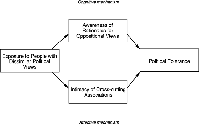
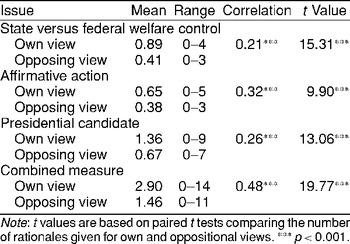
Awareness of Rationales for Own and Opposing Political Views
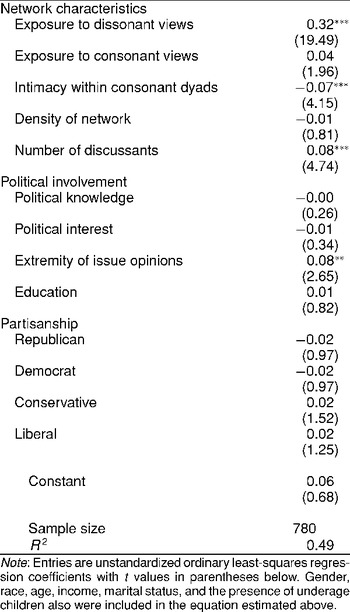
The Influence of Exposure to Consonant and Dissonant Political Views on Awareness of Rationales for Own and Opposing Political Views
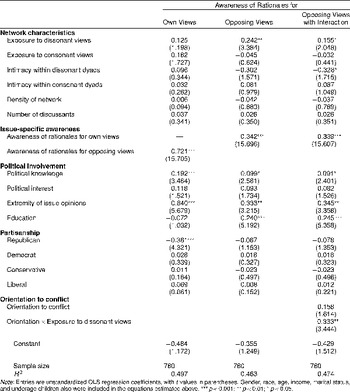
The Cognitive and Affective Influence of Discussant Networks on Political Tolerance
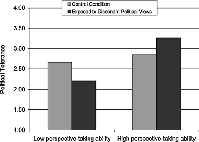
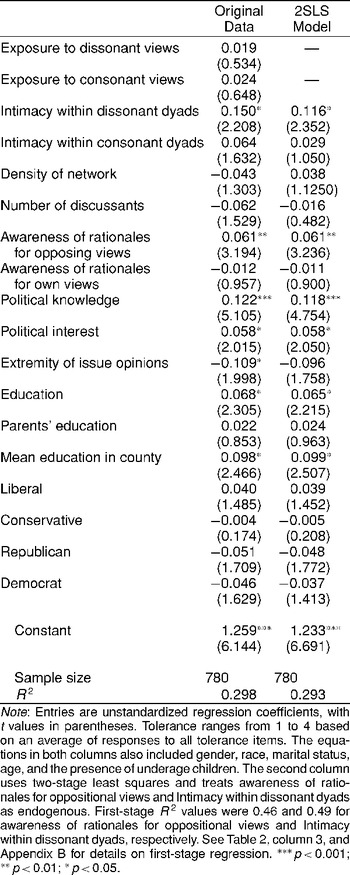
Experimental Effects of Exposure to Rationales for Consonant and Dissonant Political Views on Political Tolerance
 You have Access
- 680
- Cited by
Comments
No Comments have been published for this article.