Introduction
Studies on the community ecology of endoparasites in Palaearctic reptiles have increased in the past decade, focusing mainly on helminths of lizards (Roca, Reference Roca, Llorente, Montori, Santos and Carretero1995, Reference Roca1999; Biserkov & Kostadinova, Reference Biserkov and Kostadinova1998; Sharpilo et al., Reference Sharpilo, Biserkov, Kostadinova, Behnke and Kuzmin2001; Martin & Roca, Reference Martin and Roca2005; Galdón et al., Reference Galdón, Roca, Barbosa and Carretero2006; Roca et al., Reference Roca, Foufopoulos, Valakos and Pafilis2009). In contrast, the structure of helminth communities in ophidian species has received little attention at both hierarchical levels of organization (the component community and the infracommunity). Only the gastrointestinal communities of the grass snake Natrix natrix and dice snake N. tessellata from Bulgaria (Buchvarov et al., Reference Buchvarov, Kirin and Kostadinova2000) and Lataste's viper Vipera latastei from Spain (Santos et al., Reference Santos, Martínez-Freiría, Pleguezuelos and Roca2006) have been studied in detail. There are a few surveys, mainly from Eastern Europe, which report on basic parameters of infection of locally available ophidian species (Sharpilo, Reference Sharpilo1976; Shimalov & Shimalov, Reference Shimalov and Shimalov2000; Borkovcová & Kopřiva, Reference Borkovcová and Kopřiva2005; Mihalca et al., Reference Mihalca, Gherman, Ghira and Cozma2007; Shimalov, Reference Shimalov2010).
The Western whip snake Hierophis (syn. Coluber) viridiflavus Lacépède, 1789 is a Mediterranean colubrid occurring in France, Italy, Malta, Slovenia, Gyaros Island (Greece), Switzerland, Luxemburg, Belgium, Spain and Croatia (Naulleau, Reference Naulleau, Gasc, Cabela, Crnobrnja-Isailovic, Dolmen, Grossenbacher, Haffner, Lescure, Martens, Martinez Rica, Maurin, Oliveira, Sofianidou, Veith and Zuiderwijk1997; Vogrin et al., Reference Vogrin, Corti, Pérez-Mellado, Sá-Sousa, Cheylan, Pleguezuelos, Meyer, Schmidt, Sindaco, Romano and Martínez-Solano2008). It is associated with a wide range of well-vegetated areas, where it is a diurnal generalist feeder, mainly on lizards but also on micromammals and invertebrates (Capizzi et al., Reference Capizzi, Capula, Rugiero and Luiselli2008; Vogrin et al., Reference Vogrin, Corti, Pérez-Mellado, Sá-Sousa, Cheylan, Pleguezuelos, Meyer, Schmidt, Sindaco, Romano and Martínez-Solano2008). In southern Italy only the subspecies H. v. carbonarius occurs (Naulleau, Reference Naulleau, Gasc, Cabela, Crnobrnja-Isailovic, Dolmen, Grossenbacher, Haffner, Lescure, Martens, Martinez Rica, Maurin, Oliveira, Sofianidou, Veith and Zuiderwijk1997; Vogrin et al., Reference Vogrin, Corti, Pérez-Mellado, Sá-Sousa, Cheylan, Pleguezuelos, Meyer, Schmidt, Sindaco, Romano and Martínez-Solano2008). The knowledge about the helminth fauna of the Western whip snake is still very limited and fragmented. To date, a total of 11 helminth species including three acanthocephalans (Centrorhynchus aluconis Müller 1780, C. buteonis Schrank 1788 and Sphaerirostris lancea Westrumb 1821), three digeneans (Encyclometra colubrimurorum Rudolphi, Reference Rudolphi1819, Leptophallus nigrovenosus Bellingham 1844 and Macrodera longicollis Abildgaard 1788), three nematodes (Filaria parvomucronata Rizzo, Reference Rizzo1902, Paracapillaria sonsinoi Parona, Reference Parona1897 and Rhabdias fuscovenosa Railliet 1899) and two cestodes (Oochoristica rostellata Zschokke 1905 and Diplopylidium acanthotetra Parona 1887) have been reported in the Western whip snake (Rudolphi, Reference Rudolphi1819; Sonsino, Reference Sonsino1889, Reference Sonsino1893; Parona, Reference Parona1897; Rizzo, Reference Rizzo1902; see also Petrochenko, Reference Petrochenko1971).
Here, we report for the first time on the helminth assemblages of the Western whip snake from southern Italy (at the component and infracommunity levels), adding to the parasite list known for this host another 11 taxa, including three potential agents of zoonosis.
Materials and methods
Collection and examination of snakes
Between May and October 2009, 2010 and 2011, a total of 50 H. v. carbonarius, all road-killed specimens, were collected in Cosenza Province of the Calabria region (southern Italy). Individuals were frozen until necropsy. Snout-to-vent length (svl; cm) was recorded by a digital caliper to the nearest 0.1 mm. Snakes were dissected and sexed by gonad observation. Two age classes were established, i.e. immature and mature individuals, based on phenotypic and biometric features (Naulleau, Reference Naulleau, Gasc, Cabela, Crnobrnja-Isailovic, Dolmen, Grossenbacher, Haffner, Lescure, Martens, Martinez Rica, Maurin, Oliveira, Sofianidou, Veith and Zuiderwijk1997; Vogrin et al., Reference Sonsino2008) and gonad development observed at necropsy. Of the 50 Western whip snakes, 17 were immature (11 males and 6 females) and 33 were mature (21 males and 12 females).
The body wall was opened by a longitudinal incision, and organ surfaces and mesenteries in the body cavity were examined; then the lumen of the organs, including oral cavity, oesophagus, stomach, intestine, heart, trachea, lung, liver, gallbladder, spleen, pancreas, kidneys and coelomic cavity, were examined for endoparasites under a stereomicroscope. Parasites were washed in physiological saline and fixed in 70% ethanol. For identification, cestodes and trematodes were stained with Mayer's acid carmine and mounted in Canada balsam, and acanthocephalans, nematodes and pentastomids were cleared in temporary mounts of lactophenol. Voucher specimens are deposited in the US National Parasite Collection, Beltsville, Maryland (accession numbers: 105257–105265).
To relate feeding habits to the parasites, when present, gastrointestinal contents from each snake were recorded. Recent prey in the stomach was easily identified, while prey in the intestine was determined by hair (for micromammals), feathers (for birds), scales (for reptiles) and exoskeletons (for insects) at × 400 magnification.
Data analysis
Apart from analyses based on all parasite taxa, we considered two parasite categories in the description analysis, and interpretation of infracommunity structure, i.e. the ‘larval’ infracommunity and the ‘adult +immature’ infracommunity. The ‘larval’ infracommunity was composed of parasite taxa for which Western whip snakes act as putative intermediate/paratenic hosts (see table 1). The ‘adult + immature’ infracommunity included parasite taxa that reproduce in Western whip snakes (i.e. snakes act as definitive hosts) and those that occur as immature stages (arguably because these taxa are specific to other reptiles) (see table 1). The differentiation between both groups of parasites is obviously justified because of the different ecological role that Western whip snakes play in their life cycles. For instance, the lifespan of larvae in intermediate/paratenic hosts is expected to be generally longer than that of adult worms.
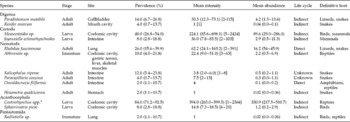
Infection parameters, life cycle and definitive hosts of the parasite taxa found in 50 Western whip snakes Hierophis viridiflavus carbonarius from southern Italy. Numbers in parentheses represent the 95% confidence interval of each parameter; numbers in square brackets are ranges.

a Centrorhynchus spp. includes C. buteonis and C. globocaudatus.
A preliminary analysis indicated that mean values (SD) of svl of males [72.0 (26.4) cm] and females [65.4 (21.5) cm] did not differ significantly (t-test, P > 0.36). Also, the mean size of snakes did not differ between years (Kruskal–Wallis test, P > 0.07). In addition, the number of females and males, or juveniles and adults, was independent of year (Chi-squared tests, P > 0.09). Therefore, we expected little influence of confounding variables on the host traits that were investigated, i.e. sex, maturity stage and svl. On the other hand, the factor ‘year’ did not have a significant effect on infection values of any parasite taxa, nor on infracommunity structure (data not shown). Thus, this factor was not considered in further analyses.
Total abundance, species richness and Brillouin's index of diversity were used as overall descriptors of infracommunities. Total abundance is the number of individuals of all helminth species, and species richness the number of helminth species harboured by each individual snake. The 95% confidence interval (CI) for prevalence was calculated with Sterne's exact method (Reiczigel, Reference Reiczigel2003), and for mean values of intensity, abundance, total abundance, species richness and Brillouin's index, with the bias-corrected and accelerated bootstrap method using 20,000 replications (Rózsa et al., Reference Rózsa, Reiczigel and Majoros2000). Species richness, mean total abundance and Brillouin's diversity index were compared between ‘larval’ and ‘adult + immature’ infracommunities with Wilcoxon's tests for paired samples.
Permutational multivariate analysis of covariance (PERMANCOVA) based on a similarity matrix (Anderson et al., Reference Anderson, Gorley and Clarke2008) was used to investigate the effects of three host traits on the structure of parasite infracommunities. Sex and maturity stage (with two categories, juvenile and adult) were treated as fixed factors, and size (svl) was used as a covariate. We first included interaction terms of the covariates with the factors, but none was significant and was removed from final models to increase the sensitivity of the analysis and to correctly interpret main effects (Engqvist, Reference Engqvist2005). To build the models, raw intensity data for each helminth species was first fourth-root transformed, then a Bray–Curtis similarity matrix between infracommunities was obtained. Because many parasite species had zero values in most snakes, a zero-adjusted Bray–Curtis matrix was obtained by adding a value of 1 to all cells (see Clarke & Warwick, Reference Clarke and Warwick2001). Pseudo-F statistics under a true null hypothesis were obtained by using a permutation procedure, i.e. group labels were randomly shuffled onto different sample units, and this procedure was repeated 10,000 times, according to the method described by Anderson et al. (Reference Anderson, Gorley and Clarke2008) in models including covariates. Our design was unbalanced and, therefore, we used a type III sum of squares to ensure a complete independence of all effects being tested (Anderson et al., Reference Anderson, Gorley and Clarke2008). PERMANCOVAs were also carried out for the ‘larval infracommunities’ and for specific subsets of parasite taxa and/or hosts.
The package Permanova+ for Primer v. 6 (Clarke & Warwick, Reference Clarke and Warwick2001) was used to carry out the PERMANCOVAs; the free software Quantitative Parasitology v. 3 (Reiczigel & Rózsa, Reference Reiczigel and Rózsa2005) to set 95% CIs, and the statistical package SPSS v. 19 for the remaining analyses (SPSS Inc., Chicago, Illinois, USA). Statistical significance was set at P < 0.05.
Results
Parasite identification and levels of infection
We identified a total of 14 parasite taxa including a single pentastomid (with a single immature specimen) and 13 helminth taxa including 6 nematodes, 3 acanthocephalans, 2 cestodes and 2 digeneans. Basic parameters of infection for each parasite species plus type of their life cycle (direct or indirect), and the main final groupings are presented in table 1. Of the 22,407 helminth specimens collected, larval forms represented 95.2% of all specimens found (0.5% encysted larval nematodes, 20.6% larval cestodes and 74.1% acanthocephalans from the body cavity). Additionally, 0.2% of specimens were adult gastrointestinal nematodes, 3.6% pulmonary nematodes, 0.01% gastrointestinal digeneans and 0.9% gallbladder digeneans (table 1).
Following the criteria described in Materials and methods, three groups of parasite taxa could be distinguished. First, in seven species at least some worms were found as adults, i.e. Paradistomum mutabile Molin 1859, Renifer aniarum Leidy 1890, Rhabdias fuscovenosa, Kalicephalus viperae Rudolphi, Reference Rudolphi1819, Paracapillaria sonsinoi, Oswaldocruzia filiformis Goeze 1782 and Hexametra quadricornis Wedl 1861 (table 1). Whip snakes can be considered to act as a definitive host for these helminths. Nematodes, especially R. fuscovenosa, were numerically dominant in this group of parasites (table 1).
A second group of parasites was composed of two species that are typical for reptiles but for which no sexually mature individuals were found in the Western whip snakes. This group includes the nematode Abbreviata sp. and the pentastomid Raillietiella sp. Prevalence was low ( ≤ 10%) in both species; a single individual of Raillietiella sp. was collected, but mean intensity in Abbreviata sp. was over 20 individuals/host (table 1).
A third group was composed of four helminth taxa that were found only as larvae, and whose adults are typical parasites of birds or mammals. This group includes two acanthocephalan species and two cestodes. The most abundant species, Centrorhynchus spp., actually represent a mixture of two species, namely, C. buteonis and C. globocaudatus Zeder 1800 (table 1). Tetrathyridia of the cestode Mesocestoides sp. were also very abundant (mean abundance: 224 individuals/host) with a maximum value of 2424 individuals. The other two species, Joyeuxiella echinorhynchoides Sonsino 1884 and Sphaerirostris picae Rudolphi, Reference Rudolphi1819, both had very low prevalence (8%) and mean abundance ( < 3 individuals/host) (table 1). Gastrointestinal remains were found only in 19 Western whip snakes (1 immature and 18 adults): 9 contained lizards (including Podarcis sicula, Anguis fragilis and Chalcides chalcides), 6 had unidentified micromammals, 3 had orthopterans and 1 had an unidentified bird.
Parasite assemblages
Descriptors of infracommunity structure are shown in table 2. Six snakes were uninfected; 18 snakes harboured two parasite taxa, 12 harboured three, 4 harboured four, and single hosts harboured five and six species, respectively. ‘Larval’ infracommunities had significantly higher species richness (Wilcoxon's test, Z= 3.455, n= 44, P= 0.0005) and total abundance (Z= 5.298, n= 44, P < 0.00 001) than ‘adult + immature’ infracommunities (table 2). Brillouin's diversity index was also higher in ‘larval’ infracommunities (table 2). However, the calculation of this index requires that at least one species is present in the community. There were 25 snakes in which Brillouin's index could be calculated for both ‘larval’ and ‘adult + immature’ infracommunities, and the difference was not significant (Wilcoxon's test, Z= 0.806, n= 25, P= 0.444).
Mean values (with 95% confidence interval in parentheses and ranges in brackets) of infracommunity parameters for parasite taxa found in 50 Western whip snakes Hierophis viridiflavus carbonarius from southern Italy. The parasite group ‘Larvae’ includes four parasite taxa for which snakes act as a putative intermediate/paratenic host; ‘Adult + immature’ includes parasite taxa that reproduce in whip snakes (seven species) or are typical from other reptiles and occur accidentally in whip snakes (two species); ‘Total’ includes all parasite taxa found.

a Indicates the number of snakes for which the diversity index could be calculated (i.e. harbouring at least one parasite taxon).
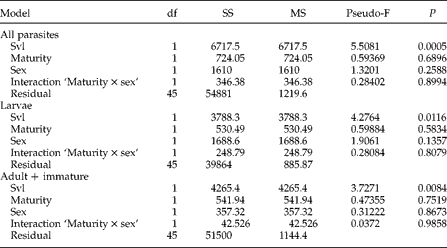
Results from PERMANCOVA analysis are shown in table 3. Svl was the only significant predictor of infracommunity structure in models including ‘larval’ forms, ‘adult + immature’ forms and ‘all parasite taxa’. In fact, there were positive and significant covariations between svl and species richness in both ‘larval’ (Spearman correlation, r s = 0.256, n= 50, one-tailed P= 0.025) and ‘adult + immature’ (r s = 0.609, n= 50, one-tailed P < 0.001) infracommunities. When infracommunity data were arranged according to svl, three clear patterns showed up. First, the four smallest snakes, measuring 25.5, 27.5, 29.0 and 32.5 cm, harboured no parasites. Second, snakes with svl ranging from 33 to 65 cm (n= 14) harboured only three larval forms, namely Centrorhynchus spp. (in 11 hosts), Mesocestoides sp. (in nine hosts) and S. picae (in one host); a single snake of this group harboured two individuals of R. fuscovenosa. Finally, snakes with svl ranging from 71 to 106 cm (n= 32) harboured these three larval forms plus the remaining parasite taxa. In this subset of 32 snakes, none of the predictors included in PERMANCOVA models for ‘larvae’, ‘adult + immature’ or ‘all parasites’ was found to be statistically significant (data not shown).
Permutational multivariate analysis of parasite infracomunity structure in 50 Western whip snakes Hierophis viridiflavus carbonarius using three models of covariance. The ‘All parasites’ model includes all parasite taxa found, the ‘Larvae’ model, those parasite taxa for which snakes act as a putative intermediate/paratenic host, and ‘Adult + immature’ model, parasite taxa that reproduce in Western whip snakes or are typical from other reptiles and occur accidentally in Western whip snakes. In all models, Svl refers to snout-to-vent length of the snake.
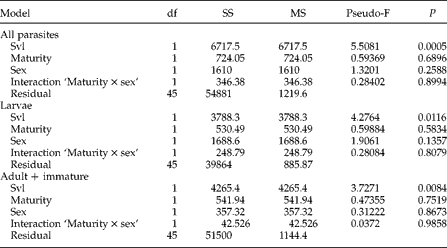
SS, sum of squares; MS, mean square.
Discussion
Parasitological examination of Western whip snakes from southern Italy revealed a total of 14 parasite taxa of which only four can be considered as snake specialists (found as adult parasites only in ophidian species), while one is shared with other reptiles and amphibians, and two with lizards (table 1). New host records are reported for all parasite taxa except for C. buteonis, Paracapillaria sonsinoi and Rhabdias fuscovenosa, while P. mutabile is reported in an ophidian host for the first time.
Renifer aniarum usually parasitizes the upper digestive tract of semi-aquatic or aquatic snakes (McAllister & Bursey, Reference McAllister and Bursey2008). Since its original description, it has been reported in viperid (Agkistrodon spp.) and colubrid snakes (Coluber spp., Farancia spp., Heteredon spp., Lampropeltis spp., Nerodia spp. and Seminatrix spp.) from the USA and in plain-bellied water snakes (Nerodia erythrogaster transversa) in Mexico (see McAllister & Bursey, Reference McAllister and Bursey2008). Recently we reported R. aniarum in grass snakes from the Calabria region as a presumptive introduced parasite from North America (Santoro et al., Reference Santoro, Tkach, Mattiucci, Kinsella and Nascetti2011). Renifer spp. use a gastropod mollusc and a frog as first and second intermediate hosts, respectively (see McAllister & Bursey, Reference McAllister and Bursey2008). The two specimens of Western whip snakes found to be infected by a single R. aniarum specimen each were collected close to the Esaro River (an important tributary of the Crati River) and the Crati River itself, where R. aniarum was found as a well-established parasite in the grass snake (Santoro et al., Reference Santoro, Tkach, Mattiucci, Kinsella and Nascetti2011). In Italy, the Western whip snake feeds only occasionally on frogs (Capizzi et al., Reference Capizzi, Capula, Rugiero and Luiselli2008) and this may explain the low prevalence of infection with this digenean (see table 1).
Paradistomum mutabile is a digenean of the gallbladder of lizards from Europe and Asia. Experimentally, lizards have been infected by ingestion of a pulmonate mollusc (Timon-David & Timon-David, Reference Timon-David and Timon-David1967). In Europe P. mutabile has been reported previously only in lizards, Podarcis spp., Lacerta spp. and Tarentola mauritanica from Italy, France, Greece, Romania and Spain (Rizzo, Reference Rizzo1902; Dollfus, Reference Dollfus1922; Timon-David & Timon-David, Reference Timon-David and Timon-David1967; Capuse, Reference Capuse1971; Roca, Reference Roca, Llorente, Montori, Santos and Carretero1995, Reference Roca1999; Roca et al., Reference Roca, Foufopoulos, Valakos and Pafilis2009).
Hexametra quadricornis, Kalicephalus viperae and P. sonsinoi are considered as snake specialists (see Sprent, Reference Sprent1978; Moravec, Reference Moravec1986; Santos et al., Reference Santos, Martínez-Freiría, Pleguezuelos and Roca2006; Ribas et al., Reference Ribas, Lopez and Roca2010). The first is a parasite of Old World snakes and uses rodents as intermediate hosts (Sprent, Reference Sprent1978). In Europe K. viperae was previously reported only from Spain in Vipera aspis, V. latastei, Rhinechis scalaris, Malpolon monspessulanus and Zamenis longissimus (Santos et al., Reference Santos, Martínez-Freiría, Pleguezuelos and Roca2006; Ribas et al., Reference Ribas, Lopez and Roca2010). Paracapillaria sonsinoi was described by Parona (Reference Parona1897) from the intestine of a Western whip snake from Pisa (central Italy). It is a Holarctic species distributed in the warm regions of Europe, eastern Asia and North and Central America (see Moravec, Reference Moravec1986). In contrast, O. filiformis is a generalist and cosmopolitan parasite found in several amphibian and reptile species (see Yildirimhan et al., Reference Yildirimhan, Bursey and Altunel2011).
Rhabdias fuscovenosa is a cosmopolitan generalist nematode found in several snake species. This lungworm is unable to penetrate the skin of snakes, and establishes infections only when it enters the host's oral cavity, penetrating oesophageal tissue (Langford & Janovy, Reference Langford and Janovy2009). Physid snails have been shown experimentally to be transport hosts when fed to snakes (Langford & Janovy, Reference Langford and Janovy2009). In Italy this species has also been genetically characterized with respect to other Rhabdias spp. from amphibians, based on three gene loci (Cipriani et al., Reference Cipriani, Mattiucci, Paoletti, Santoro and Nascetti2012).
Definitive hosts of Mesocestoides spp. are carnivorous mammals and birds, while the second larval stage (tetrathyridium) is found in tissues of snakes, lizards and amphibians (McAllister et al., Reference McAllister, Conn, Freed and Brudick1991, Reference Roca, Foufopoulos, Valakos and Pafilis1995; Khalil et al., Reference Khalil, Jones and Bray1994). When an infected arthropod, which is hypothesized as the first intermediate host, is ingested by a reptile or amphibian, the larva develops into a tetrathyridium encapsulating on the serous cavities of the host (Schmidt, Reference Schmidt1986; Khalil et al., Reference Khalil, Jones and Bray1994). Members of Mesocestoides spp. may be important zoonotic agents, causing mainly diarrhoea and abdominal pain (Kagei et al., Reference Kagei, Kihata, Shimizu, Urabe and Ishii1974). Following McAllister et al. (Reference McAllister, Conn, Freed and Brudick1991, Reference McAllister, Aaron and Russell1995) at least 30 species of snakes worldwide have been found to be infected by Mesocestoides spp., but no previous records are known from the Western whip snake.
Abbreviata spp. are cosmopolitan parasites of reptiles. This genus includes heteroxenous members with an indirect life cycle involving insects as intermediate hosts (Anderson, Reference Anderson2000). Abbreviata abbreviata Rudolphi, Reference Rudolphi1819 is the most common species within this genus, infecting Eurasian reptiles (see Yildirimhan et al., Reference Yildirimhan, Bursey and Altunel2011). Encapsulated larvae of a species of the genus Abbreviata were found in the gastric tissues of small snakes and lizards preyed upon by large Australian lizards which, in turn, serve as definitive hosts of Abbreviata (Jones, Reference Jones1995). We found encapsulated larvae from the liver, gastric serosa, skeletal muscles and coelomic cavity. Because third-stage larvae of Abbreviata had become encapsulated in the Western whip snake, we may hypothesize that this snake species is not a suitable definitive host.
Joyeuxiella echinorhynchoides is a parasite of domestic and wild carnivores in tropical and temperate countries, which may cause zoonosis. The cycle of Joyeuxiella spp. involves a coprophagous insect as first, and a reptile (mainly a lizard) as second intermediate host (Schmidt, Reference Schmidt1986). The presence of immature forms of J. echinorhynchoides (probably acquired by lizard ingestion) in the intestine of the Western whip snake suggests that this ophidian species is not a suitable host for the cestode.
Raillietiella spp. are pentastomid parasites causing zoonosis characterized mainly by fever and abdominal pain. Most human cases show a history of eating raw vegetables or snake flesh (Yao et al., Reference Yao, Wu and Tang2008). In reptiles, members of Raillietiella were reorganized, on the basis of characteristics of definitive hosts, into three groups, including small lizards, varanid lizards and snakes (Ali et al., Reference Ali, Riley and Self1985). Raillietiella orientalis Hett 1915 is the only species within this genus found in a snake (Aesculapian snake Zamenis longissimus) from Italy (Röhlig et al., Reference Röhlig, Dunlop, Horacio-Grau and Friederichs2010).
Adult helminths of terrestrial snakes consist mainly of nematodes acquired from their most abundant prey, lizards and rodents. In contrast, the possibility of exposure to other helminths, such as digeneans, whose transmission patterns include freshwater hosts, is very low compared to the aquatic or semi-aquatic snakes (Aho, Reference Aho, Esch, Bush and Aho1990; Anderson, Reference Anderson2000; Buchvarov et al., Reference Buchvarov, Kirin and Kostadinova2000; Santos et al., Reference Santos, Martínez-Freiría, Pleguezuelos and Roca2006). The Western whip snakes studied here showed strictly terrestrial feeding habits. In central Italy most of its prey is represented by lizards, insects and micromammals, but its diet changes among age classes: the juveniles and sub-adults prefer insects and lizards, while the adults have an increased consumption of micromammals (Capizzi et al., Reference Capizzi, Capula, Rugiero and Luiselli2008). In this study, the ‘larval’ infracommunities had significantly higher values of community than ‘adult + immature’ infracommunities (table 2) suggesting the most important role of the Western whip snake as an intermediate/paratenic host. Moreover, except for a snake with svl of 41.5 cm which harboured two R. fuscovenosa specimens, all parasite adult forms were found in snakes with svl greater than 70 cm. To explain these results we may hypothesize an unexpected ontogenetic change in the diet or habitat use when the Western whip snake reaches this size. Adult snakes forage more actively and in a wider variety of habitats than juveniles or sub-adults (Luiselli & Angelici, Reference Luiselli and Angelici1996; Capizzi et al., Reference Capizzi, Capula, Rugiero and Luiselli2008). Adults also feeding on a wider variety of prey types and sizes are exposed to a greater number of potential intermediate host species, resulting in a greater helminth richness when compared to immature snakes (Poulin, Reference Poulin1997, Reference Poulin2007). In contrast, the immature snakes feed almost exclusively on insects and a few lizards (Luiselli & Angelici, Reference Luiselli and Angelici1996; Capizzi et al., Reference Capizzi, Capula, Rugiero and Luiselli2008; Vogrin et al., Reference Vogrin, Corti, Pérez-Mellado, Sá-Sousa, Cheylan, Pleguezuelos, Meyer, Schmidt, Sindaco, Romano and Martínez-Solano2008). The ontogenetic shift in diet from invertebrate prey for juvenile snakes to lizard and micromammal prey for sub-adult and adult snakes may influence the structure of the helminth community because of the ingestion of different intermediate hosts (Poulin, Reference Poulin1997, Reference Poulin2007). On the other hand, if small snakes, because of developmental constraints, are able to forage only in certain habitats, they may only encounter certain prey or certain intermediate hosts. From a functional point of view, the presence of almost exclusively larval forms of helminths in immature (juveniles and sub-adults) snakes might also suggest that the latter represent the predominant prey for the vertebrates in which those parasite adult forms develop.
Invertebrates can be considered as an important source of helminth communities to their hosts (Bush et al., Reference Bush, Heard and Overstreet1993; Jiménez-Ruiz et al., Reference Jiménez-Ruiz, García-Prieto and Pérez-Ponce de León2002). Larvae of Centrorhynchus spp. and Mesocestoides spp. were the only parasites found here in snakes of all age classes, including individuals with svl of 33 cm which are known to feed almost exclusively on invertebrates (Capizzi et al., Reference Capizzi, Capula, Rugiero and Luiselli2008; Vogrin et al., Reference Vogrin, Corti, Pérez-Mellado, Sá-Sousa, Cheylan, Pleguezuelos, Meyer, Schmidt, Sindaco, Romano and Martínez-Solano2008). Invertebrates represent the first intermediate hosts of both Centrorhynchus spp. and Mesocestoides spp.
Larval forms of helminth species with higher colonization abilities (or greater dispersal potential) in respect to host vagility (i.e. larval helminths with birds or mammals as final hosts) contributed significantly to the helminth community. Higher abundance of avian parasites (cystacanths of Centrorhynchus spp. and S. picae) and those of carnivorous birds and mammals (tetrathyridia of Mesocestoides sp.) is most likely a mass effect (Shmida & Wilson, Reference Shmida and Wilson1985) linked to the greater availability of those hosts in the region. In the same geographical area, members of the Centrorhynchidae use insects as first intermediate hosts, lizards, frogs and snakes as paratenic hosts, while birds of prey and owls are their definitive hosts (Santoro et al., Reference Santoro, Tripepi, Kinsella, Panebianco and Mattiucci2010, Reference Santoro, Kinsella, Galiero, degli Uberti and Aznar2012, unpublished data).
We conclude that ontogenetic and ecological factors exert a strong influence upon the helminth assemblages of Western whip snake. However, we focused on the important role of the Western whip snake in southern Italy as an intermediate/paratenic host for species of helminths infecting other groups of vertebrates as adults.
Acknowledgements
We are grateful to the Sila National Park for supporting this study and permitting the use of the carcasses found in the area included in the National Park (permit no. 5664/2010). This work was also supported by project CGL2007-63221 from the Ministerio de Economia y Competitividad (MEC) of Spain.