All political power is primarily an illusion . . . . Mirrors and blue smoke, beautiful blue smoke rolling over the surface of highly polished mirrors . . . .
(Jimmy Breslin, Notes from Impeachment Summer, 1975)Surviving Classic and Postclassic period Maya texts are rich with symbolism, nuance, and polysemy, but also—for archaeologists who seek a clearer understanding of Maya social, political, and economic practices—annoying ambiguity. The lack of clarity is particularly problematic in efforts to identify continuities in lowland Maya civilization from its Preclassic beginnings through Classic “collapse” and Postclassic and Colonial-period transformations. The Preclassic Maya generally lacked texts; the Classic Maya created texts and elaborate imagery on stone monuments and painted pottery, but with subject matter limited to high elites; and the Postclassic and Colonial period Maya left us almanacs and “prophetic histories” written in a poetic style of discourse employing couplets and metaphors, highly allusive and maddeningly impenetrable.
Another difficulty in envisioning continuities rests with our own scholarly inclinations. Until recently Mayanists were more invested in identifying social, political, and demographic disjunctions between the Classic and Postclassic periods—understanding the “collapse” (Demarest et al. Reference Demarest, Rice and Rice2004; Webster Reference Webster2002; see also Carrasco et al. Reference Carrasco, Jones, Sessions, Carrasco, Jones and Sessions2000 for Mesoamerica in general)—rather than cultural persistence. In the early twenty-first century, however, we are beginning to see renewed interest in cultural continuities, often phrased as “resilience” (e.g., Redman Reference Redman2005).
Here I propose that one component of Maya cultural resilience lies in the coded rhetoric of calendrically-based lowland geopolitical organization. Briefly, I proposed such organization as being based on units of time: k'atuns, approximately 20 Gregorian years, 13 of which constituted a may (“cycle”) of approximately 256 years (Rice Reference Rice2004). Regional may realms were established by being “seated” in major cities, and smaller cities within the realm rotated in seating the 13 constituent k'atuns. This organization is known from the Late Postclassic northern lowlands (Edmonson Reference Edmonson, Robertson and Jeffers1979), but I propose earlier origins (Rice Reference Rice2007a). Further, I propose here that continuities in such organization can be recognized in subtle and elliptical literary devices—the language of metaphor, homophony, and synonymy—and also in iconography traceable from Preclassic through Colonial period times. Clues are especially notable in paired oppositions, discernible as early as Middle Formative art (Reilly Reference Reilly and Greene Robertson1991) and later in verbal couplets known as “kennings” (diphrastic kennings, difracismos) that structured Maya poeticized ritual discourse (Knowlton Reference Knowlton2002). Specifically, k'atun-based geopolitical cycling can be identified through representations and manifestations of God K/K'awiil, manikin scepters, and the “flint-and-shield” trope.
SMOKE AND MIRRORS: A GOD K/K'AWIIL/MANIKIN SCEPTER DEITY CLUSTER
Maya—and Mesoamerican—religious beliefs are difficult to access on the basis of available information, but it is generally agreed that through the Classic period the focus was less on personified or anthropomorphic deities and more on animistic spirits or forces (Clemency Coggins, personal communication 2009; Marcus Reference Marcus, Sharer and Grove1989; Miller and Taube Reference Miller and Taube1993:89). Personified deities tend to be associated with the Postclassic period and gods represented in the codices (Schellhas Reference Schellhas1904).
Vail (Reference Vail2000) argued that Maya supernaturals did not exist as discrete entities in separate domains, but rather in overlapping thematic clusters. She identified three of these, focused on maize, on earth, and on flowers, fertility, and life force. Some Maya supernaturals belonged to all three complexes, “suggesting that they formed the basis of a larger thematic grouping centered on sustenance and agricultural fertility” (Vail Reference Vail2000:142). None of her groupings appears to involve the Postclassic God K (or Classic K'awiil), and I propose a fourth complex centered on this supernatural.
Maya God K/K'awiil is a multivalent and pluripotent entity with shifting identities and attributes that can be tracked from the Preclassic/Formative period at least into the sixteenth century (see Coggins Reference Coggins1988, Reference Coggins, Clancy and Harrison1990; Kelley Reference Kelley1965; Milbrath Reference Milbrath1999:227–240, Reference Milbrath and Stone2002; Miller and Taube Reference Miller and Taube1993:110; Robicsek Reference Robicsek, Greene Robertson and Call Jeffers1979; Schele and Miller Reference Schele, Miller, Schele and Miller1983:9–20; Schele and Miller Reference Schele and Miller1986:49; Stone and Zender Reference Stone and Zender2011:49; Stuart Reference Stuart1987:15–16; Taube Reference Taube1992:69–79). The God K complex is primarily celestially oriented, taking as its domain storms, lightning, and sky, the last including ancestors, celestial or vision serpents (typically shown conjuring or dancing), and the planets, especially Jupiter. Perhaps most significantly, God K/K'awiil is the patron of royal dynasties and bloodlines (Stuart Reference Stuart, Benson and Griffin1988).
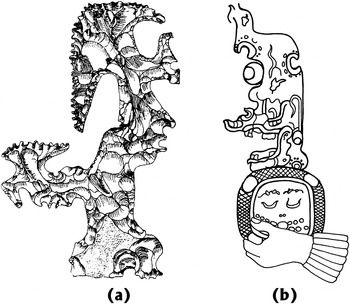
Iconographically, God K is primarily recognized by his large, decorated, up-turned nose or snout, and a smoking ax, celt, cigar, mirror, or torch on the forehead or temple. In the Classic period he is known epigraphically as K'awiil, which means “statue” or “god” in K'iche'an languages (Schele and Fahsen Reference Schele and Fahsen1991) and “sustenance” in Yukatekan (Stuart Reference Stuart1987:15–16; alimento: Barrera Vásquez Reference Barrera Vásquez1980). God K is a patron of rulers as guarantors of cosmic sustenance through sacrifice and bloodletting. He appears in the Classic period as the “manikin scepter” (Figure 1) with the above attributes, plus an elongated leg with a serpent head as the foot. This scepter, a personified ax (Looper Reference Looper2003:104), is displayed by Classic rulers at accession.
Late Classic manikin scepters depicting God K/K'awiil. (a) Made of white stone (probably albite); height 32 cm (12-5/8 inches), provenience unknown, Princeton University Art Museum (adapted from Miller and Martin Reference Miller and Martin2004: Plate 3). (b) Held by ruler Bird Jaguar IV (a.d. 752–768) at his accession; detail from Lintel 1, Temple 33, Yaxchilan (redrawn from Graham Reference Graham1979).

God K is closely related to other Maya deities, particularly God B/Chaak and the concept of rain as a life-giving force. God K also can be related to agriculture, the provisioning of earthly food, nurturance, and the growth of cacao and other food for the gods (Miller and Martin Reference Miller and Martin2004:6–63, Plate 31). In one Maya myth, God K/K'awiil appears to have opened “Sustenance Mountain” through a bolt of lightning, revealing maize inside. Thus God K is identified with God E/the Maize God (Taube Reference Taube1992:78) and images of God K/K'awiil on Palenque censer stands have been interpreted as metaphors for maize (de la Garza Camino and Cuevas García Reference de la Garza Camino and García2005). In addition, God K is also known as Unen K'awiil, the infantile GII of the Palenque Triad (Robertson Reference Robertson, Greene Robertson and Call Jeffers1979), and as Tojil, patron deity of the Postclassic K'iche Maya of the Guatemalan highlands.
In his manifestation as a manikin scepter, Maya God K/K'awiil bears strong resemblances to the central Mexican black Tezcatlipoca deity, identified by a smoking mirror in his temple and a serpent foot, who is symbolic of legitimate rulership (Carlson Reference Carlson and Benson1981:125; Coe Reference Coe1973:116; Milbrath Reference Milbrath1999:230–231; Miller and Taube Reference Miller and Taube1993:165; Olivier Reference Olivier2003; Valencia Rivera Reference Valencia Rivera2006). Tezcatlipoca and God K/K'awiil share both feline and ophidian associations (Valencia Rivera Reference Valencia Rivera2006), although Tezcatlipoca is more commonly linked to jaguars (especially the Jaguar God of the Underworld; see Miller and Taube Reference Miller and Taube1993:164) and K'awiil to serpents (Taube Reference Taube1992:73–75). The serpent is the way (spirit companion, “co-essence;” the nagual) of K'awiil (Houston and Stuart Reference Houston and Stuart1989:8).
God K's celestial associations, besides lightning and storms, appear to concentrate on the planet Jupiter, the second brightest star after Venus. Milbrath (Reference Milbrath1999:230, Reference Milbrath and Stone2002) links GII to Jupiter intervals and GII's birthday, a day 1 Ajaw, is frequently associated with Jupiter events (Thompson Reference Thompson1960). God K/K'awiil has been said to “embody” (Milbrath Reference Milbrath1999:239) the planet Jupiter, especially in retrograde. Over time he came to be associated with the temporal cycles of k'atuns because their endings in the Classic period are often related to recurrent positions of Jupiter and Saturn. God K is the main protagonist of the poorly understood 819-day count, perhaps developed at Palenque (Aldana Reference Aldana2007), which tracks the movements of Jupiter and Saturn and in which the deity tours the four cosmic quarters. Aldana (Reference Aldana2007:112, 117, 164) also connects K'awiil with the planets Mars and Mercury.
In all these incarnations and manifestations, the fundamental—albeit complexly multilayered—connection is with royal lineage and divine legitimization, embodying a ruler's power and responsibilities with respect to ensuring nourishment of the soil, of the people, and of cosmic time.
Preclassic Precursors
In keeping with the proposition that deity clusters have multiple themes and domains, it is likely that God K's muliple roles accrued over time, and some of the Classic and Postclassic God K/K'awiil attributes can be traced back to Middle Formative iconography and the accoutrements of Olmec lords. For example, Classic themes of kings' bloodletting and the invocation of ancestors might be traced back to La Venta Stela 2 (Stuart Reference Stuart, Benson and Griffin1988:221). The ambiguous feline-ophidian-reptilian characteristics of various entities in Formative, particularly Olmec, art might have been the source for both Tezcatlipoca and K'awiil, with Tezcatlipoca/feline a later Mexican transformation out of K'awiil/serpent (Valencia Rivera Reference Valencia Rivera2006:56).
The mirror shared by Tezcatlipoca and God K/K'awiil might relate back to an Early Formative “pan-Mesoamerican mirror-cult tradition of royal lineage and power” based on elite associations with concave, ground iron-ore mirrors (Carlson Reference Carlson and Benson1981:125, 130; Rice Reference Rice2007a:29; Stone and Zender Reference Stone and Zender2011:73). Mirrors were likely used as instruments of conjuring and divination, but the reflections they cast also hinted at another world which could be peered into but not physically entered; as such, mirrors represented “passageways for the supernatural” (Miller and Taube Reference Miller and Taube1993:115). The “flame eyebrow” of the Olmec were-jaguar supernatural, which appears as an icon on widely occurring Middle Formative objects, might have been a precursor to the smoking forehead mirror of the later God K. Or, stated differently, perhaps the profiled image of the were-jaguar with the flame eyebrow, projecting upper lip/snout, fangs, and swept-back cleft head is a predecessor of a rain/storm-lightning/maize god complex, including God K/K'awiil (an association hinted at by Reilly [1991]).
God K's serpent foot has origins in the “Olmec kings who depicted their lower legs as crocodile heads, to symbolize their status as the World Tree” (Freidel et al. Reference Freidel, Schele and Parker1993:196). The heavily incised “Young Lord” (a.k.a. “Slim”) serpentine figurine cradles two scepters (one probably a bloodletter), a pair of Olmec symbols of authority, in arms clasped inward over his chest (Reilly Reference Reilly and Greene Robertson1991; Joralemon Reference Joralemon, Benson and de la Fuente1996a). Each forearm is embellished with a human figure with elongated legs, and from one foot of each figure emerges the head of a “were-jaguar” supernatural. The Young Lord's feet are likewise ornamented with the heads of supernaturals.
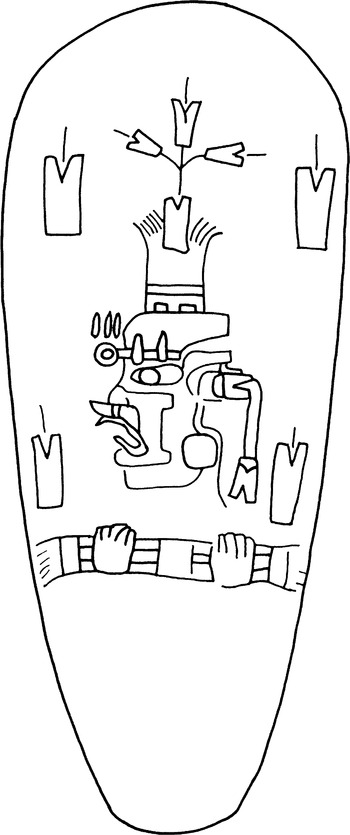
Ax-like greenstone celts, generally thought to have associations with corn and lightning, are frequently incised with Olmec symbols of rulership. One shows an individual carrying a horizontal bundle that looks like the forerunner of a Maya serpent bar, with a corn plant growing from the cleft in its head (Joralemon Reference Joralemon, Benson and Fuente1996b:269) (Figure 2). God K's later identification with maize (Taube Reference Taube1992:78)—and the celt embedded in his forehead—might be linked to this early imagery. Slightly later, Izapa Stela 3 shows a standing figure brandishing a curved stick, with a smoking torch on the forehead and a possible serpent foot (Taube Reference Taube1992:76n7).
A Middle Formative Olmec celt with an incised profile head and a ceremonial bundle, from Río Pesquero, Veracruz, Mexico. Made of jade; height 24.8 cm (9.75 inches), The Cleveland Museum of Art. Note the “corn symbol” rising from the top of the head. The bundle (cloth?) presentation is disembodied from the head (redrawn from Joralemon Reference Joralemon, Benson and Fuente1996b:269, Figure 117).

In the Maya lowlands, the murals of San Bartolo, in northeastern Peten, date to roughly 150 b.c. and display certain generalized Middle Formative (“Olmec”-like) traits, particularly the facial features of the humans or supernaturals. In particular, the left-most figure on the North wall exhibits several striking features that not only call to mind Olmec representations but also later Chaak and God K. The masked figure faces left, cradling in his left arm two curved sticks, with his right arm upraised. His face has an elongated snout that emanates smoke or breath scrolls. A shield on his brow with an emerging serpent may represent a (smoking?) mirror. On the Pacific coast, God K might be shown on Takalik Abaj Stela 5, which dates to the early second century a.d. (Miller and Taube Reference Miller and Taube1993:130; Taube Reference Taube1992:76).
Classic Period: K'awiil and Manikin Scepter
In the southern lowlands, God K/K'awiil-related imagery appears in the Early Classic period in objects displayed by rulers. For example, on the unprovenienced Leiden Plaque, which refers to the seating of a ruler in a.d. 320, God K is shown emerging from a serpent's maw on the right side of a double-headed serpent bar clutched to the ruler's chest in much the same way “Slim” carried his emblems. This supernatural also appears as an ancestral head floating above Tikal ruler Yax Nun Ahiin on his accession monument, Stela 4, dated to a.d. 379. Slightly later, a more full-figured God K appears on a ceramic box, probably from Tikal (see Kerr Reference Kerr2007:K3801). In the Late Classic period, K'awiil is materialized as the manikin scepter (Miller and Martin Reference Miller and Martin2004:Plate 3). Commonly represented on monuments in the south, God K scepters also appear in the northern lowlands, for example, at Edzna, Uxmal (Stelae 2 and 6), Dzibilchaltun (Stela 9 and 19), Oxkintok, Sayil (Stela 5), and Ek' B'alam (Stela 1). Perplexingly, the manikin scepter rarely appears on Late Classic polychrome pottery (Alexander Reference Alexander2005).
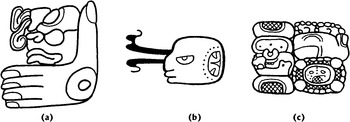
“Ch'am k'awiil” (‘take the k'awiil’) (see Figure 3a) is the expression used in Classic Maya inscriptions for the ruler's act of grasping the manikin scepter, usually at accession. This act, receiving “the divine symbols or sacred charters associated with rulership,” has been interpreted as representing a “significant or pronounced political change” in the case of Copan's ajaw Yax K'uk' Mo' (Stuart Reference Stuart, Bell, Canuto and Sharer2004:233). Upon receipt of the scepter, the newly installed ruler dances the “K'awiil Dance” as part of the public ritual performances accompanying legitimate accession (García Barrios and Valencia Rivera Reference García Barrios and Rivera2007; Grube Reference Grube1992). Other kinds of dances, memorialized on stelae and lintels primarily in the western lowlands (e.g., Dos Pilas, Yaxchilan), include a “basket staff dance,” in which a k'awiil figure sits atop an inverted basket, and a snake dance. The snake dance is commonly depicted on Classic polychrome pottery, especially on “Holmul Dancer plates” and Codex-style vessels that show God K/K'awiil appearing as, or on, the tail of the “conjuring snake” (och chan) entwined with the Snake Lady and the Old God (Grube Reference Grube1992:212–213, 214–215). This character is associated with transformation rites, particularly emergence from the maw of the Vision Serpent, and dances to conjure ancestors (Alexander Reference Alexander2005). A beautiful “Holmul-style” Late Classic vase painted by Ah Maxam, a royal artist at Naranjo, shows three dancing young lords wearing elaborate skyband backracks, topped by a bird with God K head; in each rack is a different deity holding an upside-down God K/K'awiil head (Coe Reference Coe1978:94–99; Reents-Budet Reference Reents-Budet1994:63, 319). Secondary texts reveal that each named deity is associated with an Emblem Glyph: 6 Sky with Calakmul, 10 Chuen (monkey) with Machaquila, and Ix Balam (water-lily jaguar) with Tikal (Coe Reference Coe1978:96; Milbrath Reference Milbrath1999:247).
(a) The ch'am k'awiil collocation: a hand holding (ch'am) a k'awiil head. (b) K'awiil glyph from Paris Codex (see text; Macri and Vail Reference Macri and Vail2009:100). (c) Took'-pakal glyph, detail from text on Lintel 25, Yaxchilan (redrawn from Schele and Miller Reference Schele and Miller1986:188).

As on this “Holmul-style” vase, k'awiil dancers often may be identified with Emblem Glyphs, or the verb “to dance” (ahk'ot) followed by a toponym. Nikolai Grube (Reference Grube1992:210) asks whether, given the relations among k'awiil, ancestors, and royal lineages, the “distinct manifestations of k'awiil [might] correlate with different places?” Responding in the affirmative, Ana García Barrios and Rogelio Valencia Rivera (Reference García Barrios and Rivera2007) suggest, although not particularly convincingly, that this might relate to political affiliations with Calakmul. A different interpretation comes from Aldana (Reference Aldana2007:109), who identifies k'awiil-associated places (k'awiil-nal) as the four quarters or stations of the 819-day calendar.
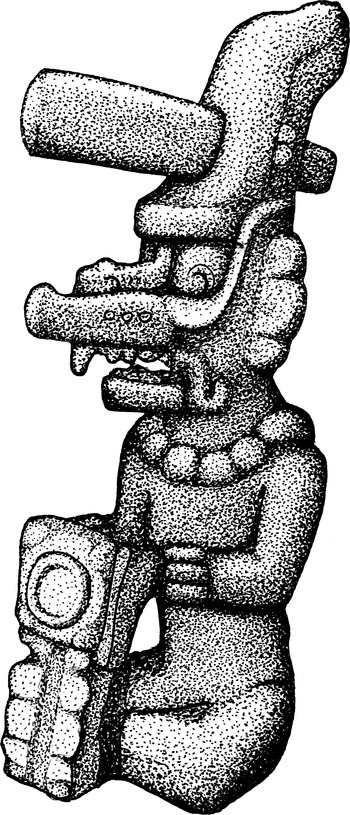
The “sustenance” meaning of k'awiil (Stuart Reference Stuart1987) has been interpreted as the powerful sacrificial offerings (e.g., royal blood) of Classic kings and their covenant with the gods. A bloodletter from Tikal Burial 116, believed to be that of the Late Classic ruler Jasaw Chan K'awiil, had an image of God K/K'awiil incised on it (Trik Reference Trik1963:Figure 8). In this sense and given material form, k'awiil is a “host object”—a statue or effigy into which a king or priest summoned a supernatural, perhaps an ancestor. This recalls the four wooden k'awiils holding mirrors interred within Late Classic Burial 195 at Tikal (Figure 4); these were probably originally mounted on staffs (Freidel et al. Reference Freidel, Schele and Parker1993:197, 199), as in Grube's (1992) “basket staff dance.”
One of four wooden effigies of God K/K'awiil, of blue-painted stucco, found in the interment of “Animal Skull” (ca. a.d. 600), in Temple 32, North Acropolis, Tikal. The wooden framework had eroded, leaving only the stuccoed casts of the figures. Height: 16 inches (redrawn from Coe Reference Coe1967:57; Taube Reference Taube1992:Figure 36a).

Classic dynasties of numerous cities incorporated “K'awiil” into rulers' regnal names or titles. These include Calakmul, Caracol, Copan, Dos Pilas, Naranjo, Quirigua, and especially Tikal beginning in the Early Classic (see Martin and Grube Reference Martin and Grube2008). Calakmul's rulers appropriated K'awiil as part of their names for much of the eighth century after Tikal's “defeat” of that city in a.d. 695 (Martin and Grube Reference Martin and Grube2008:112). For unknown reasons, dynasties in the western Usumacinta region—Palenque, Yaxchilan, Piedras Negras, Tonina—did not use the K'awiil epithet. Nonetheless, Palenque is strongly linked to God K/K'awiil via the Cross Group, with its sculptural panels featuring GII (Robertson Reference Robertson, Greene Robertson and Call Jeffers1979), its incensario stand imagery (de la Garza Camino and Cuevas García Reference de la Garza Camino and García2005), and its priests' advanced astrocalendrical computations (the 819-day count) and esoteric language, Zuyua K'awiil (Aldana Reference Aldana2007).
Postclassic: K'awiil, God K, K'atuns, and Texts
In the Terminal Classic and Early Postclassic periods in Yucatan, God K appears on Fine Orange pottery of the Sotuta complex and on various sculptures at sites in the Puuc area (Milbrath Reference Milbrath1999:230, Reference Milbrath and Stone2002:119; Taube Reference Taube1992:69). God K as manikin scepter was less prominent in the Postclassic period, as compared to the Classic. Four “Middle” Postclassic manikin scepters of wood have been recovered from Chichen Itza's cenote, however (Coggins Reference Coggins1988). In the Postclassic, God K is frequently represented by his head (often appearing in a headdress) and lacking the serpent foot. For example, he appears in the headdress of a diving figure on Stela 5 at Flores (Taube Reference Taube1992:69, 73), possibly dated to 11.8.10.0.0, (a.d. 1392) (Barrios Reference Barrios2009). He also appears—sometimes with wings—on various sculptures and Postclassic buildings, such as the murals in Tulum Structures 5 (Figure 5) and 16, which are concerned with lineage, succession, and political authority (Masson Reference Masson2000:235–237; Taube Reference Taube1992:69–73).
A winged God K terminating the east side of a celestial band, Late Postclassic Mural 1, interior east wall, Structure 5, Tulum, Quintana Roo, Mexico. Image is in black, blue, and white on a blue background (detail redrawn from a painting by Felipe Dávalos [in Miller Reference Miller1982:Plate 28]).

Taube (Reference Taube1992:73, 78) suggests that God K and God B/Chaak may substitute for each other or be composites, and gives numerous examples. The Chaaks often wear a God K headdress, wield a God K smoking ax, and sometimes have a serpent foot; in Postclassic representations God K often has the looped under-eye embellishment of God B/Chaak. Given these close relations, one wonders if the “Chaak” masks with their curving noses and eye embellishments, so ubiquitous in Puuc architecture, might actually be God K or composite God K/Chaak masks. God B/Chaak is usually depicted with a downturned nose, whereas the Puuc masks have the upturned nose typical of God K.
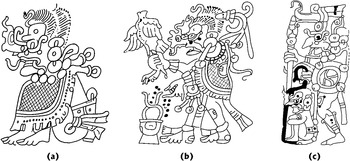
God K appears only once in the Madrid Codex (Page 31b) (Villacorta C. and Villacorta Reference Villacorta, Antonio and Villacorta1976) and only eight times in the Dresden Codex (Villacorta and Villacorta Reference Villacorta and Villacorta C1992) (Figures 6a and 6b). However, if God K can substitute for God B/Chaak, there may be more occurrences. On Page 12 of the Dresden, God K presents a bowl with cacao beans; in the Venus tables he appears, painted blue, in the lower register of Page 46 having been speared as a sacrificial victim of the heliacal rising of Venus (Morning Star); on Pages 34b and 65b GodB/Chaak wears the headdress of God K. On Page 65 God B carries a God K head in his hand; and on Page 67 he carries an image of God K in a bag tied to his arm (Figure 6c).
Images of God K in the Dresden Codex. (a) Seated in front of a structure, middle register of Page 25, the first of the New Year celebration pages. (b) “Scattering” and holding an offering of a bird; lower register of New Year Page 26. (c) At the turn of the year, God B/Chaak holds a God K head in a bag, along with a spear and shield (took'-pakal); upper register of Page 67 (adapted from Villacorta and Villacorta Reference Villacorta and Villacorta C1992).

These last depictions are analogous to God K's central role in the Paris Codex and in k'atun ceremonies—and also Classic imagery (“taking the k'awiil,” the manikin scepter)—in which the transfer of a God K head to a new ruler signals “a change in political or religious authority” (Milbrath Reference Milbrath1999:230). The k'atun pages of the Paris Codex, which was apparently painted in Late Postclassic Mayapan as a copy of a Late/Terminal Classic period manuscript (Vail Reference Vail2006:504), show the lord of the k'atun seated on a skyband throne and receiving the God K effigy head symbolic of accession to office (Love Reference Love1994:18–20; also Vail Reference Vail, Cecil and Pugh2009:96–98). Significantly, these scenes are accompanied by a text including the glyph sign tz'ak (T573/YS6, ZX6) (Macri and Looper Reference Macri and Looper2003), indicating royal succession or sequential change—that is, the rotational seating of a new k'atun. The final glyph in these phrases is a glyph (T1064/PCL) (Figure 3b) consisting of a human head with a dotted ak'ab (T166/1G5) infix and smoke emanating from the face. This might represent the glyph for the God K head (Love Reference Love1994:20, citing personal communication from Karl Taube; Macri and Vail Reference Macri and Vail2009:100). The ak'ab infix occurs commonly in animal heads in the codices (Macri and Vail Reference Macri and Vail2009:56–61), but in Classic art it also marks obsidian mirrors (Schele and Miller Reference Schele, Miller, Schele and Miller1983:15–16). Its presence typically suggests dark colors, animals that are active at night, or a “westerly, nocturnal aspect” (see Stone and Zender Reference Stone and Zender2011:145). In the case of God K, it might indicate him in the role of the night sun in the Underworld; alternatively, the dotted ak'ab might represent itz/its (Macri and Vail Reference Macri and Vail2009:207).
Milbrath (Reference Milbrath and Stone2002:141) concludes that God K is essentially a personification or “embodiment of the k'atun,” particularly in the Postclassic and post-Conquest periods. In that role, God K/K'awiil maintained ancient continuity with Classic symbolism of dynastic legitimization in rulers' official duties as mediators within the cosmos. This role also supports the possibility that, during the Late Classic period in the southern lowlands, rulers who carried the manikin scepter or deployed other God K/K'awiil symbolism in their regalia or titles were lords of rotating k'atun (or may) seats. This is especially salient given the appearance of toponyms in association with some of the textual or visual attestations of dances (e.g., the lords on the “Holmul-style” vase). Thus God K and perhaps the K'awiil epithet itself might have represented continuities with, and participation in, this calendrically-based geopolitical system.
Merideth Paxton (Reference Paxton2001:84–85) proposes an association of God K with turtle imagery (he wears a turtle carapace as a pectoral on Dresden Codex Page 46) and with the Maya turtle constellation, roughly the Western Gemini/Orion. A carving at Uxmal shows two God K figures and the Maize God emerging from a turtle carapace (Kowalski and Dunning Reference Kowalski, Dunning and Karl Kowalski1999:282). Turtle carapaces were used as drums, perhaps signifying thunder, and thus an association with the storm God K (Miller and Taube Reference Miller and Taube1993:175). A Late Postclassic cognitive association between turtle carapaces and k'atuns is seen at Mayapan, where a stone turtle was carved with 13 Ajaw faces on the edge of its carapace (Taube Reference Taube1988). Similarly, nine turtle-like figures were drawn in the Dzibichen cave, each with its carapace shown as an ajaw (‘lord;’ day name] glyph (Stone Reference Stone, Cecil and Pugh2009:120, Figure 6.4). In general, turtles are more commonly associated with Pawahtun, the aged God N (Miller and Taube Reference Miller and Taube1993:148).
With Spanish conquest and the imposition of Christianity, God K/K'awiil underwent further transformations. In the Chilam B'alam of Chumayel, Chac-xib-chac, the Red Rain god and/or ruler of Chichen Itza, was “despoiled of his insignia.” Ralph Roys (Reference Roys1967:67) proposed that this “insignia” (translated from the odd word cangel) might have been a ceremonial staff analogous to the Classic God K scepters and staffs (see also Coggins Reference Coggins1988:133; Newsome Reference Newsome2001:238–239n5). Both Roys and Munro Edmonson (Reference Edmonson1986:5) suggest a connection with Catholic statues of angels, which recalls Classic k'awiil effigy statues. Intriguingly, a God K manikin scepter was held by the Xiw patriarch in the 1557 drawing of the Xiw family tree (Cortez Reference Cortez and Stone2002:202; Miller and Taube Reference Miller and Taube1993:110).
God K was known as Bolon Dz'akab (or ts'akab) among the post-conquest Maya of Yucatan (Seler Reference Seler1990:97). This appellative has been translated as “he of the nine generations” (Taube Reference Taube1992:73), or more loosely as “many sequential lords” (Stuart Reference Stuart2011:2). Ts'akab in Yukateco means “generations” or lineages, but also cosa sin fin ‘thing without end’ (Barrera Vásquez Reference Barrera Vásquez1980:871). It will be remembered that ts'ak/ts'aak is a verb referring to change, but also to “be whole, complete” or fulfilled (Stuart Reference Stuart2011:3–4) as well as, adjectivally, to something stacked or laid end to end (YS6) (Macri and Looper Reference Macri and Looper2003:211). The reference to “nine” (bolon), if taken literally, is suggestive in many ways, particularly to the nine lords of the stacked or layered levels of the Underworld. Similarly, bolon tas wah refers to nine layered breads that appear in modern Yucatan agricultural ceremonies (Love Reference Love1994:xiii).
Numerous other supernaturals have nine or bolon in their nominals, a particularly interesting one being Bolon Yokte'. Described as “obscure” and known in the codices and the Chilam B'alams as a patron of K'atun 11 Ajaw (Roys Reference Roys1967:133n4; Thompson Reference Thompson1960:56), Bolon Yokte' recently has been shown to have Classic-period associations with war/conflict and transition, particularly on k'atun endings and the end of the thirteenth b'ak'tun in 2012, as on Tortuguero Monument 6 (Eberl and Prager Reference Eberl, Prager, Eeckhout and LeFort2005:31; Gronemeyer and MacLeod Reference Gronemeyer and MacLeod2010:24; see also Houston Reference Houston2008). “Yokte'” is difficult to translate. Te' is a numerical classifier, but yok may have many meanings in Yukatekan: as a noun, “knife, pointed tip”; as a verb, “to pierce or perforate” (Barrera Vásquez Reference Barrera Vásquez1980:979). Dresden Codex Page 60a shows Bolon Yokte' carrying an atlatl and darts aimed at an unarmed God N, the aged Pawahtun, with a took'-pakal collocation in the text above (Gronemeyer and MacLeod Reference Gronemeyer and MacLeod2010:32).
Although the evidence is slim, these associations raise the possibility that Bolon Yokte' might be a Classic-period antecedent and later manifestation of Bolon Dz'akab, both of them Postclassic manifestations of God K. The “nine generations” might not be literal, biological, human generations but rather a metaphor for the “layered” calendrical cycles of k'atuns (the nine turtle-ajaws in Dzibichen?), the may, the b'ak'tun, or even the seemingly “endless” Great Cycle itself—all flowing in their “wholeness” from end to end—and for the sequential lords of these periods, who ritually complete them.
KENNINGS: TOOK'-PAKAL ‘FLINT AND SHIELD’
The kenning u took' u-pakal ‘his flint, his shield’ (Houston Reference Houston and Houston1983) (Figure 3c) is commonly interpreted as a metaphor for or insignia of war. The flint-and-shield reference has been linked to Teotihuacan influence in the Maya lowlands via the atlatl-shield collocation, which is typically interpreted as a central Mexican emblem of war (e.g., the lechuza y armas) (Stuart Reference Stuart, Carrasco, Jones and Sessions2000; von Winning Reference von Winning1948). In the Maya area, the flint-shield/took'-pakal metaphor occurs in two formats: a physical object or its image and a verbal couplet.
Flint/Shield Objects: God K
The flint or took' incorporates reference to chipped stone knives or spear points of chert and obsidian, as well as the unusual forms known as “eccentrics” (Stone and Zender Reference Stone and Zender2011:83). Eccentric flints and obsidians are commonly recovered archaeologically in dedicatory caches in buildings and under stelae, but rarely in tombs. Many eccentrics are chipped to create profiles of God K/K'awiil, the serpent-footed god (Miller and Martin Reference Miller and Martin2004:Plates 78–82; Schele and Miller Reference Schele and Miller1986:Plates 25, 26, 114) (see Figure 7a). Twelve such objects, eccentrics depicting K'awiil, were found in the Early Classic Rosalila structure at Copan (Sharer and Traxler Reference Sharer and Traxler2006:45, Figure 13.7). The association between flint/obsidian and God K is paralleled in Tezcatlipoca, whose avatar, Itztli, is translated as “obsidian” (Olivier Reference Olivier2003). These entangled meanings might relate to a belief that flint (took') and obsidian (toh) were produced by lightning strikes (Schele and Miller Reference Schele and Miller1986:73). Took' and toh might have been conflated or punned as near-homophones along with toh/tah ‘torch’ (Schele and Miller Reference Schele and Miller1986:49; Taube Reference Taube1992:75–76; Tedlock Reference Tedlock1996:224n65) or tok ‘spark,’ and thus came to have an association with lightning God K and the torch in his brow, so often profiled in chipped obsidian.
(a). Late Classic Maya eccentric flint/chert depicting God K, a probable heirloom recovered 15 cm below the surface at the southwest corner of Structure 1, Laguna de On, Belize (redrawn with permission from Masson Reference Masson2000:237, cover illustration). (b) Took'-pakal: an eccentric flint atop a flayed face shield, presented to Palenque ruler Ahkal Mo' Nahb III (a.d. 721–736) by his mother. Detail from the carved limestone Tablet of the Slaves, Group 4, Palenque (redrawn from Schele #131; http://research.famsi.org/schele_list.php?_allSearch=131&hold_search=131&x=55&y=23).

At Palenque, the flint-shields on carved tablets (Figure 7b) consist of a small God K-like image, possibly an eccentric flint or obsidian, holding or perched upon a round shield. The stuccoed ancestors in K'inich Janaab' Pakal I's tomb carry God K manikin scepters and circular shields (Robertson Reference Robertson1983). The depictions of God K as a portable object call to mind the representations in the codices of God K images being carried and possibly signaling change in politico-ritual responsibilities. Took'-pakal objects may be heirlooms handed down through dynasties (Freidel et al. Reference Freidel, Schele and Parker1993:473n19). An example comes from rural Laguna de On Island, northern Belize, where an eccentric flint (Figure 7a) of Colha chert was recovered in a Postclassic cache near various burials including a child (Masson Reference Masson1999:54–55, Reference Masson2000:237). Quirigua's rulers frequently display three emblems—the God K scepter/ax, a round shield, and a mosaic “sak-pectoral”—which may be tied to (k'atun-) period-ending ceremonies (Looper Reference Looper2003:103–106, 133, 141).
The shields in these images are also of interest. On those of the Palenque ancestors and the Quirigua kings, the shield often displays the face of the Jaguar God of the Underworld, associated with the night sky and war (and also Tezcatlipoca). In these representations, the God K scepter and the jaguar shield can be seen as emblems of two deities of the so-called Palenque Triad, GII and GIII, respectively. The association between GIII and shields may come from the sign (T594/XD2) b'alb'a ‘shield’ (Milbrath Reference Milbrath1999:102, citing Kelley 1976:6; Macri and Looper Reference Macri and Looper2003:180), connecting GIII and the Underworld (Xib'aalb'a). Other shields depicted on sculpture and painted pottery (and in the Dresden Codex) have human faces (often upside-down) with closed eyes indicating death. Some of these, for example at Palenque, appear to have been made with flayed facial skin (Figure 7b), perhaps removed from a sacrificial victim (Mock 1998:116–117; Stone and Zender Reference Stone and Zender2011:87).
Kennings: Flints, Shields, and Texts
The second way that the took'-pakal metaphor is deployed is as a couplet in texts, and these provide further clues as to how the flint-and-shield refers to k'atun- and may-based geopolitical organization. For example, part of the brief dedicatory text of Lintel 4 on the Temple of the Four Lintels at Chichen Itza refers to an event involving a flint-shield and something called may (Boot Reference Boot2005:338–341; Voss and Kremer Reference Voss, Kremer, Colas, Delvendahl, Kuhnert and Schubart2000:9–11). The ruler K'ak'upakal, bearing the epithet K'awiil, is identified as u-kanan may, glossed as “guardian” (kanan) of the may ‘gift, offering;’ his half-brother, K'inil Ko-?-l, might be a priest (k'in) or warrior priest who presented (u-mayan) the offering and offered it sustenance. Readings of this passage differ, but Voss and Kremer (Reference Voss, Kremer, Colas, Delvendahl, Kuhnert and Schubart2000:11–12) interpret may as the supernatural “essence” or spirit companion of the took'-pakal, to which rituals were held to evoke its powers in battle. These complex associations relate took'- pakal and may to interpretations of k'awiil as a statue-like “host object” for a supernatural or ancestor.
Another example comes from the “southeastern periphery” of the Maya lowlands, where I proposed that Quirigua, Guatemala, was a k'atun seat in a larger (may) realm centered at Copan, Honduras (Rice Reference Rice2004:168–182). In a.d. 724, Copan's ruler Waxaklahun Ub'ah K'awiil performed a key duty as the head of a may realm; he supervised the accession of K'ak' Tiliw Chan Yopaat to rule at the k'atun seat of Quirigua (Martin and Grube Reference Martin and Grube2008:216). Then in a.d. 738, Quirigua pursued a successful “war” against Copan, including the sacrifice and decapitation of the Copan ruler, ritual acts that I interpret as signaling Quirigua's replacing Copan as a regional may seat. The aftermath of these events was very different at the two sites.
Quirigua enjoyed a period of growth and prosperity, with no textual reference to war (Martin and Grube Reference Martin and Grube2008:205, 219). In a.d. 751, Stela H was dedicated on the k'atun-ending of 9.16.0.0.0, and depicted the ruler cradling a serpent bar with tiny God K figures emerging from the ends. These figures have smoking torches in their mirrored foreheads and carry spears and round shields—the took'–pakal. This imagery signifies the importance of this date to Quirigua and K'ak' Tiliw; it is the first k'atun-ending since the city assumed its sacred role as may seat. Stela H closely resembles earlier Monument 26 and was erected precisely one may cycle after the k'atun ending commemorated by that monument on 9.3.0.0.0. (a.d. 495).
At Copan, by contrast, the “defeat” and beheading of its king was followed by the dedication, in a.d. 756, of the Hieroglyphic Stairway of Temple 26. The stairway's long text refers to the death of Copan's king as jub'uy took'- pakal: “bringing down” (jub' ‘demolish, tear down;’ also ‘riot, rebellion’) the flint-and-shield of Copan (Sharer and Traxler Reference Sharer and Traxler2006:482). Similar “bringing down the flint-and-shield” expressions appear on hieroglyphic stairways of at least four other sites: Dos Pilas Hieroglyphic Stairways 2 and 4; at Naranjo, following its defeat by Calakmul; on Yaxchilan Stairway 3, a possibly retrospective reference to 9.16.0.0.0; and Tamarindito Stairway 2 after defeat in a.d. 761.
Significantly, this Classic-period kenning “bring down the flint-and-shield” as a metaphor for defeat in war can be found in at least two of the Chilam B'alam books, where it specifically refers to conflict over the seating of k'atuns. Recall here that k'atun means not only an interval of approximately twenty solar years but also war(rior). In the Postclassic period, the competition to seat k'atuns was fierce because of the economic benefits (e.g., tax collection) and calendrical authority entailed, including the selection of future k'atun seats. This gave rise to the so-called k'atun wars (u k'atun k'atunob'): “katuns not only chronicled the wars of Yucatan but actually caused them” (Edmonson Reference Edmonson1986:99, see also1982:xvi–xvii). As I have argued elsewhere (Rice Reference Rice, Sabloff and Fash2007b:171–174), it is not unlikely that some of the “endemic” warfare in the southern lowlands in the Late Classic period had similar politico-calendrical motivations as the k'atun wars of the Postclassic and post-Conquest periods. K'atun- and may-cycling transfers and celebrations were likely accompanied by myriad other activities—feasts, processions, dances, performances—that left little to no material record.
In the Chilam B'alams, one particular k'atun conflict in Yucatan is referred to metaphorically in both the Chumayel and the Tizimin. This is the seating of a K'atun 8 Ajaw, thought to be in a.d. 1441–1461, when Izamal was successful against Champoton (Campeche, Mexico) in its bid to seat the k'atun a second time. This conflict is described in both texts as “descended are/will be the shields; descended are/will be the arrows” (emom chimal, emam halal) (Edmonson Reference Edmonson1982:22, Reference Edmonson1986:65). In the Tizimin this phrase (referring to Champoton's defeat) is followed by the statement that the victors “are planting their carvings in the walls” at Champoton to “end the desire” of its Xiw ruler K'ak' Mo' to seat the next k'atun cycle (Edmonson Reference Edmonson1982:22). This “carving on the walls” is, I propose, analogous to the carving of hieroglyphic stairways or lintels (in the Usumacinta region) at Late Classic sites following the cities' defeat in these conflicts. The verb “plant” here is pak'al, perhaps a homophonic pun on pakal ‘shield,’ and calls to mind the “planting” (tzap) or erection of Classic period stelae.
The Tizimin also reports that in a K'atun 4 Ajaw, “Heaven Born Merida was the seat of the katun, the rule, the shield of the katuns” (Edmonson Reference Edmonson1982:67). This suggests that “shield” (maax) is a metonym not only for k'atuns and k'atun wars, but also for the may and/or its seat. The “shield of the may” thus symbolizes a protective barrier—a “war protector” (Le Fort Reference Le Fort1998)—security, shelter, or guardian: the protection of the gods and the cosmos conferred upon the sacred city. In this instance, the “descending of the shield” would refer to the end of a k'atun cycle and associated termination activities. I suspect, given the Chichen Itza Four Lintels text, that the took'- pakal was both a term for the may and a symbol of it, and that the Chichen rulers were not just its earthly protectors; the took'-pakal/may also shielded and protected them.
God K, Huracan, and Tohil
The imagery of, and textual references to, the took'-pakal have later parallels in the Maya highlands: the highland K'iche' Maya origin myth Popol Vuh, and the still-performed drama, Rabinal Achi.
The Popol Vuh begins with a rather confusing set of couplets that identify the creator gods and/or their attributes. One of these is translated as “defender, protector” (Tedlock Reference Tedlock1996:63) and “protector and shelterer” (Christensen 2003:63), similar to the metaphor of the sacred may as a protective shield. The original K'iche' words do not denote militaristic defense, however. The supreme deity among these is Heart of Sky, also called Huracan—from jun raqan ‘one leg’—who is accompanied by (or also called) Newborn/Youngest Thunderbolt and Sudden Thunderbolt. These names clearly establish this/these god(s)' associations with rain and thunderstorms. The one-legged Heart of Sky/Huracan (“hurricane”) is the deity of power, life, and creation: it is he who “first conceives the idea of what is to be formed” and then other supernaturals “carry out his will by giving it material expression” (Christenson Reference Christenson2003:69, Note 56). Moreover, Huracan is “the only deity to appear in every phase of the creation, as well as throughout the mythological and historical portions of the text” (Christenson Reference Christenson2003:69, Note 56). Dennis Tedlock (Reference Tedlock1996:223–224, Note 65) notes that Huracan becomes Tohil, the one-legged tutelary deity of the K'iche'. This name may be related to toh or tah. Tohil's “counterpart” among the Classic lowland Maya was God K/GII/K'awiil/manikin scepter (and, by extension, central Mexican Tezcatlipoca).
Similarly, three characters in the Rabinal Achi play carry an upraised scepter/ax in the right hand and a small round shield in the left, analogous to both the manikin scepter and the “flint and shield” objects of Classic lords and warriors (Tedlock Reference Tedlock2003:23, 130–135). Symbols of lordly power, these objects are repeatedly mentioned in the play's dialogue in kennings: “the power of my weapon, the power of my shield” (Tedlock Reference Tedlock2003:41).
I have argued elsewhere that the Maya Popol Vuh origin myth is extremely ancient in Mesoamerica, and elements of its narrative appear to predate the late Archaic separation of major language families and calendars (Rice Reference Rice2007a). Over time, certain of these elements were selected as important in some areas, while other elements were deselected and disappeared. If the myth's extreme antiquity is real, then it is not difficult to envision the continuity of a one-legged ophidian supernatural associated with rain, lightning, life, and creation, which becomes a perduring insignia of kingship and dynastic legitimacy among the Maya. As the tale has come down to us in written form in the sixteenth century, it is clear that the key to the continuity of the present creation of the cosmos was the creation of humans who could “speak, pray to us, [and] keep our days” (Tedlock Reference Tedlock1996:67).
CONCLUDING COMMENTS
In Late Postclassic and Colonial times, the geopolitical organization of the northern lowland Maya was structured by little-known and rarely directly referenced calendrical cycling. I (Rice Reference Rice2004) have proposed that this system also structured Classic period geopolitical organization in the southern lowlands as evidenced by hierarchical settlement patterns, a hierarchy of political titles, patterns of dated monuments celebrating k'atun endings, and warfare, among other practices (Rice Reference Rice, Sabloff and Fash2007b), structuring beliefs about time and power (Rice Reference Rice2008), polychrome ceramic production (Rice Reference Rice2009a), and political economy (Rice Reference Rice2009b).
It is true that may-based rotational geopolitical organization is not explicitly mentioned in the political rhetoric of known Classic hieroglyphic texts. I suggest that, given other supportive evidence plus the tendency for Maya discourse to rely on allusion, polysemy, and imagery, we simply might not know what to look for. Consideration of Colonial, Postclassic, and Classic period texts and images leads me to suggest that the interwoven concepts of God K, k'awiil, the manikin scepter, and the flint-and-shield kenning provide evidence for geopolitical continuity and resilience—even through the demise of the institution of k'ul ajaw—by means of overarching organizational principles. Kennings are common in the Chilam B'alam books, with 52 listed in the index to the Tizimin (Edmonson Reference Edmonson1982:212–213). Thirty-two reference the well-known “mat and throne” (pop, tz'am) and the “shield and arrow” or “flint and shield” difracismo occurs at least four times. Perhaps other kennings might be found to relate to thus far unexplored sociopolitical behavior and organization traceable back to the Classic period. For example, in ritual speech modern Tzotzil use the phrase ch'ul toj ch'ul nen ‘holy flint, holy mirror’ to refer to scribes (Schele and Miller Reference Schele, Miller, Schele and Miller1983:9–10, quoting Robert Laughlin), an expression that relates to many elements of the God K/k'awiil thematic cluster discussed here.
Among the lowland Maya, God K and k'awiil were central entities in a larger complex of celestial supernaturals or deities. God K/K'awiil was expanded to include, or was conflated with, the responsibilities of cities and their royal dynasties to nurture, protect, and shelter their populace. Manikin scepters, obsidian (and flint) eccentrics, and shields were material representations of this complex, and were widely deployed in public displays associated with Classic divine kingship—for example, in dynastic paraphernalia, dance performances, hieroglyphic stairway texts, and k'atun celebrations. During the Late Classic period in central Peten, rulers who carried the manikin scepter or displayed other God K or k'awiil symbolism in their regalia or titles were, I propose, lords of k'atun seats or may seats. Possibly the K'awiil epithet itself signified participation in this system.
God K in its many manifestations can be construed as a symbol of the resilience of rotating, calendrically-based geopolitical organization. Over time, as the institution of lowland rulership changed, related objects and concepts were also transformed, becoming metonyms in the oblique discourse surrounding the actual operations of this geopolitical structuring. Such tropes enabled the calendar priests and the b'alams to obscure the mystical workings of the covenant between humans and the supernatural beings and forces that assured the eternity of the cosmos and earthly fecundity.
Within the concept of “thematic clusters” of deities, the key elements of the God K/K'awiil cluster include celestial/sky phenomena (lightning, storms, Jupiter), calendrical cycling (especially k'atuns)—what Aldana has labeled “K'awiilian astronomy”—and royal blood and legitimacy. These are variously materialized in the form of manikin scepters, smoking mirrors, obsidian objects, and the took'-pakal, and the agency of these objects (sensu Latour Reference Latour2005) is evident in representations of accession ritual and rulers' dances. Like the other three deity clusters discussed by Vail (Reference Vail2000), the God K/K'awiil theme overlaps with them in relating to sustenance (blood, food/maize, rain), but most specifically to continuities in sacred time. Maya God K/K'awiil, then, constituted the core of a thematic cluster of cosmic forces, symbols, and metaphors harnessed for the legitimization of dynastic power within a geopolitical ideology of protecting, defending, and nurturing the earthly world. If these propositions have any validity, “sustenance,” as a translation of k'awiil, should not be limited to food (alimento) but instead broadened to the senses of the verb “sustain:” to uphold, bear, endure, maintain, and thereby provide physical and conceptual support and power. This ideology had roots in the Mesoamerican Middle Formative period and persisted into post-Conquest times, as long as proper sacrifices were offered to the gods.
In the late twentieth-century United States, a “smoke and mirrors” kenning was evoked as a derogatory idiom for political deception and “spin.” Among the Maya, “smoke and mirrors” was sacred practice.
RESUMEN
Los textos jeroglíficos del período clásico no proveen detalles sobre la organización política de los mayas, ni tampoco lo hacen los documentos del período colonial, resultando en la necesidad de buscarlos en otros lugares. Propongo que existen continuidades en la retórica de la organización geopolítica basada en el calendario, encontradas en las imágenes y las figuras literarias desde tiempos preclásicos hasta la conquista y colonia. La imaginería se manifiesta en el Dios K, el k'awiil, y el cetro maniquí (manikin scepter). El cetro clásico es una materialización del Dios K/k'awiil como símbolo del señorío legítimo, sobre todo para la ascensión de un rey. En el posclásico se ve una cosa similar en los Códices Dresde y Paris: la entrega de una cabeza efigie del Dios K, quien es también un símbolo de un k'atun. Las figuras literarias relacionadas son los difracismos, específicamente el took'-pakal o “pedernal y escudo,” que aparecen en los textos clásicos y también en los libros del Chilam B'alam en el contexto de la derrota en la guerra. El último refiere sobre todo a la guerra de los k'atunes. Otros conceptos, incluyendo la obsidiana, los espejos, las serpientes y los dioses con una sola pierna en el mito Popol Vuh y en México (el dios Tezcatlipoca), están relacionados y son discutidos para ampliar las continuidades propuestas en la organización geopolítica.
ACKNOWLEDGMENTS
I am grateful to Andy Hofling, Susan Milbrath, Clemency Coggins, and David Freidel for reading earlier drafts of this manuscript and offering many helpful suggestions and corrections, and as always to Don Rice for carefully preparing the illustrations. The final manuscript was much improved by the comments of Guilhem Olivier, Carolyn Tate, and an anonymous reviewer, and I thank them for their thoughtful readings.
Neither journal space nor my own scholarly limitations (I am neither an epigrapher nor an art historian) permit an exhaustive analysis—including historiographic development and spatio-temporal variations—of the extensive literature on God K, GII, k'awiil, Tezcatlipoca, manikin scepters, and other deities and images referred to here. Rather, I employ selected examples of existing interpretations of such figures that are relevant to, or suggestive within, my argument. (Critics dub this “cherry-picking.”) I acknowledge that God K and k'awiil are enormously complex entities that are embedded in, or refer to, many other aspects of Mesoamerican life besides the ones I discuss here. To the extent that published instantiations substantially contradict my proposal about a k'atun-related God K/K'awiil complex, I accept full responsibility for the incompleteness of my exposition.