Introduction
This article seeks to understand how working part-time rather than full-time influences the duration of low-paid employment and the probability of progressing onto higher wages for UK employees. Using panel data from the British Household Panel Survey (2001–2008) and Understanding Society (2010–2017) (Knies, Reference Knies2017), a discrete-time event history approach is used to estimate the probability of progressing onto higher wages relative to remaining on a low wage, defined as earning below two-thirds of the median hourly wage. The results show that all things being equal, part-time workers are less likely than full-time workers to progress out of low pay. However, part-time workers who transition to full-time employment experience similar rates of progression to full-time workers. This suggests that lower rates of progression for part-time workers stem from differential opportunities or treatment in the labour market rather than selection into part-time work. The results show a similar pattern for male and female employees, although women remain more likely than men to work part-time and tend to do so for longer periods of time, particularly if they have children. The discussion reflects on how labour market regulation might be used to improve the quality of part-time jobs. The results also raise broader questions around the extent to which the policy context in the UK encourages part-time work and for whom, including the effect of Universal Credit (UC). The in-work conditionality element of UC is designed to encourage low-paid part-time workers to increase their working hours but the effect is likely to be uneven across the population and dependent on labour market conditions.
Part-time employment and progression out of low pay
Given the increasing dearth of middle-tier jobs associated with labour market polarisation in the UK (Goos and Manning, Reference Goos and Manning2007), it may not be the case that low-paid jobs function as a stepping stone to higher-paid employment. Experienced over the long term, low pay has serious consequences for lifetime earnings (Brewer et al., Reference Brewer, Dias and Shaw2012), pension entitlements (Sefton et al., Reference Sefton, Evandrou and Falkingham2011) and vulnerability to financial shocks. A long spell of low-paid employment has greater consequences for household income than a short spell (D’Arcy and Hurrell, Reference D’Arcy and Hurrell2014). It is therefore important to understand whether low pay is enduring or transitory, and for whom. Groups in the UK labour market identified as at risk of longer spells of low-paid employment include women relative to men (Sloane and Theodossiou, Reference Sloane and Theodossiou1996; Stewart and Swaffield, Reference Stewart and Swaffield1999), low-skilled workers (Cappellari and Jenkins, Reference Cappellari and Jenkins2008; D’Arcy and Hurrell, Reference D’Arcy and Hurrell2014; D’Arcy and Finch, Reference D’Arcy and Finch2017; Phimister and Theodossiou, Reference Phimister and Theodossiou2009; Stewart and Swaffield, Reference Stewart and Swaffield1999) and those with a disability (D’Arcy and Hurrell, Reference D’Arcy and Hurrell2014; D’Arcy and Finch, Reference D’Arcy and Finch2017). Low-paid workers in certain industries such as sales and hospitality and in the private sector more generally are known to face barriers to pay progression (D’Arcy and Hurrell, Reference D’Arcy and Hurrell2014; D’Arcy and Finch, Reference D’Arcy and Finch2017). Across all industries, workers in low-skilled jobs and those based in small establishments (Sloane and Theodossiou, Reference Sloane and Theodossiou1996; Stewart and Swaffield, Reference Stewart and Swaffield1999) are more at risk of experiencing long spells of low pay.
Few previous studies estimate the effect of working part-time relative to full-time on the likelihood of progressing out of low pay. Where it is included as an explanatory factor, working part-time has a negative effect on the probability of progressing out of low pay (D’Arcy and Hurrell, Reference D’Arcy and Hurrell2014; D’Arcy and Finch, Reference D’Arcy and Finch2017; Phimister and Theodossiou, Reference Phimister and Theodossiou2009; Sloane and Theodossiou, Reference Sloane and Theodossiou1996). There are a number of reasons why this might be the case. Part-time workers may be a ‘selected’ group with lower skills and abilities or less motivation to move up the career ladder. Differences in human capital, for instance, are known to contribute to wage differentials between full-time and part-time workers (Nightingale, Reference Nightingale2019; Bardasi and Gornick, Reference Bardasi and Gornick2008; Matteazzi et al., Reference Matteazzi, Pailhé and Solaz2014). Differences in progression out of low pay may also relate to differences in the type of jobs undertaken on a full-time and part-time basis. Part-time jobs are known to be disproportionately clustered in low-paying sectors and occupations in the UK labour market (Nightingale, Reference Nightingale2019; Fagan et al., Reference Fagan, Norman, Smith and Menéndez2013; Matteazzi et al., Reference Matteazzi, Pailhé and Solaz2014; Manning and Petrongolo, Reference Manning and Petrongolo2008). It may be that the type of jobs that are available on a part-time basis are disproportionately low paid and offer few opportunities for progression. It may also be the case that part-time workers are treated differently to full-time workers within the same job – for instance, being less likely to be offered training and advancement opportunities.
The first research question this article seeks to answer is: how does working part-time relative to full-time influence the probability of progressing onto higher wages for low-paid employees in the UK? The article also considers transitions between full-time and part-time employment, something not addressed by previous studies. The second research question is: how does transitioning between full-time and part-time employment affect the probability of progressing onto higher wages for low-paid employees in the UK? If part-time workers continue to face barriers to progression if they transition to full-time employment, this offers some support for the idea that the part-time/full-time difference is linked to the characteristics of the worker. If, in contrast, part-time workers cease to be at a disadvantage if they transition to full-time employment then this suggests that lower rates of progression out of low pay are a product of the nature of jobs available on a part-time basis and/or the way in which part-time workers are treated in the labour market.
Another contribution of this article is to explore potential gender differences in the effect of working part-time relative to full-time on the probability of progressing out of low pay. The third research question is: how does the relationship between part-time employment and progression out of low pay differ for men and women in the UK labour market? When it comes to part-time employment, there are reasons to expect gender differences. As well as being highly feminised, men and women tend to work part-time at different stages of the life cycle and for different reasons (Eurofound, 2006; Fagan et al., Reference Fagan, Norman, Smith and Menéndez2013). Men in the UK do not adjust their working hours in response to parenthood in the same way that women do (Dias et al., Reference Dias, Joyce and Parodi2018). For men, part-time employment more often functions as a means of transitioning into or out of the workforce (Fagan and Walthery, Reference Fagan, Walthery and Hobson2014). Men are more likely than women to be classed as involuntary part-time workers i.e. to work part-time because they cannot find a full-time job (OECD, 2010). Men are frequently overlooked in the literature on part-time employment (although there are some exceptions, see: Nightingale, Reference Nightingale2019; O’Dorchai et al., Reference O’Dorchai, Plasman and Rycx2007; Russo and Hassink, Reference Russo and Hassink2005) and studies rarely allow for gender differences in the implications of working part-time.
Data and descriptive statistics
Data come from Understanding Society (USoc) and its predecessor the British Household Panel Survey (BHPS). Respondents from the BHPS became part of the USoc sample from its second wave (Knies, Reference Knies2017). The two data sets are linked, creating an unbalanced panel of thirteen waves spanning the calendar years 2001Footnote 1 –2017 (henceforth referred to as USoc/BHPS). An unbalanced panel describes a data set where not all longitudinal units (in this case, individuals) are represented at all waves. The uneven representation of individuals across waves reflects both panel attrition and the recruitment of new respondents to the panel. Since those dropping out of the USoc/BHPS sample are not randomly distributed (Lynn et al., Reference Lynn, Burton, Kaminska, Knies and Nandi2012; Uhrig, Reference Uhrig2008), there is a danger of bias from panel attrition. Caution is therefore required in generalizing the results to the UK population. The analysis relates to employees only, and does not consider the situation of self-employed workers. This is due to difficulties estimating hourly earnings for self-employed workers, for whom both earnings and working hours are more variable than for employees. This decision is also based on high levels of non-response for earnings data for self-employed workers in USoc/BHPS (Knies, Reference Knies2017). Reflecting the gendered nature of part-time employment, male and female employees are treated as separate samples.
Data are interval-censored, based on information collected at annual interviews. Earnings data is captured at the time of the interview, and by necessity this is assumed to be representative of the intervening period. The data set is comprised of person-year observations relating to low-paid employees who are ‘at risk’ of experiencing the event (entering higher-paid employment). The dependent variable captures whether low-paid employees continue to be low paid in the following year (time t+1), or whether they progress onto higher wages. This transition is modelled as a function of characteristics, including information about the duration of the current low pay spell. In situations where the individual has more than one job (7.4 per cent of person-year observations for employees), the analysis relates to the main job only.
In order to distinguish low remuneration from low work intensity, this article focuses on hourly pay (also referred to as wages) rather than annual or monthly earnings. Hourly pay is calculated based on information about gross monthly earnings and working hours (including paid overtime). To avoid bias from a temporary change in circumstances, calculations are based on usual earnings and working hours. Overtime payments are included because for some workers these have a substantial impact on take-home pay. Calculations include earnings data imputed by the Institute for Social and Economic Research (Knies, Reference Knies2017), resulting in a low level of missing data. A relative approach to measuring low pay is taken, recognising that earning substantially below the prevailing societal standard is likely to have serious consequences. The definition of low pay is tied to the average wage, with low pay threshold set at two-thirds of the median hourly wage for employees in each wave. This measure of low pay aligns with previous literature, as well as official statistics produced by the European Commission and the OECD.
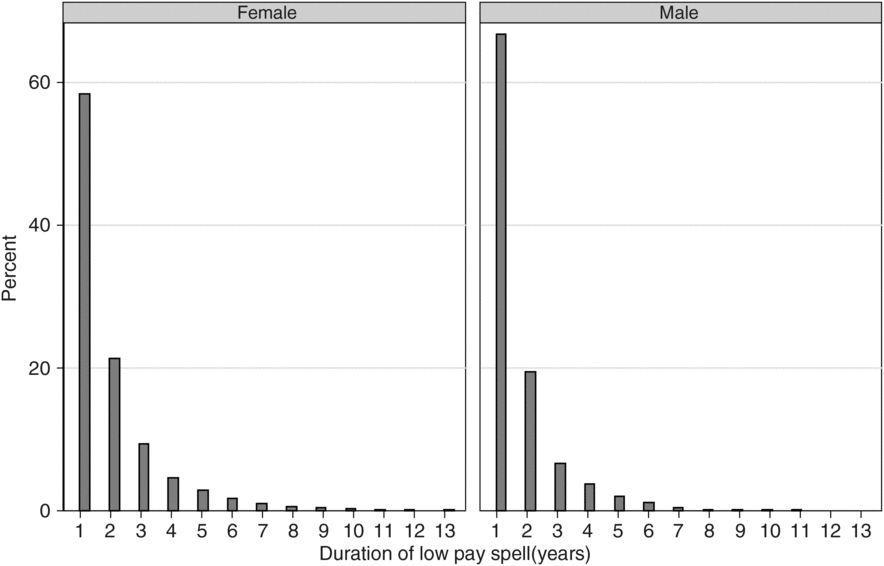
The distribution of low pay spells for male and female employees is shown in Figure 1. In line with previous literature, the majority of low pay spells are found to be short in duration. For women, 57.6 per cent of low pay spells last only one year; for men, the proportion is 67.0 per cent. The mean duration of a low pay spell is 2.0 years for women and 1.6 years for men. Although the majority of low pay spells are short in duration, the longest recorded spell is 14 years for women and 13 years for men.
Distribution of low pay spell durations for male and female employees.

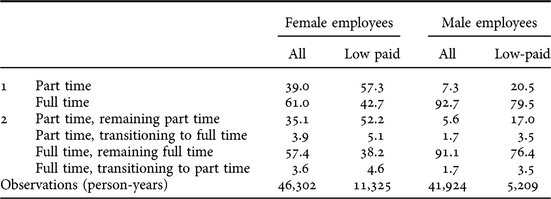
Part-time workers are identified as those who work fewer than 30 hours a week, as recommended by the OECD (van Bastelaer et al., Reference van Bastelaer, Lemaître and Marianna1997). This differs from the approach recommended by Eurostat, which is to rely on the respondent’s own assessment of their employment situation because the number of hours considered to constitute part-time work varies across sectors, occupations and individuals. This approach is not possible using the USoc/BHPS data set, which does not contain information about self-described full-time/part-time status. A second focal explanatory variable distinguishes between full-time and part-time employees whose status remains consistent in the following year, and those who transition to the other category. Table 1 displays descriptive statistics for these two variables. For both men and women, the proportion of person-year observations classed as part-time rather than full-time is considerably higher for low-paid employees than employees in general. A clear majority of full-time and part-time employees remain in the same category in the following year. Full-time/part-time transitions are slightly more common for low-paid employees than employees in general, and for women compared to men.
Distribution of variables across person-year observations for employees (percentages)

Source: USoc/BHPS 2001–2017, sample restricted to employees / low paid employees
Methodology
Low pay spells are modelled using a discrete-time event history approach. Two separate models are specified: Model 1 estimates the effect of working part-time relative to full-time and Model 2 disaggregates full-time and part-time workers into those who remain in their current state and those who transition to the other state. The discrete-time approach treats each time unit in which the individual is ‘at risk’ as a separate observation. The data set is comprised of person-year observations for low-paid employees at time t who may transition to higher-paid employment at time t+1. The analysis takes the form of a binary response model, where the probability of escaping low pay at each observation is modelled as a function of episode duration and covariates (Allison, Reference Allison1982; Jenkins, Reference Jenkins2008). The complementary log-log model is used because it offers the advantage that exponentiated coefficients can be interpreted as hazard ratios (Jenkins, Reference Jenkins2008). The discrete-time hazard rate is the conditional probability that pay progression will occur, given that it has not already occurred. Hazard ratios displayed in the regression tables compare the hazard rate for two groups.
Given the existence of a ‘low pay no pay’ cycle (Stewart and Swaffield, Reference Stewart and Swaffield1999), it is important not to conflate exiting employment (to unemployment, inactivity or self-employment) with pay progression. This is particularly important given the subject matter at hand: previous research shows that part-time workers are more likely than full-time workers to transition out of the labour market (Phimister and Theodossiou, Reference Phimister and Theodossiou2009). As a result, part-time workers experience on average shorter low pay spells than full-time workers, despite being less likely to progress onto higher wages (Phimister and Theodossiou, Reference Phimister and Theodossiou2009). Previous researchers have modelled multiple low pay exits as competing risks using a multinomial logit model (Pavlopoulos and Fouarge, Reference Pavlopoulos and Fouarge2010; Phimister and Theodossiou, Reference Phimister and Theodossiou2009). In cases in which substantive interest lies in a particular event type, as is the case here, it is possible to apply a binary response model, treating other event types as censored (Allison, Reference Allison1982). For the sake of simplicity the latter approach is followed, modelling the probability of pay progression relative to remaining on a low wage.
Event history analysis offers the advantage of being able to incorporate information from right-censored cases – i.e. those where the end of the low pay spell is not observed (Allison, Reference Allison1982). Left-censored cases present more of a challenge, and are omitted from the analysis. Another advantage of the event history approach is the ability to model duration dependence (Longhi and Nandi, Reference Longhi and Nandi2015) – i.e. estimating whether the duration of time spent in a state or condition itself influences the probability of transition. Previous studies highlight duration dependence in low pay, where the probability of pay progression decreases with the length of time of the spell (Cappellari and Jenkins, Reference Cappellari and Jenkins2008; Clark and Kanellopoulos, Reference Clark and Kanellopoulos2013; Stewart, Reference Stewart2007; Stewart and Swaffield, Reference Stewart and Swaffield1999). The effect of duration may not be strictly linear, and to allow for this spell duration is modelled as a piecewise constant baseline.
The regression models control for personal and job characteristics associated with progression out of low payFootnote 5 . Control variables relating to the individual worker are age, education and job tenure. Women are often thought to face challenges to pay progression associated with household circumstances, in particular caring responsibilities, and control variables capture household composition and the number of dependent children. Job and firm level controls include contract type (temporary or permanent), industry of work, employer size, sector (public or private) and the share of part-time workers in the occupation. Occupational position is measured in terms of social class (EseC coding), identifying three broad social class groups. The social class approach developed by Goldthorpe and colleagues (Erikson et al., Reference Erikson, Goldthorpe and Portocarero1979; Goldthorpe, Reference Goldthorpe2007) focuses on occupational skill and skill-specialisation, and the type of employment relations engendered by variation therein. From a social class perspective, low pay is expected to be primarily associated with employment conditions governed by ‘the labour contract’, a basic exchange of money for time, characteristic of occupations in which skill requirements are rudimentary and generic, and output easily monitored. Arrangements of this kind predominate in routine and manual (working class) occupations, and to some extent in intermediate occupations; they are rare in professional and managerial occupations (the ‘salariat’).
When modelling the effect of transitions between full-time and part-time employment (Model 2), additional covariates are included to reflect job and occupational change. Existing evidence suggests that workers who change jobs are more likely to experience pay progression than those who stay in the same job (Connolly and Gregory, Reference Connolly and Gregory2008). This may be because job transitions are associated with switching to a higher-skilled, more lucrative occupation. Even within the same occupation, changing employers may improve prospects for escaping low pay. To adjust for these factors, Model 2 includes control variables identifying workers who change occupations and employers. Occupational change is measured according to the individual’s occupational group (ISCO-88) at time t+1 relative to time t, and disaggregated into upward and downward mobility (reflecting whether the new occupation is higher or lower skilled than the previous occupation). These variables are only available in the later waves of the data set and Model 2 is run on a reduced sample of nine waves.
In addition to controlling for measured covariates, the regression models take account of unobserved heterogeneity (or ‘frailty’). Some low-paid workers will have a higher propensity to progress onto higher wages than others, and the reasons for this variability may not be fully captured by covariates. Taking unobserved heterogeneity into account is particularly important because the data set contains repeated spells (i.e. more than one low pay spell for the same individual), and there is likely to be a correlation between spell durations for the same individual. To adjust for individual-specific, time-invariant unobservable characteristics the model includes a random component, which is assumed to be normally distributed. The presence of unobserved heterogeneity is assessed by performing a likelihood ratio test for the random effect (rho). If the rho term is not statistically significant from zero, there is no evidence that the time-invariant unobserved characteristics of individuals influence the hazard rate.
Results
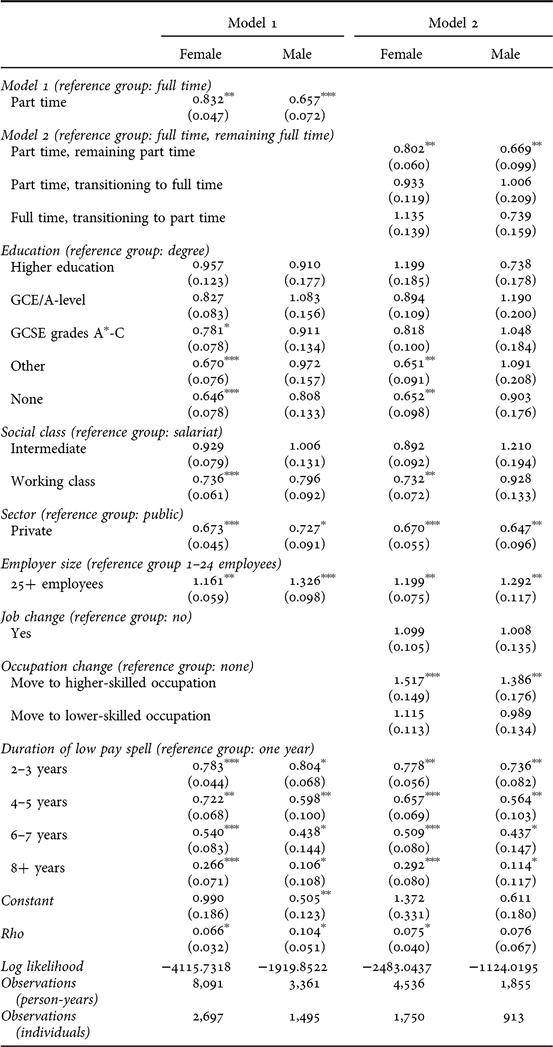
The first research question asks how working part-time rather than full-time influences the probability of progressing onto higher wages for low-paid employees. Hazard ratios shown in Table 2 (Model 1) show that all things being equal, both male and female part-time workers have a lower probability of escaping low pay compared to their full-time counterparts (OR = 0.66, p < 0.001; OR = 0.83, p < 0.01 respectively). For both men and women, the odds of exiting low pay are highest in the first year of the spell, and decline thereafter. The odds of progressing out of low pay are, for instance, much lower in the eighth (or more) year of the spell compared to the first year (OR = 0.10, p < 0.05 for men; OR = 0.27, p < 0.001 for women). This suggests that there is a scarring effect associated with low-paid employment, where spending several years on a low wage decreases the likelihood of progression.
Hazard ratios from two discrete-time proportional hazard models estimating the probability of progressing out of low pay for male and female employees

Note: Hazard ratios (exponentiated coefficients), with standard error in parenthesis; * p <0.05; ** p <0.01; *** p <0.001; Control variables not shown in the table are age, household type, number of children in the household, job tenure, contact type (temporary/permanent) industry of work and the share of part-time workers in the occupation; Due to data availability Model 2 is run on a reduced sample of 9 waves, resulting in a different sample size for the two models.
Source: USoc/BHPS 2001–2017, sample restricted to low-paid employees
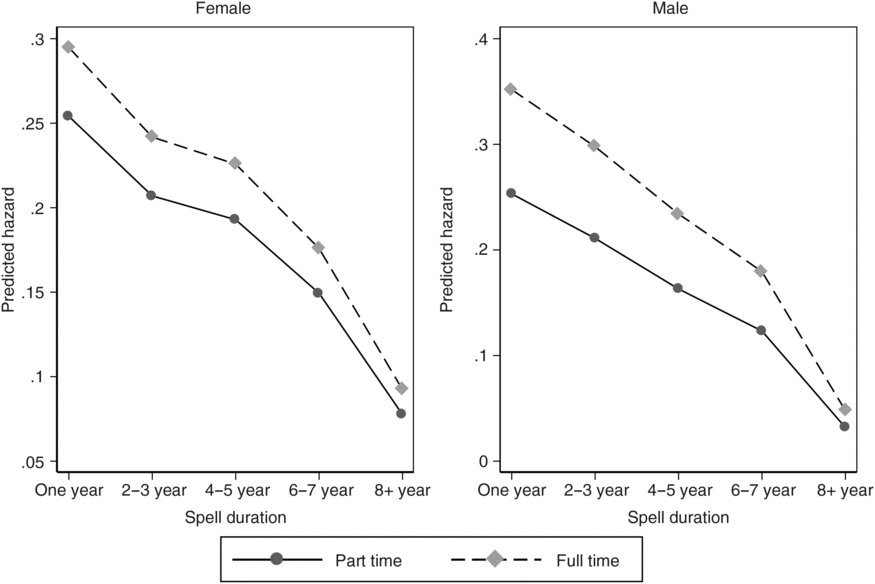
The effect of working part-time relative to full-time appears to vary according to spell duration, as shown in Figure 2. The gap between full-time and part-time workers in the odds of experiencing progression is largest for spells of only one year, and declines with the duration of the low pay spell. This indicates that the main disadvantage associated with working part-time rather than full-time is that it decreases the likelihood of a very short spell of low pay, or a quick exit. For workers who have been low paid for a period of several years, the distinction between full-time and part-time employment is less important. This may be because workers who have been low paid for several years are a distinctive group regardless of whether they work full-time or part-time. This distinctiveness may relate to unobserved worker or job characteristics, or simply the scarring effect associated with several years of low-paid employment.
Predicted hazard of progression out of low pay according to spell duration for male and female employees working full time and part time.

The second research question concerns how transitioning between full-time and part-time employment affects the probability of progressing onto higher wages for low-paid employees. Results from Model 2 show that for both men and women changing employers does not affect the odds of progressing out of low pay, but changing occupations does. Workers who move to a higher skilled occupation are considerably more likely to escape low pay than those who remain in the same occupation (OR = 1.39, p < 0.01 for men; OR = 1.52, p < 0.001 for women). Compared to the reference group (full-time workers who remain working full-time), part-time workers who remain working part-time have lower odds of progressing out of low pay (OR = 0.67, p < 0.01 for men; OR = 0.80, p < 0.01 for women). In contrast, part-time workers who transition to full-time employment have similar odds of escaping to low pay to the reference group (OR = 1.00, p > 0.05 for men; OR = 0.93, p > 0.05 for women). Men transitioning from full-time to part-time employment have lower odds of escaping low pay than full-time workers who remain working full-time (OR = 0.74, p > 0.05), but the effect is non-significant. For women the odds are slightly higher for full-time workers transitioning to part-time employment, but the difference is not statistically significant (OR = 1.13, p > 0.05).
These results cast doubt on the idea that the differential probability of progressing out of low pay for full-time and part-time workers is driven by the skills or attributes of workers. This perspective is most closely associated with Catherine Hakim (Hakim, Reference Hakim1991, Reference Hakim1995, Reference Hakim2002), who has argued that positioning part-time disadvantage as a product of poor quality jobs rather than the characteristics of part-time workers is a “feminist myth” (Hakim, Reference Hakim1995 p. 429). According to Hakim, there are fundamental dispositional differences between women working full-time and part-time (she does not discuss men working part-time), namely that the latter group are less ambitious and career orientated. It is conceivable that differences in work preferences and motivation such as these are why part-time workers are less likely than full-time workers to progress out of low pay. The results do not support this conclusion, however. Not only does the effect of working part-time rather than full-time remain robust to the inclusion of a random effect controlling for time-invariant unobserved heterogeneity, there is evidence to show that part-time workers experience the same odds of escaping low pay to full-time workers if they transition to full-time employment. This adds credence to the idea that working part-time itself makes it more difficult for workers to escape low pay, whether through differential treatment of full-time and part-time workers or through differences in the type of jobs available on a full-time and part-time basis.
The final research question concerns potential gender differences in the relationship between working part-time and progression out of low pay. Comparing the hazard ratio for working part-time relative to full-time for men and women in Model 1, the negative effect is more pronounced for men than for women (OR = 0.66, p < 0.001 for men; OR = 0.83, p < 0.01 for women). If anything, it appears to be men working part-time in a low-paid job who are most disadvantaged in relation to pay progression. Overall, however, there is a high degree of alignment between the results for men and the results for women. Including an interaction term between being female and working part-time on a pooled sample of all employees did not produce a significant result. This suggests that gender differences in the effect of working part-time relative to full-time on the probability of progressing out of low pay are modest.
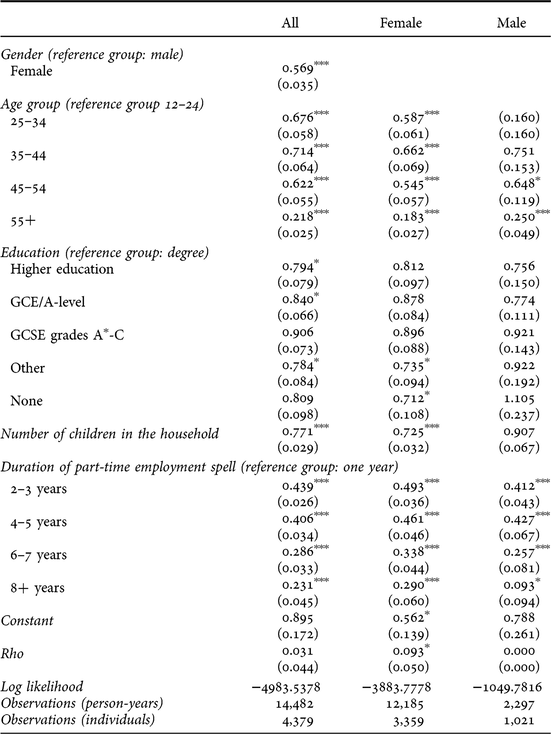
If transitioning from part-time to full-time employment improves prospects for progression out of low pay, the question that arises is how often these transitions are made, and by whom. Supplementary analysis shown in Table 3 examines how personal characteristics affect the duration of part-time employment spells, using the same data set and methodological approach used in the main analysis. The results show that women are significantly less likely than men to transition from part-time to full-time employment (OR = 0.57, p < 0.001). The results also show that this transition is less likely for older workers and for those with a low level of education. The number of children in the households exerts a negative effect on the likelihood of transitioning to full-time employment, but this effect is specific to women (OR = 0.91, p > 0.05 for men; OR = 0.73, p < 0.001 for women). In highlighting a comparable – if anything, larger – effect for working part-time for men compared to women, this study aligns with other recent research highlighting the precarious situation of many men working part-time in the UK labour market (Belfield et al., Reference Belfield, Blundell, Cribb, Hood and Joyce2017; Gardiner and Gregg, Reference Gardiner and Gregg2017; Nightingale, Reference Nightingale2019). It is important to recognise, however, that this issue still disproportionately affects women. It remains the case that far more women than men work part-time, and as the analysis in this article has shown women tend to work part-time for longer periods of time than men. This fundamental difference in behaviour, associated predominantly with parenthood, is a major contributing factor to gender inequality in the labour market (Dias et al., Reference Dias, Joyce and Parodi2018). Results in Table 3 indicate that there is an indirect effect where motherhood decreases the odds of escaping low pay, not in itself, but because it channels women towards longer spells of part-time employment.
Hazard ratios from a discrete-time proportional hazard model estimating the probability of transitioning from part-time to full-time employment

Note: Hazard ratios (exponentiated coefficients), with standard error in parenthesis; * p <0.05; ** p <0.01; *** p <0.001; Control variables not shown in the table are household type, social class, job tenure, industry, sector (public/private), contract type (temporary/permanent), employer size and the share of part-time workers in the occupation.
Source: USoc/BHPS 2001–2017, sample restricted to part-time employees
Policy discussion
Given the well-established issues with low pay and pay progression in the UK labour market, promoting and enabling pay progression is currently high on the political agenda. This is a key factor underpinning the design of Universal Credit (UC)Footnote 7 , in particular the in-work conditionality element. Under UC, claimants whose earnings fall below a certain thresholdFootnote 8 are required to undertake efforts to increase their working hours and/or secure a higher wage, facing a punitive system of sanctions if they fail to do so (Dwyer and Wright, Reference Dwyer and Wright2014). There is a lack of evidence about the effectiveness of in-work conditionality in promoting pay progression (Brewer and Finch, Reference Brewer and Finch2018; House of Commons, 2016b), although results from a Randomised Controlled Trial (RCT) run by DWP are expected later this yearFootnote 9 . Critics have warned that conditionality is most effective in situations in which people lack motivation, whereas barriers faced by people in work to increasing their earnings are likely to be structural in nature (House of Commons, 2016b). In order to function effectively, in-work conditionality requires employers to be willing to offer additional hours and/or opportunities for higher-paid work (European Commission, 2018). This may not be the case, particularly given the recent increase in the number of jobs paid at or around the statutory minimum wage (Brewer and Finch, Reference Brewer and Finch2018; D’Arcy, Reference D’Arcy2018). This increase in the density of wage earners at the bottom end of the distribution has been linked to the growing generosity of the minimum wage for workers aged 25 and over (Brewer and Finch, Reference Brewer and Finch2018), reforms positioned by the government as a new National Living Wage (NLW) (Low Pay Commission, 2017). Although the NLW boosts the earnings of low-paid workers, concerns have been expressed that this policy may stifle further pay progression since a large proportion of workers will be earning at or just above the statutory minimum in a context where employers are adapting to a hike in wage costs (Brewer and Finch, Reference Brewer and Finch2018; D’Arcy and Hurrell, Reference D’Arcy and Hurrell2014).
This article demonstrates that part-time workers are disproportionately left behind when it comes to progression out of low pay. In light of this, it is pertinent to consider how part-time workers in particular are affected by these policy changes and what else might be done to support this group to progress out of low pay. In light of the difficulties low-paid part-time workers face in moving up the earnings distribution, more might be done to enable or encourage this group to increase their working hours. In moving away from a minimum hours threshold as applies under the current tax credits system, UC may incentivise some groups to work fewer rather than more hours per week (Brewer et al., Reference Brewer, Finch and Tomlinson2017; Dwyer and Wright, Reference Dwyer and Wright2014). For second earners in couple households, the rate of benefit withdrawal as earnings rise is higher under UC than the current system (Bennett, Reference Bennett2012), reducing the incentive to maintain or increase working hours. These effects are balanced by the in-work conditionality element, which is designed to encourage low-paid part-time workers to increase their working hours (House of Commons, 2016b). However, conditionality varies according to personal and household circumstances (Dwyer and Wright, Reference Dwyer and Wright2014) and some groups, for instance lone parents with young children (Rafferty and Wiggan, Reference Rafferty and Wiggan2017), may not be required to seek full-time employment. Furthermore, in-work conditionality is premised on the idea that low-paid part-time workers lack motivation to increase their working hours. In situations where part-time workers face structural barriers to increasing their working hours or finding a full-time job, conditionality is unlikely to be effective. The end result may be an increase in the number of workers juggling multiple low-paid part-time jobs, rather than growth in full-time employment.
Another policy domain relevant to working hours is childcare, particularly for women, who remain far more likely than men to reduce their hours in response to parenthood (Dias et al., Reference Dias, Joyce and Parodi2018). Following the National Childcare Strategy (1998), governments from across the political spectrum have sought to expand the provision of free early years education. Free provision has always been limited in relation to factors such as timing (restricted to school term-time), hours per week and the age of the child. As a result, even those eligible for free provision may face barriers to working full-time or increasing their working hours. Using fuzzy set ideal-type analysis, Ciccia and Bleijenbergh assess how closely childcare policies in European countries adhere to different models of care (Ciccia and Bleijenbergh, Reference Ciccia and Bleijenbergh2014). More than any other country, the UK is found to embody the ‘one and a half earner’ model, premised on widespread part-time employment. There is some indication that this is beginning to change, however. In EnglandFootnote 10 , the government has pledged to increase the provision of free education for three- and four-year olds to 30 hours per week for working families from 2017 (Butler and Rutter, Reference Butler and Rutter2016; Cory, Reference Cory2015). Concerns have been raised about the degree to which this 30-hour offer is feasible or affordable under the current system (Cory, Reference Cory2015; Lewis and West, Reference Lewis and West2016; Roberts and Speight, Reference Roberts and Speight2017). There is also a large number of parents, for instance those whose children do not fall into this age range, who are not eligible for free provision. In short, despite this new offer, childcare costs are likely to continue to restrict working hours for parents, particularly women, limiting their capacity to move up the wage distribution.
Aside from policies influencing working hours, there may be scope to improve the position of part-time workers with regards to progression out of low pay by improving the quality and diversity of jobs available on a part-time basis. The right to request flexible working, first introduced in 2003, was designed to open up opportunities for part-time work across a broader range of sectors and occupations (Fagan et al., Reference Fagan, Norman, Smith and Menéndez2013). This right could be expanded, for instance by making it available at the point of recruitment (House of Commons, 2016a), to further encourage growth in part-time employment outside of low-wage sectors and occupations. There have also been calls to place greater restrictions on the circumstances under which employers can refuse flexible working requests (Anderson, Reference Anderson2003). Sector-specific initiatives may also play a role in improving progression opportunities for part-time workers, since escaping low pay is particularly difficult in sectors such as hospitality and retail in which a high proportion of the workforce is part-time (D’Arcy and Hurrell, Reference D’Arcy and Hurrell2014; D’Arcy and Finch, Reference D’Arcy and Finch2017). Organisations such as The Resolution Foundation and the Joseph Rowntree Foundation have called on the government to work with employers in key sectors to develop progression pathways (D’Arcy and Hurrell, Reference D’Arcy and Hurrell2014; Ussher, Reference Ussher2016). The organisation Timewise has recently launched a pilot scheme, Retail Pioneers, aimed at enabling career progression for part-time workers in the retail sector (Timewise, 2017) This initiative is designed to address the fact that part-time jobs in retail are often viewed as ‘dead end’ jobs, working with retailers to develop progression pathways for jobs frequently undertaken on a part-time basis. Although the pilot has not yet been evaluated, initiatives of this kind could go some way in reducing disparities between full-time and part-time workers in progression out of low pay.
Conclusion
The degree to which low paid workers are able to move up the wage distribution is high on the political agenda. Part-time workers are rarely the focus of this discussion, but as this article shows, this group are disproportionately left behind when it comes to progression out of low pay. For some workers, switching to full-time employment appears to be the ‘stepping stone’ that is needed to progress out of low pay. A similar pattern of results is observed for men and women, although women are more likely to work part-time for long periods of time, particularly if they have children. Further research is needed to understand how factors such as the National Living Wage (NLW) and Universal Credit (UC) affect the pay progression landscape in the UK. As the results in this article show, it is important to understand how these developments differentially affect full-time and part-time workers. The in-work conditionality element of UC, for instance, is designed to encourage low-paid part-time workers to increase their working hours and/or earnings, but the effectiveness of this is not yet known, nor is it clear whether the effect will operate in the same direction for all groups of part-time workers.
Acknowledgements
I would like to thank Erzsébet Bukodi and Fran Bennett for their helpful comments on previous drafts of this article.