Introduction
While there is improved access to medical care in developed countries, many adults will require increased support and will need to be placed in residential care facilities (RCFs). These include adults aged under 65 years, who have certain medical and psychiatric conditions such as acquired brain injury and younger-onset dementia. In Australia, 4% of total residents in RCF were aged under 65 years (about 6,371 Australians) (Australian Institute of Health and Welfare, 2012).
In metropolitan Victoria, there are specialized RCFs that accommodate these younger adults. Younger adults in RCFs have differing needs compared to older adults and are reported to have higher complex care and behavioral requirements (Australian Institute of Health and Welfare, 2012). Thus, engaging these younger residents with individualized activities is just as important as for older residents.
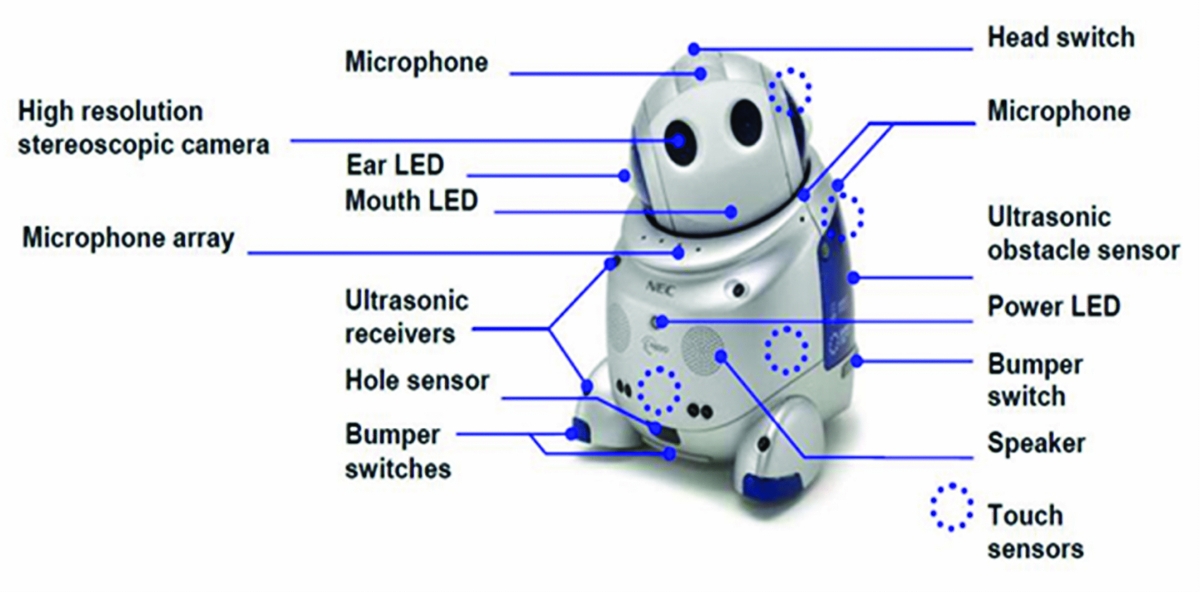
Socially assistive robots have successfully been trialed in RCFs to engage older residents (Bemelmans et al., Reference Bemelmans, Gelderblom, Jonker and de Witte2012; Khosla and Chu, Reference Khosla and Chu2013). They are different to companion-type robots such as Paro (a robotic seal) that provides calming effects (Shibata and Wada, Reference Shibata and Wada2011) but lack human-like engagement and reciprocal interaction. Betty, a socially assistive robot (technological name Partner Personal Robot, PaPeRo), was developed addressing these limitations; she can respond with human-like gestures, voice, and body movements. There is the capacity to program Betty with a person's preferences such as music, books, and games (called “services”), thus creating individualized services (Khosla and Chu, Reference Khosla and Chu2013). A touch-pad and voice recognition are used to “control” Betty. Betty is 39-cm tall, weighs 6.5 kg, and is equipped with a camera, speakers, and a microphone (Figure 1). She is portable, mobile, and can move her head and body. She also has the ability to record the type, frequency, and duration of services when used. Currently, Betty has not been used in facilities for younger residents, and it would be important to first investigate the acceptability of these robots by the staff working there, as they would be responsible for engaging the residents with Betty.
Betty.

The Technology Acceptance Model, TAM (Davis, Reference Davis1989), was developed to explain technology acceptance and usage. It states that people are more likely to use technology if they perceive it to be easy to use, and it will improve and enhance their own performance.
This main objective of this study was to investigate RCF staff's acceptability of Betty in engaging residents under 65 years old. A secondary objective was to report on the services via Betty utilized by the staff and residents.
Methods
Cyril Jewell House (CJH), located in metropolitan Victoria, was conveniently selected for participation. It is a 45-bed specialized RCF accommodating younger adults who have a range of neuropsychiatric conditions, such as younger-onset dementia, multiple sclerosis, and Huntington's disease.
Two 1-hour training/introductory sessions over 2 weeks were provided by Latrobe University staff (KN, RK). This was an opportunity for CJH staff to interact with, troubleshoot, and familiarize themselves with Betty. Latrobe staff programmed Betty with a basic set of music (such as modern albums by Adele and Katy Perry and older albums by Elvis and the Beetles), talking books and relaxation.
Betty spent 12 weeks at CJH. MP attended CJH weekly for 3 h, to support the staff, assist with troubleshooting, and engage residents with Betty. Latrobe staff were available via telephone during business hours if there were technological issues. CJH staff were able to make requests for particular services to be programmed depending on the residents’ preferences. For example, one resident barracked for a particular football team, so this theme song was programmed.
CJH staff were administered pre- and post-questionnaires, developed by Latrobe staff and used previously (Khosla and Chu, Reference Khosla and Chu2013), with some statements based on the TAM such as “Betty will help me look after the person I care for.” The questionnaires contained 6 statements pertaining to the staff themselves and 11 statements about the residents. There was a 5-point Likert scale for responses, ranging from Strongly Disagree to Strongly Agree. Examples of resident statements included “They will enjoy the contact with Betty,” and examples of staff statements included “I will be comfortable with Betty dancing and playing games.” Cronbach's α was calculated as 0.793. Staff demographics such as age and gender were also obtained. There were two questions at the end of the post-questionnaire that asked about the benefits and barriers of Betty.
Statistical analyses consisted of descriptive statistics to explore staff demographics. Percentages were used to calculate responses to statements. Fisher's exact test was used to compare the responses from pre- and post-questionnaires. Betty's record of the services used (type and duration) was downloaded onto an Excel spreadsheet. The amount of time the service used was tabulated in minutes. Significance value was set at p < 0.05.
This project was completed between July 2016 and February 2017 following approval from the Melbourne Health Human Ethics Committee (project 2016.017).
Results
Pre-questionnaires
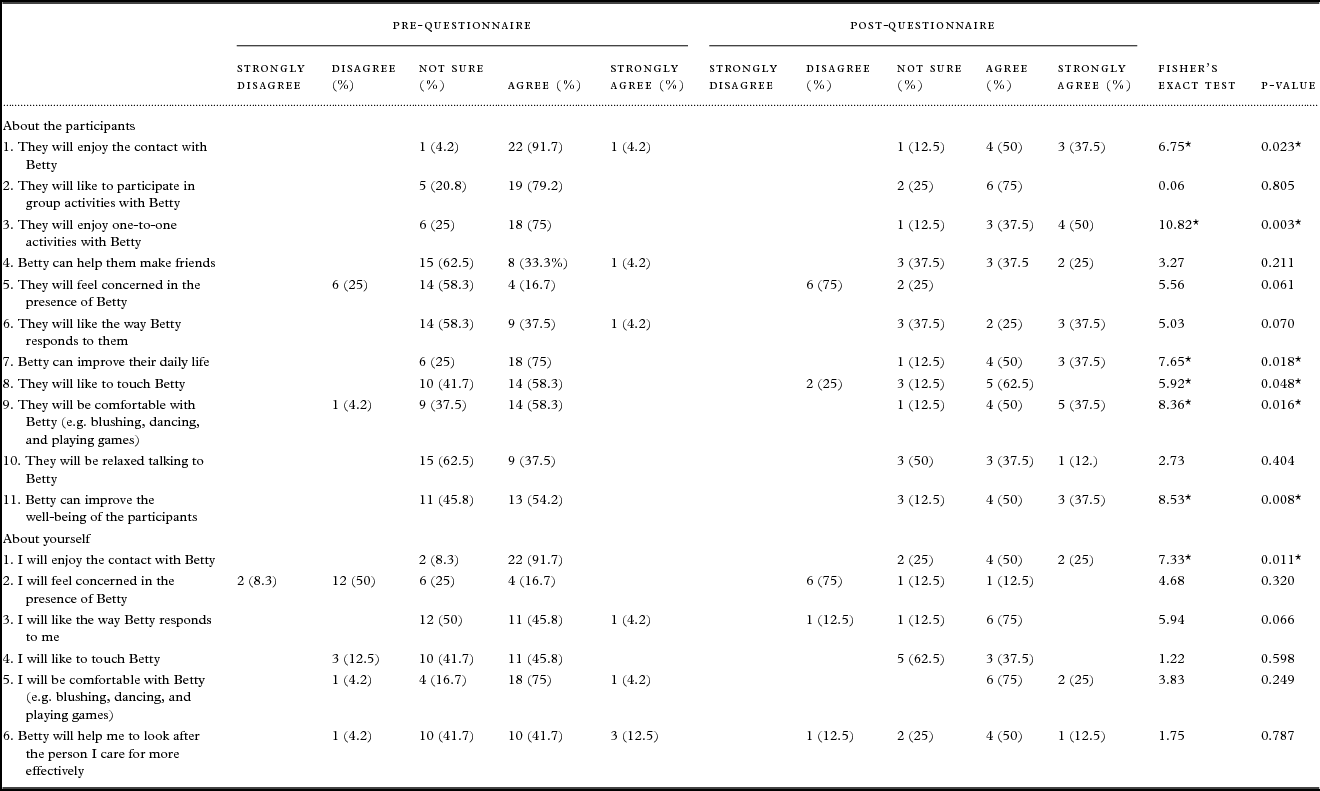
Thirty questionnaires were distributed to the staff following the second demonstration of Betty. Twenty-four staff completed the pre-questionnaires (Table 1). All were female with a mean age of 39 years (SD 14.6). They had worked at CJH for an average of 4.5 years (SD 5.0). The majority of respondents were nurses (83.3%). An exact response rate could not be estimated due to turnover of staff, but because approximately 30 were distributed, it was estimated that approximately 80% were returned.
Pre- and post-questionnaire, staff responses, and Fisher's exact test

*p < 0.05 denotes significance.
Types of services
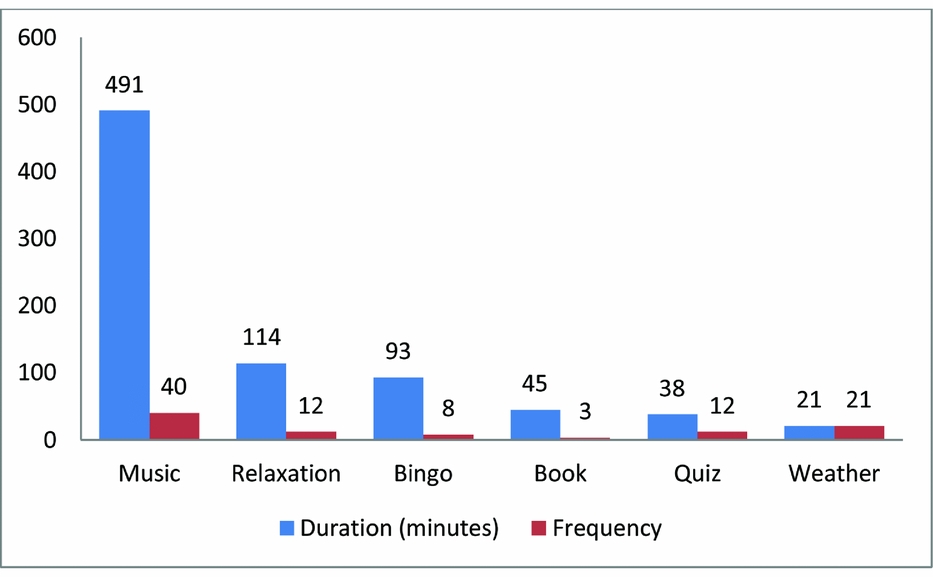
Using the data downloaded from Betty (Figure 2), it was estimated that the services used for the longest accumulated amount of time were Music (491 minutes), Relaxation (114 minutes), and Bingo (93 minutes). The longest duration at one time was Music (55 minutes) and the shortest duration was 1 minute (Weather). The most frequently selected service was Music (40 times), followed by Weather (21 times). Songs frequently chosen included modern (“Rolling in the deep” and “Shake it off”) and older tunes (“Suspicious minds” and “Hey Jude”).
Recorded services used by the participants and staff.

Post-questionnaires and feedback
Of the 30 post-questionnaires distributed, 10 were returned (30%) and 2 of these were incomplete (Table 1). The majority were female (87.5%) and nursing staff (77.8%). The respondents’ mean age was 48.6 years (SD 13.1). Overall, comparing the pre- and post-questionnaires (Table 1), the statements about the residents were significantly positive, including statements such as “They will enjoy the contact with Betty” (pre-questionnaire “Strongly Agree” 25%; post-questionnaire “Strongly Agree” 75%, p = 0.023), “They will be comfortable with Betty” (pre-questionnaire “Not sure” 37.5%, “Strongly Agree” 0%; post-questionnaire “Not sure” 12.5%, “Strongly Agree” 37.5%, p = 0.016), and “Betty can improve the wellbeing of participants” (pre-questionnaire “Not sure” 45.8%, “Strongly Agree” 0%; post-questionnaire “Not sure” 12.5%, “Strongly Agree” 37.5%, p = 0.008). The only staff statement that was significantly positive was “I will enjoy the contact with Betty” (pre-questionnaire “Strongly Agree” 0%; post-questionnaire “Strongly Agree” 25%, p = 0.011).
The barriers involved technical problems, such as “Betty was clunky and not intuitive” and “she lacked functionality,” and the benefits were focused on the residents’ reactions: “she was a wonderful diversion,” “reduced behaviours” and “residents were calmer, they would focus on her instead.”
Discussion
The staff who participated were mostly female, middle-aged and worked as nurses. They were overall positive about engaging the residents with Betty prior to, and after the study, but there was minimal significant improvement in their own reactions to Betty. Music was the most frequently chosen service, and it was used for the longest duration.
Of interest was that staff reported improvements in the interactions between Betty and the residents, but their opinions regarding themselves and Betty did not. Similar results were found in a previous study that used touchscreen tablets (such as iPads) to engage residents in RCFs, where staff reported improvement in residents interacting with the tablets after completion of the study (Loi et al., Reference Loi2017). Possibly, the RCF staff in this study were overwhelmed with their work (task-focused), which may lead to less engagement with the residents (Livingston et al., Reference Livingston2014). Perhaps they had assumptions that residents in RCFs may not have the cognitive capacity or interest to engage with new technology. It was perhaps not unexpected that the staff's pre- and post-questionnaire responses about themselves and Betty were not significantly different as the pre-questionnaire responses were already positive. Similarly to findings in Moyle et al. (Reference Moyle, Bramble, Jones and Murfield2016), staff found that Betty offered a novel opportunity to engage residents, but this had to be on an individualized basis.
Music has been previously found to have efficacy in engaging older adults with dementia in RCFs (Livingston et al., Reference Livingston, Johnston, Katona, Paton and Lyketsos2005; Livingston et al., Reference Livingston2014), but there has been less research in the younger-onset group. In this study, not all the residents had a dementia diagnosis. However, the principles of person-centered care still extend to this younger group (Roach et al., Reference Roach, Keady and Bee2012), and music still plays an important role in engaging this group.
There were some important limitations in this pilot study. First, the questionnaires did not have many statements on the TAM's second principle of “ease of use,” which was evident in the post-questionnaire feedback. In addition, there was a low response rate of post-questionnaires, limiting the generalizability of results and perhaps creating a bias toward responses that were more positive. Although a strength of the study was the ability of Betty to “record” the services utilized, there were some problems. One of the authors, MP, spent regular time at CJH; thus, the services may only have been used when she was facilitating, rather than the staff taking the initiative. It was unknown the number of residents or staff who were engaging with Betty at the time of these services, and it was possible that Betty was just on “automatic.” It was also unknown whether the services chosen were by the staff or the residents.
Further research in this area might involve more robust study design with larger sample sizes, including investigating the residents’ reactions/feedback to Betty. Nevertheless, this is one of the first study that we are aware of that explores the use of a socially assistive robot in residential care and encourages ongoing trials of novel technology in this setting.
Conflict of interest
None.
Description of authors’ roles
SML designed and conceived the study, did the statistical analyses and wrote the paper. AB, MP, and KN provided technical and staff support. RK was responsible for loan of Betty and provided technical support. NTL and DV supervised SML. All authors reviewed the manuscript.
Acknowledgments
The project was funded by the Royal Melbourne Hospital Home Lottery Grant. We would like to acknowledge the staff and residents at CJH who participated in this project.