The exploration and production of oil and gas resources will inevitably encounter challenges such as greater formation temperatures and salinity levels in the future. Under more extreme conditions, bentonite-containing montmorillonite particles tends to disperse, passivate, agglomerate and even gel, making it difficult to meet engineering requirements. Sepiolite is a commonly used base material in saline drilling fluid systems. When faced with the challenges of high temperature and high salinity, the protection of sepiolite requires the use of polymer treatment agents. Therefore, investigating the adsorption and degradation of polymers on sepiolite under such conditions will contribute to a better understanding of the mechanisms by which polymer–sepiolite suspensions control filtration loss.
Sepiolite is a fibrous and porous silicate clay mineral. Changes in temperature and pressure can damage the microstructure of sepiolite and affect its adsorption sites and surface area, but it is currently difficult to effectively verify these effects in macroscopic experiments. Its nanoscale fibre shape provides a large internal micropore size of 0.37 nm × 1.06 nm and excellent adsorption capability (Galan, Reference Galan1996). Acidification can increase the surface activity of sepiolite, and the interactions between its surface SiOH and the hydroxyl groups of polymer molecular chains can be utilized to create composite materials. Generally, sepiolite exhibits a greater cation-exchange capacity (20–30 meq 100 g–1) and greater specific surface area (100–900 m2 g–1) than other clay minerals (Stathopoulou et al., Reference Stathopoulou, Suárez, García-Romero, Del Rio, Kacandes, Gionis and Chryssikos2011; García-Romero & Suárez, Reference García-Romero and Suárez2013). It also can be modified chemically to improve its adsorption capability, and the high density of silanol on its surface facilitates hydrogen bond formation.
Sepiolite has excellent thermal stability and resilience to high temperatures and salinities. The hydration dispersibility of sepiolite remains approximately the same in deionized water or saturated saltwater (Pozo et al., Reference Pozo, Armijo, Maraver, Ejeda and Corvillo2018). As a result, adding sepiolite particles to drilling fluids can increase their plastic viscosity and shear force, as well as improving their rock-carrying capability. Sepiolite forms thixotropic gels easily in suspension, which benefits its use in drilling fluids by increasing their rock-carrying capability. The plastic fluid properties of sepiolite suspensions are consistent with the Bingham flow model. In addition, increasing the impurity concentration of sepiolite decreases its thixotropy. Sepiolite's distinct crystalline structure prevents it from delaminating or exfoliating like platy clays. When the sepiolite package and cluster structure are disseminated, a great number of individual particles connect to form a three-dimensional network that binds the water molecules in the solution, increasing its viscosity (Koltka et al., Reference Koltka, Sabah and Can2021). When polyelectrolytes are added, the negative charge of the silanol surface groups is reduced, and individual particles agglomerate along their surfaces, increasing the viscosity of the suspension (Echt et al., Reference Echt and Plank2019).
However, sepiolite tends to combine in water via hydrogen bonds and van der Waals interactions, generating bundles and aggregates that alter the suspension's stability and the rheological properties of sepiolite. To address this issue, the surface features of individual sepiolite particles, such as their charge and surface chemistry, can be modified to improve dispersion (Alves et al., Reference Alves, Ferraz, Santarén, Rasteiro and Gamelas2020).
Researchers have investigated the use of sepiolite nanoparticles to improve the rheological characteristics and filtration loss performance of water-based drilling fluids. Abdo et al. (Reference Abdo, AL-Sharji and Hassan2016) found that adding nano-sepiolite to bentonite-based drilling fluids maintained consistent plastic viscosity and yield stress while improving gel strength at various temperatures and pressures. Al-Malki et al. (Reference Al-Malki, Pourafshary, Al-Hadrami and Abdo2016) reported that sepiolite nanoparticles increased the plastic viscosity and yield value of bentonite-based drilling muds, ensuring stable rheological properties across wide temperature and pressure ranges. Geng et al. (Reference Geng, Qiu, Zhao, Zhang and Zhao2019) explored the surfaces of organic sepiolite particles after high-temperature ageing and observed changes in rheological properties under alkaline conditions. Liu et al. (Reference Liu, Du, Clode, Li, Liu and Leong2020) demonstrated that sepiolite gel exhibited increased yield stress over time due to attractive and repulsive forces amongst their rigid fibre microstructures. Ettehadi et al. (Reference Ettehadi, Ülker and Altun2022) investigated the relationship between the gel strength and mechanical stability of bentonite and sepiolite fluids, highlighting the superior performance of sepiolite fluids at greater temperatures. However, sepiolite's material properties may deteriorate under extreme conditions, highlighting the need for further research. These studies collectively contribute to our understanding and optimization of sepiolite-based drilling fluids, which offer potential benefits in terms of rheological control, filtration loss prevention and stability.
This study focused primarily on the adsorption and degradation effects of three representative drilling fluid additives on sepiolite under varying temperature and salinity conditions, aiming to elucidate the mechanisms by which they control filtration loss under the same conditions. The adsorption behaviour influenced the performance of the polymer directly, underscoring the importance of investigating the adsorption and desorption characteristics of polymers on the surface of sepiolite under high-temperature and high-salinity conditions.
Experimental
Materials
Three types of polymers with the codenames RE, PP and DD were provided by CNPC Engineering Technology R&D Company Ltd (Beijing, China), and their main composition was as follows (Fig. 1): NaCl (99.5%) was provided by Chengdu Kelong Chemical Reagent Factory (Chengdu, China) and sepiolite (96.2%) was provided by Sigma-Aldrich. RE is a low-molecular-weight acrylamide polymer containing cyano groups with good heat and salinity resistance. PP is a polymer containing sulfonic acid groups, carboxylic acid groups and amide groups, and it can be dissolved completely in saturated saline solution. DD is a polymer containing sulfonic acid groups, carboxylic acid groups and amide groups, and it is formed by crosslinking.
Structural of polymers RE, PP and DD. The values of a, b, c and d change with variations in the type of polymers. *Joining point of repeating units.

The main elemental ratios of the three types of treatment agent are shown in Table 1.
The elemental ratios in the polymers.

The infrared spectra revealed the presence of both crystalline water and adsorbed water in the sepiolite sample. As shown in Fig. 2a, the bands at 3560 and 3400 cm–1 are assigned to hydroxyl stretching, indicating the presence of zeolitic water within the channels, as well as bound water coordinated to magnesium in the octahedral sheet. The appearance of bands at 1660 and 660 cm–1, resulting from hydroxyl bending vibrations, further confirms the existence of bound water. The Si–O combination bands at 1210, 1080 and 980 cm–1 are observed due to Si–O vibrations, while the deep bands at 1020 and 470 cm–1 can be attributed to the stretching of Si–O in the Si–O–Si groups within the tetrahedral sheet. In addition, the composition and content of the samples were identified using X-ray diffraction (XRD) by comparing them with standard cards, as shown in Fig. 2b. The observed peaks in all samples are consistent with the reported d-spacings and {hkl} values for pure sepiolite in the literature (e.g. 1.210 (110), 0.747 (130), 0.673 (040), etc.). These findings align with the space group Pncn (52) and the corresponding JCPDS No. 13-0595, confirming the presence of sepiolite in the analysed samples. Based on the calculations, the content of sepiolite in the samples was determined to be 96.2%.
(a) Infrared spectra of sepiolite. (b) XRD traces of a sepiolite sample and a sepiolite standard card.

Methods
Preparation of sepiolite and polymer–sepiolite suspensions
Sepiolite was dispersed in distilled water to form sepiolite suspensions with concentrations of 2 and 4 wt.%. The dispersion process involved an initial 20 min of stirring at low speed, followed by 5 min of high-speed stirring. Subsequently, the suspensions were allowed to settle undisturbed at room temperature for a duration of 24 h. To promote consistent mixing and mitigate potential stratification, the suspensions underwent an additional 1 h of low-speed stirring prior to each usage. The 2 wt.% sepiolite suspension was employed for high-temperature desorption experiments, while the 4 wt.% sepiolite suspension was utilized for high-temperature ageing experiments.
For the preparation of the sepiolite suspension, a measured quantity of hydrated sepiolite was introduced into a beaker. Subsequently, a specific quantity of polymer was weighed accurately and dissolved in the suspension. Next, the suspension was supplemented with the appropriate concentration of NaCl in accordance with the experimental requirements. The mixture was stirred continuously using a magnetic stirrer for a duration exceeding 24 h to ensure complete dissolution of the polymer and the attainment of an adsorption equilibrium between the polymer and the sepiolite surface.
Before each test, a total of 4.0 g of sepiolite or sepiolite–polymer suspension was combined with deionized water to achieve a total mass of 60.0 g.
Particle-size distribution
The mixture was stirred carefully to ensure a uniform dispersion. Subsequently, the sample was subjected to analysis using a MasterSizer 2000 laser particle-size analyser (Malvern Instruments Ltd, UK).
Rheological properties
To assess the impact of high-temperature and high-salinity conditions on suspension performance, changes in suspension viscosity were measured using a rotational viscometer (ZNN-D6B, Qingdao Tongchun Petroleum Instrument Co., Ltd, China) before and after the ageing treatment. The apparent viscosity (AV) and plastic viscosity (PV) can be used to measure the carrying capacity of sepiolite suspensions for rock fragments, and they are calculated according to Equations 1 and 2, respectively:


where φ600 represents the dial reading at a rotational speed of 600 rpm and φ300 represents the dial reading at a rotational speed of 300 rpm.
Filtration properties
The test method for determining filtration loss is based on the standard GB/T16783.1-2014, and the ANS-5A medium-pressure filtration apparatus (Qingdao Tongchun Petroleum Instrument Co., Ltd, China) was used for testing.
Desorption measurements
The high-temperature desorption test analysis was conducted using a Var10EL-III organic element analyser (Elementar Analysensysteme GmbH, Germany), with a combustion time of 45 s and a combustion temperature of 1150°C. The hydrated sepiolite suspension was placed in a beaker and a certain amount of polymer was added to the suspension and stirred for at least 24 h. The sepiolite–polymer suspension was then poured into a high-temperature and high-pressure filtration apparatus and aged under constant-temperature conditions for 90 min. After the filtrate was released, the mud cup was cooled rapidly and the mud cake was taken out, dried and ground into a powder sample. The mass contents of the four elements C, N, S and H in the sepiolite powder were determined using an organic element analyser and the mass content of the residual polymer in the mud cake was calculated. Based on this, the changes in the trends of high-temperature desorption and adsorption of the polymer on the sepiolite surface can be inferred.
ζ-potential measurements
A total of 4.0 g of suspension was diluted with deionized water to a total weight of 60.0 g. The solution was mixed thoroughly and then transferred to a ζ-potential analyser (Zeta PALS 190 Plus, Brookhaven Instruments Corp., USA) for testing.
XRD analysis
The XRD analysis of sepiolite mineral types and composition was conducted using an X'Pert PRO MPD X-ray diffractometer (PANalytical B.V., The Netherlands), running under Cu-Kα radiation, 40 kV, 40 mA and a scan speed of 0.05 s per step (step size: 0.02°). The XRD traces were collected from 4° to 80°.
Scanning electron microscope analysis
The microstructure of sepiolite minerals was observed using an FEI Quanta 650 FEG field-emission scanning electron microscope (SEM; FEI Czech Republic s.r.o., Czechia). Sepiolite was aged at 240°C for 5 h, then dried and ground into powder samples for SEM testing.
Evaluation of wettability
The evaluation of wettability was performed using a DSA30S drop shape analyser (KRUSS, Germany). Dry sepiolite powder was prepared in a 2 wt.% suspension and dropped onto a glass slide. After the surface of the sepiolite became completely dry, a smooth sepiolite layer was formed on the glass slide for contact angle testing.
Elemental analysis
The compositions of the three polymers codenamed RE, PP and DD were analysed using the Var10EL-III element analyser (ELEMENTAR, Germany). Samples were first passed through a 60 mesh sieve and dried, and then they were subjected to complete combustion to determine the relative contents of the elements C, N, O and S.
Thermogravimetric analysis
The hydrated sepiolite suspension was aged in a high-temperature and high-pressure dehydration instrument, and the filtrate was collected and cooled to obtain a sepiolite cake. The sepiolite cake was then dried and crushed, and the dried sepiolite powder was subjected to thermogravimetric/differential thermogravimetric testing using a TGA/DSC3+ thermal gravimetric and synchronous thermal analysis instrument (METTLER TOLEDO, Switzerland). The testing conditions were 25–850°C, with a heating rate of 10°C min–1 and a nitrogen atmosphere of 40 mL min–1.
Results and discussion
Properties of sepiolite
Particle size and ζ-potential of sepiolite
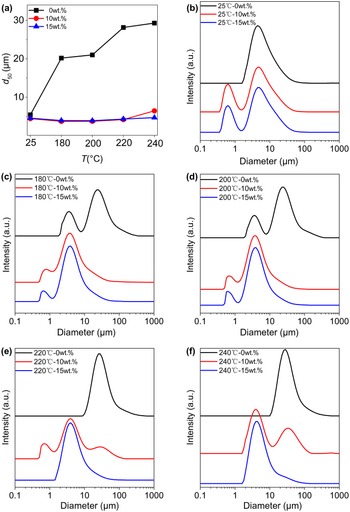
The sepiolite treated with thermal ageing in deionized water showed an increase in the median particle size from 5.5 to 29.3 μm at 25°C. However, the median particle size of the sepiolite decreased significantly after thermal ageing with the addition of NaCl, as shown in Fig. 3. These findings demonstrate that the inclusion of NaCl mitigates the aggregation of sepiolite particles effectively, thereby facilitating the fragmentation of sepiolite particles into smaller dimensions. This phenomenon was further confirmed by the particle-size distribution, as the distribution curve of the sepiolite thermally aged with NaCl shifted towards smaller particle sizes under the same conditions.
(a) The effects of temperature and salinity on the diameter of sepiolite particles. (b–f) The particle-size distribution of thermally aged sepiolite under various temperature and salinity conditions.

The results of the ζ-potential tests were not stable, and each sample was tested three times (results with error bars shown in Fig. 4). When there was no NaCl, the three test results were relatively stable, and the ζ-potential of the aged sepiolite remained at approximately –15 mV. After adding NaCl, the stability of the test results was affected. The ζ-potential of the sepiolite suspension was negative, and the ζ-potential was only positive under the condition of 25°C with 15 wt.% NaCl, and the absolute value was very small.
ζ-potential of sepiolite after thermal ageing (5 h).

Wettability and thermogravimetric analysis
Comparing the results of the thermogravimetric analysis of aged sepiolite at 240°C under various salinity conditions, it was found that brine increased the hydrophilicity of the sepiolite surface, resulting in an increased free water content of 6.76% (Fig. 5). This may be due to the dispersion of sepiolite particles and the formation of more ‘haystack-like’ structures between particles, which effectively restrained the free water, leading to a decrease in the relative content of bound water.
Modifications in surface contact angle of sepiolite after thermal ageing (5 h).

Additionally, bound water existed on the surface of sepiolite particles, which was a part of the solid phase of sepiolite and the main medium in which exchangeable ions existed. The increase in salinity led to a rapid decrease in the concentration of exchangeable ions around the sepiolite particles, which in turn reduced the bound water content on the surface of sepiolite particles (Fig. 6). Unlike montmorillonite, which has a layered structure, sepiolite has a chain-layered structure with nanoscale micropores in the middle. After adding NaCl, the space in the micropores of sepiolite particles that originally contained pore water and bound water was occupied by Na+ and Cl–, which further reduced the bound water content of sepiolite.
Thermogravimetric analysis of sepiolite after thermal ageing (5 h): (a) 0 wt.% NaCl; (b) 15 wt.% NaCl. DTG = differential thermogravimetry; TG = thermogravimetry.

SEM analysis
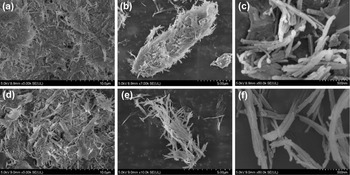
This study compared the microscopic morphologies of sepiolite after ageing at 240°C under various salinity conditions. Under salt-free conditions, the particles were tightly connected, poorly dispersed and had a relatively low free water content. The sepiolite particles exhibited clear flocculent and lumpy structures (Fig. 7).
SEM images of sepiolite after thermal ageing (5 h): (a–c) without NaCl; (d–f) with 15 wt.% NaCl.

Under 15 wt.% NaCl conditions, free water was more easily adsorbed onto the surface of sepiolite, and its relative content increased to 6.8%. In addition, the distance between particles increased, tending towards dispersion, and the sepiolite particles appeared as smaller, fibrous structures. Generally, under the influence of high temperature and high salinity, the particle-size distribution of sepiolite will shift towards smaller sizes.
Properties of polymer–sepiolite suspensions under high-temperature conditions
Adsorption analysis
To mitigate the detrimental impacts of temperature and electrolytes on sepiolite mineral properties, the addition of polymers has emerged as a prominent approach. Typically, polymers interact with the surface of sepiolite minerals through adsorption groups. Cationic groups establish robust adsorption via electrostatic interactions with the negatively charged surface of sepiolite minerals. Anionic groups and certain polar groups can form hydrogen bonds with sepiolite minerals, leading to their adsorption onto the surface. Simultaneously, these groups contribute to the formation or augmentation of the hydration film and solvation layer, thereby weakening or even preventing agglomeration among sepiolite particles.
The adsorption of polymers on the surface of sepiolite was approximately positively correlated with polymer concentration, and the adsorption amount approached the maximum value at a concentration of 0.4 wt.% (Fig. 8). Thereafter, there was no significant change in adsorption with varying concentration. Based on this, subsequent experiments were conducted using a default initial condition of 0.4 wt.% polymer concentration.
Adsorption of polymers on sepiolite at 25°C: (a) 0 wt.% NaCl; (b) 15 wt.% NaCl.

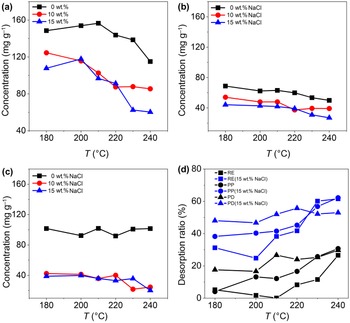
As shown in Fig. 9, the adsorption behaviour of the three polymers on the surface of sepiolite changed when temperature and salinity varied. Specifically, as a result of the conformational influence of electrolytes, polymer RE underwent significant curling and could not stably adsorb onto the surface of sepiolite, leading to a decrease in the adsorption amount from 156.7 to 125.0 mg g–1. By contrast, polymers PP and DD maintained stability under high-temperature and high-salinity conditions. They exhibited minimal changes in adsorption amount on the surface of sepiolite, even under high-salinity conditions. However, as the temperature increased, all three polymers on the surface of sepiolite underwent desorption. Polymer RE showed significant desorption at >210°C. The amount of desorption increased significantly with increasing temperature. This trend was more pronounced under high-salinity conditions. Under the conditions of 15 wt.% NaCl at 240°C, the desorption even reached 60%. The desorption amounts of polymers PP and DD also increased slightly with increasing temperature. Increasing salinity increased the desorption amount significantly. Overall, increases in both temperature and salinity resulted in decreased adsorption of polymers onto the surface of sepiolite, limiting their protective effect.
Desorption of polymers on sepiolite: (a) RE; (b) PP; (c) DD. (d) The effect of temperature and salinity on the desorption ratio.

Rheological property analysis
The sepiolite suspension system generally exhibited the characteristics of a non-Newtonian fluid, and its viscosity decreased as the shear rate increased, indicating shear-thinning behaviour. In addition, the sepiolite suspensions also exhibited rheological instability phenomena, including yield stress and variations in the deformation rate of shear flow over time. Polymers are often added to stabilize such suspensions. Figures 10 & 11 depict the impacts of temperature and salinity on the viscosity of the suspension.
AV of polymer–sepiolite suspensions: (a) RE; (b) PP; (c) DD.

PV of polymer–sepiolite suspensions: (a) RE; (b) PP; (c) DD.

The AV of the polymer–sepiolite RE suspension without salt addition after ageing at 240°C was 8 mPa·s and the PV was 10 mPa·s. The thickness of the mud cake was essentially maintained at ~1.0 mm and the filtration loss was maintained at ~25 mL when the temperature was <220°C. When the temperature increased to 240°C, the filtration loss increased suddenly to 38 mL. After adding salt, both AV and PV decreased, and the maintenance rates of AV and PV in high-temperature and high-salinity environments were around 30% and 40%, respectively. At 25°C, the addition of NaCl can increased the AV of the polymer–sepiolite PP suspension significantly.
After high-temperature treatment, the rod-shaped structure of sepiolite aggregated into clusters. When the cluster structure flowed in the liquid phase, the movement resistance increased. Consequently, AV and PV increased with the ageing temperature. At 180°C, the polymer experienced substantial degradation in the high-temperature and high-salinity environment, leading to pronounced reductions in both AV and PV. The degradation led to the destruction of the network structures formed between sepiolite particles and between sepiolite and polymer, resulting in a decrease in viscosity.
Filtration property analysis
When the ageing temperature was <220°C, the filtration loss remained low (20 mL). This suggested that sepiolite was effective at controlling filtration loss at high temperatures. The addition of salt resulted in a decrease in viscosity, so the filtration loss increased and the mud cake became thicker due to rapid accumulation.
In the polymer–sepiolite RE suspension aged at 240°C and 15 wt.% NaCl for 5 h, the American Petroleum Institute (API) filtration loss (FLAPI) was still <100 mL (Fig. 12). ‘API filtration loss’ refers to measurements conducted in accordance with the standardized testing method stipulated by the API. This indicated the good filtration properties of the polymer–sepiolite RE suspension. Even if the particle size remained relatively small, the FLAPI of the suspension still increased with temperature.
FLAPI of polymer–sepiolite suspensions: (a) RE; (b) PP; (c) DD.

Furthermore, with increasing thermal ageing temperature and salinity, the treatment agent that was adsorbed onto the surface of sepiolite underwent greater thermal degradation and desorption.
Desorption analysis
The median particle size of the polymer–sepiolite RE suspension after thermal ageing indicated that RE had the strongest flocculation effect on sepiolite in brine (Fig. 13). The addition of the polymer led to an increase in the median particle size to 58.7 μm.
The effects of temperature and salinity on d 50 of polymer–sepiolite suspensions after thermal ageing: (a) RE; (b) PP; (c) DD.

After high-temperature ageing, the sepiolite particle size in deionized water remained at ~6.0 μm, which is slightly larger than that without the polymer. In brine, the flocculation effect was decreased due to polymer degradation at 180°C ageing, resulting in a decrease in particle size. However, as the ageing temperature increased further, the median particle size of sepiolite continued to increase, eventually reaching 37.6 μm.
When the temperature was <220°C, the median particle size of sepiolite remained stable at ~5.0 μm. Additionally, at temperatures <220°C, the suspension's viscosity assisted in the maintenance of the stable existence of sepiolite particles in the suspension. However, when the temperature reached 240°C, most of the sepiolite particles were too large to maintain their suspension stability through Brownian motion alone, and the suspension viscosity was too low to maintain the enlarged particle size of sepiolite. Therefore, the polymer–sepiolite PP suspension with 10 and 15 wt.% NaCl added at 240°C and aged for 6 h exhibited significant sedimentation, which continued over 24 h of settling.
Comparing the experimental results regarding the median particle size and suspension stability of sepiolite, polymer–sepiolite RE and polymer–sepiolite PP suspensions shows that the median particle size limit for significant sedimentation of sepiolite particles in the suspension is ~10.0 μm.
Mechanism
We investigated how polymer adsorption onto the surface of sepiolite affected filtration loss at high temperatures. Increased filtration loss results from a decrease in adsorption capacity (Fig. 14). Effectively reducing filtration losses requires increasing adsorption capacity under high-temperature conditions.
The effect of polymer adsorption on filtration loss (FL).

Great colloidal stability is a property of sepiolite. Its network structure is further improved by the polymer. A polymer–sepiolite suspension's dispersibility deteriorates and the sealing effectiveness is constrained at room temperature and without salt, leading to an increase in filtration loss.
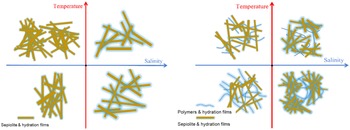
At room temperature and without salt, sepiolite forms clusters with minimal free water at the surface. The addition of salt results in a stable network structure that is supported by fibre structures (Fig. 15). Sepiolite develops clusters under high-temperature and salt-free conditions, increasing the median particle size. Salt can destabilize these clusters and improve hydrophilicity and dispersibility.
State of sepiolite in suspension.

To effectively reduce filtering loss under high-temperature conditions, polymer adsorption capacity must be increased. Under salt-containing circumstances, the stable network structure generated by polymer–sepiolite suspensions demonstrates good filtration control.
Conclusion
This study investigated the degradation and desorption behaviour of sepiolite and polymer–sepiolite suspensions under high-temperature and high-salinity conditions. The conclusions obtained are as follows.
Firstly, sepiolite demonstrated robust suspension stability and maintained its stability even after exposure to high-temperature and high-salinity ageing. Although slight settling occurred after thermal ageing in fresh water, sepiolite maintained good settling stability after 24 h of static settling when aged in brine. The addition of NaCl promoted the dispersion of sepiolite particles, and both 10 and 15 wt.% NaCl exhibited similar effects on particle dispersion. Due to the unique structural characteristics of sepiolite, the addition of polymers to the suspension preserved good stability even after 240°C thermal ageing, with no noticeable settling observed after 24 h of static settling.
Secondly, following ageing in a high-temperature and high-salinity environment, sepiolite particles increased in size with temperature. The network structure formed between the polymer treatment agent and sepiolite particles was disrupted, leading to rapid deterioration in suspension stability and rheological properties. The viscosity decreased with increasing temperature. The rheological and filtration performance of the polymer–sepiolite mineral suspension after ageing was dependent on the properties of sepiolite itself, which exhibited good resistance to high-temperature and high-salinity conditions.
Finally, the high-temperature adsorption behaviour of polymers under 5, 10 and 15 wt.% NaCl conditions showed similarities, supported by experimental results. At 240°C, polymer adsorption decreased by a maximum of 60 wt.% compared to normal-temperature conditions. Various polymers exhibited varying degrees of changes in adsorption on sepiolite surfaces, with polymer RE being the most affected by temperature, while polymer DD was the least affected. To maintain the colloidal stability of the polymer–sepiolite suspension system under high-temperature and high-salinity conditions, the polymer needs to have both good adsorption properties and strong hydration groups to maintain the dispersed state of sepiolite in the drilling fluid. With this understanding, polymers used in drilling fluids for sepiolite systems can be designed with greater specificity.
Financial support
Financial support was provided by the CNPC key core technology project (Environment-Friendly New Materials for Well-Bore Working Fluid with Temperature Resistance Above 240°C, grant no. 2020A-3913), Science and Technology Cooperation Project of CNPC-SWPU Innovation Alliance, grant no. 2020CX020000, and the Opening Project of Oil and Gas Field Applied Chemistry Key Laboratory of Sichuan Province, grant no. YOKF202214.
Conflicts of interest
The authors declare none.