Introduction
The start of the twenty-first century may well be remembered for mass mobilization. In 2002, large networks of younger activists proved to be a major political force in bringing the previously unknown Roh Moo-hyun to presidential power in Korea. In 2003, millions of people were mobilized in 800 cities across the world to demonstrate against their states’ involvement in the Iraq war, the largest protest in human history, including a demonstration of two million in London on February 15. In 2006, millions of US citizens protested against changes to the US immigration policy – 500,000 in Los Angeles alone. In 2007 in the United Kingdom, a petition against a planned road pricing policy was presented to No. 10 Downing Street with over 1.8 million signatories, which appears to have played a role in the final abandonment of the policy. In 2008, the United States elected its first black president, with record levels of turnout (particularly among black and first-time voters), community support, popular excitement, and fund raising from the general public. Mass demonstrations occurred in Iran in protest at allegedly rigged election results in 2009, both organized and beamed across the world through internet-based communications. Political activism has taken on a global dimension, with mass demonstrations against corporate globalization attended by activists from all over the world and writing campaigns to world leaders attracting millions of supporters.
What do these developments have in common? They share the use of the internet, which made communication and the transmission of information among the participants much easier. The internet reshapes the information environment within which citizens operate and make decisions about whether to participate or not in politics. It facilitates online communication networks, which allow the rapid spread of information. It reduces the costs of interacting and finding information. Moreover, it alters people's understanding of what other people are doing or have done, for example, through the provision of information about participation or through ‘recommender’ or ‘reputation’ systems. As a result of these benefits, some commentators proclaim that the internet will bring in a new age of participation through ‘peer production’ (Benkler, Reference Benkler2006), ‘crowdsourcing’ (Howe, Reference Howe2006), and the possibility of ‘organizing without organizations’ (Shirky, Reference Shirky2008, Reference Shirky2010). However, the dynamics of political participation in online environments remain under-explored. Although there are many examples of internet-based mobilizations that have attained high levels of participation, such as those listed above, there are many more that have disappeared without much trace. For example, of 2000 petitions made to the No. 10 Downing Street website during 2009, only 5% received the 500 signatories required to receive an official response.Footnote 1 So why do some mobilizations gain more momentum than others?
This paper focuses on the effects of one particular aspect of this changed information environment, the provision of social information. By providing real-time information about what other people are doing, the internet affects the perceived viability of a political mobilization. This has an impact upon the potential benefits of joining, thereby altering the incentives of individuals to participate. The term social information is borrowed from social psychology where social information processing is used to learn about individual behaviour by studying the informational and social environment within which that behaviour occurs and to which it adapts (Salancik and Pfeffer, Reference Salancik and Pfeffer1977, Reference Salancik and Pfeffer1978). More recently, economists and psychologists have studied the impact of social information on charitable giving and on willingness to participate in public goods provision (see Cialdini and Goldstein, Reference Cialdini and Goldstein2004; Andreoni, Reference Andreoni2006). We use the term social information to indicate information about what others are doing or have done. Potential participants take this information (or, lacking this information, their perception of what it might be) into account when they are deciding whether to participate. But we believe that the relationship between social information and actual participation may depend on the extent to which the information communicates the size of the mobilization. When such participation occurs online, there is a far greater possibility of the potential participants receiving real-time feedback information about how many other people have participated, something that someone who signs a petition in the street or throws money into a charity collector's bucket is unlikely to receive.
This paper reports a field experiment to investigate the effect of social information on participation in an online environment and to advance understanding of the dynamics of online mobilization. We investigate social information effects on the propensity of people to sign petitions, a political activity in which growing numbers of people participate online and with increasing significance, particularly in countries such as the United States where recent judgments have mandated that petition signatures be made public, making the act of signing more costly. First, we review the relevant literature on social information and collective action, identifying four lines of argument from across social science disciplines (political science, economics, communications, psychology and sociology), which put forward a view on social information effects. Second, we outline the experimental design, hypotheses, and methods. Third, we report the results of the experiment, and fourth we discuss the implications of the findings.
Collective action and social information
What do we know about the impact of social information on political participation? There is a body of work on collective action in political economy, sociology and psychology, where theorists and empirical researchers have considered the informational context of participatory decision-making. We consider the below four distinct arguments regarding the effects of social information that have been identified in previous work: conditional co-operation; social pressure; thresholds; and bandwagon effects. Research that uses these perspectives identifies different causal mechanisms to explain how citizens react to social information, which we test in our empirical work.
Conditional co-operation
Economists have studied the effect of information about the contributions of others on people's willingness to undertake pro-social behaviour, in particular making charitable donations. Researchers have identified a range of possible mechanisms for conditional co-operation, including conformity, social norms, or reciprocity (see Frey and Meier, Reference Frey and Meier2004: 1721). This work has shown that people are more likely to contribute to a campaign if they are provided with information that other people are doing so, and that increasing the numbers of other participants enhances this effect (Fischbacher et al., Reference Fischbacher, Gaechter and Fehr2001; Frey and Meier, Reference Frey and Meier2004). It has also shown that people are likely to increase their contribution (by donating more money, for example) if they know that other people are increasing the size of their commitment (Shang and Croson, Reference Shang and Croson2006, Reference Shang and Croson2009). This work provides robust evidence of social information effects and we follow these researchers in using experiments to vary randomly the existence and level of social information provided to participants. But the experiment presented here diverges from this work in a number of ways. First, most of the work on conditional co-operation looks at charitable donations, rather than the political context of petition signing of this experiment. Second, the most recent work examines the influence of social information on contribution amount, rather than participation. Psychological research (Brooks, Reference Brooks2004) shows that ‘decisions about whether to act and about how much to act, although positively correlated, may be caused by different psychological motivations’ (Shang and Croson, Reference Shang and Croson2009: 1426), which indicates that the question of how social information affects people's decision whether or not to act politically is worthy of further investigation. Furthermore, there are a number of other possible social information effects identified in work from other social science perspectives, discussed below, that we test as these have been left unexplored by researchers looking at conditional co-operation.
Social pressure
Another body of work follows the argument that social information can exert social pressure on individuals to participate. In The Logic of Collective Action, Olson (Reference Olson1965) argues that individuals take into account information about the potential size of the group when they consider whether to participate. If they perceive the size of the group to be small, they consider it worthwhile to contribute; but in a large latent group, if one member does or does not help provide the collective good, no other member will be significantly affected and so no one has an incentive to contribute. Although Olson does not discuss social information explicitly, he does discuss the effect of social pressure to incentivize group members to participate in small groups, but discards it for larger groups: ‘In general social pressure and social incentives operate only in groups of smaller size, in groups so small that the members can have face-to-face contact with one another’ (Olson, Reference Olson1965: 62).
Some writers from the field of communications speculate on how the widespread use of the internet could affect Olson's thesis, particularly by reducing the costs of co-ordinating and participating in collective action (Bimber, Reference Bimber2001, Reference Bimber2003; Krueger, Reference Krueger2002; Lupia and Sin, Reference Lupia and Sin2003; Klotz, Reference Klotz2004; Bimber et al., Reference Bimber, Flanagin and Stohl2005; Lev-on and Hardin, Reference Lev-On and Hardin2007). Much of this work looks at the effect of online political information in general, rather than social information in particular. But Lupia and Sin (Reference Lupia and Sin2003) discuss ‘noticeability’, which may have an inverse relationship with group size, and the possible effect of the internet's capacity to provide social information as a form of coercion. They identify a footnote to Olson's thesis: ‘If the members of a latent group are somehow continuously bombarded with propaganda about the worthiness of the attempt to satisfy the common interest in question, they may perhaps in time develop social pressures not entirely unlike those that can be generated in a face-to-face group, and these social pressures may help the latent group to obtain the collective good’ (Olson, Reference Olson1965: 63, fn. 8). Writing in the pre-internet era, Olson argued that such social pressures would be prohibitively expensive for groups to exert, but decades later ‘evolving technologies reduce substantially the costs of communicating with large audiences’ (Lupia and Sin, Reference Lupia and Sin2003: 324).
Threshold effects and signals of viability
Another line of argument has made the case for tipping points or threshold effects in patterns of mobilization, which act as signals of viability and increase the rate of mobilization. The sociologists Marwell and Oliver claim that larger groups find it easier to form as their size makes it more likely that they will be able to attain a critical mass of activists who organize around public goods (Marwell and Oliver, Reference Marwell and Oliver1993). The costs of collective action do not vary with group size because they are the same, regardless of the number of potential contributors. It is irrelevant how many others there are over and above the critical mass, so free-riding is unlikely to be problematic (Oliver and Marwell, Reference Oliver and Marwell1988). In this view, evidence of a critical mass sends a vital signal to potential participants about the viability of the group and social information of this kind could act as a mechanism to increase participation: ‘It is not whether it is possible to mobilize everyone who would be willing to be mobilized… Rather, the issue is whether there is some social mechanism that connects enough people who have the appropriate interests and resources so that they can act’ (Oliver and Marwell, Reference Oliver and Marwell1988: 6).
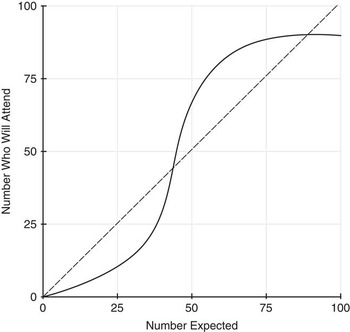
Schelling develops the idea that a threshold in political participation sends a signal of viability. In one part of Micromotives and Macrobehaviour (1978), he points to examples where people's behaviour depends on information about how many other people are participating: how many people attend an optional seminar; how many people applaud and how loudly; and how many people leave a failing school (Schelling, 2006: 94). He argues that the number representing critical mass varies by context, which can mean that it will be a proportion of potential participants (which is what matters to people considering adopting a certain fashion, for example), or an actual number (which is what might matter to attendees at a seminar). Critical mass will also vary by person (Schelling, 2006: 9); some people take the lead by participating when few others have done so while others require high levels of participation before they will take part. He argues that people's threshold for participation is normally distributed and that most people will have a threshold of around 45%. Such a distribution would give an S-shaped curve of people participating as shown in Figure 1. These characteristics of mobilization and people lead to a range of models of the form that mobilization will take (see Schelling, 2006: 95–110), some of which are viable and some not. But where thresholds of people are normally distributed, and where there is some identifiable measure of success (such as an absolute number of participants), this argument suggests the effect of social information is that when around 45% of people are participating there will be a sharp rise in the number of participants because the majority (in the normal distribution) were waiting for this point. This represents a critical mass in Marwell and Oliver's terms (Colomer, Reference Colomer1995, Reference Colomer2010).
Relationship between participation and expected participation assuming a normal distribution of individual thresholds according to Schelling (2006: 104).

Bandwagon effects and majority opinion
The fourth argument supporting the idea of a dynamic relationship between collective action and social information is based on the ‘bandwagon effect’, a label given to a situation where the information about majority opinion will cause individuals to rally to that opinion. Likewise, other authors have argued that individuals who perceive they are in the minority will feel pressure either to express the majority opinion or to remain silent in what has been labelled the ‘spiral of silence’ (Noelle-Neumann, Reference Noelle-Neumann1974), which would reinforce the bandwagon effect. Conversely, an underdog effect is held to exist if the information causes some people to adopt a minority view (Marsh, Reference Marsh1985). Studies of the bandwagon effect are usually carried out on voting behaviour (where opinion polls are the observation of social information) and have also been applied to public opinion on key policy issues (see Nadeau et al., Reference Nadeau, Cloutier and Guay1993), reflecting the concern of such research with opinion formation. Researchers into the bandwagon effect are interested in whether potential participants change their views in response to knowing the views of others, rather than people's willingness to participate at all, as in the research reported here. However, given that the effects of social information on these different parts of the decision-making process can be difficult to distinguish, we use the bandwagon idea to provide an alternative hypothesis for what effect social information might have.
Empirical support for the bandwagon effect is sparse (see Nadeau et al., Reference Nadeau, Cloutier and Guay1993 for a review, and Cain, Reference Cain1978) and where an effect has been identified, it seems to apply only to social information about trends rather than to current levels of support. Moreover, Nadeau et al. (Reference Nadeau, Cloutier and Guay1993) find only an absolute effect of information about trends with no numbers. Marsh (Reference Marsh1985) also shows that information about static public opinion has no effect, although information about dynamic public opinion trends has an effect on support. A meta-analysis of survey studies from ‘spiral of silence’ research finds little support for the theory (Glynn et al., Reference Glynn, Hayes and Shanahan1997).
In general, the arguments about social information and collective action outlined above are concerned with anonymous information; that is, people are receiving information about people they do not know. There are various other arguments highlighting thresholds in participation rates, which come from the identification of network effects where individuals use their social networks as a group of reference and it is social information regarding the network that will affect an individual's likelihood of participating (Granovetter, Reference Granovetter1978; Gould, Reference Gould1993; Valente, Reference Valente1996; Siegel, Reference Siegel2009). The structure of an individual's personal network (e.g. in terms of size, density, and centralization) will be as important as an individual's threshold for participating, perceptions of a critical mass, or the more general informational context of the latent group. In online environments, the distinction between anonymous and personalized social information becomes blurred as large-scale anonymous networks become viable. Hence, we recognize that network effects can be at play in the type of mobilizations in which we are interested, and could be built into a model of the relationship between the internet and collective action. But we do not investigate them in the experiment reported here; rather, we endeavour to isolate the effect of social information, a phenomena that has received less scholarly attention in recent work on the internet and collective action.
The experimental method and social information
Experiments can provide unbiased estimates of how different kinds of information affect participation by randomly varying the information provided to subjects and observing the effect on their behaviour. Experiments have already been used to test some elements of the four groups of arguments outlined above. For conditional co-operation, economists have used laboratory experiments involving public goods and co-operation games (Keser and van Winden, Reference Keser and van Winden2000; Fischbacher et al., Reference Fischbacher, Gaechter and Fehr2001) and, more recently, field experiments in which subjects are provided with varying levels of information about the participation of others (Andreoni and Scholz, Reference Andreoni and Scholz1998; Frey and Meier, Reference Frey and Meier2004; Shang and Croson, Reference Shang and Croson2009).
A range of experiments have also been used to test the social pressure claim, particularly to investigate people's willingness to undertake environmentally conscious behaviour and also for charitable donations and voting turnout. In Goldstein et al.'s (Reference Goldstein, Cialdini and Griskevicius2008) widely reported experiment with the recycling of towels in hotels, a treatment group received a message to say that 75% of other guests had recycled their towels. This group was 26% more likely to recycle than those who saw the basic pro-environmental message. Where participants were given more local information – that is feedback information on the past recycling behaviour of guests who had used the same room – the difference with the control group was even greater. Schultz (Reference Schultz1999) conducted a randomized controlled trial examining the impact on recycling behaviour of providing written feedback on individual and neighborhood-recycling behaviour, finding statistically significant increases from baseline in the frequency of participation and in the total amount of recycled material. The most influential treatments were door hangers telling households the average amount of material collected from householders and the percentage participating in recycling in their immediate locality. Cotterill et al. (Reference Cotterill, John and Richardson2010) have carried out a similar experiment investigating the effect of visibility on citizen's willingness to contribute books to a charitable campaign sending books to Africa. Similarly, Gerber et al. (Reference Gerber, Green and Larimer2008) ran a large-scale field experiment to investigate the effect of social pressure on voter turnout, manipulating the voters’ knowledge about their neighbours’ turnout.
There is much less experimental research investigating threshold effects as signals of viability. Marwell and Oliver give a largely theoretical argument for the existence of ‘critical mass’ and do not attempt to put a numerical value on it, either in terms of absolute numbers or in terms of percentages, nor do they test its existence empirically. Schelling's models are also theoretical as there are no experiments that investigate whether his assumptions of the distribution of ‘k’ or his assertion about a possible threshold point of 45% (assuming a normal distribution) is correct.
Empirical support for the bandwagon effect comes from an experiment, suggesting that there is an effect of around 5–7% (Nadeau et al., Reference Nadeau, Cloutier and Guay1993). That is, when subjects were told that opinion was growing for an issue, it meant they were 5–7% more likely to support this issue themselves compared with a control group who were given no such information. The meta-analysis of ‘spiral of silence’ research mentioned above found the field to be dominated by survey-based studies, noting that ‘experimental studies are perhaps better suited’ (Glynn et al., Reference Glynn, Hayes and Shanahan1997: 461) to answer the type of questions asked.
None of the above experiments endeavour to isolate social information effects on online mobilization in a political context. A few internet-based experiments, which also test social information effects, are starting to emerge, including Salganik et al. (Reference Salganik, Dodds and Watts2006), Goel et al. (Reference Goel, Muhamad and Watts2009), Salganik and Watts (Reference Salganik and Watts2009), and Smith et al. (Reference Smith, John, Sturgis and Nomura2009). Internet experiments are less common because they require re-evaluation of the traditional ethical and logistical challenges of experimental design, such as incentivization, deception, control, randomization, and maintenance of a subject pool (Nosek et al., Reference Nosek, Banaji and Greenwald2002; Skitka and Sargis, Reference Skitka and Sargis2006; Margetts and Stoker, Reference Margetts and Stoker2010). But the work of Salganik et al. (Reference Salganik, Dodds and Watts2006), which explored the effect on cultural markets of information about other people's preferences, illustrates the potential of using the internet as a ‘field’ and has informed the design of the experiment into political participation on the internet presented here.
Hypotheses
We test how social information provided through the internet affects political participation either by fostering conditional co-operation (Frey and Meier, Reference Frey and Meier2004); by applying social pressure (Olson, Reference Olson1965; Lupia and Sin, Reference Lupia and Sin2003); by sending a signal of viability or critical mass (Schelling, Reference Schelling2006; Marwell et al., Reference Marwell, Oliver and Prahl1988); or by generating a bandwagon effect (Marsh, Reference Marsh1985). We focus on anonymous information about other people rather than on effects deriving from individuals’ social and personal networks. Our expectation is that information about the preferences of others will affect the decision whether to incur costs in the pursuit of collective action. For example, if people know how many others have signed a petition, we claim it will affect their willingness to sign or to incur other costs in the pursuit of the issue being petitioned for. Previous work on collective action leads us to expect that the influence of social information will vary according to the levels of participation; we would expect information about high levels of participation (which individuals might take as a signal of viability) to have a different effect from information about low levels of participation (which individuals might take as evidence of non-viability). The work on conditional co-operation, social pressure, critical mass, and threshold effects, and the bandwagon effect can be used to generate two hypotheses:
H1: A large number of other petitioners will encourage individuals to incur costs and sign up.
H2: A small number of petitioners will discourage individuals from incurring the costs of signing up.
Verification of both of these hypotheses would lead us to believe that – in the earliest stage of a petition – social information would have a negative effect on those potential participants who are exposed to it. When the number of other participants reaches higher levels, we would expect social information to have a positive effect because it is an indicator that other people are co-operating and therefore encourages reciprocity or compliance with social norms; because it exerts social pressure; because it acts as a signal of viability, indicating the likelihood of attaining critical mass; or because it indicates majority opinion and exerts a bandwagon effect.
Within this generalized pattern, the different arguments discussed above would lead us to expect different ‘participation curves’. That is, although all the arguments would lead us to support H1, not all would lead us to support H2 and the differential effects of social information indicating different levels of participation would vary. For conditional co-operation, we would expect social information to have a greater effect for reports about high numbers of other participants. However, experimental work has indicated that the differential effects would not be very large. Frey and Meier (Reference Frey and Meier2004) found, for example, that for two treatment groups given information about a relatively high percentage of contributors to a charitable campaign (64%) and a relatively low percentage (46%), participation rates varied by only 2.3%, which was not a statistically significant difference. For arguments about social pressure, with the hypothesis that indications of large numbers of participants could exert the same type of social pressure as Olson observed for small groups, there is little available evidence to inform our expectation of the relative weights of such pressure; large numbers might have the same effect as small numbers, meaning that the effect of social information would be relatively consistent or could dip for ‘middling’ numbers. For arguments based on threshold effects, we would expect key tipping points in participation where the number provided in the social information would have, relatively, a greater effect than in other points in the mobilization curve. This would give us an overall pattern consistent with the S-shaped participation curve predicted by Schelling for certain contexts. In contrast, for bandwagon effects, we would expect that there would be a continuously positive effect of information about the participation of others, which would accelerate in a cumulative way, yielding an exponential curve if the percentage of people participating were plotted against the percentage expected to participate.
Research design
We designed a field experiment to test the hypotheses. First, we carried out a much smaller pilot experiment in the laboratory to test out a prototype, the results of which informed the design of the field experiment.
The pilot laboratory experiment
For the pilot, we randomly selected 47 individuals from the subject database (which includes both students and non-students from the local area). We provided subjects with a list of six petitions across a range of issues which petitioners had created on the website of No. 10 Downing Street,Footnote 2 including a proposal to use a policy of opt-out instead of opt-in to organ donation, another to scrap identity cards, and another to introduce a tax on carrier bags. Three of the petitions had ‘high’ numbers of signatories (between 300,000 and 1,200,000) and three had ‘low’ numbers of signatories (less than 12). They were asked, first, whether they agreed with the issues being petitioned for, second, whether they would sign the petition on the issue, and third, whether they would donate a small proportion of their participation fee towards supporting the issue (or to a campaign against the petition if they declined to sign it). Participants were randomly divided into two groups: individuals assigned to the treatment group received information about how many people had signed the petition, whereas subjects in the control group received no such information. We incentivized them to participate by a payment of between £12 and £15, depending upon the amount they chose to donate to the various causes. We anonymized all the subject information and we collected no addresses. The participants did not sign the petitions during the experiment, but were provided with the opportunity to do so after its completion through a link on the screen interface. The research team donated all the money raised by the subjects during the experiment to the respective causes once the experiment had finished.
The results of the pilot suggested that the social information treatment did have an effect, but that as hypothesized, this varied according to the type of social information. We found that 59% of petitions were signed overall, with 54% in the control group and 63% in the treatment group (those who received information about other people signing); but this difference is not statistically significant. For the three petitions with higher numbers of signatories, there was a positive correlation with the number of other signatories and an individual's likelihood of signing. We identified one issue (out of six) where subjects were significantly more likely to sign a petition if they received the social information than those in the control group. This petition was the only one for which the number of signatures was over a million, suggesting the possibility that the threshold at which social information makes a difference could be the one million mark.
The results of the pilot laboratory experiment informed the design of the main field experiment. First, and most importantly, it confirmed that the experiment was viable and that our intervention was, even at this modest scale, having some effect. Second, having observed a differential effect for the petition with over one million signatures, we re-defined ‘high’ numbers as over one million. To account for the larger scale of the experiment and the global nature of the issues (and therefore the latent group), we defined ‘low’ numbers as below 100. After observing a weaker but still statistically significant effect of ‘medium’ numbers between these two categories on the propensity to donate (see Table 2 below), we created a further category of ‘middle’ numbers for the mid way range of 100–1,000,000. Third, we extended the number of treatment groups and randomized the social information (low, medium, or high numbers of other signatories) across subjects for each petition, allowing us to control for the effect specific to particular issues. In the laboratory pilot experiment, all subjects in the treatment group saw the same social information for each petition, so we did not have a mechanism to disentangle issue and social information effects.
The field experiment
For the field experiment, we recruited a subject pool of 668 people from the subject database, who participated in the experiment remotely using their own internet connection. Participants were asked to consider six issues successively through a custom-built web interface. They were invited (a) to express their willingness to sign a petition supporting the issue and (b) to donate a small amount of their participation fee to support the issue (or against the petition if they declined to sign it). To express willingness to sign a petition, subjects were required to provide their name, email, and address. This meant they had to incur some costs to support their statement, even though they did not sign the petition. Participants could donate 20p towards every issue, a sum which the experimenters matched in the final donation. We randomly allocated the subjects to a control (of 173) and a treatment group (of 495). All participants received the same six petitions with different levels of social information. In the control group, participants received no information about other people signing. In the treatment groups, subjects were shown two petitions in each of the following categories:
• petitions with very large numbers of signatories (S > 1 million)
• petitions with medium numbers of signatories (100 < S < 1 million)
• petitions with very low numbers of signatories (S < 100).
We randomized the order in which participants saw the six petitions to eliminate systematic biases of any individual petition.
We incentivized the participants with a small payment (£6–£8), which varied according to the amount they chose to donate, which we paid with Amazon.co.uk vouchers. There was a pre-experiment questionnaire to establish the extent to which participants agreed (or not) with the issues in the petitions. As with the pilot, we anonymized all subject information and did not collect addresses. The petitions were (with the high, medium, and low numbers shown in brackets) as follows:
1. National governments should put pressure on the Chinese leadership to show restraint and respect for human rights in response to protests in Tibet (high: 1,682,242, medium: 1,189, low: 76).
2. National governments should negotiate and adopt a treaty to ban the use of cluster bombs(high: 1,200,000, medium: 330,000, low: 7).
3. Governments should lobby the Japanese government to stop commercial whaling of the humpback whale(high: 1,082,808, medium: 57,299, low: 98).
4. Governments should support a stronger multinational force to protect the people of the Darfur region of Sudan (high: 1,001,012, medium: 5978, low: 16).
5. World leaders should negotiate a global deal on climate change(high: 2,600,053, medium: 575,000, low: 53).
6. Governments should work to negotiate new trade rules – fair rules to make a real difference in the fight against poverty(high: 17,800,244; medium: 22,777, low, 25).
There was no deception. The petitions were shown in generic format (to control for the reputation effect that different web platforms would bring), yet the numbers of signatories shown to the participants were taken from existing online petitions that had been created on these issues with different numbers of signatories (low, medium, and high). The issues were all selected to be of international significance and petitions were all drawn from across different geographical spaces and points in time (during the last 3 years). Again, subjects did not sign the petitions in the experiment, but at the end of the experiment the interface directed them to a site where they could. The research team made the donations to the causes after the experiment.
Results of the field experiment
As there were six petitions, we stacked the data so as to examine the variation according to the numbers of signatories that subjects could see before signing, which yielded a total of 4008 observations or person-petitions.
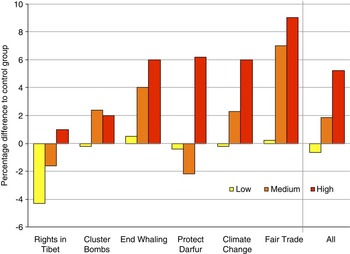
Overall, participants in the control group signed 61.5% of the petitions. When presented with low numbers, the participants signed slightly less (−0.9%) than the control group, and when presented with medium numbers they signed slightly more (+1.9%). Neither of these results are statistically significant, so we do not find evidence to support hypothesis (H2) that small numbers would discourage participation. For those presented with high numbers, the figure was 66.7%, 5.2% more than in the control group, which is a statistically significant difference (P = 0.015) and confirms our first hypothesis (H1). The percentages of participants signing each petition are shown in Figure 2, compared with the proportion of people signing in the control group (shown as the base line).Footnote 3 The effect of the high numbers treatment is strongest for the petition on fair trade, which also had by far the highest number of signatories in this category (17.8 million), leading to a further hypothesis that the effect of high numbers varied according to the magnitude of the number of other signatures. But when we tested this hypothesis by using the logarithm of the number of signatures in a regression, we found no effect.
How different levels of social information affect subjects’ propensity to sign petitions in a field experiment.

A further test for the actual willingness of a subject to support a petition is whether or not the person would also commit to a donation. This would cost the subject real money and so is a greater cost of participation. In the ‘real world’, the costs of signing a petition can be high, particularly in the United States where a recent Supreme Court ruling deemed that signatories of petitions on referendums should be made public.Footnote 4 But in this experimental setting, the subjects’ decision to sign was anonymous. On average two-thirds of those who signed a petition went on to make a donation. For each petition in the larger experiment, almost exactly two-thirds of those who signed went on to donate, suggesting a general relationship. Even with the different experimental set-up and much smaller numbers than in the field experiment, a similar effect could be observed in the pilot laboratory experiment. It should be noted, however, that subjects were always asked to sign first and then to donate, so there could have been a crowding out effect, in that subjects who had already signed felt that they had done enough already.
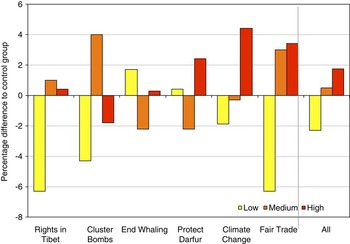
In a similar way, as the graph in Figure 2 reported signing petitions in relation to the social information provided, Figure 3 indicates the proportion of participants donating to petitions compared with the control group (broken down into petitions and treatments). Here, the effect of the social information treatment is less clear, but low numbers have a negative effect in most cases except for the petitions on whaling and on Darfur. High numbers have a small positive effect in all but one petition (cluster bombs). The difference between signing and donations is possibly due to less people donating than signing (40% vs. 63%). It seems that these individuals have a higher threshold for donating and are consequently less influenced by high numbers and more easily discouraged from doing so by low numbers of other signatories.
How different levels of social information affect subjects’ propensity to donate to petitions in a field experiment.

Regression analysis
To test further the impact of each treatment and to control for the effects of covariates, we run separate logistic regression models for subsets of the data comprising participants of one treatment together with the control group and use the high, medium, and low numbers as independent variables to indicate social information. As the individuals are nested within petitions owing to the stacking of the data, we apply a Huber–White correction to adjust the standard errors.
Prior agreement to a given petition (measured in the pre-experiment questionnaire) should determine signing and we included it as control variable. It seemed likely that the effect of social information on an individual's likelihood to sign would vary according to the extent to which the person supports the issue at stake. Initial support varied across the issues, for example Climate Change (P5, 92%) and Fair Trade (P6, 91%) were by far the most popular issues, while the Protect Darfur (P4, 77%) and End Whaling (P3, 79%) had more opponents than supporters (14%), and also the highest numbers of undecided subjects (11%).
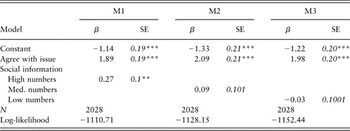
Table 1 shows the regression results. As expected, initial support for the issue has a strong positive effect (statistically significant at the 0.001 level). We were most interested in the impact of social information, for which we compared the dichotomous variables of ‘high’, ‘medium’, and ‘low’ numbers. Only for high numbers do we observe a consistent effect on the likelihood of signing (statistically significant at the 0.01 level as it had also been in the pilot), which confirms the results from the descriptive statistics and our inference for the hypotheses. To interpret this figure, we calculate that the change in likelihood of an individual signing a petition, if the person is shown there is a high number of other signatories, all other things being equal, is +10%.
Logistic regression for signing petitions

**P < 0.01, ***P < 0.001 (two-tailed tests).
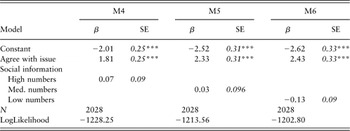
Donating to a cause is the next step towards supporting an issue. We report the results in Table 2. We find the initial support for the issue is highly statistically significant as with signing. However, we find no significant effects for the ‘low’, ‘middle’, or ‘high’ number treatments. We do not confirm our hypotheses for donations.
Logistic regression for donating to petitions

**P < 0.01, ***P < 0.001 (two-tailed tests).
We carried out a range of other tests, testing for results that would lend support to one or more of the arguments about variation in social information effects discussed above. First, we investigated whether the numbers of signatories as an independent variable yield statistically significant results (as opposed to using three dummy variables for low, medium, and high numbers). However, neither using the number of signatories for each petition nor its natural logarithm transformation shows statistically significant results.Footnote 5
We tested the effect of the ordering of petitions. Findings from social psychology and behavioural economics (see e.g. Ariely et al., Reference Ariely, Loewenstein and Prelec2003) suggest that order affects respondents’ decisions. As participants were shown petitions with varying numbers of signatories in random order, we investigated whether – for instance – the fact of being prompted to consider a fledgling petition just after a highly successful one could significantly alter a decision. Our tests do not substantiate such effects,Footnote 6 but it remains a relevant hypothesis to examine in future research.
Further, analogous to the compassion fatigue theory (Kinnick et al., Reference Kinnick, Krugman and Cameron1996), whereby a heightened number of public solicitations for charity are likely to drive out individuals’ empathy, we reasoned that participants who signed and donated to many causes initially may tend to decline to do so for the later petitions – not because of the petitions’ importance or likelihood of success, but because they reached their limit of compassion. We find this effect for the donating decisions of respondents, in that their likelihood to donate to the petition decreases with the number of solicitations during the course of the experiment. This effect is not present for signing decisions, however.Footnote 7
Discussion
Our results support the findings of previous work on conditional co-operation in charitable giving for a more political context, the signing of petitions. That is, when indication of a relatively high number of other participants is provided to potential participants, they are more likely to participate. The effect of social information in this non-pecuniary setting was commensurate with previous work on charitable donations and seems to be stronger than that observed by Frey and Meier (Reference Frey and Meier2004), perhaps the most directly comparable study because it also looked at the rate of participation rather than contribution amount. In our experiment, however, such an effect was only observed when the number of other participants reached the figure of one million, suggesting the existence of a threshold below which social information does not influence potential participants’ behaviour.
For arguments based on social pressure, we see that the mechanisms Olson described for small groups seem to apply now to large groups in the age of the internet, where real-time information about other participants is readily available. We do not observe the type of social pressure that would for Olson cause a rapidly rising participation when social information indicates that levels of participation are very low. In contrast, information that numbers are small seemed to have a negative effect for many of our petitions. However, we observe this effect at higher levels of participation, lending support to Lupia and Sin's (Reference Lupia and Sin2003) hypothesis.
We found evidence for threshold effects in the effect of social information on political participation that there is a tipping point when participation reaches a million at the higher end. The figure of one million is higher than what Oliver and Marwell (Reference Oliver and Marwell1988: 1) envisaged (but did not enumerate) as the critical mass for a large group and, indeed, the level of commitment demonstrated by signing an online petition in an experiment is far lower than anything they anticipated. In an online context, however, such information may provide a signal to potential participants that this is a group that can attain critical mass and thereby act as a signal of viability.
The findings therefore lend support to Schelling's argument about a tipping point where social information has an impact, which is where most people believe the number of expected participants is sufficient for them to participate. The importance of the one million figure and the mechanism by which it has an effect on behaviour remains open. The figures over a million were high in relation to the other social information provided to participants, but we did not ask subjects about expected levels of participation or whether they themselves considered these numbers to be high. We did not provide subjects with an estimate of the size of the latent group and so we could not expect them to estimate the figure as a percentage of potential participants. However, one million is less than 2% of the UK adult population and a far smaller slice of the global population, more relevant to the international nature of these petition issues, so it seems unlikely that this was the mechanism at work. It could be that it is just that one million is a large, significant, and memorable number, likely to attract media attention and act as a signal of viability for that reason. However, a further possibility could be that participants make some calculation of the absolute number of participants that a petition must attain to make a difference. The one UK petition that has been shown to have a significant policy effect is the petition against road pricing with 1.8 million signatories noted in the introduction. If we consider this figure to be the goal for participants, then the one million figure is around the half-way mark and not so far from the crucial 45% threshold that Schelling suggested would be the point that the majority of participants would join a mobilization. Of course, we are not able to test this possibility with these data; but it could inform the design of future experiments, where we might test the effects of providing subjects with a statement such as ‘Evidence suggests that petitions with two million signatories make a difference’.
We can make no clear assertion about the lower or higher ends of the participation curve. The fact that we saw no relationship between the number of participants and social information after the one million mark could support the tailing off of the participation curve after expected participation has reached about two-thirds as in Schelling's model. This too is worthy of further investigation.
Researchers into the bandwagon effect will find little comfort from these results. Evidence of crucial points where social information makes a difference, others where it does not, and others where it has a negative effect, goes against the bandwagon hypothesis, although the sometimes depressive effect of low numbers might lend some support to the disincentives to participation hypothesized in the ‘spiral of silence’ argument. As discussed above, researchers looking for bandwagon effects have tended to test the effect of dynamic information about trends rather than static information about actual numbers, meaning it is unclear where they would expect the bandwagon effect to start. Even if we were to hypothesize from our results that it impacts at one million, we would have expected to see a continuously increasing influence of social information after the crucial million was reached, which we did not.
Conclusion
We have investigated the effects of various types of social information on the willingness to participate in an online political mobilization, applying models of conditional co-operation, social pressure and noticeability, threshold effects and viability, and the bandwagon effect. Internet-enabled social information does not challenge the assumptions of these models; rather, it provides a new arena for the provision of information, which is likely to grow in importance along with growing numbers on the internet and with increasing frequency of its use.
Our experiments test a portion of Schelling's participation curve, and the results suggest that further research along these lines could prove fruitful. There seem to be key points where social information makes a statistically significant difference. We also found some evidence for a limited negative effect of information that middle and low numbers of other people have participated, supporting the lower end of Schelling's diffusion curve.
While research makes strong claims about how the internet enhances political participation, evidence of the dynamics of internet-based participation is much scarcer. Experiments of this kind could prove to be a fruitful way to establish specific internet effects on participation, as researchers have started to do in the context of charitable donations (Cotterill et al., Reference Cotterill, John and Richardson2010) and citizen redress (Margetts et al., Reference Margetts, Reissfelder and Escher2010). These results provide insights into the influence of one type of social information, the raw numbers of other people participating, but there is potential for further investigation into the influence of other types of social information, such as the number of other participants expressed as a percentage of the number required for a successful outcome (i.e. one that could be productive in attaining policy change). Other types of social influence might come from information about the personality and preferences of other participants, their socio-demographic status, or their experience of past participation (indeed, the significance of the results of Frey and Meier (Reference Frey and Meier2004) relied on experience of past participation as a control variable). Newer features of the internet allow for the provision of these other types of information, particularly those associated with so-called Web 2.0 technologies on the basis of user-generated content. These include recommender systems, reputation systems, blogs, user feedback applications, video sharing sites, and discussion streams such as Twitter. When used for political activities, these applications allow participants to see many other types of social information, such as other participants’ comments and feedback in real time or information about people with similar preferences to each other. They can see what other participants are willing to pledge if other people also participate (see www.pledgebank.org). These types of social information are likely to have an even greater effect on political participation as they become increasingly the norm for acts of political and social engagement.
Besides having methodological and theoretical implications, research of this kind could also inform the design of participatory initiatives, such as when it is advantageous to give information and when it is not. In designing the experiment, we found a large range of online petitions set up by non-governmental organizations and individuals, some of which gave no information at all about how many people had participated and some of which gave full information. Our findings suggest that there are circumstances where it makes sense to provide information when numbers reach a tipping point.
The findings could also have broader significance for public policy-making. The provision of social information is at the heart of the ‘nudge’ strategy, promoted by Thaler and Sunstein (Reference Thaler and Sunstein2008) as a way to encourage civic behaviour, less costly than other tools of government policy such as financial incentives or the use of authority and coercion. Although Thaler and Sunstein's book says little about the internet, their notion of ‘choice architecture’ is eminently suited to internet-based environments, where real-time social information can be provided to inform the choices that citizens make. Given that nudge interventions are being enthusiastically promoted by some national governments, particularly the UK's Liberal–Conservative coalition elected in 2010, the time is ripe for developing an understanding of how the provision of social information can be designed to nudge citizens towards pro-social participatory decisions.
Acknowledgements
The research for this article is part of a programme of work called Rediscovering the Civic and Achieving Better Outcomes in Public Policy project (see www.civicbehaviour.org.uk), funded by the Economic and Social Research Council, the Department of Communities and Local Government, and the North West Improvement and Efficiency Partnership, grant reference: RES-177-025-0002. We thank our funders. We would also like to thank all the colleagues who have provided valuable comments and constructive discussion on earlier drafts of this paper, including Josep Colomer; participants at the WebSci09 conference in Athens, 20 March 2009; participants in the panel on Contemporary Collective Action Dilemmas at the European Consortium Political Research general conference in Potsdam, 10 September 2009; participants at a seminar at IN3, Open University of Catalonia, Barcelona, 7 October 2010 (particularly Jaume López); and the three anonymous referees for European Political Science Review.
Appendix 1 Wording of petitions and numbers presented to subjects
Petition 1: Tibet
Statement: National governments should put pressure on the Chinese leadership to show restraint and respect for human rights in response to protests in Tibet.
Petition: We the undersigned call on the government to call an urgent meeting of the United Nations Security Council to discuss the current situation in Tibet and we petition Chinese President Hu Jintao to show restraint and respect for human rights in your response to the protests in Tibet and to address the concerns of all Tibetans by opening meaningful dialogue with the Dalai Lama. Only dialogue and reform will bring lasting stability. China's brightest future, and its most positive relationship with the world, lies in harmonious development, dialogue, and respect.
High: 1,682,242 [Avaaz, live]
Medium: 1,189 [my-cause-com]
Low: 76 [Downing Street, live].
Petition 2: Ban cluster bombs
Statement: National governments should negotiate and adopt a treaty to ban the use of cluster bombs.
Petition: Cluster munitions have no place in a civilized world. We the undersigned petition all governments meeting in Oslo in December 2008 to negotiate and adopt a treaty to ban cluster bombs with no exceptions, no delays, and no loopholes and provide all necessary assistance to affected communities and victims.
Medium: 330,000 [Handicap International http://www.handicap-international.org.uk]
Low: 7 [No. 10 Downing Street]
High: 1,200,000 [International Campaign to Ban Landmines, organized by Handicap International, see http://www.stopclustermunitions.org/]
Petition 3: End to whaling
Statement: Governments should lobby the Japanese government to stop commercial whaling of the humpback whale.
Petition: We the undersigned wish to show our support for an end to whaling, adding our voices to the global campaign to protect these precious mammals from extinction. We ask world leaders to force Japan to withdraw from its decision to reintroduce commercial whaling of the humpback whale.
Low: 98 [No. 10 Downing Street]
Medium: 57,299 [care2petitionsite, live]
High: 1,082,808 [www.whalesrevenge.com]
Petition 4: Protect the people of Darfur
Statement: Governments should support a stronger multinational force to protect the people of the Darfur region of Sudan.
Petition: We the undersigned petition the government to support a stronger multinational force to protect the people of Darfur and to seriously press for the establishment of a functioning ceasefire.
Low: 15 [No. 10 Downing Street].
Medium: 5,978 [www.petitiononline.com]
High: 1 million [The Save Darfur Coalition www.savedarfur.org]
Petition 5: Climate change
Statement: World leaders should negotiate a global deal on climate change.
Petition: We the undersigned petition world leaders to pull together an effective and fair global deal on climate change.
Low: 53 [No. 10 Downing Street]
Medium: 575,000 [Oxfam]
High: 2.6 million [petition to Hilary Benn, Secretary of State for Environment Food and Rural Affairs]
Petition 6: Fair trade
Statement: Governments should work to negotiate new trade rules – fair rules to make a real and positive difference in the fight against poverty.
Petition: We the undersigned press decision-makers and governments to negotiate for new trade rules – fair rules to make a real and positive difference in the fight against poverty – and to operate according to the principles of ‘fair trade’.
High: 17.8 million [Big Noise petition convened by Oxfam's Make Trade Fair campaign http://www.maketradefair.com/en/index.htm]
Medium: 22,777 [US version of the Big Noise at http://www.thepetitionsite.com]
Low: 25 signatures [No. 10 Downing Street]