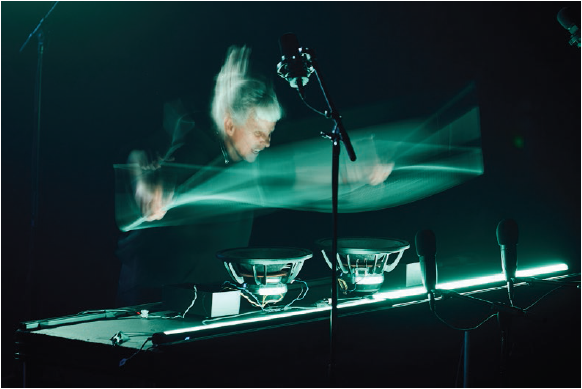
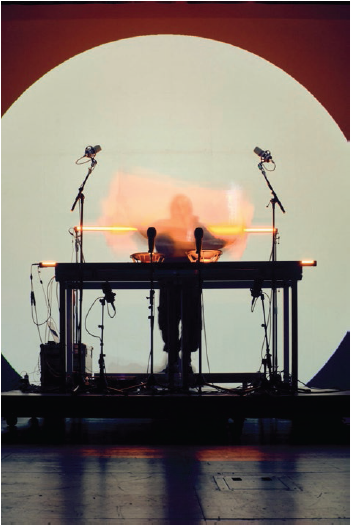
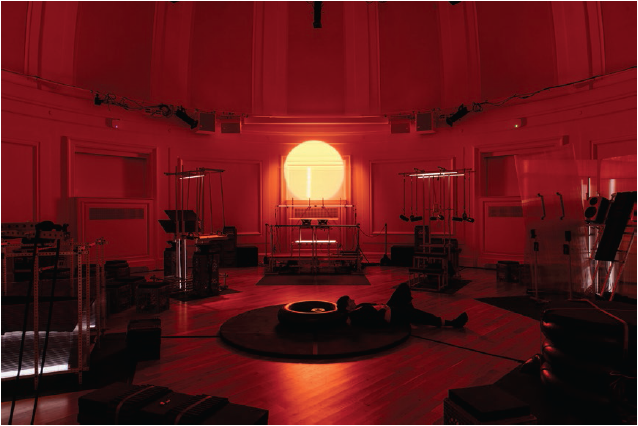
ANIMAL [for body and sound] live at Mutek Montreal, 2025. (Photo by Bruno Aïello-Destombes; courtesy of MUTEK)

This is not an essay about raving. It is a reflection on how sounds stitch together and enter the body at Berghain, and what those listening protocols reveal about power, relation, and time. It’s also a thought piece on my practice, the strategies of sounding and listening I pursue, and the deeper questions that draw me to a life in sound.
When humans music, something is always posited, practiced, affirmed in the act (see Small Reference Small1998). How bodies are arranged, how behavior is coaxed, what we wear, whether we speak, which sounds are sounded and how they are sounded all give rise to distinct structures of meaning. Richard Wagner, for example, puts us all in fixed seats, makes it dark so we can’t move, makes the stage super wide, throws the players in the pit so we can stare undistracted at his Gesamtkunstwerk. The ethics of the event are clear: center the genius, still the body, quiet the masses, homogenize the vantage point, anchor it to story, bind it to notation, spare no expense.
Berghain throws a different set of cues in the room. The sound is continuous, hypercontinuous, neither broken into tracks nor forced into arcs (you come when you come, you leave when you leave). Bodies are in motion, often with abandon. Vantage points shift (you roam, you renew). Speaker stacks hug two distinct dancefloors, but you carve your own intensity arc toward them, the volume knob and tuning dials are in your feet. Language is minimal or drowned out by volume. A DJ holds the space, but they’re tucked in a corner, barely raised above the dancefloor. They play the work of many, sculpting, layering. There’s only one price (contra opera tiers and boxes) and everyone (who gets in) can go anywhere.
How might we articulate the ethics latent here? Maybe: sweat is equity, making is multiple, sensation trumps story, bodies should be free. You raise it together, the dancefloor frisson; it asks for your energy and boomerangs it back, amplified and radiated through the efforts of others. The DJ is to be respected not reified. The sonic experience is bigger than the singular vision of one sole author. It asks through its pulse for the body’s submission; it asks through its loudness for our language brains to chill. The building is dilapidated, modernity’s debris: postindustrial, cavernous, concrete. So the subtext reads suspicious of overt wealth. No chandeliers or glass, no designer bags or heels, and no one can buy their way past the bouncers.
The moves toward crowd control and theatre design that Wagner made at his Bayreuth Festpiele still dominate Western classical music culture, and formed the set of strictures against which I (gnashed and) cut my teeth as a young composer. By the time I walked into my first Klubnacht at Berghain in early 2018, I had spent over 15 years at the noisy edge of contemporary music, trying all sorts of tactics to reassert the body and challenge the power structures at play in that cerebral, modernist form. I’d use visceral noises and thick, wild timbres that shot right to the skin of listeners; craft intricate choreographic notations to accentuate the muscular efforts of performers; spread sources of sound all throughout a concert hall to scramble the proscenium power codes in the room. But Berghain blew open my sense of what a collective sono-somatic experience could be, and the encounter with listening I had there catalyzed transformative expansions in my practice.
Tracing these vectors through my creative work maps the spatial dynamism, relational agency, and full-bodied expanse of the club onto an affective range that stretches far past four-on-the-floor rhythmic formulas. To situate this sonic terrain between the club and the concert hall, I also consider the protocols that structure two distinct cultural events: a Klubnacht at Berghain and a typical night with the New York Philharmonic. Both of these sites are pinnacles in their respective domains: Berghain, a revered temple of techno; and David Geffen Hall, a pillar of Western classical music—and both have housed pivotal premieres for me as an artist. Reading their respective differences enlightens how collective listening experiences articulate social hypotheses through the internal dynamics of the musics they mobilize and the relational intricacies of the encounter itself.
Acts of listening are never neutral. Every sonic architecture—club, church, concert hall—scripts relations of power, embodiment, and time. Here, I examine how these protocols operate, and how my own work tries to rewire them.
After the forceful impact of my first night at Berghain, I knew I needed to crack what I’d found so arresting about the experience—why it felt so distinct from any collective listening encounter I’d had prior. I entered that space in a situated, historically implicated body: a 30-something white, queer, cis female composer trained in the privilege of Western institutions. Techno was born in Detroit and forged through histories that precede and exceed me; it didn’t emerge for my benefit, nor does it belong to me. My aim is not to claim Berghain as my own but to trace how my body was reorganized by it, how the lived experiences I had there unsettled habits of listening, authorship, and hierarchy imprinted on me since childhood. My interests lie not in the aesthetic surface but the social and sonic force of Berghain—how it troubles modernity’s defaults through a profoundly physicalized experience of sound.
The reason that first impression felt like a rupture had partly to do with time. Klubnachts are Berghain’s weekly techno marathons. On most weekends, they open at midnight on Saturday and continue without pause or silence until closing Monday morning. The flow of sound is ceaseless across that expanse. Track to track, DJs match tempos and subtly modulate parameters to avoid even momentary discontinuity. Sets typically run four hours, with the “closer” extending that duration to six, and historically up to eleven. (Eleven hours is a phenomenal amount of time to ride an arc of sonic tension, to hold and tune the collective trembling of a dancefloor.) Transitions between DJs are marked by cheers but never by silence; there is no interval music, no structural reset, only a carefully calibrated handoff that maintains the forward propulsion of the room. This macro-continuity is reinforced by a micro-continuity of unbroken four-on-the-floor beat structures, a kinetic protocol whose mimetic pull borders on instinctive; play a techno beat for a toddler and watch their primal coding take hold. Add to that the absence of windows, the lack of sunlight, the time-warping, ego-dissolving substances moving through many neurochemistries in the space, and a very particular expansion of the temporal field unfolds.
This durational logic stands in stark contrast to nearly every other common sonic form. Pop stars rile up the crowd with words; movements in a symphony are separated by silence; even multiday festivals punctuate sets with interval music and overnight breaks. These gaps frame authorship and chop sonic flux into timescales that can circulate through commodity culture. The lack of interruptions or silence at Berghain—plus the scratch, blur, and molding of the DJ’s hand—deemphasizes the boundaries of any single track. What arises through the unbroken flow of sound and the charged energy of the dancefloor feels less like the output of discrete egos and more like an emergent form generated through the efforts of many.
Space also played a role in my reorientation. Berghain is housed in an old thermal power station in former East Berlin, three floors cut through by an atrium that extends up the building’s towering height. Two Funktion-One sound systems anchor the smallish dancefloors on the second and third levels, but the sounds they blast out ricochet through the entire concrete expanse (technically, the second-floor “Berghain” system is what carries through the atrium and ground floors; the third-floor music stays pretty contained in Panorama bar). Unlike listening experiences that pin you to a fixed position, mobility here exposes how profoundly physical architecture alters acoustic experience—with each precise location receiving a distinct path of vibration from sound source to ear. Cathedrals are designed to do this too: to take a priest’s voice or the air from an organ pipe and ripple it through a massive stone structure so it sounds more-than-human, so it points to other scales of power and time. Berghain pries cathedral listening away from religion. In contrast to Wagner’s homogenized vantage point, its ever-shifting auditory field heightens the sense that listening is contingent, not universal, and that sonic “objects”—even those that are an authored “piece” of music—are not fixed forms, not a thing dropped into a neutral container, but phenomena continuously coshaped by bodies, materials, and space.
And then there was the near-total evacuation of language. On several fronts: (1) It’s fucking loud. You cannot talk and be heard on the dancefloor, so you stop trying. Around the peripheries you can talk, but only by huddling close, lips-to-ear, so there’s an enforced intimacy even when language is invoked. (2) Berghain fronts a hard, minimal strain of techno with far fewer vocal samples than the house tracks that populate Panorama (the third-floor bar). When voices do emerge, they tilt robotic, repetitive, stripped of confession and identity. Language, and the left-brain cognitive processing it demands, is decentered both in the music itself and in the acoustic conditions of the space.
Making low sounds loud requires an inordinate amount of physical force. Some symphonic instruments can graze the sub-bass zone—pedal tones on the tuba, the lowest string of the double bass—but they do so with quiet fragility (and oh so much beauty). The cut-through-the-hall acoustic force of an orchestra lies in the upper reaches of piccolos and trumpets. Berghain’s subwoofers flip this spectral focus completely. Their amplified power activates an entirely other region of bodily listening, one that draws attention away from the mid-range of speech and hits directly at the gut.
You can also walk right up to the speaker stacks at Berghain. And unlike lesser systems, they don’t shred your ears when driven at full throttle. I’d always had that kind of proximity to the sounds I composed with; the multiphonics on a detuned cello string were in my hands and inches from my ear before I ever heard them on a distant stage. Listening to my work performed far away often felt alienating, out-of-body. So the high of being that close to the orbital launch of vibration with others was a skin-based pleasure I found both recognizable and startlingly new.
And all of this was scaffolded by a ritual of entry that disarmed the ego step-by-step. First, the waiting: long lines in the dark, where being reverent and quiet helps (though never guarantees) your chances of making it past the bouncers. If you do get in, your stuff is checked, your body patted down, your phone camera stickered (no photos, no videos). You enter the coat check, strip down, gear up. Exchange your outside clothes for a number.
Then comes the extreme, extended exertion (12 to 16 hours is my typical range, though there are many who are more hardcore than I), the beat-driven, integrated movement with others, the thick haze and strobe lights that deemphasize the dominance of sight, blur bodies, and disorient the contours of the space. Layer onto this all the lacks: no star on a stage, no spotlight on the DJ, no longform solos or confessional lyrics, no mirrors or cell phones or selfies, no VIP cordons, and a general inhospitality to language itself. Taken together, these conditions produce a striking absence of hierarchy in the dense aggregate of bodies, and (in my experience) a finger-by-finger unclenching of the ego’s grip across the arc of a night.
If we think of an evening with the New York Philharmonic as a generative contrast to a Klubnacht at Berghain, a wholly different set of conventions and ethics emerges. In place of the durational expanse, relational agency, spatial dynamism, bodily abandon, and amplified intensity described above, it is hierarchy, obedience, and separation that are coded into Geffen Hall at every scale. Audience members sit in fixed seats mapped according to price (tickets for a regular season orchestral concert ranged from $60–480 in early 2025). Seats all angle towards the stage, which performers access from their own entry, never intersecting with the flow of the crowd (separate groups, separate spaces). An all-powerful conductor commands the room with the flick of a stick. Notated music anchors the experience and enshrines a rationalist approach to sound that emerged from a medieval emperor’s desire for social control. Each instrumental family is ranked by “chair,” with power and prestige distributed accordingly. And then there’s the opulence of the building itself, which announces—through its glass and steel, its grand foyer and chandeliers—that those who esteem this music have the capitalist force and municipal might to construct a building expressly to house it. Christopher Small captures the totality of this scene with stark clarity in Musicking: The Meaning of Performing and Listening:
Whatever the event may be celebrating, it does not seem to be unity, unanimity or intimacy, but rather the separation of those who produce from those who consume and the impersonal relationships of a society whose dominant mode of relating is through the passing of money. (1998:74)
For Small, meaning emerges from the set of relations a collective act of musicking brings into being.
Many of these spatial and social conventions trace back to the shifts in opera house design Richard Wagner proposed for his famous Festpiele at Bayreuth in the 1870s (see Bishop Reference Bishop2024:13). Wagner despised the raucous social energy of operagoers in his day, and he thought the issue lay partly in the horseshoe shape of theatres common at the time, which encouraged crowds to ogle each other more than they watched the stage. So Wagner did away with that horseshoe shape and its multiple tiers and put the entire audience in a single plane of seats that faced frontal towards a massive stage. He stuck the orchestra in a recessed pit so as not to block sightlines to the drama onstage and plunged the houselights into total darkness so the audience couldn’t get up and mill about. These choices, radical at the time, encoded a worldview into the walls. Again: quiet the masses. Still the body. Center the genius. Homogenize the vantage point. Lock it to script. Bind it to notation. Spare no expense.
The historical roots of the notation system that codes Wagner’s operas and all of Western music traces back to the reign of Charlemagne in the 9th century CE. As Christianity expanded across his disparate Holy Roman Empire, Charlemagne grew concerned by the many local variations in chanting used by priests in different regions. In order to better control his subjects, he wanted to standardize these liturgical practices, to make sure he knew exactly what was being sung to them at all times. So he launched a mission to find a system to write down sound, which forms the basis of the five-line staff still taught in Western music conservatories today. Notated music draws a boundary between the literate and the illiterate (and to become literate, one needs to be taught, which requires institutional access and resources); makes precision and fidelity to the absent author the sonic ideal; consolidates power in the hands of the conductor; and pushes Western instruments toward ever greater standardization of timbre.
If notation centralizes authorship and expertise, the technologies that seeded techno distribute both. The Roland 808 and 909 drum machines that form the rhythmic core of early hip hop and techno put the power to create ceaseless grooves in an object that fits in a backpack. New virtuosities emerged from these machines that grew into vibrant new musical terrains. The digital audio workstations used by producers today trace their logics back to these early rhythm makers, which democratized access to sonic production and made sampling and remixing accessible.
In the orchestral world, on the other hand, expertise remains tethered to capital. When you look at the NY Phil’s stage and start to run the numbers—the decades of rigorous (and expensive) conservatory training behind each performer, the cost of the world-class violins and harps and trombones, the architectural price tag of the hall itself, the staff who run, clean, tune, and light it—the scale of financial investment is staggering. That performance of capital also radiates outward: through the glass and chandeliers and the dress and social codes of those who attend. Even the name of the hall itself celebrates a mega donor.
Club culture is hardly immune from aesthetic monetization (witness the Berghain-to-Balenciaga pipeline tracked by Diana Weiss [(2021) Reference Weiss2024]),Footnote 1 but the experience of a Klubnacht is comparatively resistant to luxury’s more overt logics. One ticket price. No VIP cordons. No merch tables. No corporate sponsorships. No photo wall of famous patrons. Get caught posing for a selfie and you’re banned. Add to that the relative accessibility of the door price, the resistance to stratification, the stripped-down bodies, the endless duration, the subwoofer gut punch, the architectural vastness, the fog, the lights, the bouncers filtering out the bros and gawkers and drunks, and you get a very different proposition for being-a-body-with-other-bodies than what Geffen Hall serves up.
What I’m trying to surface is that obedience, hierarchy, and separation—the values of colonial modernity—are grafted into classical music at both micro and macro scales. They appear in the organization of bodies; in the centrality of written notation; in the fiction of architectural neutrality; in the proportional rhythms and unilinear time of orchestral form; in the deference to the conductor; in the engineering of instruments toward predictability and coherence; in the ranking of performers by chair; in the separation of ensemble from audience; in the lionization of donors; in the mapping of proximity to price; and in the staggering financial machinery required to keep the whole system alive.
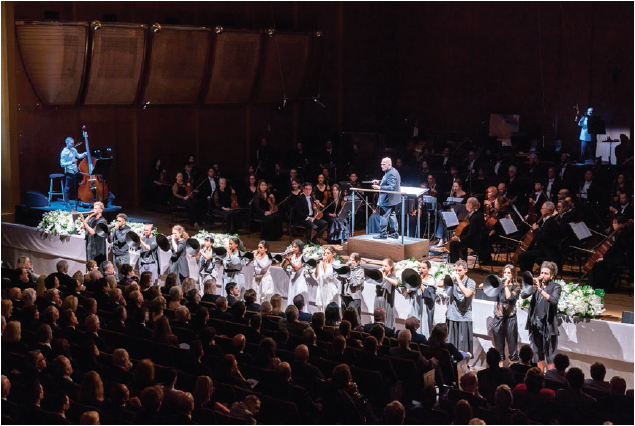
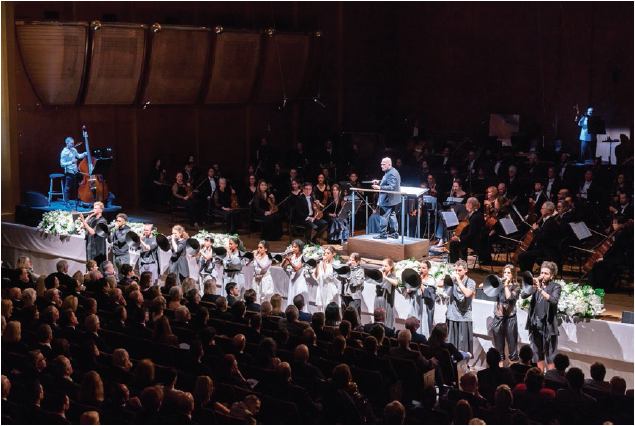
My compositional work inside the concert hall aimed to loosen and rewire its strictures from within. In Filament: For Trio, Orchestra, and Moving Voices, commissioned and premiered by the NY Phil in 2018, I set out to charge the relational field of Geffen Hall with a different kind of intimacy and spontaneity; animate a spherical sense of listening where sound could hit the body from any direction; work with the physical acoustics of the building so that its active impact on the sound could be sensed; draw attention away from the stage and into an expanded field of focus that included the space of the audience; break the price-for-proximity hierarchy; compel the conductor (for the premiere, Jaap van Zweden) to reckon with and relate to energies that were all around (and not just in front of) him; and create a longer rehearsal process than the monetized-down-to-the-minute (and insane brevity) of contemporary orchestral rehearsals.
Filament by Ash Fure. Live at David Geffen Hall, 21 September 2018. Featuring the New York Philharmonic conducted by Jaap van Zweden, with soloists Rebekah Heller on bassoon, Brandon Lopez on double bass, Nate Wooley on trumpet, and the Constellation Choir. (Photo by Chris Lee; courtesy of New York Philharmonic)
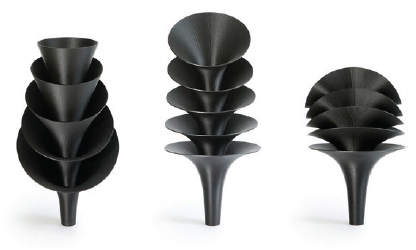
Filament’s megaphones, designed by Matter Design. (Photo by Brandon Clifford)
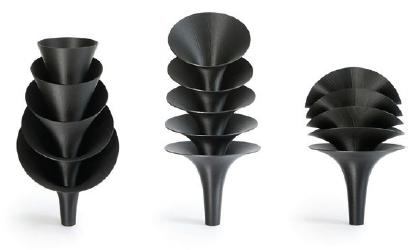
My strategies for doing this were manifold, but I’ll pull just one thread now. I knew I wanted bodies in the space somehow—to distribute energy, activate the architecture, and disrupt the audience’s unilinear focus—but I also knew I didn’t want music stands or microphone cables pinning performers in place. So I worked with architectural collaborator Brandon Clifford to design custom 3D-printed megaphones that were extremely loud (without electricity) and highly directional. If you found yourself in the jet stream of one you could feel the whispered hiss of a performer 40 feet away. Sounding at full force through them towards the curve of the ceiling or the plane of a wall allowed the resonant bounce of the architecture to surface with startling clarity. These singers formed a mobile, energetic force that animated the entire auditorium, from the “cheap” seats to the stage, and compelled the conductor to feel and communicate not just with the battalion of virtuosos arrayed obediently before him but with an ecosystem of sound that extended behind him and beyond the stage. It also cracked open an uncommon intimacy in the audience itself: two people turning toward different sound sources might suddenly catch each other’s gaze at close range, puncturing the parallel solitudes concert halls typically enforce.
Sitting in the balcony during the premiere of Filament—and through all four runs—watching the crowd arrive, assemble, assume the postures of the known, then disarm bit by bit: bright-eyed, wondering, excited, unnerved, turning left, right, looking up, closing their eyes, sensing the room, feeling each other, making choices, navigating a shared sensory-intensive experience through the bodied intelligences they were born with—that’s when I realized: ohhhhh.
The composed work of sound is crucial—it shapes time, massages the nervous system into states of arousal, catharsis, ease, alarm, release, spatial acuity. But the authored form, as an expression of self, in and of itself, is not the end goal.
If Filament staged these provocations inside the disciplinary shell of the concert hall, Hive Rise marked another threshold: the chance to work inside Berghain itself, not as a listener but as a maker. Almost two years to the day after my first Klubnacht, I had the deep privilege of premiering a work there during the 2020 CTM (Club TransMediale) festival. CTM is one of the few times a year that Berghain is activated outside club mode and open to sonic experiences that break from the protocols of techno. The baseline conditions of the space—and the vectors of intervention they enable—are in many ways the inverse of Geffen Hall. If at Geffen I wanted to disrupt the unidirectional focus of the crowd, at Berghain I wondered whether I could draw that attention toward the knife’s edge of silence within a space so habituated to amplified overwhelm. Could I bring the subtle energies of the performing body into the live electronic realm? Could I cultivate human-to-human listening inside a room defined by mass mediation?
The Filament megaphones were key to the solve. I used them in Hive Rise to activate an ecosystem of ASMR-level whispers and tongue clicks sent straight to the skin of listeners. Twelve megaphonists bobbed and weaved through the crowd in subtle sonic choreographies, climbing onto custom plinths, designed by architect Xavi Aguirre, to scan above the dancefloor like searchlights—calling out with full human force into the amplified void around them.
I was on a low side stage, performing live on a custom instrument built with speaker cones projecting sound too low for humans to hear. This bottom edge of audible perception—where seeing and hearing crossfade—has become a central site of inquiry for me: a space where the body re-learns how to sense past its own limits. A strange thing happens to the eye and the ear at this exact threshold. When a speaker cone moves fast enough to generate airwaves humans perceive as sound, its physical motion blurs into stillness, like stop-motion animation or a camera’s frame rate. (If we can hear it, we can’t see it move.) But when a cone moves too slowly for humans to hear—below roughly 20 oscillations per second—our eyes begin to parse that up-and-down motion, the engine of the air puncher revealed in all its blunt glory.Footnote 2 (If we can’t hear it, we can see it move.)
Hive Rise at LA’s MOCA Geffen, 19–20 October 2021. Scenic architecture by Xavi Aguirre. (Photo by Sam Richardson)
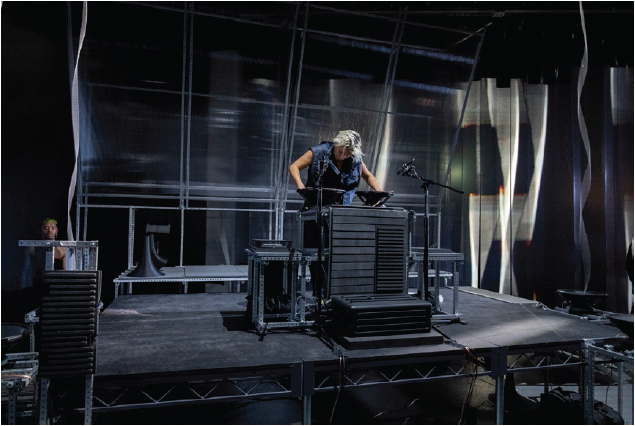
In Hive Rise, I play that slowed-down action of a speaker cone pumping out the otherwise inaudible sound, letting its palpitating surface slap against my knuckles, palms, nails, and forearms. What emerges as perceptible is not the subaudible sine tone itself but the impact of the speakers as they strike against my body and all my body brings. It’s a pulse borne of physical confrontation; polyrhythm emerging from the conflict of touch; an unbroken flow of ictus and accents generated by bodies and objects in flux.
The instruments I design work with kinetic fields of energy that carry their own internal momentum and force. Meeting them in performance means adapting to—and reckoning with—an active, animate landscape. Virtuosity requires not fixity or control but a muscular intelligence tuned toward the live friction of matter. If Western instruments lie inert until performed, and MIDI loops obey with machinic precision, the custom instruments I create cultivate a lively, dynamic baseline condition that makes performance feel less like hammering and more like surfing.
If Hive Rise probed the threshold between touch and sound, ANIMAL [for body and sound] extends that inquiry into even more body-forward terrain. My setup uses two 12-inch coaxial speaker cones face up in an 8-foot square of tube lights. I stand inside that shifting frame of light, holding a 2’x4’ sheet of polycarbonate plastic. In contrast to Hive Rise, the speaker cones here pump out a thick (audible) web of sound, which I warp in real time by waving and pressing the polycarbonate plane above them. The process is intensely physical, both in terms of what it asks of my body and in terms of the blunt pool-ball physics it deploys—no sensors mapped to digital effects, just the brute force of molecules bumping molecules.
Think this path with me: lying on their magnet backs, the cones shoot soundwaves straight up to the ceiling. I intersect that jet stream of energy inches from its point of release, using the angled plane of polycarb to beam sound out into the room like a laser. Pressing the plastic sheet straight onto the cones adds friction-filled distortion as it grinds against the drivers. Shifting its height depresses or accentuates different parts of the frequency spectrum. So there’s live spatialization and bump-and-grind friction and the physical filtering of sound and light, all fluidly unfolding and reflecting off the architecture as I whip and whirl the plastic through the air.
The blunt materiality of this system is key to the abandon it opens up for me in performance. The setup requires no sensors, cameras, motion tracking or click tracks: just a wide-open spherical listening to the space and a muscular attention to the present. The filter sweeps in ANIMAL aren’t inside the soundfile, and aren’t tied to a MIDI knob, they’re in the live collision of molecules in the room, in the play of energy and movement and matter that constitutes precisely at that exact moment. This hyperlive, athletic approach to form gives ANIMAL its conceptual punch and throws a side-eye wink at AI models prowling the perimeter of digital music’s domain: like, algorithm this motherfucker, I dare you.
ANIMAL [for body and sound] live, composed and performed by Ash Fure. Berlin, Germany, 27 January 2025. (Photo by CTM)
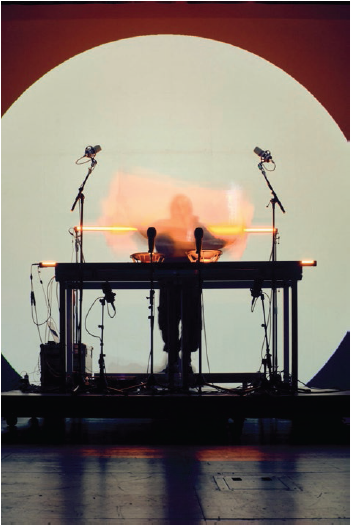
Not every sound opens up to this kind of molding through thin air. The rabbit hole dive—the intense empirical research behind ANIMAL—lay in seeking out sounds responsive to this kind of touch and stitching them into an elastic sonic surface I could bounce off in live performance. Much of the rhythmic content in ANIMAL draws on impulse responses: full-spectrum clicks used by audio engineers to measure a space’s reverberant qualities, usually when modeling reverb algorithms. These clicks surface the frequency regions each building naturally accentuates or dampens, as well as the decay patterns embedded in its structure. (Older reverb plugins let you simply tweak decay time; now you can “place” a digital sound in the nave of a very specific, real-life church.) Like the megaphones in Filament or the open atrium of Berghain, my ability to laser-beam these clicks around a room highlights each architecture’s acoustic character. To do this, I have to hear past the amplification, train my attention on deep-order reflections, notice hotspots and odd geometries that make a reverberant structure feel uniquely alive. It’s a nonneutral mode of listening—one that shifts attention away from a fixed, authored object in a supposedly neutral vacuum and toward a shared complicity of bodies, sound, and space, where everything present—right here, right now—shapes the work’s emergent form. The polycarb that flies between my face and the audience in ANIMAL has some kinship with techno atmospherics. Because of its lines and translucency, the polycarb warps light as well as sound, distorting the backlit shadow of my body as I move. The piece unfolds in total darkness except for the shifting intensities of the tube lights woven into the temporal structure. From the vantage point of the crowd, one senses intense exertion and physicality, but the blur of the light plane and the speed of its motion scramble clear visual access to my face. Like dancers dissolving in fog, the visual field turns liquid and blurred—distilled into a concentrated release of energy, exertion, permission, abandon.Footnote 3
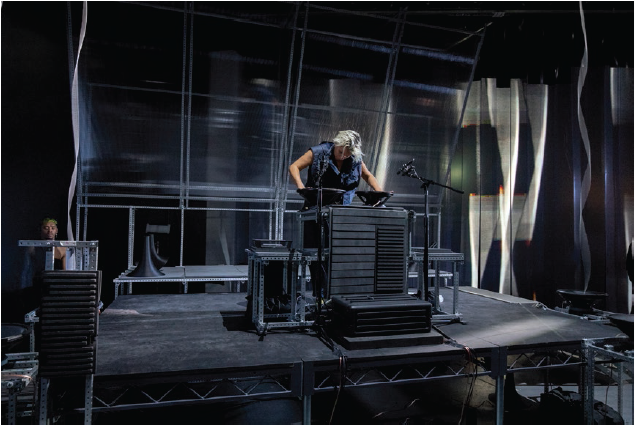
ANIMAL [the listening gym], by Ash Fure and Xavi Aguirre. Commissioned by the Schwarzman Center for the Arts, Yale University, 21–28 October 2023. (Photo by Brooke Holm)

The sonic arc of ANIMAL unfolds in one unbroken 38-minute flow—without words and without any release of my focus or grip on the polycarb. While 38 minutes is far from a Klubnacht’s 30 hours, there is a kind of dancefloor adrenaline summoned by the continuity of my exertion and the live massaging of an energetic thread through a variegated landscape of time. I am also inevitably drenched in sweat by the end of the performance. The intensity of that physical abandon contrasts sharply with the behavioral norms of classical music. But it also flips a cheeky feminist wink at the disembodied knob-twisting and laptop shielding of most live electronic music. It’s erotic, athletic, and transparent to the crowd. You can see the sound being molded before your eyes, not locked behind a screen or a tangled patch of cables.
The instruments I build all have a kind of untamable kineticism that challenges the principles of obedience and control built into Western music. They resist notation, resist symbolic semantic reduction, but more than that critical posture, they manifest a certain kind of wonder-based listening. People often rush the stage after ANIMAL to try and understand what is happening in the rig. It reads like magic. It shouldn’t make sense, or at least they think it must involve some kind of high-tech sensor-based wizardry, not the simple bump of matter and air. For myself and for many I’ve shared the work with, the strangeness and specificity of this phenomenon opens an invitation to a different kind of listening, something more curious, more beginner’s mind, more rapturous in the body and the attentional field.
ANIMAL [for body and sound] exists in a series, each work sharing sonic DNA and a body-forward listening ethic while operating at different spatial scales (as indicated by their subtitles). Where ANIMAL [for body and sound] is a solo performance—compact enough to tour in a couple of PelicanTM cases—ANIMAL [the listening gym] is a gallery-scaled installation, and ANIMAL [the underground] is a site-specific sonic takeover of an entire architecture. ANIMAL [the underground] is set to debut in 2026 in a massive concrete basement underneath an old masonic temple in downtown LA. The site is vast and acoustically startling, with a labyrinth of concrete columns and a huge, crumbling empty pool.
I think of the project as an underground listening gym: a space of collective, sound-fueled focus that is body-amped and adrenaline-tuned. It features a sea of subwoofers and speakers that activate the architecture as a resonant force, and a custom rig of full-bodied “listening gym” machines that spread throughout the space like stations at a gym. Made of foam, ratchet straps, metal strut, speaker cones, and polycarb, and designed with architect Xavi Aguirre, these zones riff on kink club or circuit workout logics: a sequence of sonic propositions to the body that offer intense, haptic access to sound. The gym machines function not to force participation but to raise the stakes of bodily investment without relying on a dancefloor (and all a dancefloor demands of music and audience). They also shake loose a different kind of listening, as though they vibrate the words right out of your brain and kickstart a heightened corporeal awakeness in uncommon proximity to strangers.
Liveness saturates ANIMAL [the underground]: in the 200-foot resonating metal cables that stretch across the building’s infrastructure; in the friction and grind of polycarb and speaker cones thrumming through the gym machines; in the ricocheted echo of the empty pool as it rebounds spatial sound across its expanse. And there are bodies doing, being, listening, everywhere in the shifting light. It’s just that it’s your body—your liveness, your listening, your interior arc through a durational flow of sensation.
For all its monumental scope—the empty pool, the labyrinthian concrete, the tectonic waves of sound—ANIMAL [the underground] shapes encounter at the scale of the bonfire, the bathroom line, the coat check bench. The crowd is mobile but the listening is thick, and the sites of assembly, of body-ready architecture, are distributed, intimate, and posture-varied. These moves break away from proscenium forms that are frontal, optical, stationary, and totalizing, elevating queer modes of attention that are bodied, sensorial, relational, partial, spherical, emergent, and unfixed.
Within this relational experiment, I’m trying to recuperate some of the social questions posed in those early days in Berlin, right after the wall came down, when everything was an unanswered question, a living experiment, with techno its pulse. ANIMAL [the underground] shapes a sensory architecture, charges a social sphere, lays out some ground rules (no talking, no phones), some invitations to the body, but leaves the aggregations, the agency, the reckoning with where to be when and for how long—in the deep end of the pool, in the gym, on a bleacher—in the active hands of all who move through.
This open spatial and durational structure calls forth Tyler Bradway’s “strategic” sense of form. In “Queer Narrativity and the Relationality of Form,” Bradway thinks through formal strategies “as patterning arrangements that move promiscuously across social, aesthetic, material, and other domains.” He writes:
Narrative is not a master form that organizes everything in its orbit; it collides with, changes, and is changed by the forms it encounters. Thus a strategic approach enables an analysis of narrative’s queer interactions with social, corporeal, temporal, and other forms. (2021:712)
All of the ANIMALs operate in this register: tightly composed sensory architectures that collide with the shifting decisions of a crowd (in the installations) or the live motion of my body (in the solo). Form becomes not a site of constriction but an elastic surface to bounce off in an emergent experience. This affordance invites a kind of generative loitering—a being-a-body-with-other-bodies—that echoes Jenny Odell’s call in How to Do Nothing to “wrest our focus from the attention economy and replant it in the public, physical realm” (2019:xii).
ANIMAL [the underground] vivifies this public, physical realm. It manifests a sensory-intensive social sphere that functions entirely outside language. It pursues the spatial expanse and full-bodied sonic swallowing of the club, but with an appetite for form and an affective range that draws far outside the lines of dancefloor formulas. It activates the relational agency of the crowd, and the durational expanse of a more-than-authored form, but with wordless questions posed about the codes of copresence that govern the social contract at play. It works with the primary friction of sound, the rub, the collision of matter and molecules, rather than digitized patterns, MIDI knobs, or notated scores. Its orchestration aims at the nervous system, playing on the body and the body politic, leveraging the visceral impact of sound to get at its social force.
I once heard a story from Katy Payne that stopped me in my tracks. Payne—a pioneering bioacoustician who transformed our understanding of how animals communicate—spent years listening to elephants and discovering, among other things, that they use sub-bass frequencies far below human hearing to communicate. In one interview, she described watching a herd roaming the savannah—all rumbling and rowdy, as elephants are—when all of a sudden, every single one of them froze. Dozens of animals in flash-mob stillness for over 60 seconds. Payne was stunned. What had she witnessed? What signal had passed between them? She later learned that this startling synchrony occurred when a matriarch sensed far-off danger (in Tippett Reference Tippett2007). On her subtle, forceful, silent cue, the herd stopped cold so they could hear the horizon. In the face of risk, they listened—fiercely, together.
Music is an ancient technology. Humans have used it since the dawn of the species to bind groups, orient attention, mobilize action, amplify sensation, and metabolize emotion. Every human culture, on every single continent, has left evidence of prehistoric rituals involving animal masks, drums, and unified movement. In Dancing in the Streets—her study of ecstatic collectivity and the centuries-long legislation of such togetherness out of European life—Barbara Ehrenreich links our hunger for connection to the fundamental softness of our mammal bodies:
Taken individually, humans are fragile, vulnerable, clawless creatures. But banded together through rhythm and enlarged through the artifice of masks and sticks, the group can feel—and perhaps appear—to be as formidable as any nonhuman beast. When we speak of transcendent experience in terms of “feeling part of something larger than ourselves,” it may be this ancient many-headed pseudo-creature we unconsciously invoke. (2006:30)
Ehrenreich points here to the species utility of sound, how we use it as animals to activate an integrated intelligence more powerful than we could manifest alone. She quotes anthropologist and evolutionary psychologist Richard Dunbar in the book, who argued that music provided a crucial evolutionary counterpart to the left-brained machinations of language and order.
Just as we were acquiring the ability to argue and rationalize, we needed a more primitive emotional mechanism to bond our large groups […] Something deeper and more emotional was needed to overpower the cold logic of verbal arguments. It seems that we needed music and physical touch to do that. (Dunbar Reference Dunbar1996:148)
Sensory attunement is not ornamental—it is a survival mechanism. It strengthens our ability to move, feel, and focus as a collective force.
Yet the dominant cultural architectures of listening—shaped by hierarchy, separation, and capitalism’s pressure to sell thyself—train us toward atomization. Techno protocols pull us back towards the herd, towards models of time and space and togetherness larger than the centering of any single voice. And yet, club culture too has its risks and limits, its danger zones, its constrictions. While I have (at times) had profound experiences there, I have also (at times) seen the Black force of techno drained into a pale aesthetic shell. I have also (at times) seen the pull of the club trap loved ones in a dizzying boomerang of ecstasy and depression, precarity and drugs, exuberant togetherness and toxic isolation. When I turn my practice toward this terrain, it’s not in search of surface signifiers, drum rack patterns, or codes of coolness. I’m looking for the deep-sea DNA resistance, for the cracks it chisels in modernity’s shell.
If being together is something we practice, then every site of listening is a social training ground. Bodies are arranged. Attention is choreographed. Power, relation, and time are scripted. But shifting the conditions of listening can also unscript these codes—rewiring perception, redistributing focus, retuning how we sense one another’s presence and the world around us.
Concert halls rehearse one social order; dancefloors another. My work tries to widen the field of what becomes possible through these practices. It asks what futures our collective acts of listening prepare us for—what forms of relation they prototype in our nerves, our lungs, our pulse. And it asks what it might take for us to learn to listen like elephants: trained on the horizon, in our bodies, fierce, awake, together.