Although rare in children, constrictive pericarditis can result from viral pericarditis, tuberculosis, incomplete drainage of purulent pericarditis, haemopericardium, mediastinal irradiation, neoplastic infiltration, or connective tissue disorders. All these conditions can lead to a thickened fibrotic pericardium, which restricts the diastolic filling of the heart, leading to cardiac failure. Usually, acute pericarditis in children responds to timely and adequate pharmacological therapy.Reference Lange and Hillis 1 Hence, pericarditis requiring surgical intervention in children is a rare occurrence. We discuss our experience in surgically managing constrictive pericarditis in children <15 years of age over a 10-year period.
Patients and methods
This retrospective study includes 27 children <15 years of age who underwent pericardiectomy between January, 2002 and December, 2011 at All India Institute of Medical Sciences, New Delhi, India. The study protocol was duly approved by the institute ethics committee, and the need for individual informed consent was waived off. These children were identified from the operation register and their medical records were reviewed for detailed data regarding the clinical history, diagnostic work-up, course in the hospital before surgery, surgical details, post-operative stay, and condition at discharge. Follow-up of these patients was assessed by reviewing the cardiac clinic files, which contained the details of their follow-up outpatient clinic visits, and by contacting over telephone regarding the present medications and functional status.
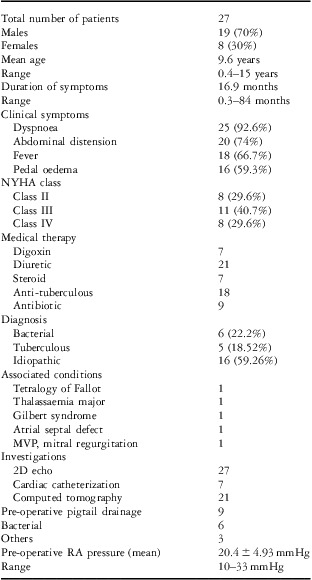
The mean age was 9.3 ± 4.96 years (median 11 years, range 0.4 to 15 years). At presentation, the mean duration of symptoms was 16.9 ± 22.15 months (median 8 months, range 0.3 to 84 months). In all, 25 (92.6%) children had dyspnoea as the predominant symptom and eight were in New York Heart Association (NYHA) class IV. There was one child who had thalassaemia major and another child had Gilbert's syndrome. All were in normal sinus rhythm. There were three children who were detected to have additional intracardiac defects, which were atrial septal defect, tetralogy of Fallot, and mitral valve prolapse causing moderate mitral regurgitation.
The spectrum of clinical scenarios consisted of tuberculous pericardial effusion with constriction (n = 5), pyopericardium with constriction (n = 6), and chronic constriction without any antecedent cause (n = 16).
In all, 10 children were admitted to the hospital for management of cardiac failure and underwent medical management for a mean of 13.8 days (median 10 days) before referral for surgery. The rest were worked up on outpatient basis and were directly admitted for surgery, being symptomatically stable on medications. Only nine children had a proven history of tuberculosis for which a full course of anti-tuberculosis treatment had been administered. However, a total of 18 patients were receiving anti-tuberculosis medications at the time of admission to the hospital.
Of the 10 children admitted for medical stabilisation, seven underwent pigtail drainage of the pericardial fluid under echocardiography guidance. The fluid collected was sent for gram stain, acid fast bacilli stain, and bacterial culture. We arrived at a diagnosis of bacterial pericarditis in six children in the following manner: one child, 5 months of age, had gluteal abscess after vaccination and was admitted with sepsis and cardiac failure. Echocardiography showed large pericardial effusion that was drained with pigtail catheter placement. The culture of the fluid drained yielded heavy growth of Staphylococcus aureus. There were two children who were admitted with fever and pyomyositis with multiple abscesses over the lower limbs. Both of them had a course of antibiotic therapy at another hospital and were referred because of progressing dyspnoea. Pigtail catheter drainage was carried out in both these children, but the pus drained failed to yield any bacterial growth. They were also treated as pyopericarditis. There were two children with fever and pericardial effusion who were drained and one had both the blood and pus culture positive for acinetobactor species and the other child had a heavy growth of Staphylococcus aureus in the pus. There was one child with an infected leg wound with gangrene of the toes who had massive pericardial collection and was referred from another centre after 6 weeks’ course of antibiotic therapy, and after pigtail catheter drainage of the pericardial fluid pus was drained, which yielded no bacterial growth on culture. Among these six children, three had intra-pericardial instillation of streptokinase via the pigtail catheter due to the presence of pus pockets and organised collection. The drug was administered at a dose of 10,000–15,000 units/kg body weight twice daily into the pericardial cavity for a period of 6–8 days. The posture of the patient was changed every 15 minute after instillation for 1 to 2 h.
Of the remaining 21 patients, eighteen were on anti-tuberculosis medication. Of these, nine had a history of tuberculosis in the past and were considered as having tuberculous pericarditis. There was one child in the tuberculous pericarditis group who also underwent placement of pigtail catheter owing to significant pericardial effusion but did not require instillation of intra-pericardial streptokinase. There were two others in the group who had their pericardial effusion drained via pigtail catheter a year ago. In all, three patients had no evidence of tuberculosis/pyopericardium/pericardial growth/previous cardiac surgery/mediastinal irradiation. Tuberculosis being a common disease in India, the management of these children was also undertaken along the lines of tuberculous pericarditis.
The predominant symptom was dyspnoea (92.6%) followed by abdominal distension (74%), fever (66.7%), and pedal oedema (59.3%). There was no history of chest pain during the illness. In all, eight children were in NYHA class II (29.6%), 11 were in NYHA class III (40.7%), and eight were in NYHA class IV (29.6%). All children were on medical management before surgery. Medications included digoxin (n = 7:25.9%), diuretics (n = 21:77.8%), steroids (n = 7:25.9%), anti-tuberculosis drugs (n = 18:66.7%), and antibiotics (n = 9:33.3%).
Only one of our patients had pericardial calcification detectable on chest radiographs. All the patients underwent two-dimensional transthoracic echocardiography based on which the diagnosis was made. All nine pigtail catheter placements were performed under echocardiography guidance. In all, 24 patients (88.8%) had a dilated inferior caval vein and 15 patients (55.5%) had no respiratory variation in the size of the inferior caval vein. Significant pericardial effusion was present in 15 (55.5%) patients and 17 (62.9%) had a thickened pericardium. Blood flow across the mitral valve E/A ratio >1 (end diastole > atrial systole) was identified in eight patients (29.6%). Other echocardiographic findings were mild tricuspid regurgitation in five (18.5%) patients, right atrial enlargement in 17 (62.9%), and left atrial enlargement in six (22.2%) patients. Ventricular dysfunction was graded as mild (ejection fraction 40–55%), moderate (ejection fraction 25–40%), or severe (ejection fraction <25%). There were two children who had mild left ventricular dysfunction.
There were seven patients who underwent cardiac catheterisation. The mean right atrial pressure was 25.57 mmHg (range 21–33 mmHg), mean right ventricular pressure was 33.7 mmHg (range 26–47 mmHg), and mean pulmonary artery pressure was 33.7 mmHg (range 28–50 mmHg). The left ventricular end-diastolic pressure ranged from 22 to 34 mmHg (mean: 29.7 mmHg, median 28 mmHg). Only three patients had documented positive square root sign. In all, 21 patients underwent contrast-enhanced computed tomography. There was computed tomography evidence of thickened pericardium more than 5 mm in 19 (70.4%) patients and pericardial effusion in 16 (59.2%) patients. There were 11 patients who had enlarged mediastinal lymph nodes, nine had pleural effusion, and seven patients had lung parenchymal changes in the form of consolidation or atelectasis. No child had any evidence of parenchymal calcification/nodule or cavitation in computed tomography. There were six children in whom all the three diagnostic investigations were performed.
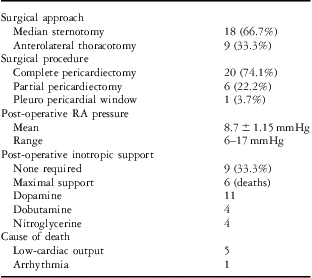
The mean right atrial pressure measured in the operating room before surgery was 20.4 ± 4.93 mmHg (median 23 mmHg, range 10 to 33 mmHg). Surgical approach was via median sternotomy in 18 patients and left anterolateral thoracotomy in the remaining patients. In all, 20 children underwent complete pericardiectomy, six had partial pericardiectomy, and one underwent pleuropericardial window creation. We define a complete pericardiectomy as the procedure of removing the pericardium in between the phrenic nerves on either sides and from the great vessels above to diaphragm below. Anything less than this is defined as partial pericardiectomy. The child who underwent pleuropericardial window creation was in NYHA class III. Echocardiography was not conclusive in diagnosing the cause of his symptom as constrictive pericarditis or restrictive cardiomyopathy. Owing to the fact that he had significant pericardial effusion and findings correlated more with an early stage of constrictive pericarditis, he was referred for a surgical pericardial biopsy. We undertook a median sternotomy; the pericardium was only minimally thickened and no evidence of constriction was found intra-operatively. There was moderate amount of pericardial effusion with yellowish fluid. Hence, we opened the left pleura widely and obtained a pericardial biopsy so as to leave a pleuropericardial window open. The left pleural drainage was only 30 ml, and the drainage tube was removed on the first post-operative day. The child was discharged on the fourth post-operative day on digoxin, diuretics, and enalapril.
Statistical analysis
Quantitative variables such as age, duration of symptoms, duration of intensive care unit stay, and post-operative stay were summarised as mean ± standard deviation and were compared between survivors and non-survivors and between adverse outcome and good outcome groups, using Student's t-test/Wilcoxon Rank-sum test. Adverse outcomes were defined as death/prolonged intensive care unit stay or prolonged post-operative stay. Qualitative variables such as discharge from the hospital, sex, NYHA class were summarised as proportions (percentage) and compared between groups using χ2-test. The proportion of deaths in each NYHA class was compared using a trend χ2-test. A p < 0.05 was considered significant. All statistical analyses were carried out on Stata 11.0 software.
Results
At operation, all patients were found to have a thickened pericardium, with 25 patients (92.6%) having significant adhesions to the underlying cardiac chambers. Pericardial calcification could be identified in only six patients (22.2%) and pericardial effusion was present in 17 patients (80.9%). The nature of pericardial fluid was clear/haemorrhagic or purulent. Cardiopulmonary bypass was not instituted in any case, and no concomitant intracardiac procedures were carried out. There were six (22%) hospital deaths due to low cardiac output (n = 5) and arrhythmia (n = 1). There was one death in the bacterial pericarditis group, one in the tuberculous and five in the idiopathic pericarditis groups. This final diagnosis was arrived at after the final tissue diagnosis (see below). Death in the tuberculous group (NYHA class III) was due to malignant ventricular arrhythmias refractory to medical management. The one death in the pyopericarditis (NYHA class IV) was due to disseminated sepsis with myocardial dysfunction leading to low cardiac output and multi-organ failure. Of the four deaths in the idiopathic group, three were in NYHA class IV. There was one child who was extubated on the first post-operative day who had bradycardia and cardiac arrest on the 4th day. Prompt mechanical ventilatory and inotropic support was instituted, but he sustained hypoxic brain damage. Later on, he developed acute renal failure, which progressed on to multi-organ dysfunction ultimately leading to death. Another child had severe ventricular dysfunction and low cardiac output, had oliguria and severe metabolic acidosis on the second post-operative day and was started on peritoneal dialysis. However, hyperkalaemia and metabolic acidosis persisted and renal function failed to improve with dialysis. He had severe coagulopathy and had massive bleeding from the upper gastrointestinal tract from which the child could not be resuscitated. The other two children also had severe biventricular failure, which persisted even after ventilatory and maximal inotropic support (dopamine/dobutamine/adrenaline/noradrenaline) (Tables 1–3).
Clinical characteristics.

MVP = mitral valve prolapse; RA = right atria
Operative features.

RA = right atria
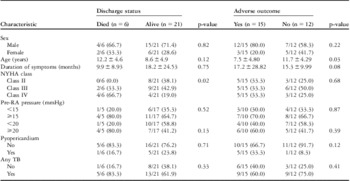
Comparative analysis of survivors versus non-survivors and those with or without adverse outcomes

RA = right atria; TB = tuberculosis
The mean intensive care unit stay was 2.7 ± 1.2 days (median 3, range 1–5 days). The mean post-operative stay was 9.9 days (median 5 days, range 3–39 days). The mean right atrial pressure dropped to 8.7 ± 1.15 mmHg after the procedure (median 8 mmHg, range 6–17 mmHg). There were nine (33.3%) patients who did not require any inotropic support in the post-operative period. The most frequent inotrope used in the other patients was dopamine (11 patients) followed by dobutamine and nitroglycerine in four patients each. The patients who expired because of low cardiac output were given maximal inotropic support by the addition of adrenaline and noradrenaline.
Adverse outcome defined as death/prolonged intensive care stay more than 3 days or prolonged post-operative stay more than 5 days were not found to be associated with sex, diagnosis of tuberculosis or pyopericardium, or the duration of symptoms or the pre-operative right atrial pressure. Younger age group was found to be associated with prolonged intensive care unit and hospital stay (p = 0.03), but not associated with increased mortality. Advanced NYHA class predicted adverse outcome in our study (p = 0.02). The proportion of mortality increased steadily with increasing NYHA class (0% in NYHA II; 18% in NYHA III; 50% in NYHA IV).
Reports of histopathological examination of the excised pericardium were available for 26 patients of which five specimens showed epitheloid granuloma suggestive of tuberculosis. However, none of these stained positive for acid fast bacilli. The remaining 21 specimens had changes of chronic inflammatory reaction with features of fibrous pericarditis.
The mean follow-up was 23.1 ± 23.8 months (median 15.5 months, range 2–85 months) and was 80% complete (17 out of 21 survivors). All but one child are in NYHA class I without any cardiac medication. The one child who underwent pleuropericardial window creation was in NYHA class III after 2 months of follow-up, and was later lost to follow-up.
Discussion
Although a wide variety of causative factors have been proposed for pericarditis in children, our study identified only limited aetiologies. In India, tuberculosis is fairly common in the paediatric population, especially in those from poor socio-economic background and therefore it is not surprising that it was the predominant cause of pericarditis. Although nine patients had a history and clinical findings of extracardiac tuberculosis, only two of these patients had a histopathological picture of tuberculosis. Of the nine other patients who had been receiving empiric anti-tuberculosis treatment without any documented tuberculosis, three demonstrated the histopathological picture of tuberculosis. This aetiology constitutes less proportion of patients in another similar study.Reference Thompson, Burkhart, Dearani, Cetta, Oh and Schaff 2 Of patients with pulmonary tuberculosis, 1–8% develop pericardial involvement.Reference Mayosi, Burgess and Doubell 3 It is estimated to account for 70% of large pericardial effusions and most cases of constrictive pericarditis in developing countries.Reference Syed and Mayosi 4 Mortality is estimated to be 17–40%, with a similar proportion going on to constriction after development of an effusion. Owing to the high incidence of tuberculosis, it is not an uncommon practice in developing countries to start anti-tuberculosis therapy even in the absence of any conclusive evidence of tuberculosis as was the case in many of our patients.
At presentation to our unit, the majority of the patients (more than 70%) were in NYHA class III/IV. Owing to the poor socio-economic background of these patients, the beginning of symptoms is often ignored and children are taken to the physician only when the symptoms are severe enough to hamper daily life. This delay in presentation can affect the surgical outcome. When the myocardium is involved, there may be chronic inflammation and fibrosis and true contractile dysfunction results. Such patients often have a suboptimal result even after a satisfactory pericardiectomy. In addition, poor nutrition, hepatic and renal dysfunction, and at times coexisting infections often lead to a suboptimal outcome. Therefore, we believe that early referral to the surgical unit is extremely important for a satisfactory outcome, and the diagnosis of constrictive pericarditis in itself should form a sufficient indication for surgery.
The pyopericarditis group had a good symptomatic recovery after the pigtail catheter drainage of pus and parenteral antibiotic therapy. There were three children who had organised collection and pus pockets on echocardiography, which made complete drainage of pus via pigtail catheter difficult. Intra-pericardial streptokinase was instilled in these patients for the purpose of lysis of the adhesions and to break open the pus pockets so that a complete drainage could be obtained. Owing to the fact that they had persistent symptoms and incomplete drainage, surgical pericardiectomy was considered and they had a smooth post-operative course and were discharged on antibiotics alone. The one child who died in the pyopericarditis group had generalised sepsis before surgery, and even after a complete pericardiectomy could not be revived of sepsis. Among the tuberculous pericarditis group, two patients had already undergone pigtail catheter drainage a year ago and one child underwent creation of a pleuropericardial window. However, recurrent symptoms necessitated a surgical pericardiectomy.
Transthoracic echocardiography is the first diagnostic investigation performed for suspected pericarditis at our centre. Echocardiography is usually conclusive in diagnosing constrictive pericarditis based on the typical findings.Reference Maisch, Seferovic and Ristic 5 In one child, the findings were not conclusive of constrictive pericarditis or restrictive cardiomyopathy. Owing to the fact that this patient had significant pericardial effusion, features were thought to mimic an early phase of constrictive pericarditis, and the patient was considered for a surgical pericardial biopsy.
Being a non-invasive investigation, a contrast-enhanced computed tomographic scan was performed as the second diagnostic tool. In addition to detecting pericardial thickness and effusion, it also commented on the enlargement of the mediastinal lymph nodes and the lung parenchyma, which in a previous study from our centre has been important in patients suspected to have tuberculosis.Reference Mukund, Khurana, Balla, Gupta and Kabra 6 In all, seven children were subjected to cardiac catheterisation and measurement of intra-cardiac pressures to arrive at a definitive diagnosis. Elevation and near equalisation of the intra-cardiac pressures were noted in these patients.
Various surgical approaches have been described for pericardiectomy in many series;Reference McCaughan, Schaff and Piehler 7 , Reference Tiruvoipati, Naik, Loubani and Billa 8 however, we used approaches such as median sternotomy and anterolateral thoracotomy. The surgical approach was a matter of surgeon preference. Median sternotomy was the preferred approach, more so in the pyopericarditis group. The one patient who had a pleuropericardial window created earlier was also approached by median sternotomy. Every effort was made during surgery to ensure complete removal of the pericardium as defined earlier, as a complete pericardiectomy has been shown to provide superior haemodynamic results compared with a partial procedure.Reference Chowdhury, Subramanian and Kumar 9 Those having severe adhesions and direct myocardial involvement underwent a partial pericardiectomy as a safer alternative.
Post-operative low cardiac output has been reported to be frequent in adults after pericardiectomy.Reference McCaughan, Schaff and Piehler 7 Among our patients, only two had mild reduction in the left ventricular function, and low cardiac output occurred in 18 patients requiring prolonged mechanical ventilatory and inotropic support. There were five children who had severe reduction in cardiac output in spite of having a left ventricular ejection fraction more than 50% and could not be resuscitated even with maximal inotropic support. Only one child in our study had troublesome arrhythmia, which proved fatal. The mortality rate in our series is high when compared with other studies of paediatricReference Thompson, Burkhart, Dearani, Cetta, Oh and Schaff 2 and adult pericardiectomyReference Chowdhury, Subramanian and Kumar 9 – Reference Yetkin, Kestelli and Yilik 11 where the peri-operative mortality varied from 6% to 11%. However, 19 out of our 27 patients were in NYHA class III/IV compared with a single patient out of 27 in a similar series from the Mayo Clinic where the low mortality is explained by early diagnosis and surgical intervention.Reference Thompson, Burkhart, Dearani, Cetta, Oh and Schaff 2 In addition, the patient population in our series was much younger (mean age 9.3 years) compared with the Mayo Clinic series (mean age 16.7 years).
Conclusion
Despite adequate pericardiectomy, the early mortality following surgery remains high in children undergoing pericardiectomy. The mortality is higher in patients with poor pre-operative functional class. This calls for prompt surgery once the diagnosis of constrictive pericarditis is made in children. Younger patients tend to require a prolonged intensive unit care stay compared with older children. No specific pre-operative variable other than worse pre-operative NYHA class is a predictor of survival.
Acknowledgements
None.
Financial Support
This study received no specific grant from any funding agency, commercial or not-for-profit sectors.
Conflict of Interest
The authors declare that they have no conflict of interest.
Ethical Standards
The study does not involve any human experimentation. However, the study protocol was duly approved by the institutional ethics committee and all relevant protocols were duly followed.