Speakers who routinely use more than one language may not use any of their languages in ways which are exactly like that of a monolingual speaker. In sequential bilingualism, for example, there is often evidence of interference from the L1 in the L2 system. Describing these interference phenomena and accounting for them on the basis of theoretical models of linguistic knowledge has long been a focus of interest of Applied Linguistics. More recently, research has started to investigate linguistic traffic which goes the other way: L2 interferences and contact phenomena evident in the L1. Such phenomena are probably experienced to some extent by all bilinguals. They are, however, most evident among speakers for whom a language other than the L1 has started to play an important, if not dominant, role in everyday life (Schmid and Köpke, Reference Schmid, Köpke, Köpke, Schmid, Keijzer and Dostert2007). This is the case for migrants who move to a country where a language is spoken which, for them, is a second or foreign language. We refer to the phenomena of L1 change and L2 interference which can be observed in such situations as language attrition.
The single most astonishing feature of first language attrition is how minimal and localised it usually appears to be. Once a speaker has attained a stable (monolingual) command of his or her first language, large areas of this knowledge appear to be so entrenched that they are affected to a surprisingly small degree by non-use and non-exposure, even if the speaker has lived in a migrant setting for several decades. While other native speakers may notice something odd about the way that the attriter uses the L1, the apparent proficiency still tends to outstrip that of highly proficient routine L2 users. Most attriters report that they are not perceived as anything other than L1 speakers if and when they return to their country of origin, and those few whose origin may appear doubtful are often congratulated by L1 speakers on their astonishing proficiency, suggesting that their level of command surpasses that of the prototypical L2 speaker. Moreover, while linguistic investigations of language attrition among mature speakers usually do find some differences between attrited and non-attrited populations, the attrited speakers tend to appear astonishingly proficient in their L1. This is particularly true with respect to grammatical knowledge: while lexical access often does appear to be impaired to some degree, even those individuals who, among a group survey, appear to have experienced the greatest changes in their L1 still outperform all but the most advanced L2 speakers on virtually all grammatical aspects (Schmid, Reference Schmid2009).
It is precisely this stability of L1 knowledge, and particularly L1 grammar, which makes the study of language attrition so interesting: it makes it possible to turn the magnifying glass of linguistic investigation onto those areas where phenomena of contact or deterioration are visible, and to try and account for these phenomena on the basis of linguistic theory. It is therefore possible to identify those micro-areas of language where contact phenomena can first lead to language change under certain conditions (typological relatedness of the two contact languages, amount of linguistic contact, and so on). These observations are of particular interest to linguistic theory at large, since in language attrition among mature speakers the emerging system is a derivation of the full-fledged L1 system, not an approximation, as is the case in second language acquisition (SLA). Language attrition has been described as a “creative interplay between two languages” (Kaufman, Reference Kaufman1991), and detailed investigations can identify those linguistic areas and circumstances where two languages are more or less likely to play with and learn from each other. This, in turn, may tell us much about the architecture of linguistic knowledge in general and the bilingual mind in particular.
In order to achieve a better understanding of the process of language attrition, scientific investigations first have to identify those areas of the L1 system which are most likely to be affected by influence from the L2. Initially, in the absence of experimental data and evidence of L1 attrition itself, a profitable approach is to look to neighbouring areas of linguistic investigation, such as language contact, creolisation, L2 acquisition, or aphasia. In the early years of L1 attrition research, the 1980s, many researchers made valuable contributions of this nature, often augmented by small-scale experiments and/or case studies (see Köpke & Schmid, Reference Köpke and Schmid2004). A number of strong predictions with intriguing theoretical implications were made during this period of L1 attrition research (ibid.).
The second step is for such predictions to be tested in quantitative experimental research. The 1990s were given to a number of such investigations, often in the form of Ph.D. theses (e.g. Ammerlaan, Reference Ammerlaan1996; Yağmur, Reference Yağmur1997; Köpke, Reference Köpke1999; Gross, Reference Gross2000; Hulsen, Reference Hulsen2000; Schmitt, Reference Schmitt2001; Gürel, Reference Gürel2002; Schmid, Reference Schmid2002). The findings from these studies often led to intriguing insights in the context of the theoretical frameworks within which language attrition research was being conducted, suggesting that attrition was determined by factors such as lexical accessibility (Ammerlaan, Reference Ammerlaan1996; Köpke, Reference Köpke1999), the architecture of the linguistic system (Gross, Reference Gross2000; Schmitt, Reference Schmitt2001), the socio-ethnic environment (Yağmur, Reference Yağmur1997; Hulsen, Reference Hulsen2000; Schmid, Reference Schmid2002) and their interaction.
The next step in order to validate these findings is to revisit and replicate them, to see whether they hold true in investigations conducted on different languages, in different settings, with different methodologies or from different theoretical frameworks, in order to provide independent corroboration of the conclusions they offer. This is what the papers collected in this volume attempt to do. All studies presented here take as their starting point earlier investigations or findings, and attempt to verify or expand them by looking at them from a somewhat different angle, applying them to different languages, or broadening their empirical base.
The first paper in this volume, by Merel Keijzer, takes a fresh look at one of the oldest predictions made for language attrition: the regression hypothesis, which assumes that the loss of a language will be the mirror-image of its acquisition. While this framework has played an important role in investigations of L2 attrition and been validated in this context (e.g. Hansen, Reference Hansen2001), whether or not L1 attrition might be the mirror image of the acquisitional process has, so far, been a controversial issue. Jordens, de Bot and Trapman (Reference Jordens, Bot and Trapman1989) found no evidence for a process of decline which paralleled the sequence of L1 acquisition on a morphological feature (L1 German case marking), while Håkansson (Reference Håkansson1995) and Schmid (Reference Schmid2002) could interpret their data to some extent within this framework. Keijzer's investigation of the attrition of L1 Dutch morpho-syntax among Canadian immigrants provides consistent evidence for this scenario. This corroborates the tentative conclusion by Schmid (Reference Schmid2002, p. 168), whose findings suggest that the deterioration of L1 morphology among German speakers in English-speaking environments are consistent with the assumptions of the regression hypothesis, while syntactic patterns appear to be governed by L2 influence – a suggestion which is also in line with Håkansson's (Reference Håkansson1995) results. While these are interesting findings offering intriguing possibilities of explanation, it should be pointed out that all three studies investigate the L1 attrition of Germanic languages (Dutch in Keijzer's case, Swedish in Håkansson's study and German in Schmid's investigation). A different picture might emerge from investigations of other language families. Keijzer furthermore points out that while the regression hypothesis may provide an interesting descriptive framework, it lacks explanatory power: it is not enough to say that a language is lost in some way because it was acquired in the opposite sequence; underlying reasons situated in the nature of linguistic knowledge have to be found which can account for both. She proposes that Dynamic Systems Theory might provide insights which can be helpful in this respect.
Doris Stolberg and Alexandra Münch's contribution takes as its starting point two longitudinal investigations of the development of one speaker's L1 proficiency, provided by Jaspaert and Kroon (Reference Jaspaert, Kroon, Fase, Jaspaert and Kroon1992) and Hutz (Reference Hutz2004). However, while these two investigations rely on a corpus of letters written over a long time-span by an attriter who otherwise had minimal contact with the L1, Stolberg and Münch base their analysis on a spoken corpus from a speaker who, after several decades of virtually no exposure to her L1 German, was re-exposed to it on a regular basis over the course of almost four years through regular conversations with two German researchers. Stolberg and Münch's investigation thus begins at the “nadir” of the attritional process and documents the pathway of reactivation which is evident in their participant's linguistic system. They conclude that lexical accessibility does indeed benefit from this re-exposure, but that the grammatical system had shown surprisingly little contact effects to start with, so that a dramatic recovery process was not to be expected here. They propose that the stability of this particular speaker's grammatical L1 knowledge may be due to the fact that she had so infrequently had the occasion to use her L1 since her emigration, and that this non-use had prevented language mixing. This suggestion is corroborated by the fact that other studies (e.g. Lattey and Tracy, Reference Lattey, Tracy and Ureland2001; Hutz, Reference Hutz2004) which investigate more actively bilingual speakers have found more interference in the area of morpho-syntax (see also below for a more detailed comparison of Stolberg and Münch's results and another study of the L1 attrition of German).
A similar finding is presented by Esther de Leeuw, Monika S. Schmid and Ineke Mennen, who investigate the development of foreign accent among German migrants in Canada and The Netherlands and conclude that bilingual speakers may diverge from native phonetic norms and eventually come to be perceived as less native-like by native judges. This study also investigates the impact of extra-linguistic factors on the perceived foreign accent of long-term migrants. The results indicate that language use in situations where frequent code-switching and code-mixing is likely (informal L1 use with other bilinguals) does not prevent the development of divergence from the native norms, while L1 use in monolingual settings apparently does have an impact on the maintenance of L1 pronunciation. De Leeuw et al.'s experiment to some extent reinterprets the studies on foreign accent in the L1 of French–English bilinguals in Flege (Reference Flege1987) and the case study of English–Portuguese bilinguals presented by Major (Reference Major1992), who also found evidence for change in pronunciation among bilinguals in a migrant setting. The experimental design used here, which comprises an investigation of the change of the same L1 (German) in two L2 environments (Dutch and English) has the advantage that it allows for the assessment of perception of foreign accent, rather than instrumentally measured inconsistencies in production, which may in fact not be perceived by native speakers. The impact of typological distance on the development of foreign accent is also addressed, specifically with regard to dialectal differences within the source language. Interestingly, de Leeuw et al.'s findings suggest no difference between speakers living in an L2 English environment or an L2 Dutch environment.
The issue of typological similarity is also central to the investigation reported by Anne Ribbert and Folkert Kuiken, who investigate the L2 acquisition and L1 attrition of the complementiser um/om in German/Dutch bilinguals. This feature has previously been identified as highly vulnerable to the attrition of German as an L1 (Brons-Albert, Reference Brons-Albert1992, Reference Brons-Albert and Spillner1994) specifically because of the similarity and minimal difference of its distribution in the two languages studied here. Ribbert and Kuiken propose that those areas of grammar where the L1 forms a subset of the L2 will be the areas where contact phenomena will first become evident. Linguistic items with a distribution more restricted in the L1 than in the L2 may eventually no longer be constrained by the L1 rules but used in contexts where they are licensed by the L2. This finding is in line with Seliger's prediction that two linguistic systems will interact in those domains where both contain a rule which serves the same semantic function, and “that version of the rule which is formally less complex and has a wider linguistic distribution . . . will replace the more complex more narrowly distributed rule” (Seliger, Reference Seliger, Hyltenstam and Obler1989, p. 173).
A similar phenomenon is investigated in Aneta Pavlenko's study of the system of Russian verbs of motion, in which she develops her earlier framework of Crosslinguistic Influence and language attrition (Pavlenko, Reference Pavlenko2004). She investigates three areas which are grammatically encoded in Russian verbs: aspect, directionality and path of motion, and one area in which lexical verbs are more specific than English ones, namely manner of motion. Only one of these, aspect, has a grammatically encoded counterpart in English. However, while English marks aspectual distinctions contextually, so that the same verb can be used with either an imperfective/progressive or a perfective meaning, Russian aspect is inherent in the verb. Directionality and path are not by default encoded in English verbs, so these categories lack a counterpart in the L2 of Russian–English bilinguals, and while there are English verbs of motion which imply the manner of transport (e.g. drive), there is no Russian counterpart of more generic English verbs, such as go. Pavlenko finds some instances of convergence for all four categories. The nature of her data does not permit quantification, but it seems clear that at least path of motion (thus, one of the categories which lack an L2 counterpart) appears very well preserved, with only one error in the corpus.
The hypothesis that it is largely those areas of grammar where there are similarities between L1 and L2 – and where there is therefore most competition between the systems – in which the interplay of two languages will first lead to divergences is also taken up by Elena Schmitt. She takes as her starting point her own earlier investigation on lexical and morphological L1 attrition and convergence among Russian–English bilinguals (Schmitt, Reference Schmitt2001) within the theoretical frameworks of Levelt's Speaking model (Levelt, Reference Levelt1989) and the various models of language contact proposed by Myers-Scotton (e.g. Reference Myers-Scotton2002). Schmitt argues that while these models can, to some extent, predict which classes of lexical and grammatical morphemes will be most vulnerable in a language contact situation, they cannot grasp differential susceptibility within the same class. By invoking a second theoretical framework, the Activation Threshold Hypothesis (Paradis, Reference Paradis1993) she is able to give a more detailed account for the convergence phenomena evident in her data.
The last paper in this collection takes a different theoretical perspective: Ji-Hye Kim, Silvina Montrul and James Yoon investigate the binding properties of anaphors in Korean–English and English–Korean bilinguals, to some degree replicating the investigation of the attrition of binding properties among Turkish–English bilinguals by Gürel (Reference Gürel2002). Based on the assumption that, in English, the governing category (GC) for core binding is defined by the Specified Subject Condition (SSC) and the Tensed-S Condition (TSC), while in Korean, GC is defined only by SSC, they investigate the interpretation of anaphors among four groups of speakers: Korean–English late bilinguals (attriters), Korean–English early bilinguals (incomplete learners), late Korean L2 learners and Korean monolinguals residing in Korea (control group). While there were some interesting divergences from the monolingual norm on the part of the incomplete learners and the Korean L2 speakers, the attriters behaved in every way exactly like the monolinguals, suggesting that the feature in question here has not deteriorated over the 10+ years which these speakers have resided in the US.
One of the benefits of studies which to some degree replicate earlier investigations is the possibility of comparing findings across samples and thereby putting the validity of earlier results to the test. In the case of the studies collected in this volume, two such comparisons offer particularly interesting insights into the overall process of language attrition. The paper by Stolberg and Münch reports on the case of a German migrant who used her L1 extremely infrequently from the time of emigration in 1953 to the beginning of the data collection in 2000. Despite this long period of non-use, her German seems very well preserved, with only an astonishingly small number of interferences. On the other hand, Schmitt investigates L1 speakers of Russian, who use their L1 frequently in their daily lives. In this case, however, case-marking is target-like only in around 80% of all required contexts. Both studies investigate relatively free spoken data, and both studies have an antecedent to which they can be compared: Schmid (Reference Schmid2002) also investigated German speakers who had lived in an anglophone environment, with minimal exposure to German, for a period of approximately five decades, while Schmitt (Reference Schmitt2004) investigateed younger speakers of Russian after a somewhat shorter emigration span than the one reported on here.
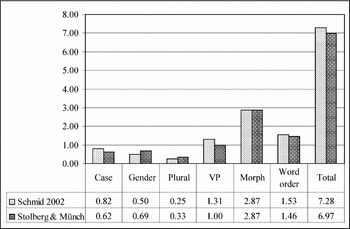
Firstly, a comparison between the sample investigated by Schmid (Reference Schmid2002) and the speaker analysed by Stolberg and Münch reveals extraordinary parallels between the two data sets in those areas where the data analysis allows a direct comparison. Figure 1 summarises the overall distribution of morpho-syntactic errorsFootnote 1 per 1,000 words of spoken data in both studies.
A comparison of morphosyntactic errors per 1,000 words of spoken data, reported by Schmid (Reference Schmid2002) and Stolberg and Münch (this volume).

As is evident here, the speakers investigated by Schmid (Reference Schmid2002) and the speaker investigated by Stolberg and Münch make on average only seven mistakes per 1,000 spoken words in these domains, confirming the assumptions that the L1 grammatical system of mature speakers is extremely robust in an emigrational setting, even though exposure is minimal for several decades. More striking, however, is the distribution of these errors across the various categories. The parallels evident between two data sets from attriters in similar circumstances, collected and analysed independently by different researchers, point very strongly to similar overall effects of linguistic insecurities in this particular type of language contact situation.
As was pointed out above, the speakers reported on by Schmitt exhibit far more non-target-like constructions in the particular area of grammar investigated here (Russian case marking) than the speakers in the studies discussed above, with around 20% of all required tokens being deviant. A direct comparison between Schmitt's study of Russian case marking and the German language data reported on above is unfortunately not possible, since Schmitt relates deviant instances to obligatory contexts, while Stolberg and Münch as well as Schmid (Reference Schmid2002) base their analyses on an overall word count. However, Schmid (Reference Schmid2004) did conduct an analysis of case marking on a subset of her data (1,000 words per speaker), which allows the estimate that case assignment is non-target-like in only 0.3% of overall required contexts in her data. Moreover, the largest estimated proportion of deviant instances of case marking for any one of her speakers is only 2%.
There are a number of possible explanations for this discrepancy in findings across studies. Firstly, it is possible that case is more difficult to maintain in Russian than in German. Given that the Russian grammatical system is apparently more complex with respect to case marking, as there is a greater variety of overt case forms (Russian having six cases, while German has only four), this explanation may not seem implausible. However, it has been pointed out that the cue validity of Russian case marking is much higher than that of German, and that adult L2 speakers whose L1 is English find case marking in Russian easier to acquire and are more successful than comparable L2 learners of German (Kempe and MacWhinney, Reference Kempe and MacWhinney1998). Whether this finding can be extended to L1 attrition, predicting better maintenance of case marking for Russian than for German speakers, is an intriguing question. In order to resolve this puzzle, however, one would have to base the analysis on populations which are otherwise comparable. Based on the evidence available here, this is not possible, as there are two important differences between the German and Russian speakers under observation: the Russians are active bilinguals who use their L1 on a daily basis, while the Germans have very little contact with their L1; furthermore, the Russian speakers were under the age of 10 at the time of emigration, while the Germans are post-puberty migrants.
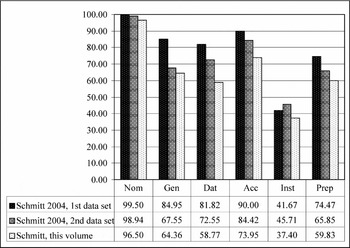
It was pointed out above that active bilingualism might be a factor which is conducive to language change in an attritional setting. To what degree this has contributed to the incipient levelling of Russian case reported by Schmitt is a question which cannot be resolved on the basis of the evidence available here. To what extent the younger age of the speakers might be a factor can, on the other hand, be elucidated to some degree on the basis of Schmitt's earlier study (Reference Schmitt2004). In this study, five speakers are investigated who emigrated from Russia with their parents around the age of four. Schmitt describes two data collection moments, the first one after between four and five years of emigration, when the speakers were around nine-and-a-half years old, and a second one two years later. The overall proportion of target-like cases reported in both studies is presented in Figure 2.
A comparison of the percentage of target-like case-marking, reported by Schmitt (Reference Schmitt2004 and this volume).

The impression to be gained from this comparison is that Russian case-marking can undergo what might be a process of fossilisation in language attrition. During the two years between Schmitt's (Reference Schmitt2004) first and second data collection, accuracy decreases notably for all cases except Nominative and Instrumental. The adult speakers reported on in Schmitt (this volume) are less accurate still on all cases. However, given that the time-span of emigration for the speakers in the second 2004 sample is around seven years after emigration, while the speakers reported on here have lived in an English-speaking environment for more than two decades, it appears likely from these figures that the process of deterioration has levelled off at some point. These findings suggest that there may be interesting discoveries to be made with respect to the impact of factors such as grammatical complexity of L1, typological similarity between L1 and L2, amount of contact, age at emigration and length of residence.
On the basis of the above considerations, it can be tentatively concluded that, while mature L1 attriters may come to exhibit a certain amount of variability with respect to overall grammatical norms, this “selective optionality” (Sorace, Reference Sorace, Cornips and Corrigan2005) is typically rather limited. The papers in this collection indicate a number of further intriguing conclusions and suggestions about the attritional process: lexical information (e.g. inherent aspect or directionality; see Pavlenko) and lexically assigned information (e.g. plural allomorphy; e.g. Keijzer) can to some extent be vulnerable to language attrition, as can a “native-like” accent in the L1 (see de Leeuw et al.). Purely grammatical information (e.g. binding properties; see Kim et al.), can remain stable in language attrition. This stability may, however, be compromised in cases where the overall grammatical properties of a feature are very similar across both of a bilingual's languages but show minimal differences in some aspects (e.g. the German and Dutch complementisers um/om; see Ribbert & Kuiken). This latter suggestion receives some corroboration from an investigation of binding properties in Turkish L1 attrition by Gürel (Reference Gürel2004): while her attriters correctly maintain the distinction between Turkish overt and null pronouns, the binding properties of the Turkish overt pronoun o seem to have to some degree been restructured on the basis of its English equivalent s/he (Gürel, Reference Gürel2004, p. 239).
In conclusion, incipient changes in an L1 attrition system appear most likely in lexical areas, in areas of morpho-syntax where there is a great deal of similarity between the two participating languages, among active bilinguals, and among speakers for whom the moment of emigration is situated before puberty.