


The United States has a distinguished history of using law to regulate the horrors of warfare. During the American Civil War, the Union army adopted the Lieber Code, the first formal codification of the laws of war and an inspiration for future international laws such as the Geneva Conventions (Witt Reference Witt2012). After World War II, the US spearheaded the creation of the tribunals at Nuremberg and Tokyo that prosecuted the crimes of senior officials in Nazi Germany and Imperial Japan (Taylor Reference Taylor1992). The US was so committed to a legal response to wartime atrocities that it overrode the staunch objections of its allies, who preferred summary executions of captured enemies (Bass Reference Bass2000, 147–205). In the 1990s, the US played an indispensable role in crafting new tribunals that tried genocidaires in Rwanda and the former Yugoslavia (Scheffer Reference Scheffer2012a). Even though the US does not always live up to the lofty standards it sets, the US unquestionably has helped to fight impunity.
The recent policies of Donald Trump’s administration, however, call into question America’s commitment to fighting impunity at home and abroad. In the domestic realm, Trump does not even pay lip service to the idea of legal accountability for atrocity crimes (Gift Reference Gift2025). He denounced the Geneva Conventions as “the problem” (quoted in Ackerman Reference Ackerman2016) and proudly described US soldiers as “killing machines” (Trump Reference Trump2019). Trump also backed up these words with deeds: he pardoned several American servicemembers accused of war crimes in Iraq and Afghanistan, including some who had already been convicted in US military courts (Philipps Reference Philipps2019).
In the international realm—the focus of this article—Trump has gone to war against the International Criminal Court (ICC). The ICC is a fascinating case for a pair of reasons. First, the ferocity of Trump’s assault on the ICC goes beyond his typical skepticism of global governance institutions. To be sure, Trump has a fraught relationship with many international institutions such as the World Health Organization, the United Nations (UN) Human Rights Council, and the North Atlantic Treaty Organization (NATO), among others. The difference is that Trump merely withdrew (or threatened to withdraw) from these organizations, whereas he appears determined to destroy the ICC. Trump has imposed devastating sanctions on the ICC, and his advisors have even threatened to “seek the dissolution of the Court itself” (Morse Tan, quoted in Lederer Reference Lederer2020). Second, prior American presidents have also sparred with the ICC. While the brazenness of Trump’s offensive against the court may be new, US antagonism toward the ICC is not. This dynamic offers a unique opportunity to explore both continuity and change in America’s relationship with one of the world’s most prominent international institutions.
The rest of this paper proceeds as follows. First, I describe the stakes of the US–ICC relationship for international relations scholarship and discuss what the US–ICC case teaches us about the broader relationship between great powers and international institutions. Second, I introduce a theoretical framework for understanding variation in American policy toward the ICC’s investigations. This framework establishes a baseline for how other presidents have treated the court, making it possible to identify the areas where Trump’s policies are similar or different. Third, I address the current moment by examining how Trump’s assault on the ICC compares to past American hostility toward the court. I argue that the key difference between Trump and his predecessors in the White House is at the level of tactics. In particular, Trump’s willingness to target the ICC indiscriminately with sanctions is a noteworthy change. At the level of strategy, however, Trump represents continuity with prior presidents. In terms of big-picture decisions about when to oppose ICC investigations, there is nothing anomalous about the Trump presidency. Fourth, I describe the implications of the Trump administration’s recent attacks on the ICC for the future of global impunity. The reverberations of American policies, I argue, will be felt around the world.
Why the US–ICC Relationship Matters for International Relations Scholarship
The US–ICC relationship is worth studying not only on its own merits but also for the valuable insights it offers into how great powers interact with international institutions. The rest of this section briefly describes some of the court’s key features and then explains how the US–ICC relationship informs broader debates about the nature of global governance.
The ICC is a permanent international tribunal with jurisdiction over atrocity crimes: genocide, war crimes, and crimes against humanity.Footnote 1 The court was created at a diplomatic conference in Rome in 1998 and now sits in The Hague in the Netherlands. The ICC formally opened its doors in 2002 after 60 states ratified its founding treaty, the Rome Statute. The court currently counts 125 countries as member states and has opened 18 investigations to date. Unlike many other international institutions, the ICC is not intended to resolve disputes between states. Instead, the ICC was created to investigate and prosecute the specific individuals guilty of ordering or carrying out atrocity crimes.
The idea underpinning the ICC is straightforward: nobody should be above the law. The ICC aims to provide a measure of justice in situations where impunity would otherwise prevail, such as when perpetrators hide behind the safety of a national border or the authority of a powerful government position. Given these ambitious aspirations, the ICC is sometimes anointed as one of the international community’s crowning achievements and celebrated as the best mechanism to end global impunity.Footnote 2 In the words of former UN secretary-general Kofi Annan, the ICC will “bring nearer the day when no ruler, no state, no junta, and no army anywhere will be able to abuse human rights with impunity” (quoted in Simons Reference Simons2002).
The ICC is a remarkable part of the global governance architecture that has “the potential to reshape our understanding of international law” (Sadat and Carden Reference Sadat and Carden2000, 385). For the purposes of this article, however, one aspect of the ICC is particularly significant: there are very few special privileges for powerful states. With the notable exception of the UN Security Council’s right to refer situations to the ICC that fall outside the court’s standard jurisdiction, powerful countries are treated like everyone else. Each member of the court, for example, gets a single vote when electing the ICC’s prosecutor and judges. This egalitarian approach stands in sharp contrast to many other international institutions, such as the World Bank and the International Monetary Fund (where the bigger economies receive weighted voting shares) and the Security Council (where the five permanent members have the right to exercise veto power). On top of that, the ICC has an independent prosecutor who can open investigations and issue arrest warrants without getting the permission of the members of the Security Council or any other state. As a consequence, the ICC can challenge the privileged position that great powers (and their leaders) have traditionally enjoyed in world affairs. Most notably, the ICC made headlines in 2023 when it issued an arrest warrant for Russian leader Vladimir Putin, often described as the “most powerful man in the world” (Zakaria Reference Zakaria2017).
The lack of privileges for the powerful at the ICC touches on a broader theoretical debate concerning the relationship between international institutions and state power. One school of thought calls attention to the dynamics of influence in international relations: powerful states generally oppose institutions that operate beyond their control (e.g., Goldsmith Reference Goldsmith2003; Mearsheimer Reference Mearsheimer1994; Posner Reference Posner2004; Posner and Yoo Reference Posner and Yoo2005). When international institutions are independent—meaning that they have considerable autonomy and are not bound by the wishes of powerful states—institutions can represent a challenge to the influence that great powers typically wield in world politics. As Joffe (Reference Joffe2003, 158) memorably puts it, “[g]reat powers loathe international institutions they cannot dominate; lesser nations like them the way the Lilliputians liked their ropes on Gulliver.”
A second perspective explains why strong states actually might support international institutions that are outside their control. To start, major powers may prefer independent institutions if they want to enhance the credibility of their commitments (e.g., Guzman Reference Guzman2008; Helfer and Slaughter Reference Helfer and Slaughter2005; Ikenberry Reference Ikenberry2001; Moravcsik Reference Moravcsik2000; Simmons and Danner Reference Simmons and Danner2010). By working through formal institutional procedures, powerful states can “tie their own hands” and make it more attractive for other states to cooperate with them. Furthermore, independent institutions, which can function as neutral third parties, help states to adjudicate disputes that they would struggle to resolve on their own (e.g., Allee and Huth Reference Allee and Huth2006; Gent and Shannon Reference Gent and Shannon2010; Mitchell and Powell Reference Mitchell and Powell2011; Powell and Wiegand Reference Powell and Wiegand2023). Finally, strong states might back international institutions for normative reasons. The ICC, for instance, is a high-profile part of the “justice cascade” and embodies a compelling set of ideals (Sikkink Reference Sikkink2011).
American policy toward the ICC aligns closely with the first school of thought. That is, the lack of unique privileges for the world’s superpower goes a long way toward explaining US hostility toward the court. Rather than have an independent ICC prosecutor, for example, the US wanted the Security Council—where the US could always shield its troops with its veto power—to initiate all of the court’s investigations. America’s position, however, was unpopular with most countries because it would have created a double standard for the permanent members of the Security Council that essentially freed them from the scrutiny of the ICC. More generally, a key fault line when the ICC was established pitted those who wanted an apolitical court that treated all states equally against those who sought a court that would accommodate the political preferences of powerful states. The American position was unambiguous. Due to its singular role in global security affairs, the US insisted that it deserved special protections from potentially biased or frivolous ICC scrutiny. In the words of a member of the American negotiating team at the Rome Conference, “[w]hat the United States cannot support is an international court that fails to recognize its unique responsibilities in the world when issues of international peace and security are involved” (Lietzau Reference Lietzau2001, 138). After most of the world was unwilling to create a different set of standards for the powerful, US antagonism toward the ICC began.
Even though American policy toward the ICC generally supports arguments emphasizing that great powers are unlikely to support international institutions that they cannot control, this viewpoint does not tell the full story of American opposition to the ICC. In particular, it does not explain why US policy toward the ICC is so unusually hostile. After all, there are several other international organizations that the US does not dominate. While the US may decline to support—or even occasionally criticize—these other institutions, the US has not sought to destroy them in a manner comparable to its onslaught against the ICC. American animosity toward the ICC is in a league of its own.
A comparison of the ICC to the International Court of Justice (ICJ) is helpful in this regard. Like the ICC, the ICJ—which is designed to adjudicate disputes between countries—operates outside the control of the US. Most notably, the ICJ permitted Nicaragua to bring a lawsuit against the US in the 1980s after the American military mined Nicaraguan harbors. Nicaragua decided to challenge the US via the ICJ (rather than directly) precisely because the US was unable to control events at the ICJ. In the words of one of Nicaragua’s attorneys, the ICJ was an institution where the Nicaraguans could confront the US “on equal terms” and the “outcome [was] not predetermined by the disparities of military and economic power between the parties” (quoted in Reichler Reference Reichler2001, 38). For American officials, Nicaragua’s lawsuit at the ICJ was an unwelcome development that caused significant angst in Washington. Yet it is worth emphasizing what did not happen: the US never threatened military action or imposed economic sanctions against the ICJ (as it has done multiple times against the ICC); the US simply withdrew from the ICJ’s compulsory jurisdiction.
The relatively more restrained American reaction to the ICJ is largely a product of institutional design.Footnote 3 With nearly all international courts, including the ICJ, states do not fall under the court’s jurisdiction unless they explicitly consent to it in some way. As two international law scholars famously described it, “[t]he most basic principle of international law is that states cannot be legally bound except by their own consent” (Chayes and Chayes Reference Chayes and Chayes1993, 179). As a result, states typically can protect themselves against any perceived threat stemming from an international court by declining to join (or withdrawing if the state had previously joined). But that is not how the ICC was designed. Individuals from countries that never joined the ICC still fall under the court’s jurisdiction when they are on the territory of a country that did join. This means that declining to join the court does not necessarily shield American nationals from the ICC, an atypical jurisdictional arrangement that drives American animosity toward the court.
This dynamic creates a difficult trade-off for proponents of global governance at the ICC and beyond. On the one hand, the desire to endow international tribunals with wide jurisdictional reach is perfectly reasonable. Without sufficiently broad jurisdiction, international courts might even struggle to get cases. On the other hand, however, when the jurisdiction of international tribunals is so expansive that states do not have an easy “opt-out” option, state officials may believe that the only way to safeguard their interests (however defined) is to attack the institution itself. This, in turn, might decrease the long-term survival prospects of the international institution. Looking ahead, as the rules-based international order weakens and global governance is increasingly in flux, this trade-off will only become more salient.
Making Sense of US Policy toward the ICC
The US has been wary of the ICC ever since the negotiations that established the court in Rome in 1998. Under Bill Clinton, the US was one of just seven states to vote against the court’s creation, putting it in the company of China, Cuba, Iraq, Israel, Syria, and Yemen. The Clinton administration’s skepticism of the ICC, which carried over to future presidential administrations, was a product of Washington’s desire to protect American servicemembers from the court. As David Scheffer (Reference Scheffer2012a, 192), the lead negotiator for the US in Rome, described it, “every deliberation [about the ICC] turned on the fear of prosecution of American soldiers.” Even though the US is not an ICC member, American troops fall under ICC jurisdiction whenever they are on the territory of a country that joined the court. As a result of America’s massive global military presence (e.g., Vine Reference Vine2015), its troops are frequently exposed to ICC jurisdiction. On top of that, numerous American officials feared the ICC prosecutor, who is granted wide discretion over where to open investigations, would inject anti-American biases into the court’s work and turn the ICC into “an instrument of political warfare” (Kissinger Reference Kissinger2001, 94).Footnote 4
George W. Bush entered the White House sharing the same concerns about the ICC. When the court formally opened its doors in 2002, the Bush administration went into attack mode. The centerpiece of Bush’s attack was the American Servicemembers’ Protection Act (ASPA), a piece of legislation that enjoyed wide bipartisan support in Congress. ASPA was colorfully dubbed “the Hague Invasion Act” because it contained language authorizing the president to use military force to free any American imprisoned at the ICC, although this was a symbolic gesture more than a real strategy. ASPA’s more meaningful provision targeted state supporters of the ICC. Specifically, the US withheld military aid from countries that refused to sign “Article 98 agreements” with the US promising not to transfer Americans to the ICC. While many countries caved to American pressure and signed the agreements, several dozen countries—particularly those with strong domestic rule of law or less dependence on the US—sided with the ICC and consequently lost American military aid (Kelley Reference Kelley2007; Nooruddin and Payton Reference Nooruddin and Payton2010).
It is important to note that Bush’s early attacks on the court were not taken in response to any specific ICC action. The ICC did not even open its first investigation until two years after ASPA passed. Bush’s first term therefore was an indiscriminate attack on the ICC and its state supporters. However, the Bush administration soon learned that such blanket opposition to the ICC was counterproductive for two reasons. First, cutting off military aid to states over their support for the ICC did not hurt just the states that lost assistance; it also hurt the US. In 2006, for example, Secretary of State Condoleezza Rice admitted that withholding aid from states that would otherwise help the US to fight terrorism and drug trafficking was akin to “shooting ourselves in the foot” (quoted in Weisman Reference Weisman2006). Second, the Bush administration realized that ICC investigations can coincide with American foreign policy interests. For example, Bush took an early interest in the genocide in Darfur and sought to isolate Sudanese leader Omar Bashir. An ICC investigation into Bashir’s conduct was perfectly aligned with this goal, so the US allowed the UN Security Council to refer the situation in Sudan to the ICC in 2005, enabling the court to open an investigation.Footnote 5
Ever since the ICC’s Sudan investigation, the US—under both Republican and Democratic presidents—has pivoted away from indiscriminate attacks and blanket opposition. This does not mean that the US has become an unabashed ICC supporter. Rather, the US has adopted a selective approach: case-by-case evaluations of the challenges and opportunities that specific ICC investigations create for American foreign policy.
Scholars have tried to make sense of the complex set of policies the US has crafted toward the ICC. For instance, Bosco (Reference Bosco2014b) offers a typology of three broad strategies—marginalization, control, and acceptance—that major powers (including the US, among others) may use to guide their interactions with the ICC. This framework compellingly captures variation at the institutional level: some countries are far more willing to submit to the authority of the ICC than others. In the context of understanding US–ICC relations, however, it has a limitation: much of the interesting variation in American policy occurs at the investigation level. American policy toward ICC investigations has a “Jekyll and Hyde” nature in the sense that the US sometimes aids one of the court’s investigations at the same time that it is undermining other investigations. In what follows, I provide a framework to explain the strategies that American presidential administrations have employed toward specific ICC investigations.Footnote 6 This serves as a baseline to identify areas of continuity and change between Trump and his predecessors in the White House.
There are three possible strategies the US can pursue in response to ICC investigations: opposition, assistance, and neglect. In an opposition strategy, the overarching American goal is to block the ICC from opening a new investigation or to undermine an investigation that is already underway. In extreme cases, the tactics associated with an opposition strategy can include direct attacks on the court such as sanctioning ICC personnel or threatening to invade The Hague. Other times, however, an opposition strategy is linked to more “velvet-gloved” tactics that could include vetoing potential referrals of new situations to the ICC at the UN Security Council, withholding crucial evidence from the court, or using rhetoric that delegitimizes an unwanted investigation. In an assistance strategy, the American goal is to give the ICC the authority to initiate a new investigation or to help the court bring an ongoing investigation to a successful conclusion. In practice, this might entail the US referring new situations to the ICC via the Security Council, sharing classified intelligence with the court for use as evidence, or employing its unrivaled global policing capabilities to apprehend ICC fugitives.Footnote 7 In a neglect strategy, the US neither hurts nor helps the ICC investigation. American officials simply allow the court to conduct its work unimpeded, meaning that the key characteristic of a neglect strategy is inaction from the US. Instead of getting involved in the ICC investigation, the US saves its political capital for other foreign policy issues.
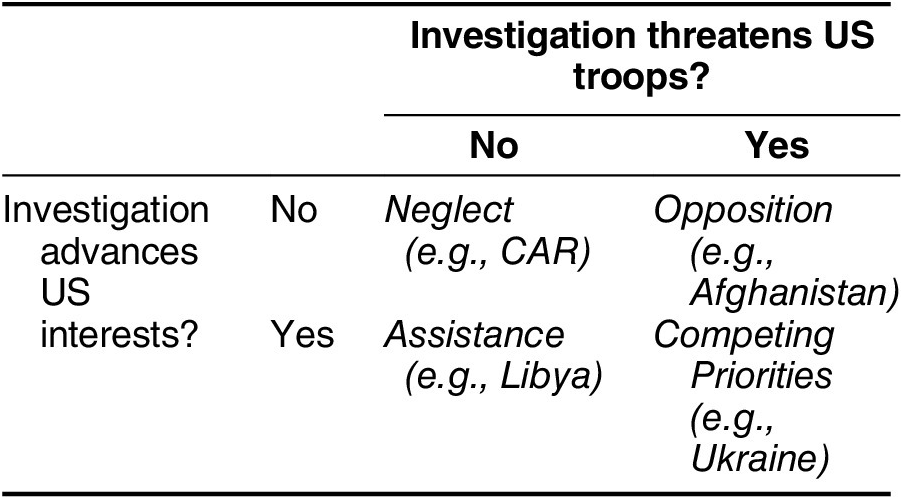
When does the US pick one strategy—opposition, assistance, or neglect—over the others? I argue that the interaction of two variables shapes American strategy toward the court’s investigations. First, does the investigation threaten American troops scattered around the world? This can occur in both a direct and an indirect fashion. In the direct variant, the court opens an investigation in an ICC member state where US forces are present, putting American soldiers in the crosshairs of the ICC prosecutor. In the indirect variant, US officials may deem an ICC investigation to be threatening to US troops whenever the court examines the conduct of armed forces from any nonmember state. The American concern is precedent setting: when the ICC exercises jurisdiction over individuals from other nonmember states, it contradicts America’s long-standing claim that the court does not have the right to investigate Americans because the US never joined the ICC. Second, does the investigation advance other US foreign policy interests? The idea here is that ICC investigations have real-world political effects that are sometimes consistent with America’s broader foreign policy objectives. As a unique source of moral authority in global politics, the ICC’s decision to brand someone as a “war criminal” can benefit the US (even if that was not the court’s intention). For example, if the ICC issues an arrest warrant for an adversarial foreign leader, it may help the US to orchestrate a global coalition to impose economic sanctions or launch a military intervention. The interaction of these two variables drives the American response to ICC investigations (see table 1).
How the US Responds to ICC Investigations

Table 1 Long description
The table categorizes U S responses into four quadrants based on two binary conditions.
Column Headers: The horizontal axis asks ‘Investigation threatens U S troops?’ with options ‘No’ and ‘Yes’.
Row Headers: The vertical axis asks ‘Investigation advances U S interests?’ with options ‘No’ and ‘Yes’.
Data Cells:
1. Top-Left (Interests No, Troops No): Neglect. Example provided is C A R (Central African Republic).
2. Top-Right (Interests No, Troops Yes): Opposition. Example provided is Afghanistan.
3. Bottom-Left (Interests Yes, Troops No): Assistance. Example provided is Libya.
4. Bottom-Right (Interests Yes, Troops Yes): Competing Priorities. Example provided is Ukraine.
Note: CAR stands for the Central African Republic.
The US uses an opposition strategy if an investigation threatens American soldiers and does nothing to further US foreign policy interests. The American response to the ICC investigation in Afghanistan is an example of an opposition strategy. Afghanistan represented the nightmare scenario that US officials had worried about ever since the court’s creation: an investigation in an ICC member state that had the potential to implicate US troops for their conduct during the American occupation. The Trump administration responded harshly. After ICC prosecutor Fatou Bensouda initially announced her plan to open an investigation, National Security Advisor John Bolton (Reference Bolton2018) labeled it “outright dangerous” and a “nightmare come to life.” The US then initiated a series of punitive measures against the ICC in the hopes that doing so would prompt the prosecutor to back off the investigation, such as revoking Bensouda’s visa and barring her from entering the US—a controversial tactic that put the US in the same company as the governments of Sudan and Burundi (Simons and Specia Reference Simons and Specia2019). Once the investigation was formally opened, US officials sought to delegitimize it. Secretary of State Mike Pompeo (Reference Pompeo2020) said the investigation proved the ICC was a “political institution masquerading as a legal body,” and Ambassador-at-Large for Global Criminal Justice Morse Tan denounced Bensouda as “a renegade prosecutor” who harbored anti-American biases (quoted in Lederer Reference Lederer2020). When these steps failed to get the ICC to drop the investigation, the US turned to one of its most potent weapons: economic sanctions. Specifically, Trump issued an executive order that labeled the Afghanistan investigation “an extraordinary threat to the national security and foreign policy of the United States” and imposed sanctions on Bensouda and one of her top aides (Office of the President 2020).
The US employs an assistance strategy if an investigation furthers US foreign policy interests and does not threaten American servicemembers in any way. The US response to the ICC’s investigation in Libya represents an example of this strategy. For starters, the Libya investigation presented no risk to American troops since Muammar Gaddafi had shut down Western military bases in Libya not long after he took power in a 1969 coup (Vandewalle [2006] Reference Vandewalle2012, 79). Moreover, with the exception of a brief period of cooperation after the September 11 terrorist attacks, Gaddafi had maintained an adversarial relationship with the US going all the way back to the Carter administration. Once Gaddafi initiated a brutal crackdown against Arab Spring protesters in 2011, there was a worldwide push for the ICC to investigate atrocity crimes in Libya. ICC involvement, however, required US assistance at the Security Council because Libya never joined the court. Recognizing that an ICC investigation could advance American interests in Libya, the Obama administration worked with other members of the Security Council to refer the situation in Libya to the ICC, granting the court jurisdiction to open an investigation and issue an arrest warrant for Gaddafi. This paid dividends for the US as the ICC’s warrant for Gaddafi’s arrest recast the Libyan conflict as a fight between good (the Libyan rebels) and evil (the Gaddafi regime), a framing that helped the US to marshal a global coalition to oust Gaddafi from power (Kersten Reference Kersten2016, 118–25).
The US turns to a neglect strategy if an investigation neither helps the US to attain its foreign policy goals nor threatens American soldiers. Precisely because this sort of ICC investigation is low stakes for the US, American officials have little incentive to devote their finite political capital to helping or hindering the court. Though a neglect strategy receives less public attention than situations where the US pursues an opposition or assistance strategy, American neglect of ICC investigations is quite common. For example, Barack Obama neglected the court’s 2014 investigation into religious-based massacres in the Central African Republic, Trump neglected the 2017 investigation of the Burundian government’s attacks on civilians protesting the abolition of term limits, and Joe Biden neglected the 2021 investigation into crimes against humanity committed in Venezuela. To be clear, the point is not that the US cared nothing about events in these countries but rather that the ICC investigations themselves never became salient American foreign policy issues on par with, say, the investigations in Afghanistan and Libya.
A final scenario—competing priorities—arises when an investigation is consistent with broader US foreign policy objectives but also threatens American troops. This creates a difficult trade-off for the US because it has something to gain and something to lose from the investigation. An example of the competing priorities dynamic appeared when the Biden administration weighed how to respond to the court’s investigation in Ukraine. On the one hand, the investigation was a clear “win” for US foreign policy interests, especially after the ICC issued an arrest warrant for Vladimir Putin. The ICC’s move bolstered the Biden administration’s ongoing efforts to cast Putin as a “war criminal” and “murderous dictator” as the US built a multinational coalition to push back against Russia’s war in Ukraine (Sanger Reference Sanger2022). On the other hand, the Ukraine investigation was an alarming development for American officials, particularly those in the Pentagon. Since Russia, like the US, had not joined the ICC, any American support for the investigation would contradict and weaken America’s long-standing position that the ICC should not investigate individuals from nonmember states. In this spirit, Pentagon officials made it clear they were prepared to give up on prosecuting Putin and other Russian elites to avoid a precedent that could undermine America’s ability to shield its own troops in the future. As Secretary of Defense Lloyd Austin told Congress, “I will always prioritize the protection of US military personnel” (quoted in Stewart and Ali Reference Stewart and Ali2023). After weighing these competing priorities for more than a year, Biden eventually decided to support the investigation by ordering US intelligence and military agencies to share classified intelligence with the ICC indicating that Russian officials deliberately targeted civilians in Ukraine.
Overall, the case-by-case approach described in my typology has guided American strategy toward ICC investigations for the past two decades. To be sure, there was a healthy dose of hypocrisy in the US approach.Footnote 8 American officials wanted their adversaries to face justice at the ICC while simultaneously holding the US (and its allies) above the law. This was most explicit during Biden’s presidency, when the US confronted three ICC investigations that all involved the court exercising jurisdiction over individuals from nonmember countries: Afghanistan, Ukraine, and Palestine (which is covered in the next section). While the legal principles in the three investigations were similar, the political calculations differed. The US supported ICC jurisdiction over Russians in Ukraine but not over Americans in Afghanistan or Israelis in Palestine—even though Russia, like the US and Israel, is not an ICC member. Despite this double standard, there is no doubt that America’s case-by-case approach to ICC investigations helped the ICC to fight impunity in places such as Sudan, Libya, and Ukraine.
What Trump’s Return Means for the ICC
What does Trump’s return to the White House for a second term imply for the future of the US–ICC relationship? In what follows, I first analyze how Trump’s ICC policies compare to those of his predecessors. A distinction between strategy and tactics is useful in this analysis. At the strategic level, Trump represents continuity: his decisions on when to oppose ICC investigations have been consistent with both this article’s theoretical framework and the strategic choices of past presidents. At the tactical level, however, Trump’s methods for opposing the court represent a significant change from prior presidents. I then consider what these different tactics, particularly economic sanctions, might mean for the future of the ICC’s fight against global impunity.
Elements of Continuity and Change
One of Trump’s first actions in his second term was to issue an executive order reauthorizing sanctions against ICC personnel. This move borrowed from the playbook Trump established after the ICC opened its Afghanistan investigation during his first term, although the details were different. This time, the sanctions targeted ICC prosecutor Karim Khan (who had replaced Bensouda), and the precipitating event was the court’s investigation in Palestine (rather than Afghanistan). During the summer of 2025, the Trump administration expanded the sanctions beyond Khan to include six ICC judges and two deputy prosecutors. All of these individuals had something in common: they either authorized the investigation that scrutinized the conduct of American forces in Afghanistan or approved the arrest warrants for Israeli prime minister Benjamin Netanyahu and defense minister Yoav Gallant in the Palestine investigation.
Each episode of American sanctions on the ICC was denounced around the world (Broache and Reed Reference Broache and Reed2023). Moreover, Trump’s sanctions were widely interpreted as a sharp break with past US policy. The European Union’s top diplomat, for instance, labeled Trump’s attacks on the ICC as “unacceptable and unprecedented” (Josep Borrell, quoted in Verma Reference Verma2020). The reality, however, is that Trump’s ICC policy has elements of both continuity and change.
The element of continuity is that every US president since the Rome Conference in 1998 has made it abundantly clear he would not tolerate ICC scrutiny of American (or allied) troops. Consistent with the theoretical framework introduced earlier, any US president—not just Trump—would have found ways to oppose the two investigations that Trump himself opposed: Afghanistan and Palestine. Start by considering the policies of Obama and Biden, respectively Trump’s first-term predecessor and successor, toward the Afghanistan investigation. Obama, a president known for supporting the ICC’s work in a variety of situations (Scheffer Reference Scheffer2012b), was decidedly unhelpful when the ICC turned its gaze toward a battlefield where US forces were present. As the ICC attempted to gather evidence of war crimes in Afghanistan before the investigation was formally opened, the US (as well as its NATO allies and the US-backed Afghan government) stonewalled the court’s requests for information.Footnote 9 Obama administration officials also flew to The Hague and tried to dissuade the court from looking into the conduct of American forces in Afghanistan (Bosco Reference Bosco2014a). Biden, who inherited Trump’s sanctions on the ICC, ultimately decided to remove the sanctions after reviewing them for several months. This decision, however, did not mean the Biden administration was giving up its opposition to the Afghanistan investigation. Instead, the administration calculated that the sanctions were an “ineffective” response that not only failed to get the ICC to drop the investigation but also alienated American allies (Blinken Reference Blinken2021). As an alternative, Biden denounced the investigation as illegitimate and pledged that his administration would find other ways to “vigorously protect current and former United States personnel” from the ICC (Office of the President 2021). Hence, all three presidents were unified in their opposition to the Afghanistan investigation.
The Palestine investigation was not formally launched until 2021, but the controversy surrounding the investigation started as early as 2009 when Palestine attempted to grant the ICC jurisdiction to investigate any atrocity crimes—including alleged Israeli crimes—committed on its territory. Trump, of course, made headlines for sanctioning the court as retaliation for the investigation. But the Obama and Biden administrations opposed it every step of the way as well.Footnote 10 Under Obama, the US used Palestine’s disputed statehood to argue that the ICC had no jurisdiction in Palestine, particularly over Israeli conduct there. As Obama administration official Jen Psaki bluntly stated, “[Palestine] doesn’t qualify to join the ICC” (quoted in Wilner, Keinon, and Bob Reference Wilner, Keinon and Bob2015). Under Biden, the US reacted furiously after ICC prosecutor Khan requested arrest warrants for senior Israeli officials for their attacks on Palestinian civilians in Gaza.Footnote 11 Biden personally denounced the ICC’s decision to target Netanyahu and Gallant as “outrageous” on multiple occasions (Borger and Roth Reference Borger and Roth2024). His administration also briefly considered sanctioning ICC personnel again, such as when Secretary of State Antony Blinken stated he “would welcome” the chance to work with Congress on a sanctions package, though Biden eventually decided against it (Lewis, Pamuk, and Zengerle Reference Lewis, Pamuk and Zengerle2024). The Biden team also excoriated the Palestine investigation in creative ways, such as feting Netanyahu and Gallant after Khan requested warrants for their arrests. Specifically, Blinken publicly shook hands with Gallant, and Netanyahu was invited to Washington and given the honor of addressing a joint session of Congress. Thus, even though there were some stylistic differences between the presidents, they all agreed on the substance: the US ought to oppose the Palestine investigation.
Moreover, American opposition to these two investigations—Afghanistan and Palestine—did not hinge on Trump winning elections in 2016 and 2024. Imagine a counterfactual in which Trump lost the 2016 presidential election to Hillary Clinton. Under Clinton, the US almost certainly would have pushed back hard against the Afghanistan investigation. Clinton had a long history of fretting over the ICC’s potential to target American servicemembers: she voted in favor of the American attacks on the ICC contained in ASPA during her stint in the Senate and even described the ICC as “abhorrent” during her time as first lady (Scheffer Reference Scheffer2012a, 196). Now imagine a counterfactual where Trump lost the 2024 election to Kamala Harris. Under Harris, the US very likely would have attacked the ICC over the Palestine investigation. Harris was staunchly opposed to Israelis facing ICC justice: while in the Senate, she joined a bipartisan group in signing a letter that urged the Trump administration to come out in “full force” against any future ICC investigation of Israeli conduct in Palestine (Cardin and Portman Reference Cardin and Portman2020). Overall, at the level of general strategy, Trump’s decision to oppose the ICC in Afghanistan and Palestine represents continuity with past US presidents as well as with Trump’s contemporary rivals for the White House.
The element of change is the particular tactics Trump has employed to oppose these investigations. Ever since the US began its case-by-case approach to ICC investigations with the Sudan referral in 2005, American presidents have typically refrained from indiscriminate attacks that damage the court itself. They have instead sought to subvert specific investigations by withholding evidence, exerting behind-the-scenes pressure, and condemning unwanted ICC scrutiny. These opposition tactics were discriminating enough that they always kept open the possibility of cooperating with the ICC in other investigations. Trump, however, is an exception to this rule. His preferred tactic for opposing the ICC—sanctions—appears on track to move the US away from selective pushback against certain investigations and toward indiscriminate attacks on the court as a whole. In other words, US–ICC relations during Trump’s second term may resemble George W. Bush’s first term.
Consider Trump’s Executive Order 14203, which imposed sanctions in February 2025.Footnote 12 The order included vague language stating that any person, institution, or company providing “services” to Khan could face “tangible and significant consequences” (Office of the President 2025). This clause has hampered the ICC’s ability to conduct basic work connected to all its investigations, not just Palestine. Indeed, Trump’s sanctions have had a chilling effect on the willingness of third parties to cooperate with the ICC. Microsoft, which provides data and technological services to the court, canceled Khan’s email after he was named in the sanctions (Quell Reference Quell2025). Nongovernmental organizations, which often work closely with the ICC on tasks such as evidence collection, have halted collaboration with the court out of fear that their assistance might pique the Trump administration’s ire (Quell Reference Quell2025). Moreover, the sanctions are wreaking havoc on ICC staff far beyond Khan himself. For instance, Trump’s executive order appears to bar the ICC’s lead prosecutor in the Sudan investigation—which the US has long supported—from doing his job, since it could be interpreted as providing services to Khan.Footnote 13 The indiscriminate nature of the recent sanctions, according to ICC president Tomoko Akane, risks undermining the court’s “operations in all situations and cases” and could “jeopardize its very existence” (quoted in Deutsch Reference Deutsch2024).
Implications for the Future of Global Impunity
The recent American attacks on the ICC have implications for the future of global impunity that will be felt in three distinct areas: in the US–ICC relationship, among ICC adversaries, and among ICC allies.
First, if Trump continues down the path of indiscriminate attacks against the ICC in a vein similar to Bush’s first term, it will represent a critical juncture in the US–ICC relationship that reverses the past two decades of selective American engagement with specific ICC investigations. This development is bound to hurt both sides of the relationship. It will harm the ICC because the court needs the backing of powerful states to enforce its arrest warrants, provide evidence, and refer new investigations via the Security Council. The US, despite its contentious relationship with the court, has previously granted the ICC all of these forms of support. Without American assistance, the ICC would have been unable to open investigations in Sudan and Libya via Security Council referrals, get its hands on warlords responsible for atrocity crimes in Uganda and the Democratic Republic of the Congo, and obtain high-quality evidence linking specific Russian commanders to attacks on Ukraine. A return to blanket opposition would preclude this sort of cooperation in the future and subvert the ICC’s quest to end impunity. At the same time, blanket opposition will backfire against the US because ICC investigations often coincide with American interests. As described earlier, ICC arrest warrants for Sudan’s Omar Bashir, Libya’s Muammar Gaddafi, and Russia’s Vladimir Putin helped the US to cast these adversarial leaders as global pariahs and bolstered American attempts to build international coalitions against them.
If America’s indiscriminate attacks on the court represent a “lose-lose” situation for both sides, then it might seem reasonable to expect the US and the ICC to find a way to deescalate the situation. However, there is a possibility that the situation could escalate even further. The ICC does not just prosecute those who commit atrocity crimes; it also can prosecute those who prevent atrocity crimes from being prosecuted. In particular, Article 70 of the Rome Statute authorizes the court to seek the arrest of those responsible for “offenses against the administration of justice,” a designation similar to obstruction of justice in American courts. Many commentators—such as Kenneth Roth (Reference Roth2025), the former director of Human Rights Watch—have speculated that the ICC might issue an arrest warrant for Trump given that he employed sanctions to obstruct justice in Afghanistan and Palestine. Even though ICC supporters may feel justified in targeting Trump, this would be an extraordinarily risky move. Not only could Trump use the arrest warrant as a justification for escalating America’s war on the ICC, but it also might poison US–ICC relations even after Trump leaves office. There likely would be little tolerance for an ICC arrest warrant for an American president regardless of who occupies the White House next.Footnote 14 If so, blanket opposition to the ICC could become a long-term state of affairs rather than a short-term blip.
Second, American attacks on the court might embolden ICC adversaries to launch their own offensives against the court. International relations scholars have long recognized the importance of emulation, the process whereby states mimic the policies and practices of their peers (e.g., Waltz Reference Waltz1979). Other states have already emulated aspects of America’s ICC policies. After the ICC issued an arrest warrant for Vladimir Putin in 2023, members of the Putin regime suggested Russia might target The Hague with hypersonic missile strikes, a threat resembling the Bush administration’s open discussion of invading The Hague (van Brugen Reference van Brugen2023). Similarly, during the first Trump administration’s spat with the ICC over Afghanistan, American criticisms of the court became “talking points for the leaders of Myanmar, the leaders of North Korea, [and] the leaders of Russia” (David Scheffer, quoted in Apuzzo and Simons Reference Apuzzo and Simons2018).
In fact, the lesson that ICC adversaries took from America’s combative approach to the Afghanistan investigation may very well be that attacking the court pays off. Before Bensouda could open the investigation, she needed the formal authorization of a panel of ICC judges. Despite widespread allegations of war crimes in Afghanistan, the ICC judges rejected Bensouda’s request for an investigation, a decision that many interpreted as the ICC caving to the Trump administration’s intimidation tactics (Amnesty International 2019). Bensouda successfully appealed the decision and was permitted to open the investigation shortly before her term as prosecutor ended. However, in one of his first major decisions as the court’s new prosecutor, Khan announced he would “deprioritize” the alleged crimes of American personnel in Afghanistan and instead devote his “limited resources” to investigating Taliban and Islamic State abuses (Office of the Prosecutor 2021). Once again, many viewed this decision as the ICC capitulating to American threats and criticized the court for letting the US “off the hook” (Zvobgo Reference Zvobgo2021). To the extent that ICC adversaries around the world interpret the court’s decision as a win for the US, they are likely to emulate Trump’s attacks if and when they face their own ICC scrutiny.
Third, America’s ICC policy may weaken support for the court even among the ICC’s allies. For the court’s state supporters, the ICC is meant to represent not just a step toward a global rule of law but also “a march away from something else: politics and expediency” (Bosco Reference Bosco2014b, 3). American policy toward the court, however, has thwarted this march by emphasizing the salience of geopolitical calculations and downplaying the importance of international legal commitments. Other states, even ICC members, have begun to follow America’s lead. In the past year alone, three ICC members—states that assumed a legal obligation to apprehend wanted individuals on their territory—declined to arrest ICC fugitives because doing so would have been geopolitically inconvenient. In particular, Italy allowed a Libyan military officer to return to Tripoli instead of sending him to The Hague, Mongolia rolled out the red carpet for a state visit from Vladimir Putin, and Hungary hosted Benjamin Netanyahu—at which point Hungary also announced it would begin the process of withdrawing from the ICC.Footnote 15
This trend does not bode well for the future of compliance with ICC arrest warrants. To be fair, international relations scholars have pointed out that when noncompliance occurs—as in the cases of Italy, Mongolia, and Hungary—it is possible that “naming and shaming” may reverse the behavior of targeted states (Hafner-Burton Reference Hafner-Burton2008; Keck and Sikkink Reference Keck and Sikkink1998; Murdie and Davis Reference Murdie and Davis2012). There is, however, a more troubling possibility for the ICC: compliance pessimism (Carnegie and Carson Reference Carnegie and Carson2018; Reference Carnegie and Carson2019). The idea here is that states generally comply with international laws and norms when they believe other states are complying too, but noncompliance—especially highly publicized incidents of noncompliance—can trigger a wave of additional violations of the law or norm. This is an acute concern for the ICC as several European democracies have recently indicated that they might follow Hungary’s path and decline to arrest Netanyahu if he were to enter their countries. Looking ahead, if ICC members witness their peers—especially those typically thought to be among the court’s staunchest defenders—flout their commitments to the institution, it only makes it easier to violate the rules themselves. This, in turn, is bound to undermine the ICC’s mission to end impunity.
Conclusion
ICC staffers are reportedly questioning whether the court can survive Trump’s second term (Quell Reference Quell2025). This gloomy outlook is justified: US–ICC relations have hit their nadir. Furthermore, American antagonism toward the court reverberates globally, influencing both ICC adversaries and ICC allies, as described above. Despite this, the ICC might be able to muddle through the coming years. The contours of the US–ICC relationship are hard to predict, but the relationship often resembles a pendulum swinging back and forth between extremes. For instance, shortly after the Trump administration imposed its first round of sanctions, an unexpected geopolitical event—Russia’s invasion of Ukraine—rapidly altered the state of America’s relationship with the court. Many American officials who had sought to punish the ICC over the Afghanistan investigation suddenly cheered on the ICC as it investigated Russian crimes in Ukraine. In the words of Sen. Lindsey Graham, “This is one of Putin’s bigger accomplishments. I didn’t think it was possible, but he did it—and that’s for him to rehabilitate the ICC in the eyes of the Republican Party and the American people” (quoted in Savage Reference Savage2022). It is conceivable that another unforeseen geopolitical shift will spare the ICC from a prolonged American onslaught. Nonetheless, there is little doubt that the ICC, once hailed as “the biggest step forward in law since the Magna Carta” (Scheffer Reference Scheffer2012a, 437), is currently fighting for its survival.

 Open access

