In the past couple of decades, the second language (L2) acquisition of syntax–semantics interface phenomena has attracted considerable attention (e.g., Inagaki, Reference Inagaki1997; Juffs, Reference Juffs1996; Montrul, Reference Montrul2001; Sorace & Shomura, Reference Sorace and Shomura2001; Wang & Lee, Reference Wang and Lee1999; Whong-Barr & Schwartz, Reference Whong-Barr and Schwartz2002; Zhang, Reference Zhang2007a, among others). The goal of this research has been to understand how L2 learners establish form–meaning relationships. Such relationships are potentially problematic because they are not always transparent and their complexity varies within and across languages. A typical case of nontransparency is posed by psych predicates, which appear to be troublesome to virtually all English as an L2 learners (Burt, Duly & Krashen, Reference Burt, Dulay and Krashen1982; Burt & Kiparsky, Reference Burt and Kiparsky1972). As observed by Baker (Reference Baker and Hageman1997), Belletti and Rizzi (Reference Belletti and Rizzi1988), Dowty (Reference Dowty1991), Grimshaw (Reference Grimshaw1990), and Pesetsky (Reference Pesetsky1995), among others, a seemingly arbitrary syntax–semantics correspondence exists cross-linguistically where sometimes the experiencer argument surfaces in the subject position, and other times it is found in the object position, as illustrated from English in (1).
- (1)
a. John [experiencer] fears the dog.
b. The dog frightens John [experiencer].
I will follow Pesetsky (Reference Pesetsky1995) in calling verbs like fear subject experiencer (SE) class verbs and verbs like frighten object experiencer (OE) verbs. Pesetsky proposes that what sets OE class verbs apart from SE is the presence of a zero CAUSE morpheme (The dog CAUSE John BECOME frighten) on the basis that verbs like frighten are morphologically causative forms in many languages, including Japanese. Psych adjectives are derived from OE verbs through the suffixation of –ed (VedAs) or –ing (VingAs), and they can appear in predicative and prenomimal positions. It is crucial that VedAs have quite a different interpretation from VingAs. Following Chen (Reference Chen1996), I assume that VingAs are morphological causatives involving a zero CAUSE as their OE verbs do, while the VedAs are noncausative, similar to SE verbs, and this can be seen from the examples in predicative constructions in (2).
- (2)
a. John is frightened by the dog. (= John fears the dog)
b. The dog is frightening to John.
Example (2b) is synonymous and bears the same thematic relations as (1b). With psych adjectives in prenominal positions as in (3), VingAs imply that the modified noun plays a causal role in the description, just as the subject does in (1b) and (2b), whereas VedAs imply that the modified noun is an experiencer in the description, as the object is in (1b) and (2b). As a consequence, VingAs can freely occur with animate and inanimate nouns, while VedAs can occur only with animate nouns, as illustrated in (4).
- (3)
a. John saw a frightening dog on the way to school.
b. A soldier helps a frightened boy find his mother.
- (4)
a. John made a frightening discovery.
b. *John made a frightened discovery.
In language acquisition, the misalignment of thematic roles to syntactic positions is known to pose learning difficulties in the case of psych verbs. The examples of (5) give some examples from first language (L1) acquisition.
- (5)
a. John (age 2 years, 3 months) *You sad me. (= You sadden/make me sad) (Bowerman, Reference Bowerman and Winits1981, Reference Bowerman1990)
b. Jennifer (age 4 years, 7 months) I'm just gonna hold ‘em and look at ‘em, and, uh, interest ‘em. (= be interested in them) (Lord, Reference Lord1979)
Similar learning difficulties can be observed for L2 speakers in the case of psych adjectives, as shown in (6).
- (6)
a. *At the news, she cried out in an exciting voice. (Qu, a Chinese middle school student)
Intended: She cried out in an excited voice.
b. *The old man has a disappointed son. (Li, a Chinese middle school student)
Intended: The old man has a disappointing son.
Previous studies of the L2 acquisition of psych predicates have focused on psych verbs and psych adjectives in predicative positions (Chen, Reference Chen1996; Juffs, Reference Juffs1996; White, Reference White and Koskinen1995; White et al., Reference White, Montrul, Hirakawa, Chen, Bruhn-Garavito, Brown and Beck1998; Zhang, Reference Zhang2007a), and the results indicate that learners have difficulty specifically with the causative interpretation of OE verbs and predicative VingAs. To the best of my knowledge, few studies to date have dealt with how L2 learners acquire the form–meaning mappings of attributive psych adjectives, and this is the topic of the present study.
It will be assumed that it is the presence of the zero CAUSE morpheme in the derivation of VingAs, but not VedAs, that gives VingAs the interpretation of the noun as a causer in the description (Chen, Reference Chen1996). Given the known difficulty that L2 speakers have in identifying the relevance of the zero CAUSE morpheme in attributive psych adjective constructions, the animacy of nouns with which psych adjectives collocate is likely to play an important role in acquisition because animacy is among the few syntactically relevant selectional restrictions that are related to the content of a thematic role (Caplan, Hildebrandt, & Waters, Reference Caplan, Hildebrandt and Waters1994; Chomsky, Reference Chomsky1965). A recent study of collocations of psych adjectives with the animacy of nouns in prenominal positions reveals that animate beings can be further subcategorized into animate, human, and metonymic human (MH), that is where a human attribute is used to represent the person, as in a frightened voice said . . ., a frightening face. . .. This forms an animacy hierarchy (Zhang, Reference Zhang2007b) that predicts a developmental path for the use of VingAs by L2 speakers: inanimate → MH → animate nouns. An acceptability judgment task is presented to native speakers (NSs) of English and Chinese intermediate and advanced learners of English as an L2. Results find that the predicted order is found in language acquisition. While making a contribution to the growing body of research on the development of L2 form–meaning relationships and the role of input, this study shows that the developmental path leading to the acquisition of the zero CAUSE morpheme as encoded in VingAs is guided by an animacy hierarchy.
PRENOMINAL PSYCH ADJECTIVES AND ANIMACY HIERARCHY
Most previous studies on the constraints on deverbal adjectives of the form VedAs and VingAs have focused on VedAs (see, e.g., Ackerman & Goldberg, Reference Ackerman, Goldberg and Goldberg1996, and references therein), and to the best of my knowledge, there is only one study of VingAs, Duffield (Reference Duffield, Bateman and Ussery2005), who observed that OE VingAs pattern with unergatives having dispositional readings. VingAs derived from unergative verbs permit two readings: either a temporally bound (verbal) reading or a dispositional (adjectival) reading, for example, a crying baby. I assume this dispositional reading of OE VingAs to be a property of individual-level predicates, which I will return to shortly.
An examination of prenomimal psych adjectives in the British National Corpus and the Corpus of Contemporary American EnglishFootnote 1 enabled an observation of MHFootnote 2 that features in the animacy of nouns collocating with psych adjectives as shown in (12)–(13), a reflection of the ubiquity of metonymy in human languages.
(7) “They gave it me,” Humpty Dumpty continued, “for an un-birthday present.”
“I beg your pardon?” Alice said with a puzzled air. (Lewis Carroll, Through the Looking Glass)
(8) DNA-based paternity tests are used every day to determine child support and custody, or to put a worried mind at ease. (Shute, Reference Shute2007)
MH nouns like air and mind in (7)–(8) are in the midst of typical human nouns such as people, children, parents, teachers, colleagues, passengers, and crowd and animal names such as ducks, rabbits, cats, dogs, and horses denote mostly human attributes that can be heard or seen. Examples in the category of voice are voice, sound, tone, chatter, cheers, laugh, noise, gurgle, grin, and sigh, and in the category of look examples include look, face, eyes, expression, brows, grin, glance, smile, air, aspect, and so on. Added to the list are heart, mind, and soul. Although more occur in collocations with VedAs, they can be combined with both VedAs and VingAs.Footnote 3
It should be noted that sound is usually an inanimate noun, unlike voice, which generally denotes people metonymically but can be MH as well (9).
- (9)
a. Even fairly inexpensive keyboards make pleasing sounds.
b. A pleased voice said, “I'm flattered.”
c. “Let's see what they decide to do next.” Rackham made an annoyed sound. “Really, Miss Wilson. They're only insects.”
Although both can modify a MH noun, VedAs express the current psychological state, thus a transient property of the experiencer, typical of stage-level predicates as in (9b), while VingAs manifest the inherent or enduring property of the causer, typical of individual-level predicates (Carlson, Reference Carlson1977; Kratzer, Reference Kratzer, Carlson and Pelletier1995). The dispositional reading of the OE VingAs pleasing clearly refers to an inherent property of the individual in (10a).
- (10)
a. Carol has a pleasing voice.
b. *Carol has a pleased voice.
Because psych predicates generally describe human psychological states, the [+animate] feature in the animacy hierarchy generally denotes [+human] feature, and such a feature in MH nouns is less salient than typical animate (human) nouns in the animacy hierarchy. The ubiquity of this MH phenomenon warrants the fine-grained animacy hierarchy (11).
(11) Animacy hierarchy: animate > MH > inanimate
The animacy hierarchy (11) with psych predicates is in accordance with the animacy hierarchy discussed first in Silverstein's (Reference Silverstein and Dixon1976) seminal paper, “Hierarchy of Features and Ergativity.” A version of Silverstein's hierarchy is given in (12a), which must be understood in connection with the semantic role hierarchy in (12b).
- (12)
a. Local (first/second) person > pronoun third > proper noun third > human third > animate third > inanimate third
b. Agent > patient
Silverstein's claim is that the unmarked situation is for elements on the upper end of (12a) to be agents in transitive propositions and for elements on the lower end to be patients (Silverstein Reference Silverstein and Dixon1976, p. 123). Among the most robust generalizations in syntactic markedness is this association of semantic role with person/animacy rank. Aissen (Reference Aissen1999) explores how Silverstein's generalizations, particularly the role of person can play a role in subject choice in optimality theory.
Similar animacy hierarchy effects are present in Sesotho double object applicatives (DOAs; Demuth, Machobane, Moloi, & Odato, Reference Demuth, Machobane, Moloi and Odato2005).Footnote 4 The animate (rather than the benefactive) object must occur immediately after the verb, and the reverse order is ungrammatical. If both objects have equal animacy (i.e., both are animate or inanimate), either order of objects is permitted. However, if one of the animate arguments is human and the other is animal, the objects are no longer reversible; the object that is highest in animacy (i.e., the human argument) must be ordered immediately after the verb (13) and (14).
(13) Animacy hierarchy effects in Sesotho DOA (adapted from Demuth et al., Reference Demuth, Machobane, Moloi and Odato2005)
Human > animate > inanimate
- (14)
a. Re-tlis-ets-a morena nku.
AGR-bring-APL-FV chief sheep
“We're bringing the sheep for the chief.”
b. *Re-tlis-ets-a nku morena.
AGR-bring-APL-FV sheep chief
The animacy hierarchy effect in collocations of psych adjectives with nouns in (11) is both linguistic and conceptual, in that collocations of VedAs with MH nouns abound in English and Chinese and their interpretations always trigger the concept of human by metonymy.Footnote 5 A question that readily arises concerning the subcategorization of animate entities into animate (human) and MH in this fine-grained animacy hierarchy is what role these subcategories play in the L2 acquisition of attributive psych adjectives, the main issue addressed in this study. The collocations of attributive psych adjectives with the nouns they modify are constrained by the animacy hierarchy. Studies in L1 acquisition have shown that children know to look for and know to use cues in constructing their early grammars (Gleitman, Reference Gleitman1990; Lidz, Gleitman, & Gleitman, Reference Lidz, Gleitman and Gleitman2003; Pinker, Reference Pinker1984, Reference Pinker1989, Reference Pinker1994). Demuth et al. (Reference Demuth, Machobane, Moloi and Odato2005) show that the development of Sesotho 4-year-old children's knowledge of DOA follows the learning path outlined as animacy → animacy hierarchy → thematic roles, given that Sesotho's relevant verb semantics is constant and the ordering of objects is constrained by the animacy hierarchy. Young learners appear to be extremely sensitive to the frequency of surface syntactic frames and to the animacy characteristics of objects. If L2 learners know to look for and know to use cues as L1 learners do, the collocation cues constrained by the animacy hierarchy will give L2 learners an enormous leverage in identifying the zero CAUSE morpheme that is encoded in VingAs, of which animacy is a major correlate.
HYPOTHESIS AND PREDICTIONS
Previous studies by Zhang have established that the animacy of nouns with which psych predicates collocate is a major correlate of the zero CAUSE morpheme as encoded in OE verbs and VingAs. The semantic salience of the zero CAUSE morpheme is observed to relate to the animacy of nouns with which OE predicates collocate in such a way as to cognitively favor inanimate over animate nouns (Zhang, Reference Zhang2007a). In (15b) and (16b), there is only one animate noun, the exclusively possible experiencer. Learners have less difficulty in grasping the form–meaning mappings of zero CAUSE in OE predicates as opposed to their counterparts in (15a) and (16a), each having two animate nouns and, consequentially, two potential experiencers.
- (15)
a. John worries his mother.
b. John's behavior worries his mother.
- (16)
a. Tom is amusing to his girlfriend.
b. Tom's fancy hairstyle is amusing to his girlfriend.
Based on this observation, Zhang (Reference Zhang2007a) proposed that the semantic salience of the zero CAUSE morpheme is more salient with inanimate causers than with animate ones. The prediction made by this proposal is that the zero CAUSE in OE verbs and VingAs is easier to identify when they collocate with inanimate than with animate nouns. The prediction was confirmed by Zhang (Reference Zhang2007a) and Zhang, Zhang, and Wen (Reference Zhang, Zhang and Wen2004). For example, Chinese learners of English as an L2 initially treated (15a) just like John worries about his mother, in that the Chinese counterpart of “worry,” danxin, matches only the inchoative part of the English worry. Furthermore, a learning strategy was observed among beginning and intermediate Chinese L2 learners of English who employed a one-to-one correspondence strategy in distinguishing VedAs from VingAs: VedAs collocating with animate nouns and VingAs exclusively with inanimate nouns.
With the identification of MH in the animacy hierarchy (11), the semantic salience of the zero CAUSE morpheme as encoded in VingAs is laid out as the hierarchy in (17).
(17) Semantic salience hierarchy of the zero CAUSE morpheme with the animacy hierarchy The zero CAUSE morpheme is most salient with inanimate causers and least salient with animate causers, with MH causers in between. Schematically this can be shown as animate < MH < inanimate.
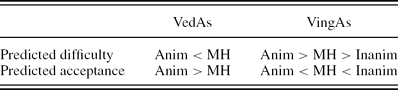
Because some psycholinguistic research has shown that people can determine without great difficulty the appropriate referents for metonymic expressions in discourse (Gibbs, Reference Gibbs1990) and Carroll (Reference Carroll2005) indicates that the initial state is marked by the transfer of L1-based processing procedures, I assume L2 learners of intermediate level and beyond can understand the MH phenomenon without great difficulty. Following Zhang (Reference Zhang2007a),Footnote 6 I hypothesize that the L2 acquisition of the syntactically relevant meaning component CAUSE in causative VingAs is guided by the semantic salience hierarchy of zero CAUSE with the animacy hierarchy. In other words, the predicted difficulty for VingAs follows the animacy hierarchy. Because VedAs can only collocate with animate nouns, typical animate nouns are easier to acquire than MH nouns. The empirical manifestations of the predicted difficulty for the two types of psych adjectives are their opposites, that is, the predicted acceptance of VedAs follows the animacy hierarchy and that of VingAs follows the animacy hierarchy in reverse order, as shown in Table 1.
Predicted difficulty and acceptance of psych adjectives constrained by animacy hierarchy
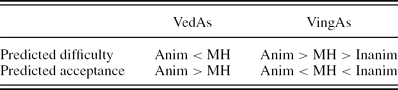
Note: VedAs and VingAs, suffixation of –ed and –ing, respectively, to object experiencer verbs to derive psych adjectives; MH metonymic human.
The predicted developmental path of attributive psych adjectives is as follows: the initial stage is marked by the first bootstrapping effects, which are marked in turn by the two most frequent, thus canonical, collocations, VedAs with animate nouns and VingAs with inanimate nouns. The second stage is marked by the second bootstrapping effects, the relaxation of the one-to-one restriction to collocations of VingAs with MH expressions because of their resemblance to inanimate nouns. This relaxation triggers the last learning stage, which is marked by the collocation of VingAs with animate nouns. To test the hypothesis and its predictions, I now turn to the experiment.
METHOD
Participants
A total of 78 subjects participated in the study, including L2 learners and NS controls. Participants were 8 NS of American English who acted as control, 30 Chinese high school students, and 40 Chinese graduate students. The NS control group consisted of 2 senior American teachers teaching English in a university in Xi'an, China, and 6 American high school students from Lab's High School of the University of Chicago. The average age of the 6 American high school students was 16.67 years (SD = 0.75).
Thirty students from Xi'an Xiguang Middle School, a key high school in Xi'an, participated in the study. They were from one of the two key classes in Grade 2 in terms of their academic achievements in all subjects, including English (there were 8 classes in the grade). Their average age was 16.80 (SD = 0.53), and they had been taught English in classroom for over 5 years before the experiment. To determine the proficiency of these high school students, a proficiency test was administered to the whole class of 62 students. The test is the English Language Skills Assessment by Cecelia Doherty and Donna IIyin for intermediate level learners, which is a cloze test with 25 items removed from a reading passage. The students’ raw scores ranged from 12 to 24, and there seemed to be much variability in their English proficiency. To ensure that the participants were at the same level, only 30 students whose raw score ranged from 19 to 22 were chosen for the study. Their proficiency was at high intermediate level according to the English Language Skills Assessment. They formed the intermediate group.
Forty graduate students of English language and literature from Shaanxi Normal University participated in the study as a course requirement. Their age ranged from 23 to 30 years with a mean of 25.84 (SD = 1.42). To be admitted as graduate students in English language and literature, they passed an advanced level English proficiency test. They were the advanced group.
Test instrument
The hypothesis was investigated using an acceptability judgment test (AJT), which was designed out of a multiple choice test (MCT) in a pilot study. The purpose of the pilot study was to check the well-formedness of the test items that would be used later in the AJT. It should be recalled that there are five possible collocations of prenominal psych adjectives constrained by the animacy hierarchy, namely, VedAs with animate and MH nouns, and VingAs with animate, MH, and inanimate nouns. For each collocation, six sentences were chosen primarily from Fillmore's online FrameNet,Footnote 7 so there were 30 sentences in the MCT. The prenominal adjective position was left with a blank, followed by the adjective and its opposite form in brackets (i.e., if the first adjective in the brackets given was a VedA, then a VingA was provided and vice versa). The MCT was given to a NS group of three American teachers of English. The NS participants were asked to choose one of the two options given that best completes each sentence so that it would make perfect sense. What determines the correct choice is the sentential context. In other words, the chosen adjective form needs to be congruent with the sentential context. Item analysis eliminated three test sentences, and they are (18)–(20).
(18) Ma Junren, the Chinese marathon trainer, is a _____ (tired, tiring) coach.
(19) Already, experts are working hard to get rid of the _____ (annoyed, annoying) pests.
(20) A _____ (tired, tiring) mind can know no rest.s
The first two were in the category of VingAs with animate nouns. Sentence (18) was eliminated because the three American teachers felt that either was fine. Sentence (19) was eliminated because pests are really not “animate” like humans and animals, and the NS treated it just like inanimate nouns. Sentence (20) was categorized as a VingA with a MH N, and it was excluded because it was rather cryptic and 2 NS made the wrong choice. Therefore, only 27 sentences in the MCT were chosen for the AJT.
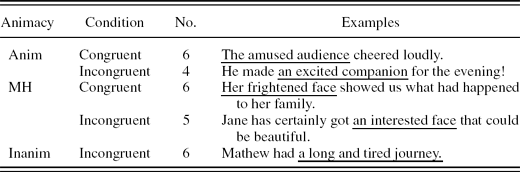
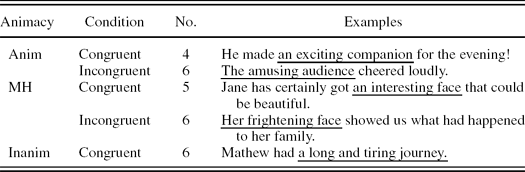
In designing the AJT, the surviving 27 sentences (see Appendix A) were first used as collocations in a congruent context condition. Then, another 27 sentences were created by changing the type of adjectives as collocations in an incongruent context condition. Altogether, there were 54 test sentences in the AJT: 27 meaningful sentences and 27 semantically odd sentences. These sentences were categorized into five sentence types according to psych adjectives’ collocations with three types of noun animacy in two context congruency conditions, as shown in Table 2 and Table 3. Another 30 sentences with psych adjectives in predicative positions served as fillers. Like the test items, half of the fillers were meaningful good sentences and the other half were semantically odd or ungrammatical sentences. These 84 sentences were first randomized and then sorted into two versions to counterbalance possible effects of presentation order. It should be noted that VedAs’ collocation with inanimate nouns in Table 2 is not really incongruent with context but is ruled out by selectional restrictions.
Sample collocations of VedAs in congruent and incongruent context conditions

Note: VedAs, suffixation of –ed to object experiencer verbs to derive psych adjectives; MH metonymic human.
Sample collocations of VingAs in congruent and incongruent context conditions
Note: VingAs, suffixation of –ing to object experiencer verbs to derive psych adjectives; MH metonymic human.
The factor of context (congruent vs. incongruent) in the experimental design is to double-check the animacy effects investigated in this study. L2 learners are expected to show sensitivity to context effects like NS controls not only by accepting adjective plus noun (Adj + N) collocations in congruent conditions but also by rejecting those in incongruent conditions. It aims to illustrate the L2 learners’ developmental trajectory in the acquisition of attributive psych adjectives.
A 5-point scale (–2, –1, 0, +1, +2) was used in the test, where –2 = completely/100% unacceptable; –1 = probably/75% unacceptable; +2 = completely/100% acceptable; +1 = probably/75% acceptable; and 0 (the partition) = can't decide, not sure, or simply 50% unacceptable and 50% acceptable.Footnote 8
Procedure
All participants were tested in Xi'an, China.Footnote 9 The intermediate group took the test in their self-study time. Because these students were unfamiliar with AJT, care was taken to explain both the test with examples and the scale they would use. The instructions were given and explained in Chinese. Both word and percentage explanations were used to familiarize the participants with the 5-point scale. Three practice items were done together to make sure instructions would be precisely followed, and (21) is one of them.
(21) John bought some cooked rice. –2 –1 0 +1 +2
Participants were not allowed to consult dictionaries or other reference books during the experiment, and they were told not to look back at any test item. There was no time limit for the test, and the experiment lasted less than half an hour for the intermediate group. The advance group took the test for course requirement in about 20 min, and the NS controls took it in their spare time.
RESULTS
For each group, an omnibus multivariate analysis of variance (MANOVA) with repeated measures was performed for all the scalar data of the AJT with adjective types and sentence types as variables. Results of the NS controls are presented first to set a model with which the results of the L2 groups can be contrasted. The results of the intermediate group are reported earlier than those of the advanced group to appreciate the developmental trends.
Results of the NS controls
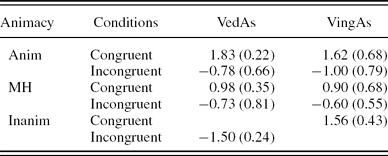
For the NS controls, repeated measures MANOVA produced a main effect of adjective types (VingAs vs. VedAs), F (1, 35) = 18.715, p < .0001, η2 = 0.348 (see Note 10); a main effect of sentence types, F (4, 35) = 63.014, p < .0001, η2 = 0.878; and an interaction, F (4, 35) = 15.344, p < .0001, η2 = 0.637. Table 4 displays means and standard deviations of Adj + N collocations for the NS controls.
Native speaker controls' means (standard deviations) of adjective + noun collocations in context conditions
Note: VedAs and VingAs, suffixation of –ed and –ing, respectively, to object experiencer verbs to derive psych adjectives; MH metonymic human.
Of the collocations of VedAs in the two context conditions, pairwise comparisons revealed a significant difference for every pair except that between VedAs with animate and MH nouns in the incongruent context condition. The NS controls' rejection of VedAs with inanimate nouns was significantly stronger than that of VedAs with animate and MH nouns in the incongruent context (p < .01). They accepted collocations of VedAs with animate nouns significantly more strongly than they did with collocations with MH nouns (p < .0001).
Of the collocations of VingAs, the NS controls exhibited strong context effects in accepting collocations of VingAs in the congruent context condition and rejecting them in the incongruent condition (p < .0001). No differences were found between VingAs with animate and MH nouns in both the congruent and the incongruent context conditions. However, they accepted collocations of VingAs with MH nouns in the congruent context condition significantly less strongly not only than they did with animate nouns in the same condition (p = .029) but also than they did with inanimate nouns (p = .045).
As a whole, the NS controls were very sensitive to context conditions of both VedAs and VingAs. They were sensitive to MH nouns in both context conditions, indicating that they had no difficulty in understanding metonymy, which confirmed Gibbs's (Reference Gibbs1990) findings of online studies. The NS controls' acceptability of attributive psych adjectives in both the congruent and the incongruent context conditions is marked by a distinction of literal and figurative language, that is, a difference between either typical animate or inanimate and MH expressions. For example, in their judgment of VingAs’ collocations in congruent contexts, the NS controls accepted the combination with a MH expression (such as interesting face as in “Jane has certainly got an interesting face that could be beautiful”) less strongly than they did either with the collocation with a typical inanimate noun (such as tiring journey as in “Mathew had a long and tiring journey”) or with the collocation with an animate N (like exciting companion as in “He made an exciting companion for the evening!”). In their judgment of VingAs’ collocations in incongruent contexts, NS controls rejected those with MH nouns (such as frightening face as in “Her frightening face showed what happened to her family”) less strongly they did with those with animate nouns (like amusing audience as in “The amusing audience cheered loudly”). The ranking of VingAs is MH (M = 0.90) < Inani (M = 1.56) / Anim (M = 1.65) for the congruent conditions and MH (M = –0.60) < Anim (M = –1.00) for the incongruent conditions. In the case with VedAs’ collocations in the congruent conditions, the NS controls' acceptance of those with animate nouns (such as amused audience as in “The amused audience cheered loudly”) is significantly stronger than that of those with MH nouns (like frightened face as in “Her frightened face showed what happened to her family”), whereas there is no difference in their rejection of the same collocations in the incongruent conditions. The ranking of VedAs is MH (M = 0.98) < Anim (M = 1.83) for the congruent conditions and MH (M = –0.73) = Anim (M = –0.78) for the incongruent conditions.
Results of the intermediate group
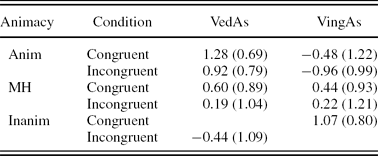
For the intermediate group, repeated measures MANOVA revealed a main effect of adjective types, F (1, 145) = 13.304, p < .0001, η2 = 0.084; a main effect of sentence types, F (4, 145) = 35.512, p < .0001, η2 = 0.495; and an interaction, F (4, 145) = 4.134, p = .003, η2 = 0.102. Table 5 presents the descriptive statistics for the intermediate group.
Second language intermediate group's means (standard deviations) of adjective + noun collocations in context conditions
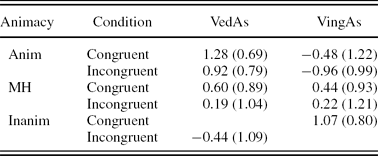
Note: VedAs and VingAs, suffixation of –ed and –ing, respectively, to object experiencer verbs to derive psych adjectives; MH metonymic human.
As shown in Table 5, in the case of animate nouns, the intermediate group accepted collocations of VedAs but rejected those of VingAs in both context conditions. Conversely, in the case of inanimate nouns, they accepted collocations of VingAs but rejected those of VedAs. This mirror-image pattern manifests the one-to-one learning strategy behavior, suggesting that L2 learners know to associate VedAs with animates and VingAs with inanimates. In addition, they accepted collocations of VedAs as well as of VingAs with MH nouns in both context conditions weakly and to roughly the same degree.
Regarding the difficulty of VedAs, pairwise comparison results indicate that the intermediate group were significantly more accurate at collocations of VedAs with animate than with MH nouns in both the congruent and the incongruent context conditions (p = .005 and .003, respectively), confirming the predicted pattern of difficulty in the case of VedAs as given in Table 1 (i.e., animate < MH). These intermediate learners correctly rejected the illicit collocation of VedAs with inanimate nouns but tended to accept collocations of VedAs with animate and MH nouns in the incongruent context condition. The acceptance of VedAs’ collocation with animate nouns in the incongruent context is explicable as the result of the application of the one-to-one (VedAs + animate N) correspondence in real language use, whereas the acceptance of VedAs’ collocation with MH nouns indicates that these intermediate learners were treating MH nouns more like animate nouns than inanimate nouns, though MH nouns resemble inanimate nouns. The only explanation for this is the awareness of the [+animate] or [+human] feature in MH expressions.
As for VingAs, pairwise comparisons show that the intermediate group found collocations of VingAs with inanimate nouns significantly more acceptable than those with MH nouns in the congruent context condition (p < .0001), which was in turn significantly more acceptable than those with animate nouns in the same condition (p < .0001), confirming the predicted difficulty of VingAs. These intermediate learners rejected collocations of VingAs with animate nouns in both the congruent and the incongruent context conditions, manifesting a marginal context effect (p = .073). They weakly accepted collocations of VingAs with MH nouns in the two conditions (M = 0.44 and 0.22, respectively). These learners also found collocations of VingAs with MH nouns in the incongruent context more acceptable than those of VingAs with animate nouns in the congruent context (p = .011) and than those in the incongruent context (p < .0001), all providing evidence for animacy hierarchy effects.
Results of the advanced group
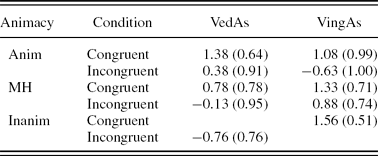
For the advanced group, repeated measures MANOVA also produced a main effect of adjective types, F (1, 195) = 46.571, p < .0001, η2 = 0.193; a main effect of sentence types, F (4, 195) = 73.011, p < .0001, η2 = 0.600; and an interaction, F (4, 195) = 3.788, p = .005, η2 = 0.072. Table 6 presents the descriptive statistics for the advanced group.
Second language advanced group's means (standard deviations) of adjective + noun collocations in context conditions
Note: VedAs and VingAs, suffixation of –ed and –ing, respectively, to object experiencer verbs to derive psych adjectives; MH metonymic human.
Results of pairwise comparisons revealed significant difference for every pair of VedAs’ collocations, manifesting strong animacy hierarchy effects. There were significant differences between VedAs with animate and MH nouns in the congruent as well as the incongruent context conditions (p = .001, .006, respectively). The advanced group rejected the illicit collocation of VedAs with inanimate nouns more strongly than they did with collocations of VedAs with animate and MH nouns in the incongruent context (p = .001). Significant context effects were revealed for collocations of VedAs with both animate and MH nouns (p < .0001), indicating they were very sensitive to the context conditions.
As shown in Table 6, the advanced group accepted collocations of VingAs with animate nouns in the congruent context and rejected them in the incongruent context, showing nativelike judgment. Pairwise comparisons revealed strong animacy hierarchy effects, too. These learners accepted the three collocations in the congruent condition, but they were only significantly more accurate at collocations of VingAs with inanimate than with animate nouns (p = .009). In other words, no significant difference existed between VingAs with inanimate and MH nouns, or between VingAs with animate and MH nouns. They correctly accepted VingAs with animate nouns in the congruent context and rejected them in the incongruent context (p < .0001), and although they incorrectly accepted VingAs with MH nouns in the incongruent context, their acceptance was significantly lower than that in the congruent context (p = .013), suggesting they were sensitive to the context conditions. All these indicate that these advanced learners’ acceptance of collocations of VingAs is truly constrained by the animacy hierarchy as well.
Results concerning group differences
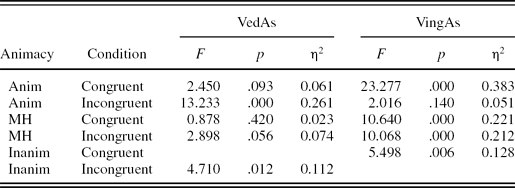
The three groups’ scalar data of collocations of VedAs and VingAs with nouns in the two context conditions were submitted into an omnibus MANOVA. Table 7 summarizes the results, and Figure 1 and Figure 2 display the mean responses to collocations of VedAs and VingAs with noun animacy in the two context conditions, congruent and incongruent, respectively.
Results of multivariate analysis of variance on group comparisons (df = 2)
Note: VedAs and VingAs, suffixation of –ed and –ing, respectively, to object experiencer verbs to derive psych adjectives; MH metonymic human.
Mean responses on collocations of suffixation of –ed to object experiencer verbs to derive psych adjectives (VedAs) in context conditions. [A color version of this figure can be viewed online at http://journals.cambridge.org/aps]
Mean responses on collocations of suffixation of –ing to object experiencer verbs to derive psych adjectives (VingAs). [A color version of this figure can be viewed online at http://journals.cambridge.org/aps]
Table 7 clearly shows that in the case of VedAs, the only significant results are all in incongruent conditions, namely, collocations with animate nouns (e.g., “an excited companion”), with inanimate nouns (e.g., “a frightened dream”), and with MH nouns (e.g., “an interested face”). That the groups did not differ in VedAs in congruent conditions confirms previous findings that L2 learners show little difficulty acquiring VedAs. In incongruent conditions, basically those differences are mainly due to the nonnativelike performance of L2 groups who either weakly accepted licit collocations of VedAs with animate or MH nouns, ignoring the context congruency, or weakly rejected illicit collocations of VedAs with inanimate nouns.
In the case of VingAs, the significant results are in all three congruent conditions (i.e., animate nouns as in “an exciting companion,” MH nouns as in “an interesting face,” and inanimate nouns as in “a really frightening dream”) and one incongruent condition (e.g., MH nouns as in “a frightening face”). The significance difference in the incongruent condition of VingAs with MH nouns among the three groups is mainly due to the nonnativelike acceptance of L2 groups. Although all groups accepted this collocation in the congruent context, the advanced group's acceptance was not only the strongest but also statistically stronger than that of the intermediate group (p < .0001). The advanced group's nonnative behavior with VingAs’ collocation with MH nouns in the incongruent context condition is similar to their other nonnativelike behavior: the acceptance of VedAs’ collocations with animate nouns in the incongruent condition, which is explicated as a side effect of a general tendency to accept the exclusive collocation of VedAs with animate nouns. MH expressions bear the same appearance as typical inanimate nouns, thus are likely to bear similar overpowering bootstrapping effects. The advanced learners’ nativelike judgments with collocations of VingAs with animate nouns and with those of VedAs with MH nouns across context conditions most likely resulted from the timing of this bootstrapping in the learning process.
As shown in Figures 1 and 2, the L2 groups behaved just like the NS controls in accepting collocations of VingAs with inanimate nouns and rejecting the illicit collocation of VedAs with inanimate nouns. Of both VedAs’ and VingAs’ collocations with animate and HM nouns in both the congruent and the incongruent context conditions, the collocations with animate nouns in the incongruent context condition are quite striking. For VedAs, it is the only collocation-condition type for which all groups differed, while for VingAs, it is the only one for which all groups did not differ.
Like the NS controls, the intermediate group tended to reject VingAs’ collocation with animate nouns in the incongruent context (as in “amusing audience”). This pattern suggests that L2 learners have the one-to-one strategy of mapping VedAs onto animate nouns. The advanced group behaved just like the NS controls with regard to this collocation in both context conditions.
DISCUSSION
The focus of this study is on how L2 learners use the cues constrained by the animacy hierarchy to explore the form–meaning mappings of attributive psych adjectives. Assuming the tenets of the semantic salience hierarchy model (Zhang, Reference Zhang2007a), it was hypothesized that the L2 acquisition of attributive psych adjectives would be constrained by the animacy hierarchy. Overall, the results of the L2 groups confirmed the predictions made by the semantic salience hierarchy of the zero CAUSE morpheme with the animacy hierarchy as outlined in Table 1. The developmental path of the L2 knowledge of the zero CAUSE morpheme as encoded in VingAs starts with the conspicuous cues in the typical inanimate causer and extends gradually to the relatively less conspicuous causer figuring in the identity of MH, and finally to the least conspicuous causer manifesting in typical animate nouns. All these indicate that the L2 acquisition of attributive psych adjectives is constrained by the animacy hierarchy.
The NS controls' acceptance of attributive psych adjectives was marked not by animacy hierarchy constrained behavior but rather by a distinction of literal and figurative language use because they were significantly more accurate with collocations of VingAs with animate and inanimate nouns than with MH nouns, and because they accepted collocations of VedAs with animate nouns significantly more strongly than they did with MH nouns. These findings are consistent with our intuitions that people understand literal language more easily than figurative language, like metonymy and metaphor, and they are consistent with Gibbs's (Reference Gibbs1990) experimental finding that people are faster at reinstating the antecedents for literal referential descriptions than at reinstating metaphoric and metonymic descriptions.
The two L2 groups did not differ from the NS control group in the acquisition of noncausative VedAs, because they found collocations of VedAs with animate nouns significantly more acceptable than those with MH nouns. The acquisition of the noncausative VedAs is not difficult, and it is marked by the same distinction of literal and figurative language. The L2 groups differed from the NS controls in the acquisition of the causative VingAs, which is problematic for L2 learners. The Chinese learners’ more targetlike behavior stems not from their L1, which employs overt morphology, but from a cognitive strategy derived from surface forms of sentences and Adj + N collocations. Collocations of psych adjectives with the animacy of nouns are a correlate of the covert argument structure, or the syntactically relevant meaning component CAUSE encoded in OE verbs and adjectives. These cues are clearly privileged, in the sense that they are used early and selectively, from typical animate and inanimate to less typical, in this case MH. MH expressions are less frequent, but nevertheless they are a universality in human languages. Because there is no evidence from the input for such a hierarchy, the results are consistent with the view that these L2 learners are drawing on universal properties of thematic organization. These findings echo what is reported in Lidz et al.'s (Reference Lidz, Gleitman and Gleitman2003) study of 3-year-old Kanada children associating argument/noun phrase number with causativity and Demuth et al.'s (Reference Demuth, Machobane, Moloi and Odato2005) study of Sesotho children acquiring their DOAs with the guidance of the animacy hierarchy. L2 learners clearly know to look for and know to use the cues, namely, the animacy of nouns and the animacy hierarchy, which are statistically available in all the languages, manifesting bootstrapping effects.
The intermediate learners accepted collocations of VedAs with animate nouns and those of VingAs with inanimate nouns but rejected combinations of VingAs with animate nouns. This one-to-one correspondence is a reflection of Andersen's (Reference Andersen1984) one-to-one principle, which causes learners to expect each newly discovered form to have one and only one meaning, function, and distribution. The necessary condition for learners to assign a one-to-one form–meaning correspondence is that they must have access to prototypicality in linguistic form–meaning relations (Andersen & Shirai, Reference Andersen and Shirai1994). Prototype theory developed by Eleanor Rosh (Reference Rosh and More1973, Reference Rosh, Rosh and Lloyd1978; Rosh & Mervis, Reference Rosh and Mervis1975) assumes a graded category of membership rather than the classical all-or-nothing membership to account for human categorization. Applied to language acquisition, the claim is that children and L2 learners acquire a linguistic category starting with the prototype of the category, later expanding its application to less prototypical cases. A prototype account has been advanced in research on L1 acquisition of lexical semantics (Barrett, Reference Barrett and Kuczaj1982, Reference Barrett, Kuczaj and Barrett1986; Bowerman, 1978; Greenberg & Kuczaj, Reference Greenberg, Kuxzaj and Kuczaj1982) and of morphology (Shirai & Andersen, 1995; Slobin, Reference Slobin and Deutsch1981, Reference Slobin and Slobin1985), and on L2 acquisition of tense and aspect (Andersen & Shirai, Reference Andersen and Shirai1994). In our case, a prototype account can provide some explanation for the conservative behavior of intermediate learners in their significantly more accurate acceptance of VingAs in collocations with typical inanimate nouns than with fake inanimate MH nouns, indicating that the frequency of the cues in the input may be an important factor.
Frequency plays a key role in language comprehension and production (Anderson, Reference Andersen1988, Reference Andersen, Hyltenstam and Viborg1993; Andersen & Shirai, Reference Andersen and Shirai1994). However, the frequency effect seems to be restricted to the acquisition of noncausative VedAs, which are not problematic for L2 learners. The acceptance of collocations of VedAs with MH nouns in the congruent and the incongruent context conditions by the intermediate group appears as a frequency effect, because collocations of VedAs with MH nouns are more frequent than VingAs with MH nouns.Footnote 11
However, the prototype account alone proves to be inadequate in accounting for why L2 learners’ developmental path of the zero CAUSE morpheme as encoded in VingAs differs from the NS controls', given that collocations of VingAs with animate nouns are more frequent, thus more typical than those with MH nouns in the input. L2 learners did relax the VingAs + inanimate noun collocation restriction in keeping with increasing proficiency. Why did they not first extend the restriction to collocations of VingAs with prototypical animate nouns and then to collocations with MH nouns but rather proceed the other way round?
The developmental path for L2 learners is actually the result of the interaction of nonovert CAUSE, L1 influence, and the animacy hierarchy. L2 acquisition is different from L1 acquisition in that it involves a fully operative L1. At the initial stage, that is, before learners are aware that L2 forms involve a zero CAUSE morpheme, there is nothing to block L1 transfer in their interpretation of VingAs + animate noun collocation, which often results in a confusion/contradiction with the context. For example, Chinese learners of English often interpret “John worried his mother” as “John worried about his mother,” which is incongruent with the context in which it occurs. In this connection, learners’ initial rejection of licit collocations of VingAs with animate nouns results from the contradiction arisen from the interpretation of such collocations through the employment of L1 form–meaning representations. In collocations of VingAs with inanimate nouns, L1 transfer is blocked or avoided because sense-making or comprehension endeavors would help learners realize that the L2 form–meaning connections are different from those of L1. Because there is no confusion involved in the comprehension of collocations of VingAs with inanimate nouns, acquisition starts there. With collocations of VingAs with MH nouns, which bear the same appearance as inanimate nouns, sense-making endeavors do not result in a confusion/contradiction with the context, which reinforces the realization of the zero CAUSE morpheme as encoded in VingAs, thus helping shape the correct form–meaning connections in the L2.
CONCLUSION
Animacy hierarchy constraints have repercussions in L2 just as in L1 acquisition. Just as Sesotho children used the guidance of the animacy hierarchy in their acquisition of DOA constructions (Demuth et al., Reference Demuth, Machobane, Moloi and Odato2005), Chinese L2 learners of English employed the guidance of the animacy hierarchy in building their interlanguage. Their targetlike behavior is found to stem not from similar constructions in L1 that involve overt morphology but from Adj + N collocations constrained by the animacy hierarchy. This certainly demonstrates one similarity between L1 and L2 acquisition in that both young and older learners know to look for syntactic and semantic cues and know to use them as one source of information regarding verb semantics when there is a mismatch of overt and nonovert morphology between the L1 and the L2. The path of interlanguage development is closely related to the saliency of CAUSE in the input and to interactions of input, L1, and animacy. Input frequency and cognitive principles like the one-to-one principle and the notion of prototypicality are involved in the learning process, but they are accounted for by the semantic salience hierarchy of natural language representation of causativity, in which the animacy hierarchy is an interacting factor.
We know for sure now that both L2 learners and NS controls treat MH expressions with VedAs as the marked form of animate nouns. However, there are two possibilities to treat MH expressions with VingAs, that is, either as the marked form of inanimate nouns or as the marked form of animate nouns, and the Chinese-speaking learners of English in this study with sentential contexts appeared to follow the former route. However, within contexts beyond the sentential, the one-to-one correspondence learning strategy of favoring VingAs in collocations with inanimate over animate nouns may be ineffective because context effects will suppress it in the meaning-making endeavor. Context effects on MH expressions as the marked form of animate nouns with both VedAs and VingAs is a topic for further research.
APPENDIX A
1. Collocations of VedAs with animate nouns
The amused audience cheered loudly.
The disappointed fans started sneaking out before the end of the game.
Interested readers can find more books by this writer in the library.
Finally an annoyed Fidel replied, “Why do you keep asking me that question?”
I have shown the results to many very excited colleagues.
When Bill got a rash on his face, his worried mother immediately called the family doctor.
2. Collocations of VedAs with MH nouns
Marcus was looking at the various speakers, with an interested air.
A worried voice said, “I couldn't find my bag, sir,” when the manager came over.
The Consul shot an annoyed glance at Maxwell for making a fool of himself.
Her frightened face showed us what had happened to her family.
His very tired eyes watched her walk to an empty table at the corner of the bar.
A pleased smile was stretching from ear to ear on the mother's face.
3. Collocations of VingAs with inanimate nouns
The project for training of musicians is a particularly interesting new development.
A pleasing thought came to his mind, and he soon cheered up.
What an extremely boring job it is! We just sat there and did nothing.
The surprising determination of Stephen's gentle wife had prevailed.
Tom had a really frightening dream last night.
Mathew had a long and tiring journey.
4. Collocations of VingAs with MH nouns
Jane had certainly got an interesting face that could be beautiful.
Jenny had a pleasing voice and was an adequate actress by the standards of opera.
“That's right,” Jeff piped up, throwing his sister a soothing glance.
Frank smiled his delightful smile and nodded eagerly.
A surprising expression of regret comes from AT&T Corporation chairman Robert Allen.
A tiring mind can know no rest.*
5. Collocations of VingAs with animate nouns
It is very difficult to focus clearly upon a boring speaker, and you can't help falling asleep.
He made a very exciting companion for the evening!
The Child Poverty Action Group was also a surprising ally: since its beginning, it was against low pay.
Anthony Trollope, an amusing writer, believed women could not exist without men in the vicinity.
Already, experts are working hard to get rid of the annoying pests.
Ma Junren, the Chinese marathon trainer, is a tiring coach.
*The italicized items were excluded in the AJT.
ACKNOWLEDGMENTS
This research was conducted with support from the Chinese Social Science Foundation Research (Grant 05BYY031) and from the New Century Educational Talents Plan of the Chinese Education Ministry (under Contract NCET-06-0873) to the author.