INTRODUCTION
The taxonomy and status of genera like Hetropanope Stimpson, Reference Stimpson1858 have been the subject of debate for a long period of time (De Man, Reference De Man1887; Alcock, Reference Alcock1898; Davie, Reference Davie1989). Species of the genus Hereopanope Stimpson, Reference Stimpson1858 are abundantly found in mangrove mudflats, specifically under small rock surfaces (Chhapgar, Reference Chhapgar1957, Davie, Reference Davie1989). Alcock, Reference Alcock1898 identified three species belonging to this genus from India: Heteropanope indica De Man, Reference De Man1887, Heteropanope laevis (Dana, 1852) and Heteropanope eucratoides Stimpson, Reference Stimpson1858; but after the revision of the genus Heteropanope by Davie Reference Davie1989, species such as Heteropanope indica (De Man, Reference De Man1887) and Heteropanope eucratoides (Stimpson, Reference Stimpson1858) were classed under the genus Benthopanope Davie, Reference Davie1989 with the new names Benthopanope indica and Benthopanope eucratoides, respecetively. Currently, Heteropanope laevis is the only representative of Heteropanope from India and the present study adds one more species – Heteropanope glabra – to the species list of the genus Heteropanope from India.
MATERIALS AND METHODS
In the present study, a total of 14 specimens (six males and eight females) were collected from two different locations: (1) Ghogha (21°40′41″N 72°17′06″E) (specimen collected 14 April 2014, mudflat near Ghogha port jetty); (2) Gopnath (21°40′41″N 72°06′31″E) (specimen collected 31 December 2013, mangrove near Gopnath temple) of Gujarat state. The male specimen of Heteropanope glabra (ZL-AR-CR-62, carapace length (CL): 11.26 mm, carapace width (CW): 7.87 mm) was deposited in the Zoology Museum at Department of Zoology, The M.S. University of Baroda, Vadodara, Gujarat, India.
Specimens were handpicked during low tide from the site indicated. All of the specimens were brought to the lab and preserved in 10% formalin for further study. The specimens were identified to the species level using different identification keys and monographs (Chhapgar, Reference Chhapgar1957; Davie, Reference Davie1989; Sethuramalingam & Khan, Reference Sethuramalingam and Khan1991; Jeyabaskaran et al., Reference Jeyabaskaran, Khan and Ramaiyan2000). For further confirmation of species, all the specimens were examined and compared with the photographs and identification information available on the Marine Species Identification Portal website (http://www.speciesidentification.org). Detailed morphometry of all the specimens was carried out using a digital Vernier calliper, and different morphological characters such as CL and CW were measured. The morphometry of the male pleopod (total length: TL; apical lobe length or tip length: TiL) was conducted using an ocular micrometre.
RESULTS
SYSTEMATICS
Order DECAPODA Latreille, 1803
Infraorder BRACHYURA Linnaeus, 1758
Superfamily PILUMNOIDEA Samoule, 1819
Family PILUMNIDAE Samoule, 1819
Subfamily PILUMNINAE Samoule, 1819
Genus Heteropanope Stimpson, Reference Stimpson1858
Heteropanope glabra Stimpson, Reference Stimpson1858
(Figures 1 & 2)
Heteropanope glabra Stimpson, Reference Stimpson1858, p. 35. Stimpson Reference Stimpson1907, p. 63, pl. 8, Figure 1. Parisi, Reference Parisi1916, p. 186. Yokoya, Reference Yokoya1933, p. 184. Blass, Reference Balss1933, p. 32. Sakai, Reference Sakai1954, p. 75. Takeda & Nunomura, Reference Takeda and Nunomura1976, p. 76. Takeda & Iwasaki, Reference Takeda and Iwasaki1983, p. 88. Garth & Kim, Reference Garth and Kim1983, p. 177. Dai & Yang, Reference Dai and Yang1991, p. 337, Figure 184 (1), pl. 50(8). Ho et al., Reference Ho, Yu and Ng2000, p. 116.
Heteropanope glabra male ZL-AR-CR-62 (CL: 11.26 mm, CW: 7.87 mm). (A) Dorsal view; (B) Ventral view; (C) Front; (D) Anterolateral border; (E) Carpus of Chelipeds; (F) Chelipeds. The white arrow shows the presence of a blunt tooth on the inner side of carpus. Scale bars = 10 mm.

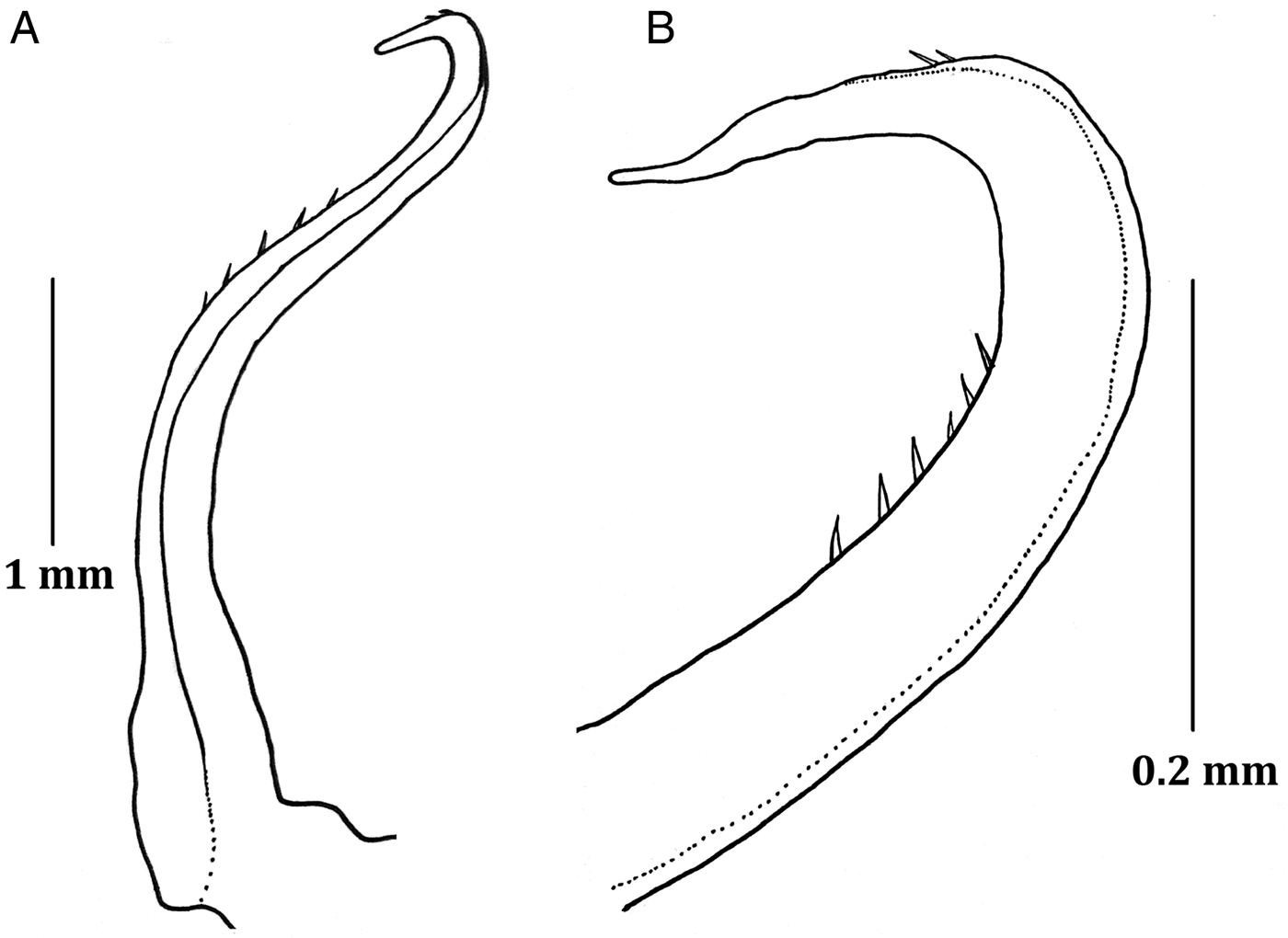
Heteropanope glabra male first G1 (left pleopod). (A) Entire pleopod; (B) Apical lobe.
Pilumnopeus maculates Milne Edwards, Reference Milne Edwards1867, p. 227. Milne Edwards, Reference Milne-Edwards1868, p. 82, pl. 19, Figures 17–19.
Euricarcinus maculates De Man, Reference De Man1887, p. 44, pl. 2, Figures 2 & 3. Ortmann, Reference Ortmann1893, p. 435. Alcock, Reference Alcock1898, p. 212. Lanchester, Reference Lanchester1900, p. 744. Roux, Reference Roux1917, p. 603. Sankarankutty, Reference Sankarankutty1962, p. 146, Figure 51.
Actumnus nudus (not Milne Edwards, Reference Milne Edwards1867) Grant & McCulloch, Reference Grant and McCulloch1906, p. 17.
Non Heteropanope glabra Sakai, 1939, p. 545, pl. 99, Figure 6. Sakai, Reference Sakai1976, p. 503, Figure 269.
Heteropanape longipedes Davie, Reference Davie1989.
MATERIAL EXAMINED
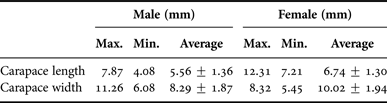
Fourteen specimens (six males and eight females) were collected, or which, four male and six female specimens were collected from Ghogha, while two male and two female specimens were collected from Gopnath. Morphological measurements of the specimens are provided in Table 1. One male specimen was deposited in the Zoology Museum at Department of Zoology, The M.S. University of Baroda, Vadodara, Gujarat, India; catalogue no. ZL-AR-CR-62. Site of collection: Ghogha, 14 April 2014. Additional specimens were sub-labelled ZL-AR-CR-62(i) to ZL-AR-CR-54(xiii).
Morphological measurements of Heteropanope glabra.
DIAGNOSIS
Carapace smooth, wider than long (1.4–1.5 times); convex on the mid line; slightly convex on the branchial region, carapace region poorly defined; cardiac region distinctly separated from gastric region (Figure 1A); front broad and bilobed (Figure 1C), lobes flat in shape, separated by V-shaped depression, anterior border of lobes slightly convex; dorsal margin of the orbit macroscopically granulated, ventral margin distinctly serrated; outer orbital angle slightly pronounced and confluent with first anterolateral teeth; antennal segment very short; merus of third maxilliped shorter than ischium; merus little broader than long; exopod not reaching the anterior margin of merus; surface of all the parts of third maxillipeds granular with long bristles on the inner margin of ischium, merus and palp; anterolateral margin finely granular, cut into four teeth including outer orbital teeth (Figure 1D); first tooth confluent with the outer orbital tooth; broad in shape; arched and round; second lobe broad; directed anteriorly; third tooth slightly smaller and separated from second tooth; fourth tooth smallest and pointed; posterolateral margin oblique and straight; transverse crest extending internally from the base of last tooth.
Chelipeds unequal in size with smooth surface (Figure 1F); merus of major cheliped short; upper posterior margin carinate with blunt subdistal lobe, upper margin granular proximally; lower margins smooth; carpus with strong blunt tooth on the inner side (Figure 1E); rounded in shape, smooth and glabrous; palm swollen, smooth and glabrous; fingers pointed; immovable finger with large molar on the proximal part with two or three molar present distally; dactyl strongly curved with two or three small teeth present on the proximal part; fingers dark in colour; band at the base of dactyl; smaller cheliped similar in appearance but less massive.
Walking legs moderate in length; slender in shape; first and second pairs sub-equal in length; slightly longer than third pair; all legs with serrated setae with thicker setae on peopodus and dactylus. Male abdomen triangular in shape and seven segmented (Figure 1B); first to third segments similar in width; four to seven similar in length; telson bluntly rounded distally and base as broad as wide; first male left pleopod slender and elongated; S-shaped with downward (Figure 2A), tapering tip; fine line of setae present distally on the inner margin of the curve of the apical lobe; 3–4 longer and stouter setae on the upper margin of apical lobe (Figure 2B). The species is olive green to yellowish green in colour with small purple-coloured granules present on the upper surface of palm and carpus of chelipeds; purple granules also present on the anterolateral margins and epibranchial region of the carapace.
REMARKS
The morphological characters of the specimens collected in the present study closely agree with the morphological characters of the species described and illustrated by Stimpson (Reference Stimpson1858) and Davie (Reference Davie1989). The male first left gonopod of the specimens examined in the present study shows some variation in the degree of deflection and length of the tip, and in the setae pattern of the tip, as compared with the illustrations made by Stimpson (Reference Stimpson1858) and Davie (Reference Davie1989). These differences are slight and unlikely to be significant. Heteropanope glabra is mostly observed in the mangrove mudflat intertidal area where it mostly stays under rock boulder surfaces (Davie, Reference Davie1989). The species can tolerate lower salinity conditions. In Gujarat, India, the species shares a habitat with other sympatric species such as Benthopanope indica. Sankarankutty (Reference Sankarankutty1962) has recorded Euricarcinus maculates, which is now treated as a synonym of H. glabra, from the Andaman and Nicobar islands, but the figure and description of the male gonopod given by him varies from the current studied material, in terms of degree of deflexion, length of the tip and setation.
The distribution range of H. glabra comprises an area from Burma to Japan. So far, the species is reported from the Mergui Archipelago (Parisi, Reference Parisi1916), Zanzibar (Milne Edwards, Reference Milne Edwards1867), Hong Kong (Stimpson, Reference Stimpson1907), Malaysia (Balss, Reference Balss1933), Singapore (Davie, Reference Davie1989), the Philippines (Garth & Kim, Reference Garth and Kim1983), Northern Australia (Davie, Reference Davie1989) and the Solomon Islands (Takeda & Nunomura, Reference Takeda and Nunomura1976). The present study reports the occurrence of the species for the first time from (Gujarat state) India, which is located outside the known distribution range of H. glabra. The study presents an interesting scope for redefining the distribution range of the species.
ACKNOWLEDGEMENTS
The authors are grateful to the Gujarat Biodiversity Board, Government of Gujarat for sponsoring the research project on ‘Documentation of Biodiversity of Crustaceans of Gujarat’ and to the Ministry of Earth Sciences, Government of India for sponsoring the research project on studies on ‘Brachyuran Crab Fauna of Saurashtra Coast’. G.M.S. and J.N.T. wish to thank the Gujarat Biodiversity Board and University Grant Commission (RFSMS Scheme) for the award of fellowships, respectively. The authors also thank Ms Dhruva Trivedi and Ms Barkha Purohit for their help in the specimen collection.