


Introduction
Landscapes are typically mosaics of heterogeneous landforms or patches that determine biological and ecological processes at different spatial and temporal scales (Thorp et al. Reference Thorp, Thoms and Delong2008). In stream ecosystems, these patches can range from a larger catchment scale at which changes respond to low-frequency events occurring over a long period (e.g., recurrence 105–106 years) to microhabitats at the local scale that change at a relatively high frequency (e.g., recurrence 10–1–100 years; Frissell et al. Reference Frissell, Liss, Warren and Hurley1986). The interaction of different spatial and temporal scales affects the availability of suitable habitats and resources for different fish species, conditioning the structures of communities at the local scale (Pringle et al. Reference Pringle, Naiman, Bretschko, Karr, Oswood and Webster1988, Erős et al. Reference Erős and Campbell Grant2015).
Heterogeneity of microhabitats in streams is related to the small-scale variability in substrate size, macrophyte density, depth and flow velocity, which can be local abiotic filters for fish species (Erős et al. Reference Erős and Campbell Grant2015, Reference Erős, Czeglédi, Tóth and Schmera2020). Macrophytes can act as a source of food and shelter from predators (Quirino et al. Reference Quirino, Lansac-Tôha, Thomaz, Heino and Fugi2021, Yofukuji et al. Reference Yofukuji, Cardozo, Quirino, Aleixo and Fugi2021), while depth and flow velocity are important for the distribution of some fish species; for instance, some Loricariidae live in areas of high water velocity (Roxo et al. Reference Roxo, Lujan, Tagliacollo, Waltz, Silva, Oliveira and Albert2017), and certain substrate particle sizes are selected by fish for foraging and reproduction (Rahel Reference Rahel, Gido and Jackson2010).
Microhabitat heterogeneity can be affected by environmental deterioration caused by increasing land-use intensification. Urbanization promotes permanent changes in watersheds and stream channels (Paul & Meyer Reference Paul and Meyer2001); for example, stream channelization and soil impermeability lead to increases in substrate siltation and the homogenization of substrate sizes through an increase of sediments (Dala-Corte et al. Reference Dala-Corte, Giam, Olden, Becker, Guimarães and Melo2016, Montag et al. Reference Montag, Winemiller, Keppeler, Leão, Benone and Torres2019), promoting changes in channel depth, water velocity and the frequency and magnitude of floods. Together with nutrient enrichment, other contaminants and turbidity, these changes contribute to reducing macrophyte diversity (Paul & Meyer Reference Paul and Meyer2001, Xavier et al. Reference Xavier, Scherner, Burgos, Barreto and Pereira2016). In agricultural streams, the impacts are related to water abstraction for crop irrigation, which reduces stream discharge and accelerates sedimentation rates (Sueyoshi et al. Reference Sueyoshi, Ishiyama and Nakamura2016). Agriculture also enhances nutrient concentrations and promotes greater macrophyte biomass (Dala-Corte et al. Reference Dala-Corte, Giam, Olden, Becker, Guimarães and Melo2016).
Homogenization or elimination of some local components due to the intensification of land use reduces microhabitat diversity (Romero & Casatti Reference Romero and Casatti2012, Dala-Corte et al. Reference Dala-Corte, Giam, Olden, Becker, Guimarães and Melo2016). This homogenization may restrict fish species segregation, forcing them to explore additional microhabitat conditions, which leads to an increase in biotic stressors (competition and predation) and the loss of specialist species (Erős et al. Reference Erős and Campbell Grant2015). Conversely, less impacted streams exhibit higher microhabitat heterogeneity, offering a wide variety of shelters and resources, promoting a greater richness of species (Moi & Teixeira de Mello Reference Moi and Teixeira de Mello2022).
In subtropical streams, the effects of different land uses on fish assemblages are focused mostly on changes in water quality (e.g., Barbosa et al. Reference Barbosa, Pires and Schulz2020, Paredes del Puerto et al. Reference Paredes del Puerto, Paracampo, García, Maiztegui, Garcia de Souza, Maroñas and Colautti2021) and certain habitat characteristics at different scales, including microhabitats (e.g., Dala-Corte et al. Reference Dala-Corte, Giam, Olden, Becker, Guimarães and Melo2016, Reference Dala-Corte, Sgarbi, Becker and Melo2019). Very little research has focused on the relationships between microhabitat types and fish species in streams with different land-use intensities (e.g., Romero & Casatti Reference Romero and Casatti2012). The Uruguayan subtropical streams are subject to a gradient of anthropogenic deterioration that increases in the south of the country, where the metropolitan areas are concentrated (Zaruki et al. Reference Zaruki, González-Bergonzoni, Teixeira de Mello and Loureiro2011). The first studies on Uruguayan stream fish assemblages focused on water quality and some meso-habitat conditions such as the width and depth of the water column (Teixeira de Mello et al. Reference Teixeira-de Mello, Meerhoff, Baattrup-Pedersen, Maigaard, Kristensen and Andersen2012, Chalar et al. Reference Chalar, Delbene, González-Bergonzoni and Arocena2013, Benejam et al. Reference Benejam, Teixeira-de Mello, Meerhoff, Loureiro, Jeppesen and Brucet2016). Moi and Teixeira de Mello (Reference Moi and Teixeira de Mello2022) used a gradient of habitat diversity at the stream scale to describe the effects of urbanization on water quality and habitat diversity and how these affect the fish trophic group diversity and ecosystem functions, but they did not analyse microhabitats and their use by fish.
Hypothesizing that the effects of urban patches are likely to be greater than those of agricultural practices on fish assemblages, this work aimed to evaluate the impacts of urban patches in an agricultural matrix on water quality, microhabitat diversity and fish assemblage structure. We also describe the use of microhabitat types by fish, highlighting the most important microhabitats selected by fish species in the Arroyo Colorado basin, Uruguay. We predicted that urban patches would lower water quality and the diversity of microhabitat types and simplify fish assemblages relative to agricultural streams, thus affecting microhabitat–fish interactions.
Methods
Study area
The biogeographical region of Uruguay is classified as Pampas, and the Koeppen climate classification of the basin is a ‘Cfa’ humid subtropical climate (Kottek et al. Reference Kottek, Grieser, Beck, Rudolf and Rubel2006). Three-quarters of Uruguay consists of the natural prairies that were transformed into grazing land for cattle 450 years ago. Agricultural, livestock and forestry activities occupy 40%, 15% and 42% of the land surface, respectively (DIEA 2019). The growth of agriculture has increased the input of pesticides, phosphorus and nitrogen into Uruguayan freshwaters (Goyenola et al. Reference Goyenola, Meerhoff, Teixeira-de Mello, González-Bergonzoni, Graeber and Fosalba2015, Ernst et al. Reference Ernst, Alonso, Colazzo, Pareja, Cesio and Pereira2018, Soutullo et al. Reference Soutullo, Ríos, Zaldúa and Teixeira-de-Mello2020, Alcántara et al. Reference Alcántara, Somma, Chalar, Fabre, Segura and Achkar2022). Urban and industrial land uses significantly impact water bodies because sewage treatment is still rudimentary and leads to inputs of hydrocarbons, nutrients, pesticides (Paul & Meyer Reference Paul and Meyer2001, Walsh et al. Reference Walsh, Roy, Feminella, Cottingham and Groffman2005) and contaminants such as pharmaceuticals, hormones and drugs of abuse (Griffero et al. Reference Griffero, Alcántara-Durán, Alonso, Rodríguez-Gallego, Moreno-González and García-Reyes2019, Alvareda et al. Reference Alvareda, Lucas, Paradiso, Piperno, Gamazo and Erasun2020), mainly in the southern part of the country (Benejam et al. Reference Benejam, Teixeira-de Mello, Meerhoff, Loureiro, Jeppesen and Brucet2016).
In the lower Santa Lucía River basin (13 448 km2), the Colorado stream basin (166 km2) has a mean altitude of 35 m, a mean temperature varying between 11°C in winter and 22°C in summer and an annual mean rainfall of 1098 mm. This region of Uruguay represents the border between an agricultural area dedicated to food production (i.e., wineries, deciduous fruits and vegetables) and the peripheral zones of the growing metropolises that houses more than 50% of the country’s human population (cities: Montevideo, Las Piedras, La Paz and Progreso). Over the years, agricultural practices have been replaced by urban and industrial growth, generating important water quality problems (Informe Anual Estratégico 2017) and the loss of ecosystem services associated with the loss of habitat diversity and fish species richness (Moi & Teixeira de Mello Reference Moi and Teixeira de Mello2022). In the Colorado Basin, we selected four independent wadeable streams; all have low slopes and depths with clear signs of lateral bank erosion (Supplementary Table S1, available online).
Land use and spatial and seasonal variation in water quality
The different land-use areas of the four streams were calculated based on satellite images using Arc-View software. Streams for this study were selected by considering the percentage of land-use types, primarily agricultural and urban use. The two sites with predominant agricultural use (‘agricultural sites’) were the Cañada Dragón stream (designated Agr-1: agriculture 96.2%, urban 1.5%) and the Cañada del Juncal stream (designated Agr-2: agriculture 92.4%, urban 0.6%). The other two streams included a larger urban area but were within an agricultural land-use matrix (‘urban sites’): Las Piedras (designated Urb-1: agriculture 57.9%, urban 23.3%) and the Colorado stream (designated Urb-2: agriculture 68%, urban 22%; Fig. S1). The riparian area of urban streams was characterized by sparse forest, mainly exotic trees and shrubs (e.g., Gleditsia triacanthos, Ligustrum lucidum, Fraxinus spp. and Pyracantha coccínea). The agricultural streams present, in the case of Agr-1, pastures with scarce native shrubs that are more abundant in Agr-2 (i.e., Vachellia caven).
Samplings were carried out in each of the four climatic seasons during the 2004–2005 year. The water quality was evaluated using variables (Table S1) in situ once in each stream per season by measuring temperature (°C), pH, dissolved oxygen (DO; mg L–1) and water conductivity (K; µS cm–1). Water samples were also taken for measurement of total suspended solids (TSS; mg L–1), suspended organic material (SOM; mg L–1; APHA 1998), total phosphorus (TP; mg L–1; Valderrama Reference Valderrama1981) and nitrate (NO3; mg L–1; Müller & Wiedemann Reference Müller and Wiedemann1955) in the laboratory.
Fish assemblage sampling
We sampled fish in the four seasons at 50 points (diameter c. 1 m2) within a 50m reach in each stream. For this, we used point electrofishing (generator type FEG 1000 backpack electrofisher) by applying one electric pulse (50 pulses per site and season; 800 total pulses; Teixeira de Mello et al. Reference Teixeira-de Mello, Kristensen, Meerhoff, González-Bergonzoni, Battrup-Pedersen and Iglesias2014). Collected fish were euthanized with an overdose of 2-phenoxy-ethanol solution (5 mL L–1) and then fixed in formaldehyde (10%). In the laboratory, all fish samples were counted and identified taxonomically to the species level. The specimens were deposited in the Zoology, Vertebrates, and Fish (ZVP) collection of the Facultad de Ciencias, Universidad de la República, Uruguay.
Spatial variation in microhabitats and fish assemblages
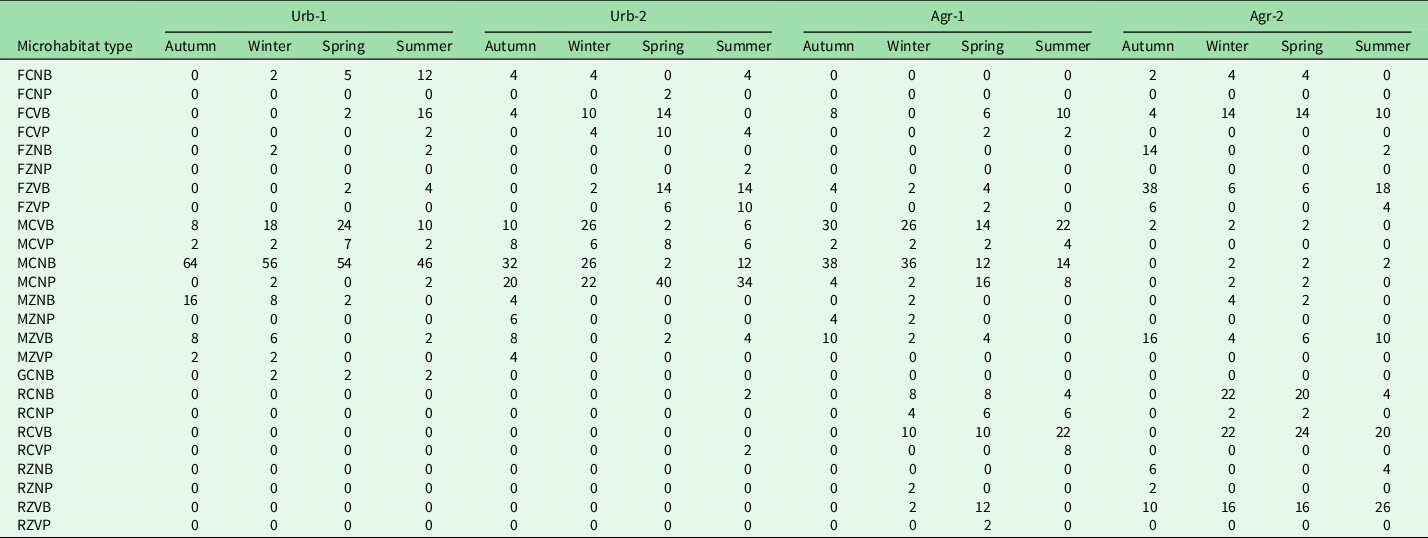
The different types of microhabitats were qualitatively assessed by visual analysis of each of the components (Fig. S2) in areas of c. 1 m2 at the same 50 points where fish were caught. The points covered as far as possible all combinations of the microhabitat components (sediment particle size, water movement, presence of macrophytes and depth). After collecting the fish, these four characteristics were qualitatively estimated: the dominant sediment particle size was computed as fine (F; 2–8 mm), medium (M; 8–64 mm, gravel and cobbles), large (G; 65–250 mm, boulders) and large-rough substratum size (R; >250 mm). The water movement was computed as flowing water (C) or slow without apparent movement (Z). The aquatic macrophytes was computed as present (V) or absent (N). The depth of the water column was computed as shallow (B; <50 cm) or deep (P; ≥50 cm). Each microhabitat type was determined as a combination of the qualitative scores of these four components (e.g., FCVP = substratum (F) + current velocity (C) + vegetation (V) + deep (P); see Fig. S2). The abundance of the resulting microhabitat types was calculated for each stream and season (Table 1).
Relative abundances of the microhabitat types in the Arroyo Colorado sub-basin.

Note: See text for definitions of the letters in the ‘Microhabitat type’ column.
Urban streams: Urb-1 = Arroyo Las Piedras; Urb-2 = Arroyo Colorado. Agricultural streams: Agr-1 = Cañada Dragón; Agr-2 = Cañada Juncal.
Data analyses
To determine the effects of land use on water quality variables, a principal component analysis (PCA) was performed. The presence of highly correlated variables was first looked for, and Bartlett’s sphericity test was used to determine whether the number of variables was optimal to perform the PCA. Subsequently, the variables were centred and scaled to obtain a correlation matrix. The percentages of accumulated variance in the components and their correlation coefficients with the variables were obtained (Borcard et al. Reference Borcard, Gillet and Legendre2018). The PCA was carried out in R using the FactoMineR (Lê et al. Reference Lê, Josse and Husson2008) and Factoextra packages (Kassambara & Mundt Reference Kassambara and Mundt2017).
Based on the abundance of each microhabitat type in each stream, we determined the diversity of microhabitats using the Shannon diversity index for each site. In addition, we calculated the percentage of microhabitats occupied by fish within each stream. To assess whether both microhabitat diversity and microhabitat occupancy differed among sites, we constructed linear mixed models using the season as a simple random intercept. For this, model parameters were estimated as the residual maximum likelihood using the lme R package (Pinheiro et al. Reference Pinheiro, Bates, DebRoy, Sarkar, Heisterkamp, Van Willigen and Maintainer2017).
To analyse seasonal variability in microhabitat compositions and fish assemblages, two non-metric multidimensional scaling (NMDS) ordinations were performed using the abundance of each microhabitat type and the relative abundances of fish species. A two-way factorial permutational multivariate analysis of variance (PERMANOVA; α = 0.05) was performed to compare microhabitats and fish assemblages in the different land-use types. To quantify the dispersion among samples within land use, we used multivariate homogeneity of group dispersion tests for each land use in terms of both microhabitats and fish assemblages (Oksanen et al. Reference Oksanen, Kindt, Legendre, O’Hara, Stevens and Oksanen2007). Similarity percentage (SIMPER) analyses were used to detect the microhabitat types or fish species responsible for separating each group. The Bray–Curtis similarity distance was used for the NMDS ordinations, PERMANOVAs and dispersion tests using the functions metaMDS, adonis and betadisper, respectively, in the R vegan package (Oksanen et al. Reference Oksanen, Kindt, Legendre, O’Hara, Stevens and Oksanen2007).
Microhabitat types can be considered as a resource in stream ecosystems, and the use of bipartite interaction networks could be a useful tool to understand the selection of different microhabitat types by fish in streams with different land uses (Romero & Casatti Reference Romero and Casatti2012, Marini et al. Reference Marini, Bartomeus, Rader and Lami2019). For this purpose, four fish–microhabitat interaction networks were obtained corresponding to each stream using seasonal mean abundances of fish in each microhabitat sampled using the bipartite package in R (Dormann et al. Reference Dormann, Gruber and Fründ2008). For these analyses, we selected microhabitats that were present in at least two seasons of the year. We analysed the numbers of links of the fish species with the microhabitat types (k value) and the importance of each microhabitat type for fish species using the strength of the microhabitat types (Bascompte et al. Reference Bascompte, Jordano and Olesen2006). The strength values represent the sum of all fishes’ dependencies on a given microhabitat. Fish dependence is the fraction of all recorded fish visits performed on that given microhabitat type. Therefore, a microhabitat type could have high strength values if it is visited by many fish species that had a low dependency on it or if it is visited by a few fish that were highly reliant on it. This metric measures the uses of microhabitats, not fishes’ preference for them. All statistical analyses were performed using R 3.6.0 software (R Core Team 2019).
Results
Spatial and seasonal variation in water quality: patterns of environmental degradation
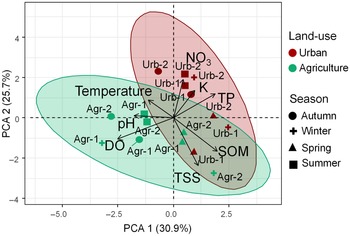
The PCA explained 54.6% of the variability in the water quality in the first two components (Fig. 1 & Table S2). The first component (PCA1 = 30.9% of variance) reflected a gradient of environmental degradation due to land use. Urban streams were related to positive values of PCA1, coinciding with the highest values of SOM (correlation with the first component: R2 = 0.69, p < 0.01) and TP values (R2 = 0.66, p < 0.001). Negative values of PCA1 were associated with agricultural streams with higher DO values (R2 = –0.87, p < 0.01) and pH values (R2 = –0.63, p < 0.01). The second component (PCA2 = 25.7%) showed seasonal variability and was correlated positively with NO3 (R2 = 0.66, p < 0.05) and negatively with both TSS (R2 = –0.82, p < 0.05) and SOM (R2 = –0.57, p < 0.05).
Principal component analyses (PCA) of water quality variables in different land-use types in the Arroyo Colorado sub-basin. DO = dissolved oxygen; K = conductivity; NO3 = nitrate; SOM = suspended organic material; TP = total phosphorous; TSS = total suspended solids.

Spatial variation in microhabitat composition
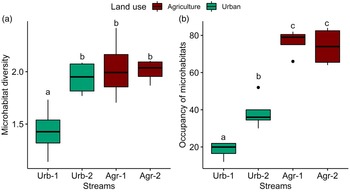
The Shannon microhabitat diversity index varied significantly among sites (mixed model effects: F = 7.463, df = 3(9), R2 = 0.57, p < 0.01); Urb-1 showed significantly lower diversity compared to those of the other sites (Fig. 2). The percentage of microhabitats occupied by fish varied significantly among sites (mixed model effects: F = 46.87, df = 3(9), R2 = 0.90, p < 0.01). The agricultural sites had higher microhabitat occupancy (74–84% of microhabitats occupied by fish) than the urban sites (12–52%). Urb-2, despite having microhabitat diversity similar to that of the agricultural sites, had significantly lower occupancy (Fig. 2).
(a) Shannon diversity of microhabitat types (A) and (b) percentage of microhabitats occupied by fish for sites in urban streams (Urb-1 = Arroyo Las Piedras; Urb-2 = Arroyo Colorado) and agricultural streams (Agr-1 = Cañada Dragón; Agr-2 = Cañada Juncal). Letters indicate significant differences (α < 0.05).

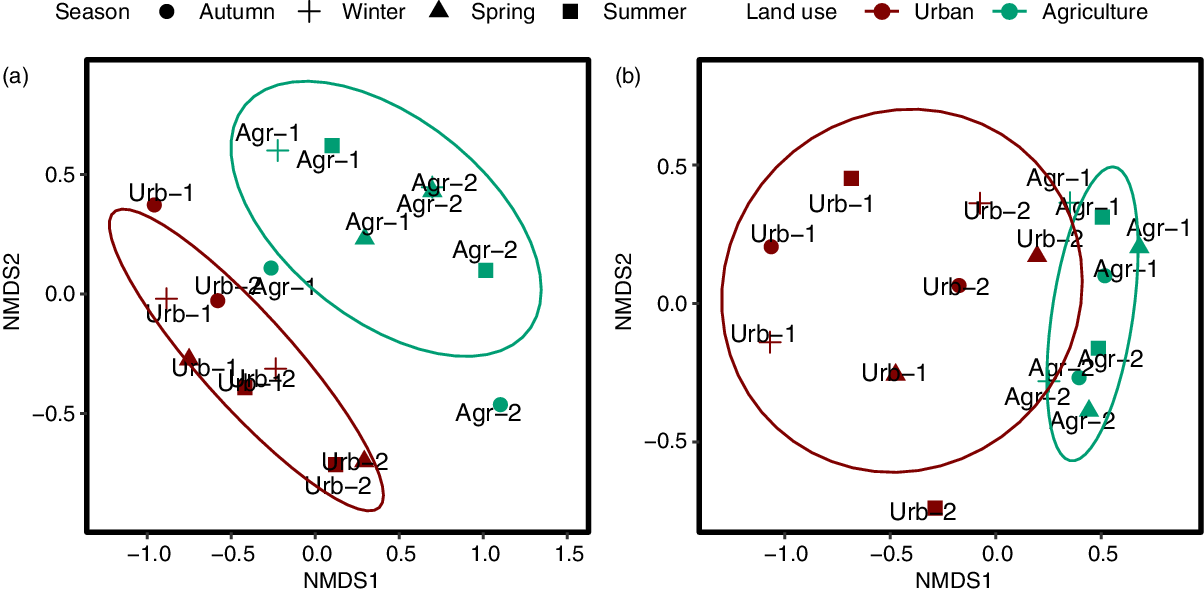
The ordination analysis of spatial variation in the sites regarding the microhabitat composition showed two main groups in the first NMDS ordination that separated agricultural from urban streams (PERMANOVA: pseudo-F = 5.12, R2 = 0.27, p < 0.01; Fig. 3a). The multivariate homogeneity of the group dispersion tests showed no significant variation in the composition of microhabitat types within each land-use stream (Fig. S3). The SIMPER analysis showed that the conditions prevailing in the urban streams included medium substrate size and running water without macrophytes (MCNB and MCNP). The agricultural streams included a prevalence of macrophytes and shallow water with different types of substrates (RCVB, RZVB and FZVB; Table S3).
Non-metric multidimensional scaling (NMDS) ordination of (a) microhabitat types (stress = 0.148) and (b) fish assemblages (stress = 0.137) in different land-use types in the Arroyo Colorado sub-basin. Urban streams: Urb-1 = Arroyo Las Piedras; Urb-2 = Arroyo Colorado, Agricultural streams: Agr-1 = Cañada Dragón; Agr-2 = Cañada Juncal.

Spatial variation in the fish assemblage
A total of 642 and 1300 fish were caught in the urban and agricultural sites, respectively, belonging to 5 orders, 11 families and 27 species. Characiformes exhibited the greatest richness, accounting for 3 families and 15 species, followed by Siluriformes, with 3 families and 8 species. The most frequent species were Cnesterodon decemmaculatus (30.4%), followed by Bryconamericus iheringi (9.9%), Jenynsia lineata (7.9%), Psalidodon sp. (7.3%) and Corydoras paleatus (4.2%). The rest of the species constituted less than 2.3% of the total abundance (Table S4).
The fish composition differed between land-use types (PERMANOVA: pseudo-F = 11.6, R2 = 0.45, p < 0.01), and the NMDS analysis of the relative abundances of fish species displayed two main groups distinguishing agricultural from urban stream sites (Fig. 3b). The multivariate homogeneity of the group dispersion tests showed that there was no significant variation in fish composition within each land-use stream (Fig. S4). The SIMPER analysis showed that the urban streams were characterized by a high relative abundance of C. decemmaculatus, while agricultural streams were characterized by high relative abundances of B. iheringi, Psalidodon sp., Cheirodon interruptus, Hyphessobricon meridionalis and Pseudocorynopoma doriae (Table S5).
The use of microhabitat types by fish species
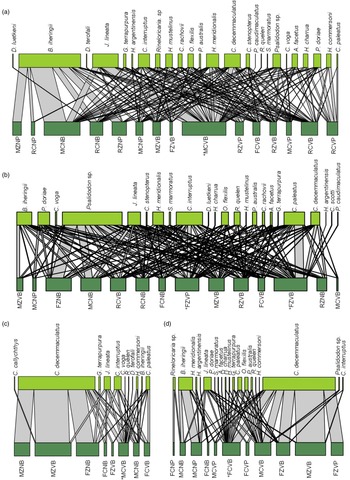
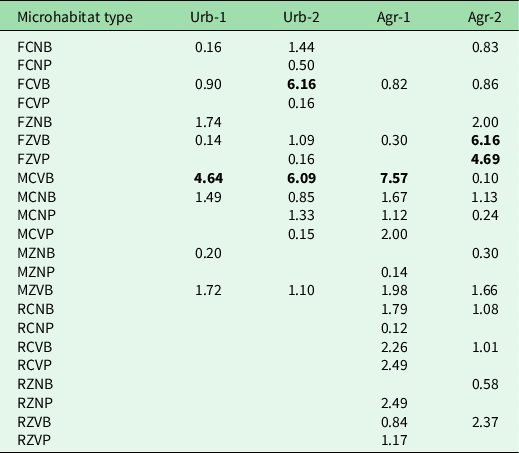
Bipartite network analysis shows that in Agr-1 the fish species that used the greatest number of microhabitats were B. iheringi (k = 12 microhabitat types representing 80% of the total microhabitats analysed); C. interruptus and H. meridionalis (both k = 11 and 73.3%); and Psalidodon sp. and C. decemmaculatus (both k = 10 and 67%; Fig. 4a). In Agr-1, the most important microhabitat types for sustaining fish species were MCVB and RCVB (Fig. 4a & Table 2), which represented 23.0% and 10.5%, respectively, of the total abundance of microhabitat composition. In Agr-2, Psalidodon sp. was highly connected with different microhabitat types (k = 13 and 93%; Fig. 4b), followed by C. interruptus, J. lineata and C. paleatus (all interacting with k = 12 and 85.7%). The most important microhabitat type for sustaining fish species in Agr-2 was FZVB (17% of the total abundance; Fig. 4b & Table 2).
Relationship between fish species and microhabitat types in agricultural streams (a) Agr-1 and (b) Agr-2 and urban streams (c) Urb-1 and (d) Urb-2. Fish species are represented above each panel and microhabitat types are represented at the bottom of each panel. The width of the grey links between fish species and the microhabitat types that they occupy is proportional to the visitation frequency. The asterisk symbol indicates the microhabitat type with the highest strength of interaction, sustaining both common and rare fish species.

Microhabitat type strengths across all interactions observed in the urban (Urb-1 and Urb-2) and agricultural (Agr-1 and Agr-2) streams. Values for the microhabitat types with high strengths (highlighted in bold font) are the most important for supporting a combination of common and rare species.

Note: See text for definitions of the letters in the ‘Microhabitat types’ column.
Urban streams: Urb-1 = Arroyo Las Piedras; Urb-2 = Arroyo Colorado. Agricultural streams: Agr-1 = Cañada Dragón; Agr-2 = Cañada Juncal.
In the case of urban streams, the species highly connected to Urb-1 were C. decemmaculatus (k = 8, which represents 100% of the total microhabitats used for the analysis), C. paleatus (k = 5 and 62.5%), C. interruptus and J. lineata (both with k = 4 and 50%), and the most important microhabitat type for sustaining fish species was MVCB (15% of the total microhabitat abundance; Fig. 4c & Table 2). Similarly, in Urb-2, the species with the higher numbers of microhabitat connections were C. decemmaculatus (k = 10 and 90.9%), J. lineata (k = 7 and 63.6%), B. iheringi and C. paleatus (both with k = 4 and 36.4%), and FCVB was the most important microhabitat type (7% of the total microhabitat abundance; Fig. 4d & Table 2).
In urban streams, the highly connected species C. decemmaculatus was associated with environments characterized mainly by low water velocity (Z), shallow water (B) and with (V) or without macrophytes (N). The MZVB microhabitat (4.0% of the total abundance of microhabitats in Urb-1 and 3.5% in Urb-2) hosted the highest relative abundance of this species in Urb-1 (43.8% of the fish relative abundance) and Urb-2 (34.1%). In agricultural streams, this species did not show a clear selection of microhabitats expanding its distribution into more diverse local conditions.
Discussion
Our research showed that urban patches promote streams with lower water quality, low diversity of microhabitat types and more simplified fish communities than agricultural streams, affecting microhabitat–fish interactions. In the case of water quality, higher concentrations of nutrients and SOM, greater water conductivity and lower DO concentration were characteristic of an urban stream syndrome (Paul & Meyer Reference Paul and Meyer2001, Walsh et al. Reference Walsh, Roy, Feminella, Cottingham and Groffman2005). Water parameters in agricultural streams are characterized by higher pH and DO values, possibly due to higher autochthonous primary productivity (Srivastava et al. Reference Srivastava, Gupta and Chandra2008, Desmet et al. Reference Desmet, Van Belleghem, Seuntjens, Bouma, Buis and Meire2011).
The diversity of microhabitat types was influenced by land use. In urban streams, microhabitats were characterized by a medium-sized substrate and an absence of macrophytes (Table S3), indicating a clear homogenization of physical conditions in response to high-impact land-use activities (Cortelezzi et al. Reference Cortelezzi, Sierra, Gómez, Marinelli and Capítulo2013). In contrast to the agricultural streams, microhabitats were more heterogeneous due to an increase in the presence of macrophytes and different substrate sizes (Table S3). The higher presence of macrophytes in agricultural streams showed that macrophytes are also sensitive to highly impacted urban streams, and they even are indicators of eutrophication in agricultural streams (Cortelezzi et al. Reference Cortelezzi, Sierra, Gómez, Marinelli and Capítulo2013, O’Hare et al. Reference O’Hare, Baattrup-Pedersen, Baumgarte, Freeman, Gunn and Lázár2018). Changes in macrophyte cover directly affect the availability of microhabitats (e.g., Giorgi et al. Reference Giorgi, Feijoó and Tell2005, Teixeira de Mello et al. Reference Teixeira-de Mello, Meerhoff, González-Bergonzoni, Kristensen, Baattrup-Pedersen and Jeppesen2015, Moi & Teixeira de Mello Reference Moi and Teixeira de Mello2022), and they do so indirectly via sediment retention and changes in water velocity (Sand-Jensen Reference Sand-Jensen1998).
As expected with greater anthropogenic impacts (e.g., Di Prinzio et al. Reference Di Prinzio, Casaux and Miserendino2009), the fish species composition was simplified in urban streams, which were dominated by species tolerant of environmental degradation such as C. decemmaculatus (Hued & Bistoni Reference Hued and Bistoni2005, Chalar et al. Reference Chalar, Delbene, González-Bergonzoni and Arocena2013, Benejam et al. Reference Benejam, Teixeira-de Mello, Meerhoff, Loureiro, Jeppesen and Brucet2016) and J. lineata (Bistoni et al. Reference Bistoni, Hued, Videla and Sagretti1999, Hued & Bistoni Reference Hued and Bistoni2005). In agricultural streams, the dominant species were Psalidodon sp., B. iheringi, C. interruptus, H. meridionalis and P. doriae, which are associated with mesotrophic conditions (Chalar et al. Reference Chalar, Delbene, González-Bergonzoni and Arocena2013). Rare species such as Rineloricaria sp. and Gymnogeophagus terrapurpura are catalogued as sensitive species (Chalar et al. Reference Chalar, Delbene, González-Bergonzoni and Arocena2013) and were collected in urban and agricultural streams, suggesting possible occupancy of sensitive species if these systems are restored. Similarly, the abundance of the most dominant species that promoted groups in the NMDS ordinations was influenced by land use, with no significant variations in the fish composition within each land-use stream. Our results suggest that the fish assemblages in these Uruguayan streams can be more accurately determined by their responses to habitat conditions and physicochemical water parameters generated by land uses than by seasonal variation in stream conditions (Ostrand & Wilde Reference Ostrand and Wilde2002).
Some species showed a selective pattern for some microhabitat characteristics that could be associated with biological and behavioural features. In urban streams, the most abundant species, C. decemmaculatus, was present in almost all microhabitat types, but it was present in greater proportions in the less represented MZVB microhabitat, demonstrating its preferential use of low water velocity and shallow water with aquatic plants. These microhabitats can be considered a refuge for C. decemmaculatus, which has a small body size (c. 1.5–3.7 cm) with little swimming capacity, rendering it easily preyed upon (Ramos-Fregonezi et al. Reference Ramos-Fregonezi, Malabarba and Fagundes2017).
The most important microhabitat types for sustaining fish species (both abundant and rare species) usually were characterized by the presence of macrophytes and shallow water, independently of substrate size and movement of water (e.g., FZVB, FCVB, MCVB and RCVB). However, these types of microhabitats were not the most abundant, highlighting their importance and the fragility of stream fish communities in the face of their loss due to environmental degradation.
In the lowland subtropical streams of Uruguay, most of the evaluations of fish assemblage responses to land-use changes have been focused on the relationships of fish community attributes and compositions with physicochemical water parameters and some components of the habitat (e.g., Teixeira de Mello et al. Reference Teixeira-de Mello, Meerhoff, Baattrup-Pedersen, Maigaard, Kristensen and Andersen2012, Benejam et al. Reference Benejam, Teixeira-de Mello, Meerhoff, Loureiro, Jeppesen and Brucet2016, Moi & Teixeira de Mello Reference Moi and Teixeira de Mello2022). For this reason, the current research contributes to generating new information on the microhabitat characteristics of lowland streams of Uruguay, describing how these local conditions can be affected by the intensification of different land uses through urbanization and agricultural practices. We also contribute new information on how different microhabitat types are selected by fish species and how this selection can be affected by the intensification of land use. For this, the use of bipartite interaction networks is demonstrated to be a practical tool for highlighting the most important microhabitats that were most often selected by fish. Using this information, we can identify optimal local conditions and habitat configurations (Marini et al. Reference Marini, Bartomeus, Rader and Lami2019) that could be useful in the effective design of restoration and monitoring programmes (Informe Anual Estratégico 2017). For instance, restoration practices that include artificial structures as refuges or hydrological changes can improve habitat complexity and may promote changes in the fish assemblage in the long term when combined with other actions such as improvements to water quality, riparian cover or the control of soil erosion (Manzotti et al. Reference Manzotti, Ceneviva-Bastos, Teresa and Casatti2020). On the other hand, we consider that future work in this area should focus on the quantitative evaluation of microhabitat components, such as the biomass and life forms of macrophytes, which may better explain the use of these microhabitats by fish.
Supplementary material
For supplementary material accompanying this paper, visit https://doi.org/10.1017/S0376892922000200.
Acknowledgements
We thank Editage (www.editage.com) for English-language editing. We also thank the editor and anonymous reviewers for suggestions and corrections to the manuscript.
Financial support
This study was funded in Uruguay by Programa de la Maestría en Ciencias Ambientales, Facultad de Ciencias, Universidad de la República, Uruguay. FTdM was supported by SNI (ANII) and PEDECIBA; MB was supported by SNB (ANII).
Competing interests
The authors declare none.
Ethical standards
Sampling was carried out according to the current recommendations for fish sampling and handling of the CHEA (Honorary Commission on Animal Experimentation).