INTRODUCTION
Rice is one of the most important crops globally because it is a staple food for approximately half of the world's human population (Grierson et al. Reference Grierson, Barnes, Chase, Clarke, Grierson, Edwards, Jellis, Jones, Knapp, Oldroyd, Poppy, Temple, Williams and Bastow2011). It is the most important crop in Vietnam, particularly in the Mekong Delta which accounts for >0·80 of the country's rice exports (De Reference De2008). In 2007 this equated to 4·7 million tonnes of rice, making Vietnam the second largest exporter worldwide at that time. If this production system fails due to climate change there would be an effect on the domestic and international economy and food security (Wassmann et al. Reference Wassmann, Jagadish, Sumfleth, Pathak, Howell, Ismail, Serraj, Redona, Singh and Heuer2009). Thus, any shortfall in rice production in this area would not only affect the economy and food security in Vietnam, but also have repercussions for the international rice market.
The possible impact of climate change in the Mekong Delta may include temperature increases between 1 and 3 °C, lengthening and intensifying of the dry season, and shortening and intensifying of the rainy season. This would lead to seasonal water shortages due both to declining rainfall and increased evaporation. Also in the lower delta, water scarcity would be further exacerbated due to saltwater intrusion (Kirby & Mainuddin Reference Kirby and Mainuddin2009) and increased water use upstream. Compounding the physical water scarcity there would also be economically induced water stress due to increases in labour and fuel costs associated with crop irrigation and fertilizers. To improve resilience to climate change of the triple rice production areas of the Mekong Delta, farming methods need to be developed that overcome the issue of water scarcity and improve productivity.
Normal rice production practice in the Mekong Delta is to keep the field continuously flooded to depths of several centimetres, resulting in anaerobic conditions for rice roots. This surplus water supply exceeds rice plant requirements (Guerra et al. Reference Guerra, Bhuiyan, Tuong and Barker1998). Bouman et al. (Reference Bouman, Humphreys, Tuong and Barker2007) found that in many water-scarce rice-growing regions of the world, water-saving technologies such as alternate wetting and drying (AWD) improve water use efficiency and overall farm profitability. Alternate wetting and drying is an irrigation management technique where irrigation water is applied to obtain flooded conditions after a certain number of days elapsed following the disappearance of previously ponded water (Bouman et al. Reference Bouman, Humphreys, Tuong and Barker2007). Typically irrigation is applied when the water level within the paddy falls below 5 cm above the ground surface to a nominated depth below the ground surface. The actual threshold (water level depth below ground surface) is dependent on site characteristics (for example, sandy v. clay soils) but generally it is between −15 and −30 cm (Bouman et al. Reference Bouman, Humphreys, Tuong and Barker2007). The Mekong Delta is characterized by acid sulphate soils (Minh et al. Reference Minh, Tuong, Xuan, Denning and Xuan1995) and AWD may promote further soil oxidation and surface acidification. In this situation, this irrigation management strategy may be a mal-adaptation to water scarcity.
In the Mekong Delta farmers currently use the direct sowing method, which needs a higher seed amount (~200 kg seed/ha for hand broadcasting and ~120 kg seed/ha for drum seeding) than the traditional transplanting method (50–60 kg seed/ha). Farmers switched from the traditional planting method to the current sowing method due to labour shortages and cost. The advantage of the transplanting method is that it uses less seed and shortens the growing time of rice plants in the main field by c. 2 weeks. This can reduce the water used in main fields and the risk of flooding at the end of the autumn/winter season (in triple crop areas). Also if the field is not level, direct sowing is a problem because in the shallow water areas, seedling mortality is significant and transplanting is needed later to get sufficient plant density. This adds further production costs. Direct-seeded rice also suffers from lodging in the rainy season.
Fertilizer recommendations for many parts of the Mekong Delta were developed about 3 decades ago for a single crop of rice. Since then, farmers have increased the cropping intensity to two or three crops per year with most rice stubble and straw either burned (at the end of the winter/spring and summer/autumn cropping seasons) or ploughed into the soil (at the end of the summer/autumn or autumn/winter seasons). In either case, apart from the amounts of phosphorus (P) in the grain, which are removed from fields, the major part of P fertilizer is returned to the soil. Over the years, there might have been substantial accumulation of P in the soil and farmers could potentially be able to reduce P fertilizer application and hence increase farm income.
Phosphorus is considered a limiting element for plant growth and development, particularly in acid soils with high levels of aluminium (Al) and iron (Fe) (Vance et al. Reference Vance, Uhde-Stone and Allan2003). Acid sulphate soils in the Mekong Delta are acidic and characterized by potential Al and Fe soil concentrations that are toxic and reduce yields in plants. Quang et al. (Reference Quang, Thai, Linh and Dufey1996) found that the maximum P-sorption capacity occurred in these soils due to increased amorphous Al-and Fe-oxihydroxides and to decreased pH. The AWD system could potentially cause further acidification of the soil profile and conversion of the amorphous minerals to a more crystalline structure due to redox fluctuations (Quang & Dufey Reference Quang and Dufey1997; Thompson et al. Reference Thompson, Chadwick, Rancourt and Chorover2006). This could change soil P dynamics and potentially alter availability of phosphorus to the rice plant.
The aim of the present study was to examine the effects of AWD irrigation in combination with reduced P fertilizer and crop establishment methods on rice yield in six consecutive rice crops (winter/spring, summer/autumn and autumn/winter) grown on acid sulphate soils between 2011 and 2013. It was hypothesized that AWD in combination with transplanted rice and reduced P fertilizer application would improve water use productivity in the winter/spring season without affecting P availability in the subsequent seasons. The increased productivity and water management adaption to water scarcity would improve farmer resilience to climate change.
MATERIALS AND METHODS
Study site
The experimental site was located on a Hai Trường seed production farm at Ta Danh village, Tri Ton district, An Giang Province, Vietnam (10°24′43″N,105°06′19″E; 1·4 m a.s.l.) Cropping intensification of rice at An Giang began after the end of the war in 1975 and the double rice cropping system became standard practice. In 2011 a dyke system was built at the site, protecting the area from flooding and allowing for development of the current triple-rice–crop system.
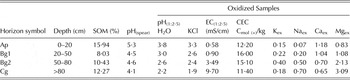
The soil at the site is classified as a Typic Sulfaquept (USDA) or Epi-Orthi-Thionic Fluvisol (IUSS) and is commonly known as an acid sulphate soil. The topsoil has been tilled and mixed with decomposed organic matter (Table 1); soil profile development is evident between 25 and 80 cm with the formation of a sulphuric horizon with jarosite mottles. Since cropping intensification the soil profile has become quite acidic throughout and partially oxidized (Table 1). In the surface soil (Ap), soil acidification has been reduced due to inputs of organic matter and inundation due to the rice production system. The soil cation exchange capacity (CEC), determined by the compulsive exchange method, is much greater than the exchangeable cations (Table 1). This is most likely due to the presence of Al and Fe within the exchange complex due to profile acidification and subsequent mineral weathering.
Soil chemical characteristics

SOM, soil organic matter; pH(spear), soil field pH measured with a spear probe; KCl, potassium chloride; EC, electrical conductivity; CEC, cation exchange capacity; ex, exchangeable cation; Ap tilled A horizon; Bg1, strongly gleyed B-horizon; Bg2, strongly gleyed B-horizon; Cg, strongly gleyed C horizon.
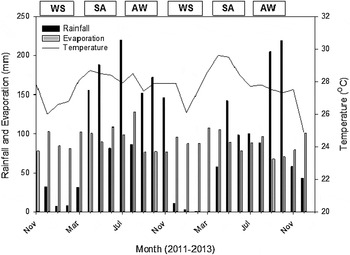
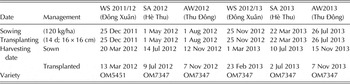
During 2011–13, six crops were grown for the experiment (Fig. 1 and Table 2). The weather data were collected at the An Giang Provincial Station located 20 km away to the north east from the site. During both dry seasons (winter/spring season) there was not enough rainfall to sustain rice production (Fig. 1) and irrigation was needed. Irrigation was also needed during summer/autumn 2013 due to the late arrival of the monsoon (Fig. 1). The average monthly temperature for the site was fairly consistent, only varying by 1–3 °C throughout the year.
Rainfall, evaporation (mm), cropping season and mean temperature at an Giang Provincial Weather Station. Each cropping season is identified winter/spring = WS; summer/autumn = SA and autumn/winter = AW.

Cropping dates and management for the experimented cropping seasons

WS, winter/spring; SA, summer/autumn; AW, autumn/winter.
Treatments and experimental design
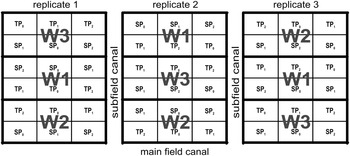
The experiment was a split-split plot design with three replications (Fig. 2). The main plot factor was water management where W1 = Farmer Practice: continuously flooded irrigation water management, with the water level in the field maintained at 5 cm; W2 = AWD irrigation water management, with irrigation applied when the water level was 15 cm below the soil surface; W3 = AWD irrigation management, with irrigation applied when the water level in the field was 30 cm below the soil surface. Twenty days after crop establishment in the W2 and W3 plots, slotted piezometers (15 diameter × 40 cm length, Tuong et al. Reference Tuong, Bouman and Lampayan2009) were installed to a depth of 30 cm within a 15 cm-wide auger hole. The slots were located between 5–30 cm below the ground surface and between 0 and 5 cm bentonite was used to seal the surface soil to the wall of the piezometer. The piezometers were used to monitor water depth and water quality (electrical conductivity (EC) and pH). All plots were irrigated and the water level maintained at c.1 cm for the first 20 days after sowing to control weeds and at 1 cm during flowering.
Experimental layout. W2 (−15 cm alternate wetting and drying) and W3 (−30 cm alternate wetting and drying) during the winter–spring triple cropping season. W1 (continuously flooded). Planting method is designated T: transplanting and S: direct seeded and P fertilizer rate are designated P0: 0 kg P2O5/ha; P1: 37·5 kg P2O5/ha; P2: 75 kg P2O5/ha.

The split plot factor was P fertilizer rate where P0 = 0 kg phosphorus pentoxide (P2O5)/ha; P1 = 37·5 kg P2O5/ha; P2 = 75 kg P2O5/ha. The P2 rate is the current fertilizer practice used by farmers in the district. Nitrogen and potassium (K) fertilizer were fixed in all plots and the current farmer fertilizer practice was used (115 kg N and 75 kg potassium oxide (K2O)/ha). The split–split plot factor was method of planting, where T = transplanting (using 16 day-old seedlings) and S = direct sowing. In total there were 54 experimental plots (5 × 8 m) and small bund walls were built between them. To minimize the lateral water movement among the main plots (20 × 16 m2), their bunds (30 high × 90 cm wide at the base) were reinforced with 60 cm wide polyethylene sheets. These sheets were placed in the middle of the bund, from the bund surface to a depth of 30 cm below the paddy soil surface. This procedure has previously been found to be effective in reducing lateral flow between adjacent plots (Tuong et al. Reference Tuong, Marquez, Kropff and Wopereis1994), even when they had different water levels (Bouman et al. Reference Bouman, Peng, Castaneda and Visperas2005). However, given the small main plot size and high water table of the current experiment, the plastic barrier might not have eliminated the lateral flows between adjacent main plots due to variations in the water level. It was assumed that the lateral flows were small; otherwise it would have been impossible to bring the field water level in treatments W2 and W3 to below the soil surface.
Land and crop management
For both winter/spring crops, the straw and stubble obtained following mechanical harvest of the crop was left to dry under natural sunlight and then burnt, as per farmer practice. The field was then left for 5 days before being inundated with water to a depth of 5 cm. The remaining plant residues were incorporated into the soil by rotary tillage. The field surface was rotary tilled for a second time and levelled before planting. The same land preparation procedure was applied for summer/autumn and AW, but the rice straw and stubble was directly incorporated without being burnt, as per farmer practice. Field and soil preparation was undertaken 1 week before the plots were sown or transplanted. The total amount of fertilizer, 115-(P0; P1; P2)-75 kg of N–P2O5–K2O/ha that was applied to each crop was split equally and top-dressed four times during the season.
The experimental field was sprayed with pre-germination herbicide 1 day after sowing or transplanting during each cropping season. Brown leaf hopper infestation was prevented by spraying insecticide at 40–45 days after planting if the hopper population reached a critical threshold (five individuals per plantlet). Fungicide for preventing rice blast was sprayed twice at 30 days after planting and full flowering stage. Fungicide was also applied to reduce seed discoloration at milking stage.
Water and soil measurements
Water level in each plot was measured in the piezometers once every 3 days, starting 23 days after crop establishment and continuing until harvest. The volume of irrigation water added to each plot was calculated by the known pump discharge rate and the pumping duration during each irrigation. The pH and EC of the surface water in the fields was measured once every 6 days, beginning at 26 days after crop establishment.
Soil samples (0–20 cm) were collected from the three locations within each plot and mixed together to form a composite plot sample. The soil samples were stored in plastic bags and transported immediately back to the laboratory for analysis. On receipt the soils were oven-dried at 60 °C for 24 h. Each soil sample was crushed, ground, sieved and the fraction >0·2 cm was discarded. Available P was determined on the fine fraction (<0·2 cm). The soils at the site are acid sulphate soils and characteristically acidic containing iron and aluminium minerals. In soils such as these, the Bray–Kurtz method (Bray & Kurtz Reference Bray and Kurtz1945) is the most suitable approach for the phosphorus determination.
Plant measurements
Plant density and height was measured at 20, 40 and 60 days after sowing or transplanting and at harvest. Plant density was measured in each plot by counting the number of plants within 2 × 0·5 m2 frames. The height of ten plants in each frame was measured: in the transplanting treatment the tallest plant in each hill was selected and for the direct sowing treatment, ten individuals were selected randomly. The hill refers to the location where the plant is physically growing and in transplanted rice, two or more plants may have been placed at the same location.
Samples for the measurement of plant biomass were collected at random locations at flowering (Zadoks growth stage (GS) 55; Zadoks et al. Reference Zadoks, Chang and Konzak1974) and physiological maturity (GS89). In the transplanting treatment, 12 hills were sampled completely and in the direct sowing treatment, all plants in an area of 0·5 m2 were collected for analysis. Dry biomass mass was determined on plant samples that were dried at 60 °C until constant mass was reached. Leaf, stem and panicle biomass and yield components were determined on the biomass samples collected at physiological maturity. Yield component measurements comprised the number of panicles/m2, filled and unfilled spikelets per panicle, 1000-grain weight and grain moisture content. Grain yield was measured using the remaining, internal and undisturbed, 5 m2 within the centre of each plot at harvest, converted to t/ha at 14% moisture content. The phosphorus content in the leaves and stem were determined on samples collected at physiological maturity.
Crop (root and stem) lodging was assessed in each plot and if present, by measuring the lodged area in each plot. Internode length was measured in the P0 fertilizer level in each water management regime to determine the correlation between internode length and lodging in two crop establishment methods. In each P0 plot, ten plants were selected randomly for measuring the length of four upper internodes from the top of individual plant.
Economic analysis
Income differences between experimental treatments were calculated by the total income (rice yield × unit price) minus the total investment (seed, labour, gasoline for pumping water, fertilizer, pesticides and water cost).
RESULTS
Irrigation management
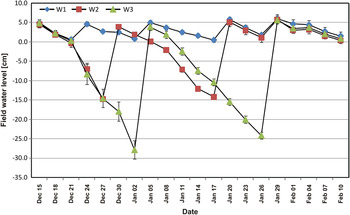
During both winter/spring seasons the groundwater level could not be lowered to 30 cm below the soil surface due to unexpected rainfall that occurred during the dry season (Fig. 3). During the wet seasons (summer/autumn and autumn/winter 2012 and autumn/winter 2013), the water level was never below the soil surface due to frequent heavy rainfall events. The only irrigation water applied to the AWD treatments was during the first 20 days and during flowering. Whenever applied, the AWD (−30 cm) required less irrigation water than AWD (−15 cm) and the continuously flooded treatment (Table 3).
The averaged field water levels and rainfall in two irrigation regimes, W2 (−15 cm alternate wetting and drying) and W3 (−30 cm alternate wetting and drying) during the winter–spring triple cropping season. W1 (continuously flooded). Colour online.

Average volume (m3/ha; n = 3) of irrigation water ( ± s.e. ) in each water treatment (P < 0·01)

WS, winter/spring; SA, summer/autumn; AW, autumn/winter; AWD, alternate wetting and drying; CF, continuous flooding.
Water quality
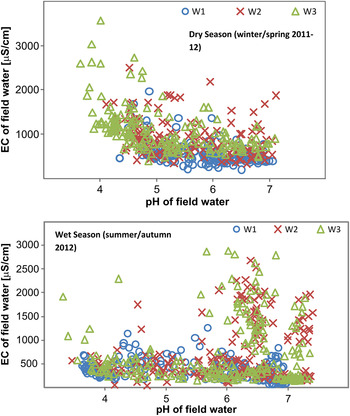
In all 3 years there was no difference between the pH values between each water treatment. The pH range in all treatments was between 4 and 7, and the EC of the water in the AWD plots (100–3000 µS/cm) was greater than the CF plots (100–500 µS/cm) in four crops. There is an inverse relationship between the EC and pH of the water in the dry season, but this relationship breaks down during the wet season (Fig. 4).
pH and EC relationship in three water management regimes of the dry season (winter/spring 2011/12) and wet season (summer/autumn 2012). Colour online.

Available soil phosphorus
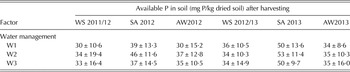
There was no effect of water management and fertilizer treatments on the available soil P concentration (Table 4). There were no differences at the end of each cropping season between P rate, crop establishment method or water management factor. There was also no reduction in the amount of available soil P in the P0 fertilization treatment across the six consecutive seasons.
Average available soil phosphorus and s.e.m. (n = 18) as a function of irrigation treatment for each crop

W1, continuous flooding; W2, −150 mm alternate wetting and drying; W3, −300 mm alternate wetting and drying; WS, winter/spring; SA, summer/autumn; AW, autumn/winter.
Agronomic measurements
Lodging occurred only in winter/spring 2011/12 and only for direct-seeded plots, not the transplanted plots. Direct-sown plants tended to have a longer first internode but shorter fourth internode in comparison to those of transplanted plants.
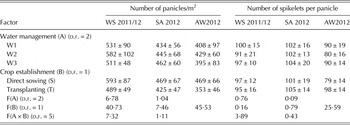
Among the yield components in each cropping season, significant differences (P < 0·05) between crop establishment methods were observed only for number of panicles/m2 and number of filled spikelets per panicle (Table 5). The field water management regimes and P levels had little effect on yield components over cropping seasons.
Differences in two selected yield components and s.e.m. from three consecutive crops

W1, continuous flooding; W2, −150 mm alternate wetting and drying; W3, −300 mm alternate wetting and drying; WS, winter/spring; SA, summer/autumn; AW, autumn/winter.
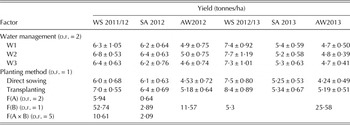
The experimental factors did not affect biomass accumulation at flowering and physiological maturity. Crop establishment method had the largest effect on grain biomass, leading to higher yield as shown in Table 6. The continuously flooded field always resulted in higher stem biomass. The application of P caused no change in biomass accumulation among different parts of the rice plant such as grain, stem or leaf. There was no significant interaction between the experimental factors and measured P accumulation in stem and leaf. There was, however, a significant difference (P < 0·05) in the accumulation of P in stem and leaf as a function of crop establishment method. The trend in accumulation varied each season.
Mean yield and s.e. in three consecutive crops

W1, Continuous Flooding; W2, −150 mm alternate wetting and drying; W3, −300 mm alternate wetting and drying; WS, winter/spring, SA: summer/autumn; AW, autumn/winter.
For the first crop of the six crops, there was a significant difference (P < 0·05) in yield between the water management regimes. Irrigation treatment W2 gave the highest yield. The water treatment did not affect yield in the remaining crops, and there was no residual AWD effect carried over into the subsequent wet season crop. Significant yield differences (P < 0·05) were caused by the crop establishment method, where transplanting resulted in a significantly higher (P < 0·05) yield than that of direct seeding in all but the summer/autumn crops (Table 6).
Economic analysis
Both AWD applications reduced investment in irrigation, leading to a higher income than the continuously flooded treatment (Table 7) during the winter/spring crop season in 2011/12. During winter/spring 2011/12 water treatment 2 (AWD −15 cm) had the highest benefit for farmers, which was also significantly different (P < 0·05) to the continuously flooded treatment in winter/spring. If AWD was applied to −30 cm, rice yield was affected and therefore income was lower than the −15 cm AWD treatment. During the 2013 cropping year there was no significant difference in income but a similar trend relative to 2012 occurred between water treatments (Table 7).
Average income and s.e.m. (in 1000 VND per hectare) from three water management regimes

W1, continuous flooding; W2, −150 mm alternate wetting and drying; W3, −300 mm alternate wetting and drying; WS, winter/spring; SA, summer/autumn; AW, autumn/winter; –, not applicable.
Crop establishment by transplanting always gave a higher average income in comparison to direct seeding, >1000 thousand Vietnamese Dong (VND)/ha (Table 8). This is due to the higher rice yield in the transplanted rice. In both the winter/spring and autumn/winter seasons the transplanted rice generated significantly more income than direct-seeded rice.
Average income ( ± s.e.m.) (in 1000 VND/ha) from two establishment methods

WS, winter/spring; SA, summer/autumn; AW, autumn/winter.
There was only a significant difference (P < 0·05) in farm income and P fertilizer applied in the autumn/winter 2012 season. The more P applied, the lower the farmer income because there was no significant increase in yield. Overall, the plots without P application in the six consecutive crops did not seriously affect the average income per hectare.
DISCUSSION
During 2011/12 and 2012/13, AWD was successfully applied to the triple rice growing site at An Giang, Vietnam. Successful implementation of AWD, where the water level was lowered to below the soil surface, implied that the plastic barriers installed in the bunds were able to minimize lateral flow between CF and AWD plots. The results show that farmers normally supply more water in the winter/spring cropping season for paddy rice production than required and this increases their investment costs significantly. The safe AWD groundwater threshold, where yield was not significantly affected, was at −15 cm during the winter/spring (dry) season during the 2011–13 seasons. In the 2012/13 season farmers pumped significantly more water into the crops when compared to 2011/12, due to lower summer/autumn rainfall.
There was no significant short-term agronomic acidification or salinization of the soil profile due to AWD. However, there is a need for on-going assessment of the soil conditions, including assessment of changes in mineralogical and chemical soil properties, pore water chemistry and biogeochemistry to quantify any AWD impacts. During 2011/12, the groundwater of both AWD treatments had higher EC and lower pH relative to the CF treatment. During the course of each cropping season, there was some evidence of concentration of acid sulphate soil weathering products in the unconfined groundwater. These salts were then probably flushed away during the next flooding sequence. Under current climatic conditions, AWD appears not to cause further oxidation of the acid sulphate soils. However, if the dry season becomes more intense or if water table dynamics change then there could be a significant acidification risk. It is recommended that production systems are developed to manage the acidification risk in acid sulphate soil areas. The risk management plan should include an assessment of the depth to pyritic material prior to instigating an AWD regime or alteration of the field hydrology. Consideration must also be given to the acidification processes and risk associated with aluminium exchange and iron hydrolysis in the sulphuric horizon.
There is a possibility in the current experiment that the relatively high soil organic carbon (SOC) and shallow water table provided some protection against an increase in redox potential, further pyrite oxidation and acid generation (Rigby et al. Reference Rigby, Dobos, Cook and Goonetilleke2006). Over time, AWD may lead to a decrease in SOC, increase in the redox potential and further oxidation. Further, the potential strengthening of the dry season due to climate change would result in further profile acidification and salinization due to drying out of the soil profile (Sammut et al. Reference Sammut, White and Melville1996; Wilson et al. Reference Wilson, White and Melville1999) and offsite impacts (Macdonald et al. Reference Macdonald, Smith, Keene, Tunks, Kinsela and White2004). Periodic assessment should be instigated to assess the impact of AWD and climate change on soil acidification. This assessment could be within an acidification management plan which the farmers or government extension officers could use to monitor soil health and maintain production. In the future AWD could be a cost-effective tool to allow production to be maintained while preventing profile oxidation by keeping the upper soil profile moist and enhancing water use efficiency.
The P fertilizer experiment showed that there is a significant amount of available soil P in the profile and there was no yield response to increasing P fertilizer amounts. A Bray–Krutz P value between 25 and 30 mg/kg is seen as an optimum level for plant growth (Pierzynski Reference Pierzynski2000). The results showed that soil at the experimental site had enough available P for at least six rice-cropping seasons. There was no decline in the P0 treatment plot yields and in all treatments the available P concentration generally exceeded recommended values. This suggests that there is sufficient P either from P fertilizer and/or the natural P within the soil. The P cycling in triple rice cropping will need to be evaluated for a longer time period to quantify the interactions with AWD and to determine the appropriate P fertilizer level for current and future conditions.
Transplanted rice had consistently higher yields than directed-seeded rice at An Giang, but labour costs eliminated any income benefit. Transplanting would be a more useful technique if a mechanized approach that reduces the input costs and minimizes transplanting shock was available to farmers. The current results show that one advantage of using transplanted rice is that it can be harvested 5–7 days earlier than direct-seeded rice. The use of transplanted rice to shorten the growing season may provide a method of avoiding environmental stresses, for example flooding, caused by future climate change.
The application of safe AWD irrigation could potentially save about 2 million VND/ha and the reduction of the phosphorus application to zero saves around 1–3 million VND/ha depending on the cropping season. It can be estimated that at least 3–5 million VND/ha could be saved if the all experimental factors were combined in rice production.
CONCLUSIONS
The application of AWD irrigation management has significant benefits for farmers using triple rice production systems on acid sulphate soils. The key is a reduction in irrigation pumping costs, which significantly improved farm income. It is clear that the farmers can reduce the amount of irrigated surface water across the entire cropping calendar. The soils contain sufficient P fertilizer to grow three successive crops with no reduction in rice yield. This indicates that there is a store of P in the soils and there is a need in these production systems to reduce the use of P fertilizer. Triple rice growers in the Mekong Delta can significantly improve farm income and resilience to drought through the immediate application of AWD and improved P fertilizer management. Further monitoring and evaluation is required to assess the long term impacts of AWD on soil salinization and acidification.
The authors acknowledge that this work was funded by Australian Federal Government Australian Centre International Agricultural Research.