INTRODUCTION
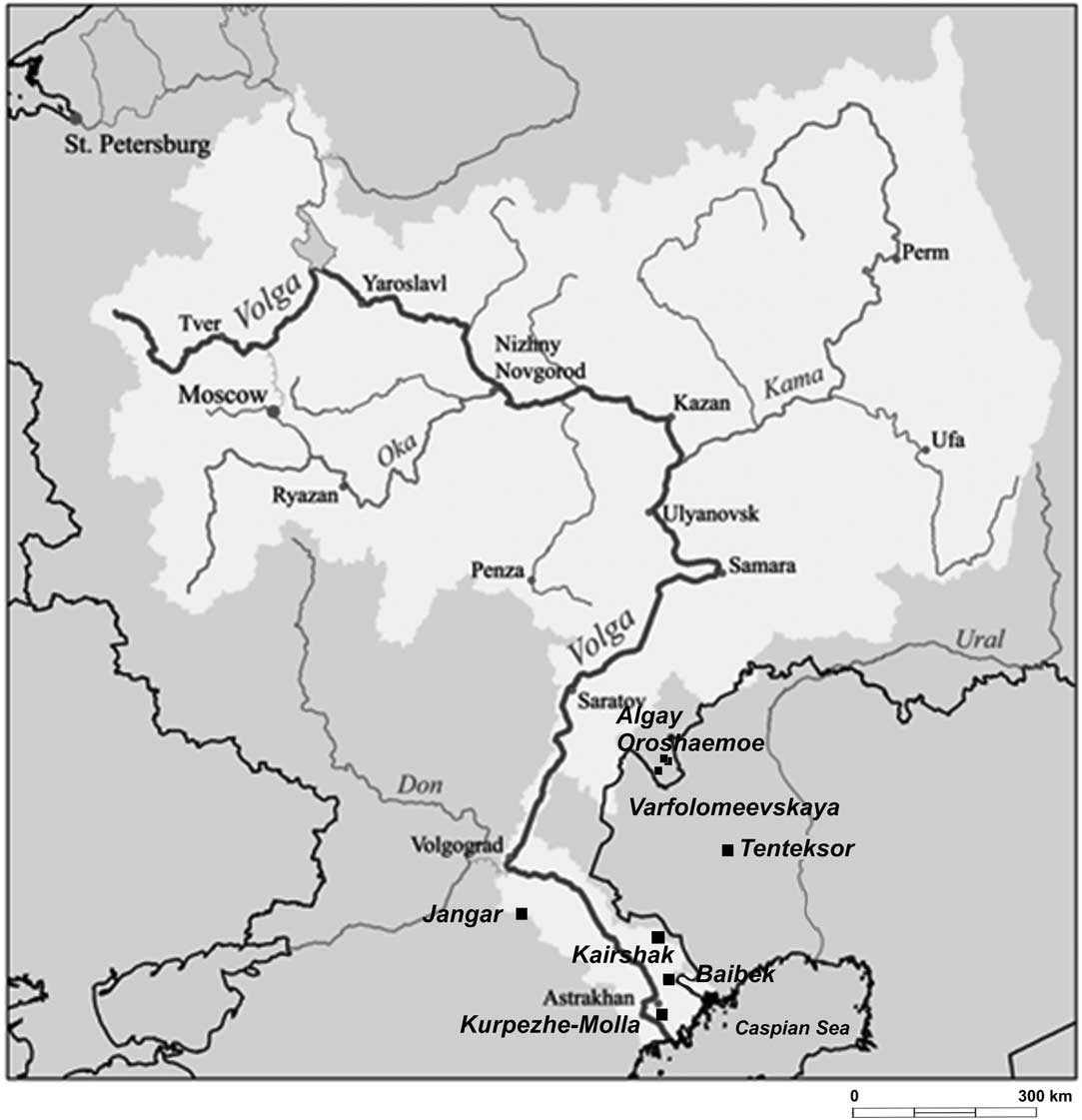
Archaeological sites containing the most ancient pottery of the Lower Volga region have been investigated since the mid-1970s (Melentiev Reference Melentiev1975, Reference Melentiev1976; Vasiliev et al. Reference Vasiliev, Vybornov and Kozin1989; Grechkina et al. Reference Grechkina, Vybornov and Kutukov2014; Vybornov et al. Reference Vybornov, Yudin, Vasileva, Kosintsev, Kulkova, Goslar and Doga2015, Reference Vybornov, Yudin, Vasileva, Kosintsev, Kulkova, Goslar, Philippsen and Baratskov2016а, Reference Vybornov, Yudin, Vasileva, Kosintsev, Kulkova, Doga and Popov2017). In 1980, the expedition of Samara Pedagogical University under the guidance of I.B. Vasiliev began the research of Neolithic and Eneolithic sites in the Northern Caspian region. During excavations, artifacts belonging to different periods and different cultural traditions were discovered. However, animal bones were not found in single-layered sites, so the Neolithic economy remained unknown. In the 1980s, several sites containing faunal remains were studied (Koltsov Reference Koltsov2004; Yudin Reference Koltsov2004). Nevertheless, it was difficult to distinguish between domestic and wild animal species. During these investigations, 12 radiocarbon (14C) dates from four archaeological sites were obtained. These dates are debatable (Vasiliev et al. Reference Vasiliev, Vybornov and Kozin1989; Grechkina et al. Reference Grechkina, Vybornov and Kutukov2014; Vybornov et al. Reference Vybornov, Yudin, Vasileva, Kosintsev, Kulkova, Goslar and Doga2015, Reference Vybornov, Yudin, Vasileva, Kosintsev, Kulkova, Goslar, Philippsen and Baratskov2016а, Reference Vybornov, Yudin, Vasileva, Kosintsev, Kulkova, Doga and Popov2017), so it remained impossible to determine the chronology of the Neolithic-Eneolithic in this region. In the period from 2007 to 2017, new multi- and single-layered archaeological sites were excavated (Figure 1). The cultural layers contained a lot of animal bones. We were able to obtain large series of 14C dates on charcoal, animal bones, and food crusts for different sites. The results allow us to develop a detailed chronological schema for Neolithic-Eneolithic cultures of this region. The detailed characteristics of Eneolithic cultures of the Northern Cis-Caspian and the steppe Volga region were presented in the book of David Anthony (Reference Anthony2007). Therefore, we will not discuss them further in this paper.
The map of Neolithic-Eneolithic sites in the Lower Volga basin.

Methods and materials
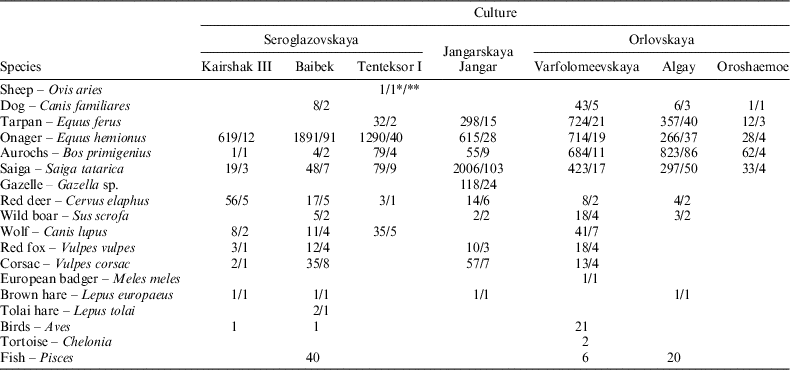
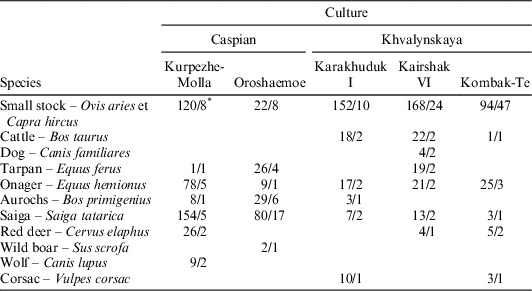
Bones from cultural layers of archaeological sites were studied by palaeozoological analysis (Tables 1 and 2). Determinations of animal species from sites of Tenteksor I, Kurpezhe-Molla, and Karakhuduk I have been published by Kuzmina (Reference Kuzmina1988). One of the authors (P Kosintsev) of our new study has studied these bone assemblages further. The results obtained (Tables 1 and 2) show the results of this reinvestigation of species composition and distribution of different animal bones on these sites.
Species composition and numbers of vertebrate bone remains.

* The sheep bone has later age than other bones in the 14C dating (Table 3).
** NISP/MNI (number of identified specimens/minimum number of individuals).
Species composition and numbers of vertebrate bone remains, NISP/MNI.

* NISP/MNI (number of identified specimens/minimum number of individuals).
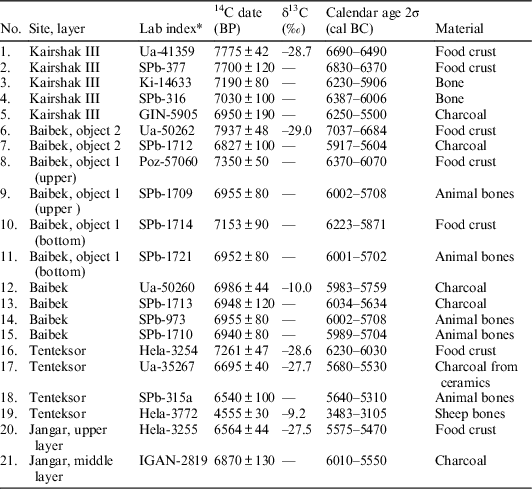
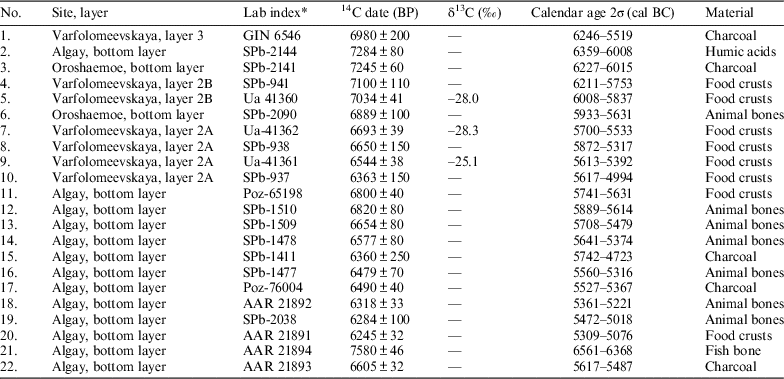
For 14C analysis, samples of charcoal and food crusts were pretreated with diluted HCl acid (1.2N) and NaOH (0.1N) to remove contaminants such as carbonates and organic acids from the soil originating from decomposed organic matter. The CO2 produced from samples was graphitized before being dated by accelerator mass spectrometry (AMS) (Cottereau et al. Reference Cottereau, Arnold, Moreau, Baqué, Bavay, Caffy, Comby, Dumoulin, Hain, Perron, Salomon and Setti2007). For 14C dating of bones, collagen extraction was carried out according to the standard procedures of Arslanov and Svezhentsev (Reference Arslanov and Svezhentsev1993). For liquid scintillation counting (LSC), benzene cocktails were measured on a Quantulus 1220 liquid scintillation counting system. The 14C calibration program OxCal 4.3 was used for calibration of 14C dates (Bronk Ramsey et al. Reference Bronk Ramsey, Scott and van der Plicht2013). The calibrated age results are presented in Tables 3–5.
14C dates for sites of the northern Caspian Sea region.

* AMS radiocarbon laboratory codes: Hela – Helsinki University, Finland; Poz – Poznań Radiocarbon Laboratory Foundation of the Adam Mickiewicz University, Poland; Ua – Tandem Laboratory, University of Uppsala, Sweden; LSC radiocarbon laboratory codes: GIN – Geological Institute, Russian Academy of Sciences, Moscow, Russia; IGAN – Institute of Geography, Russian Academy of Sciences, Moscow, Russia; Ki – Institute of Radio- Geochemistry of the Environment, Ukraine; SPb – Herzen State University, St. Petersburg, Russia.
14C dates for sites of the Low Volga region.

* AMS radiocarbon laboratory codes: AAR – the University of Aarhus, Denmark; Poz – Poznań Radiocarbon Laboratory Foundation of the Adam Mickiewicz University, Poland; Ua – Tandem Laboratory, University of Uppsala, Sweden; LSC radiocarbon laboratory codes: GIN – Geological Institute, Russian Academy of Sciences, Moscow, Russia; SPb – Herzen State University, St. Petersburg, Russia.
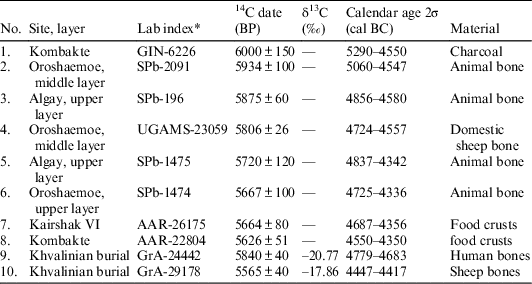
14C dates for sites of the Cis-Caspian (1–5) and Khvalinian cultures (6–10).

* AMS radiocarbon laboratory codes: AAR – the University of Aarhus, Denmark; GrA – Groningen, Netherlands; UGAMS – the University of Georgia, USA; LSC radiocarbon laboratory codes: GIN – Geological Institute, Russian Academy of Sciences, Moscow, Russia; SPb – Herzen State University, St. Petersburg, Russia.
Mass spectrometry of lipids was carried out for 14 food crusts samples from pottery in the Department of Chemistry of Samara University: 1 – Kombak-Te; 2 – Tenteksor; 3 – Tenteksor I; 4 – Аlgay; 5 – Аlgay; 6 – Kairshak VI; 7 – Kairshak VI; 8 – Kairshak VI; 9 – Kairshak VI; 10 – Karakhuduk; 11 – Baibek; 12 – Baibek; 13 – Baibek; and 14 – Baibek. The deposit (m=5 mg) from the surface of 14 ceramic samples was peeled off the scalpel and placed in glass cells, where organic compounds were derivatized for 8 hr at 60°C with a 2% solution of sulfuric acid in absolute methanol. The mixture was centrifuged for 10 min and 500 μL of the mixture from each sample was taken. Fatty acid methyl esters adsorbed into the archeological ceramics were extracted with n-hexane (500 μL). 400 μL of extract was taken from the upper hexane layer and placed in Eppendorf vials. The extracts were analyzed using a gas chromatograph FK Agilent 7890A with a mass-selective detector 5975C, a gas chromatography column MP_5-M8 (length 30 m, inner diameter 0.25 mm), temperature programming from 40°C (5 min) to 100°C with a heating rate of 5°C/min, from 100°C (40 min) to 280°C with a heating rate of 10°C/min. The measurement error in the GC-MS analysis did not exceed 3%.
Results and discussion
Lipid Analysis
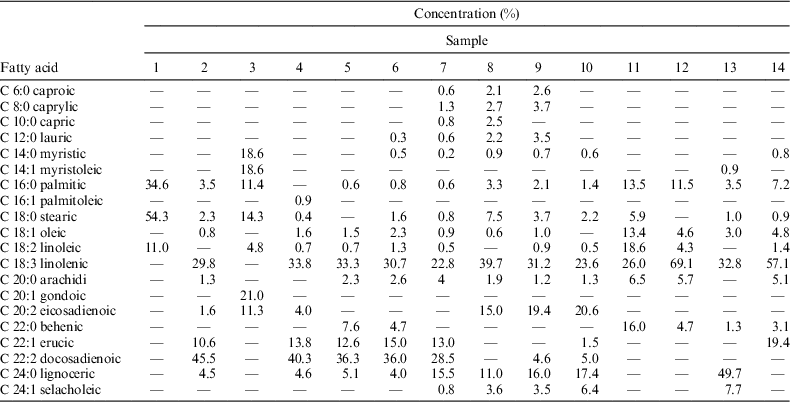
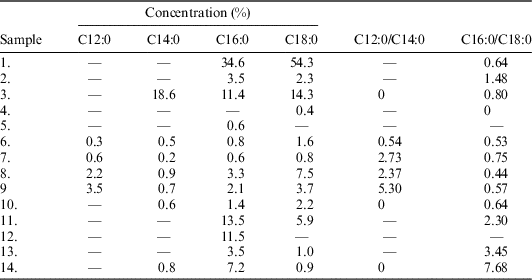
According to the results of lipid analysis by GC-MS, the presence of methyl esters of palmitic and stearic acids extracts from the charred crusts on ceramics were identified, as methylation of fatty acids occurs (Table 6). The predominance of these fatty acids in the sample is typical for food of animal origin. It should be noted that linolenic acid (C18: 3) and long-chain fatty acids (C20, C22, C24) are also in sufficient quantities in all samples, which may indicate the preparation of food of vegetable origin in these vessels (Table 6). One of the most useful criteria for interpreting the results of the analysis of fatty acids and understanding which products were used for cooking is the ratio of fatty acids C12: 0 / C14: 0 and C16: 0 / C18: 0. These results are presented in Table 7. Based on these criteria, it can be concluded that the food crusts of 6-9 ceramic samples includes fatty acids of vegetable origin, namely, seeds and nuts (C16: 0 / C18: 0 = 0-18, C12: 0 / С14: 0>0.15) (Eerkens Reference Eerkens2005). Food of animal origin was prepared in ceramic vessels of 1-4 and 10-14 (acid ratios C16: 0 / C18: 0 <7, C12: 0 / C14: 0 <0.15). Thus, it can be argued with a high degree of probability that food of animal and vegetable origin was prepared in these vessels. Small amounts of residues of short-chain fatty acids (caproic C6: 0, caprylic C8: 0 and capric C10: 0) are found in samples 7, 8, and 9 (Table 6). These vessels could have been used to prepare dairy products (Evershed Reference Evershed, Dudd, Copley, Berstan, Stott, Mottram, Buckley and Crossman2002), but this may also be related to the decomposition of longer chain acids.
Concentrations of fatty acids found in the deposit from the walls of 14 samples of ceramics.

Concentrations and ratios of fatty acids C12:0/C14:0 and C16:0/C18:0, allowing interpretation of the results.Footnote *

* С12:0 – lauric acid; С14:0 – myristic acid; С16:0 – palmitic acid; С18:0 – stearic acid.
Archaeozoology and Radiocarbon Dating – Caspian Sea Region
Kairshak Type of Sites (Earlier Stage of the Neolithic Seroglazovskaya Culture)
In the southern part of the Lower Volga basin (the semiarid zone of the Northern Caspian Sea region), the Kairshak III site was investigated, which is the locus classicus of the Kairshak archaeological type. The Kairshak type of sites was defined based on ceramic typology and the slab stone tools with geometric microliths in the shape of segments (Vasiliev et al. Reference Vasiliev, Vybornov and Kozin1989). Organic silt (probably from the river floodplain) with admixture of shells was the basic raw material used in pottery making. The pottery is flat-bottomed, with pinned and incised ornamentation. On the base of typology, researchers (Koltsov Reference Koltsov2004; Yudin Reference Yudin2004; Vybornov Reference Vybornov2008) described these materials as the Earliest stage of the Neolithic Seroglazovskaya culture. The Neolithic Seroglazovskaya culture was defined by Meleniev taking into consideration the sites with complex of pottery with pinned and incised ornamentation and stone tools with geometric microlites (Melentiev Reference Melentiev1975). The sites with homogenic complexes were not known in this time. Preliminary results about diet on the sites of Kairshak type have been considered earlier elsewhere (Barynkin and Kozin Reference Barynkin and Kozin1998). However, to be useful, they should be derived from statistically significant sites containing preserved animal bones. Based on typology, the researchers (Koltsov Reference Koltsov2004; Yudin Reference Yudin2004; Vybornov Reference Vybornov2008) describe these materials as the Earliest stage of the Neolithic Seroglazovskaya culture. The authors were not able to determine the economy of the site.
During 2013–2017, the Baibek site of Kairshak type was excavated (Grechkina et al. Reference Grechkina, Vybornov and Kutukov2014). This is a single layered site and the artifacts occurred in houses and household pits. Animal bones were found inside these structures in a clear archaeological context. Onager, saiga antelope, red deer, aurochs, wild-boar, corsac fox, wolf, and birds (Table 1) were identified at Kairshak type sites of the Seroglazovskaya culture (both Baibek and Kairshak-III) in the North Caspian Sea region (Vybornov Reference Vybornov2008; Grechkina et al. Reference Grechkina, Vybornov and Kutukov2014). The dog (Canis familiaris) is the only example of domestic animals. While Kairshak III is located far from water bodies, Baibek is situated near a river and a lot of fish bones (stellate sturgeon, bream, starlet, catfish, pike perch, perch, pike) were found at this site. This is evidence of consumption of freshwater resources by people, indicating a diverse economy and diet in the southern part of the Low Volga basin.
Some of the 14C results on the Kairshak sites were controversial (Vybornov Reference Vybornov2008; Grechkina et al. Reference Grechkina, Vybornov and Kutukov2014). Over several years, about 50 14C dates were obtained for these sites. Most of these dates were obtained on organics from pottery and food crusts and they fall into the interval from ca. 7000 to 6400 cal BC (Vybornov Reference Vybornov2008). The dates on animal bones and charcoal fall into the interval ca. 6300–5500 cal BC (Table 3: 4–6). Two dates on food crusts (Table 3: 1–2) from Kairshak III appear to be outliers. Besides the 14C dates on food crusts (ca. 6800–6700 cal BC) from this site there are the 14C dates on bones (Table 3: 3–4) and on charcoal (Table 3: 5), which are in interval of 6300–6200 cal BC. Probably, the dates on food crusts are older because of the reservoir effect (a δ13C value of –28.7‰ indicates the presence of freshwater resources). From Baibek, we obtained two dates on food crusts and charcoal from the same construction No. 2 (Table 3: 7–8). These dates differ by about 1000 years. We suggest the reservoir effect influenced the older food crust (δ13C = –29.0‰). Similar results were recorded on the dates from other house pits. The difference between 14C dates on food crusts and animal bones is 200–300 yr (Table 3: 9–12). The most valid 14C date for Baibek is about 6000 cal BC, supported by 14C dates on charcoal and animal bones (Table 3: 13–16). So, the interval of development of the Kairshak type of sites is from ca. 6300 to 5700 cal BC.
Tenteksor Type of Sites (the Later Stage of the Neolithic Seroglazovskaya Culture)
On the base of typological analysis, researchers (Koltsov Reference Koltsov2004; Yudin Reference Yudin2004; Vybornov Reference Vybornov2008) considered the materials of the Tenteksor site as the Later stage of the Neolithic Seroglazovskaya culture. The material culture is presented by pottery with retreating pinned ornamentation with complex geometric design and stone tools with trapezoidal microliths. The Jangar site is located on the right shore of the Volga in the northwestern part of the Caspian Sea and, according to some investigations (Koltsov Reference Koltsov2004) has been attributed to the Jangar culture.
At later sites of the Tenteksor type in this region, onager, saiga antelope, red deer, aurochs, tarpan, and wolf were identified (Table 1). At the Tenteksor site as well as on other sites of the Seroglazovskaya culture, bones of onager are predominant, exceeding 80% of bone material. Some archaeologists (Vasiliev et al. Reference Vasiliev, Vybornov and Kozin1986) considered the possibility of the presence of domestic sheep on this site. One sheep bone was found in the deposits of Tenteksor. The AMS date of this bone (Table 3: 20) deviates from other 14C dates on different organic materials for the Tenteksor site (Table 3: 18–19). However, the hypothesis of the presence of domestic sheep at Tenteksor cannot been confirmed on the basis of this limited data.
The chronology of Tenteksor type of sites was poorly developed. On the base of the first obtained date of 5500±150 BP (4684–4036 cal BC), some archaeologists (Koltsov Reference Koltsov2004) suggested the coexistence of the Tenteksor culture and the Khvalinian Eneolithic culture. A series of 14C dates for several sites of the Tenteksor type was obtained recently (Vybornov Reference Vybornov2008). There are discrepancies in these dates. One of the dates was obtained on food crusts from pottery (Table 3: 17). Stable isotope analysis showed a value of δ13C = –28.6‰. Probably, in this case the reservoir effect influenced value of this date also: This date (7261±47 BP, Hela 3254) is the same age as the date on shells (7235±45 BP [Ua_35226]; Zaitseva et al. Reference Zaitseva, Skripkin, Kovaliukh, Possnert, Doluhanov and Vybornov2009). Charcoal from this ceramic fragment is 500 years younger than the date on shells (Table 3: 18). The last date was supported also by the date on animal bones from this site (Table 3: 19). Consequently, we propose that sites of the Tenteksor type date to 5700 to 5400 cal BC.
The Jangar Site
The Jangar site is located on the right shore of the Volga in the northwestern part of the Caspian Sea region (Koltsov Reference Koltsov2004). The main feature of the Jangar site is its location. This site is located in the Northern part of the steppe zone, whereas the Kairshak site is located in the semi-desert zone. Thus, the fauna at these sites are expected to be different. Unlike the sites of Kairshak type the dominant species at the Jangar site are saiga (Table 1). Gazelle bones occurred as well, but they have not been found in the sites of the northern Caspian Sea region. On the other hand, the bones of tarpan were found in the Tenteksor site. Saiga and gazelle might occur at Jangar as it lies farther north to the steppe zone than Kairshak. Aurochs, red deer, corsac fox, wild boar, and wolf bones were determined in the layers of Jangar site. The suggestion about horse domestication (Gasilin et al. Reference Gasilin, Kosintsev and Sablin2008) was not confirmed by palaeozoological investigations. Thereby the meat diet of the Jangar culture has some distinctions from habitants of the northern Caspian Sea region.
The chronology of this cultural complex was based on only two dates (6100±70 BP [Le-2564] for the second cultural layer and 5890±70 BP [Le-2901] for the first cultural layer) that were obtained on charcoal in the 1980s. Based on these dates, the Jangar complex would coexist with the later Cis-Caspian culture. In the last years, new dates on different organic materials were obtained. The 14C date on food crusts (Table 3: 21) from pottery of the second cultural layer is 6564±44 ВР (6010–5550 cal ВС) (HeLa-3255) and the 14C date on charcoal from the first cultural layer is 6870±130 ВР (5575–5470 cal ВС) (IGAN-2819) (Table 3: 21–22). The most reliable date of Jangar is thus from ca. 6000 to 5500 cal BC.
Archaeozoology and Radiocarbon Dating – Steppe Povolzhie Region
Sites of the Orlovskaya Neolithic Culture
In the steppe zone of the Low Volga region, just one site, Varfolomeevskaya, was investigated by the zooarchaeological method (Yudin Reference Yudin2004; Gasilin et al. Reference Gasilin, Kosintsev and Sablin2008). In 2014–2017, assemblages of the Orlovskaya culture from the site Algay and the lower layer of Oroshaemoe I were studied (Vybornov et al. Reference Vybornov, Yudin, Vasileva, Kosintsev, Kulkova, Goslar and Doga2015, Reference Vybornov, Yudin, Vasileva, Kosintsev, Kulkova, Goslar, Philippsen and Baratskov2016a, Reference Vybornov, Yudin, Vasileva, Kosintsev, Kulkova, Goslar, Doga and Popov2016b, Reference Vybornov, Yudin, Vasileva, Kosintsev, Kulkova, Doga and Popov2017). It needs to be noted that these three sites have good stratigraphy. According to stratigraphy three cultural layers were distinguished: the Early Neolithic, the Middle Neolithic, and the Eneolithic. These periods were confirmed by 14C dates also. The results of paleozoological analysis showed that unlike Kairshak and Jangar, the bones of aurochs and other ungulates prevailed in the cultural layers of the Orlovskaya culture (Table 1). Bones of saiga, tarpan, and onager were found. Bones of red deer, wild boar, wolf, fox, hare, and fish were less numerous. Bird bones were rare. The presence of domestic sheep bones in the cultural layer of the Orlovskaya culture was not supported (Gasilin et al. Reference Gasilin, Kosintsev and Sablin2008). The dog (Canis familiaris) is the only domestic animal. There are noted some differences in the meat diet between the inhabitants of the steppe Povolzhie region and the Caspian Sea region.
The chronological framework of the Orlovskaya culture had been based on seven 14C dates for four layers of Varfolomeevskaya. Some dates are disputable. At present, for the Orlovskaya culture 50 14C dates on bones, charcoal, food crusts and organics from pottery were obtained (Vybornov Reference Vybornov2008; Vybornov et al. Reference Vybornov, Zaitseva, Kovaliukh, Kulkova, Skripkin and Possnert2012, Reference Vybornov, Yudin, Kulkova, Goslar, Possntrt and Philippsen2016c). The oldest phase of the Orlovskaya culture is dated to ca. 6200 cal BC (Table 4: 1–4). The next stage is dated to 6000–5620 cal BC (Table 4: 5–6, 11–12). Interestingly, the 14C dates on animal bones and food crusts agree, indicating only a minimal reservoir effect. The dates on charcoal and fish bones from the same cultural layer of Algay differ by 1000 years (Table 4: 21–22). The sequence of obtained dates, with considering outliers, is supported also by the clear stratigraphic layer successions of the Algay, Oroshaemoe, and Varfolomeevskaya sites. The final phase of the Orlovskaya culture is dated to ca. 5600–5300 cal BC (Table 4: 9, 10, 13–20).
Sites of the Cis-Caspian Culture
In the Low Volga basin, apart from the sites of Kairshak, Tenteksor, Jangar, and Orlovsky types, another cultural group of sites was distinguished. This is the Cis-Caspian culture (Melentiev Reference Melentiev1976; Vasiliev Reference Vasiliev1981; Yudin Reference Yudin2012). Prior to 2007, only a few sites with artifacts of the Cis-Caspian culture had been excavated. During 2014–2017, the new site Oroshaemoe I of the Cis-Caspian culture was excavated (Vybornov et al. Reference Vybornov, Yudin, Vasileva, Kosintsev, Kulkova, Goslar and Doga2015, Reference Vybornov, Yudin, Vasileva, Kosintsev, Kulkova, Doga and Popov2017). The well-preserved cultural layer includes numerous animal bones. Species such as saiga, aurochs, tarpan, onager, red dear, wild boar, and wolf were identified (Table 2). This selection is similar to the bone assemblages of Orlovskaya and Tenteksor types. But there are some differences. In the layer of the Cis-Caspian culture, the bones of domestic sheep and goat were identified (Table 2). The bones of domestic sheep and goat were also found in the Kurpezhe-Molla site, which is located in the northern Caspian Sea region (Table 2). Before this study, the first domestic ungulates were assigned to the Khvalinian Eneolithic culture (Kuzmina Reference Kuzmina1988). The latest results agree with the conclusion that domestic animals appeared together with carriers of the Cis-Caspian culture (Table 2, Table 4: 5).
The chronology of the Cis-Caspian culture was defined on the basis of a series of dates obtained on different type of organics from different archaeological sites (Table 5: 1–5). One of the dates was obtained on bones of domestic sheep (Table 5: 4). It is a temporal marker for the earliest appearance of domestic sheep in the Cis-Caspian culture. Based on the new results, we can date the Cis-Caspian culture to the interval from ca. 5200 to 4700 cal BC.
The results of the lipid analysis showed that animal or plant food had been cooked inside of the pottery from Kairshak III, Baibek, Tenteksor, Algay and Varfolomeevka sites. Fatty acids of fish have not been identified in those vessels.
Eneolithic Sites
The sites of the Khvalinian culture were spread over the territory of the Low Volga basin. The first copper artifacts were found in the assemblages of the Khvalinian culture (Vasiliev Reference Vasiliev1981; Yudin Reference Yudin2012). In the single layered sites of this culture (Kombakte and Kairshak VI), animal bones were sampled. The bones of onager, saiga, tarpan, red deer, aurochs, and corsaс fox were identified. The harpoons found in burials are evidence of fishing (Barynkin Reference Barynkin1989; Agapov et al. Reference Agapov, Vasiliev and Pestrikova1990). Domestic animals are represented by sheep and cattle (Table 2). The meat component of the diet of the Khvalinian culture was thus more diverse than in the Neolithic period.
Twenty-five 14C dates are available for the Khvalinian culture, spanning from ca. 5100 to 4700 cal BC (Morgunova Reference Morgunova2011). This interval coincides with the Cis-Caspian culture. However, most of these dates were obtained on human bones from the Khvalinian burials and they could be older because of the reservoir effect. There are differences between dates on human bones (Table 5: 9) and animal bones (Table 5: 10) from the same burial of about 300 years (Shishlina et al. Reference Shishlina, Plicht, Zazovskaya, Sevastyanov and Chichagova2006). Two samples of organics from pottery are dated to ca. 4300 cal BC. There are several dates on different organics (Table 5: 6–8) in the interval 4700–4400 cal BC. These data show sequential development of the Cis-Caspian and Khvalinian cultures.
In the Eneolithic sites of Karakhuduk and Kombakte, an animal diet prevailed. At the Kairshak VI site, vegetarian food prevailed. It is very important to note the presence of short-chain fatty acids in the food crusts from the pottery of Kairshak VI site, as they are a characteristic of dairy products.
cONCLUSION
These results represent the first data about the diet of people of different cultures in the Low Volga basin. Wild species prevailed on the Kairshak and Tenteksor type of sites of the Seroglazovskaya culture of the northern Caspian Sea region, at the sites of the Jungar culture located in the northwestern Caspian Sea region and at the sites of the Orlovskaya Neolithic culture of the Low Volga region. In the materials of the Eneolithic cultures (Cis-Caspian and Khvalinian), domestic animal bones (sheep, cattle) were identified. The diet included both wild and domestic animals. The large series of 14C dates gave the possibility to establish a detailed chronology for these cultures. For the first time in the study of the Neolithic and Eneolithic of Russia, lipid analysis of charred food crusts by mass spectrometry was carried out for diet reconstruction. Further investigations of lipids and stable isotopes in food crusts are needed for a detailed analysis of food preparation and to specify the chronological frameworks of those cultures. It is necessary to carry out additional studies of the samples of food crusts as well as the isotopic analysis of the C16: 0 and C18: 0 acids (Dudd and Evershed Reference Dudd and Evershed1998). This large series of 14C dates obtained on different organic materials (bone, food crusts, charcoal) is very important because it allowed to us reconstruct the diet during the Neolithic-Eneolithic periods in the Lower Volga basin. The first Neolithic sites in Eastern Europe developed exactly in this region. As a result, the chronological stages of the Neolithic and the time of transition to the Eneolithic on this territory were determined. According to the dates obtained, we established the time of cattle herding appearance in Eastern Europe. It is worth noting that in Europe, the development of cattle herding has earlier dates (see Anthony Reference Anthony2007).
ACKNOWLEDGMENTS
These investigations were supported by the project 33.1907.2017 state order of Russian Ministry of Education and Science. The study is partially supported by program of UD RAS, project No. 18-4-4-3.