Monolingual children with specific language impairment (L1-SLI) and typically developing sequential bilingual (L2-TD) children have been shown to have language-specific problems with morphosyntactic properties, such as tense morphemes in English (Paradis, Rice, Crago, & Marquis, Reference Paradis, Rice, Crago and Marquis2008) and definite articles and clitic pronouns in Romance languages (Bottari, Cipriani, Chilosi, & Pfanner, Reference Bottari, Cipriani, Chilosi and Pfanner1998; Jakubowicz, Nash, Rigaut, & Gerard, Reference Jakubowicz, Nash, Rigaut and Gerard1998). Most studies have focused primarily on production data and have reported a similar acquisition profile in the two populations (Håkansson & Nettelbladt, Reference Håkansson, Nettelbladt, Johnson and Gilbert1996; Paradis, Reference Paradis2005; Paradis & Crago, Reference Paradis and Crago2000).
However, a number of recent studies investigating the acquisition of morphosyntactic phenomena in L2-TD children using off-line (Grüter & Crago, Reference Grüter and Crago2012; Marinis & Chondrogianni, Reference Marinis and Chondrogianni2011) and on-line comprehension tasks (Blom & Vasić, Reference Blom and Vasić2011; Chondrogianni & Marinis, Reference Chondrogianni and Marinis2012; Vasić & Blom, Reference Vasić, Blom, Danis, Mesh and Sung2011) have reported that their pattern differs from that of children with SLI (Marinis & Saddy, Reference Marinis and Saddy2013; Montgomery & Leonard, Reference Montgomery and Leonard1998, Reference Montgomery and Leonard2006). Yet, the studies directly comparing both groups on expressive and receptive abilities remain few (e.g., Grüter, Reference Grüter2005; Paradis et al., Reference Paradis, Rice, Crago and Marquis2008).
The investigation of the different modalities aims at unravelling the nature of the production problems of the L2-TD children and the children with SLI in relation to the status of their underlying grammatical representations. It further aims at exploring whether more sensitive experimental methods that measure language comprehension in real time, such as on-line processing tasks, can help us identify similarities and differences between the two populations and disentangle the processes that subserve typical bilingual from impaired monolingual development (Marinis, Reference Marinis, Blom and Unsworth2010).
The present study addresses these issues by directly comparing the performance of L1 Greek-speaking children with SLI with Greek-speaking L2-TD children with L1 Turkish on production and on-line comprehension tasks examining definite articles and clitic pronouns. We investigated whether L2-TD children pattern similarly to children with SLI on production. We further examined whether children with SLI and L2-TD children exhibited sensitivity to the grammatical violations induced by article and clitic omission in an on-line processing task, and we explored whether on-line processing tasks can complement production tasks in differentiating between the language profiles of L2-TD children and children with SLI.
GREEK DEFINITE ARTICLES AND CLITIC PRONOUNS
Greek is a language with a relatively free word order and rich morphology, which allows for the omission of pronominal subjects (subject pro-drop language). Definite articles in Greek precede the noun and are used obligatorily with singular and plural count nouns (to peδi/ta peδja, “the child/the children”), and proper names in argument positions, as in Example (1).
(1)

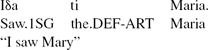
Bare nouns are disallowed in the subject position; licit bare nouns can be licensed under certain circumstances, such as when they are in the object position and governed by a verb (Marinis, Reference Marinis2003; Sioupi, Reference Sioupi2002), as in Example (2).
(2)
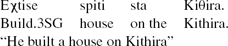
The pronominal system of Greek has a bipartite distinction between strong and clitic pronouns. Strong pronouns can appear in the subject or the object position and can be placed postverbally, or preverbally, when focused or stressed (3a–c). Greek has object clitics but no subject clitics. Object clitics always precede the finite verb and cannot be focused or stressed, as in Example (3d–f).
- (3)
a. iδa afton
b. ??afton iδa
c. AFTON iδa
d. *iδa ton / TON
e. ton iδa
f. *TON iδa
“I saw him”
Definite articles and clitic pronouns are morphophonologically similar and are marked for phi features, namely gender and number, as well as case; clitic pronouns are also marked for person. Definite articles and clitic pronouns are weak monosyllabic unstressed forms that cliticise on their host, that is, definite articles cliticise on the noun and clitic pronouns on the verb.
Definite articles and clitic pronouns can have a fully referential use as in Examples (1) and (3), but they can also have a purely grammatical function, as in the case of definite articles’ being used with proper names, or clitic pronouns referring to a sentential complement, as in Example (4) (Tsimpli & Stavrakaki, Reference Tsimpli and Stavrakaki1999).
(4)

The purely grammatical function of definite articles and clitic pronouns coupled with their morphophonological similarity has led to the proposal that the two elements belong to the same determiner (D) category in Greek (Anagnostopoulou, Reference Anagnostopoulou and van Riemsdijk1999; Tsimpli & Stavrakaki Reference Tsimpli and Stavrakaki1999). When used with proper names or in contexts such as in Example (4), they take on an expletive (resumptive) use; they serve as a mere spell-out of uninterpretable features (gender and number) and case, and they are not associated with semantic features of definiteness or referentiality (Tsimpli & Stavrakaki Reference Tsimpli and Stavrakaki1999).
However, there are also some important differences between definite articles and clitic pronouns. Clitic pronouns constitute verbal arguments that are optionally produced under specific discourse conditions, and they have a more complex derivation than definite articles (Anagnostopoulou, Reference Anagnostopoulou2003; Mavrogiorgos, Reference Mavrogiorgos2010). More specifically, Mavrogiorgos (Reference Mavrogiorgos2010) argues that clitics are morphophonologically deficient elements with an impoverished structure. This impoverished structure gives rise to a hybrid status with clitics being both XP/X categories (for arguments whether they constitute DP/D or φP/φ, that is, mere spell-out of phi features, see Mavrogiorgos, Reference Mavrogiorgos2010). In order for clitics to be assigned case and to check their phi features, they have to move to their verbal host. This movement takes place in an incorporation fashion, where clitics move as (argumental) phrases (XPs), but land as heads (Xs), that is, they get stripped off during the derivation. This is in contrast to definite articles that are base generated as heads of the determiner phrase (DP) and therefore involve no movement. Instead, cliticize only phonologically on the noun (Arvaniti, Reference Arvaniti1991). Differences in complexity between definite articles and clitic pronouns are important for their acquisition and will be addressed in the present study.
In the present study, the L2 children had Turkish as their L1. Turkish is a head-final language with agglutinative morphology and an unmarked subject–object–verb word order. Turkish has no definite articles; the formal features of case and number are marked as nominal suffixes. Licit bare nouns in Turkish can be found in argument positions, as in Example (5) (Ketrez, Reference Ketrez2005).
(5)
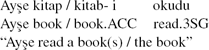
Case marking in Turkish interacts with the definiteness and referentiality of the noun. More specifically, direct objects bearing accusative case marking are interpreted as definite, whereas bare (noncase-marked) nouns are interpreted as nonreferential (Enç, Reference Enç1991; Ketrez, Reference Ketrez2005), as in Example (5).
In terms of the Turkish pronominal system, Turkish allows null objects in contexts where a referent has already been introduced into the discourse, as in Example (6) (Kornfilt, Reference Kornfilt1997).
(6)
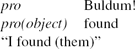
In Example (6), the null pronoun replaces a previously introduced entity, for example, the keys. In the same context, Greek would license a direct object clitic pronoun.
In languages that do not grammaticalize definiteness via the use of overt definite articles, there is a controversy about whether they project a DP layer (Bošković, Reference Bošković2008; Öztürk, Reference Öztürk2005). In these languages, accusative case is the most suitable candidate for heading the DP (Ketrez, Reference Ketrez2005). Ketrez proposes that Turkish has a maximal category DP that closes off the noun phrase (NP) with accusative case heading the DP. More specifically, whenever the noun is case marked, it becomes referential and bears the [+definite] feature, and a DP projection can be postulated (Ketrez, Reference Ketrez2005). In these contexts, case marking can serve as a type shifter in the same sense that an overt article has a type-shifting operation in languages that license overt articles (cf. Longobardi, Reference Longobardi1994; Öztürk, Reference Öztürk2005). In this account, nonovertly case-marked nouns are analyzed as NPs, which incorporate with their verbal host, while case-marked noun phrases constitute fully referential noun phrases (DPs).
For the purposes of the present study, we assume that both Greek and Turkish project a DP, with the cross-linguistic difference that this DP is headed by definite articles in Greek, whereas in Turkish it is headed by accusative case.
Acquisition of Greek articles and clitic pronouns by L1-TD children and L1 children with SLI
Longitudinal studies with L1-TD Greek children have shown that definite articles emerge very early, at around the age of 1 year, 9 months (1;9), and they are felicitously produced in more than 90% of obligatory contexts at around the age of 2;5 to 2;9 (Marinis, Reference Marinis2003). Furthermore, definite article production is higher in the subject than in the object position (Marinis, Reference Marinis2003). Longitudinal and experimental studies have shown that clitic pronouns appear in Greek between the ages of 1;7 and 2;1 (Marinis, Reference Marinis, Alexiadou, Fuhrop, Kleinhenz and Law2000; Tsimpli, Reference Tsimpli, Stavrou and Terzi2005) and are systematically produced to a ceiling rate by the age of 2;6 (Tsakali & Wexler, Reference Tsakali, Wexler, Kampen and Baauw2003).
Despite the early acquisition of definite articles and clitic pronouns by Greek L1-TD children, there is evidence that definite articles and clitic pronouns show a high rate of omission, especially in preschool children with SLI (Diamanti, Reference Diamanti2000; Mastropavlou, Reference Mastropavlou2006; Tsimpli & Mastropavlou, Reference Tsimpli, Mastropavlou, Goodluck, Liceras and Zobl2008; Tsimpli & Stavrakaki, Reference Tsimpli and Stavrakaki1999; but cf. Manika, Varlokosta, & Wexler, Reference Manika, Varlokosta, Wexler, Danis, Mesh and Sung2011; and Varlokosta, Reference Varlokosta and Clairis2002, who report low omission of clitics in Greek children with SLI).
In a study with school-aged children with SLI with a mean age of 7;3, Stavrakaki (Reference Stavrakaki2001) reported that they had mastered the acquisition of definite articles and clitics, suggesting that children with SLI overcome with age previous problems with the two D-elements. Tsimpli and Mastropavlou (Reference Tsimpli, Mastropavlou, Goodluck, Liceras and Zobl2008) compared a group of children ages 4;0 to 4;6 to a group of children ages 5;6 to 6;2 with SLI using naturalistic data. The younger group, which had received less treatment than the older group, had a higher rate of definite article omission (range = 38%–72%) and clitic pronoun omission (23%–68%) than the older group, which had a much lower rate of definite article (5%–7%) and clitic pronoun omission (4%–15%). These studies indicate that the acquisition of definite articles and clitics is subject to age and treatment, although it was not possible to tease these two factors apart in the studies above.
To date, there is only one study examining off-line comprehension of strong and clitic pronouns in children with SLI by Stavrakaki and van der Lely (Reference Stavrakaki and van der Lely2010). They examined the production and comprehension of strong and clitic pronouns in different syntactic contexts in a group of nine older Greek children with SLI (mean age = 10;6, range = 7;7–13;5) and three groups of TD younger, vocabulary- and grammar-matched children. The results showed that the Greek children with SLI performed worse on third person direct object clitics compared with all the other pronominal constructions. They also performed slightly better on production (accuracy of 65%) than on comprehension (accuracy of ~55% or 4.4 out of 8 items) but significantly worse than all groups of TD younger children on both tasks. It is unclear whether this small difference between comprehension and production is meaningful. The authors regarded this as a task effect, and they attributed it to the metalinguistic demands of the comprehension (a four-picture selection task) compared with the cognitively less demanding production task.Footnote 1
Finally, some studies have shown that clitic pronouns are more vulnerable than definite articles in children with SLI (Smith, Reference Smith2008; Tsimpli, Reference Tsimpli2001). In an experimental study, Smith (Reference Smith2008) reported higher production rates of definite articles (mean = 88%) than clitics (mean = 64%) in a group of nine age 4;9 to 6;8 children with SLI. The children with SLI differed from their language-matched controls only in terms of clitic use but not in terms of article use, suggesting that clitics are more vulnerable than definite articles in children with SLI.
Domain-general versus domain-specific accounts of SLI
The acquisition and processing of definite articles and clitic pronouns provides a good testing ground for domain-specific and domain-general accounts of SLI due to the grammatical and phonetic properties of the two D-elements. Domain-specific accounts of SLI attribute the children's difficulties with definite articles and clitic pronouns to the grammatical properties of the two D-elements (Tsimpli & Stavrakaki, Reference Tsimpli and Stavrakaki1999) and to the syntactic operations involved in the derivation of clitics (Stavrakaki & van der Lely, Reference Stavrakaki and van der Lely2010), whereas domain-general accounts focus on the phonetic properties of these grammatical morphemes (e.g., Leonard, Reference Leonard1989). We now discuss these different approaches in greater detail.
The interpretability hypothesis (IH; Tsimpli, Reference Tsimpli2001) assumes that children with SLI have a deficit specific to the domain of grammar that affects uninterpretable features (Chomsky, Reference Chomsky1995). These are purely morphosyntactic features (case, gender, lack of referentiality), which carry no semantic content and may be associated with D-elements in Greek. These features will remain inaccessible for children with SLI. In the case of Greek children with SLI, Tsimpli and Mastropavlou (Reference Tsimpli, Mastropavlou, Goodluck, Liceras and Zobl2008) argue that the delay observed in the acquisition of articles and clitic pronouns may be the result of (a) a genetically based reduced ability to analyze syntactically the L1 input or (b) the result of a deficit in the syntactic system which requires considerably more exposure to the input in order to achieve targetlike performance indirectly, that is, via a learning rather than an acquisition process. The latter claim derives from Paradis and Gopnik's (Reference Paradis and Gopnik1997) implicit rule deficit account, which assumes that children with SLI are unable to form automatic and implicit rules based on grammatical features. In this account, children with SLI can compensate for grammatical deficits by resorting to explicitly learned metalinguistic rules. At the same time, length of treatment along with age may impact on their ability to employ explicit morphosyntactic rules (Paradis & Gopnik, Reference Paradis and Gopnik1997; Ullman & Gopnik, Reference Ullman and Gopnik1999).
Stavrakaki and van der Lely (Reference Stavrakaki and van der Lely2010) explain the late acquisition of Greek clitic pronouns in children with SLI within the computational grammatical complexity hypothesis (CGCH; Van der Lely & Battell, Reference Van der Lely and Battell2003), which is a domain-specific account. According to the CGCH, syntactic dependencies involving movement and chain formation between the moved constituent and its trace are impaired in children with SLI, and this impairment should lead to optionality in performance. Object clitics are interpreted through syntactic dependencies at the clausal level and require feature checking, movement, and chain formation. Therefore, they are expected to be impaired in children with SLI. Stavrakaki and van der Lely argue that the CGCH account captures the optionality demonstrated by the Greek children with SLI in their study. However, on a theoretical level and given the assumptions of this account, it is not clear why impairment in movement in children with SLI should lead to optionality and not to complete omission or lack of comprehension of the impaired structure.
Domain-general accounts attribute the difficulties of children with SLI to their well-documented processing limitations (Bishop, Carlyon, Deeks, & Bishop, Reference Bishop, Carlyon, Deeks and Bishop1999; Montgomery & Leonard, Reference Montgomery and Leonard1998). According to the surface account (Leonard, Reference Leonard1989, Reference Leonard and Schwartz2009; Leonard, Eyer, Bedore, & Grela, Reference Leonard, Eyer, Bedore and Grela1997), grammatical morphemes with relatively short duration and low phonetic salience (e.g., single consonants or unstressed syllables) will be problematic for children with SLI. This account assumes that the morphosyntactic functions carried by the grammatical morphemes combined with their brevity will result in incomplete processing of these morphemes in children with SLI because of processing limitations. This will lead to underspecified morphological paradigms and hence may hinder the lexical representations of inflectional suffixes, which may lead to underspecified morphological paradigms (Paradis, Reference Paradis2010b). In this account, a minimal threshold of exposure is required before productive use of morphemes can be reached.
In the present study we explored these theoretical accounts by examining production and processing of morphosyntactic elements of low phonetic salience that carry uninterpretable features (IH) and involve different syntactic operations (CGCH).
The acquisition of articles and clitics in Greek L2-TD children
Greek-speaking L2-TD children with L1 Turkish have been shown to have problems acquiring definite articles and clitic pronouns in Greek (Chondrogianni, Reference Chondrogianni2008a, Reference Chondrogianni, Haznedar and Gavruseva2008b; Tsimpli & Mastropavlou, Reference Tsimpli, Mastropavlou, Goodluck, Liceras and Zobl2008). However, the studies differ with respect to the success rate that they report on articles and clitics for the L2-TD children.
In a small-scale study, Tsimpli and Mastropavlou (Reference Tsimpli, Mastropavlou, Goodluck, Liceras and Zobl2008) examined the production of clitic pronouns and definite articles in the spontaneous speech of five 8- to 9-year-old and five 11- to 12-year-old Turkish-speaking children with Greek as an L2. The results showed that both groups of L2-TD children omitted definite articles and clitic pronouns and that performance was better on definite articles compared with clitic pronouns. However, the older group of L2-TD children did not reach high accuracy on clitics (younger group: definite article: 62%, clitics: 27%; older group: definite article: 89%, clitics: 56%).Footnote 2
Chondrogianni (Reference Chondrogianni2008a, Reference Chondrogianni, Haznedar and Gavruseva2008b) examined the acquisition of definite articles and clitics in a cross-sectional study with 70 TD Turkish-speaking children with Greek as an L2 belonging to different proficiency levels (beginners to advanced) and aged between 7;0 and 12;0. Their mean age of L2 onset was 5;3 and their length of exposure ranged between 12 and 72 months. Definite articles and clitics were examined in referential anaphoric contexts using a narrative task. Clitics were also elicited using a picture-based production task following Schaeffer (Reference Schaeffer2000), similar to the task in the present study.
The results showed that the low proficiency group with an average exposure to the L2 of less than 3 years (mean = 35 months, range = 12–60 months) had low production of definite articles (mean = 26.9%). However, article production followed a steep developmental path that reached ceiling at intermediate (86%) and advanced (95%) proficiency levels. Few clitics were initially produced in the elicited production task (mean = 10.7%, range = 0%–57.1%, SD = 19.3) and the developmental path of clitics was also more protracted than that of articles. L2-TD children were also able to produce a high rate of clitics at the advanced proficiency levels (narrative task = 96.8%, elicited production task = 83%).Footnote 3 Omissions were the predominant error type for both article and clitic contexts, followed by substitutions (substitution errors were indefinite articles instead of definite articles, or full NPs instead of clitics).
The difficulties of the Greek-speaking L2-TD children with clitics and pronouns have been interpreted by Tsimpli and Mastropavlou (Reference Tsimpli, Mastropavlou, Goodluck, Liceras and Zobl2008) within the IH (Tsimpli, Reference Tsimpli, Liceras, Zobl and Goodluck2003). More specifically, Tsimpli (Reference Tsimpli, Liceras, Zobl and Goodluck2003) assumes that uninterpretable L2 features not present in the L1 are problematic for L2 learners and are susceptible to critical period effects. In the case of child L2 learners who are still within the critical period for language acquisition, uninterpretable features can be analyzed and integrated in the L2 grammar eventually but not following the same route as in the case of L1 acquisition. Targetlike acquisition is not guaranteed even at advanced stages of development. In the context of the acquisition of Greek articles and clitics by Turkish-speaking children with Greek as an L2, Tsimpli and Mastropavlou (Reference Tsimpli, Mastropavlou, Goodluck, Liceras and Zobl2008) argue that the nature of the problem lies in that the L2 children misanalyze case in Greek as a lexical instead of a functional feature, because case in Turkish is a feature associated with nouns (lexical category), and in their analysis arguments are not DPs but case phrases or NPs. Consequently, L2 learners have problems analyzing definite articles and clitics as D-categories, which are linked with argument licensing in Greek. It is this parametric property associated with the representation of case as a feature on a lexical (N) rather than a functional feature associated with argumenthood that is not reset in the L2 learners.
However, Tsimpli and Mastropavlou's (Reference Tsimpli, Mastropavlou, Goodluck, Liceras and Zobl2008) analysis of case in Turkish is based on Kowaluk's (Reference Kowaluk2001) analysis of Slavic languages and contrasts with other theoretical accounts that analyze case in Turkish as a potential head of the D-category. In these analyses, case can act as a nominal type shifter, since accusative case-marked nouns in Turkish become definite and resist incorporation with the verbal host (Öztürk, Reference Öztürk2005). If the latter account is adopted, then a D-category can be postulated for both Greek and Turkish. However, this category is occupied by different morphophonological exponents in the two languages, namely, by definite articles in Greek and case in Turkish. When the DPs are referential in both languages, then they share interpretable features related to referentiality and should be learnable, especially by L2-TD children.Footnote 4
Chondrogianni (Reference Chondrogianni2008a, Reference Chondrogianni, Haznedar and Gavruseva2008b) postulated that nouns in Turkish and in Greek are DPs when case-marked or preceded by a definite article in referential contexts. The difficulties with articles and clitic pronouns in L2-TD children and the asymmetrical pattern in the acquisition of the two D-elements were attributed to two main factors. First, the low accuracy on articles and clitics may be attributed to the L2-TD children's difficulties with reassembling the L1 features into target morphophonological exponents in the L2 in the form of definite articles and clitics (Lardiere, Reference Lardiere, Dekydtspotter, Sprouse and Liljestrand2005), since these two morphophonological exponents of the D-category are missing in Turkish.Footnote 5 Second, better performance on articles compared to clitics may be attributed to the derivational complexity of clitic pronouns, which move as heads and incorporate into their verbal host to check their case and phi features (Mavrogiorgos, Reference Mavrogiorgos2010); articles do not show this derivational complexity. Chondrogianni (Reference Chondrogianni, Haznedar and Gavruseva2008), following Lardiere's feature reassembly account (Reference Lardiere, Dekydtspotter, Sprouse and Liljestrand2005), argued that the morphosyntactic realization of a specific category in the L1 and the L2 may affect the L2 acquisition pattern. In the case of Turkish and Greek, both definite articles and case can head the D-category. However, its morphophonological manifestation in the two languages differs. In Greek, determiner is occupied by articles whereas in Turkish by case. The task of the Turkish L2 learner of Greek is to figure out that nouns in Greek turn into arguments by supplying an overt inflectional element (the definite article) before the noun. The consistency and systematicity with which the definite article occurs in Greek can guide the L2 learner into acquiring definite articles. In contrast, clitic pronouns are derivationally more complex and do not consistently appear before their verbal host, as they are discourse dependent. The appearance of clitics in noncanonical argument positions coupled with their derivational complexity could give rise to their delayed acquisition pattern. This account predicts that L2-TD children do not have problems understanding that clitics are arguments unlike the predictions of the IH; the problems lie in spelling them out in a noncanonical argument position.
Comprehension of grammatical morphology in children with SLI and L2-TD children
The above studies from monolingual children with SLI and L2-TD children point toward the problematic nature of definite articles and clitic pronouns in both populations. However, the source of the problem is different for the L1-SLI and the L2-TD children. First, L2-TD children have intact language processing and acquisition systems and develop their L1 in a typical manner before they are exposed to the L2 around the age of 3 or 4 years (Meisel, Reference Meisel, Haznedar and Gavruseva2008; Schwartz, Reference Schwartz, Beachley and Brown2003). Conversely, children with SLI have been shown to possess less efficient processing (Montgomery & Leonard, Reference Montgomery and Leonard2006) or language learning systems (Paradis & Gopnik, Reference Paradis and Gopnik1997; Ullman & Gopnik, Reference Ullman and Gopnik1999). Second, the linguistic experience of monolingual and bilingual children differs considerably. L2-TD children usually receive less input in the L2 than monolingual children, and L2-TD children with fewer than 3 years of L2 exposure have been shown to resemble monolingual children with an impaired developmental profile (Genesee, Paradis, & Crago, Reference Genesee, Paradis and Crago2005). Third, the nature of the L1 may influence L2 acquisition, especially when the structures acquired in the L2 are not present in the L1 (Grüter & Crago, Reference Grüter and Crago2012; Zdorenko & Paradis, Reference Zdorenko and Paradis2011), as in the case of Turkish-speaking children acquiring articles and clitics in Greek, morphosyntactic elements that are missing in Turkish.
Recent studies directly comparing production and off-line comprehension or metalinguistic judgment of morphosyntactic abilities in children with SLI and L2 children have shown differences between the two populations (Grüter, Reference Grüter2005; Paradis et al., Reference Paradis, Rice, Crago and Marquis2008). To date, the only on-line comprehension study comparing directly the two populations is the one by Marinis and Saddy (Reference Marinis and Saddy2013) that examined on-line and off-line comprehension of English actives and passives, but currently there are no studies directly comparing L2 and SLI children's production and sensitivity to morphosyntactic violations using an on-line comprehension task.
On-line comprehension studies can provide us with a window into the underlying representations and processing routines of language learners (Clahsen, Reference Clahsen, Sekerina, Fernández and Clahsen2008; Marinis, Reference Marinis, Blom and Unsworth2010; Snedeker, Reference Snedeker and Bavin2009). On-line sentence comprehension requires drawing information from multiple levels of linguistic representation to construct syntactic analyses (Snedeker, Reference Snedeker and Bavin2009; Trueswell, Sekerina, Hill, & Logrip, Reference Trueswell, Sekerina, Hill and Logrip1999). Performance on on-line comprehension tasks can be modulated by whether the necessary linguistic representations are available to the child but can also be compromised due to processing limitations related to lack of speed and automaticity.
In a series of studies, Montgomery and Leonard (Reference Montgomery and Leonard1998, Reference Montgomery and Leonard2006) and Leonard, Miller, and Finneran (Reference Leonard, Miller and Finneran2009) reported that children with SLI had significantly longer reaction times (RTs) than their age-matched TD peers when comprehending sentences in real time, and they were not able to detect the grammatical violations induced by omission of grammatical morphemes with low phonetic substance, such as third person –s, and past tense –ed in English, compared with grammatical morphemes of high phonetic substance, such as –ing, in contrast with their age-matched TD peers. Following the surface account, the inability of the children with SLI to detect the grammatical violations related to morpheme omission was attributed to processing limitations coupled with the grammatical properties of these morphemes (Leonard et al. Reference Leonard, Miller and Finneran2009).
Turning to L2 acquisition, performance on on-line sentence comprehension tasks and the ability to detect morphosyntactic anomalies has been shown to be susceptible to proficiency effects, especially in adult L2 learners (VanPatten, Keathing, & Leeser, Reference VanPatten, Keathing and Leeser2012). In addition, processing speed and automaticity have been shown to be related to vocabulary size (Bialystok, Craik, & Luk, Reference Bialystok, Craik and Luk2008; Segalowitz & Hulstijn, Reference Segalowitz, Hulstijn, Kroll and de Groot2005). Studies examining on-line processing of morphosyntax in L2-TD children have shown that L2-TD children are able to process the grammatical violations induced by omitted or erroneous morphemes despite slow speed, smaller vocabularies, and production limitations (Blom & Vasić, Reference Blom and Vasić2011; Chondrogianni & Marinis, Reference Chondrogianni and Marinis2012; Vasić & Blom, Reference Vasić, Blom, Danis, Mesh and Sung2011).
Chondrogianni & Marinis (Reference Chondrogianni and Marinis2012) compared the production and on-line comprehension of tense morphemes (third person –s, past tense –ed) by Turkish-speaking children acquiring English as L2 using a modified version of the on-line processing task by Montgomery and Leonard (Reference Montgomery and Leonard1998, Reference Montgomery and Leonard2006). The results showed that the L2-TD children were sensitive to the grammatical violations related to the omission of tense morphemes in the on-line comprehension task despite variable production of the same morphemes and despite having longer RTs than their L1 peers. This is in contrast with the previous findings by Montgomery and Leonard (Reference Montgomery and Leonard1998, Reference Montgomery and Leonard2006) with children with SLI, who were not sensitive to the omission of tense morphemes. Sensitivity to grammatical violations during an on-line task despite variable production has been found in studies examining the nominal domain in Dutch L2-TD children (Blom & Vasić, Reference Blom and Vasić2011; Vasić & Blom, Reference Vasić, Blom, Danis, Mesh and Sung2011; Vasić, Chondrogianni, Marinis, & Blom, Reference Vasić, Chondrogianni, Marinis, Blom, Biller, Chung and Kimball2012). In all of these studies, the L2-TD children had at least 3 years of exposure to the L2.
Chondrogianni and Marinis (Reference Chondrogianni and Marinis2012) interpreted the L2-TD children's ability to detect the grammatical violations related to missing or erroneous morphology despite variable production as evidence for the missing surface inflection hypothesis (MSIH; Haznedar & Schwartz, Reference Haznedar, Schwartz, Hughes, Hughes and Greenhill1997; Prévost & White, Reference Prévost and White2000). According to the MSIH, L2 learners’ problems with grammatical morphology are output related and do not indicate impaired underlying grammatical representations. These output problems are unique to production and may be caused by lexical access and retrieval problems (Bialystok et al., Reference Bialystok, Craik and Luk2008), prosodic differences between languages (Goad & White, Reference Goad and White2006), lack of automaticity or a combination of these factors.
To date there are no studies that directly compare children with SLI with TD L2 children using a combination of production and on-line processing tasks to examine morphosyntax.
THE PRESENT STUDY
In this study we directly compared production and on-line comprehension of definite articles and clitic pronouns by L2-TD children and L1-SLI. We focused on L2-TD children at initial stages of acquisition to examine whether the difficulties that L2-TD children have with articles and clitics are related to output problems or represent problems with underlying grammatical structures. We postulated that the more sensitive and implicit on-line comprehension tasks used in the study might help us differentiate between L2-TD children and children with SLI more successfully compared with production tasks. We addressed the following research questions:
1. Do L2-TD children and L1 children with SLI differ in terms of accuracy and error patterns in the production of definite articles in different syntactic contexts (subject, object) and clitic pronouns?
2. Do the same L2-TD children and L1 children with SLI differ when processing the grammatical violations induced by definite article and clitic pronoun omission in an on-line processing task?
3. Does the performance on articles and clitic pronouns differ in the production and the on-line comprehension task for the L1-SLI and the L2-TD children?
Predictions
For the children with SLI
According to the IH (Tsimpli, Reference Tsimpli2001; Tsimpli & Mastropavlou, Reference Tsimpli, Mastropavlou, Goodluck, Liceras and Zobl2008; Tsimpli & Stavrakaki, Reference Tsimpli and Stavrakaki1999), definite articles and clitic pronouns will be problematic for Greek children with SLI since they carry uninterpretable features. This difficulty will be manifested as impaired production of definite articles and clitic pronouns. However, school-aged children who have received extensive treatment may perform well on these two structures because of learning rather than automatization of rule application (Paradis & Gopnik, Reference Paradis and Gopnik1997). In the present paper, we hypothesize that lack of automatization of rule application may be manifested more clearly in the on-line comprehension task which taps into real-time implicit knowledge. The production task is also an on-line task that requires automaticity in lexical retrieval and articulation. However, the production task that we employed in the present study was not time constrained and children had ample time to reflect and respond, which may lead to the use of metalinguistic knowledge.
According to the CGCH (Stavrakaki & van der Lely, Reference Stavrakaki and van der Lely2010), Greek children with SLI will have optional performance on clitics since they require movement at the sentential level and chain formation. In contrast, definite articles will not be impaired because they involve a local relation between the determiner and the noun. Production will be on a par with comprehension.
According to the surface account (Leonard et al., Reference Leonard, Eyer, Bedore and Grela1997), Greek children with SLI will have equal problems producing definite articles and clitic pronouns and processing the grammatical violations related to their omission, as these two elements are morphophonologically similar and they have the same low phonetic salience.
For the L2-TD children
According to the IH, the acquisition of definite articles and clitic pronouns will be problematic for Turkish-speaking children with Greek as L2. In this account, Greek L2-TD children will not acquire case and argument licensing in Greek in the same way as Greek L1 children. As a result, L2-TD children may exhibit variable production of definite articles and clitic pronouns. Later high production of the definite article and the clitic pronoun could be achieved, but this does not indicate that L2-TD children have L1-like representations of these two D-elements. Problems in production and with underlying representations will be particularly evidenced in the case of clitics that are derivationally more complex and do not enter into a local relationship with the agreeing noun. Furthermore, their realization is dependent upon discourse properties, which makes their use less consistent than that of definite articles that obligatorily precede nouns in argument positions.
According to the feature reassembly account (Lardiere, Reference Lardiere, Dekydtspotter, Sprouse and Liljestrand2005, Reference Lardiere2009) and the MSIH (Haznedar & Schwartz, Reference Haznedar, Schwartz, Hughes, Hughes and Greenhill1997), low production will not indicate impaired underlying representations, in contrast to the IH. Both the feature reassembly account and the MSIH predict that the L2-TD children will be sensitive to the omission of definite articles and clitic pronouns, even though they are omitted in production. Within the feature reassembly account, the systematicity and the locality of occurrence of the definite article in relation to the clitic can affect the L2 acquisition pattern, as these factors relate to the nature and the context of occurrence of the morphophonological exponents.
Comparing L2-TD children and children with SLI on production and on-line comprehension
Previous studies with L2-TD children with limited exposure have shown that their production of definite articles and clitic pronouns is low (Chondrogianni, Reference Chondrogianni2008a, Reference Chondrogianni, Haznedar and Gavruseva2008b). Studies with school-aged children with SLI have shown that they can overcome problems with these two D-elements at a school age given sufficient treatment (Smith, Reference Smith2008; Stavrakaki, Reference Stavrakaki2001; Tsimpli & Mastropavlou, Reference Tsimpli, Mastropavlou, Goodluck, Liceras and Zobl2008). Therefore, we expect L2-TD children to have low production of definite articles and clitics, whereas we expect the school-aged children with SLI in our study to have high production of articles and clitics. L2-TD children may also show sensitivity to the grammatical violation induced by article and clitic omission following previous studies showing a similar dissociation between production and on-line comprehension (Blom & Vasić, Reference Blom and Vasić2011; Chondrogianni & Marinis, Reference Chondrogianni and Marinis2012). We also expect that if children with SLI have not internalized the morphophonological and syntactic properties of articles and clitics, they should not exhibit sensitivity to the omission of these elements in the on-line comprehension task.
Finally, we expect both L2-TD children and children with SLI to have higher production on definite articles than on clitics following previous studies (Chondrogianni, Reference Chondrogianni2008a, Reference Chondrogianni, Haznedar and Gavruseva2008b; Smith, Reference Smith2008; Tsimpli & Mastropavlou, Reference Tsimpli, Mastropavlou, Goodluck, Liceras and Zobl2008) and given the difference in derivational complexity between the two D-elements (Chondrogianni, Reference Chondrogianni2008a, Reference Chondrogianni, Haznedar and Gavruseva2008b; Mavrogiorgos, Reference Mavrogiorgos2010).
Methodology
Participants
Twenty TD Turkish-speaking children learning Greek as an L2, 16 L1 Greek-speaking children with SLI, and 31 L1-TD Greek-speaking children participated in the study (total = 67 participants). The L2-TD children were recruited in the northeastern part of Greece (Thrace), which has a bilingual (Turkish–Greek) community. They did not have any reported speech or language difficulties. The children with SLI were recruited through speech and language therapists (SLTs) and through the Athens University Children's Hospital in Athens. They were diagnosed as having persistent difficulties with language development by speech therapists on the basis of both clinical assessment and results on standardized and nonstandardized tests of language abilities. Exclusion criteria for all groups was performance below one standard deviation on Raven's Coloured Matrices (Raven, Reference Raven1998), a history in hearing impairment, frank neurological impairment, psychoemotional disturbance, and diagnosis of autism. One L1-TD child scored below one standard deviation on the Raven's Coloured Matrices and was therefore excluded from the study. At the time of testing, all L1-SLI children had speech and language therapy between 1 and 3 years. The L1-TD children were recruited from schools in Athens and did not have any reported speech or language difficulties.
The L2-TD children had a mean age of 7;6 at the time of testing (SD = 10.6, range = 5;9–8;10), the L1-SLI had a mean age of 6;8 (SD = 9.9, range = 5;6–8;4) and the L1-TD children a mean age of 7;3 (SD = 10.1 months, range = 6;0–8;6). Post hoc comparisons using Bonferroni correction showed that the L1-TD children were matched on age with the L2-TD children and the children with SLI (L1-TD vs. L2-TD: p = 1; L1-TD vs. L1-SLI: p > .1). The L2-TD children were significantly older than the L1-SLI children (p < .05).
The L2-TD children were tested in their homes by a bilingual research assistant familiar with the local community who elicited information from parents and caregivers regarding the children's language history and status, the age of onset, and years of exposure to Greek. All L2-TD children's parents and caregivers were Turkish speaking. The L2-TD children's systematic exposure to Greek begun at preschool (at the age of 4 or 5 years) or primary school entrance (at the age of 6 years). The mean age of the start of Greek exposure was 5;5 years (SD = 10 months, range = 4;0–6;6) and the mean length of exposure to Greek was 21 months (SD = 14 months, range = 6–54 months). The L1-SLI children were tested in their homes or at the SLTs’ practices. The L1-TD children were tested in their schools.
Baseline verbal and nonverbal tasks
To compare the language abilities of the three groups we used the comprehension of morphosyntax from the Diagnostic Verbal IQ Test for Preschoolers by Stavrakaki and Tsimpli (Reference Stavrakaki and Tsimpli2000). In this task, children are presented with a three-picture panel, they listen to a sentence and they are asked to indicate which picture matches the sentence they heard. This is not a standardized task, and therefore, raw scores were used for further statistical comparisons. The children's nonverbal IQ was assessed through Raven's Coloured Progressive Matrices (Raven, Reference Raven1998). Raw scores were converted into standard scores.
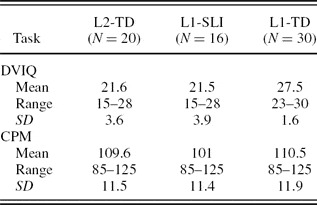
Post hoc tests with Bonferroni correction showed that the L2-TD children and the L1-SLI children were matched on their language abilities on the basis of the Diagnostic Verbal IQ Test for Preschoolers (p > .1); both groups had significantly lower scores than the L1-TD group in terms of language abilities (L1-TD vs. L2-TD: p < .001; L1-TD vs. L1-SLI: p < .001). Although the L1-SLI children had significantly lower scores than the L1-TD children on nonverbal abilities (L1-TD vs. L1-SLI: p < .05), they did not differ from the L2-TD children (p = .08). The L2-TD children also did not differ in their nonverbal abilities from the L1-TD children (p > .1; Table 1).
Results from the DVIQ and the Raven's CPM

Note: DVIQ, Diagnostic Verbal IQ Test for Pre-schoolers; CPM, Coloured Progressive Matrices; L2, second language; TD, typically developing; L1, first language; SLI, specific language impairment.
Experimental tasks
PRODUCTION TASKS
To assess the children's production on definite articles we developed a task similar to the definite article elicitation subtest of Seymour, Roeper, de Villiers, and de Villiers (Reference Seymour, Roeper, de Villiers and de Villiers2005) with short stories without picture props. In this task, children listen to short stories, and they are asked to provide answers to the question “Guess which?,” which elicits definite specific NPs, as in Examples (7) and (8).
(7) Experimenter: Mia melisa ke mia petaluδa petusan sto δasos. Ena apo ta zoa piγe na mazepsi γiri apó ta luludja. Mantepse pjo.
Experimenter: A bee and a butterfly were flying in the forest. One of the animals went to get pollen from the flowers. Guess which!
Child (expected response): I.FEM.NOM melisa.
Child (expected response): The bee.
(8) Experimenter: I Maria iχe enan pinaka ke ena trenaki. Kremase ena apo ta δio ston tiχo tu δomatiu tis. Mantepse pjo.
Experimenter: Mary had a painting and a train. She hung one of the two on her bedroom wall. Guess which!
Child (expected response): Ton.MASC.ACC pínaka.
Child (expected response): The painting.
The production of Greek definite articles was elicited in two syntactic positions, namely in the subject position, as in Example (7), and in the object position, as in Example (8). In Greek the NP in the subject condition is nominative case marked, and in our sentences it was the subject of the intransitive verb that appeared in the lead-in sentence. In the object condition, the elicited NP was the object of the transitive verb in the lead-in sentence and was marked with accusative case. The elicited nouns in the subject condition were animate (bee, bird, frog, hen, mouse, turtle) and in the object condition inanimate (ball, book, doll, painting, tie, train). This is because prototypically subjects are animate and objects are inanimate. The nouns in the two conditions were matched for frequency on the basis of the Hellenic National Corpus and length (number of syllables). All nouns and verbs were also included in the textbooks used for teaching Greek in primary schools (Institute for Language and Speech Processing, 2001). There were 6 items per condition (subject, object) and 12 filler items, for a total of 24 items.
To elicit third person direct object clitic pronouns, we used a picture-based elicitation task following Schaeffer (Reference Schaeffer2000) and Chondrogianni (for Greek; Reference Chondrogianni2008a, Reference Chondrogianni, Haznedar and Gavruseva2008b). In this task, children are first presented with a picture showing two participants. They are then shown another picture with the same participants engaging in an activity involving a transitive action and are asked the question “What is X doing to Y?,” which elicits a transitive verb with a clitic pronoun, as in Example (9).
(9) Experimenter (first picture): Kita! Eδo ine ena ljontari ke ena elafi. To ljontari pinai poli.
Experimenter (first picture): Look! Here is a lion and a deer. The lion is very hungry! Experimenter (second picture): Kita eδo tora! Ti kani to ljontari sto elafi?
Experimenter (second picture): Look here, what is the lion doing to the deer?
Child (expected response): To.CLIT δagοni.
Child (expected response): It is biting it.
All nouns used in the elicitation task for clitics were animate and depicted animals. There were five depictable transitive verbs (kiss, kick, hug, bite, pinch) and 10 animal characters (bear, cat, deer, elephant, goat, lion, monkey, rabbit, sheep, wolf) as arguments of the verbs.
Coding and scoring
In the case of definite articles, scoring proceeded as follows. Responses involving a definite article and the target noun, that is, the noun that had already been introduced in the story, were coded as “correct.” Responses that involved an indefinite article with the target noun were coded as “substitutions.” Responses with bare (articleless) target nouns were coded as “omissions.” If a child produced a noun not already mentioned in the story with or without an article, then this response was coded as “other” and was excluded from the final calculation. Definite articles with erroneous number, gender, or case feature specifications were considered target responses for the purposes of this study and were included in the “correct” category. This was because we were interested in the production versus omission of the two D-elements regardless of their target morphology.
In the case of clitic pronouns, target responses involved a transitive verb preceded by a clitic pronoun. Responses involving full lexical NPs, for example, the lion is biting the deer, were counted as “substitutions,” and sentences with no object, for example, he is biting, were counted as “omissions.” Clitic pronouns with erroneous number or gender feature specification were considered target responses and were included in the “correct” category. If a child responded with a different transitive verb than the one in the elicitation question, then this context was still considered felicitous for eliciting a clitic pronoun and was included in the calculation.
For both articles and clitics, proportion correct, omissions, and substitutions were calculated out of the three responses (denominator: sum of correct, substitutions, and omissions).
Self-paced listening task
To assess the children's ability to process the omission of definite articles and clitics in real-time, we used an on-line self-paced listening task. Self-paced listening tasks measure the children's RTs by pressing a button to listen to sentences word-by-word or phrase-by-phrase. They can be used with (e.g., Marinis & Saddy, Reference Marinis and Saddy2013) or without picture verification (present study). They are child friendly and can easily be used with participants who have language impairment and/or process sentences at a slower rate, because they have control over the pace of the auditory stimuli. This is in contrast to cross-modal priming (e.g., Marinis & van der Lely, Reference Marinis and van der Lely2007) and word-monitoring tasks (e.g., Montgomery & Leonard, Reference Montgomery and Leonard1998, Reference Montgomery and Leonard2006) that are challenging because they are speeded and children cannot control the pace of presentation. For a discussion about the usefulness of RT experiments with language impaired populations, see Marinis (Reference Marinis, Ball, Perkins, Mueller and Howard2008, Reference Marinis, Blom and Unsworth2010).
In this self-paced listening task, half of the sentences were grammatical and included definite articles and clitic pronouns and the other half of the sentences contained omissions of these elements. The sentences involved stories about animals engaging in imaginary activities. At the beginning of each trial, children saw a picture on a computer screen and at the same time they listened to a lead-in sentence introducing the participants (animals) or objects in the picture. The lead-in sentence was followed by the critical sentence that was segmented into phrases. To hear the critical sentence, children were instructed to press a response button as fast as they can in an E-prime box. One-third of the sentences was followed by a comprehension question to make sure that the children were attending to the task. These comprehension questions did not examine comprehension of the experimental structures. The experiment was programmed and controlled by the software E-prime (Schneider, Eschmann, & Zuccolotto, Reference Schneider, Eschmann and Zuccolotto2002). Examples (10)–(12) illustrate the grammatical and ungrammatical sentences in the experimental conditions.
(10) Definite article–subject position
Xtes ena delfιni epeze sti θalasa me ta ala zoa. Arγa / to apoγevma / (to) delfini / kiniγise / ta psaria.
Yesterday a dolphin was playing in the sea with the other animals. Late / in the afternoon / (the) dolphin / chased / the fish.
(11) Definite article–object position
Xtes ena kaŋguro epeze me mia prasini bala. To kaŋguro / klotsise / (ti) bala / sto γipeδo / χtes to apoγevma.
Yesterday a kangaroo was playing with a green ball. The kangaroo / kicked / (the) ball / on the pitch / yesterday afternoon.
(12) Direct object clitic pronoun
To ljontari iθele na fai to elafi. To elafi / tromakse polí / otan / to ljontari / (to) δagose / sti zugla / pano stus vraχus.
The lion wanted to eat the deer. The deer / got very scared / when / the lion / (it) bit / in the jungle / on the rocks.
The grammatical and ungrammatical versions of each sentence were recorded separately to avoid the disruption in the intonation of the sentences that would have occurred if we spliced out the article or the clitic from the grammatical versions of each sentence. This ensured that the grammatical and ungrammatical sentences had the same natural intonation. Moreover, in the case of clitics, we used falling intonation at the verb to indicate an intonation phrase boundary. This was to ensure that children did not expect any further arguments after the verb. If TD children and children with SLI are sensitive to the grammatical violations induced by the omission of articles and pronouns, then their RTs are predicted to be longer in the critical segment of the ungrammatical compared to the grammatical sentences.
There were 8 critical nouns per sentence type, which appeared only once across the sentence types. This produced 24 critical nouns in total (16 animate, 8 inanimate). The overall number of animate and inanimate nouns was controlled for in the whole experiment, as was the number of NPs containing an article and bare nouns (licit or illicit). The nouns in the critical conditions were matched for frequency and length in numbers of syllables following the same resources as in the production task. The critical sentences in the article conditions comprised five segments and the critical segment was Segment 3. The conditions with clitics involved accusative clitic pronouns that were direct objects of transitive verbs. Seven transitive verbs were used (kiss, kick, chase, hug, bite, push, throw), and 10 animal characters were used as arguments of the verbs. All verbs appeared in the perfective aspect, which has been found to elicit a higher production rate of overt arguments compared to the imperfective aspect (Chondrogianni, Reference Chondrogianni2008a; Tsimpli & Papadopoulou, Reference Tsimpli and Papadopoulou2006). The critical sentences in the clitic pronoun conditions had seven segments and the critical segment was Segment 5.
The experiment consisted of 68 experimental trials (8 per condition for articles and 10 per condition for clitic pronouns, half grammatical and half ungrammatical) and eight fillers, which consisted of sentences with licit bare objects in the form of mass nouns. We used a single-case design; that is, each participant encountered the grammatical and ungrammatical version of each sentence in a different list.
Two lists of 34 items were created that differed in the order of the items. Each participant saw both lists at weekly intervals. The presentation of the lists was randomized across participants in order to control for any sequencing effects. The experimental session was preceded by a practice session in which the children were familiarized with the task. In order to proceed to the experimental session, the children had to successfully complete the practice session, which could be repeated twice. No child failed to complete the practice session.
Procedure
Each child participated in three sessions. In the first session, the baseline and production tasks were administered. In the following two sessions the on-line processing tasks were carried out. Production tasks always preceded on-line comprehension tasks to avoid making participants aware of the phenomena being examined by exposing them to the sentences with grammatical violations within the on-line comprehension task. Each session lasted up to one hr depending on the child's age and language abilities.
RESULTS
To calculate within-subjects effects across the three groups we used repeated-measures analyses of variance (ANOVAs). For all ANOVAs, effect sizes were computed using a partial eta-square (ηp2). Post hoc tests were calculated using Bonferroni correction. To unpack interactions, we ran paired-samples t test for each group separately. Effect sizes for t tests were calculated using a Cohen d. Thresholds of 0.20, 0.50, and 0.80 were used for small, moderate, and large effect sizes, respectively (Cohen, Reference Cohen1992).
Production
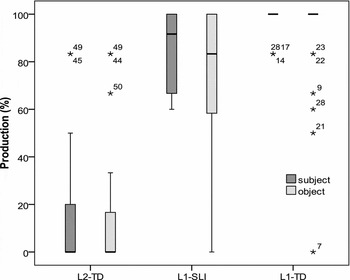
To examine between-group differences in the production of definite articles depending on syntactic position, we calculated the children's accuracy in the production of definite articles in the subject and in the object position, respectively, as shown in Figure 1.
Production (%) of definite articles in the subject and the object position by typically developing sequential bilingual (L2-TD) children, monolingual children with specific language impairment (L1-SLI), and L1-TD children.

To determine statistical significance, a repeated-measures ANOVA was run with Position (subject, object) as the within-subjects factor and Group (L2-TD, L1-SLI, L1-TD) as the between-subjects factor. This revealed a main effect of Position, F (1, 63) = 6.41, p < .05, ηp2 = 0.09), because overall there were more definite articles produced in the subject than in the object position, and a main effect of Group, F (1, 63) = 98.89, p < .001, ηp2 = 0.76, indicating that the three groups differed in terms of accuracy. Consecutive post hoc tests with Bonferroni correction revealed that the L1-TD and the L1-SLI groups had significantly higher accuracy than the L2-TD group (p < .001 in both cases). There was no difference between the L1-TD children and the L1-SLI children.
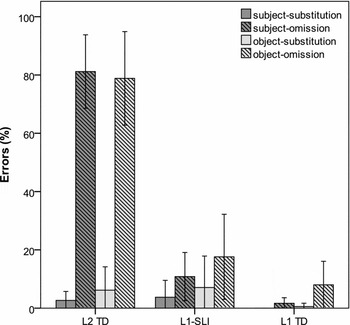
Subsequently, we calculated the types of errors that children produced, when not producing the target form. Figure 2 presents the proportion of substitution and omission errors in the subject and the object position for each group separately.
Substitution and omission errors (%) in the subject and the object position by typically developing sequential bilingual (L2-TD) children, monolingual children with specific language impairment (L1-SLI), and L1-TD children.

To examine whether the three groups differed in the types of errors that they committed in each syntactic position, we ran a repeated-measures ANOVA with Position (subject, object) and Error Type (substitutions, omissions) as the within-subjects factors and Group (L2-TD, L1-SLI, L1-TD) as the between-subjects factor. This revealed a main effect of Position, F (1, 63) = 5.22, p < .05, ηp2 = 0.08, a main effect of Error Type, F (1, 63) = 7.77, p < .001, ηp2 = 0.58, a main effect of Group, F (1, 63) = 101.81, p < .001, ηp2 = 0.76, and a significant interaction between Error Type and Group, F (2, 63) = 54.69, p < .001, ηp2 = 0.64, suggesting that the three groups differed in the types of errors that they committed.
To unpack the interaction between error type and group, we ran paired-samples t tests with Error Type (substitutions, omissions) as the within-subjects factor for each group separately. For the L2-TD group, the predominant error type was omissions (omissions: 80%; substitutions: 4.4%), t (19) = 9.6, p < .001, d = 3.4. For the L1-SLI children, there was no significant difference between the two error types (omissions: 14.2%; substitutions: 5.4%; p > .2). For the L1-TD group, there were more omissions (4.8%) than substitutions (0.3%) t (29) = 2.16, p < .05, d = 0.57.
Consecutive post hoc comparisons using Bonferroni correction revealed that the L2-TD children had significantly more omissions than the L1-TD and the L1-SLI groups (p < .001 in both cases) but the groups did not differ from each other in terms of substitutions. The L1-TD and the L1-SLI children did not differ from each other in terms of error types.
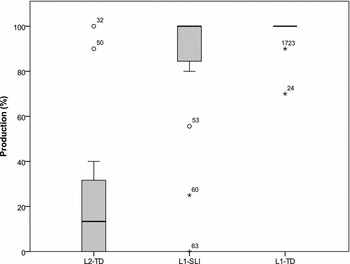
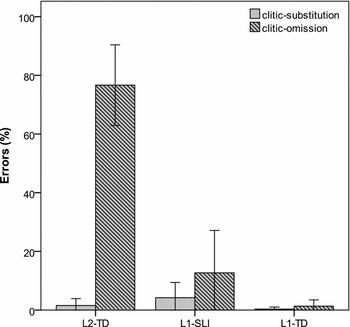
Subsequently, we calculated the children's accuracy on the production of clitic pronouns, as well as the types of errors they committed. These were substitutions of the clitic pronoun by a full lexical NP and omissions of the clitic (Figures 3 and 4).
Production (%) of clitic pronouns by typically developing sequential bilingual (L2-TD) children, monolingual children with specific language impairment (L1-SLI), and L1-TD children.

Substitution and omission errors (%) errors (%) of clitic pronouns by typically developing sequential bilingual (L2-TD) children, monolingual children with specific language impairment (L1-SLI), and L1-TD children.

To examine whether the three groups differed in their accuracy on object clitic pronouns we ran a one-way ANOVA on children's accuracy rates with Group (L2-TD, L1-SLI, L1-TD) as the between-subjects factor. This showed a significant difference between the groups, F (1, 63) = 76.05, p < .001, ηp2 = 0.71. Post hoc comparisons using Bonferroni correction revealed that the L2-TD group produced significantly fewer clitics than the L1-TD and the L1-SLI groups (p < .001 in both cases).
To examine whether the three groups differed in terms of error types, we ran a repeated-measures ANOVA with Error Type (substitutions, omissions) as the within-subjects factor and Group (L2-TD, L1-SLI, L2-TD) as the between-subjects factor. This revealed a main effect of Error Type, F (1, 63) = 101.84, p < .001, ηp2 = 0.62, a main effect of Group, F (1, 63) = 76.05, p < .001, ηp2 = 0.71, and a significant interaction between Error Type and Group, F (1, 63) = 74.6, p < .001, ηp2 = 0.73, suggesting that the three groups performed differently in terms of error types.
To unpack the interaction between Error Type and Group we ran paired-sample t tests with Error Type (substitutions, omissions) as the within-subjects factor for each group separately. This revealed a main effect of Error Type only for the L2-TD group, t (19) = –10.87, p < .001, d = –3.57, as there were significantly more omissions (76.7%) than substitutions (1.6%), but not for the L1-TD group (substitutions: 0.3%; omissions: 1.3%; p > .3) or the L1-SLI group (substitutions: 4.2%; omissions: 12.7%; p > .2).
Post hoc comparisons using Bonferroni correction showed that the L2-TD children had significantly more errors of omission than the L1-TD and the L1-SLI children (p < .001 in both cases), but they did not have more substitution errors. The L1-SL1 children differ not from the L1-TD children in terms of substitutions (p = .08).
Subsequently, we examined whether the children's performance differed depending on the type of DP produced (i.e., articles and clitic pronouns). To that end, we aggregated the scores from the definite articles in the subject and the object position, giving rise to a single score on definite articles. For the L2-TD children the overall accuracy of definite articles was 15.7% (SD = 27.1, range = 0%–83.3%), for the L1-SLI children it was 81.3% (SD = 22.5, range = 33.3%–100%), and for the L1-TD children it was 94.8% (SD = 11, range = 50%–100%).
A repeated-measures ANOVA with DP type (article, clitic) as the within-subjects factor and Group (L2-TD, L1-SLI, L1-TD) as the between-subjects factor showed a main effect of Group, F (1, 63) = 149.38, p < .001, ηp2 = 0.83. Post hoc comparisons using Bonferroni correction showed that the L2-TD children had significantly lower accuracy than the L1-TD and the L1-SLI children (p < .001 in both cases), who in turn, had lower accuracy than the L1-TD children (p < .01). We did not find an effect of DP type or any interactions.
Self-paced listening task
Raw RTs were transformed into residual RTs in order to control for the difference in length between the critical segments in the grammatical and ungrammatical conditions. Extreme values were calculated using the boxplot procedure in Statistical Package for the Social Sciences. This revealed that residual RTs above 2000 ms constituted extreme values and were excluded from the final calculation as extreme values. Outliers were defined as RTs of 2 SD above or below the means per condition per subject and per item. Outliers were replaced with the mean per participant and per item per condition. The total proportion of extreme values and outliers was 4% for the L2-TD children, 5% for the L1-SLI, and 3% for the TD children.
Accuracy to comprehension questions was 78.9% for the L2-TD children (SD = 9.6, range = 61.5%–100%), 82.6% for the L1-SLI children (SD = 15.3, range = 55%–100%), and 91.8% for the L1-TD children (SD = 7.3, range = 78.7%–100%). Post hoc tests using Bonferroni correction revealed that the L2-TD children (p < .001) and the L1-SLI children (p < .05) had significantly lower accuracy in the comprehension questions than the L1-TD children. The L2-TD and L1-SLI children did not differ from each other (p > .1). Items with erroneous responses to the comprehension questions were excluded from the analyses of RTs.
Definite articles
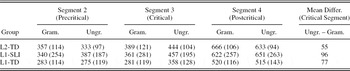
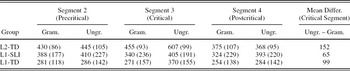
The residual RTs for the definite article in the subject and object positions for L2-TD, L1-SLI children, and L1-TD are presented in Tables 2 and 3, respectively. To examine whether the L2-TD, the L1-SLI, and the L1-TD children were sensitive to the grammatical violations due to article omission in the subject and the object position, we ran a repeated-measures ANOVA with Position (subject, object) and Grammaticality (grammatical, ungrammatical) as the within-subjects factors and Group (L1-TD, L2-TD, L1-SLI) as the between-subjects factor in a per participants (F 1) and a per items (F 2) analysis for each segment separately. We report the results from the precritical, the critical, and the postcritical segments. The precritical segment is crucial to investigate whether an effect of grammaticality in the critical segment is caused by an effect of grammaticality earlier on in the sentence. The postcritical segment can reveal spill-over effects.
Mean (standard deviation) residual reaction times and mean differences (critical segment) for the grammatical and ungrammatical sentences for definite articles in the subject position by L2-TD, L1-SLI, and L1-TD children

Note: Mean differences are calculated by subtracting the mean reaction times on the grammatical condition from the mean reaction times on the ungrammatical condition. L2, second language; TD, typically developing; L1, first language; SLI, specific language impairment.
Mean (standard deviation) residual reaction times and mean differences (critical segment) for the grammatical and ungrammatical sentences for definite articles in the object position by L2-TD, L1-SLI, and L1-TD children

Note: Mean differences are calculated by subtracting the mean reaction times on the grammatical condition from the mean reaction times on the ungrammatical condition. L2, second language; TD, typically developing; L1, first language; SLI, specific language impairment.
For the precritical segment (Segment 2), there was a main effect of Position, F 1 (1, 63) = 13.29, p = .001, ηp2 = 0.17; F 2 (1, 21) = 23.8, p < .001, ηp2 = 0.53; a main effect of Group, F 1 (1, 63) = 6.27, p < .01, ηp2 = 0.17; F 2 (1, 21) = 15.12, p < .001, ηp2 = 0.59; and a significant interaction between Position and Group in the per participants analysis, F 1 (1, 63) = 4.74, p < .01, ηp2 = 0.13; F 2 (1, 21) = 2.88, p = 0.078, ηp2 = 0.22.
For the critical segment (Segment 3), we found a main effect of Grammaticality, F 1 (1, 63) = 50.55, p < .001, ηp2 = 0.45; F 2 (1, 21) = 31.53, p < .001, ηp2 = 0.6, as the RTs in the ungrammatical condition were significantly longer than in the grammatical condition. There was also a main effect of Group, F1 (1, 63) = 3.892, p < .05, ηp2 = 0.110; F 2 (1, 21) = 15.35, p < .001, ηp2 = 0.59. Consecutive pairwise comparisons using Bonferroni correction revealed that the L2-TD children had longer RTs than the L1-TD children in the per participant (p < .05) and the per item analysis (p < .05). The L1-SLI children had longer RTs than the L1-TD children in the per item (p < .01) but not in the per participant analysis (p > .1); there was no difference in speed between the L2-TD children and the L1-SLI children.
For the postcritical segment, there was a main effect of Position, F 1 (1, 63) = 296.626, p < .001, ηp2 = 0.83; F 2 (1, 21) = 291.6, p < .001, ηp2 = 0.93, and a main effect of Group, F 1 (1, 63) = 5.55, p < .01, ηp2 = 0.15; F 2 (1, 21) = 14.69, p < .001, ηp2 = 0.58. Consecutive post hoc comparisons using Bonferroni correction revealed that the L2-TD children had significantly longer RTs than the L1-TD children in the per participant (p < .01) and the per item (p < .001) analysis, but their RTs did not differ from the L1-SLI children. The L1-SLI children had longer RTs than the L1-TD children in the per item analysis (p < .01) and there was a tendency in the per participant analysis (p = .071).
Clitic pronouns
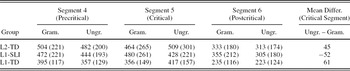
The residual RTs for direct object clitic pronouns are presented in Table 4. To examine whether L1-TD, L2-TD, and L1-SLI children were sensitive to the grammatical violations due to clitic omission, we ran a repeated-measures ANOVA with Grammaticality (grammatical, ungrammatical) as the within-subjects factors and Group (L2-TD, L1-SLI, L1-TD) as the between-subjects factor in a per participants (F 1) and a per items (F 2) analysis for each segment separately.
Mean (standard deviation) residual reaction times and mean differences (critical segment) for the grammatical and ungrammatical sentences for clitic pronouns by L2-TD, L1-SLI, and L1-TD children

Note: Mean differences are calculated by subtracting the mean reaction times on the grammatical condition from the mean reaction times on the ungrammatical condition. A negative mean difference represents that the mean for the ungrammatical condition is smaller than the mean for the grammatical condition. L2, second language; TD, typically developing; L1, first language; SLI, specific language impairment.
For the precritical segment (Segment 4), we found a main effect of Grammaticality in the per participant analysis, F 1 (1, 63) = 3.86, p = .054, ηp2 = 0.06; F 2 (1, 27) = 3.86, p > .1, ηp2 = 0.06, but in the opposite direction from the one predicted for the critical segment: RTs to the grammatical condition were longer than to the ungrammatical condition. There was also a main effect of Group, F 1 (1, 63) = 5.12, p < .01, ηp2 = 0.14; F 2 (1, 27) = 3.23, p = .055, ηp2 = 0.19. Post hoc comparisons using Bonferroni correction revealed that the L2-TD children (p < .01) and the children with SLI (p = .05) had longer RTs than the L1-TD children, but there was no difference in speed between the L2-TD and the L1-SLI children.
For the critical segment (Segment 5), we found a main effect of Group in the per item analysis, F 1 (1, 63) = 1.98, p > .1, ηp2 = 0.057; F 2 (1, 21) = 291.60, p < .05, ηp2 = 0.93, and a significant interaction between Grammaticality and Group in the per participant analysis, F 1 (1, 63) = 3.18, p < .05, ηp2 = .09; F 2 (1, 21) = 1.18, p > .3, ηp2 = 0.08. To unpack the interaction, we ran paired-samples t tests for each group separately. The L1-TD group had longer RTs in the ungrammatical compared to the grammatical condition, t (29) = –2.49, p < .05, d = 0.39. The L2-TD group had also longer RTs in the ungrammatical compared to the grammatical condition (grammatical = 464 ms, ungrammatical = 509 ms), t (19) = –2.51, p < .05, and there was a small effect size (d = 0.16). Given that the precritical segment showed the opposite effect (longer RTs in the grammatical compared to the ungrammatical condition), the Grammaticality effect in the critical segment cannot be attributed to the effect found in the precritical segment. The L1-SLI group did not show a significant difference between the ungrammatical and the grammatical condition (Table 4). There was only a numerical difference in the opposite direction (grammatical = 480 ms, ungrammatical = 428 ms), as indicated by the negative mean difference (–52) and a negative effect size (d = –0.22). The different pattern in the children with SLI gave rise to the Grammaticality × Group interaction.
For the postcritical segment (Segment 6), there was a main effect of Grammaticality in the per participants analysis, F 1 (1, 63) = 5.52, p < .05, ηp2 = 0.08; F 2 (1, 27) = 1.78, p > .1, ηp2 = 0.05; RTs in the grammatical condition were longer than in the ungrammatical condition and indicates no spill-over effect from the critical segment. There was also a main effect of Group, F 1 (1, 63) = 4.76, p < .05, ηp2 = 0.09; F 2 (1, 21) = 3.23, p = .055, ηp2 = 0.19. Post hoc comparisons using Bonferroni correction showed that the L2-TD children and the L1-SLI children had longer RTs than the L1-TD children (p < .05 in both cases); there was no difference in speed between the L2-TD and the L1-SLI children.
DISCUSSION
This study investigated production and on-line comprehension of sentences involving definite articles and clitic pronouns in Greek-speaking TD-L2 children and monolingual children with SLI. The rationale for this comparison was to find out whether the similarities between the two populations attested in previous research using production tasks (e.g., Paradis, Reference Paradis2004) also hold for definite articles and clitic pronouns, as well as to trace the source of the problem in the two populations. L2-TD children acquire language in a typical manner and other factors, such as the amount of L2 input and the properties of the L1, can affect the acquisition of their L2 (Paradis, Reference Paradis2010). Conversely, children with SLI have been shown to have processing limitations and less efficient language learning systems (Montgomery & Leonard, Reference Montgomery and Leonard1998, Reference Montgomery and Leonard2006). These differences between the two populations may be masked in production due to their (low) vocabulary abilities, their lexical access problems (Windsor & Kohnert, Reference Windsor and Kohnert2004), the degree of input and length of exposure to the L2 in the L2-TD children, or the amount of treatment received by the children with SLI, or a combination of these factors. Differences between the two groups may surface when sensitive experimental methods are employed.
To address the nature of the grammatical representations in the two populations, we used two elicitation tasks targeting production of definite articles and clitics and an on-line comprehension task. The on-line task investigated how L2-TD and L1-SLI children process grammatical violations with articles and clitic pronouns, while they were listening to sentences on-line for comprehension. The aim of this task was not to explore reference assignment of articles and pronouns but to find out whether L2-TD children and children with SLI were sensitive to the omission of these morphemes in real-time. The combination of these tasks can help us understand the relationship between performance on production and sensitivity to grammatical violations.
Production of definite articles and clitics in L2-TD children and children with SLI
The first research question examined whether L2-TD children and children with SLI differ in terms of accuracy and error patterns in the production of definite articles in different syntactic contexts (subject, object) and in the production of clitic pronouns.
The results from the production task revealed that the L2-TD children in the present study had significantly lower accuracy than the younger language-matched children with SLI and behaved similarly to the L2-TD children from the same population with similar age of onset and length of exposure reported in previous studies (Chondrogianni, Reference Chondrogianni2008a, Reference Chondrogianni, Haznedar and Gavruseva2008b). The differences between the L2-TD children and the L1-SLI children emerged both in terms of accuracy and in terms of error types. The L2-TD children had significantly more omissions than the children with SLI, who had equal amount of omission and substitution errors for both definite articles and clitic pronouns. The L2-TD children and the children with SLI also produced overall significantly fewer D-elements (both definite articles and clitic pronouns) on both production tasks compared with the L1-TD children. The children with SLI had overall lower accuracy in the production of definite articles than the L1-TD children, but the difference did not approach significance, probably due to the large range and substantial individual variability. Large individual variability was also observed in the case of the production of definite articles in the subject and the object position.
Finally, the three groups did not exhibit the previously reported asymmetry between the two elements; namely, they did not have higher production of definite articles compared with clitic pronouns (Chondrogianni, Reference Chondrogianni2008a, Reference Chondrogianni, Haznedar and Gavruseva2008b; Smith, Reference Smith2008). For the L2-TD children, this may have been due to the overall low accuracy on both articles and clitic pronouns.
For the L2-TD children, the results from the production task seem to suggest that L2-TD children of this particular age and with a length of exposure of fewer than 3 years have not yet reassembled the L1 features into the L2 morphophonological exponents; as a result, the rates of article and clitic pronoun omission are high. However, the production results alone cannot inform us as to whether there is a representational deficit due to feature interpretability (Tsimpli & Mastropavlou, Reference Tsimpli, Mastropavlou, Goodluck, Liceras and Zobl2008). Omission rates cannot provide evidence for case misanalysis, and they cannot provide evidence that errors arise purely at spell-out nor that L2-TD children have reassembled the L1 features following L2 specifications at a representational level (Haznedar & Schwartz, Reference Haznedar, Schwartz, Hughes, Hughes and Greenhill1997; Lardiere, Reference Lardiere2009).
In contrast, school-aged children with SLI seem to have overcome severe problems with definite articles and clitic pronouns reported in preschool children (e.g., Tsimpli & Stavrakaki, Reference Tsimpli and Stavrakaki1999), as evidenced by their almost targetlike performance. This is in line with previous studies with school-aged children with SLI that report convergence to the target grammar at an older age after receiving sufficient input or remediation (Stavrakaki, Reference Stavrakaki2001; Tsimpli & Mastropavlou, Reference Tsimpli, Mastropavlou, Goodluck, Liceras and Zobl2008). The findings from the children with SLI of the present study contrast with the results on clitic pronouns from older children with SLI from Stavrakaki and van der Lely (2011), who reported variable production for clitic pronouns (65% at the group level). The production data from the children with SLI seem to suggest that representational problems due to feature interpretability (Tsimpli & Mastropavlou, Reference Tsimpli, Mastropavlou, Goodluck, Liceras and Zobl2008) or syntactic computations (Stavrakaki & van der Lely, Reference Stavrakaki and van der Lely2010) have been resolved at this age.
Production-processing (a)symmetries in L2-TD children and children with SLI
The second research question addressed the issue of whether L2-TD children and children with SLI would differ on the on-line task. On-line tasks may unravel similarities and differences between L2-TD children and children with SLI and help us understand the relationship between production and underlying representations. The rationale is that sensitivity to the grammatical violations induced by article and clitic omission in an on-line task indicates that the syntactic representations of children are intact. Previous studies have shown that Turkish–English L2-TD children were sensitive to the omission of tense morphemes in English despite variable production (Chondrogianni & Marinis, Reference Chondrogianni and Marinis2012). Turkish–Dutch children were also sensitive to the omission of articles (Vasić & Blom, Reference Vasić, Blom, Danis, Mesh and Sung2011) and to gender mismatches in Dutch (Blom & Vasić, Reference Blom and Vasić2011). In contrast, studies of children with SLI have shown that they are not sensitive to the grammatical violations induced by omission of tense morphemes in an on-line task (Leonard et al., Reference Leonard, Miller and Finneran2009; Montgomery & Leonard, Reference Montgomery and Leonard1998, Reference Montgomery and Leonard2006).
Our results revealed that the TD-L1 and L2-TD children exhibited longer RTs in sentences where the definite article and the clitic pronoun were omitted compared with sentences with definite articles and clitic pronouns. These results indicated that both TD populations were sensitive to the grammatical violations induced by the omission of the two D-elements. This was evidenced in the L2-TD children, even though they had low production of definite articles and clitics and although they had overall longer latencies than their monolingual peers. This suggests that the L2-TD children are able to process the grammatical violations due to definite article and clitic drop, even though they omit definite articles and clitics in their production.
It is crucial that the children with SLI exhibited sensitivity to definite article omission but not in sentences with clitic omission. In the definite article condition, they had longer RTs when the definite article was omitted compared with sentences with the definite article. In the clitic condition, however, they did not show a significant difference between the grammatical and the ungrammatical conditions and the difference between the grammatical and ungrammatical sentences followed the opposite than expected direction. These results suggest that children with SLI are able to process the grammatical violations due to definite article drop and that they also have high rates of article production. However, they cannot process the grammatical violation due to clitic drop, even though they produce it to a rate similar to that of their TD monolingual peers.
These findings have important implications regarding the relationship between production and abstract grammatical representations in L2-TD children and children with SLI, and they point toward different linguistic processes and profiles in the two populations. More specifically, a recurring debate in the L2 acquisition literature concerns the nature of L2 learners’ abstract grammatical representations. Most studies with L2-TD children have provided evidence for an asymmetry between production and comprehension and have argued for the presence of abstract grammatical representations in L2-TD children despite variable production (Ionin & Wexler, Reference Ionin and Wexler2002; Paradis et al., Reference Paradis, Rice, Crago and Marquis2008; Vasić & Blom, Reference Vasić, Blom, Danis, Mesh and Sung2011). The findings from the L2-TD children in our study are in line with those previously reported in literature using similar methodology (e.g., Chondrogianni & Marinis, Reference Chondrogianni and Marinis2012). This is despite the fact that the L2-TD children in our study had fewer than 3 years of exposure and low production of definite articles and clitics. Therefore, although the production results considered in isolation would have pointed toward a representational deficit, possibly due to the (un)interpretability of the L2 features (Tsimpli & Mastropavlou, Reference Tsimpli, Mastropavlou, Goodluck, Liceras and Zobl2008), the results from the on-line comprehension task argue for the MSIH (Haznedar & Schwartz, Reference Haznedar, Schwartz, Hughes, Hughes and Greenhill1997) and show that the L2-TD children have reassembled the L1 features into L2 categories at an abstract representational level.
The results from the children with SLI give rise to a more challenging picture, as this group did not exhibit a delayed or divergent profile for definite articles and clitics in production compared with the L1-TD children. However, in the on-line comprehension task, the children with SLI were not sensitive to the grammatical violations related to clitic drop. How can this asymmetry that follows the opposite than expected pattern between production and comprehension in the SLI population be explained?
According to the predictions of the IH (Tsimpli & Mastropavlou, Reference Tsimpli, Mastropavlou, Goodluck, Liceras and Zobl2008), definite articles and clitics will remain inaccessible for Greek children with SLI because of the uninterpretable features carried by these morphemes. This account assumes that convergence to the target grammar will be achieved via a process of learning rather than an acquisition process, similarly with the assumptions of the implicit rule deficit account (Paradis & Gopnik, Reference Paradis and Gopnik1997). For this reason, school-aged children who are older and have received more treatment may perform well on these structures because of learning rather than automatization of rule application (Paradis & Gopnik, Reference Paradis and Gopnik1997; Ullman & Gopnik, Reference Ullman and Gopnik1999). Within this rationale, rule learning may be more easily achievable in the case of definite articles than clitics. Definite articles consistently precede all noun types in Greek and are necessary for argument assignment. Conversely, clitics are dependent on discourse factors and do not consistently appear with a verbal host.Footnote 6 According to SLTs in Greece, both of these structures are routinely treated in SLT practice using production tasks similar to the ones we used in this study. The children we tested had already been receiving between 1 and 3 years of treatment. It is possible that the children with SLI were able to successfully carry out the production task because of the application of well-trained strategies for both articles and clitic pronouns. Moreover, the strength of the association and co-occurrence between articles and nouns may have reached a sufficient threshold for rules to be internalized and to be applied implicitly in the on-line comprehension task (Leonard et al., Reference Leonard, Eyer, Bedore and Grela1997; Paradis & Gopnik, Reference Paradis and Gopnik1997). For clitics, training may have led to almost targetlike production but has not given rise to abstract representations, as manifested in the on-line comprehension task, which taps more into implicit knowledge, rather than application of strategies.
The on-line results of the children with SLI seem to be accommodated within the CGCH (Stavrakaki & van der Lely, Reference Stavrakaki and van der Lely2010) that argues for intact performance on definite articles and impaired performance on clitic pronouns due to differences in derivational complexity. However, this account cannot predict the high performance on clitics in the production task by children with SLI. As mentioned previously, it is not clear why this account assumes that representational impairment will lead to optionality.
Definite articles versus clitic pronouns
The third research question concerned whether performance on definite articles and clitic pronouns would differ within all groups of children, as it had been previously reported (Chondrogianni, Reference Chondrogianni, Haznedar and Gavruseva2008; Marinis, Reference Marinis2003; Smith, Reference Smith2008; Tsimpli & Stavrakaki, Reference Tsimpli, Mastropavlou, Goodluck, Liceras and Zobl2008). In the present study, we did not find an asymmetry between the two D-elements in production; numerical trends did not reach significance due to individual variability. We also did not find an asymmetry between the two D-elements in the on-line comprehension task in the L1-TD and the L2-TD children, because both groups were sensitive to the grammatical violations induced by article and clitic omission. However, the children with SLI showed a dissociation between the two D-elements, because they exhibited a grammaticality effect in the case of articles but not in the case of clitics.
How can the dissociation between definite articles and clitic pronouns in the children with SLI be explained? In the sentences with clitics, children have to access the argument structure of the verb and keep track of the various referents engaged in a particular action. When the children show sensitivity to clitic drop, this indicates that they can process the syntactic and discourse properties associated with the clitic plus verb complex, and they can detect that the verbal argument is missing in these contexts. For the children with SLI, the lack of sensitivity to clitic drop in the on-line comprehension task may reflect the argument status of the clitic and that children with SLI fail to process a derivationally more complex argument that appears in a noncanonical position. To disentangle the nature of the difficulties with clitics in children with SLI, that is, whether they are discourse or movement related, future research would need to compare the on-line comprehension of clitics to other pronominal elements in Greeks, such as strong pronouns, which are referential and derivationally not complex; that is, they do not involve movement. Furthermore, to address potential difficulties with (head) movement, future research could investigate other structures involving head movement in Greek, such as adverbial placement. (See Alexiadou & Stavrakaki, Reference Alexiadou and Stavrakaki2006, for problems with head movement in Greek-speaking aphasics.)
Finally, although the surface account is not incompatible with the assumptions regarding the derivational properties of articles and clitics, in its core form, this account makes predictions based on the phonetic substance of these morphemes rather than on the derivational complexity of the two D-elements. Therefore, the surface account (Leonard et al., Reference Leonard, Eyer, Bedore and Grela1997) alone cannot explain the asymmetry found in the on-line comprehension task between definite articles and clitic pronouns in the children with SLI; although both D-elements have the same phonetic salience, the children with SLI were sensitive only to article drop and not to clitic drop.
CONCLUSION
The present study compared production and on-line processing of articles and clitic pronouns in school-aged Greek-speaking L2-TD children and children with SLI. The two populations showed distinct profiles in both production and on-line comprehension. L2-TD children had low accuracy on both D-elements. However, they were sensitive to the grammatical violations induced by definite article and clitic omission in the on-line comprehension task. This was despite their overall low language abilities and their longer latencies compared with their L1-TD peers. By contrast, children with SLI were only sensitive to definite article drop, but not to clitic drop, in the on-line comprehension task even though they had high production of clitics and articles. For the L2-TD children, these results suggest output problems related to production but not lack of grammatical representations (Haznedar & Schwartz, Reference Haznedar, Schwartz, Hughes, Hughes and Greenhill1997). For the children with SLI, derivationally complex structures, like clitics, can be successfully remediated and can show a high rate of production. However, results from more sensitive implicit tasks indicate that despite high rates of production, children with SLI have difficulties internalizing derivationally complex structures like clitics. These results also suggest that on-line comprehension tasks may help us differentiate between the language profiles of the L2-TD children and the children with SLI.