Introduction
Late bilinguals are people who have learnt a new language as adults or in late childhood. Previous research on grammatical morphology in this population has mainly relied on spontaneous speech or elicited production data (White, Reference White2003, chapter 6). Recently, however, a number of experimental studies have begun to examine processes involved in the recognition of morphologically complex words in late bilinguals. One controversial question in this area of research is to what extent late learners make use of the same mechanisms and representations for morphological processing as native speakers who have acquired the same language from birth; see, for example, Clahsen, Felser, Sato and Silva (Reference Clahsen, Felser, Sato and Silva2010) for a review of this literature.
Consider, for illustration, results from morphological priming experiments; see Marslen-Wilson (Reference Marslen-Wilson and Gaskel2007) for a review. In morphological priming tasks, participants are presented with a morphologically complex prime word before a different word form of the same lexeme as a target word, e.g. walked as a prime for the target walk, for which participants have to perform a (word/non-word) lexical decision task or which they have to read aloud. A robust finding from priming experiments on participants’ L1 native language is that response latencies to target words are shorter for morphologically related than for unrelated prime–target pairs. However, priming effects differ depending on the kind of morphologically complex word. In L1 English, for example, regularly inflected prime words were found to produce the same amount of facilitation as an identity prime, i.e., the same word as the target. For example, walked was an equally effective prime for lexical decision on the target word walk as the prime word walk itself, a data pattern referred to as full priming. By contrast, irregular past-tense forms were found to produce less priming than an identity prime, a pattern referred to as partial or reduced priming. For example, sing was primed to a lesser extent by sang than by sing; see Stanners, Neiser, Hernon and Hall (Reference Stanners, Neiser, Hernon and Hall1979) and much subsequent work. While the full stem-repetition priming effect for regular inflection has been interpreted as a result of stem–affix decomposition of the prime word (e.g. [[walk]-ed]), by which the base stem is isolated thereby directly facilitating recognition of the target word, the reduced or partial priming effect for irregular forms is a likely result of the lexical entry of the prime word indirectly activating the entry of the target word, rather than of direct stem reactivation; see Pinker (Reference Pinker1999, chapter 5) for review.
Priming techniques have also been used to study morphological processing in late bilinguals. Most studies have investigated priming from regularly inflected word forms using unimodal priming tasks with visual presentation of both prime and target words; see Kırkıcı & Clahsen (published online November 27, Reference Kırkıcı and Clahsen2012) for a review. Unlike for L1 native speakers, none of these studies revealed a full stem-priming effect in late bilinguals. For English, Silva and Clahsen (Reference Silva and Clahsen2008) obtained a full priming effect for ‑ed forms in L1 native speakers, whereas the same materials did not produce any morphological priming in German, Chinese, and Japanese late bilinguals. Likewise, Neubauer and Clahsen (Reference Neubauer and Clahsen2009) found full priming effects for regular -t participles in L1 German, but not in Polish L2 learners of German. Other priming studies did not include an identity condition, and have produced mixed results. For inflected prime words in Turkish, Kırkıcı and Clahsen (published online November 27, Reference Kırkıcı and Clahsen2012) reported significant priming effects for L1 native speakers and no priming for late bilinguals. By contrast, Basnight-Brown, Chen, Hua, Kostić and Feldman (Reference Basnight-Brown, Chen, Hua, Kostić and Feldman2007) and Feldman, Kostić, Basnight-Brown, Filipović Durdević and Pastizzo (Reference Feldman, Kostić, Basnight-Brown, Filipović Durdević and Pastizzo2010) found significant priming effects for inflected word forms of English in both L1 speakers and late learners. Yet, without an identity condition it is difficult to decide whether the reported priming effects in recognizing the target word are due to direct stem activation from the prime word or due to indirect activation of related lexical entries.
The picture that emerges from previous morphological priming studies with late bilinguals is incomplete and inconclusive in a number of ways. Most unimodal visual priming studies did not reveal any morphological priming for late learners, whereas Basnight-Brown et al.'s (Reference Basnight-Brown, Chen, Hua, Kostić and Feldman2007) and Feldman et al.'s (Reference Feldman, Kostić, Basnight-Brown, Filipović Durdević and Pastizzo2010) cross-modal priming experiments with aurally presented prime words produced reliable priming effects for past-tense forms of English. It is not clear how these conflicting results are to be interpreted. Furthermore, while most previous studies with late learners have examined priming from morphologically complex words that consist of stems without allomorphy plus segmentable affixes, for example regular past-tense forms of English, morphological processes also produce other kinds of output, including non-affixal exponents that involve changes to a stem's or a root's phonological representation. It is true that Basnight-Brown et al. (Reference Basnight-Brown, Chen, Hua, Kostić and Feldman2007) and Feldman et al. (Reference Feldman, Kostić, Basnight-Brown, Filipović Durdević and Pastizzo2010) also examined priming from irregular past-tense forms, for example prime–target pairs with vowel alterations such as sang – sing, and for late learners both studies reported that morphological facilitation for regularly inflected prime–target pairs was at least as strong as for irregularly inflected pairs (Feldman et al. Reference Feldman, Kostić, Basnight-Brown, Filipović Durdević and Pastizzo2010, p. 132). It is not clear, however, whether this priming effect is morphological in nature or due to semantic relatedness.
Against this background, the current study investigates an inflectional system, past participle formation in German, in which the role of different kinds of morphological exponent for priming can be more straightforwardly assessed than for the English past tense. The most common way of encoding past-time reference in German is a composite form consisting of a present-tense auxiliary and a past participle (e.g. Ich habe ein Boot gekauft “I bought a boat”). Past participles carry one of two segmentable endings, ‑t and -n. The ‑t participle suffix is highly productive and, like the English past-tense suffix ‑ed, readily applies to novel verbs (Clahsen, Reference Clahsen1997), irrespective of whether they are similar to existing verbs. By contrast, verbs that take ‑n participles represent a lexically restricted closed class of items, and ‑n participle formation only generalizes to novel words that are similar to existing strong verbs (Weyerts & Clahsen, Reference Weyerts and Clahsen1994). Regular so-called “weak” participle forms are suffixed with -t and do not exhibit any stem changes (e.g. kaufen – gekauft “to buy – bought”), whereas irregular so-called strong forms have the ending ‑n and sometimes but not always undergo (phonologically unpredictable) stem changes, e.g. gehen – gegangen “to go – gone”, schlafen – geschlafen “to sleep – slept”. Finally, participles carry the prefix ge- if the stem is stressed on the first syllable. The prefix is not inserted when stress occurs on another syllable, e.g. verlaufen – verlaufen “to go astray – gone astray”. To determine how different types of affixes affect priming, we can compare priming effects from -t participles to those from -n participles such as geschlafen “slept”, none of which contain any stem changes. To determine how stem allomorphy affects priming, we can compare priming effects from -n participles without stem changes to those from -n participles with stem changes.
The main aim of the current study is to contribute to a better understanding of morphological processing in late bilinguals. The cross-modal priming technique was used to investigate a group of advanced late learners of German with Russian as L1 and a control group of adult native speakers of German. Participants listened to prime words that were immediately followed by visually presented target words, which they had to read aloud as quickly and as accurately as possible. As primes and targets are presented in different modalities, cross-modal priming is likely to tap more directly into abstract lexical representations than unimodal experiments (Marslen-Wilson, Tyler, Waksler & Older, Reference Marslen-Wilson, Tyler, Waksler and Older1994; but see Allen & Badecker, Reference Allen and Badecker2002). Furthermore, an advantage of the variant of cross-modal priming we employed for the present study is that the task assigned to participants, to read aloud a printed word, does not require any kind of metalinguistic skill, unlike lexical (word/non-word) decision which was used in previous morphological priming studies with late learners.
The design of the current study should allow us to determine the source of cross-modal priming effects from inflected word forms in late bilinguals. Consider first non-morphological factors. On the basis of their findings and those of Basnight-Brown et al. (Reference Basnight-Brown, Chen, Hua, Kostić and Feldman2007) from cross-modal priming experiments on past-tense forms in English, Feldman et al. (Reference Feldman, Kostić, Basnight-Brown, Filipović Durdević and Pastizzo2010, p. 132) suspect that “shared semantics governs cross-modal L2 facilitation”. If this generalizes to German participle forms, we expect the same priming patterns for both -t and -n forms and for participles with and without stem changes, due to shared semantics between primes and targets in all these cases. Another non-morphological source for priming could be orthographic, surface-form overlap between the prime and the target. If this applies to cross-modal priming effects in late bilinguals, we would expect to find the same priming patterns for -t and -n participles without stem changes (due to the same degree of orthographic overlap between primes and targets), but less priming for participles with stem changes than for those without, due to reduced formal overlap between prime and target for the former compared to the latter. Consider alternatively the possibility that morphological relatedness (affixation, stem allomorphy) determines cross-modal priming effects. If late bilinguals represent -t participles in terms of their morphological constituents in the same way as native speakers, we expect to find a full stem-priming effect for -t participles in both participant groups. Furthermore, if late bilinguals represent -n participles as lexical (sub)entries in the same way as native speakers, these forms irrespective of any additional stem change should produce partial priming effects for both participant groups.
Method
Participants
Thirty advanced L2 learners of German with Russian as L1 (mean age: 27.20, SD: 8.60, 24 females) participated in the study for course credit or payment. In addition a control group of 72 adult native speakers of Modern High German (mean age: 37.65, SD: 13.98, 41 women) was also tested. The L2 participants achieved a mean score of 82% (SD: 14.90) in the Goethe Institute Placement Test, a cloze test consisting of 30 items with gaps participants had to fill in to examine grammatical proficiency in German. The score achieved by the L2 participants corresponds to the C1 level, labeled as “advanced” or “effective operational proficiency” on the Common European Framework of Reference for Languages (CEFR). All L2 participants were living in Germany at the time of testing and reported having lived in Germany for 6.3 years (SD: 7.0) prior to the experiment and to have started learning German 8.9 years (SD: 6.0) before testing, 17 participants even before they came to Germany (4.9 years, SD: 3.3), and 13 participants shortly after their arrival in Germany. While all L2 participants considered themselves proficient in at least one other foreign language in addition to German (most notably L2 English, with a wide variety of other languages mentioned), all of them described themselves as native speakers of just one language, Russian.
Materials
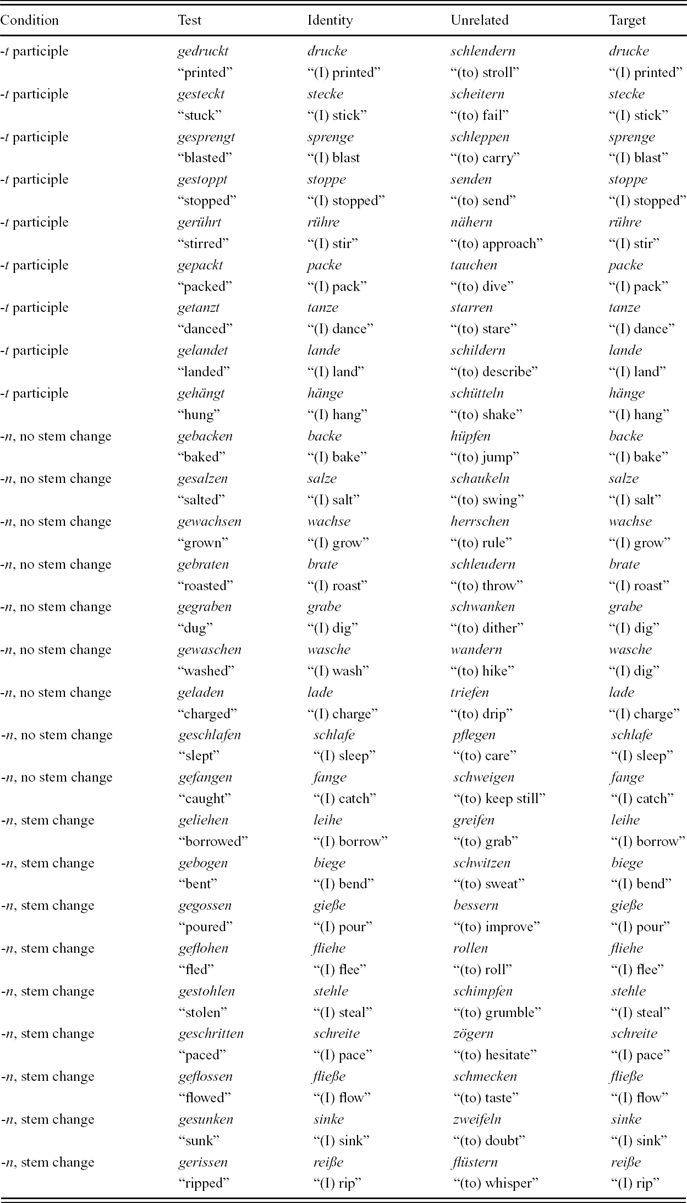
Twenty-seven experimental prime–target pairs were constructed, each of which consisted of a participle form as prime and a first person singular present-tense form of the same verb as the target word. There were three types of prime: nine -t participles without stem changes (e.g. gedruckt, inf.: drucken “to print”), nine -n participles without stem changes (e.g. geschlafen, inf.: schlafen “to sleep”), and nine -n participles with stem changes (e.g. gestohlen, inf.: stehlen “to steal”); see Appendix for a complete list of experimental prime–target pairs. Each experimental target word occurred in three different conditions, (a) “Test” condition, with one of the three participle forms as prime (e.g. gedruckt → drucke), (b) “Identity” condition, with the same verb form as prime and target (e.g. drucke → drucke), and (c) “Unrelated” condition, with a semantically and formally unrelated word as prime (e.g. schlendern – drucke).Footnote 1
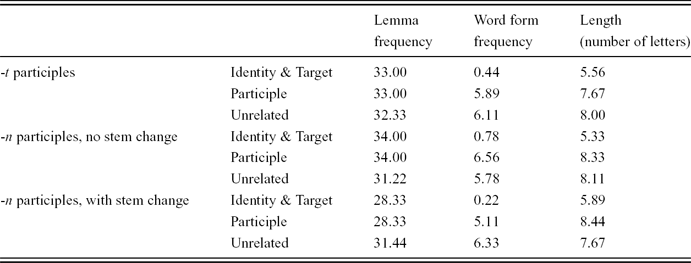
Prime words were presented aurally and target words visually, immediately at the offset of the prime word. The prime words used in the Unrelated condition were pairwise matched with the corresponding primes in the Test condition with regard to lemma and word form frequency, and with regard to length (in terms of number of letters) based on data from the CELEX corpus (Baayen, Piepenbrock & Gulikers, Reference Baayen, Piepenbrock and Gulikers1995). To allow comparisons between -t and -n participles (with and without stem changes), we also matched the three types of participles for mean lemma frequency, mean word form frequency, and mean number of letters; see Table 1. The critical items were also matched with respect to mean neighborhood size (-t: 11.8; -n with stem change: 11.0; -n without stem change: 12.3). Eighty-one filler prime–target pairs were also constructed. Filler items consisted of a variety of inflected forms of verbs, for example, bare stem forms, first person singular present-tense forms, infinitives, or participles.
Mean frequency and length of experimental items.

Note: Mean lemma and word form frequencies are per million words in the CELEX corpus (Baayen et al., Reference Baayen, Piepenbrock and Gulikers1995).
We constructed three counter-balanced lists, with each list containing the same number of experimental trials from each condition, and with exactly one of the three prime types (Identity, Test, Unrelated) of each experimental target word occurring in each list. Each list contained a total of eight short breaks, with blocks consisting of 12 items each. For each of the three lists, we created a reverse-order list, which was identical to the original list except for the fact that the order of items was reversed. In total, each presentation list contained 81 filler items and 27 experimental items, 18 of which were related (i.e., either “identity” or “test” items), the other nine were unrelated. Thus, each list contained 17% of related trials (18 out of 108 items). A practice session consisting of eight additional filler items was added at the beginning of each list. Each participant was tested on one of the six presentation lists with an equal number of participants from each of the two participant groups being assigned to each list.
Procedure, data analysis, scoring
The experiment was presented on a laptop computer with a 17-inch screen using the DMDX experiment software (Forster & Forster, Reference Forster and Forster2003). Auditory primes, spoken by a female native speaker of German, were recorded with the Audacity 1.3 recording software and presented through loudspeakers. Targets were shown visually in the middle of the computer screen, in font size 36 in white letters against a black background.
Participants were instructed to listen carefully to the prime, and to subsequently read the target word aloud as quickly as possible when it appeared on the computer screen. Each trial started with a fixation point in the middle of the screen, which was shown for 800 ms and indicated the position where the target word would appear. The fixation point was followed by an auditory attention tone, which was presented for 200 ms and indicated the beginning of a trial. Immediately following the attention tone, the prime word was presented. At the offset of the prime, the target word appeared on screen. After the participant had produced the target, the experimenter pressed a button to initiate the next trial. To encourage participants to listen carefully to the primes, 10 randomly-distributed filler trials were followed by a question, asking participants to repeat the prime word after they had produced the target word. The session was recorded using Audacity 1.3. After the experiment, the .wav files were processed with the PRAAT sound file editor to calculate response latencies for all experimental targets.
Participants were tested in a quiet room. They filled out a short biographic questionnaire before the experiment, and the Goethe Institute Placement Test after it. Before the main cross-modal priming experiment, participants were given detailed instructions about the task. The experiment started with the practice session, after which participants had the opportunity to ask questions about the procedure. Each experimental session (including placement test and instructions) took approximately 20 minutes for the L1 and 35 minutes for the L2 participants.
The dependent measure was participants’ response latencies calculated from the offset of the prime word to the onset of their spoken response. To measure these latencies we used an automatic pause detection script in PRAAT which records pause boundaries (< 45 Hz) onto the audio files; these were subsequently double-checked by two transcribers. Prior to the calculation of response latencies, incorrect responses, e.g. forms of a different lexeme, forms other than the targeted inflected verb forms, and trials containing vocal hesitations such as um or uh, were excluded from any further analysis; this affected 0.7 % of all trials from the L1 group and 1.0 % of all trials from the L2 group. We also excluded extreme response latencies that were 2.5 standard deviations shorter or longer than the participant group's mean, affecting a further 1.5 % of all trials from the L1 group and 2.5% from the L2 group.
The response latency data were submitted to Analyses of Variance (ANOVA) with the factors “Participle Type” (-t, -n without stem change, -n with stem change), “Prime Type” (Identity, Test, Unrelated), and “Group” (L1, L2), followed by planned comparisons if appropriate. To examine the role of the two participle endings and the role of stem changes independently of each other, we conducted two separate analyses, one comparing -t and -n participles (both of which without stem change), and one comparing participles with and without stem changes (both of which -n forms). For each comparison, we conducted two 3 (Prime Type) × 2 (Participle Type) × 2 (Group) mixed ANOVAs, one by subjects, one by items. We also included presentation list as a factor to account for possible error variance based on list (Pollatsek & Well, Reference Pollatsek and Well1995), but did not analyze this factor. Whilst mean response latencies are shown, statistical analyses were performed on the log-transformed data. The p-values of all analyses were Greenhouse-Geisser corrected for non-sphericity whenever applicable.
Results
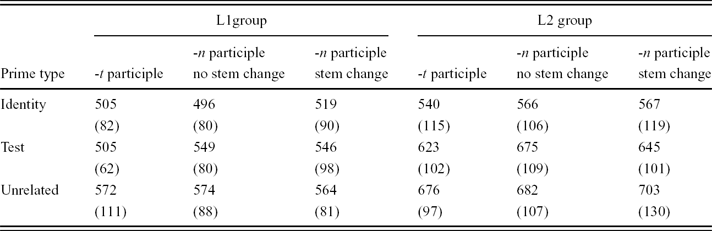
Table 2 presents mean response latencies (as well as standard deviations) to the target for the three types of participle prime words in the two participant groups.
Mean response latencies (and standard deviations) in ms for the L1 and L2 groups.
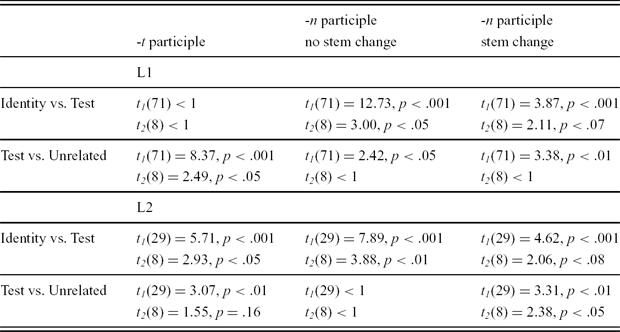
With respect to the comparison between “-t participles” and “-n participles without stem change”, the ANOVAs showed significant interactions of Prime Type by Group (F1(2,192) = 21.74, p < .001; F2(2,24) = 8.42, p < .01) and of Prime Type by Participle Type, the latter for subjects only (F1(2,192) = 8.33, p < .001; F2(2,24) = 1.30, p = .29). In addition, there were significant main effects of Prime Type (F1(2,192) = 197.37, p < .001; F2(2,24) = 22.30, p < .001), Group (F1(1,96) = 26.10, p < .001; F2(1,12) = 82.51, p < .001), and of Participle Type (F1(1,96) = 26.24, p < .001; F2(1,12) = 1.28, p = .28), the latter again for subjects only. For the comparison between “-n participles without stem change” and “-n participles with stem change”, the ANOVAs revealed a significant two-way-interaction of Prime Type and Group (F1(2,192) = 14.77, p < .001; F2(2,24) = 6.57, p < .01) and of Prime Type and Participle Type (F1(2,192) = 3.59, p < .05; F2 < 1), the latter significant by subjects, but not by items. Furthermore there were significant main effects of Prime Type (F1(2,192) = 166.30, p < .001; F2(2,24) = 35.44, p < .001) and of Group (F1(1,96) = 26.97, p < .001; F2(1,12) = 86.38, p < .001). These main effects and interactions indicate performance differences between the L2 group and the L1 control group, which were further examined in planned comparisons using two-tailed paired t-tests shown in Table 3.
Planned comparisons of mean response latencies.
As seen in Table 3, the L1 group showed a full priming effect for -t participles, i.e., significantly shorter target response latencies after participle primes than after unrelated prime words, and no difference between identity and participle primes, while the L2 group showed a partial priming effect for -t participles, i.e., shorter latencies for participle primes than for unrelated primes (in the by-subjects analysis only) but significantly longer ones than for identity primes for both subjects and items. For -n participles without stem change, the L1 group showed a partial priming effect, i.e., significantly shorter response latencies for participles than for unrelated prime words, but longer target latencies after participle than after identity prime words (with the latter differences only significant in the by-subjects analyses), while the L2 group did not show any reliable participle priming effect, with a significant difference between identity and participle primes, but no significant difference between participle and unrelated prime words. Finally, for -n participles with stem changes, both the L1 and the L2 groups produced a partial priming effect, both in the subjects and the items analyses, again with shorter latencies for participle than for unrelated primes (in the by-subjects analysis only), but longer ones than for identity primes. These results indicate that the priming patterns in the L1 group are determined by the type of participle ending, with -t and ‑n participles producing different priming patterns irrespective of stem changes, whereas -t participles and -n participles with stem changes produced similar priming effects in the L2.
We also calculated magnitudes of priming for the different participle types in the two participant groups and compared the differences between target response latencies after participle and after unrelated primes using Cohen's d effect size scores. While the L1 group showed a large priming effect (d = 0.75) for -t participles, the corresponding effect size in the L2 group was considerably smaller (d = 0.54). For -n participles, by contrast, the L1 group had small priming effects of similar size, both for those with stem changes (d = 0.21) and without stem changes (d = 0.31). The L2 group, however, showed a priming effect for -n participles with stem changes, with a similar effect size (d = 0.51) as for -t participles, and no priming effect for -n participles without stem changes. These comparisons are again indicative of different priming patterns in the two participant groups. Whilst in the L1 group the magnitudes of priming from a participle form are largely determined by the type of affix, with -t producing large and -n small effects, in the L2 group an allomorphic stem in a participle form increases the magnitude of prime as much as a -t participle form.
Finally, we note that the number of participants in the two groups as well as their mean ages were different, L1 (n = 72, mean age: 37.65), L2 (n = 30, mean age: 27.2).Footnote 2 Could these differences be responsible for the different priming patterns in the two participant groups? To address this question, we performed an additional analysis on an otherwise randomly selected subset of participants from the original L1 group which was matched to the L2 group with regard to number of participants, mean age, and standard deviation for age. This analysis revealed almost identical means and standard deviations of response latencies for the age-matched L1 subset of 30 participants as for the original L1 group of 72 participants, with differences of between 1 and 8 ms. We conclude that the priming patterns obtained for the L1 group can be replicated for a sample of L1 participants that was closely matched on age and number of participants to the L2 group.
Discussion
The results from the present study revealed cross-modal priming patterns for late bilinguals that were different from those of German native speakers. The L1 group showed full priming for -t participles and partial priming for -n participles. The L2 group had partial priming for both -t participles as well as for -n participles with stem changes, and no priming for -n participles without stem changes. Our results for the L1 group replicate those of Sonnenstuhl, Eisenbeiss and Clahsen's (Reference Sonnenstuhl, Eisenbeiss and Clahsen1999) cross-modal experiment and those of Neubauer and Clahsen's (Reference Neubauer and Clahsen2010) masked priming study, both of which also reported full priming for -t participles and reduced priming for -n participles without stem changes. The new finding from the current study regarding L1 processing of German participles is that affix type (-t vs. -n) determines priming patterns and that the presence or absence of stem changes has no measurable effect.
Previous cross-modal experiments with late bilinguals (Basnight-Brown et al., Reference Basnight-Brown, Chen, Hua, Kostić and Feldman2007; Feldman et al., Reference Feldman, Kostić, Basnight-Brown, Filipović Durdević and Pastizzo2010) examined the English past tense, which – unlike in German – does not offer the possibility to systematically disentangle effects of regular vs. irregular affixes from effects of stem change vs. no stem change. In addition, Basnight-Brown et al. (Reference Basnight-Brown, Chen, Hua, Kostić and Feldman2007) and Feldman et al. (Reference Feldman, Kostić, Basnight-Brown, Filipović Durdević and Pastizzo2010) did not include an identity condition. Hence we can only compare a subset of the current findings from the L2 group to those of previous cross-modal priming studies, namely magnitudes of priming for regular vs. irregular forms, i.e., differences between the morphological and the unrelated condition for -t participles and -n participles with stem changes. The L2 group we examined showed similar magnitudes of priming for these forms, which is indeed parallel to what Basnight-Brown et al. (Reference Basnight-Brown, Chen, Hua, Kostić and Feldman2007) and Feldman et al. (Reference Feldman, Kostić, Basnight-Brown, Filipović Durdević and Pastizzo2010) reported for regular and irregular past-tense forms in English. It should be clear from our findings, however, that the comparison of inflected forms with stem allomorphy to those without stem allomorphy and the exclusion of the identity condition provides an incomplete and misleading picture of the priming patterns in late bilinguals relative to those in native speakers.
To explain the different priming patterns in the two participant groups, consider first possible non-morphological sources. According to Gonnerman, Seidenberg and Andersen (Reference Gonnerman, Seidenberg and Andersen2007), morphological priming effects are due to the convergence of shared meaning and shared surface form. If this account applied to priming from German participle forms, we should have found similar amounts of facilitation for -t and -n participles without stem changes and less priming for -n participles with stem changes than for those without stem changes. Our results disconfirm these predictions for both participant groups. We therefore conclude that morphological facilitation cannot be explained in terms of the convergence of semantic and orthographic/phonological codes, neither for L1 native speakers nor for late bilinguals.Footnote 3
To account for the observed priming patterns in morphological terms, recall that we assume full priming to signify a stem-repetition priming effect and partial priming to indicate a shared lexical entry for the prime and the target word form. Full priming was only found in the L1 group and only for -t participles, suggesting that these forms are morphologically decomposed into stems and affixes during L1 processing, by which the base stem directly primes the base stem of the target word. Partial priming was found for both native speakers, in the case of -n participles, and for late bilinguals for both -t and -n participles, indicating overlapping lexical entries for the prime and the target word. This applies to prime–target pairs such as gesunken – sinke “sunk – (I) sink” in which the participle form constitutes a subentry of the base entry (Wunderlich & Fabri, Reference Wunderlich and Fabri1995). Hence, recognition of gesunken indirectly activates the stem sink, which then facilitates the recognition of the corresponding stem of the target word yielding a partial priming effect.
The main between-group difference from the present experiment is that unlike the L1 group, late bilinguals did not show a full stem-priming effect for any condition. This finding replicates results from previous masked priming experiments which obtained stem priming in L1 native speakers (Neubauer & Clahsen, Reference Neubauer and Clahsen2009; Silva & Clahsen, Reference Silva and Clahsen2008), but not for late learners. Indeed, none of the available priming studies, including the two earlier cross-modal studies on English (Basnight-Brown et al., Reference Basnight-Brown, Chen, Hua, Kostić and Feldman2007; Feldman et al., Reference Feldman, Kostić, Basnight-Brown, Filipović Durdević and Pastizzo2010), demonstrated a full stem-priming effect for inflected word forms in late bilinguals. We interpret this finding as an indication that the comprehension system in a late-learned L2 relies less on morphologically structured representations than the L1 system.
Partial priming effects, on the other hand, were found for both the L1 and the L2 groups, consistent with the results of previous studies. For -n participles with stem changes, late bilinguals showed a native-like partial priming pattern. In contrast to the L1 group, however, they also had a partial priming effect of the same magnitude for -t participles, suggesting parallel lexical representations for -t and -n participles in the L2 mental lexicon. Thus, unlike for German native speakers, late bilinguals seem to store a regular -t participle form such as gekauft “bought” in the same way as an irregular form such as gesunken, namely as a subentry of the main lexical entry. This accounts for why both kinds of participle produced the same partial priming effect in the L2 but distinct priming patterns in the L1.
One final comment concerns the results for -n participle primes without stem changes, e.g. geschlafen – schlafe “slept – (I) sleep”. If -n participles have their own (sub)entries in the mental lexicon, they should yield partial priming effects irrespective of whether or not they contain stem changes. This was indeed the case for the L1 group. The L2 group, however, did not show any priming for participles such as geschlafen. This is an unexpected result in the face of the priming effects that the same participants demonstrated for both -n participles with stem changes (e.g. gesunken) and for -t participles without stem changes (e.g. gekauft). It is of course difficult to determine why an expected priming effect was not obtained, and we can only speculate about possible reasons. One linguistic property, however, that clearly distinguishes -n participles without stem changes from the two other types is that participle forms such as geschlafen (without the prosodically induced ge-) are identical to their corresponding infinitive form (schlafen “to sleep”). Note that this does not hold for cases such as gesunken or gekauft which have clearly distinct infinitive forms (sinken “to sink”, kaufen “to buy”). It is conceivable that infinitives are highly prominent for late learners, due to the fact that the infinitive is the citation form of any verb in German and that at least in classroom contexts, new verbs are typically learned in their infinitive form. Thus, it could be that a word form such as geschlafen not only activates a distinct participle entry (as for gesunken and gekauft) but also co-activates the corresponding infinitive form. It has been proposed (Marslen-Wilson et al., Reference Marslen-Wilson, Tyler, Waksler and Older1994, pp. 18f.) that the lexical representations of suffixed forms such as government and governor that share the same stem include inhibitory links, due to the fact that these forms are distinct lexical items that compete for the same lexical region during word recognition. This may also be the case for word forms such as geschlafen and schlafen in the L2 mental lexicon. Consequently, co-activation of these two forms may lead to competition during recognition precluding any measurable priming effect on the target word. Further study is required to properly examine this possibility.
Experimental prime–target pairs
We conclude from the present study that in contrast to claims made in the literature (e.g. Feldman et al., Reference Feldman, Kostić, Basnight-Brown, Filipović Durdević and Pastizzo2010; Gonnerman et al., Reference Gonnerman, Seidenberg and Andersen2007), priming from inflected word forms is indeed morphological in nature and that non-morphological notions such as “shared surface form” and/or “shared semantics” are insufficient to explain the reported priming effects, neither in the L1 nor for late bilinguals. With regard to processing a late-learned L2, the current findings provide further support for the view that non-native processing relies less on grammatical analysis and more on lexical representations than L1 processing (Clahsen & Felser, Reference Clahsen and Felser2006).