Introduction
What will encourage the transition of more US farms to organic farming? Answering that question is of interest to farmers, food businesses, consumers and others who value the perceived environmental, economic and health outcomes related to organic production systems.
This paper presents the results of a national survey of farmers related to the transition to organic certification. We examine what motivates farmers to transition to organic certification and what obstacles they encounter during the process of transition. Our survey population included farmers in the midst of the transition process (Transitioning) and farmers who began the transition process but decided not to pursue organic farming (Not Pursuing), allowing us to compare each group to farmers who successfully transitioned to certified organic (Certified). Farmers do not control all of the factors that influence their success in achieving organic certification. To address this, we used a ‘spheres of influence’ framework to analyze obstacles at four levels: the farm, local and regional infrastructure, the marketplace and policy. This analysis improves our understanding of how farmer success in the transition process depends on support from a wide range of stakeholders and service providers, through crop research, infrastructure development, market development and policy. The paper concludes with a set of recommendations based on study findings and informed by the co-authors' perspectives as leaders of an international organic certification service provider engaged in policy and US university faculty engaged in organic research, education and outreach.
Consumer demand for organic food and farm products has experienced continuous annual sales growth in recent years to over $55 billion for all products in 2019 (Organic Trade Association, 2020). However, even with farmgate sales increasing by 31% since 2016 to nearly $10 billion (USDA NASS, 2020), supply is not growing as quickly. This slow growth is noted by the United States Department of Agriculture (USDA) and university researchers (Dimitri and Oberholtzer, Reference Dimitri and Oberholtzer2009; Greene et al., Reference Greene, Dimitri, Biing-Hwan, McBride, Oberholtzer and Smith2009; Greene, Reference Greene2013; McBride and Greene, Reference McBride and Greene2015), non-government organizations (Jerkins and Ory, Reference Jerkins and Ory2016; Reaves et al., Reference Reaves, Healy and Beach2019) and the farm credit sector (CoBank, 2017).
There have been a variety of responses to mitigate the shortfall. Some organic food manufacturers are providing direct support to farmers to increase supply (Dimitri and Baron, Reference Dimitri and Baron2020). Some organic certifiers, such as Oregon Tilth, Inc., provide information and support for transitioning farmers. University researchers are examining the needs of farmers who choose to transition to organic in order to identify where support is needed (Stephenson et al., Reference Stephenson, Gwin, Garrett and Powell2012; DiGiacomo and King, Reference DiGiacomo and King2015). The USDA's Natural Resources Conservation Service (USDA-NRCS), through its Environmental Quality Incentives Program (EQIP) Organic Initiative (OI) provides financial and technical assistance to certified, transitioning and exempt farmers to support conservation on their land (USDA NRCS, n.d.).
One approach to increasing the number of certified organic farms is to understand what does or does not motivate individual farmers to transition to organic certification, and what obstacles they encounter during the process. This knowledge can inform outreach efforts, applied research, market development and policy supporting farmer success.
Several studies have noted that farmers may be motivated to transition to organic certification for reasons related to economics or personal values from pragmatic to idealistic (Darnhofer et al., Reference Darnhofer, Schneeberger and Freyer2005; Best, Reference Best2008; Stofferahn, Reference Stofferahn2009; Cranfield et al., Reference Cranfield, Henson and Holliday2010). Obstacles to organic transition may be related to economics (Strochlic and Sierra, Reference Strochlic and Sierra2007; Cranfield et al., Reference Cranfield, Henson and Holliday2010; Sahm et al., Reference Sahm, Sanders, Nieberg, Behrens, Kuhnert, Strohm and Hamm2013), production (Strochlic and Sierra, Reference Strochlic and Sierra2007; Lau et al., Reference Lau, Hanagriff, Constance, York, VanDelist and Higgins2010; Lloyd and Stephenson, Reference Lloyd and Stephenson2020), markets and infrastructure (Strochlic and Sierra, Reference Strochlic and Sierra2007; Lau et al., Reference Lau, Hanagriff, Constance, York, VanDelist and Higgins2010), social factors (Cranfield et al., Reference Cranfield, Henson and Holliday2010; Koesling et al., Reference Koesling, Loes, Flaten, Kristensen and Hansen2012; Home et al., Reference Home, Indermuehle, Tschanz, Ries and Stolze2019) and public policy (Cranfield et al., Reference Cranfield, Henson and Holliday2010; Stephenson et al., Reference Stephenson, Gwin, Garrett and Powell2012).
In addition, some farmers shift their view of organic farming during transition or after certification. Researchers have examined why some farmers begin but do not complete transition or later ‘decertify’. For instance, one national study noted that farmers most likely to decertify were those that produced vegetables, perceived the organic certification process as a barrier or were located in the US Midwest (Torres and Marshall, Reference Torres and Marshall2018). For an extensive review, see Sahm et al. (Reference Sahm, Sanders, Nieberg, Behrens, Kuhnert, Strohm and Hamm2013).
Our analysis of obstacles to transition goes beyond identifying the obstacles themselves and also identifies where action or change needs to happen to address the obstacles. We adapted concepts from the decision support systems literature (e.g., Doorman, Reference Doorman1991; Jakku and Thorburn, Reference Jakku and Thorburn2010) to organize the obstacles to transition in a manner that, first, indicates where in the system the obstacles reside and, second, indicates what work is needed and potentially by whom (farmers, researchers, non-government organizations, etc.). To understand a farmer's sphere of decision making, Doorman (Reference Doorman1991) identifies three factors: personal, situational and external. Personal refers to traits of individual farmers (values, skills, etc.). Situational refers to the interaction between the farmer and the immediate environment (the farm) that can be manipulated by the farmer (on-farm cultural practices). External refers to elements that are outside the sphere of influence of the farmer and cannot easily be manipulated by an individual farmer (government policy, regional food system infrastructure, etc.).
Methods
The USDA EQIP-OI program provided the survey population for this paper. As noted above, the EQIP-OI program is a voluntary conservation program that provides technical and financial assistance for organic farmers and ranchers, or those interested in transitioning to organic. Three categories of farms are eligible for the program: currently certified organic, exempt from certification (producers who are selling less than $5000 a year in organic agricultural products) and transitioning to organic (producers who are in the process of transitioning or wish to transition to organic). Farmers participating in the program as transitioning to organic agree to develop and work toward implementing an Organic System Plan, as required by the National Organic Program.
We surveyed a national population of farmers who participated in the EQIP-OI program. The survey was conducted by Oregon Tilth, Inc. and the Oregon State University Center for Small Farms & Community Food Systems (OSU-CSF&CFS). The survey was sent to farmers who:
(1) Had an EQIP-OI contract over the 5-year period between 2010 (when EQIP-OI began) and 2015, and
(2) Self-identified in the ‘transitioning to organic’ category of participants in that program.
The EQIP-OI list, which USDA NRCS provided to Oregon Tilth, Inc., included 1829 farmers who met both of the conditions above. Since EQIP-OI contracts last less than the 5-year period from which the survey population was derived, some individuals on the list had already completed their contracts, while others were still active at the time of the survey. Because of this, the survey captures farmers still in the transition process, farmers who had successfully completed the process and were certified, and farmers who started the transition process but decided not to pursue organic farming.
We constructed our questionnaire after reviewing existing survey-based research on farmer motivations, barriers and other aspects of organic farming (Strochlic and Sierra, Reference Strochlic and Sierra2007; Stofferahn, Reference Stofferahn2009; Cranfield et al., Reference Cranfield, Henson and Holliday2010; Johnston, Reference Johnston2010; Lau et al., Reference Lau, Hanagriff, Constance, York, VanDelist and Higgins2010).
We designed our questionnaire to be brief in order to increase the response rate. As a consequence, data on some aspects of the population were not collected (e.g., state or region, race, ethnicity, income). The questionnaire included basic demographic questions and a series of questions to learn what motivated farmers to transition to organic certification and what obstacles they encountered during the transition process.
The survey was administered by Oregon Tilth, Inc., using both an online platform (Qualtrics) and paper questionnaires. Survey methods followed the protocols of Dillman and Smyth (Reference Dillman and Smyth2014) and guidance from the Oregon State University Survey Research Center (OSU-SRC). The survey was initiated on October 1, 2015, with an introductory letter followed by three follow-up and reminder letters (the first with an access code to an online questionnaire, the second and third with a paper copy of the questionnaire and a pre-paid business reply envelope). Survey data collection ended on March 1, 2016. The OSU-SRC collected and organized the data. Six hundred and fifteen (615) farmers completed the questionnaire for an adjusted response rate of 34.2% (based on the American Association for Public Opinion response rate calculator).
The OSU-CSF&CFS analyzed the data using IBM SPSS software, with consultation from OSU-SRC. The analysis utilized descriptive statistics including frequencies and cross-tabulations. The χ2 tests were used to compare responses among data categories and detect significant differences in the proportion of responses. We use an α level of 0.05 for statistical tests.
The survey questionnaire asked participants to select one of five categories for their farms (certified organic, transitioning to organic, not pursuing organic, split operations and exempt from certification). This paper examines three of the categories:
(1) Certified Organic (Certified): 165 farms had completed the transition process and were successfully certified at the time of the survey. These farms are utilized as a reference for comparison to the other two categories.
(2) Transitioning to Organic (Transitioning): 186 farms were in the midst of transition to organic certification at the time of the survey.
(3) Not Pursuing Organic (Not Pursuing): 101 farms were initially committed to the transition process but decided not to pursue organic farming at the time of the survey.
These three categories of farms form a subset of 452 of the 615 farms in the full sample. The two categories of farmers not included in the analysis for this paper are:
(1) Split Operations. 69 farms were part certified organic, part non-organic.
(2) Exempt from Organic Certification. 76 farms were exempt from the requirement for organic certification (less than $5000 gross annual organic sales).
Eighteen (18) of the 615 farms did not respond to this question and were not included in our analysis.
Results
We present our results in four sections: demographic profiles of the three farmer categories; farmer motivations for the full subset and by category; farmer-identified obstacles for the full subset and by category; and obstacles organized into spheres of influence.
Demographic profiles of farmer categories
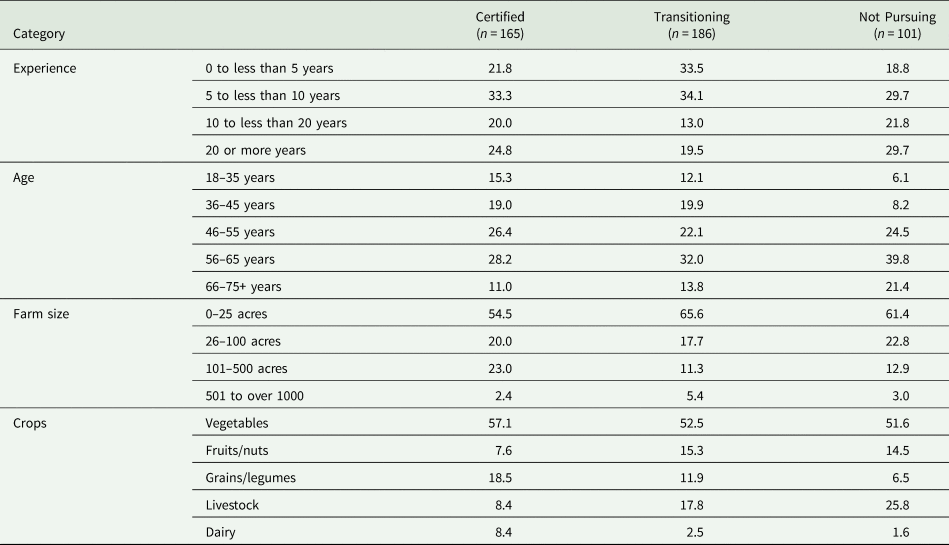
The questionnaire included five demographic questions: years farming, age, number of acres in production, cropping system and their organic certification status. This information offers a very basic glimpse of the farmer and the farm, and—based on their status regarding organic certification—assigns them to one of the three categories we are examining. Below is a profile of each category (Table 1).
Demographics of farmers—percent Certified, Transitioning and Not Pursuing

Certified organic (Certified)
The Certified category includes 165 respondents (37% of the subset). We profile this group because these farmers have successfully transitioned to organic farming. Since our focus is learning what will encourage more farmers to transition to organic, these farmers serve as a reference for comparison to the other two categories of farmers.
Farmers in the Certified category have a fairly even distribution of experience from less than 5 years to more than 20 years. More than half have less than 10 years of experience, but nearly 25% have 20 or more years' experience. About 34% of these farmers are 45 years old or younger, and nearly 40% are over 55 years old.
The majority of Certified farmers are farming 25 or fewer acres. However, mid-scale farms are well represented with more than 25% of farms over 100 acres. Over 50% of Certified farmers produce vegetables, and nearly two-thirds produce intensive crops (vegetables, fruits, nuts). This category still includes crop diversity, with over 35% of the farmers operating more extensive cropping systems (grains/legumes, livestock, dairy).
Transitioning to organic (Transitioning)
The Transitioning category includes 186 respondents (41% of the subset). This category is of particular interest because they were in the midst of their 3-year transition to organic certification at the time of the survey and offer an important perspective.
Transitioning farmers have less experience than Certified farmers with fully two-thirds classified as beginning farmers and ranchers as defined by USDA (10 or fewer years of experience), and half of those (34%) with fewer than 5 years of experience. Transitioning farmers are similar to Certified farmers in age: 32% are 45 years or younger, and 46% are more than 55 years old.
The Transitioning category includes a high percentage, nearly 66%, of smaller farms (less than 25 acres). Still, nearly 17% of the farms are 101 to over 1000 acres. Over half of Transitioning farms produce vegetables, but other crops (fruits and nuts, grains and legumes, livestock, dairy) are represented.
Not pursuing organic farming (Not Pursuing)
The Not Pursuing category includes 101 respondents (22% of the subset). This group of farmers is of interest because they considered organic farming and agreed to a plan to transition their farms to organic under their EQIP-OI contract but then decided not to pursue it. Their survey responses therefore provide an important perspective regarding the obstacles to organic certification, potentially suggesting how to improve the experience for other farmers.
This category includes primarily experienced farmers: more than half have more than 10 years of experience, and nearly a third have more than 20 years. These farmers tend to be older than farmers in the other two categories: only 14% are under 45 years old, and more than 60% are over 55 years old. These farms are also small with over 60% less than 25 acres and only 15% larger than 100 acres. The most common crops are vegetables (52%) and livestock (25%).
Motivations to transition to organic
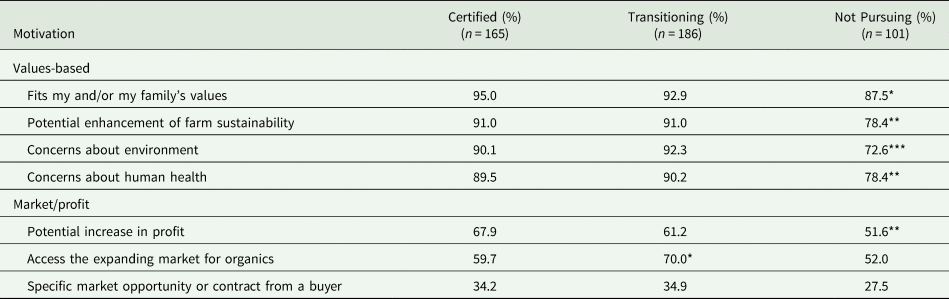
We asked respondents what initially motivated them to transition to organic farming, providing a list of possible motivations including ‘values-based’ motivations and ‘market or profit’ motivations. Table 2 shows the percentage of respondents who selected each value, for each of the three categories.
Motivations of farmers to adopt organic farming comparing Transitioning and Not Pursuing farmers to Certified farmers

Note: Statistical comparisons are between Certified and Transitioning, and Certified and Not Pursuing.
*P < 0.05, **P < 0.01, ***P < 0.001.
Certified farmers have a high level of commitment to some of the values-based foundations of the organic farming movement such as enhancement of farm sustainability, and concerns about the environment and human health. They are also pragmatic, rating ‘potential increase in profit’ high on the list of market or profit values.
Transitioning farmers are similar to Certified farmers in their values-based motivations. They are also significantly more motivated than Certified farmers by ‘access to the expanding market for organics’ (70.8 vs 59.7%).
Not Pursuing farmers show significant differences from Certified farmers. As with the other two farmer categories, Not Pursuing farmers rank values-based motivations higher than market and profit motivations. However, Not Pursuing farmers are significantly different from Certified farmers in terms of the percentage of farmers motivated by each factor. Compared to Certified farmers, Not Pursuing farmers were less motivated by all the factors and significantly less motivated by five of the seven factors: the four values-based motivations and a ‘potential increase in profit’. Although this may not seem surprising, this is an important finding for organizations that support farmer transition to organic certification in designing their programs.
Obstacles to organic transition
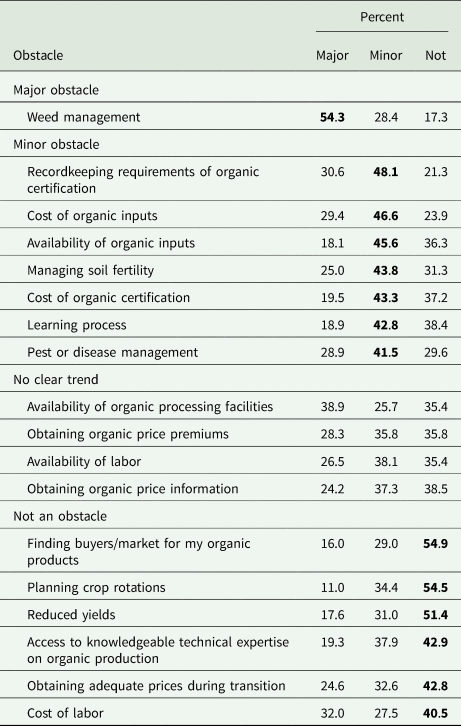
The questionnaire offered a list of 18 potential obstacles to organic transition related to costs, production and marketing. Farmers were asked to rate each as a major obstacle, a minor obstacle or not an obstacle. For simplicity, in Tables 3 and 4, we categorize each obstacle as being major, minor or not an obstacle based on the highest percent response of 40% or more, representing a strong plurality. When the response in all categories is below 40%, we identify the obstacle as having ‘no clear trend’. This simple approach does not capture the subtleties of the responses. For instance, obstacles identified as ‘not an obstacle’ were still typically identified as major or minor by some farmers.
Obstacles to organic farming for Certified farmers

Note: Percentages in Bold represent the trend based on 40% or greater response.
The obstacles are arranged vertically by type of obstacle—major, minor, no clear trend and not an obstacle—and horizontally by percent response of farmers.
Obstacles to organic farming for Transitioning compared to Certified farmers

Note: Percentages in Bold represent the trend based on 40% or greater response.
The obstacles are arranged vertically by type of obstacle—major, minor, no clear trend and not an obstacle—for Transitioning farmers and horizontally for comparison to Certified farmers.
*P < 0.05, **P < 0.01, ***P < 0.001.
Obstacles to organic transition for Certified farmers are presented in Table 3. The obstacles are arranged vertically by importance of obstacle—major, minor, no clear trend and not an obstacle—and horizontally by percent of response from the farmers. For Certified farmers, only weed management qualified as a major obstacle. These farmers identified seven minor obstacles: the top three are recordkeeping requirements of organic certification, the cost of organic inputs and the availability of organic inputs. Six obstacles are identified as ‘not an obstacle’ and include finding buyers for my organic products, planning crop rotations and reduced yields, among others.
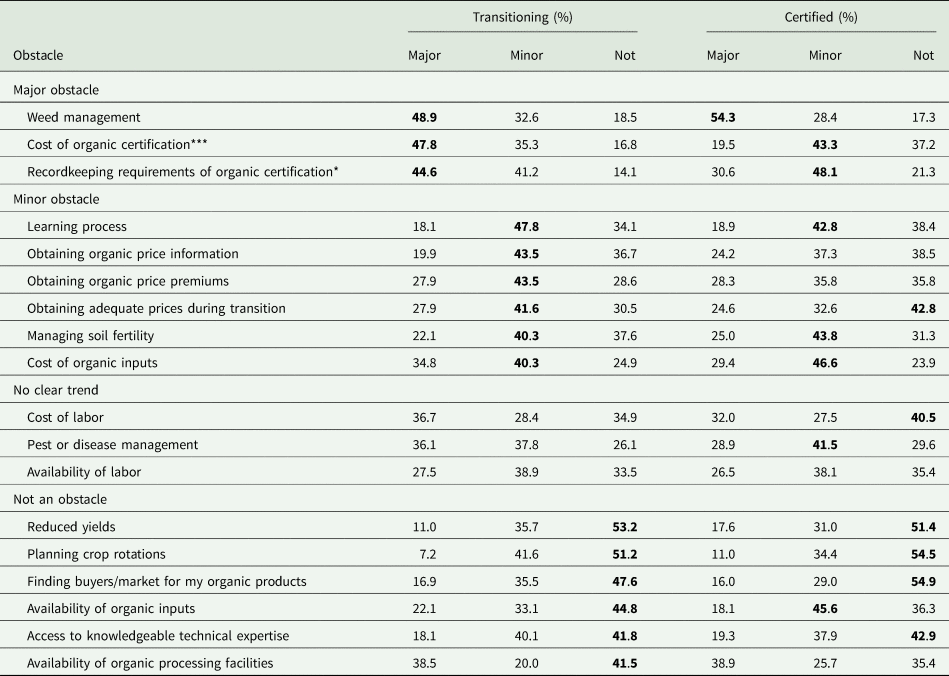
Table 4 shows how Transitioning farmers compared with Certified farmers in how they rated obstacles. The obstacles are arranged vertically by importance of the obstacle for Transitioning farmers and compared horizontally to the Certified farmers' responses for the same obstacles. The two groups are similar in their view of obstacles with some exceptions. They strongly agree on weed management as a major obstacle, but Transitioning farmers also rate the cost of organic certification and the recordkeeping requirements of organic certification as major obstacles while Certified farmers rate them as minor. These are significant differences.
Transitioning farmers identify six obstacles as minor, and Certified farmers agree on three: learning process, managing soil fertility and the cost of organic inputs. One notable difference is that Transitioning farmers identify obtaining adequate prices during transition as a minor obstacle, while Certified farmers rate it as not an obstacle. Clearly, this is an issue while in transition but not after certification.
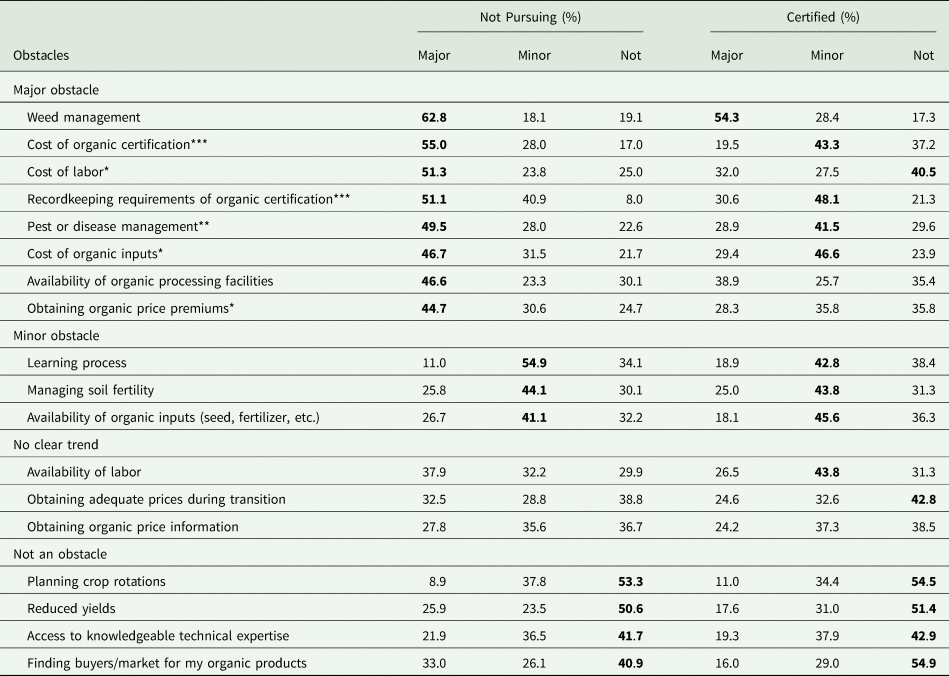
Table 5 shows how Not Pursuing farmers compared with Certified farmers in how they rated obstacles. As in Table 4, the obstacles are arranged vertically by importance of the obstacle for Not Pursuing farmers and compared horizontally to the Certified farmers' responses for the same obstacles. The reasons the Not Pursuing group of farmers decided not to pursue organic farming become clearer when we examine their perception of obstacles. They identified eight of the 18 obstacles as major. In contrast, Certified farmers identified only one major obstacle.
Obstacles to organic farming for Not Pursuing compared to Certified farmers

Note: Percentages in Bold represent the trend based on 40% or greater response.
The obstacles are arranged vertically by type of obstacle—major, minor, no clear trend and not an obstacle—for Not Pursuing farmers and horizontally for comparison to Certified farmers.
*P < 0.05, **P < 0.01, ***P < 0.001.
The top major obstacles for Not Pursuing farmers include weed management, the cost of organic certification, the cost of labor, recordkeeping requirements of organic certification, pest or disease management, the cost of organic inputs, availability of organic processing facilities and obtaining organic price premiums—a very long list.
The two groups differ significantly on the importance of six obstacles: the cost of organic certification, the cost of labor, the cost of organic inputs, recordkeeping requirements of organic certification, pest or disease control, and obtaining organic price premiums. Not Pursuing farms identified these obstacles as major while Certified farms identified the obstacles as minor, no clear trend or not an obstacle.
Assessing obstacles by sphere of influence
We sorted the 18 obstacles into spheres of influence that are internal (farm-level) or external (local/regional levels and national/international levels). The spheres are farm-level obstacles, infrastructure obstacles, marketplace obstacles and policy/administrative obstacles. The farmer has the most influence over farm-level obstacles and less influence over local/regional and national/international obstacles.
Farm-level obstacles are internal and focus on farmer learning and farm production management. They involve the interaction between farmers and their immediate environment:
(1) Weed management
(2) Pest or disease management
(3) Managing soil fertility
(4) Reduced yields
(5) Planning crop rotations
(6) Learning process
Local and regional infrastructure obstacles are external to the farm (unless the farm creates needed infrastructure internally) but directly influence the farm's ability to produce and market crops or products:
(1) Availability of organic inputs
(2) Cost of organic inputs
(3) Availability of labor
(4) Cost of labor
(5) Availability of organic processing facilities
(6) Availability of technical expertise
Marketplace obstacles are external to the farm and may be local, national or international:
(1) Finding buyers for organic products
(2) Obtaining organic price premiums
(3) Obtaining adequate prices during transition
(4) Obtaining organic price information
Administrative/policy obstacles on our list primarily relate to the requirements of the USDA National Organic Program in terms of cost and complexity:
-
Cost of organic certification
-
Recordkeeping requirements of organic certification
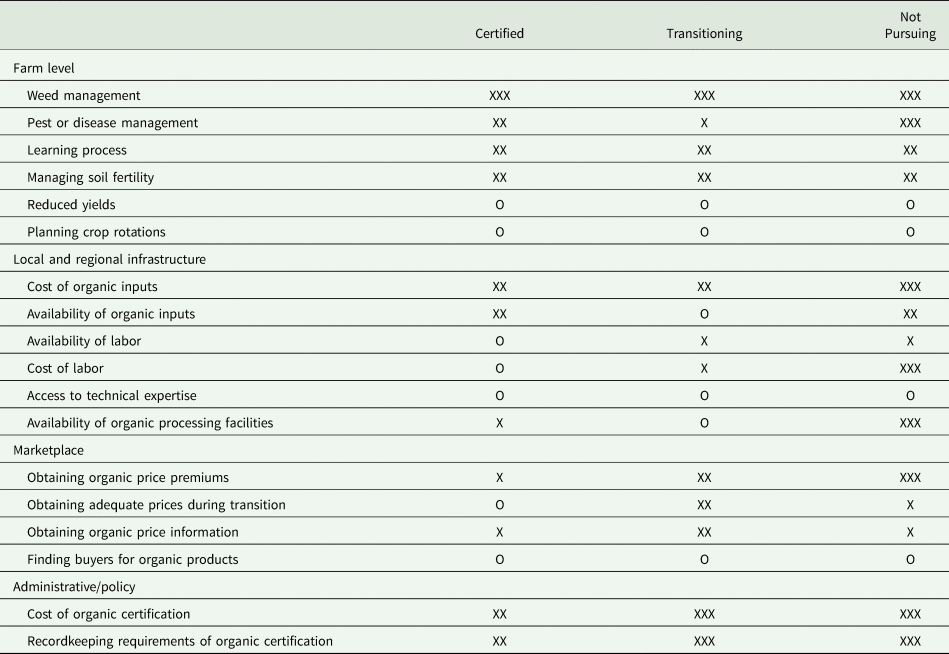
With these spheres in mind, we took a fresh look at how each of the three categories of farmers rated obstacles. Table 6 shows the importance of each obstacle (major, minor, not an obstacle) for each farmer category, organized vertically by sphere of influence. ‘XXX’ indicates major obstacles, ‘XX’ represents minor obstacles, ‘X’ represents no clear trend and ‘O’ represents not an obstacle. Obstacles with ‘no clear trend’ or ‘not an obstacle’ are still important to consider, because they are often major or minor obstacles for a segment of farmers.
Obstacles to organic farming by sphere of influence and Certified, Transitioning or Not Pursuing organic farming

Note: Major obstacle: XXX; minor obstacle: XX; no clear tread: X; not an obstacle: O.
When we examine obstacles by sphere of influence, we see that seven of the 18 are identified as major by at least one category of farmers. Two are at the farm-level, and the other five are beyond the farmer's direct influence. Ten of the 18 are identified as minor by at least one category of farmers. Three of these are at the farm-level, and the other seven are beyond the farmer's direct influence. Most of the obstacles identified by the farmers are beyond the farmers' direct influence. This indicates a need for research, education and action at multiple levels. That is, increasing the number of farmers willing and able to transition to organic certification requires not only farm-level research and education but also the development of regional infrastructure and shifts in state or national policy. A holistic approach supports organic farmers and expands opportunities for organic food businesses enhancing the organic food and agriculture marketplace.
Discussion and recommendations
The farms and farmers represented in this study cover a range of farm sizes, crop types, farming experience, age and status of organic certification. The three groups of farmers—Certified, Transitioning and Not Pursuing—are dominated by smaller scale farms that primarily grow vegetables, and, with the partial exception of Not Pursuing farmers, often operated by farmers with less than 10 years of experience. The dominance of this ‘typical’ respondent influences many of our results.
The farmers were participants in the NRCS EQIP-OI/Transition program. Due to USDA policies on participant privacy, we do not know whether our sample represents all farmers who participated in EQIP-OI. Also, based on the USDA's past and continued discrimination against African-American and other farmers of color in its programs (Carpenter, Reference Carpenter2012), we suspect farmers of color are underrepresented in the EQIP-OI program and therefore in our survey population. We would not expect the farmers who participated in our survey to represent the general organic farmer population collected by USDA NASS through the Census of Agriculture or special organic surveys. Those data often do not include transitioning farmers, and do not include farmers who began transition but decided not to pursue organic farming.
Our study offers contributions in three important areas. We have a clearer picture of the motivations of and the obstacles encountered by farmers in the midst of transition and farmers who started the transition process but changed their minds. In addition, using a spheres of influence framework offers a more nuanced view of obstacles in the organic system from the farm to policy, discussed more below.
In general, Transitioning farmers were similar to Certified farmers in being motivated by the values-based foundations of organic farming as well as how they perceived obstacles. Not Pursuing farmers were generally less motivated than Certified farmers by most factors, both values- and market-based. There were often clear differences in the perceptions of obstacles between Certified and Not Pursuing farmers. Embracing the values-based foundations of organic farming is an important component of successfully transitioning to organic certification.
Other studies have identified similar farmer motivations and obstacles to organic transition and some differences. For instance, Texas producers interested in transitioning to organic ranked high input costs, and organic processing facilities as the most ‘severe’ production barriers (Lau et al., Reference Lau, Hanagriff, Constance, York, VanDelist and Higgins2010). Cost of organic inputs was rated as a minor or major obstacle by all farmers in this paper but access to organic processing facilities was rated as an obstacle only by Not Pursuing farmers.
The financial risk of the transition period was noted as a major obstacle to organic certification by mid-western grain growers (Reaves et al., Reference Reaves, Healy and Beach2019). This is similar to ‘obtaining adequate prices during transition’ noted as a minor obstacle by Transitioning farmers in this paper.
California farmers who ‘decertified’ listed a number of obstacles but overwhelmingly cited access to markets and the ability to obtain organic price premiums as the main obstacles they faced (Strochlic and Sierra, Reference Strochlic and Sierra2007). Obtaining organic price premiums was ranked as a minor or major obstacle by Transitioning and Not Pursuing farmers in this paper but finding buyers for organic products was not considered an obstacle by any of the farmer categories. That difference may be due at least in part to how much the organic market has changed in the 13 or more years since the California study was conducted.
An Oregon study that explored the same 18 obstacles as our study agreed with it on the top four obstacles: the recordkeeping requirements of organic certification, cost of organic certification, weed management, pest or disease management (Lloyd and Stephenson, Reference Lloyd and Stephenson2020). However, that study found that the cost of labor was among the highest ranked obstacles, while it was rated as not an obstacle or had no clear trend by all the farmer categories by our study.
Our second contribution is that the perspectives of both Transitioning and Not Pursuing farmers can inform research, education and policy to make the transition to organic easier. Transitioning farmers in this study have some important concerns that should be considered. They identified the record-keeping requirement and cost of organic certification as major obstacles. In addition, these farmers were highly motivated by access to the expanding organic market but also identified three marketplace obstacles: price premiums, adequate prices during transition and obtaining organic price information. These farmers may need additional support—through education, mentorship and policy changes—to successfully navigate the cost and paperwork of certification, and to manage farm profitability during transition (see Recommendations).
We can also learn from the perspectives of farmers who began the process to organic transition but changed their minds and decided not to pursue organic farming. It would be easy to cast this group as lost to organic farming, but a deeper look shows possible opportunities. Even though the Not Pursuing farmers identified the highest number of obstacles, they were not often in disagreement with the other two farmer categories. There are only two obstacles that the Not Pursuing farmers ranked as major that the other two categories ranked as not an obstacle or no clear trend: the availability of organic processing facilities and the cost of labor. Otherwise, all three farmer categories agree on six of the obstacles but just differ on whether they are major or minor.
Although Not Pursuing farmers identified eight major obstacles compared to one for Certified and three for Transitioning, only two were at the farm level and within their direct control (weed management and pest or disease management). Six of the eight obstacles were at the infrastructure, marketplace and policy level and therefore beyond the influence of these farmers. Perhaps their transition to organic certification would have been more successful if additional infrastructure, market and policy support related to these obstacles had been in place (see Recommendations).
Our third contribution is to organize obstacles by sphere of influence. Many different types of organizations—universities, federal and state agencies, non-government service providers, and organic businesses (wholesale, retail and food and non-food product processors)—work at different scales (international, national, regional and local) to support organic farmers and to expand the organic market. Organizing obstacles into levels—the farm, regional infrastructure and administrative/policy—indicates where in the system these obstacles need to be addressed and potentially by whom (farmers, researchers, non-government organizations, etc.). Whether they work directly with farmers or on national policy, organizations can tailor and target educational programs and research that will not only benefit certified and transitioning farmers but also minimize the number of farmers who begin transition but then opt out. We suggest that those interested and invested in organic transition look closely at this study to identify what they can do to provide training, solve obstacles or promote policy to encourage more farmers to transition and also retain certified organic farmers.
Recommendations
Guided by the findings and sphere of influence analysis, we recommend the following specific strategies to support the success of farmers who choose to pursue organic certification. We also urge readers to examine recommendations by the National Sustainable Agriculture Coalition (NSAC) (2020) and the Organic Farming Research Foundation (OFRF) (2020a, 2020b). Many of the recommendations by these organizations are supported by our research findings. We have highlighted several examples below.
Farm level
Develop more effective management strategies for weeds, pests and disease, and soil fertility
All three farmer categories report weed management, soil fertility management, and pest and disease management as obstacles. Unlike non-organic farming, organic systems depend on sustained, multi-season, multi-year approaches. Positive results build over time. Research should not only address key problems but should include long-term trials. In its research priorities, OFRF (2020a) recommends research on (1) organic soil management strategies to optimize nutrient input efficiency and sequester carbon, and (2) systems-level approaches to weed, pest and disease management.
There is a role for the Cooperative Extension Service in effective outreach and support for farmers on soil fertility, weed, and pest and disease management in organic systems through targeted educational programs and on-farm demonstration. The value of these approaches is enhanced through participatory projects in which farmers are engaged in both design and implementation. In its policy priorities, OFRF (2020b) recommends funding and support for the university extension system to support the widespread adoption of research findings and tools.
Study the relationship between yield and successful transition
A common perception among some farmers and agricultural professionals is that reduced yield is a critical barrier to organic transition. Reduced yield was not an obstacle for the farmers in this study (including those who decided not to pursue organic farming). We recommend further research to understand why reduced yield might not be as significant of a concern as it is typically perceived to be. For instance, are there specific practices (i.e., nutrient management, crop rotation plans) that can produce comparable yields between organic and non-organic management systems? Do organic price premiums offset reduced yields?
Adopt a values-based approach to appeal to a wider audience of farmers
The farmers in this study who were in transition to organic certification were generally motivated to do so through an alignment of their personal values with benefits they ascribe to organic production. Do values-based motivations position farmers for greater odds of success due to a deeper commitment to organic management systems? Are other US farmers not currently motivated by the ideals, principles and practices of organic certification? Or have these ideals, principles and practices not been effectively presented to most US farmers?
Convincing more US farmers to pursue organic certification requires that the values intrinsic to the organic sector be communicated broadly and without boundaries. While the opportunities that come with certification are numerous and span social, environmental and market factors, there is a common land ethic that transcends the organic sector and speaks to those who depend upon natural resources for their livelihoods.
We recommend infusing values-based dialogue when working with farmers to evaluate the option to transition to organic agriculture. This should be informed by an understanding of and sensitivity to local context and concerns.
Local and regional infrastructure
Develop more local and regional infrastructure that is certified organic
The availability and cost of organic inputs, the cost of labor and the availability of organic processing facilities were identified as barriers by some or all of the farmer categories. Proximity and access to all the necessary infrastructure links in the organic supply chain can make the difference between profitability and loss. During 2020, the COVID-19 pandemic revealed the weaknesses of heavily consolidated and vertically integrated supply chains. What these systems gain in efficiency and economies of scale, they trade in resiliency and adaptiveness when a crisis occurs. This emphasizes the need for increased investment in local and regional infrastructure for access to organic inputs, processing, storage and distribution of crops and value-added goods.
Administrative, policy and marketplace
Keep an eye on the special needs of Transitioning farmers
Transitioning farmers in our study were motivated by access to the expanding organic market but encounter marketplace obstacles (e.g., adequate prices during transition) and identified recordkeeping requirements as a major obstacle. Certification cost-share assistance (see below) will provide important support for transitioning farmers. In addition, we recommend exploring solutions to the perceived burden of organic certification recordkeeping. OFRF policy recommendations (2020b) include creating an advanced payment option for limited-resource farmers applying to certification cost-share programs, and removing the lower payment limit for organic producers under EQIP.
Support certification cost-share assistance
The results clearly demonstrate the importance of certification cost-share programs. All three categories of farmers identified the cost of certification as a major or minor obstacle to transition. With the majority of respondents being smaller scale, the USDA NOP certification cost-share program is crucial to smaller farms' ability to access and afford organic certification. The USDA Farm Service Agency's August 2020 announcement (Federal Register, 2020; USDA Farm Service Agency, 2020) to reduce cost share reimbursement percentages and total amounts—from 75% reimbursement with a cap of $750 to 50% reimbursement with a $500 cap—risks deterring smaller scale farms from organic certification by increasing their costs.
Design and implement USDA programs with a commitment to racial equity
We noted the historical discrimination by the USDA to exclude farmers of color from participating in farm programs. We do not know the racial demographics of our respondents. We suspect that farmers of color are underrepresented in the EQIP-OI program and therefore among the respondents in this research. We recommend research with farmers of color to identify special needs and barriers to entering organic farming, followed by policy changes to reduce barriers and enhance entry into organic farming [see NSAC (2020) for additional recommendations to boost equity in USDA programs].
Conclusion
Our results make it clear that there is plenty of work to do by a wide variety of organizations and agencies working in the organic sector with relevant expertise in farmer education, infrastructure development, market development and policy development. Farmers in our study echo long-standing concerns about costs, recordkeeping, on-farm production challenges, infrastructure and profitable markets. This paper provides an analysis and perspective valuable in formulating research, outreach and policy to address those concerns.
Supplementary material
The supplementary material for this article can be found at https://doi.org/10.1017/S1742170521000119
Data
The data that support the findings of this study are available from the corresponding author, upon reasonable request. Requests are subject to restrictions to avoid compromising the privacy of research participants and within the guidelines of the Oregon State University Institutional Review Board.
Acknowledgements
Oregon Tilth, the Oregon State University Center for Small Farms & Community Food Systems and USDA-NRCS are grateful to producers who voluntarily participated in this survey. Portions of this paper previously appeared in a research report Breaking New Ground: Farmer Perspectives on Organic Transition published by Oregon Tilth, Inc. and Oregon State University. The analysis presented here is of particular interest to this special issue of RAFS.
Conflict of interest
None.